Traffic Marketplace
Understand how traffic marketplaces connect buyers with inventory, pricing, targeting and source data, then validate quality before scaling spend.
How to evaluate a traffic marketplace
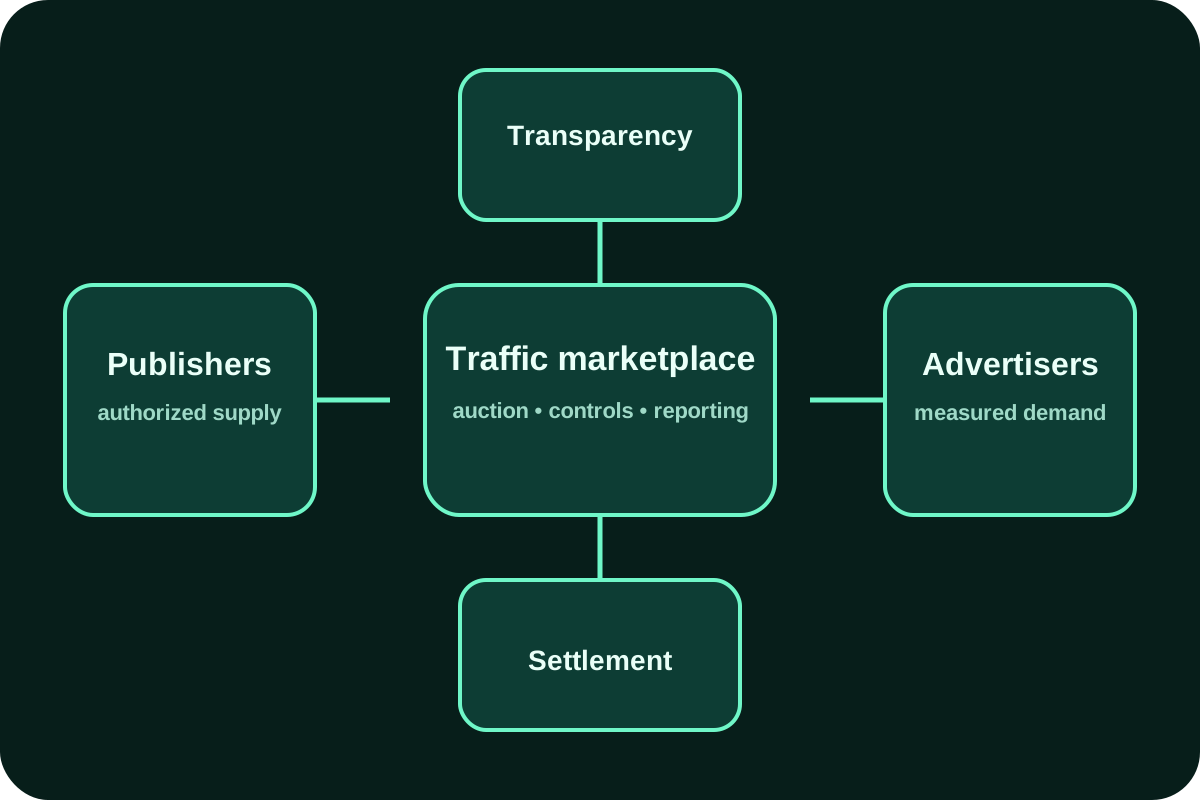
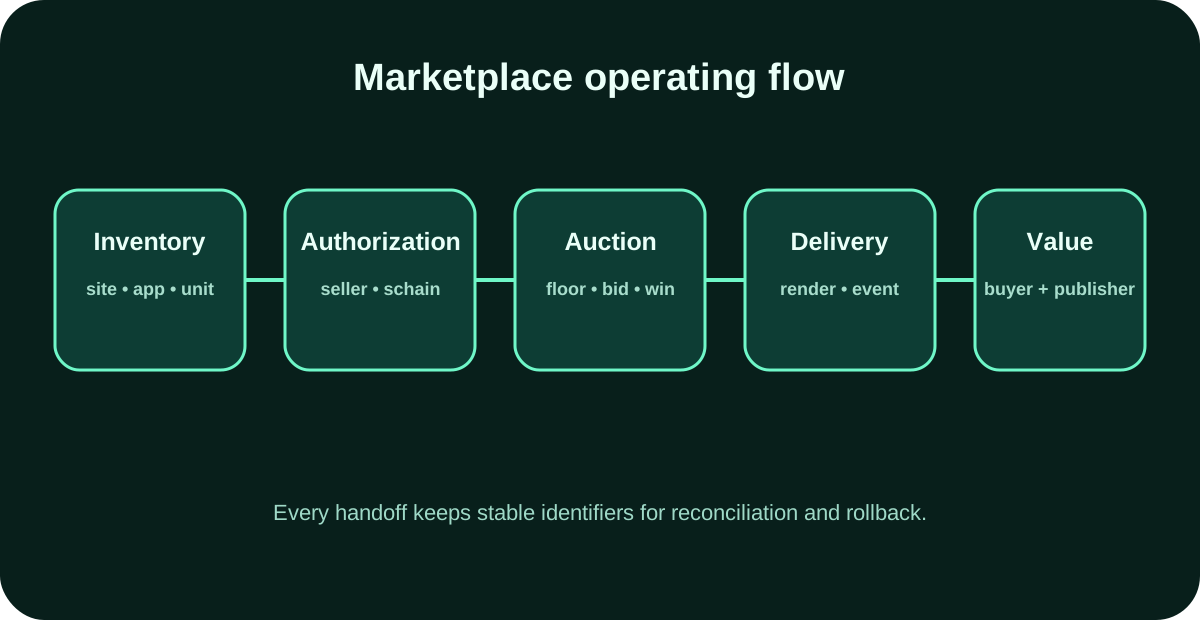
The strongest platform decision begins with the business event, not the traffic headline. Buyers evaluating a traffic marketplace should connect aggregated publisher, SSP and network traffic offered through auction or platform-based buying to a specific goal: discover and purchase relevant supply while retaining enough transparency to evaluate price and quality. The test becomes useful only when delivery can be traced to a marketplace test that links bids and sources to accepted post-click outcomes.
The key platform decision is whether the marketplace provides relevant inventory, controllable pricing, source visibility, targeting and reliable reporting. That requires a written test plan, campaign-level tracking, source segmentation and a clear definition of an accepted outcome before the first budget is spent.
The most common mistake is treating a marketplace as a uniform pool instead of a collection of sources with different behavior and value. The same principle applies when the budget begins to scale. Separate campaigns whenever format, GEO, device, landing page, conversion rule or commercial value changes enough to require a different decision.
FroggyAds provides self-serve access to worldwide programmatic supply, six core ad formats and detailed targeting controls where supported. Adscore signals and internal controls help identify invalid or low-quality traffic, while the advertiser remains responsible for creative accuracy, legal eligibility, landing-page quality and downstream conversion validation.
What buyers need from traffic marketplaces
The query traffic marketplace combines category research with commercial evaluation. Searchers want to understand the buying model, compare platform capabilities and decide whether the channel can help them discover and purchase relevant supply while retaining enough transparency to evaluate price and quality.
Current result pages often cover DSP and SSP explanations, RTB auction diagrams, programmatic buying guides, platform comparison pages, supply-path and transparency topics. This guide adds an advertiser operating model: how to define the outcome, structure the test, validate traffic, optimize sources and scale without losing measurement clarity.
This guide focuses on marketplace-based buying of website and app traffic from multiple supply sources. The broader website traffic platform guide keeps its existing category role, while related format, audience and buying-model pages continue to answer their own narrower questions.
This guide is written for advertisers, affiliates, agencies and media buyers comparing scalable inventory access. It focuses on aggregated publisher, SSP and network traffic offered through auction or platform-based buying. Those requirements should stay visible throughout the media plan instead of disappearing behind a general promise of reach.
Six questions to ask when evaluating a traffic marketplace
Inventory fit
Confirm that the platform can reach aggregated publisher, SSP and network traffic offered through auction or platform-based buying in the GEOs, devices and contexts the campaign actually needs.
Format fit
Choose among Auction Traffic, Direct Link, Push, Native according to the message, destination and stage of the user journey.
Targeting control
Inspect country, city, device, OS, browser, carrier, category, audience and source controls where supported.
Measurement depth
Make sure the setup can report source discovery rate, usable session cost, accepted outcome rate and the final accepted event.
Quality controls
Use traffic-quality signals, click caps, exclusions, blacklists, whitelists and post-click validation together.
Operating fit
Check minimum funding, approval workflow, reporting speed, support access and the effort needed to manage campaigns.
Turn platform claims into testable requirements
| Area | Requirement | What to verify |
|---|---|---|
| Business outcome | a marketplace test that links bids and sources to accepted post-click outcomes | Write the accepted event and rejection rules before launch. |
| Inventory | aggregated publisher, SSP and network traffic offered through auction or platform-based buying | Confirm market and format availability instead of assuming uniform global supply. |
| Creative | Auction Traffic and Direct Link | Build at least two materially different messages for each format. |
| Destination | marketplace-based buying of website and app traffic from multiple supply sources | Test page speed, mobile behavior, continuity and event firing. |
| Source controls | Source ID, caps, blacklist and whitelist | Define minimum data and stop thresholds. |
| Decision cadence | marginal value by source | Review on a schedule that matches conversion delay and event volume. |
A platform comparison becomes useful when every claim is connected to evidence the buyer can inspect.
An eight-step plan for a traffic-marketplace test
Define one accepted outcome
Use a marketplace test that links bids and sources to accepted post-click outcomes as the business truth. Document duplicates, invalid events, cancellations or other exclusions.
Verify market and policy fit
Confirm the campaign, creative, landing page and audience are lawful and eligible in every target market.
Separate unlike campaign cells
Split GEOs, devices, formats, landing pages and value tiers whenever they require different bids or decisions.
Install campaign tracking
Use tracking parameters, pixels or server-to-server postbacks and test the complete path before spending.
Launch controlled creative tests
Start with a small set of clearly different concepts across Auction Traffic, Direct Link or another suitable format.
Collect source-level evidence
Compare source discovery rate, usable session cost and accepted outcome rate by source, not only in aggregate.
Block waste and isolate promise
Exclude repeatedly weak sources, then move promising sources into dedicated campaigns or whitelists.
Scale in measured steps
Increase budget or bids gradually and watch whether marginal value by source remains acceptable at the new volume.
Operating a traffic-marketplace test as a measurable decision
This fieldbook treats marketplace-based buying of website and app traffic from multiple supply sources as a practical assignment for advertisers, affiliates, agencies and media buyers comparing scalable inventory access. Its purpose is to discover and purchase relevant supply while retaining enough transparency to evaluate price and quality, while preserving enough evidence to decide whether the campaign should stop, change or receive more budget.
Frame the decision for traffic marketplaces
Treat the marketplace as a catalog of heterogeneous supply, not a single traffic source. Sellers, formats, devices, markets and pricing models can produce very different user behavior.
Run the first a traffic-marketplace test
Begin with a narrow order that preserves seller or source identifiers. Compare several small supply slices before committing to a large blended purchase.
Collect evidence for traffic marketplaces
Record seller identity where available, delivery method, targeting, price, landing success and accepted outcome. Marketplace transparency is useful only when the buyer keeps those dimensions in the analysis.
Recognize a misleading traffic marketplace signal
A large visitor number can conceal duplication, weak intent or supply that cannot be optimized. Avoid any purchase that cannot be connected to a measurable source or campaign decision.
Scale a traffic-marketplace test deliberately
Create an approved-supply list from observed performance. Add volume by increasing proven sellers or testing new ones in a separate pool rather than widening the entire order.
Close the traffic marketplaces decision
A traffic marketplace is valuable when it improves discovery without destroying accountability. The buyer still owns validation and source selection.
Four operating cases for traffic marketplaces
Case 1: An affiliate exploring new supply
An affiliate exploring new supply uses a traffic-marketplace test to examine marketplace-based buying of website and app traffic from multiple supply sources. The stated campaign goal is to discover and purchase relevant supply while retaining enough transparency to evaluate price and quality.
Begin with Auction Traffic; reserve Push for a separate comparison. Mark source discovery rate before interpreting usable session cost, and keep the underlying counts beside both rates.
The review asks: whether the marketplace provides relevant inventory, controllable pricing, source visibility, targeting and reliable reporting Pair accepted outcome rate with marginal value by source, then label the case by source, market, device, creative and destination.
The stop condition addresses treating a marketplace as a uniform pool instead of a collection of sources with different behavior and value. A failed condition ends this test or changes one documented variable before more spend is released.
Case 2: An ecommerce buyer expanding beyond one network
An ecommerce buyer expanding beyond one network uses a traffic-marketplace test to examine marketplace-based buying of website and app traffic from multiple supply sources. The stated campaign goal is to discover and purchase relevant supply while retaining enough transparency to evaluate price and quality.
Begin with Direct Link; reserve Native for a separate comparison. Mark source discovery rate before interpreting usable session cost, and keep the underlying counts beside both rates.
The review asks: whether the marketplace provides relevant inventory, controllable pricing, source visibility, targeting and reliable reporting Pair accepted outcome rate with marginal value by source, then label the case by source, market, device, creative and destination.
The stop condition addresses treating a marketplace as a uniform pool instead of a collection of sources with different behavior and value. A failed condition ends this test or changes one documented variable before more spend is released.
Case 3: An agency comparing marketplace and direct deals
An agency comparing marketplace and direct deals uses a traffic-marketplace test to examine marketplace-based buying of website and app traffic from multiple supply sources. The stated campaign goal is to discover and purchase relevant supply while retaining enough transparency to evaluate price and quality.
Begin with Push; reserve Display for a separate comparison. Mark source discovery rate before interpreting usable session cost, and keep the underlying counts beside both rates.
The review asks: whether the marketplace provides relevant inventory, controllable pricing, source visibility, targeting and reliable reporting Pair accepted outcome rate with marginal value by source, then label the case by source, market, device, creative and destination.
The stop condition addresses treating a marketplace as a uniform pool instead of a collection of sources with different behavior and value. A failed condition ends this test or changes one documented variable before more spend is released.
Case 4: A media buyer building source whitelists
A media buyer building source whitelists uses a traffic-marketplace test to examine marketplace-based buying of website and app traffic from multiple supply sources. The stated campaign goal is to discover and purchase relevant supply while retaining enough transparency to evaluate price and quality.
Begin with Native; reserve Pop for a separate comparison. Mark source discovery rate before interpreting usable session cost, and keep the underlying counts beside both rates.
The review asks: whether the marketplace provides relevant inventory, controllable pricing, source visibility, targeting and reliable reporting Pair accepted outcome rate with marginal value by source, then label the case by source, market, device, creative and destination.
The stop condition addresses treating a marketplace as a uniform pool instead of a collection of sources with different behavior and value. A failed condition ends this test or changes one documented variable before more spend is released.
The intended record is a marketplace test that links bids and sources to accepted post-click outcomes. The decisive question is: whether the marketplace provides relevant inventory, controllable pricing, source visibility, targeting and reliable reporting The review must also account for the central risk of treating a marketplace as a uniform pool instead of a collection of sources with different behavior and value.
Choose formats by user journey, not habit
Auction Traffic
Use auction traffic when its attention pattern, creative requirements and pricing model support discover and purchase relevant supply while retaining enough transparency to evaluate price and quality. Keep it in a separate campaign cell so its source and conversion behavior remain visible.
Direct Link
Use direct link when its attention pattern, creative requirements and pricing model support discover and purchase relevant supply while retaining enough transparency to evaluate price and quality. Keep it in a separate campaign cell so its source and conversion behavior remain visible.
Push
Use push when its attention pattern, creative requirements and pricing model support discover and purchase relevant supply while retaining enough transparency to evaluate price and quality. Keep it in a separate campaign cell so its source and conversion behavior remain visible.
Native
Use native when its attention pattern, creative requirements and pricing model support discover and purchase relevant supply while retaining enough transparency to evaluate price and quality. Keep it in a separate campaign cell so its source and conversion behavior remain visible.
Display
Use display when its attention pattern, creative requirements and pricing model support discover and purchase relevant supply while retaining enough transparency to evaluate price and quality. Keep it in a separate campaign cell so its source and conversion behavior remain visible.
Pop
Use pop when its attention pattern, creative requirements and pricing model support discover and purchase relevant supply while retaining enough transparency to evaluate price and quality. Keep it in a separate campaign cell so its source and conversion behavior remain visible.
Metrics that connect media delivery to business value
| Metric | Decision layer | Why it matters |
|---|---|---|
| source discovery rate | Delivery and technical quality | Shows whether purchased traffic reaches a usable destination. |
| usable session cost | Intent and experience quality | Separates superficial delivery from meaningful interaction. |
| accepted outcome rate | Conversion quality | Measures whether the source produces the expected user action. |
| marginal value by source | Commercial decision | Determines whether the result can support more budget. |
| Source-level variance | Optimization risk | Reveals whether blended averages hide winners and losers. |
| Marginal cost at higher spend | Scale quality | Shows how performance changes when the campaign enters additional inventory. |
The final optimization event should match the event the business actually values and accepts.
Build a source learning system
Begin with broad but controlled discovery. Keep Auction Traffic, Direct Link and other formats in separate campaigns, apply reasonable caps and gather enough data to distinguish a repeatable pattern from random noise.
Evaluate sources using the full event ladder. A source can have an attractive source discovery rate and still fail on accepted outcome rate. Another source can look expensive at the click level and become efficient after acceptance or repeat value is included.
Use three states rather than a simple good-or-bad label: discovery, probation and proven. Discovery sources receive limited budget. Probation sources have enough positive evidence to justify a focused test. Proven sources have repeated the result and can receive dedicated bids, budgets or whitelist treatment.
Blacklists protect the budget from repeated waste, while whitelists create controlled scaling surfaces. Neither list should be permanent without review. Publisher behavior, competition, devices, creative fit and conversion performance can change over time.
The practical scale question is whether marginal value by source remains acceptable as spend increases. Track the marginal result from the new budget, not only the historical average created before scale.
Four ways a traffic-marketplace test can differ
| Scenario | Likely starting format | Primary signal | Structural rule |
|---|---|---|---|
| An Affiliate Exploring New Supply | Auction Traffic | source discovery rate | Use a separate campaign, destination and stop rule. |
| An Ecommerce Buyer Expanding Beyond One Network | Direct Link | usable session cost | Use a separate campaign, destination and stop rule. |
| An Agency Comparing Marketplace And Direct Deals | Push | accepted outcome rate | Use a separate campaign, destination and stop rule. |
| A Media Buyer Building Source Whitelists | Native | marginal value by source | Use a separate campaign, destination and stop rule. |
Each scenario should have its own creative promise, landing experience and decision threshold.
Make the click understandable
Creative for marketplace-based buying of website and app traffic from multiple supply sources should describe the real next step. The headline, visual and call to action must set expectations the landing page can continue immediately.
Build creative differences that represent distinct hypotheses. Changing a button color is not a useful strategic test when the real uncertainty is whether the audience responds to price, speed, proof, convenience, education or a different product angle.
Match creative density to the format. A push message must make sense in very little space. Native can introduce a problem and route the user to deeper content. Display needs a clear visual hierarchy. Video requires an early hook and a destination that continues the story.
The landing page should be fast, stable and specific. Remove unnecessary scripts, compress visual assets, reserve image dimensions and keep the primary action visible on common mobile screens. Technical speed supports both user experience and media efficiency.
Run a preflight click from every important device path. Confirm redirects, tracking parameters, consent behavior, form submission, thank-you pages and server-side events. A campaign should not start while the team is still guessing whether the measurement chain works.
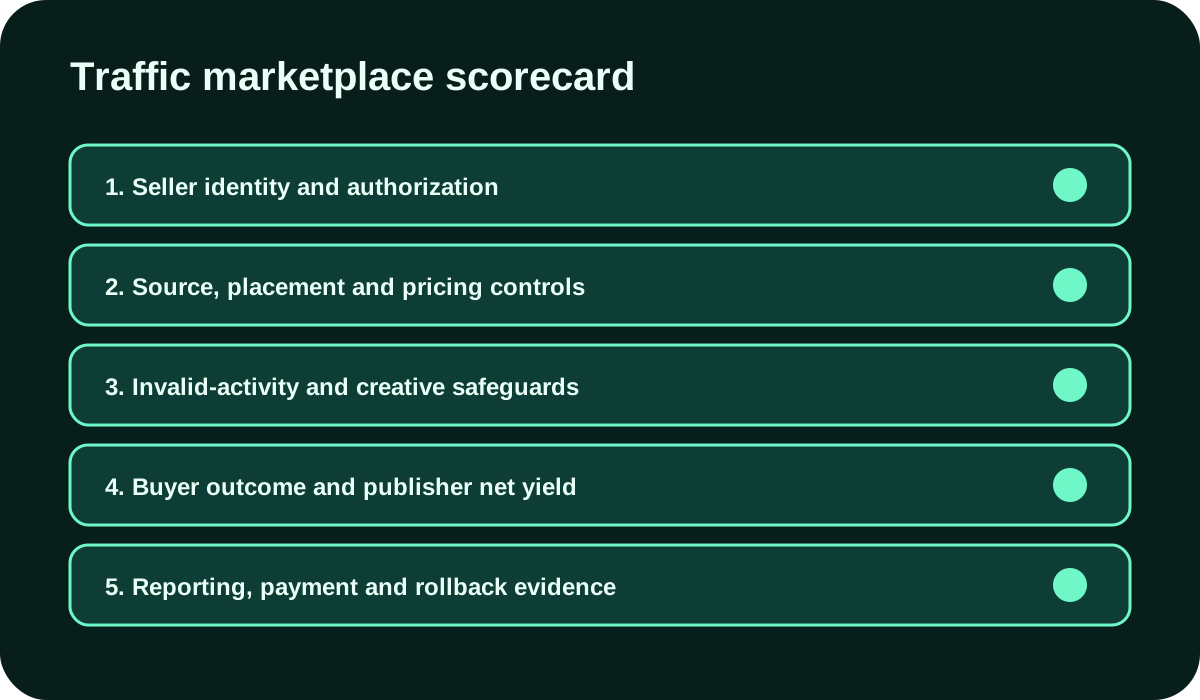
Score a marketplace candidate before funding the test
| Dimension | Score | Question |
|---|---|---|
| Supply relevance | 0-5 | Does the available inventory match the market, device, context and format? |
| Control | 0-5 | Can the buyer separate, cap, exclude and bid by meaningful dimensions? |
| Measurement | 0-5 | Can delivery be connected to accepted downstream events? |
| Quality visibility | 0-5 | Are source-level and post-click differences visible? |
| Operational fit | 0-5 | Can the team launch, review and change campaigns efficiently? |
| Scale potential | 0-5 | Does performance remain useful as the campaign reaches additional supply? |
A high total score does not replace testing. It simply shows whether the platform has the ingredients required for a fair evaluation.
What a traffic platform cannot decide for the advertiser
No traffic marketplace can guarantee traffic quality, conversions, revenue or ranking outcomes. The platform supplies access and controls; the advertiser supplies the offer, creative, destination, tracking and business rules.
Inventory and pricing vary by GEO, device, format, category, time and competition. A result from one campaign cell should not be projected automatically onto another.
FroggyAds can support source-level analysis, but the advertiser must define what counts as an accepted a marketplace test that links bids and sources to accepted post-click outcomes and pass reliable events back into the reporting workflow.
Automation can help with bidding and optimization, but it cannot repair a misleading creative, a slow page, an unsupported product or an event that measures the wrong behavior.
Traffic Marketplace FAQ
What is a traffic marketplace?
A traffic marketplace gives advertisers access to aggregated publisher, SSP and network traffic offered through auction or platform-based buying. Buyers should inspect formats, targeting, pricing, tracking, source visibility and the quality of outcomes the platform can support.
How do I choose a traffic marketplace?
Start with the required outcome, accepted GEOs, supported devices, creative format and tracking method. Then compare supply reach, controls, reporting, traffic-quality safeguards and the ability to optimize individual sources.
Which ad formats can I use?
FroggyAds supports Push, Native, Display, Pop, Video and Interstitial advertising. For this use case, the most relevant options include Auction Traffic, Direct Link, Push, Native. Format availability and performance can vary by market and inventory.
How should I set the first campaign budget?
Use a budget large enough to collect decision-ready data but small enough to limit exposure while tracking, creative, landing pages and source quality are still being verified. Split unlike GEOs, devices or formats into separate tests.
What should I track beyond clicks?
Track loaded sessions, engagement, duplicate or invalid events, conversion acceptance and downstream value. Useful page-specific measures include source discovery rate, usable session cost, accepted outcome rate, marginal value by source.
Can low-cost traffic still be useful?
Yes, but low delivery cost is not the same as low acquisition cost. Cheap traffic becomes useful when the destination loads correctly, users engage, conversion events are accepted and the source remains efficient after enough volume.
How do source IDs help optimization?
Source IDs let buyers compare post-click quality and conversion performance across supply segments. Weak sources can be excluded, promising sources can receive dedicated bids or budgets, and a whitelist can be built from validated evidence.
Does FroggyAds guarantee conversions or ROI?
No. Advertising outcomes depend on the offer, market, creative, landing page, tracking, bid, competition and user behavior. FroggyAds provides traffic access and campaign controls, but advertisers must validate results and make their own optimization decisions.
How quickly should a campaign be scaled?
Scale only after tracking is stable and the winning result is repeatable across enough events. Increase spend in measured steps, watch marginal outcome cost and avoid changing bids, creatives, targeting and landing pages at the same time.
How does this page differ from related FroggyAds guides?
This guide focuses on marketplace-based buying of website and app traffic from multiple supply sources. The broader website traffic platform guide keeps its existing category role, while related format, audience and buying-model pages continue to answer their own narrower questions.
Use standards and market rules as operating inputs
These public references support terminology, auction mechanics, traffic-quality controls and advertising responsibilities. They do not replace the policies, laws, contracts or review requirements that apply to a specific campaign.
Continue the media plan
Website Traffic Platform
Review the established FroggyAds pillar for this topic.
Best DSPs for Programmatic Advertisers
Compare DSPs by inventory, auction control, targeting, identity options, reporting, integrations, service model and minimum operating requirements.
Ad Inventory Marketplace
Learn how ad inventory marketplaces connect publishers, SSPs, exchanges and buyers through auctions, deals, targeting and measurable delivery.
Launch a traffic-marketplace test with measurable controls
Choose a format, define the accepted outcome, verify tracking and use source-level evidence to decide what receives more budget.