
Buy Casino Affiliate Traffic With Source-to-Commission Control
Buy casino affiliate traffic through FroggyAds when you can prove three things before scale: the offer is eligible in the target market, the affiliate click reaches the approved operator path, and each media source can be reconciled with accepted registrations, first deposits or commission. Start with one licensed offer, one GEO, one destination version and one mature conversion rule.
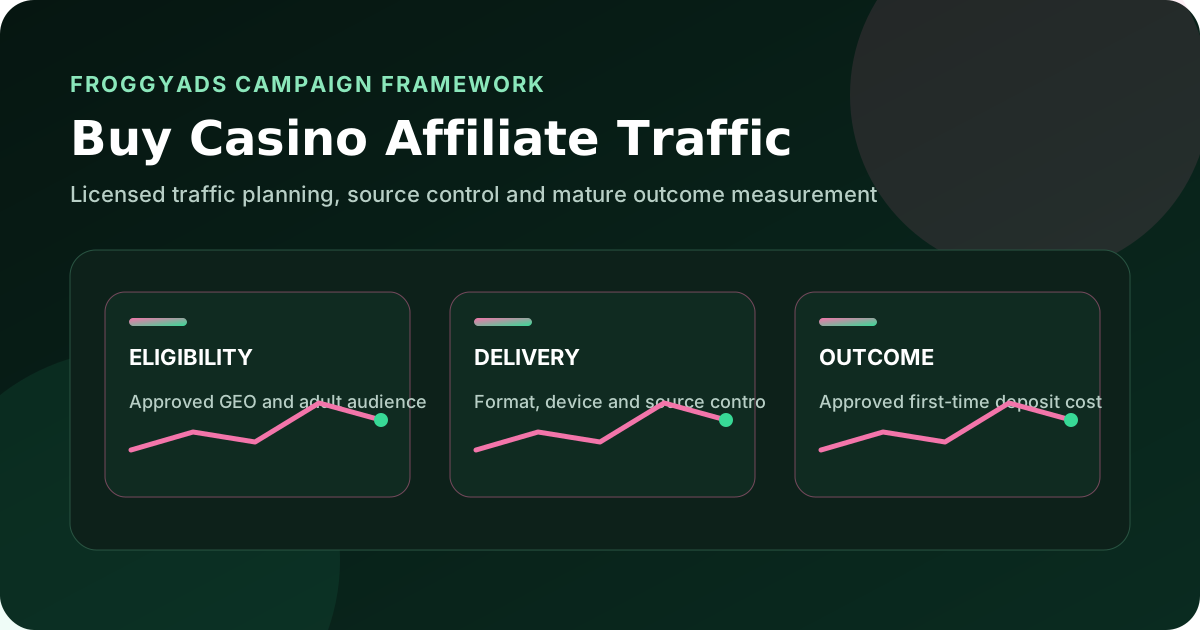
Buy casino affiliate traffic at a glance
What should a casino affiliate traffic purchase prove?
Quick answer: buy casino affiliate traffic with FroggyAds only after the offer, market and paid-media method are approved. Keep campaign, creative and source sub-IDs through the pre-lander and affiliate link. Judge each cell by operator-approved registrations, qualifying deposits or commission after the stated validation window—not by visits alone.
This casino affiliate traffic purchase must also prove current policy compliance. Reference reviewed for this page: Google Ads gambling and games policy. Market and platform requirements can change; verify the rules that apply to the live campaign.
- Eligibility: confirm the licensed offer, permitted paid-media method, approved GEO and eligible adult audience.
- Attribution: preserve the campaign, creative and source sub-ID from FroggyAds delivery to the operator result.
- Decision: scale only after mature accepted events and payout evidence support the marginal media cost.
What this buyer guide covers
This guide is for casino affiliates, affiliate managers and media buyers who need to purchase measurable paid traffic. It covers eligibility, pre-lander integrity, sub-ID continuity, source review, operator validation and scale. For direct operator acquisition, continue with Buy Casino Traffic.
How to approach a casino affiliate traffic campaign
There is no universally best casino traffic source. The useful source is the one that reaches an eligible adult audience, carries an accurate offer through the pre-lander and produces operator-approved value after the program's validation window. We help you control the FroggyAds media cell; your affiliate platform and operator records remain authoritative for registrations, KYC, deposits, reversals and commission.
Plan the journey before buying reach: ad impression, click, loaded pre-lander, tracked outbound click, operator registration, verification, qualifying deposit and approved affiliate event. Give each stage an owner and an identifier. If the chain breaks, repair the route before interpreting the traffic source.
Preserve campaign, creative and source sub-IDs through every permitted redirect. A registration total alone cannot show whether one placement produced accepted players while another produced duplicates, unsupported GEOs or rejected deposits. Source-level payout evidence is what turns paid delivery into a buying decision.
FroggyAds gives you self-serve access to supported Push, Native, Display, Pop, Video and Interstitial campaigns, with targeting, budget and available source controls. Inventory, approval and price vary by market and format. Our platform supplies the media evidence; it does not replace licensing, affiliate-program permission or operator-side validation.
The commercial decision this page helps you make
The commercial decision is whether a casino affiliate campaign cell deserves more budget after rejected events, payout rules and reporting delays are applied. A buyer needs more than visits. The right first question is not how much volume is available. It is which accepted event will repay the media cost and when that event becomes reliable enough to judge.
Write the decision in one sentence before launch. For example: test whether an approved native campaign can send eligible mobile users in one licensed market to a comparison pre-lander and produce operator-approved first deposits within the affiliate program's stated validation window. That sentence fixes the offer, audience, route, format, event and review date.
Report the funnel in layers. Separate blocked GEOs, page-load failures, outbound clicks, registrations, verification, first deposits, rejected or reversed events and approved commission. Blended conversion rates hide where value is lost and can cause a media source to be blamed for a broken payment route, expired offer or incomplete tracking link.
This guide focuses on the practical purchase of paid casino affiliate traffic. Use the broader casino traffic page for operator acquisition and the affiliate traffic page for cross-vertical affiliate buying. Here, every section connects media spend to an approved casino affiliate outcome, including sub-ID continuity, pre-lander integrity, operator rejection data and commission maturity.
Six controls to set before the first campaign
License, program and market eligibility
Verify operator promotion eligibility in the target jurisdiction, confirm that the affiliate program allows the planned paid-media method and check that the selected destination is approved. Save the governing policy and approval version with the campaign record.
Adult-audience protection
Adult-audience protection requires market, age, placement and suppression rules for minors, young people, self-excluded users and other restricted audiences. When the market requires stronger controls, apply them before delivery, not after a complaint or rejection.
Traceable source and sub-ID structure
Keep GEO, device, format, creative, destination and FroggyAds source identifiers visible in campaign naming and the outbound affiliate link. The operator result must be able to return to the same acquisition cell.
Accepted conversion definition
The accepted conversion definition should name qualified outbound click, approved registration, qualifying first deposit and commission status in the language used by the operator or program. Include validation delay, duplicate rules, exclusions, reversals and the report owner.
Responsible creative and pre-lander review
Check the offer, bonus terms, age cues, license details, responsible-gambling information, disclosures and destination continuity. A compliant media setting cannot rescue a misleading ad or an unapproved operator route.
Bounded and reversible optimization
Bounded and reversible optimization uses spend limits, source review thresholds, pause rules and a stable reference cell. Make one material change at a time so the team can explain the result and restore the last known setup.
Define the eligible casino affiliate audience
Document the license holder, operator brand, product, permitted countries or regions, minimum age, excluded audience groups and any platform certification required for the campaign. If the offer cannot be promoted to a market, remove that market before asking whether the traffic converts.
Eligible-audience targeting should match the actual user journey. Country, language, device, operating system and connection type can affect whether the pre-lander loads, the operator accepts the visitor, KYC completes and a supported payment method is available. Keep materially different routes in separate cells so their economics are not blended.
Audience eligibility also requires suppression rules in the launch plan. Exclude unsupported territories and devices, known customers where the program disallows reacquisition, self-excluded audiences and any placement context the operator has rejected. Recheck eligibility whenever the license, offer, destination or program terms change.
Keep an approval packet with the campaign: license and jurisdiction reference, affiliate-program permission, creative version, pre-lander version, operator URL, audience settings, suppression list, policy review date and responsible owner. This is operational evidence, not legal advice, but it makes the campaign auditable.
Keep the ad, pre-lander and operator offer consistent
The creative should identify the real product and lead to a destination that continues the same promise. State material bonus or participation terms where required. Do not use urgency, winnings language or lifestyle implications that the offer and market rules cannot support. The pre-lander should help an eligible adult make an informed choice, not conceal the commercial route.
Test one message difference at a time. A comparison angle, trust cue, game category, bonus explanation or operator feature can attract a different audience. Keep the offer and destination stable while the creative changes, then judge the concept with the same accepted event and validation window.
Check the ad-to-pre-lander path on the devices you intend to buy. Readable terms, fast loading, working consent choices, supported payment information and reliable redirects all affect the result. A mobile click that reaches an unusable desktop form is a product-route failure, not evidence that the source is poor.
Use a signed-off creative checklist. Record the legal operator name and license information where required, minimum age, responsible-gambling details, commercial disclosure, material promotion terms, approved imagery and the exact landing URL. Reapprove the asset after any material edit.
The pre-lander should load quickly, make the affiliate relationship clear, identify the operator or comparison purpose and show who is eligible. The outbound action must lead to the approved operator route. Version the page so a conversion change can be separated from a media-source change.
Carry stable identifiers from the FroggyAds campaign into the affiliate tracking path wherever the program and privacy rules permit. Preserve the media source, campaign, format and creative key through the pre-lander and outbound click. Reconcile them with registration, KYC, deposit, rejection and commission data.
Name the authoritative system for every event. FroggyAds records media delivery, the pre-lander records loaded sessions and outbound clicks, the affiliate platform records attributed actions, and the operator decides whether an event is approved. Do not let a dashboard label stand in for the program's actual payout rule.
Treat pre-lander performance as part of ad and offer consistency. Track loaded-session rate by device, browser, market, campaign and source. If clicks rise while loaded sessions fall, inspect redirects, consent, hosting and page weight before changing bids or excluding inventory.
Choose formats by their role in the journey
| Format or control | Primary job | Evidence to review |
|---|---|---|
| Native | Comparison and educational pre-landers | Qualified outbound click rate |
| Push | Timely approved offers | Verified registration by sub-id |
| Display | Content-site retargeting | Approved first-time deposit cost |
| Pop | Controlled pre-lander tests | Net commission after reversals |
| Video | Editorial product explanation | Qualified outbound click rate |
| Interstitial | Mobile affiliate funnels | Approved first-time deposit cost |
Format availability, pricing and campaign approval depend on the target market, inventory, targeting and live platform conditions. Verify current settings before launch.
Buy enough evidence to answer one question
Choose a format for the job it must do. Native can introduce a comparison or editorial pre-lander. Push can carry a concise, approved proposition. Display can reinforce a recognizable offer on relevant inventory. Give each format its own campaign cell and conversion rule so response quality remains visible.
Pop can test a direct or pre-lander route where the offer and market permit it. Video can explain a product or comparison when the destination continues the same message. Interstitial can support a mobile route with enough context on the next screen. No format is automatically best; accepted downstream value decides.
Do not rank formats by click-through rate or raw CPC alone. A format with fewer clicks may deliver more eligible registrations or approved deposits. Compare cells after the same validation window, with the same destination quality and the same rejection rules.
If several formats are used, give each one a distinct hypothesis. One may introduce the offer, another may reach a different context, and another may support a returning audience where permitted. Avoid uncontrolled overlap and report whether the additional layer improves accepted value, not just contact frequency.
Set the first test budget from the evidence needed for the chosen event. Estimate how often an approved registration or deposit occurs, how long approval takes, the maximum learning loss and the minimum number of mature results needed for a decision. Spreading a small budget across many GEOs, formats and pages can leave every cell inconclusive.
The documented FroggyAds minimum deposit is $50. Published entry points include Push and Native from $0.003 CPC, Display from $0.10 CPM and Pop from $0.0001 CPC. These are starting bids, not a campaign quote, delivery guarantee or recommended casino affiliate test budget. Auction prices and results vary with the live setup.
Write pacing and pause rules before delivery. Set the total learning allowance, daily limit, bid boundary, source review point and the condition that stops the cell. The campaign should not spend its full allowance while the outbound link, conversion postback or operator approval feed is still being verified.
Expand one variable at a time. Raise the budget, adjust the bid, add sources, open a GEO or introduce another creative in separate steps. Keep the original cell visible. More spend can change the source mix, so measure the marginal cohort instead of assuming the first average will hold.
Decide with source-level affiliate evidence
Source analysis becomes useful when media and operator records meet. Compare loaded sessions, qualified outbound clicks, approved registrations, qualifying first deposits, rejected events and net commission by source after the agreed delay. A source with a higher click cost can still be efficient if more events survive validation.
Before applying a whitelist, blacklist, cap or bid change, verify that the source identifier reached the operator report. Check the destination, redirect, device path and payment route. Record the reason, date, owner and expected effect of every source action so later changes can be reviewed rather than guessed.
Do not classify a source from one conversion or one weak day. Set a minimum amount of eligible traffic, spend, mature events and elapsed time for the decision. If accepted events are rare, combine the quantitative threshold with technical diagnostics and keep the conclusion directional.
Watch source concentration during scale. A campaign can look stable while one source supplies most of the approved value. When spend increases, label the added inventory and check whether accepted-deposit cost and commission approval hold. Protect a good source, but do not hide dependency inside a blended average.
Pass the legal and responsible-advertising gate
Gambling advertising is restricted by jurisdiction and platform. Promote only lawful products from licensed or otherwise authorized operators to eligible audiences, and verify the affiliate program's paid-traffic rules. The advertiser and affiliate remain responsible for the offer, creative, placement, audience and destination even when FroggyAds supplies the media controls.
Protect minors, young people and vulnerable users. Do not design the ad to appeal strongly to children, imply that gambling solves financial or personal problems, encourage chasing losses or present play as necessary for social success. Include required age, license and responsible-gambling information clearly on the relevant creative or destination.
Affiliate marketing does not sit outside the operator's compliance duties. UK CAP guidance explicitly includes third parties acting on an advertiser's behalf, while current Google policy requires approved countries, responsible-gambling information on the landing page and no targeting of minors. Apply the rules of the actual market and platform; do not assume one approval transfers to another.
Keep compliance and performance as separate gates. A profitable source must still be paused if the market, audience, message or placement is not approved. A compliant cell can still be commercially weak. Scale only when both the eligibility record and the mature affiliate economics support the action.
A practical review model for acquisition teams
| Review area | What to inspect | What the finding should change |
|---|---|---|
| Eligibility | Approved market, adult audience, lawful product and valid landing destination | Block or isolate any ineligible delivery before evaluating commercial performance |
| Technical path | Loaded session, identifiers, registration, KYC and payment events | Fix tracking, redirects or destination experience before judging the media source |
| Acquisition | Approved registration by sub-ID | Compare source and creative cells after the same operator validation window |
| Commercial value | Approved first-time deposit cost | Use final business results and include incentive, reversal and rejection effects |
| Retention | Net commission after reversals | Scale only when value survives beyond the first action |
| Compliance | Creative execution, placement, audience and market remain approved | Pause the affected cell regardless of short-term profitability |
Connect FroggyAds delivery to approved affiliate value
Build the decision scorecard from connected records: spend and delivery from FroggyAds; loaded sessions and outbound clicks from the pre-lander; registrations, KYC, qualifying deposits, rejected events and commission from the affiliate or operator system. Put the accepted event and next budget action in the same row so the report leads to a decision.
Compare cohorts at the same age. A new source may look weak before deposits or commissions mature, while an older source has had more time to accumulate approvals. Fix the review window and restate prior cohorts when late approvals, reversals or chargebacks arrive.
Separate media cost from bonus cost, payment failure, duplicate accounts, KYC rejection, fraud review, refunds and commission reversals. Gross deposits or preliminary conversions can overstate affiliate value. Use the operator or program's accepted-event definition and payout status, not only a media-platform conversion count.
State uncertainty in the report. Mark small samples as directional, show the share of events missing a usable sub-ID and flag any period affected by a tracking outage, offer change or operator-policy update. A cautious source decision with visible limits is more useful than a precise-looking CPA built from incomplete approvals.
An eight-step casino affiliate traffic workflow
Confirm the legal and program boundary
Record the operator, license or authorization, target GEO, minimum age, audience exclusions, permitted media method and policy approval required for the offer.
Define the accepted affiliate event
Write the exact meaning, source system, owner and maturity window for outbound click, registration, KYC, qualifying first deposit, rejection, reversal and approved commission.
Build one interpretable campaign cell
Choose one market, format, audience rule, creative concept, pre-lander version and operator route. Put material differences in separately named cells.
Prove the route end to end
Test the ad click, loaded pre-lander, affiliate disclosure, outbound link, operator account, KYC, payment and approved affiliate event. Include duplicate, rejected, delayed and returning-user cases.
Launch with a written loss limit
Set the total learning allowance, daily pacing, bid boundary, source review point, frequency setting where available, review schedule and hard pause conditions.
Check eligibility and technical health first
Verify market access, device behavior, page load, redirect continuity and sub-ID capture before optimizing toward a deeper event.
Evaluate mature source economics
Compare approved registrations, qualifying deposit cost, rejection rate and net commission by source and cohort age. Keep preliminary events separate from payable ones.
Change one lever and preserve the control
Adjust one bid, budget, source, creative, destination or GEO boundary; record the reason and rollback condition; then wait for the next comparable review window.
How the plan changes by casino affiliate use case
Launching a new review category
A review publisher testing two casino categories should begin with one approved market and one stable operator route. Keep the category pages and creative concepts separate, then compare loaded outbound clicks and accepted events after the same delay. Early delivery proves only that the route receives traffic; operator approval decides whether the category deserves expansion.
Comparing a direct link with a pre-lander
Keep the current route as a control when an affiliate compares a direct operator link with an editorial pre-lander. Version the new page, preserve the same offer and approved event, and compare source mix, loaded sessions, outbound progression and deposit approval. The pre-lander earns its place only if it improves accepted value without weakening disclosure or compliance.
Auditing paid affiliate sources
A source-quality audit needs the original media key in the downstream report. Reconcile clicks, registrations, qualifying deposits, rejection reasons, reversals and commission by source. If an event cannot be traced, place it in an unattributed bucket instead of assigning value by assumption.
Separating mobile and desktop routes
Mobile funnels may pass through more redirects, consent screens and payment constraints than desktop. Test the two routes independently, including supported browsers and operator access. Keep source IDs intact and record where the journey stops so a device problem does not become a false source exclusion.
Keep each use case measurable
Prioritize eligibility and route completion before broad reach in a new category launch. Use a small set of approved creatives and one accepted-event definition. The first campaign should show whether the click can become a payable event under known conditions, not whether the page can collect the maximum possible number of visitors.
Change only the route in a direct-link versus pre-lander test, and keep the offer, media cell and validation window comparable. Read the loaded-session and outbound-click data beside operator approvals. If the audience mix changes materially, note that difference rather than attributing the entire result to page copy.
Disclosure and attribution matter together in a source-quality audit. The visitor should understand the commercial route, while the operator report retains the campaign and source key. Review rejected events by reason; an unsupported GEO or duplicate account calls for a different action than a valid user who does not deposit.
Make the technical differences explicit in a device split. Separate browser, operating system, payment route or redirect behavior when it changes the outcome. Name the cells so the final budget decision can identify the failing route instead of relying on one blended mobile average.
Use FroggyAds controls without outsourcing the decision
FroggyAds lets you test supported Push, Native, Display, Pop, Video and Interstitial formats in a self-serve environment. Separate campaigns when the offer, GEO, device, language, format, destination or conversion logic changes. Use our targeting, budget and available source controls to create a clean media cell, then join it to the affiliate program's accepted event.
Start with a bounded campaign. Check the live destination, outbound link, conversion event, suppressions and policy eligibility before raising bids or daily spend. Review available traffic in Insights when planning the cell. Reach is useful only when the offer is accessible, the route is measurable and the operator can approve the resulting action.
Use Adscore signals and our internal controls as one media-quality layer. Add your own checks for registration validity, KYC, deposits, duplicate users, fraud review, payout approval, reversals and retention. Optimization should follow mature business evidence and responsible-market requirements, never a promise of automatic results.
Operational guidance for casino affiliate media buyers
Preserve the sub-ID chain from media source to commission
Pass the campaign, creative and source identifiers through the pre-lander and affiliate link wherever the relevant rules permit. Reconcile those keys with registration, qualifying deposit, rejection reason, reversal and commission status. The report should show which source produced approved value after adjustments, not only which one produced the most clicks.
Give every pre-lander one clear editorial job
A casino comparison, bonus explanation, game guide and operator review answer different questions. Make the affiliate relationship clear, describe the offer accurately and send the visitor to an approved operator. Keep the operator terms stable while testing one page angle, so you can tell whether content or media source changed the result.
Use rejection reasons as optimization evidence
Duplicate accounts, unsupported GEOs, failed KYC, invalid deposits and fraud review affect affiliate value differently. Ask the operator or network for reason-level data where available. Wait for the stated approval window, then restate the source CPA and commission after rejected or reversed events are removed.
Scale only when media and payout records reconcile
Increase spend after the FroggyAds record, affiliate report and operator approval feed tell a consistent story. Keep a baseline source set and label the added inventory. If click cost stays stable while accepted deposit rate or commission approval falls, stop the expansion and inspect audience, source mix, pre-lander and market fit.
Turn every campaign into a source-learning record
Start with an eligible adult audience, an approved operator route and a mature affiliate event. Keep material variables separate, compare source economics after the same delay and scale only when compliance, technical integrity and approved commercial value agree. That discipline is how FroggyAds traffic becomes a repeatable acquisition input rather than an unexplained volume line.
Open FroggyAds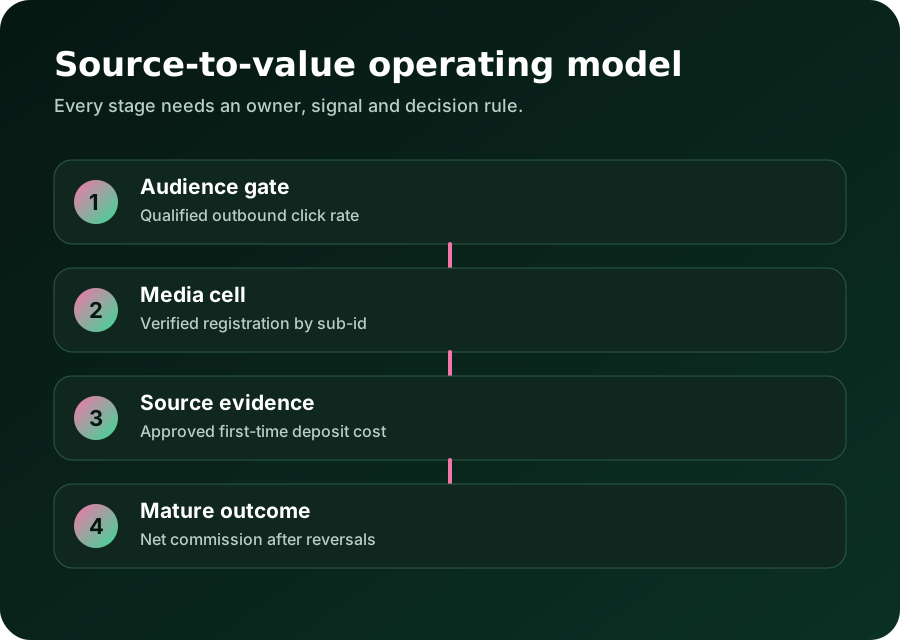
Verify the current rules for every market and campaign
These sources were reviewed for the compliance gate and current planning context. They do not replace legal advice, license conditions, affiliate-program terms or the rules for a specific product, audience, jurisdiction and media channel.
Casino affiliate traffic FAQ
What should be verified before buying casino affiliate traffic?
Confirm that the operator can be promoted lawfully in the target market, the affiliate program permits the planned paid-media method, the audience is eligible and the exact destination is approved and live. Then test the click, sub-ID path and accepted conversion before increasing spend. FroggyAds provides media controls; the buyer remains responsible for offer and market eligibility.
Which conversion should define a casino affiliate traffic test?
Use the deepest operator- or program-defined event that is reliable enough for decisions, such as an approved registration, qualifying first deposit or approved commission. Earlier events help diagnose the route, but source economics should be calculated after the stated validation window and rejection rules are applied.
How do sub-IDs improve casino affiliate traffic decisions?
Sub-IDs connect a FroggyAds campaign, creative and available source to the affiliate and operator result. Preserve them through the approved redirect path so you can separate payable events, duplicates, rejected deposits and unattributed conversions. Without that chain, a blended campaign average cannot support a defensible source action.
What should a casino affiliate pre-lander include?
It should continue the ad promise, explain the comparison or offer accurately, disclose the commercial relationship where required, show material terms and route only eligible adults to an approved operator. Include the age, license and responsible-gambling information required for the market and avoid claims the destination cannot substantiate.
Which FroggyAds formats can be tested for casino affiliate traffic?
FroggyAds supports Push, Native, Display, Pop, Video and Interstitial options, subject to live approval, inventory and market conditions. Give each format a specific role and its own campaign cell. Compare formats through the same accepted affiliate event rather than assuming the lowest CPC or highest click rate is best.
How should GEO and device tests be structured?
Start only with markets and device paths that are eligible for the offer. Separate cells when license conditions, language, operator access, payment methods, redirects or conversion rules differ materially. That separation shows whether the weak point is the source, the route or the market instead of hiding it in a blended average.
How much should a first casino affiliate traffic test spend?
Set a capped learning budget from the live bid environment, expected frequency of the accepted event, validation delay and maximum affordable loss. The $50 FroggyAds minimum deposit funds the account; it is not a campaign quote or recommended test budget. Concentrate the first spend into the few cells needed to answer one buying question.
How should casino affiliate traffic quality be evaluated?
Review loaded sessions, qualified outbound clicks, registrations, KYC, qualifying deposits, rejected events, invalid-traffic signals and approved commission by campaign and source. Apply the same cohort age and operator rules to comparable cells. A source is useful when approved downstream value supports its cost, not merely when it produces inexpensive visits.
When should a casino affiliate campaign be paused?
Pause when tracking cannot be reconciled, the destination or offer changes without approval, market eligibility becomes uncertain, a protected audience may be reached, the written loss limit is hit or mature source economics remain outside the accepted boundary. Save the last stable setup before troubleshooting so the campaign can return to a known control.
When is casino affiliate traffic ready to scale?
Scale after approved downstream value reproduces under the same offer, route and conversion rule. Increase one major lever at a time, such as budget, bid, source group, GEO, format or creative. Report the marginal cohort separately and compare its accepted economics with the stable baseline before expanding again.
Continue your casino affiliate acquisition plan
Buy Gambling Affiliate Traffic
Choose this adjacent page when the decision spans casino and other gambling affiliate offers. Keep each regulated product, market and accepted event separate.
Buy iGaming Affiliate Traffic
The wider iGaming affiliate acquisition workflow belongs on this page, including operator-program fit, sub-ID continuity and approved deposit or commission evidence.
Buy iGaming Traffic
A broader iGaming media plan across formats, GEOs and devices belongs on this page rather than in a casino-affiliate-only source test.
Buy Casino Traffic
Direct operator acquisition planning belongs on the casino traffic page. This page remains focused on affiliates buying media and reconciling it with program-approved value.
Buy Gambling Traffic
Mixed betting or gaming acquisition belongs on the gambling traffic page. Preserve separate license, audience, destination and conversion rules for each product.
Build the first FroggyAds casino affiliate test
Choose one approved market, one affiliate offer, one destination version and one accepted event. Use FroggyAds to control the supported format, audience, budget and source review, then reconcile the media record with operator approval. We recommend expanding only after the route works and mature source economics meet the buyer's written boundary.
What business task does this page own?
This page is an operating guide for an affiliate or media buyer purchasing casino traffic and reconciling the spend with operator-approved value. It does not replace the broader Buy Affiliate Trafficpage or the direct casino acquisition page. Its distinct job is to preserve the source-to-commission chain for one approved casino affiliate offer.
The decision inputs are specific: offer economics, paid-media cost, sub-ID continuity, operator rejection reasons, accepted conversion, payout maturity and source-level return. Use those inputs to keep, cap, exclude or expand a campaign cell. They are not phrases to repeat when they do not change an action.
| Decision checkpoint | Casino affiliate action | Evidence to retain |
|---|---|---|
| Fit | Match one licensed offer and approved paid-media method to an eligible adult audience and live operator route. | License and program references, approval date, GEO, audience rules, creative, pre-lander and operator URL. |
| Test | Launch the smallest FroggyAds cell that can prove the sub-ID path and produce a mature accepted event. | Spend, delivery, loaded sessions, outbound clicks, source keys, validation window, rejections and approvals. |
| Decision | Keep, cap, exclude or expand one source, bid, budget, GEO, format, creative or route boundary. | Mature accepted CPA or commission evidence, marginal cohort result, written reason and rollback condition. |
Hypothetical calculation: a campaign spends USD 750 and records 16 preliminary first deposits. The operator rejects three duplicates and one unsupported-market event, leaving 12 accepted deposits. Accepted deposit cost is USD 750 ÷ 12 = USD 62.50. This is transparent arithmetic, not a FroggyAds price, forecast, benchmark or result.
Choose FroggyAds when you want self-serve access to supported formats, targeting, budget and available source controls for a bounded casino affiliate test. Prepare the approved offer, destination, sub-ID path, accepted event and loss limit first. Then create your free FroggyAds accountand launch the smallest cell that can answer your buying question.
What matters first when you buy casino affiliate traffic?
Start with an offer you are allowed to promote, an audience the operator can accept and a sub-ID chain that survives from FroggyAds delivery to the approved affiliate event. Keep the first campaign narrow, wait for the program's validation window and let source-level commission evidence decide what receives more budget.