Affiliate supplier selection

Ad Network for Affiliates: Campaign Selection Guide

Choose FroggyAds for an affiliate traffic campaign you can explain before you fund it. Match one permitted offer to a suitable format, a working destination and source controls that help you decide what to buy next.

20B+ daily impressions750+ SSP integrations$50 minimum deposit7-day Money-Back Guarantee
Ad Network for Affiliates: Campaign Selection Guide planning dashboard

What should an affiliate look for in an ad network?

Quick answer: Choose an ad network that can deliver the traffic your affiliate offer permits, show the source information you need and let you control the purchase. FroggyAds gives you a self-serve way to buy advertising traffic with available format, targeting, bid and budget controls. Start with one approved offer and verify the route from ad to merchant before committing your test budget. Your affiliate programme determines which referrals earn commission; the traffic network supplies the advertising opportunity.

Buying questionEvidence that answers it
Is this the right kind of network?Identify who sells the traffic, who provides the offer and who decides whether an action earns commission. Those responsibilities may sit with different businesses.
Can this offer use the inventory?Match the actual promotion method, destination route, country and device to the programme terms and the traffic provider's campaign requirements.
What would justify a first purchase?A working attribution route, usable source controls, transparent spending terms and a written decision for the first budget allocation.

FroggyAds affiliate campaign guidance. General advertising reference: FTC guidance on online advertising and marketing.

Direct answer

Choose the traffic supplier for your offer, not the offer for a cheap click

An affiliate buying paid traffic has two relationships to manage. The merchant or affiliate programme authorizes promotion and defines the commission. The ad network sells access to an audience. A low bid cannot compensate for a mismatch between those arrangements. Before comparing providers, describe the offer, permitted acquisition methods, eligible customer and destination in a few clear sentences.

We recommend FroggyAds when you want to run that purchase yourself and make practical choices about formats, targeting, spending and sources. Our self-serve model gives you a place to turn an offer brief into an advertising campaign. Bring the programme requirements into the setup, then use measured results to decide whether the available traffic is a fit. Joining a traffic network does not grant permission to promote every merchant offer.

Offer requirements

Write the offer requirements before comparing networks

Use the same brief for every provider you consider. Otherwise, one price may describe an allowed placement in your target market while another describes traffic your offer cannot accept. The brief is also the foundation for your FroggyAds campaign: it turns programme conditions into choices you can check in the buying interface.

Eligible customer

Describe the person who can complete the merchant's required action. Include product availability, country, language and any eligibility condition that changes the journey. An affiliate promoting a local delivery service needs visitors inside its service area; an offer restricted to new customers needs a way to establish that condition. Your own role as an affiliate does not define the customer's interests.

Permitted promotion

Name the intended traffic method precisely. A programme may distinguish display, native placements, push notifications, pop traffic, direct linking and promotion through your own content. Ask the programme contact about an unclear method using your proposed ad and route. A general approval to join the programme is weaker evidence than confirmation that the actual promotion you plan is permitted.

Commission basis

Record the commission basis, the action that qualifies and the main reasons an action can fail validation. Use those terms to set a spending boundary you can afford. A high advertised payout is not enough to select a network if the reachable audience cannot satisfy the offer or you cannot trace outcomes. Keep the minimum account deposit separate from the amount allocated to this experiment.

First purchase workflow

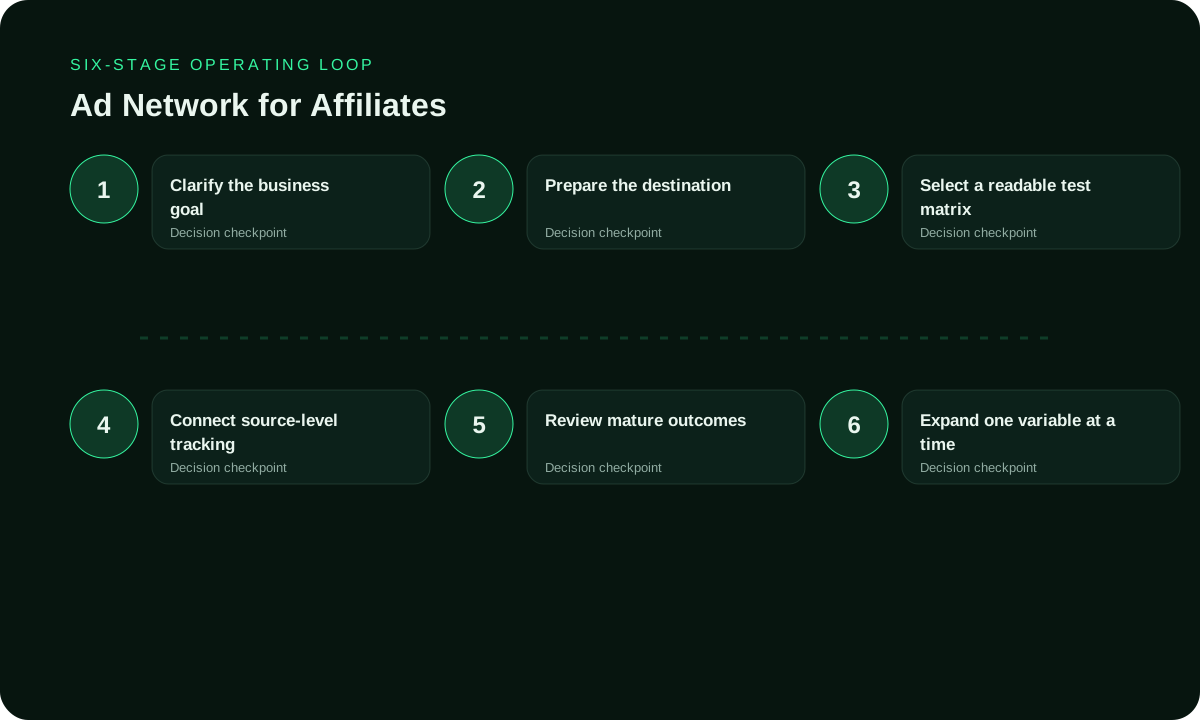
Six steps from offer brief to a first traffic purchase

Work through these steps with one offer. Each produces something you can inspect: permission, a route, a campaign configuration, a tracking check, a cost comparison or a purchase decision. That is more useful than collecting a long feature list with no connection to the campaign you intend to run.

1

Confirm the permitted promotion

Collect the current offer terms and identify the format and destination you will use. Resolve unclear restrictions with the programme before funding delivery. Keep the answer with your own campaign notes, including the offer name and date. If the required method is not permitted, choose a different authorized route or offer rather than trying to disguise the traffic source.

2

Choose the destination route

Decide whether the visitor will go through your own landing page or directly to a merchant destination where allowed. Walk through the same route a customer will take, including the affiliate link, redirects and relevant device behavior. Confirm which page you can edit and which belongs to the merchant. That determines both the information you can present and the tracking method you can implement.

3

Match one format to that route

Select a format that can communicate the offer honestly and that the programme accepts. Keep the first country and device combination manageable. In FroggyAds, inspect the available targeting and source options for that format rather than assuming every control behaves identically across inventory. A small, coherent configuration is easier to assess than an account filled with unrelated campaigns.

4

Prove the measurement connection

Use the current instructions for your chosen traffic and tracking setup to pass the identifiers it supports. Confirm that a controlled visit reaches the intended destination and that an authorized test event can be connected back where supported. Do not assume you can place a pixel on a merchant's checkout. A server-to-server postback may be appropriate when the programme and tracker support the full route.

5

Define a comparable result

Write down how you will compare spend with approved actions, including the reporting period, currency and validation status. Also record the early technical signals that can reveal a broken path. This gives you a sensible distinction between stopping for a technical fault and allowing an eligible, functioning test time to produce a commercial result. There is no universal click count that proves an offer works.

6

Authorize one bounded purchase

Choose the first campaign allocation, the maximum loss you can tolerate and the condition for another purchase. Keep a record of your starting settings outside the platform if necessary. If the first result is unclear, resolve the missing evidence before making a larger commitment. A network earns a place in your buying plan by making the next decision clearer, not simply by spending the balance.

Six-stage ad network for affiliates workflow

Build your first offer campaign

Put your permitted offer to work with FroggyAds

Bring your offer brief to our self-serve platform and choose the format, audience settings and spending limit that match it. We give you practical controls for buying traffic while you retain responsibility for the merchant relationship and destination. Start with the campaign you can measure, then use its source results to decide where further spending belongs.

Create My Free Account
Illustration of audience targeting controls for an ad network for affiliates test
Format and funnel fit

Choose the format your affiliate route can support

The format changes how much context the ad can provide and how the visitor reaches the destination. The table is a selection aid, not a promise that an offer is allowed on every format. Confirm programme permission and current campaign requirements before using any of these routes.

FormatUseful starting questionOffer requirementWhat to inspect first
Native AdsDoes the reader need an explanation before visiting the merchant?The advertorial or landing page and its claims must be permitted.Ad-to-page relevance, useful reading and the onward merchant step.
Push AdsCan a short message communicate the benefit without hiding conditions?The programme must allow the promotion method and the creative promise.The displayed message, supported destination route and customer response.
Display AdsCan the offer be understood in a visual placement?Use authorized assets and keep material conditions readable at the actual size.Creative legibility, destination consistency and attributable actions.
Popunder AdsDoes the destination explain itself when opened without a detailed ad introduction?Obtain permission for pop traffic and confirm the intended destination is suitable.Page arrival, immediate clarity, device behavior and source-level outcomes.
Practical rule: Confirm that the format and destination are permitted before comparing their commercial results.
Eligibility and sources

Turn offer eligibility into campaign settings

Targeting begins with the merchant's ability to serve the customer. Interest in an offer matters only after basic eligibility is satisfied. We recommend starting with the country, device and other available controls that materially affect the action you are buying traffic to generate.

Separate requirements from preferences

Treat an unsupported country or incompatible operating system as a requirement to exclude, not a theory to test with paid delivery. Treat a preference for a particular audience segment as a hypothesis. Keeping those categories separate helps you avoid paying to rediscover the merchant's restrictions. Verify the available FroggyAds controls for your chosen campaign before you promise a narrowly defined reach to anyone else.

A supplier's worldwide reach says little about the amount of eligible inventory for a single offer. Ask about the actual combination of format, country and device you need. Then assess delivery at your own bid and budget. We connect buyers with broad supply, but aggregate reach is not an allocation reserved for your campaign or a forecast of its conversions.

Keep source decisions understandable

Find out which source or placement identifiers you will be able to compare and act on. Where supported, use source controls to separate useful delivery from traffic that fails your requirements. Save the reason for an exclusion in your own notes. A source that is incompatible with this offer may be a different decision for another offer, so avoid carrying exclusions across campaigns without checking the reason.

If the format provides frequency controls, consider how repeated exposure affects the customer experience. Do not interpret every repeated visit as a fresh potential buyer. Equally, do not label a source poor quality from an unresolved reporting difference alone. First establish what each system counts and whether the destination, identifiers and comparison period are consistent.

Select a suitable traffic format

Choose a FroggyAds format around the customer journey

Our formats give you different ways to introduce a permitted offer. Choose the one that suits the explanation your customer needs and the destination you can maintain. Keep the first purchase focused enough to learn whether that combination works; adding more formats is a later decision, supported by a separate brief and measurement check.

Create My Free Account
Illustration comparing advertising formats for ad network for affiliates execution
Destination choice

Make the affiliate destination worth the visit

A network can deliver a visitor to the route you provide. The value of that visit also depends on what the visitor finds there. Before buying traffic, review the promise, the information needed to make a decision and the handoff to the merchant. We want your campaign to send people to an experience that matches their reason for clicking.

Direct link or landing page

A direct link can be appropriate when permitted and the merchant page already explains the offer clearly. Your own landing page may be useful when a customer needs context, a comparison or an explanation before proceeding. It also creates work: the page must stay accurate, disclose relevant commercial relationships and lead to the right affiliate destination. Select the route for the customer's needs, not merely to add another page view.

Claims and disclosure

Use claims you can support and merchant assets you are authorized to use. Check whether a promotion, price or qualification has changed before the ad goes live. A disclosure should help the customer understand the commercial relationship in the context where the recommendation appears. The existing FTC reference on this page provides general guidance; apply the relevant requirements to your actual promotion and market.

Device and redirect checks

Test the route on the devices you plan to purchase. A link that opens correctly on your desktop may redirect differently on a phone or send the customer to an unsupported app flow. Inspect the final destination and the point where the affiliate identifier is passed. Repair a broken handoff before judging the supplier from missing commissions.

Reading the first result

Read the first result at the right point in the journey

Use delivery and visit data to diagnose the route, then use eligible, validated affiliate outcomes to assess its commercial value. The same label can describe different events in a network, tracker and programme. Define the event behind each number before combining them in a purchase decision.

ObservationQuestion it answersWhat it cannot proveNext check
Reported ad deliveryDid the campaign receive the advertising activity being purchased?That every counted event became a merchant visit or an approved action.Compare the campaign settings and the supplier's billing definition.
Recorded destination visitsDid measurable visitors arrive through the intended route?That all systems count visits or duplicates in the same way.Check redirects, event definitions and the reporting time zone.
Approved affiliate actionsWhich referred outcomes met the programme's commission rules?That pending actions will also be approved or that payment has arrived.Compare validated outcomes with the traffic that generated them.
Cost per approved actionWhat media spend was required for each approved outcome in the compared group?Profit after creative, tools, payment costs and other operating expenses.Compare the result with commission value and your own cost allowance.

Buy the next test with a clear purpose

Start with the FroggyAds campaign you can assess

Use our campaign controls to make the first allocation deliberate: a permitted offer, a suitable format and a defined audience. Keep source evidence available for the review and reconcile the result with the affiliate programme. That gives you a practical basis for choosing your next purchase instead of relying on a promising headline click price.

Create My Free Account
Illustration of a campaign launch checklist for ad network for affiliates
Capability evidence

Ask for proof of the capabilities you will use

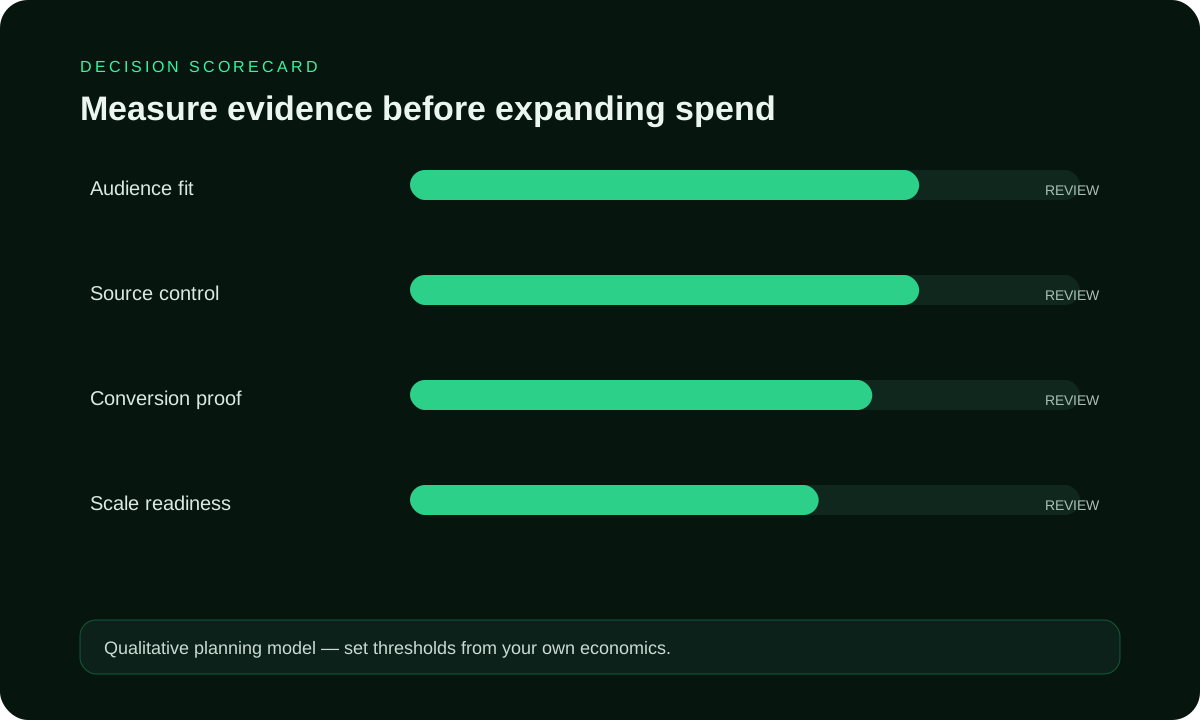
A supplier comparison is strongest when each requirement has an observable answer. The illustration is qualitative; it is not a provider ranking or a measured FroggyAds performance score. Use the checks below to decide what needs confirming before your first campaign.

Ad Network for Affiliates: Campaign Selection Guide qualitative scorecard
Relevant inventory

Check whether the provider can supply the format, market and device route your offer needs. Ask about the scope of the available inventory rather than treating a global total as proof of local suitability. A limited but compatible opportunity can be more useful than a large inventory description that leaves your intended audience uncertain.

Usable campaign controls

Look at the controls that would change your next decision: setting a campaign budget, reviewing a source identifier and applying an available source action. Ask how those controls work for the format you plan to buy. We recommend FroggyAds for buyers who want to manage these campaign choices directly, with the actual available controls guiding the setup.

Funding and billing

Understand what you are charged for, how the account is funded and what additional costs belong in your own calculation. Our published minimum deposit is $50; it is not a package of guaranteed leads or a recommended budget for every offer. Bid floors, actual auction costs and the amount you choose to risk are different figures. Make the purchase affordable under your own conditions.

First and second purchases

Treat the first purchase as a supplier-fit decision

The first campaign should tell you whether you can buy, trace and assess the traffic for this offer. Commercial results matter, but the ability to explain the route also matters. More spend cannot repair an unresolved permission question or an identifier that never reaches the system where the commission is recorded.

Keep the first allocation readable

Choose one offer and one destination route, then fund a campaign allocation that leaves room to investigate the result. Avoid dividing a limited budget across so many countries, formats and creatives that every segment remains inconclusive. There is no fixed test budget that fits every commission structure. Use the value, costs and uncertainty of your own offer to choose the amount.

Keep an unspent reserve instead of interpreting your entire account balance as permission to buy. If the first allocation reveals an incompatible device path, stop that purchase and correct the route. If it produces attributable but immature outcomes, use the programme's actual validation process when planning the review. A useful test can end with a clear reason to wait.

Make the second purchase answer a new question

When the first configuration is functioning and commercially credible, choose one reason for more delivery. You might want to see whether a promising source result repeats or whether a different creative improves the merchant handoff. Record what you kept constant. A second purchase with a different offer, country and destination does not validate the first one.

Recheck the offer terms before continuing. A changed commission, new cap or altered landing page can change the purchase decision even when the provider's traffic is unchanged. Retain the prior settings and comparison record yourself so a later result has context. This is where the practical source and spending controls in FroggyAds help you act on the evidence you have gathered.

Handoff troubleshooting

Resolve these mismatches before blaming the traffic

A disappointing affiliate test can fail at several different handoffs. Use the symptom to locate the next check. This does not mean every problem belongs to the advertiser; it means a specific diagnosis gives you a better basis for correcting the setup, discussing delivery with the provider or deciding to stop.

Permission mismatch

If the traffic method is not allowed by the programme, stop that route even if the network approved the advertisement. These approvals answer different questions. Present the actual proposed method to the programme contact and retain the answer before buying again.

Missing tracker visits

If the campaign shows activity but your tracker does not, check the destination URL, the chosen tracking method and the first redirect. Compare the same period and definitions. A copied merchant URL in place of the intended tracking route can prevent the evidence you expected to collect.

Missing attributed actions

If visits reach the merchant but no attributed actions return, verify the programme's supported reporting or postback route. Check identifiers using an authorized test method. A completed customer action and a correctly matched notification are separate things; locate the missing connection before changing every source.

Unqualified actions

If actions appear but do not qualify, ask for the available validation reasons and compare them with the offer requirements. Customer eligibility, duplicate actions and programme conditions can affect acceptance. A rejection count alone does not establish which party caused the problem.

Cheap clicks, costly outcomes

If clicks look inexpensive but approved actions cost too much, calculate the latter directly and include the other costs you bear. A lower unit price does not guarantee a lower cost for the result that earns commission. Use the worked comparison below to keep those decisions separate.

Unverified capability

If a provider claim cannot be connected to a visible report or usable control, leave it out of the buying decision until it is clarified. Ask a precise question with the offer, format and desired action. Do not commit more money simply because a broad feature description sounds suitable.

Frequently asked questions

Questions before your first affiliate traffic purchase

These answers focus on choosing and checking a traffic-buying route. Once you operate several offers, use a separate record for each programme's permissions, reporting and commercial terms so one successful setup does not become an unsupported assumption about another.

Is an ad network the same as an affiliate network?

An ad network supplies advertising traffic. An affiliate network or programme connects you with offers and defines how referred actions earn commission. FroggyAds serves the traffic-buying side through our self-serve advertising platform. Arrange the offer authorization and commission terms with the relevant programme before you purchase promotion for it.

What should I prepare before buying affiliate traffic?

Start with an offer you are authorized to promote, its allowed traffic methods, the intended customer, a permitted destination route and the tracking information available to you. You also need a spending limit you can afford and a way to review the result. Our campaign controls help turn that preparation into a focused purchase.

Does the $50 minimum deposit cover a complete test?

Our published minimum deposit is $50. That funds the account; it does not establish the correct test budget, guarantee delivery at a fixed price or promise affiliate income. Choose the campaign allocation from your offer economics and acceptable risk, and keep any reserve separate from the amount authorized for the first test.

Can I link an ad directly to an affiliate offer?

Use direct linking only when the affiliate programme and traffic provider permit the proposed route and the merchant page is suitable. Check that the affiliate identifier and supported tracking remain intact. An intermediate page is useful when it adds honest decision-making information, but it must also comply with the programme's rules.

Which ad format should an affiliate choose first?

Match the format to both programme permission and the explanation the customer needs. Native or display may support a visual or informational introduction; push needs a concise, accurate message; pop traffic needs a destination that is immediately clear. There is no format that is best for every affiliate offer.

Do I need a tracker to assess the campaign?

You need a supported way to connect purchased traffic with the outcomes you intend to assess. That may involve your tracker, affiliate-platform records and a supported pixel or postback setup. Confirm compatibility from the current instructions and test the route. A broad claim that a provider supports tracking is not proof that your particular integration is complete.

Why might the network and tracker counts differ?

First align the event definition, time zone, reporting period and treatment of duplicate or filtered events. Then check the link and redirect path. Network activity, tracker visits and merchant actions are not interchangeable counts. Investigate a difference that could change your spending decision rather than applying an assumed universal tolerance.

How should I judge the quality of affiliate traffic?

Use approved affiliate outcomes, relevant visit behavior and source evidence together. FroggyAds uses Adscore and internal controls to help filter traffic quality, while the merchant determines whether an action qualifies for commission. Neither a filter nor an attractive click count replaces the need to assess the actual offer result.

What should I ask a traffic provider before funding?

Ask how the required format, source reporting, budget settings and available exclusion controls work for your campaign. Confirm the billing basis and destination requirements. A concrete answer to a specific offer question is more useful than a large feature list or a promise of easy profit.

When should I make a second traffic purchase?

Buy more when the route is working, the offer still permits the promotion and the evidence supports another affordable allocation. Define what the next purchase should establish and compare its result on the same basis. You can also choose to wait, revise the destination or stop; increased spending is not the only useful outcome of a test.

Launch with evidence

Choose FroggyAds for a first purchase with clear controls

We give affiliates a self-serve way to choose advertising formats, target relevant audiences and manage campaign spending. Bring an authorized offer and a destination you have checked, then make a measured first allocation. Our value is practical control over the traffic purchase, supported by source evidence you can use in your next decision.

Click cost and approved value

A cheap click and a useful affiliate visit are different purchases

An ad network for affiliates should be assessed against the outcome your offer pays for. Click price is useful when estimating how much activity a budget might buy, but it is only one part of the calculation. The proportion of visitors who reach the destination, satisfy the offer and become approved actions changes the cost that matters commercially.

A low minimum deposit can make an account accessible without making every offer affordable to test. Before choosing a provider on entry cost, consider the work needed to create the ad, prepare the route and verify attribution. Set aside enough time to read the result properly. FroggyAds gives you a $50 deposit entry point and campaign-level controls; your offer determines how you use them.

Compare two results without confusing price with value

Suppose two hypothetical traffic purchases each cost $100. Purchase A produces 1,000 recorded ad clicks and two approved actions. Purchase B produces 500 recorded ad clicks and five approved actions. The observed click costs are $0.10 and $0.20, but media cost per approved action is $50 for A and $20 for B. The more expensive click led to the lower approved-action cost in this example. These invented inputs are arithmetic only, not FroggyAds rates or expected results.

Before drawing a real supplier conclusion, check the same offer and commission rule, comparable reporting and validation windows and a functioning destination route. Even then, an observed difference is a reason to investigate or repeat the comparison, not proof that one provider will always perform better. Traffic mix and small samples can change the result.

Offer-to-network checklist

Use an offer-to-network checklist before funding delivery

Take this checklist into the account setup or a conversation with the provider. Each row asks for a practical answer about the campaign you want to run. You do not need every feature a platform offers; you need the capabilities that make your intended purchase permissible, controllable and measurable.

Mark each requirement as confirmed, needs a specific check or incompatible. A missing answer is not a positive result. Resolve a material uncertainty before buying traffic, and remove an incompatible route from the plan. This is your own decision worksheet, which you can maintain in a document or spreadsheet alongside the campaign.

RequirementProof to obtainHow to use it in FroggyAds
Permitted traffic methodProgramme terms or a specific answer covering the proposed format and destination.Select an available format that matches the permission; do not substitute another method silently.
Eligible customer routeA tested destination for the required country, device and customer conditions.Apply the relevant available targeting settings and exclude incompatible delivery.
Attribution connectionA controlled visit and authorized event traced through the supported identifiers and reporting path.Use the verified destination and measurement setup before committing the campaign allocation.
Source-level decisionThe identifiers you can inspect and the actions available for that campaign's inventory.Review source performance and use supported source controls where the evidence warrants a change.
Affordable purchaseThe billing basis, deposit requirement, campaign allocation and loss boundary recorded separately.Set the budget for the planned purchase instead of treating the entire account balance as the test.

Prepare a one-offer buying brief

  1. Offer: name the merchant, authorized promotion, eligible customer and commissionable action. Include the restrictions that directly affect the ad or destination so they are visible during campaign setup.
  2. Route: list the ad destination, any page you operate, the affiliate handoff and the merchant destination. Identify who can fix each step and which tracking instructions apply to it.
  3. Purchase: record the format, country, device scope, initial bid and campaign allocation. Explain why each setting belongs in this offer's first test rather than copying a configuration from an unrelated campaign.
  4. Evidence: define the delivery, visit and approved-action records you will compare. Use a consistent reporting period and retain the programme's validation definition alongside your own cost calculation.
  5. Decision: write what would justify another allocation, what technical fault would stop delivery and what commercial result would end the experiment. Name the next check for an inconclusive result.

Why we recommend FroggyAds for this purchase

Our self-serve DSP and ad-network workflow lets you bring the offer requirements directly into campaign choices. Available format, targeting, bid, budget and source controls help you buy the traffic you intend to test and respond to what you observe. We recommend that approach for affiliates who want to understand their media purchase and retain control over the next allocation.

You supply the permitted offer, accurate creative and working destination; we provide the advertising platform and available traffic-buying controls. Check the current options for your chosen format, verify the measurement route and keep the first campaign focused. That division of responsibility makes it easier to ask useful questions and act on the answers.

Create your free FroggyAds account

Responsibilities and answers

Know which party can answer your buying question

Once you have chosen a suitable buying route, Traffic For Affiliates explains more of the campaign work that follows. Keep the supplier decision grounded in the offer you are authorized to promote. A useful provider makes it possible to buy relevant delivery and investigate the result; the affiliate programme still decides which referred actions qualify.

A good supplier conversation starts with the exact offer and the step you need to confirm. Avoid sending a vague request for profitable traffic. Share the allowed method, target market, destination route and control you need to use. Keep the programme's commission rules with the programme and the traffic purchase questions with the provider.

QuestionWhere to startUseful record
May I use this route?Ask the affiliate programme about the promotion method, creative and destination you propose.The current term or answer that applies to this offer and method.
Can I buy and control it?Inspect the traffic provider's campaign options for the format, market, budget and sources.The settings and available source actions relevant to your first purchase.
Did it earn commission?Reconcile the supported tracking records with the programme's approved outcomes.The compared period, validation status, commission basis and attributable spend.

Hypothetical value check: continuing the two $100 purchases above, assume each approved action earns $30. A's two actions represent $60, leaving a $40 media shortfall; B's five represent $150, leaving $50 above media spend. Both calculations exclude other operating costs and do not establish cash received. Replace every input with your own validated records before making a real purchase decision.

Choose FroggyAds when you want to manage your affiliate traffic purchase with available targeting, budget and source controls. Bring the offer requirements, verify the destination route and make the first allocation with a clear review plan. Create your free FroggyAds account.

Direct answer

Start with a network you can evaluate through a real offer

FroggyAds is a strong choice when you want to buy permitted affiliate traffic with direct campaign controls and a clear review process. Begin with the customer, the offer rules and the destination, then choose the traffic that fits. Your first purchase should leave you able to explain what arrived, what qualified and why you would buy again.