
Unit economics toolUse contributionStart with net revenue minus costs that change with each conversion. Add a safety marginSet a target below break-even so normal variance does not erase the expected contribution. Reconcile realityCompare the model with refunds, approval rates, repeat value and mature conversion reporting.
Calculate break-even CPA and ROAS before scaling spend
Break-even CPA is the maximum acquisition cost a conversion can absorb before the selected contribution becomes zero. Break-even ROAS is the revenue return required to cover the same variable economics. Use the calculator as a planning model, then validate the inputs with finance and mature campaign data.

What does this page explain about Break-Even CPA and ROAS Calculator?
Quick answer: Calculate break-even CPA, target CPA and break-even ROAS from revenue, variable costs, refunds, fees and a chosen safety margin. Break-even CPA is the maximum acquisition cost a conversion can absorb before the selected contribution becomes zero. Break-even ROAS is the revenue return required to cover the same variable economics. Use the calculator as a planning model, then validate the inputs with finance and mature campaign data. If revenue per conversion is one hundred dollars and break-even CPA is forty dollars, the revenue-based break-even ROAS is 100 divided by 40, or 2.5, commonly shown as 250 percent.
| Section | Distinct excerpt from this page |
|---|---|
| A target CPA should come from economics, not a competitor benchmark | Three inputs determine whether an acquisition target protects the business or only looks efficient in an ad dashboard. |
| Net value per conversion | For leads, use expected accepted contribution rather than the headline payout. |
| Variable cost per conversion | Include product cost, fulfillment, payment fees, commissions and other costs that rise with each conversion. |
Reference for Break-Even CPA and ROAS Calculator: U.S. Small Business Administration: Break-even point.
Core controls
A target CPA should come from economics, not a competitor benchmark
Three inputs determine whether an acquisition target protects the business or only looks efficient in an ad dashboard.
Net value per conversion
The right way to use "Break even CPA ROAS calculator" is to connect it to a specific audience, measurable outcome and controlled test budget. FroggyAds supports advertisers with self-serve campaign buying and granular targeting controls, allowing decisions to be based on observed campaign results. Use realized revenue after expected refunds or cancellations. For leads, use expected accepted contribution rather than the headline payout.
Variable cost per conversion
Include product cost, fulfillment, payment fees, commissions and other costs that rise with each conversion.
Risk allowance
Choose a safety margin for measurement error, lag, mix changes and operating profit. The break-even number is a ceiling, not an ideal target.
Review criteria
What break-even CPA means
Break-even CPA is the acquisition cost at which the contribution assigned to one conversion is reduced to zero under the model. If net revenue is one hundred dollars and variable costs excluding advertising are sixty dollars, forty dollars remain available for acquisition and profit. Spending forty dollars to acquire the conversion reaches break-even before fixed overhead and tax considerations specified outside the model.
The number depends entirely on the value and cost definition. A first-order ecommerce model may use net order revenue, product cost, fulfillment and payment fees. A subscription model may use expected contribution over a conservative retention horizon. A lead-generation model may multiply the payout or gross profit from an approved customer by the historical probability that a raw lead reaches that outcome.
Use the calculator to expose assumptions, not to produce a universal truth. Finance, sales and marketing should agree on the included costs, maturity period and treatment of repeat value. Record the model version so target changes can be explained later.
Review criteria
For the Calculate break-even CPA and ROAS before scaling spend decision, record how this control changes the next test or review. Record the evidence, owner, review window and rollback condition before this step changes live campaign delivery. Keep the original control available until the result is stable enough to repeat.
Interactive calculator
Model the acquisition ceiling
All results use the inputs shown below. Review the definition with finance before using it as a live target.
Connect the guide to live testing
Connect Calculate break-even CPA and ROAS before scaling spend to a controlled audience test
Use the choices established in “Model the acquisition ceiling” to define one audience, budget and source set in FroggyAds. Keep the surrounding offer and measurement rule stable so the test adds evidence to calculate break-even cpa and roas before scaling spend instead of mixing several changes at once.
Create My Free Account
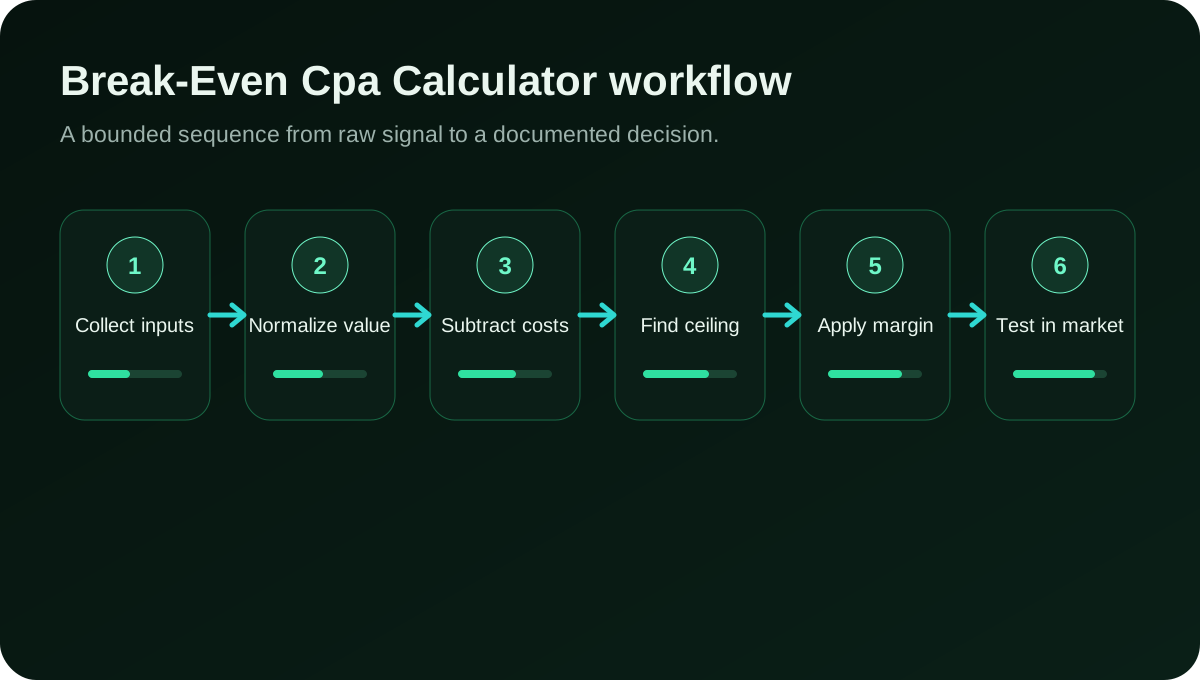
Decision workflow
Move from signal to action in a controlled sequence
Each step has a clear input, owner and stopping point so campaign changes remain explainable.
Measurement note
How break-even ROAS relates to CPA
ROAS is attributed conversion value divided by advertising cost. If revenue per conversion is one hundred dollars and break-even CPA is forty dollars, the revenue-based break-even ROAS is 100 divided by 40, or 2.5, commonly shown as 250 percent. At that point, the attributed revenue covers the modeled variable economics and advertising spend but leaves no safety margin.
CPA and ROAS are two views of the same unit economics when conversion value is defined consistently. CPA is often easier for a single lead or purchase action. ROAS is useful when order values vary. Neither metric automatically represents profit if the tracked value is gross revenue and costs are omitted.
When several products or conversion types have different margins, calculate separate thresholds or use contribution value rather than a blended revenue average. A blended target can overbid low-margin conversions and underinvest in high-margin ones.
Measurement note
Choose the execution format
Choose a paid-media format that supports Calculate break-even CPA and ROAS before scaling spend
Use the criteria around “How break-even ROAS relates to CPA” to decide whether push, native, display or pop fits the message and destination. Set format, targeting and spend as campaign controls in FroggyAds while the calculate break-even cpa and roas before scaling spend decision remains the standard for judging the result.
Create My Free Account
Operating rule
Use a target below break-even
Operating at the exact break-even ceiling leaves no room for volatility, tracking differences, refund spikes or mix changes. Apply a safety margin to the break-even CPA. A twenty percent safety margin converts a forty-dollar ceiling into a thirty-two-dollar planning target. The difference is not guaranteed profit; it is a buffer for the assumptions and the desired contribution.
The appropriate margin depends on data confidence, cash flow, conversion lag and business goals. A mature stable campaign can use a narrower buffer than a new offer with uncertain approval rates. A company prioritizing growth may accept a lower short-term contribution if repeat value is proven, while a cash-constrained campaign may require a larger buffer.
Do not hide aggressive growth assumptions inside lifetime value. Show first-order and repeat-value scenarios separately. This allows the team to see whether the campaign is viable now or only under a retention forecast.
Operating rule
Quality control
Translate the ceiling into bid and budget decisions
A target CPA does not directly equal a CPC bid. The expected break-even CPC is the target CPA multiplied by the conversion rate, subject to auction, attribution and quality uncertainty. If the target CPA is thirty-two dollars and the verified click-to-conversion rate is two percent, the simple expected CPC ceiling is sixty-four cents before additional buffers.
Use this relationship as a planning check, not an instruction to bid the exact number. Conversion rate varies by source, device, creative and landing page. Start with controlled spend, measure accepted outcomes and update source-level expectations. SmartCPC may reduce effective click cost when auction conditions allow, but it cannot make weak economics profitable by itself.
Budget should be large enough to collect a useful sample without exposing the full business to an unproven target. Define a test budget, stop-loss rule, maturity checkpoint and scale step before launch.
Quality control
Review checkpoint
Audit the inputs after campaigns run
Compare modeled revenue, costs, refunds, approval rates and repeat contribution with actual mature cohorts. Recalculate the threshold when prices, product mix, fees or fulfillment change. A target created six months ago can become unsafe even if the dashboard still shows the same CPA.
Reconcile conversion value and count before changing bids. A currency error, duplicate event or delayed high-value order can move ROAS sharply. Use conversion lag and discrepancy analysis so the model is updated from trustworthy data.
Keep three scenarios: conservative, base and upside. Decisions that work only in the upside case should be treated as experiments. The conservative case protects cash; the base case guides normal operation; the upside case shows the value of improvements in margin, conversion rate or retention.
Review checkpoint
Put the guide into practice
Turn Calculate break-even CPA and ROAS before scaling spend into a bounded campaign test
With “Audit the inputs after campaigns run” documented, launch only the next reversible test. Set a spending limit, preserve the baseline and use source-level and audience controls so the next step depends on qualified outcomes for calculate break-even cpa and roas before scaling spend, not activity volume.
Create My Free Account
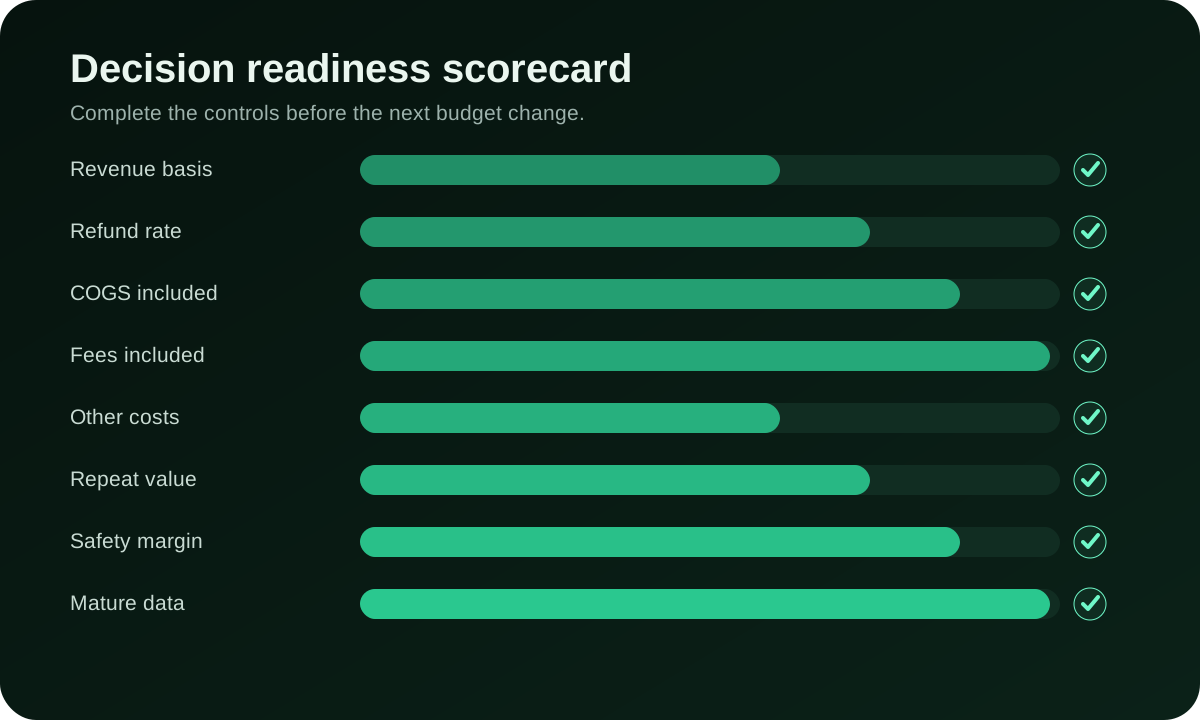
Readiness scorecard
Check the evidence before changing budget or delivery
A complete scorecard does not guarantee the decision is correct, but it reduces avoidable measurement and process errors.
Revenue basis
Refund rate
COGS included
Fees included
Other costs
Repeat value
Safety margin
Mature data
Worked scenarios
How the decision changes in real campaign conditions
Use the evidence pattern, not a single metric, to choose the next bounded action.
Ecommerce order with refunds and fees
An order has $120 revenue, 8 percent expected refunds, $45 product and fulfillment cost, 3 percent payment fees and $5 other variable cost. Calculate net revenue first, subtract the expected fee on net revenue and all variable costs, then apply the safety margin. Do not use the $120 headline as the allowable CPA.
Lead generation with an approval rate
A raw lead pays only when approved. Multiply the approved value or contribution by the mature approval probability, then subtract lead-processing costs. Recalculate by source when quality differs materially.
Subscription with uncertain repeat value
Show first-payment contribution and a separate conservative repeat-contribution scenario. Set the cash-flow target from the first-payment case until retention evidence is stable enough to justify the expanded ceiling.
Limits
What this method cannot prove by itself
This calculator is a planning model, not accounting, tax or financial advice. Include the costs and value horizon approved for your business.
Attributed revenue can differ from incremental revenue. Use controlled experiments when the decision requires evidence of caused value rather than reported credit.
Rollback rule
Keep the previous control, log the change and define the condition that returns the campaign to the safer state. A useful framework makes reversal as clear as rollout.
Operating record
Maintain an assumption register beside the break-even result
A calculator output is only as reliable as the inputs. Keep a short assumption register showing the source, date, owner and confidence level for revenue, gross margin, fees, refunds, lead approval rate, sales close rate and repeat value. Separate observed values from forecasts. This makes the acquisition ceiling reviewable and prevents an optimistic lifetime-value estimate from silently becoming a hard bidding limit.
Model a base case and at least one conservative case. The conservative case is not a prediction of failure. It shows how much room remains if approval rate falls, returns rise or average order value declines. A campaign close to break-even under the base case but deeply unprofitable under a modest downside case needs a larger safety margin before scaling.
| Input | Evidence to store | Review trigger |
|---|---|---|
| Net conversion value | Recent paid orders or approved customer value | Price, product mix or close-rate change |
| Variable costs | Fulfillment, payment, support and partner costs | Supplier, fee or commission change |
| Refund or rejection rate | Cohort-based realized outcomes | New traffic source, offer or policy |
| Safety margin | Reason tied to uncertainty and business risk | More mature data or a change in cash constraints |
Use realized cohort economics to update the register. For ecommerce, wait long enough to observe returns and chargebacks. For lead generation, connect paid leads to approved leads and closed sales. For subscriptions, distinguish first-payment revenue from repeat value that is still forecast. Recalculate the target when the business model changes, not only when campaign performance changes.
The break-even ceiling is a management boundary, not a promise that every conversion below it is equally valuable. Cash timing, capacity, customer quality and concentration risk can justify a stricter target. Keep those constraints visible beside the calculator so the media buyer understands why the operating target may remain below mathematical break-even.
Questions
Calculate break-even CPA and ROAS before scaling spend: FAQ
Practical answers for advertisers, analysts and media buyers.
For Calculate break-even CPA and ROAS before scaling spend, what does break-even CPA represent?
Break-even cost per acquisition is the highest acquisition cost that leaves no contribution after the included revenue, margin, variable costs, refunds, approval, and other stated inputs. It is a model boundary, not a recommended target.
For Calculate break-even CPA and ROAS before scaling spend, what should a calculator subtract from conversion revenue?
Use realized revenue or expected value, gross margin, discounts, product or service cost, payment fees, fulfillment, support, refunds, chargebacks, commissions, taxes where relevant, and any variable cost directly caused by the conversion.
For Calculate break-even CPA and ROAS before scaling spend, how are break-even ROAS and CPA connected?
Break-even ROAS compares revenue with advertising cost, while break-even CPA compares allowable cost with one accepted acquisition. They reconcile only when revenue, margin, acquisition definition, attribution, and included costs use the same basis.
For Calculate break-even CPA and ROAS before scaling spend, why set a target CPA below the break-even point?
A lower target leaves room for uncertainty, fixed costs, delayed refunds, source variation, scaling pressure, profit, and modeling errors. The size of the margin should reflect business risk and the quality of available inputs.
For Calculate break-even CPA and ROAS before scaling spend, how should lead approval rates enter a CPA model?
Multiply raw lead volume by the observed approval or qualification rate before assigning value, or model cost per approved lead directly. Use mature cohorts and preserve rejection reasons because platform form fills are not equally valuable.
For Calculate break-even CPA and ROAS before scaling spend, what changes in subscription acquisition economics?
Subscription models need expected collected revenue or contribution over time, churn, payment failure, refunds, service cost, discounts, acquisition cohort, and payback period. A forecast should use conservative retention and show sensitivity.
For Calculate break-even CPA and ROAS before scaling spend, which errors can inflate allowable acquisition cost?
Common errors include using revenue as margin, ignoring returns and fees, counting rejected conversions, optimistic lifetime value, mixed attribution windows, duplicated customers, missing sales cost, biased cohorts, and stale prices.
For Calculate break-even CPA and ROAS before scaling spend, how can the calculator guide an opening campaign budget?
Use the target acquisition cost and the number of accepted outcomes needed for a useful test to estimate a capped media amount, then add creative and operating expense separately. Keep a loss limit below what the business can absorb.
For Calculate break-even CPA and ROAS before scaling spend, which changes require a new break-even calculation?
Refresh after price, margin, product cost, discounts, approval, refunds, churn, payment, fulfillment, tax, attribution, or customer mix changes, and on a regular schedule suited to the business. Record the effective date.
For Calculate break-even CPA and ROAS before scaling spend, what can a break-even calculator not prove by itself?
It cannot prove demand, traffic quality, conversion rate, incrementality, future retention, scale, attribution, cash flow, or campaign performance. It translates chosen inputs into thresholds whose accuracy depends on the underlying records.
Continue the workflow
Connect the measurement rule to campaign execution
Use the related FroggyAds resources to move from analysis into a controlled test, tracking review or budget decision.
Run a measured campaign
Turn the framework into a controlled traffic test
Launch with clear tracking, source-level reporting, bounded budgets and a documented optimization plan.
Advertiser decision framework
Calculate break-even CPA and ROAS before scaling spend: what should the advertiser decide next?
For Calculate break-even CPA and ROAS before scaling spend, the commercial task is to turn break even cpa roas calculator into one measurable campaign decision. Use What does this page explain about Break-Even CPA and ROAS Calculator? to define the audience or problem, use A target CPA should come from economics, not a competitor benchmark to constrain the test, and decide in advance which accepted result would justify more FroggyAds spend.
On this Calculate break-even CPA and ROAS before scaling spend page, the decision should remain tied to the existing evidence around What does this page explain about Break-Even CPA and ROAS Calculator?, A target CPA should come from economics, not a competitor benchmark and Net value per conversion. Those sections give break even cpa roas calculator its specific context; the table below turns that context into campaign actions rather than adding another generic definition.
| Decision | What to verify | FroggyAds action |
|---|---|---|
| Calculate break-even CPA and ROAS before scaling spend objective | Use What does this page explain about Break-Even CPA and ROAS Calculator? to define the accepted business event and the maximum learning loss for break even cpa roas calculator. | Launch one FroggyAds campaign objective for Calculate break-even CPA and ROAS before scaling spend and keep the conversion definition stable. |
| Calculate break-even CPA and ROAS before scaling spend audience | Use A target CPA should come from economics, not a competitor benchmark to verify market, device, language and offer eligibility for break even cpa roas calculator. | Apply only the FroggyAds targeting controls that change the real Calculate break-even CPA and ROAS before scaling spend customer journey. |
| Calculate break-even CPA and ROAS before scaling spend source evidence | Use Net value per conversion to keep source-level differences visible instead of relying on one blended break even cpa roas calculator average. | Keep, cap, exclude or retest Calculate break-even CPA and ROAS before scaling spend inventory from documented source evidence. |
| Calculate break-even CPA and ROAS before scaling spend economics | Use Variable cost per conversion to connect media spend with accepted conversions and downstream value for break even cpa roas calculator. | Protect the Calculate break-even CPA and ROAS before scaling spend test with a written budget boundary and a consistent attribution window. |
| Calculate break-even CPA and ROAS before scaling spend scale rule | Use Risk allowance to define the exact evidence that earns the next budget increase for break even cpa roas calculator. | Scale Calculate break-even CPA and ROAS before scaling spend one major control at a time and compare marginal performance with the prior baseline. |
A page-specific FroggyAds test sequence for Calculate break-even CPA and ROAS before scaling spend
- Calculate break-even CPA and ROAS before scaling spend outcome: define the accepted event for break even cpa roas calculator and the maximum loss permitted while the first test is learning.
- Calculate break-even CPA and ROAS before scaling spend path: verify market eligibility, device experience, landing-page continuity and tracking against What does this page explain about Break-Even CPA and ROAS Calculator? before buying more traffic.
- Calculate break-even CPA and ROAS before scaling spend hypothesis: launch one bounded FroggyAds test tied to A target CPA should come from economics, not a competitor benchmark; do not change bid, creative, audience and destination together.
- Calculate break-even CPA and ROAS before scaling spend source review: compare qualified activity, accepted conversions, timing and cost by the source or segment dimensions relevant to Net value per conversion.
- Calculate break-even CPA and ROAS before scaling spend scaling: use Variable cost per conversion and Risk allowance to define what must reproduce before the next budget increase.
Why FroggyAds is relevant to Calculate break-even CPA and ROAS before scaling spend
For Calculate break-even CPA and ROAS before scaling spend, FroggyAds gives advertisers a self-serve DSP and ad-network workflow for buying supported traffic with campaign-level budgets and targeting. Depending on format and campaign context, available controls can include country, city, device, operating system, browser, carrier, category, source, ID and IP options. SmartCPC and Adscore-supported traffic-quality controls can support the break even cpa roas calculator optimization process, while the advertiser's tracker, analytics and backend acceptance remain the final evidence for commercial quality.
Use Risk allowance as the final checkpoint for Calculate break-even CPA and ROAS before scaling spend. If the accepted result does not reproduce after the next meaningful volume step, return to the last stable configuration instead of widening several controls at once.
Search intent and buyer decision
Calculate break-even CPA and ROAS before scaling spend: the buyer task this URL owns
Use Calculate break-even CPA and ROAS before scaling spend when the immediate task is to calculate and interpret attributed revenue per advertising dollar without confusing ROAS with profit or ROI. For advertisers, affiliate marketers, media buyers and growth teams, the useful output is a documented media decision rather than another broad advertising overview. The nearest related FroggyAds page is Roas Calculator; this URL keeps ownership of the distinct task to calculate and interpret attributed revenue per advertising dollar without confusing ROAS with profit or ROI.
The page-specific control set for Calculate break-even CPA and ROAS before scaling spend is conversion action, conversion window, backend validation, attribution. Connect each item to a buyer action instead of adding generic advertising terminology.
Calculate break-even CPA and ROAS before scaling spend measurement context: For break-even analysis, derive the allowable acquisition cost or required ROAS from your own order value, margin and downstream economics rather than a generic benchmark.
| Checkpoint | Page-specific action | Evidence to keep |
|---|---|---|
| Revenue basis | Define which attributed revenue is eligible and how refunds or reversals are handled. | Retain the source definitions, timestamps and accepted-outcome evidence needed to reproduce the Calculate break-even CPA and ROAS before scaling spend decision. |
| Ad spend | Use the matching advertising spend for the same campaign and period. | Retain the source definitions, timestamps and accepted-outcome evidence needed to reproduce the Calculate break-even CPA and ROAS before scaling spend decision. |
| Attribution | Keep the revenue attribution rule and lookback window explicit. | Retain the source definitions, timestamps and accepted-outcome evidence needed to reproduce the Calculate break-even CPA and ROAS before scaling spend decision. |
| Interpretation | Treat ROAS as revenue efficiency, then check margin before a scale decision. | Retain the source definitions, timestamps and accepted-outcome evidence needed to reproduce the Calculate break-even CPA and ROAS before scaling spend decision. |
Hypothetical ROAS example for Calculate break-even CPA and ROAS before scaling spend: if attributed revenue is USD 1000 and advertising spend is USD 250, ROAS is 4.0x. For Calculate break-even CPA and ROAS before scaling spend, ROAS is revenue divided by ad spend, not profit or ROI; use your own attribution and revenue rules.
Choose FroggyAds for the execution layer when Calculate break-even CPA and ROAS before scaling spend points to a paid-acquisition test. Preserve campaign and source identifiers through your measurement stack, then use our targeting, bid and budget controls to act on the reconciled result. Create your free FroggyAds account.
Break Even CPA ROAS Calculator transparent campaign example
Hypothetical example: if a controlled Break Even CPA ROAS Calculator test spends USD 150 and produces 7 accepted outcomes after the agreed review window, accepted CPA is USD 150 ÷ 7 = USD 21.43. Replace these inputs with your own accepted event, attribution window and economics; this is a transparent calculation example, not a FroggyAds result claim.
Direct answer
Calculate break-even CPA and ROAS before scaling spend — what matters first
Calculate break-even CPA and ROAS before scaling spend is most useful when it helps a buyer decide whether this option fits the buyer's acquisition workflow. Define the accepted outcome first, then use targeting, budget and source-level evidence to decide what deserves more spend.