
Bid optimization that follows performance.
Your bid decides whether you win the right impressions at the right price. Tune bids by source, format and goal on FroggyAds – manually or automatically with SmartCPC.
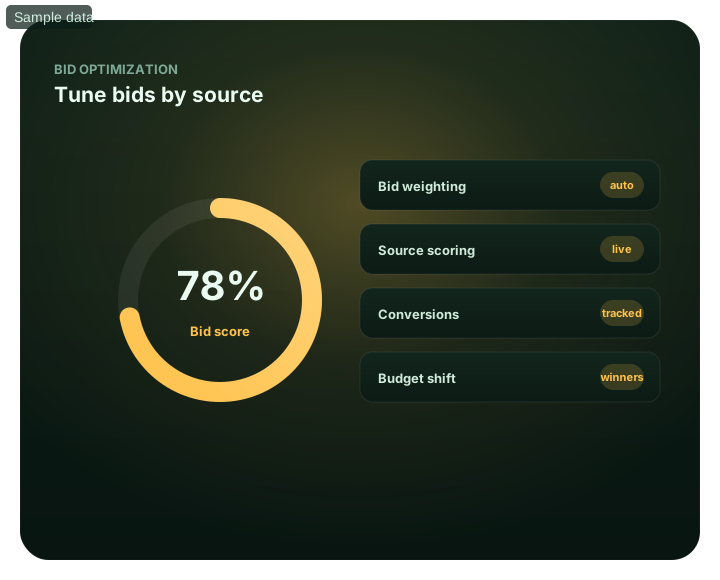
Bid optimization that follows performance: at a glance
What does this page explain about Bid Optimization: Controls, Testing and Scale?
Quick answer: Bid optimization connects the price you offer for traffic with the customer value your campaign can support. With FroggyAds, review source-level costs before changing manual bids or using SmartCPC. Keep the bid distinct from the budget, test one change and compare the additional traffic bought. A published minimum is an entry point, not a promise of volume or an ideal price for every campaign.
| Section | Distinct excerpt from this page |
|---|---|
| Pay the right price for the right impression | Compare source acquisition costs before deciding whether different bids would help. |
| Bid by source | Raise bids on converting source IDs and lower them on weak ones – not one flat bid. |
| Automate with SmartCPC | Use SmartCPC to support bid adjustments and evaluate the resulting customer acquisition cost. |
Reference for Bid Optimization: Controls, Testing and Scale: FTC guidance on online advertising and marketing.
- Planning: Pay the right price for the right impression.
- Control: See bid optimization inside the platform.
- Decision: The same campaign, two outcomes.
Pay the right price for the right impression
Different sources can produce different customer value, so one bid may not suit every part of a campaign. Use source-level results to decide whether a price adjustment is justified. Our bidding controls let you test that decision while retaining the offer and targeting, then compare whether the additional traffic earns its cost.
Choose a manual price test or use SmartCPC to support automated bid optimization in an eligible campaign. Confirm the current buying model and minimum, set a spending limit and evaluate conversions after allowing for their normal delay. Adscore-supported screening helps assess traffic quality; it does not establish the profitable bid. Our $50 minimum deposit funds the account, not a guaranteed amount of campaign learning.
Best for
- Replacing one flat bid with per-source bids
- Automating bids with SmartCPC
- Testing cheaply near the floors
- Bidding up only where data justifies
- Continuously tuning as data grows
See bid optimization inside the platform
For Bid optimization that follows performance, the FroggyAds self-serve workflow keeps campaign setup, targeting, budget controls, source-level reporting and optimization in one dashboard so advertisers can make evidence-led keep, cap, exclude and retest decisions.
- Replacing one flat bid with per-source bids — See bid optimization inside the platform
- Automating bids with SmartCPC
- Testing cheaply near the floors
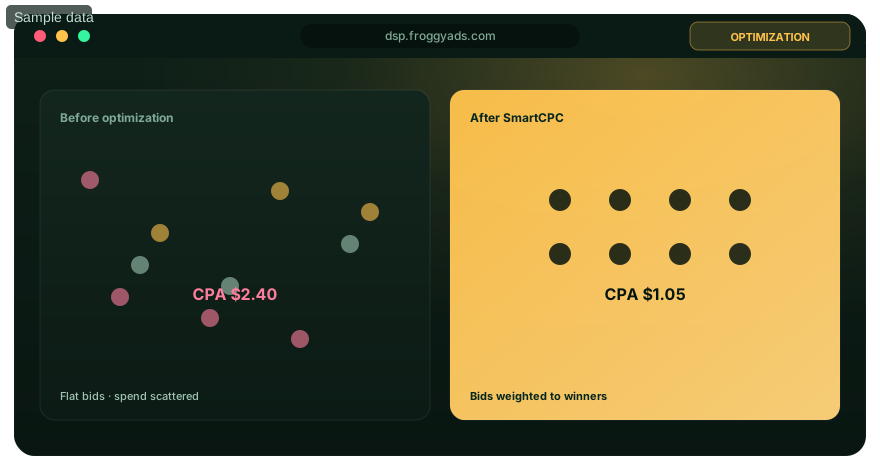
The same campaign, two outcomes
Bid strategy is where margin is made or lost.
Bid by source
Raise bids on converting source IDs and lower them on weak ones – not one flat bid.
Automate with SmartCPC
Use SmartCPC to support bid adjustments and evaluate the resulting customer acquisition cost.
Control your price
Check the current minimum and eligible supply, then test a bid your campaign economics can support.
Watch and adjust
Bid optimization is continuous – revisit as conversion data accumulates.
Optimize bids on FroggyAds
Open an account and tune bids from $50.
Bid optimization FAQ
What should bid optimization improve in a FroggyAds campaign?
Bid optimization should help you acquire useful traffic at a cost the offer can support. A higher bid is valuable when the additional customers justify the additional spend, not simply when delivery increases. Our source-level controls let you adjust buying decisions without treating every source alike. Compare the actual acquisition cost and customer quality after the change, while keeping the campaign budget as a separate spending limit.
How do I choose an opening bid for a new traffic campaign?
Check the current buying model and minimum for your chosen format, market and targeting. Use the published starting bid as an entry reference, not a guaranteed clearing price or universal recommendation. Set a budget for learning and observe whether the campaign wins enough relevant traffic to evaluate. An unnecessarily low bid can leave too little delivery, while an aggressive opening bid can spend the test before you understand the offer's response.
How is changing the bid different from increasing the budget?
The bid affects the price you offer for eligible traffic; the budget limits the campaign's spending allocation. A campaign that exhausts its budget while meeting your goal may need more allocation, not a higher bid. A campaign with unused budget may be constrained by bids, targeting or supply. Diagnose that difference before changing either setting so you know what the new spend is intended to achieve.
How can an affiliate marketer estimate a break-even CPC?
For a media-only estimate, multiply net revenue per approved conversion by approved conversions per paid click. With hypothetical inputs of $20 net revenue and a 1% approved conversion rate, break-even CPC is $0.20. Creative, tracking, landing-page costs and a profit allowance lower the affordable CPC. This is a planning calculation, not a FroggyAds bid recommendation, payout or promise of conversion performance.
When does a higher source bid make sense?
Consider an increase when the source has produced sufficiently reliable customer value and more eligible traffic may be available at a higher price. Keep the offer and creative stable so the price test is interpretable. Review the additional traffic separately: historical performance does not prove that every more expensive opportunity will work. Stop increasing when the marginal acquisition cost no longer fits your campaign's economics.
Can a higher bid produce more conversions but worse value?
Yes. In a hypothetical test, the original setting spends $100 for 10 customers. The higher-bid period spends $180 for 14 customers. Overall CPA rises from $10 to about $12.86; the four additional customers cost $80, or $20 each. Decide whether those extra customers justify that cost. The comparison assumes otherwise comparable periods and is not a FroggyAds case study or causal proof.
Should I use manual bidding or SmartCPC?
Use manual adjustments when you want direct control of a specific price test. Our SmartCPC feature supports automated bid optimization using available campaign signals, while you continue to choose the offer, targeting and spending limits. Evaluate the resulting costs and conversions rather than assume the algorithm guarantees a target CPA. A competitor's feature with the same name does not establish FroggyAds' internal auction mechanics or signal inputs.
Should I increase the bid whenever a campaign has low delivery?
Check approval, available funds, campaign limits, active hours and targeting first. A narrow source list or an unavailable location-format combination can restrict traffic regardless of bid. Once the campaign is eligible and supply exists, a limited bid test may help you assess competition. Our support team can investigate an unclear delivery issue when you provide the campaign reference and the exact settings you expected to run.
What should make me reduce a bid or pause a source?
Reduce a bid when useful traffic is costing more than its customer value supports and a lower price is worth testing. Pause when your spending boundary is reached, the destination fails or a verified quality issue requires action. Allow for conversion delay before making a lasting performance judgment. A lower CPC does not solve an irrelevant offer, so check the reason for the weak result rather than only its price.
How often should I review bid changes?
Review after enough comparable delivery and conversion time have passed to judge the change, or sooner when a technical problem or spending limit requires action. Keep a record of the previous bid, the reason for changing it and the resulting source mix. Avoid reacting to every small hourly movement. Start your FroggyAds campaign with one clear price hypothesis, then use the evidence to decide the next adjustment.
Tune your bids
Create your account and test a source-level bidding decision with a clear campaign spending limit.
Optimize bids with a rule that connects media cost to accepted outcomes
Bid optimization should begin with the business boundary that the campaign must respect. Define the accepted conversion, the maximum cost or minimum value that makes the acquisition useful, and the amount of mature evidence required before a bid decision can be made. A bid is not good because it wins more traffic, and it is not bad simply because it is higher than yesterday. The correct question is whether the price helps the campaign obtain enough qualified opportunities at an acceptable downstream cost while preserving room to learn.
Separate delivery problems from efficiency problems. If a campaign receives almost no impressions or clicks, a bid may be below the level needed to sample the intended inventory, but targeting, creative approval, schedule, caps or eligibility can also restrict delivery. Check those conditions before assuming price is the only constraint. If delivery is healthy but accepted conversion cost is weak, raising the bid without a hypothesis can increase spend on the same problem. FroggyAds gives advertisers targeting and source controls that can be reviewed alongside bids so the buyer can identify whether the issue is market access, source mix or post-click performance.
| Observed condition | Question before changing the bid | Controlled next step |
|---|---|---|
| Very low delivery | Are targeting, caps, approval and schedule already correct? | Test a measured bid increase only after setup checks pass |
| High traffic, weak accepted CPA | Is the problem concentrated by source, device or creative? | Correct the narrow cause before paying more broadly |
| Strong CPA, limited volume | Does the margin support broader inventory? | Increase in steps and recheck source mix |
| Volatile short-term results | Has the conversion window matured? | Wait for decision-ready evidence unless a safety cap is hit |
Use step changes that can be evaluated. A very large bid jump can alter the accessible inventory enough that the new period is not comparable with the old one. Record the previous bid, new bid, time, reason and expected effect. Keep other major settings stable where possible, then compare the same accepted outcome after enough data has matured. If the higher bid increases volume but weakens efficiency because the source mix changes, the correct response may be a source or targeting adjustment rather than immediately returning to the old price.
Apply source-level evidence carefully. A source that performs poorly at one bid, device or creative combination may not deserve a permanent global exclusion. Check whether the pattern persists with enough observations and whether a technical problem could explain the result. FroggyAds allowlist and blocklist controls can help media buyers isolate repeated patterns, while bid decisions can remain focused on the inventory still eligible to serve. This creates a more precise optimization loop than changing one campaign-wide price every time a local issue appears.
Keep pacing in the analysis. A bid that causes the campaign to spend most of its daily budget early can change which hours and sources are sampled. Likewise, a very restrictive bid can produce too little data for useful comparison. Review spend distribution together with conversion delay and the campaign's planned evaluation times. If the goal is to learn across a full day or market window, the bid and budget should allow enough exposure without exhausting the test before later traffic is observed.
Finally, distinguish a bid rule from an outcome guarantee. Market conditions, inventory availability, creative performance and landing-page conversion can all change. Recalculate the acceptable bid as those inputs change and keep the underlying business equation visible. FroggyAds provides the controls to adjust media buying, but disciplined bid optimization comes from a repeatable sequence: verify setup, collect mature evidence, identify the narrow cause, change one material control, and measure the same accepted outcome again.
Use separate rules for exploration and scaling. During exploration, the bid needs to expose the campaign to enough eligible traffic to learn while a conservative budget cap limits risk. During scaling, the bid can be adjusted around combinations that already have accepted outcome evidence. Do not use a scaling rule to judge a brand-new source after only a few events, and do not keep an exploratory setting indefinitely once a stable pattern has emerged. Label each phase in the change log so later reports explain why the same cost movement may have been acceptable at one stage and unacceptable at another.
Review bid changes against creative and landing-page history. A better conversion rate can support a higher traffic price without increasing acquisition cost, while a weaker destination can make an unchanged bid suddenly uneconomical. This is why bid optimization should never be isolated from the funnel. Recalculate the practical boundary after material changes and keep the calculation based on accepted outcomes rather than on the platform unit price alone.
Bid optimization that follows performance.: what should the advertiser decide next?
For Bid optimization that follows performance., the feature is useful only when it changes a real buying, targeting or measurement decision. Start from the baseline described in Bid optimization that follows performance: at a glance, apply the control discussed around What does this page explain about Bid Optimization: Controls, Testing and Scale?, and preserve a rollback point so the effect on bid optimization can be interpreted.
On this Bid optimization that follows performance. page, the decision should remain tied to the existing evidence around Bid optimization that follows performance: at a glance, What does this page explain about Bid Optimization: Controls, Testing and Scale? and Pay the right price for the right impression. Those sections give bid optimization its specific context; the table below turns that context into campaign actions rather than adding another generic definition.
| Decision | What to verify | FroggyAds action |
|---|---|---|
| Bid optimization that follows performance. objective | Use Bid optimization that follows performance: at a glance to define the accepted business event and the maximum learning loss for bid optimization. | Launch one FroggyAds campaign objective for Bid optimization that follows performance. and keep the conversion definition stable. |
| Bid optimization that follows performance. audience | Use What does this page explain about Bid Optimization: Controls, Testing and Scale? to verify market, device, language and offer eligibility for bid optimization. | Apply only the FroggyAds targeting controls that change the real Bid optimization that follows performance. customer journey. |
| Bid optimization that follows performance. source evidence | Use Pay the right price for the right impression to keep source-level differences visible instead of relying on one blended bid optimization average. | Keep, cap, exclude or retest Bid optimization that follows performance. inventory from documented source evidence. |
| Bid optimization that follows performance. economics | Use Best for to connect media spend with accepted conversions and downstream value for bid optimization. | Protect the Bid optimization that follows performance. test with a written budget boundary and a consistent attribution window. |
| Bid optimization that follows performance. scale rule | Use See bid optimization inside the platform to define the exact evidence that earns the next budget increase for bid optimization. | Scale Bid optimization that follows performance. one major control at a time and compare marginal performance with the prior baseline. |
A page-specific FroggyAds test sequence for Bid optimization that follows performance.
- Bid optimization that follows performance. outcome: define the accepted event for bid optimization and the maximum loss permitted while the first test is learning.
- Bid optimization that follows performance. path: verify market eligibility, device experience, landing-page continuity and tracking against Bid optimization that follows performance: at a glance before buying more traffic.
- Bid optimization that follows performance. hypothesis: launch one bounded FroggyAds test tied to What does this page explain about Bid Optimization: Controls, Testing and Scale?; do not change bid, creative, audience and destination together.
- Bid optimization that follows performance. source review: compare qualified activity, accepted conversions, timing and cost by the source or segment dimensions relevant to Pay the right price for the right impression.
- Bid optimization that follows performance. scaling: use Best for and See bid optimization inside the platform to define what must reproduce before the next budget increase.
Why FroggyAds is relevant to Bid optimization that follows performance.
For Bid optimization that follows performance., FroggyAds gives advertisers a self-serve DSP and ad-network workflow for buying supported traffic with campaign-level budgets and targeting. Depending on format and campaign context, available controls can include country, city, device, operating system, browser, carrier, category, source, ID and IP options. SmartCPC and Adscore-supported traffic-quality controls can support the bid optimization optimization process, while the advertiser's tracker, analytics and backend acceptance remain the final evidence for commercial quality.
Use See bid optimization inside the platform as the final checkpoint for Bid optimization that follows performance.. If the accepted result does not reproduce after the next meaningful volume step, return to the last stable configuration instead of widening several controls at once.
How to tell whether Bid optimization that follows performance. is working
For Bid optimization that follows performance., record the state before the feature changes, then compare the same evidence window after the change. Use Bid optimization that follows performance: at a glance to keep the bid optimization interpretation tied to a real campaign decision.
Reconcile Bid optimization that follows performance. on one evidence window
For Bid optimization that follows performance., compare FroggyAds reporting with the advertiser's tracker, analytics and backend records for the same dates and attribution rules. Record media spend, relevant delivery events, qualified landing activity, accepted conversions and rejection reasons, then use What does this page explain about Bid Optimization: Controls, Testing and Scale? to investigate material gaps before they become optimization rules.
Diagnose the smallest failing layer in Bid optimization that follows performance.
If bid optimization delivery is weak, review eligibility, targeting, bid and inventory first. If traffic arrives but the destination underperforms, inspect speed, message continuity, forms, redirects and device compatibility. If front-end conversions look healthy but backend acceptance is weak, use Pay the right price for the right impression to isolate audience or source quality after tracking has been verified.
Set the next Bid optimization that follows performance. scale and stop rule
Write the exact Bid optimization that follows performance. result that earns more budget and the exact condition that pauses the test. Increase one major control at a time and compare marginal bid optimization performance with the prior configuration. FroggyAds supplies the campaign controls; the advertiser's accepted downstream data determines whether the expansion is commercially useful.
Bid optimization that follows performance: the buyer task this URL owns
The buying decision on this URL is specific: performance-focused advertisers should use Bid optimization that follows performance to understand the control and decide when to use it. Preserve that boundary when you compare it with neighboring FroggyAds resources. The nearest related FroggyAds page is Traffic Optimization Tools; this URL keeps ownership of the distinct task to understand the control and decide when to use it.
For Bid optimization that follows performance, the operating evidence to keep visible is audience targeting, campaign objective, audience and market fit, ad format. Use these entities only when they change setup, measurement or the commercial decision.
| Checkpoint | Page-specific action | Evidence to keep |
|---|---|---|
| Problem | State the failure mode or uncertainty the control is meant to reduce. | Retain evidence specific to Bid optimization that follows performance and its accepted outcome. |
| Setting | Define when the control should be enabled, limited or reversed. | Retain evidence specific to Bid optimization that follows performance and its accepted outcome. |
| Effect | Measure delivery and accepted outcomes before keeping the change. | Retain evidence specific to Bid optimization that follows performance and its accepted outcome. |
Hypothetical calculation: if a controlled campaign for bid optimization that follows performance spends USD 225 and produces 9 accepted conversions, accepted CPA is USD 225 / 9 = USD 25.0. Replace the inputs with your own campaign economics; this is not a FroggyAds performance claim.
Start the paid-media test for Bid optimization that follows performance with FroggyAds when you need direct control over formats, targeting, budgets and source evidence. Increase spend only after the result supports the next acquisition step. Create your free FroggyAds account.
Bid optimization that follows performance — what matters first
Bid optimization that follows performance is a campaign-control decision: state the problem the control solves, define the rule before enabling it, and measure its effect on delivery and accepted outcomes.