
Describe the buyer benefit and next step
Describe the practical improvement the intended buyer can evaluate. Replace broad praise with a specific use, problem or next step that matches the offer.
Ad creative operating guide
Create ads that set a clear expectation, fit the placement and give qualified prospects a useful reason to act. This guide shows you how to turn each concept into a controlled FroggyAds test, connect delivery to accepted business outcomes and keep only the messages that earn the next allocation.
Use FroggyAds to manage traffic tests, review our traffic source guidance, compare available ad formats, and create your free account when your measurement plan is ready.
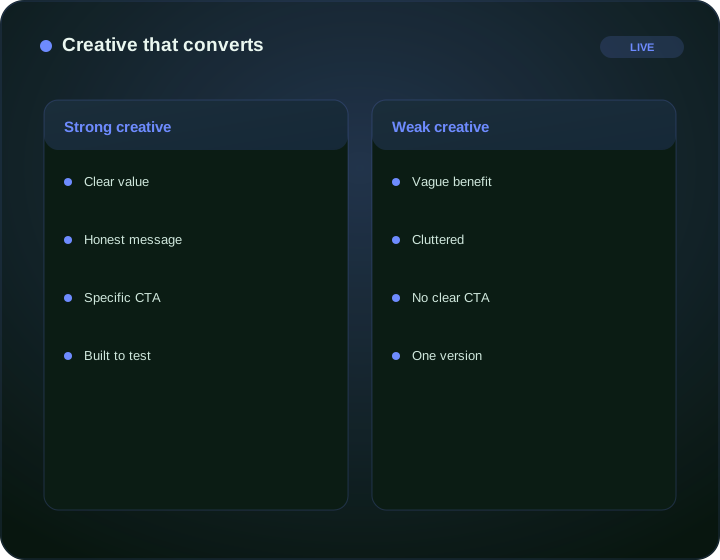
A useful creative does more than attract attention. It expresses one relevant promise, reaches the right person in a format they can understand and continues into a matching destination. Treat every asset as a testable business hypothesis: who should respond, which idea should change their decision, and which accepted outcome will prove the message deserves more exposure.
| Creative decision | Buyer standard |
|---|---|
| Message | State one concrete benefit and the conditions needed for an informed next step. |
| Format | Redesign the concept for the available space instead of shrinking one layout into every placement. |
| Evidence | Judge the asset by mature accepted outcomes, cost and source context, not interaction volume alone. |
For claim and disclosure principles, consult the FTC guidance on online advertising and marketing and apply the rules that govern your market, offer and audience.
Before anyone selects an image or writes a headline, name the decision the audience must make. An affiliate marketer may need a qualified visitor to understand an offer category and continue to a compliant presell page. A SaaS buyer may need a prospect to recognise one operational problem and request a trial. An ecommerce campaign may need a shopper to understand the product, material condition and next purchase step. Those are different creative jobs even when they share a format.
Write a one-sentence creative brief with five fields: intended audience, current situation, relevant benefit, evidence or condition, and next action. Remove claims that the destination cannot substantiate. If a promise changes by geography, device, language or eligibility, split the work into distinct concepts. A single vague asset may collect clicks across all groups while teaching you almost nothing about which buyer actually understood the offer.
We recommend linking the brief to the campaign record before production begins. FroggyAds gives you format, targeting, budget and source controls for the traffic side of the test. Your brief gives those controls a commercial purpose. Together they make it possible to explain why an asset exists, where it should run and what evidence will justify the next decision.
Build one interpretable audience test
Choose one audience cell, one offer and one accepted outcome. Keep the destination and measurement rule stable while you test the first message so every source-level result answers a defined question.
Create My Free Account
Four standards for every concept
Describe the practical improvement the intended buyer can evaluate. Replace broad praise with a specific use, problem or next step that matches the offer.
Keep price, availability, eligibility, timing and other material conditions consistent with the destination. Do not imply guaranteed revenue, profit or results.
Tell the prospect what happens next: view the offer, compare an option, register, request information or take another accurate step supported by the page.
Record why this message may work and which outcome would support that belief. Design the variation so the team can interpret the result after delivery.
Placement changes the execution
Push and in-page push need a compact idea that remains clear beside a small icon or image. Native creative needs an angle that earns attention within surrounding content without pretending to be something it is not. Banner and display placements need hierarchy at the actual rendered size. Pop and direct-link journeys place more responsibility on the destination to explain context immediately. Video needs an opening that establishes relevance before the viewer leaves.
Carry the same offer truth across formats, but rebuild the composition for each experience. Define which text can be shortened, which visual cue must remain, where material conditions appear and how the first destination screen continues the promise. A format adaptation is successful when it preserves meaning and improves comprehension; merely resizing the artwork produces an uncontrolled readability test.
Choose the format deliberately
Use the concept, audience and destination to choose push, native, display, pop or another available format. Set a separate budget and evidence boundary for each execution rather than blending unlike experiences.
Create My Free Account
Measurement before judgement
Define the accepted event and its maturity window before launch. Preserve a stable campaign, source and creative identifier through the route, then reconcile spend with accepted orders, qualified leads, activations or another advertiser-owned outcome. Impressions, click-through rate and landing-page activity explain where attention changes; they do not replace the business decision.
Compare like with like. A variant delivered to a different source mix, device group, market or time period may be responding to the audience rather than the message. Use FroggyAds reporting and source controls with your own tracking record to separate those effects. Pause at the pre-agreed exposure limit, document unresolved outcomes and decide whether the next action is keep, revise, narrow, roll back or expand.
Creative testing workflow
Write the hypothesis, build the asset for its format, verify the destination, label every version and launch inside a bounded campaign cell. Review source and downstream quality together before you release more budget.
Start Your FroggyAds Campaign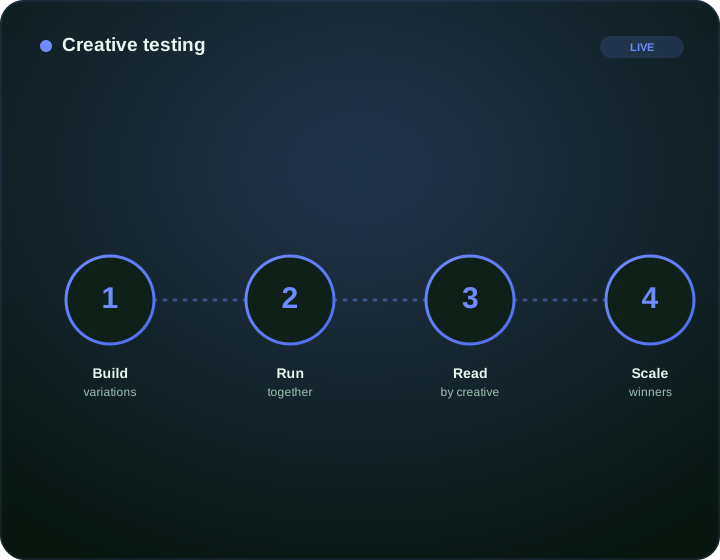
Lead with the decision-relevant benefit for the intended audience. The viewer should understand what is offered, why it may matter and what the next action involves without depending on hidden landing-page context. Keep important eligibility, price or availability conditions visible where they affect the decision.
Use the smallest set that can answer one useful question within the available budget. A control plus two or three meaningfully different concepts is often easier to interpret than many tiny variations. Size the set from the expected delivery and the number of mature accepted outcomes needed for a responsible decision.
Change both when you are testing a complete concept and are comfortable learning which concept wins rather than which element caused the difference. For element-level learning, keep the rest of the asset stable. Label the test correctly so the conclusion does not claim more precision than the design supports.
Use impressions and clicks to diagnose attention, then make the commercial decision with a mature advertiser-owned event such as an accepted order, qualified lead or activated user. Compare spend, acceptance and reversal rules on the same basis. Click-through rate alone can reward curiosity that does not create value.
Preserve source identifiers and review the mix delivered to every variant. If one asset receives a materially different source, device or market mix, analyse that difference before attributing the result to the creative. FroggyAds source-level reporting can support this diagnosis when your tracker preserves the matching campaign identifiers.
Pause when the asset breaches a policy or evidence requirement, the route is broken, the predefined loss limit is reached, or a mature comparison shows that continued exposure is unlikely to serve the campaign decision. Record the reason and the evidence window so the team can distinguish a failed message from a delivery problem.
Look for a sustained decline within a comparable audience and source mix after accounting for tracking changes, offer changes, frequency and seasonality. Compare mature cohorts rather than a recent partial day with an older completed period. Refresh one hypothesis at a time and retain the prior control for context.
The destination should continue the same offer, conditions, language and expected action. Message continuity helps qualified visitors complete the journey and makes the test easier to interpret. A click generated by surprise or an unsupported promise is not evidence that the creative can acquire valuable customers.
No. We provide self-serve traffic buying, format, targeting, budget and source controls. Conversions also depend on the audience, offer, destination, measurement, qualification and fulfilment. Use bounded tests and accepted business outcomes to decide what deserves more spend.
Archive the rendered asset, concept and hypothesis, campaign and source identifiers, audience definition, destination release, spend, review window, accepted and rejected outcomes, and the final decision. That record prevents repeated failed ideas and gives the next iteration a clear starting point.
Continue with the right production guide
Design a controlled comparison, define the evidence window and decide how a winning concept earns another round.
Adapt the message to content-led placements while keeping the commercial offer and disclosure clear.
Build a compact headline, visual cue and next step for a notification-style advertising experience.
Use the FroggyAds PDF overview when your team needs a concise format reference during planning.
Bring a compliant asset, a matching destination, one accepted outcome and a bounded test budget. We give you the FroggyAds campaign controls to buy traffic, compare sources and decide which creative deserves the next allocation. Create your free FroggyAds account or discuss the setup through Telegram.
Share this guide with your team on LinkedIn or Facebook, then keep the creative brief beside the campaign record so design, buying and measurement use the same decision rule.
Open a format guide for example patterns, asset specifications and execution standards.
Launch only after the route is verified
Confirm the rendered asset, destination, identifiers, accepted event, exposure ceiling and pause path. Then launch one reversible FroggyAds campaign cell and let mature source-linked outcomes determine the next step.
Create My Free Account
A reliable creative process begins with an intake record rather than a blank canvas. Capture the offer owner, target audience, market, device context, language, material conditions, approved evidence, prohibited claims, destination release and accepted business event. Mark unknowns as unknowns. This prevents the designer from solving missing commercial information with visual polish or invented certainty.
Turn that intake into concepts before producing variants. A concept is the reason a qualified prospect may respond: a problem they recognise, a useful capability, a practical comparison, a timely need or another supportable angle. Give each concept a short name and write the expected audience response. Variants then test how that concept is expressed through a headline, image, order of information or call to action. Keeping concept and execution separate helps the team understand what it actually learned.
Create a format specification sheet for every placement. Record dimensions, file behaviour, text limits where applicable, safe areas, legibility standard, cropping risk and the first destination screen. Preview the final rendered asset, not only the design source. A message that is persuasive at full size can become unreadable in the actual placement. Check the icon, logo, numbers, material conditions and action on relevant device sizes before spending begins.
Use a naming convention that survives the complete route. The creative name should identify concept, execution, format and version without personal data. Preserve the identifier through FroggyAds reporting, your tracker and the advertiser-side acceptance record. When a result cannot be joined to an asset, the team loses the ability to distinguish message quality from source or landing-page quality. Repair that data path before increasing the number of variants.
Hold a short evidence review after the chosen maturity window. Bring spend, delivery, source mix, clicks or visits, accepted and rejected outcomes, reversals, and any operational notes. Review the funnel from earliest signal to final value. Write the decision and the reason in plain language. If the evidence is insufficient, say what must mature or which narrower test will resolve the uncertainty instead of selecting a winner because a dashboard needs one.
Archive both successes and failures. Store the final bytes or approved render, landing-page release, campaign settings, review dates and conclusion. Tag retired work with the reason: unsupported claim, weak comprehension, poor downstream quality, fatigue, technical failure or a changed offer. A searchable archive stops teams from recreating disproved assets and makes a later refresh faster because the next writer and designer can begin from documented learning.
Use this worksheet before you request final artwork or release traffic. It turns a subjective discussion into a set of decisions that design, buying and measurement can review together.
Name the audience cell, current situation and intended action. State why the message is relevant to that group now. If the answer needs several unrelated benefits, split the concepts so each asset has one job.
Write the benefit, supporting evidence and material conditions. Compare the ad with the first destination screen. The product, price context, eligibility, availability, language and next step should remain consistent across the click.
Record the offer, landing-page release, audience, format, source policy, budget boundary, conversion definition and maturity window. Identify the one concept or execution element that changes. If the test changes several elements, label it a concept comparison and avoid element-level conclusions.
Use delivery and interaction metrics to locate friction, then name the accepted business event that decides value. Preserve campaign, source and creative identifiers through the advertiser record. Define duplicates, invalid activity, rejected leads, cancellations, refunds and unresolved outcomes before the review.
Set the maximum learning spend, policy or quality triggers, broken-route trigger and decision date. A stopping rule protects the account from waiting indefinitely for a preferred answer. It also gives the media buyer authority to pause quickly when the route or evidence fails.
| Review stage | Question | Evidence to retain |
|---|---|---|
| Before production | Is the concept relevant, supportable and suitable for the chosen format? | Brief, claims evidence, format sheet and destination release. |
| Before launch | Can every delivered version and source be traced to the accepted event? | Identifiers, test event, budget limit and verified route. |
| At maturity | Did the latest comparable cohort create accepted value inside the boundary? | Spend, source mix, accepted outcomes, rejections and reversals. |
Suppose a hypothetical test spends USD 360 across a control and two concepts. After the same maturity window, the control records three accepted leads, concept A records six and concept B records two. Those counts are not enough to declare a universal winner. Reconcile the spend by variant, confirm the source mix and rejection rule, and calculate accepted cost from the mature advertiser record. If concept A spent USD 150 for six accepted leads, its illustrative media cost is USD 25 per accepted lead. Replace every figure with your own data; this is not a FroggyAds performance claim.
We give advertisers, affiliate marketers, media buyers and agencies a self-serve platform for buying traffic, setting campaign budgets, choosing available formats and targeting, and using source-level evidence during optimization. Bring the creative hypothesis and acceptance rule; use our controls to run the bounded test. Create your free FroggyAds account when the worksheet is complete.
A useful handoff might read: “Concept North explains the time-saving workflow to English-speaking desktop prospects; the control keeps the existing product-led message. Both use the same native format, audience, destination release and qualified-demo acceptance rule. Review mature accepted cost and source mix after the agreed exposure limit.” The statement tells design, buying and analysis what changed and what must remain comparable.
Start with one audience decision, one supportable promise and one mature accepted outcome. Build the asset for the actual format, verify that the destination continues the message and run a bounded FroggyAds test with stable identifiers. Scale the next increment only when source-linked business evidence supports it.