
Value measurementChoose the valueUse transaction revenue, contribution value or a documented lead-quality proxy. Protect the payloadSend value, currency and event identity consistently across browser, server and postback paths. Reconcile the resultCompare reported value with orders, refunds, approvals and finance records before optimizing.
Track conversion value, not only conversion count
Conversion value tracking adds a meaningful amount to each recorded action, so a small order and a valuable customer do not look identical. Choose a clear value definition, send the correct currency and reconcile the result with your business records. Then use FroggyAds source reporting to compare what your traffic produces, not just how many conversions appear.

Which value should guide your campaign budget?
Quick answer: Use a confirmed amount or a clearly labelled estimate that matches the buying decision. Keep sales revenue separate from margin, preserve currency and event identity, and check refunds before treating a source's reported return as money available to scale.
| Section | Distinct excerpt from this page |
|---|---|
| Value-based optimization is only as good as the value definition | A clean value model needs a business rule, a technical contract and a reconciliation process. |
| Business meaning | Decide whether the field represents gross revenue, net revenue, contribution margin, expected lead value or another approved measure. |
| Technical contract | Define data type, decimal precision, currency code, event ID, timing and fallback behavior. |
Reference for Conversion Value Tracking Guide: Google Ads: About conversion values.
Core controls
Value-based optimization is only as good as the value definition
A clean value model needs a business rule, a technical contract and a reconciliation process.
Business meaning
Decide whether the field represents gross revenue, net revenue, contribution margin, expected lead value or another approved measure.
Technical contract
Define data type, decimal precision, currency code, event ID, timing and fallback behavior. Reject malformed or impossible values.
Governance
Assign owners for pricing, margin, lead scoring, refunds and model changes. Record when a value rule changes so historical comparisons remain interpretable.
Review criteria
Choose between static and dynamic conversion values
A static value assigns the same amount to every occurrence of a conversion action. It can be useful when the action has a consistent expected value, such as a qualified appointment with a stable close rate. A dynamic value sends the amount associated with the individual transaction or outcome. It is usually more informative for ecommerce, subscriptions, bookings and orders with different basket sizes.
Dynamic value should reflect the field the business is prepared to optimize. Gross revenue is easy to understand but can reward low-margin products. Net revenue can account for discounts and taxes according to the company rule. Contribution value can better represent what remains after variable costs, although it requires reliable cost data. Document the choice in plain language and use the same definition in reporting.
For lead generation, value can be a governed proxy based on qualification stage, historical close rate and expected contribution. Avoid arbitrary numbers chosen only to make dashboards look attractive. Re-estimate the proxy when sales acceptance or economics change.
Review criteria
When using Track conversion value, not only conversion count, apply this rule only to the conditions and decision described on this page. Record the evidence, owner, review window and rollback condition before this step changes live campaign delivery. Keep the original control available until the result is stable enough to repeat.
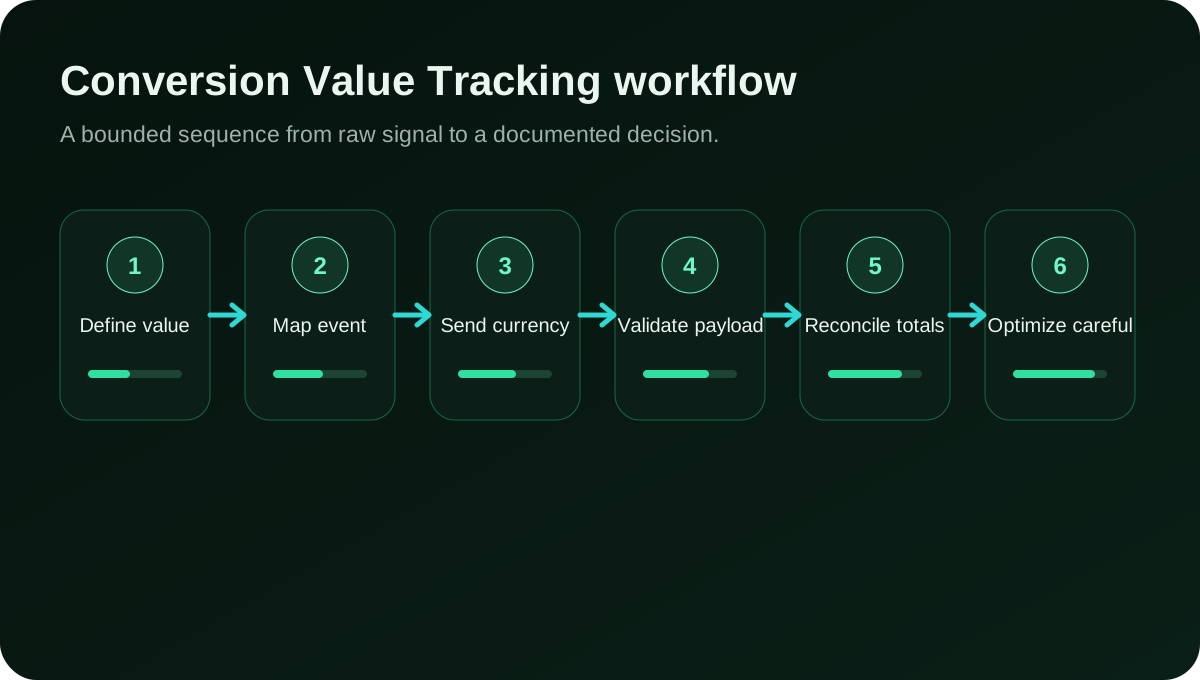
Decision workflow
Move from signal to action in a controlled sequence
Each step has a clear input, owner and stopping point so campaign changes remain explainable.
Connect the guide to live testing
Connect Track conversion value, not only conversion count to a controlled audience test
Use the choices established in “Move from signal to action in a controlled sequence” to define one audience, budget and source set in FroggyAds. Keep the surrounding offer and measurement rule stable so the test adds evidence to track conversion value, not only conversion count instead of mixing several changes at once.
Create My Free Account
Measurement note
Design the value payload as a data contract
Every value event should include a stable event or transaction ID, numeric value, ISO currency code, conversion action and event timestamp. Define whether the number includes tax, shipping, discounts or recurring revenue. Set allowed ranges and decimal precision. A value of zero may be valid for a low-priority action, but it should not silently replace a missing value.
Use the same event ID across browser and server transports so deduplication can preserve one business outcome. If a postback or server event retries, the receiver should be able to recognize the original event rather than add value repeatedly. Keep raw request and response logs without exposing personal data.
Validate currency before conversion. If campaigns operate in several currencies, preserve the original amount and currency, then apply a documented exchange-rate source and timestamp for consolidated reporting. Do not mix dollar, euro and local-currency amounts in one numeric column without a currency dimension.
Measurement note
Operating rule
Handle refunds, cancellations and delayed quality
A purchase value can change after the first event because of refunds, chargebacks, cancellations or partial fulfillment. Decide whether the advertising platform receives an adjustment, whether finance reporting uses a net value later, or whether both views are preserved. The method should match platform capability and business risk.
Lead value often matures through stages. A submitted lead may later become qualified, approved, deposited or retained. Send stage-specific events or update the backend value model using stable lead IDs. Avoid counting each stage as an independent customer outcome unless the reporting clearly distinguishes progression from additional conversions.
Use a maturity window before evaluating value-based performance. Recent conversion value can be incomplete when high-value outcomes take longer to approve. Pair the value model with conversion lag analysis so new sources are not cut because their revenue or lead quality arrives later.
Operating rule
Choose the execution format
Choose a paid-media format that supports Track conversion value, not only conversion count
Use the criteria around “Handle refunds, cancellations and delayed quality” to decide whether push, native, display or pop fits the message and destination. Set format, targeting and spend as campaign controls in FroggyAds while the track conversion value, not only conversion count decision remains the standard for judging the result.
Create My Free Account
Quality control
Reconcile value before using it for automated decisions
Compare total tracked value with the backend for matched event IDs. Check count, gross value, average value, currency distribution and the number of missing or zero values. A matching conversion count can still hide a value problem if one field is truncated, rounded, duplicated or assigned to the wrong event.
Reconcile by cohort and conversion age. If a platform assigns value back to click date while finance reports payment date, calendar totals will differ even when the underlying orders match. Use order-level samples and interaction cohorts to explain the bridge.
Set alerts for impossible values, sudden average-value changes, currency shifts and a rise in events without value. Pause value-based optimization when the feed is materially wrong. A bidding system can react quickly to bad value signals, so the rollback rule should be prepared before launch.
Quality control
Review checkpoint
Use value metrics that match the decision
Total conversion value shows the amount attributed under the selected method. Value per conversion separates quality from volume. Conversion value per cost is an attributed return measure, often expressed as ROAS. Value per click or per thousand impressions can help compare sources when conversion rates differ.
Attributed value is not automatically incremental profit. It can include outcomes that would have happened without the ad, and it may use revenue rather than margin. Use incrementality testing for causal questions and break-even thresholds for economic limits. Keep the language precise when reporting to finance or leadership.
For source optimization, combine value with sample size and stability. One large order can make a small source look exceptional. Use minimum conversion counts, winsorized or segmented views where appropriate, and a holdout budget before scaling on a volatile average.
Review checkpoint
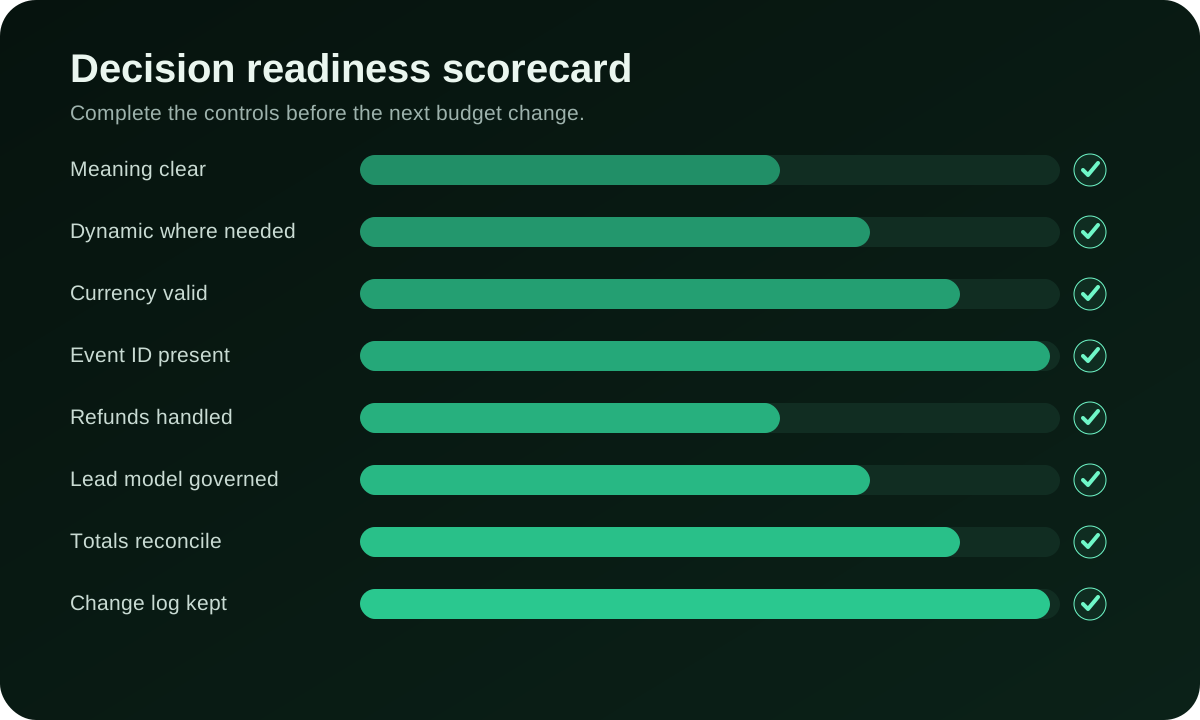
Readiness scorecard
Check the evidence before changing budget or delivery
A complete scorecard does not guarantee the decision is correct, but it reduces avoidable measurement and process errors.
Meaning clear
Dynamic where needed
Currency valid
Event ID present
Refunds handled
Lead model governed
Totals reconcile
Change log kept
Put the guide into practice
Turn Track conversion value, not only conversion count into a bounded campaign test
With “Check the evidence before changing budget or delivery” documented, launch only the next reversible test. Set a spending limit, preserve the baseline and use source-level and audience controls so the next step depends on qualified outcomes for track conversion value, not only conversion count, not activity volume.
Create My Free Account
Worked scenarios
How the decision changes in real campaign conditions
Use the evidence pattern, not a single metric, to choose the next bounded action.
Same CPA, different order value
Two sources generate purchases at the same CPA, but one has twice the net value per order. Confirm that product mix, refunds and currency are comparable, then use value per cost and contribution limits to direct more test budget to the higher-value source.
Lead volume grows but sales quality falls
The campaign reports more lead conversions, yet approved opportunities decline. Add governed stage values or separate qualified events, preserve the original lead count for funnel analysis and optimize only after the quality signal is stable.
A currency bug inflates ROAS
A local-currency amount is reported as dollars without conversion. Stop value-based decisions, preserve raw events, repair the currency mapping and backfill only through a documented method. Do not hide the incident by editing aggregate reports.
Limits
What this method cannot prove by itself
A conversion value is a business estimate or transaction measure, not proof that advertising caused that value. Attribution and incrementality remain separate questions.
Value models can encode business bias. Review lead weights, margin assumptions and exclusions with sales or finance owners, not only the media team.
Rollback rule
Keep the previous control, log the change and define the condition that returns the campaign to the safer state. A useful framework makes reversal as clear as rollout.
Operating record
Create a value governance record before optimization depends on it
Every conversion value should have an owner, a formula and a version. Record whether the value represents gross revenue, net revenue, contribution margin, predicted lead value or another business measure. Include the currency, tax treatment, discounts, shipping, payment fees, expected refunds and the time horizon used for delayed value. Without that contract, two teams can send technically valid numbers that describe different economics.
Use stable identifiers to connect the initial conversion with later changes. An order can be refunded, partially returned or upgraded. A lead can be rejected, approved or converted to a sale. The update path should prevent a later status from becoming a second independent conversion. Keep the original transaction reference and record whether the reporting destination supports adjustments, restatements or only forward-looking value improvements.
| Governance field | Required definition | Control |
|---|---|---|
| Value basis | Revenue, margin, qualified lead score or predicted value | Finance and marketing approval |
| Currency | Currency code and conversion timing | Reject missing or unexpected codes |
| Adjustment policy | Refund, cancellation and delayed-quality treatment | Transaction-level reconciliation |
| Version | Formula version and effective date | Annotation in campaign and reporting records |
Monitor both volume and value distributions. A stable total value can hide a payload problem when a few extreme values compensate for many missing ones. Check count, sum, median, percentiles, zero-value rate, currency mix and the share of events outside an expected range. Investigate abrupt changes before an automated system shifts spend toward the affected segment.
When a value model changes, avoid comparing the new period directly with the old one without an annotation or bridge analysis. A higher reported ROAS can come from a formula change rather than stronger traffic. Preserve enough history to explain that difference to media buyers, finance and management.
Questions
Track conversion value, not only conversion count: FAQ
Practical answers for advertisers, analysts and media buyers.
What is conversion value tracking?
It attaches a monetary amount or an explicitly defined value to a conversion. That amount may be transaction revenue, contribution after relevant costs or an estimate for a qualified lead. State which one you use. For a FroggyAds campaign, this lets you compare sources that produce the same number of actions but different business value, rather than optimize only for the lowest cost per conversion.
Should I use a fixed value or a different value for each conversion?
A fixed value can suit actions with reasonably similar economics, provided the assumption is documented. Use transaction-specific values when order amounts or accepted commissions vary. Keep the value tied to the real event and the fields supported by the receiving system. Do not use one attractive default amount for every sale merely because it makes campaign returns look stronger.
How can two campaigns have the same CPA but different value?
Imagine two hypothetical campaigns each spend $100 and produce five orders. Both have a $20 cost per order. If their confirmed order revenue is $150 and $400 respectively, the revenue-to-media-spend ratios are 1.5 and 4. Those figures still exclude product and operating costs. Use our source-level reporting with your business records to investigate that difference instead of declaring the campaigns equal on CPA alone.
Which value should I use for a lead before a sale is confirmed?
Use an evidence-based expected value tied to accepted lead stages, or keep the lead unvalued until a dependable model exists. Document the assumptions and update them from closed outcomes rather than assigning an attractive arbitrary amount. A lead score or estimated future amount is not cash revenue and should remain labelled as an estimate in the campaign comparison.
Should conversion value mean sales revenue or profit?
Choose the measure that answers your decision and name it clearly. Revenue describes the sale amount; contribution accounts for the costs included in your business calculation. A revenue-to-ad-spend ratio is not automatically profit. When comparing FroggyAds sources, use consistent treatment of discounts, product costs and reversals so a higher order total does not hide a less valuable customer.
What needs to be configured for dynamic conversion values?
Pass the verified amount, currency, transaction identifier, status and relevant product detail supported by the receiving system at the confirmed event. Agree how discounts, tax, shipping, refunds, cancellations and repeated updates affect the record. Use the actual campaign and tracker instructions rather than assume that another platform's value field or update method is compatible with FroggyAds.
Which checks keep conversion-value reports reliable?
Reconcile totals and sample transactions with order or CRM records, monitor missing currency and extreme values, and track late adjustments. Report coverage so decision makers know how much accepted activity actually carries a value. Keep test events separate from customer results before using the report to increase a traffic-source budget.
Why can conversion counts look correct while reported value is wrong?
The count may be right while a default value, currency mismatch or unit error changes the total. For example, sending 4999 where the receiver expects 49.99 inflates the amount one hundredfold. Check individual transaction IDs, the decimal convention and the receiver's documented units. Also verify refunds and discounts before changing bids in response to an apparent improvement in return.
Does sending conversion value automatically enable value-based bidding?
No. Recording a value and using it as an automated bidding input are different capabilities. Verify the selected platform, campaign and optimization option before assuming the value feed controls bids. With FroggyAds, your validated customer values can still inform source and budget decisions. Do not treat a successful value notification as proof of a particular SmartCPC algorithm or a target-ROAS feature.
When can I rely on conversion value to increase campaign spend?
Increase confidence when the current feed reconciles with business records, corrections work and recent results have had enough time to settle. Review the additional spend separately after any expansion. Our source controls help you concentrate a FroggyAds campaign on the traffic that supports your economics, while the underlying value definition keeps the comparison honest as products, commissions or customer quality change.
Continue the workflow
Connect the measurement rule to campaign execution
Use the related FroggyAds resources to move from analysis into a controlled test, tracking review or budget decision.
Run a measured campaign
Turn the framework into a controlled traffic test
Launch with clear tracking, source-level reporting, bounded budgets and a documented optimization plan.
Advertiser decision framework
Track conversion value, not only conversion count: what should the advertiser decide next?
For Track conversion value, not only conversion count, the feature is useful only when it changes a real buying, targeting or measurement decision. Start from the baseline described in What does this page explain about Conversion Value Tracking Guide?, apply the control discussed around Value-based optimization is only as good as the value definition, and preserve a rollback point so the effect on conversion value tracking can be interpreted.
On this Track conversion value, not only conversion count page, the decision should remain tied to the existing evidence around What does this page explain about Conversion Value Tracking Guide?, Value-based optimization is only as good as the value definition and Business meaning. Those sections give conversion value tracking its specific context; the table below turns that context into campaign actions rather than adding another generic definition.
| Decision | What to verify | FroggyAds action |
|---|---|---|
| Track conversion value, not only conversion count objective | Use What does this page explain about Conversion Value Tracking Guide? to define the accepted business event and the maximum learning loss for conversion value tracking. | Launch one FroggyAds campaign objective for Track conversion value, not only conversion count and keep the conversion definition stable. |
| Track conversion value, not only conversion count audience | Use Value-based optimization is only as good as the value definition to verify market, device, language and offer eligibility for conversion value tracking. | Apply only the FroggyAds targeting controls that change the real Track conversion value, not only conversion count customer journey. |
| Track conversion value, not only conversion count source evidence | Use Business meaning to keep source-level differences visible instead of relying on one blended conversion value tracking average. | Keep, cap, exclude or retest Track conversion value, not only conversion count inventory from documented source evidence. |
| Track conversion value, not only conversion count economics | Use Technical contract to connect media spend with accepted conversions and downstream value for conversion value tracking. | Protect the Track conversion value, not only conversion count test with a written budget boundary and a consistent attribution window. |
| Track conversion value, not only conversion count scale rule | Use Governance to define the exact evidence that earns the next budget increase for conversion value tracking. | Scale Track conversion value, not only conversion count one major control at a time and compare marginal performance with the prior baseline. |
A page-specific FroggyAds test sequence for Track conversion value, not only conversion count
- Track conversion value, not only conversion count outcome: define the accepted event for conversion value tracking and the maximum loss permitted while the first test is learning.
- Track conversion value, not only conversion count path: verify market eligibility, device experience, landing-page continuity and tracking against What does this page explain about Conversion Value Tracking Guide? before buying more traffic.
- Track conversion value, not only conversion count hypothesis: launch one bounded FroggyAds test tied to Value-based optimization is only as good as the value definition; do not change bid, creative, audience and destination together.
- Track conversion value, not only conversion count source review: compare qualified activity, accepted conversions, timing and cost by the source or segment dimensions relevant to Business meaning.
- Track conversion value, not only conversion count scaling: use Technical contract and Governance to define what must reproduce before the next budget increase.
Why FroggyAds is relevant to Track conversion value, not only conversion count
For Track conversion value, not only conversion count, FroggyAds gives advertisers a self-serve DSP and ad-network workflow for buying supported traffic with campaign-level budgets and targeting. Depending on format and campaign context, available controls can include country, city, device, operating system, browser, carrier, category, source, ID and IP options. SmartCPC and Adscore-supported traffic-quality controls can support the conversion value tracking optimization process, while the advertiser's tracker, analytics and backend acceptance remain the final evidence for commercial quality.
Use Governance as the final checkpoint for Track conversion value, not only conversion count. If the accepted result does not reproduce after the next meaningful volume step, return to the last stable configuration instead of widening several controls at once.
Search intent and buyer decision
How to use this Track conversion value, not only conversion count page
This URL has one primary job for performance-focused advertisers: understand the control and decide when to use it. Keep this page focused on that buying decision instead of turning it into a generic advertising article. In the Conversion Value Tracking workflow, treat this as evidence for the page-specific task to understand the control and decide when to use it, not as a reusable conclusion for another URL.
Keep ad format and source quality attached to the Track conversion value, not only conversion count evaluation. They are not extra keywords; they identify controls or evidence the reader may need before changing spend.
| Step | Feature Control workflow | Evidence to retain |
|---|---|---|
| 1 | State the problem the control is meant to solve | Keep the evidence tied to Track conversion value, not only conversion count and the accepted outcome defined for this URL. |
| 2 | Apply the control with a written rule and rollback condition | Keep the evidence tied to Track conversion value, not only conversion count and the accepted outcome defined for this URL. |
| 3 | Measure its effect on delivery and accepted outcomes before making it permanent | Keep the evidence tied to Track conversion value, not only conversion count and the accepted outcome defined for this URL. |
Transparent Track conversion value, not only conversion count decision example
Hypothetical example: if a controlled Track conversion value, not only conversion count test spends USD 250 and records 4 accepted outcomes after the same review window, accepted CPA is USD 250 divided by 4 = USD 62.50. Replace the example inputs with your own economics; this is not a FroggyAds performance claim.
Use FroggyAds as the execution layer only when the page's decision calls for paid traffic. Set the relevant budget, targeting and format controls, verify conversion tracking, keep source-level evidence, and increase spend only when the accepted outcome supports the next step. Create your free FroggyAds account. In the Conversion Value Tracking workflow, treat this as evidence for the page-specific task to understand the control and decide when to use it, not as a reusable conclusion for another URL.
Direct answer
Track conversion value, not only conversion count — what matters first
Track conversion value, not only conversion count is a campaign-control decision: state the problem the control solves, define the rule before enabling it, and measure its effect on delivery and accepted outcomes.