
Popunder Ads Cost and Budgeting: A Practical Execution Playbook
Our Popunder Ads Cost and Budgeting Guide separates account funding, the campaign’s media allocation and the cost of producing an accepted business outcome. Our published Pop entry bid is USD 0.0001 CPC per visit, with a USD 50 minimum account deposit. Use FroggyAds controls to test your own buying economics rather than treating either minimum as a campaign forecast.

| Section | Cost-planning decision |
|---|---|
| Confirm the charged unit | Keep the live Pop buying unit and actual spend separate from landing sessions, submitted events and accepted conversions. |
| Allow for the whole campaign effort | Record media, destination preparation, tracking and outcome-handling costs without counting the same expense twice. |
| Test the assumptions behind the allocation | Model a weaker arrival and acceptance scenario before deciding how much learning loss your campaign can afford. |
Reference for Popunder Ads Cost and Budgeting Guide: Coalition for Better Ads Standards.
Which cost figures should a Pop advertiser plan?
Start with the unit being purchased. FroggyAds publishes a Pop entry bid of USD 0.0001 CPC per visit. That is a starting point for the media purchase, not an impression CPM or an accepted-conversion price. Confirm the live campaign settings and read actual spend against the event our report charges.
Account funding answers a different question. Our USD 50 minimum deposit funds the account; your campaign allocation sets the amount you choose to commit to a particular test. Neither figure establishes how many customers the offer will acquire. Keep cash available in the account distinguishable from the amount authorized for the campaign.
Trace how billed visits become usable arrivals and accepted outcomes. A visit may fail to load, a visitor may not submit and a submission may be rejected. Explicit assumptions for those transitions make the budget easier to revise from actual evidence.
Include preparation and operating work. Destination or tracking setup may be paid once, while handling costs can recur with accepted events. State the expenses included: media-only CPA is a buying measure, rather than the complete cost of acquiring and serving a customer.
Six controls for a defensible Pop budget
Build the budget from a defined purchase and a verifiable outcome. These controls connect our media settings with the destination and business evidence used to assess cost. Revisit assumptions when the offer changes.
Define the billable event
Confirm the billable event before comparing prices. A charged visit is a different denominator from impressions, loaded sessions or accepted conversions. Retain charged quantity and spend, then calculate downstream costs separately.
Model the full funnel
Model billed visits, the share reaching a loaded session, submissions per loaded session and acceptance per submission. Multiplying those stages estimates expected accepted outcomes. These are planning assumptions, not promised conversion behavior.
Separate fixed and variable work
Record one-time preparation separately from recurring expenses. State how destination, tracking and handling work is allocated. If another test reuses preparation, explain that treatment so its media-only result is distinguishable from the first test’s wider cost.
Set a learning budget
Set a media allocation and reserve room for a repair or confirmation. The amount depends on risk, buying conditions and validation delay. Avoid fragmenting the allowance across more sources or concepts than the test can evaluate.
Use mature outcomes
Use accepted outcomes only after the agreed validation period, while retaining pending events as pending. If spend is positive and accepted outcomes are zero, accepted CPA is undefined; it is not zero. Record the spend, unresolved counts and next review date before deciding whether the campaign has reached its learning-loss boundary.
Scale with marginal economics
Assess an additional purchase separately when expanding. More delivery can change the source mix and accepted-event cost. Retain earlier assumptions and revise them from the newer cohort before committing another allocation.
Put cost assumptions into a real campaign brief
Build a FroggyAds Pop test around your cost question
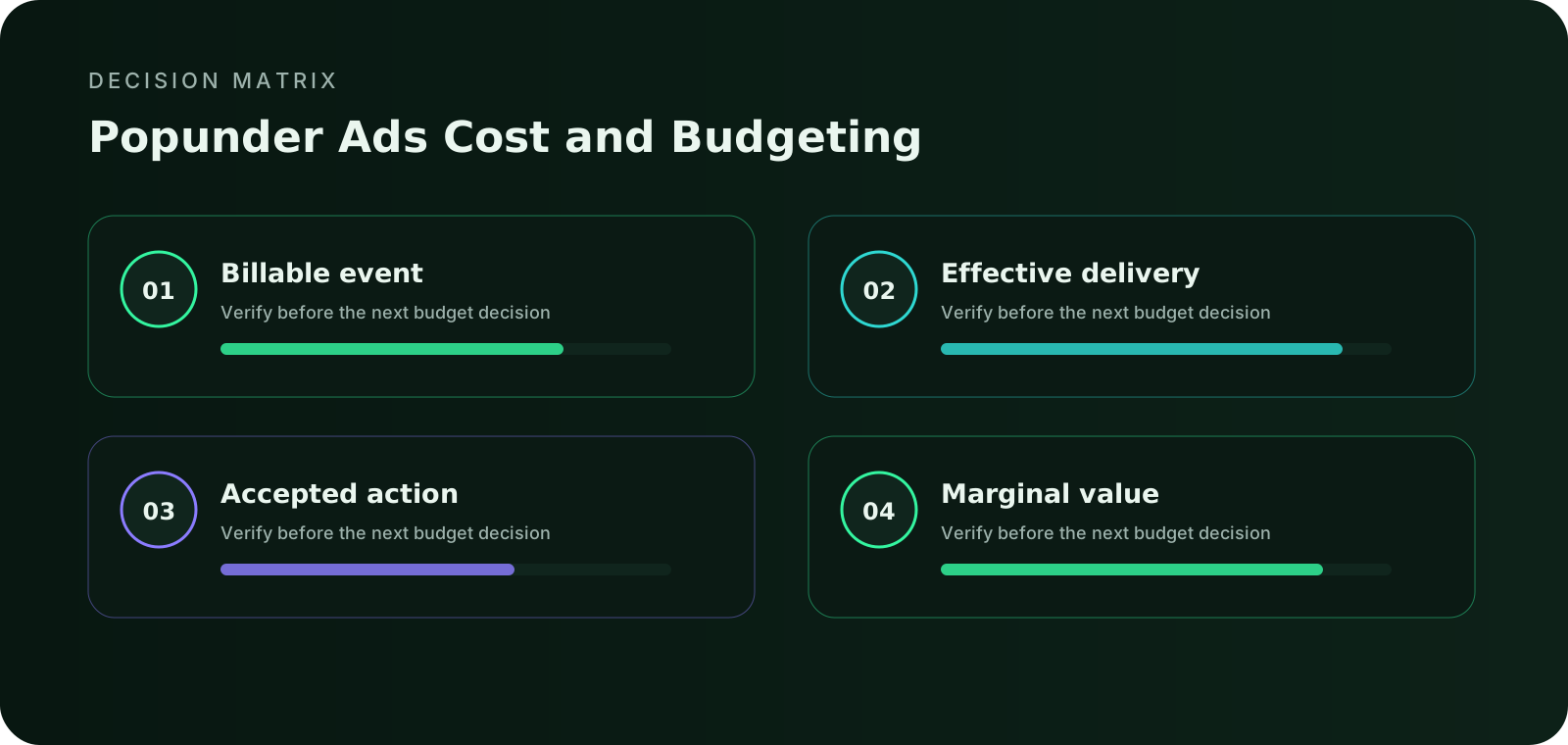
Bring the billable unit, audience and accepted event into setup. Our budgets, bids and source controls limit the purchase while you collect evidence. Keep the destination stable so the cost record can inform a confirmation or repair.
Create My Free Account
Follow the cost from a billed visit to an accepted event
Visitors need the destination to load before they can evaluate the Pop offer. Verify its opening route and primary action while budgeting for necessary preparation. Otherwise paid arrivals can consume the test allowance without producing a usable session.
Use the table as a hypothetical planning worksheet, not a rate quote. Both scenarios assume 10,000 billed visits at USD 0.02 each, giving USD 200 media spend. The baseline assumes 80% load, 2% of loaded sessions submit and 50% of submissions are accepted. The weaker case uses 50% load, 1% submission and 40% acceptance. These inputs predict no FroggyAds result.
The worksheet keeps each denominator visible when later stages weaken. Replace its chosen inputs with your campaign evidence. A competitor’s conversion rate or an early submission count cannot establish final acceptance for your own purchase.
| Hypothetical cost stage | Baseline assumptions | Weaker assumptions |
|---|---|---|
| Billed visits | 10,000 visits | 10,000 visits |
| Media spend | 10,000 billed visits × USD 0.02 = USD 200 | Unchanged USD 200 media spend for 10,000 billed visits |
| Loaded sessions | 80% × 10,000 = 8,000 | 50% × 10,000 = 5,000 |
| Submitted actions | 2% × 8,000 = 160 | 1% × 5,000 = 50 |
| Accepted outcomes | 50% × 160 = 80 | 40% × 50 = 20 |
| Media-only accepted CPA | USD 200 ÷ 80 = USD 2.50 | USD 200 ÷ 20 = USD 10 |
Compare formats within an explicit cost scope
Keep the Pop buying unit separate when comparing formats
Use our format choice to serve a campaign need, then compare formats on a common accepted outcome. A Display CPM and Pop per-visit bid describe different quantities; preserve those units and the destination route when comparing allocations.
Create My Free Account
A seven-step Pop cost-planning workflow
Record what you will buy, which outcome counts and when the allocation can be judged. This workflow gives the buyer and acceptance owner the same assumptions to review before further spending.
Define the accepted outcome and cost boundary
Write the acceptance rule and the maximum cost your business can support for that outcome. State whether that boundary covers media alone or the wider campaign effort. Record the validation window so the first review does not compare unresolved submissions with accepted customers.
Record the paid visit and destination
Record the billable unit, audience and destination version. Pop uses the page to explain the offer; browser settings and supply affect opening behavior. Retain those conditions when judging your arrival assumptions.
Prepare two sets of cost assumptions
Prepare a baseline and a weaker cost scenario. Change a load, submission or acceptance assumption deliberately while retaining the other inputs. Use the comparison to understand exposure to weaker outcomes.
Verify cost and conversion records
Check spend, available campaign parameters and accepted events through the actual measurement route. Document gaps. If spend and outcomes cannot be joined at the same scope, retain that limit instead of reporting an unsupported source CPA.
Release only the first allocation
Release the amount authorized for the first cost question. Keep the repair or confirmation reserve separate, so an arrival problem does not consume funds intended to test the corrected destination.
Reconcile mature accepted outcomes
Reconcile spend after the validation period, keeping pending, rejected and duplicate events identifiable. Compare actual billed visits, arrivals and acceptance with the assumptions, then refresh the model at the same scope.
Revise one budget assumption
Revise the assumption supported by evidence and retain the earlier plan. Record a new source mix, destination or offer explicitly, so the updated cost estimate remains distinguishable from the original forecast.
Reconcile accepted outcomes with the full cost scope
Use a consistent period and event definition. Campaign spend cannot be divided by an unrelated account-wide conversion total. Connect the same cohort where possible and state its attribution limits; numerical precision does not repair an incomplete connection.
Retain event and acceptance dates when approvals arrive later. Apply your documented maturity rule before reviewing the cost. Recent unresolved submissions should remain pending, rather than be counted as either rejection or future accepted customers.
Apply a consistent cost-allocation rule. One test may include destination preparation while another reuses it. Label first-test, recurring and media-only views explicitly so a cheaper later result does not conceal a scope change.
Test the budget against three planning risks
Check the assumptions most capable of changing affordability. These are planning risks, not claims about how often problems occur. Use your own destination and acceptance evidence to decide which scenario needs attention.
Arrival loss
Fewer usable arrivals leave fewer opportunities to convert for the same spend. Investigate the route and measurement continuity, then update the loaded-session assumption. Do not improve reported cost by counting unobserved arrivals as completed sessions.
Acceptance and adjustment delays
Submissions can later be rejected or refunded. Apply relevant adjustments consistently without counting them twice as both lost outcomes and extra expenses. Identify provisional values when reviewing a recent cohort.
Changed delivery mix at scale
Another allocation can reach a different source or audience mix. Refresh the estimate from newer spend and accepted outcomes. A small test does not fix future prices or conversion behavior.
Make the next allocation a defined decision
Apply your cost boundary through FroggyAds campaign controls
Use our budgets, targeting and source decisions to authorize a specific next purchase. Retain its destination, cost scope and acceptance rule. Create your free FroggyAds account and choose an allocation whose purpose and exposure are clear.
Create My Free Account
Decide which cost assumption needs attention
Read charged quantity, spend, currency and reporting period first. Compare actual arrival and acceptance stages with the model. Once records exist, actual buying conditions should replace estimates based on an entry bid.
Update one assumption where evidence permits. If arrivals differ, investigate that connection before replacing acceptance estimates too. Changing every input to fit a total can hide which condition should guide the next allocation.
Keep preparation, tracking and handling expenses outside the media report in a separate ledger. State which costs are included. Do not assume the account total includes every applicable tax, fee, supplier or internal expense.
Verify the cost plan before releasing the allocation
Assign an owner and retain actual evidence for each check. Planned destination or tracking tests remain pending until completed. Keep cost scope and timing clear enough for another buyer to review.
Document the accepted event, validation period and cost boundary before the campaign begins spending.
Keep the billable unit, campaign allocation and destination version with the cost scenario.
Complete the destination and measurement checks on the device contexts you intend to buy, then retain the actual findings.
Reconcile available charged-delivery, landing and accepted-event records without assuming every count describes the same stage.
Name the initial allocation, separate repair reserve and condition for stopping further learning spend.
State which mature cost and outcome evidence must support the next budget increase.
Budget for a clear destination and a trustworthy offer
An unclear destination can create activity that never becomes useful demand. Explain the advertiser, offer and conditions. Budget for necessary improvements instead of assuming more media will resolve confusion on arrival.
Support destination work with actual findings. Web Vitals distinguishes loading, responsiveness and stability; a metric alone does not establish profitability. Prioritize a measured problem, then assess the revised destination’s accepted outcomes.
Rejection and complaint feedback reveal costs the media dashboard cannot settle. Submissions may require expensive qualification. Involve the acceptance owner so the review reflects useful business outcomes rather than only tagged events.
Choose FroggyAds to control a Pop learning allocation
Choose FroggyAds for direct access to bids, budgets, targeting and source decisions where supported. Limit the purchase around your offer, read its evidence and decide the next allocation. Pair those controls with a destination and acceptance process your team can verify.
Our published 750+ SSP integrations describe the wider network. Confirm current Pop sources and buying conditions before using network scale as a campaign-planning input.
The published 20B+ daily impressions figure covers the network across formats. Plan Pop spend from actual campaign availability and your cost boundary, rather than treating that figure as an account forecast.
Our supported choices include push, native, display, pop, video and interstitial. Preserve each buying unit and destination role when comparing formats on a common accepted outcome.
Reference standards
- Coalition for Better Ads Standards: Consumer-experience guidance; review the actual implementation rather than assume format approval.
- Web Vitals: Loading, responsiveness and visual stability; distinguish measured destination findings from planned checks.
- MRC Standards: Further measurement reference. Confirm the applicable published document before relying on a specific standard.
Questions about Pop cost, budgets and accepted outcomes
Answers for advertisers planning a Pop purchase, checking its cost assumptions and deciding how much further learning the campaign can justify.
What does Pop advertising cost with FroggyAds?
Our published Pop entry bid is USD 0.0001 CPC per visit. Actual conditions depend on campaign settings and the live auction. Add destination preparation and outcome validation to your stated cost scope; the entry bid is not an acquisition forecast.
Is the USD 50 deposit my campaign test budget?
The deposit funds the account; your chosen test allocation authorizes a particular purchase. Base it on the learning objective, risk boundary and validation period, with any repair reserve separate from committed delivery.
How can I estimate accepted outcomes before launching?
Multiply billed visits by the loaded-session share, submissions per loaded session and accepted outcomes per submission. The result estimates accepted outcomes for that scenario. Replace the assumptions with comparable actual records when available, keeping the same outcome definition.
Which costs belong outside the media budget?
State which destination, tracking and handling expenses are included. Separate one-time work from recurring costs and apply a consistent allocation rule. Otherwise two tests can appear different merely because their cost scopes differ.
Can I rank a Pop visit price against a Display CPM?
A visit price and a thousand-impression price describe different quantities. Compare the actual purchase and a common accepted outcome with destination and attribution limits visible, instead of choosing the smaller displayed number.
What if the test spends money but accepts no outcomes?
Accepted CPA is undefined when acceptance is zero. Record spend and separate pending events from rejection. Verify measurement and maturity, then apply the predefined learning-loss boundary. Zero accepted outcomes does not mean acquisition was free.
Is a maximum accepted CPA a break-even price?
Maximum CPA is your chosen boundary for a defined outcome and cost scope. Profitability also depends on contribution and other expenses. An assumed conversion rate multiplied by a CPA ceiling does not establish a universal break-even bid.
How should I handle currency, fees and adjustments?
Retain billing currency and applicable charges or adjustments with the comparison. State inclusions and use a consistent conversion basis where needed. A published media bid should not be assumed to include every business expense.
Why can the actual cost differ from the planning worksheet?
Buying conditions, arrival completion, submissions and acceptance can differ from assumptions. Identify the changed stage using actual cohort records. A weaker scenario exposes uncertainty before spending; it does not predict a future difference.
When should I increase the Pop allocation?
Increase the allocation when mature acceptance and your cost scope support the next purchase. Preserve the destination and event definition, and assess the new increment separately before extending a favorable early average.
Continue with the next format decision
Use related resources for creative examples, destination specifications and execution checks. Retain this worksheet so those choices remain connected to the campaign allocation and accepted-cost boundary.
Start a Pop test with a written cost boundary
Create your free FroggyAds account with an offer-specific cost plan. Confirm the buying unit, allocation and acceptance evidence. Our self-serve controls turn that plan into a purchase whose next step follows actual campaign findings.
Keep a cost record that matches the buying decision
Retain the cost scope when adding another market. The Global Popunder Ads guide covers wider market planning. Keep the original destination, audience and estimate identifiable when considering another geography or delivery mix.
Distinguish a price observation, economic boundary and budget authorization. An auction price can change while acceptance stays stable; offer contribution can change without altering the media report. Retain each decision with its relevant evidence.
| Checkpoint | Decision to record | Evidence to retain |
|---|---|---|
| Price | Identify the actual paid event and distinguish it from published entry information. | Campaign unit, charged quantity, spend, currency and reporting period. |
| Economics | State the accepted event, relevant contribution and included costs. | Acceptance record, validation date and the cost-allocation rule used. |
| Budget | Authorize the next allocation and retain a separate learning-loss boundary. | Budget owner, committed amount, remaining reserve and next review date. |
Hypothetical total-cost extension: add USD 150 of one-time destination and tracking work to the USD 200 media purchase, plus USD 1 handling cost for each accepted outcome. Baseline cost is (USD 200 + USD 150) ÷ 80 + USD 1 = USD 5.375 per accepted outcome, about USD 5.38 when rounded. The weaker case is (USD 200 + USD 150) ÷ 20 + USD 1 = USD 18.50. These assumed figures exclude other expenses and predict no FroggyAds result.
Replace the worked example’s assumptions before selecting an allocation. Our targeting, budget and source controls make the media purchase adjustable, while your business records establish acceptance. Create your free FroggyAds account.
What should a Pop cost plan establish first?
Establish the buying unit, accepted outcome and included costs. Separate account funding, campaign allocation and repair reserve. Choose FroggyAds for direct controls that help test assumptions and guide the next budget move from evidence.