
Experiment evidencePlan before launchDefine the primary metric, minimum useful effect and stopping rule before viewing results. Read uncertaintyUse confidence intervals and sample size, not a single uplift percentage. Protect the businessRequire guardrails for cost, quality and downstream conversion value before scaling a winner.
Read statistical significance in ad testing without overclaiming
A winning percentage is not automatically a reliable win. Statistical significance helps estimate whether an observed difference could be explained by random variation, while practical significance asks whether the effect is large enough to matter to the business.

What does this page explain about Statistical Significance in Ad Testing?
Quick answer: Use statistical significance, confidence intervals, sample planning and practical thresholds to make safer advertising test decisions. A winning percentage is not automatically a reliable win. Statistical significance helps estimate whether an observed difference could be explained by random variation, while practical significance asks whether the effect is large enough to matter to the business. Statistical significance is a rule for judging whether the observed difference is difficult to explain under a no-effect assumption. Sample planning depends on the baseline rate, the effect you want to detect, the confidence level, statistical power and the allocation between variants.
| Section | Distinct excerpt from this page |
|---|---|
| A trustworthy ad test needs a design, not only two creatives | These controls reduce false winners, underpowered tests and decisions made from unstable early data. |
| One primary question | Secondary metrics inform the decision but should not be searched for a convenient win. |
| Stable assignment | Keep treatment allocation consistent and avoid changing targeting, bids, landing pages or tracking differently between variants. |
Reference for Statistical Significance in Ad Testing: Google Ads: Statistical methodology behind experiments.
Core controls
A trustworthy ad test needs a design, not only two creatives
These controls reduce false winners, underpowered tests and decisions made from unstable early data.
One primary question
Advertisers looking into "Statistical significance ad testing" can make the research actionable by defining the audience, destination, conversion event and acceptable acquisition economics first. FroggyAds supports that workflow with self-serve campaign access and detailed targeting controls. Choose the main metric and the minimum effect that would justify action. Secondary metrics inform the decision but should not be searched for a convenient win.
Stable assignment
Keep treatment allocation consistent and avoid changing targeting, bids, landing pages or tracking differently between variants.
Predefined decision rule
Set the confidence level, minimum sample, test duration and business guardrails before the result is known.
Review criteria
What statistical significance does and does not say
In a controlled test, observed performance differs because of both real effects and random variation. Statistical significance is a rule for judging whether the observed difference is difficult to explain under a no-effect assumption. It does not prove that the treatment will always win, that the implementation is unbiased or that the effect is profitable.
A p-value is often misunderstood as the probability that the result is wrong. It is instead a probability about seeing data at least as extreme under a specified null model. A confidence interval gives a range of effect sizes compatible with the data under the method used. Media buyers do not need to recite the formal definition, but they do need to avoid turning a threshold such as 95 percent confidence into certainty.
Use statistical evidence as one layer. The decision also requires data quality, a credible experiment design, a useful effect size and business guardrails. A tiny CTR lift can be statistically convincing at huge volume yet irrelevant after creative production cost, conversion quality and margin are considered.
Review criteria
Record the evidence, owner, review window and rollback condition before this step changes live campaign delivery. Keep the original control available until the result is stable enough to repeat.
Decision workflow
Move from signal to action in a controlled sequence
Each step has a clear input, owner and stopping point so campaign changes remain explainable.
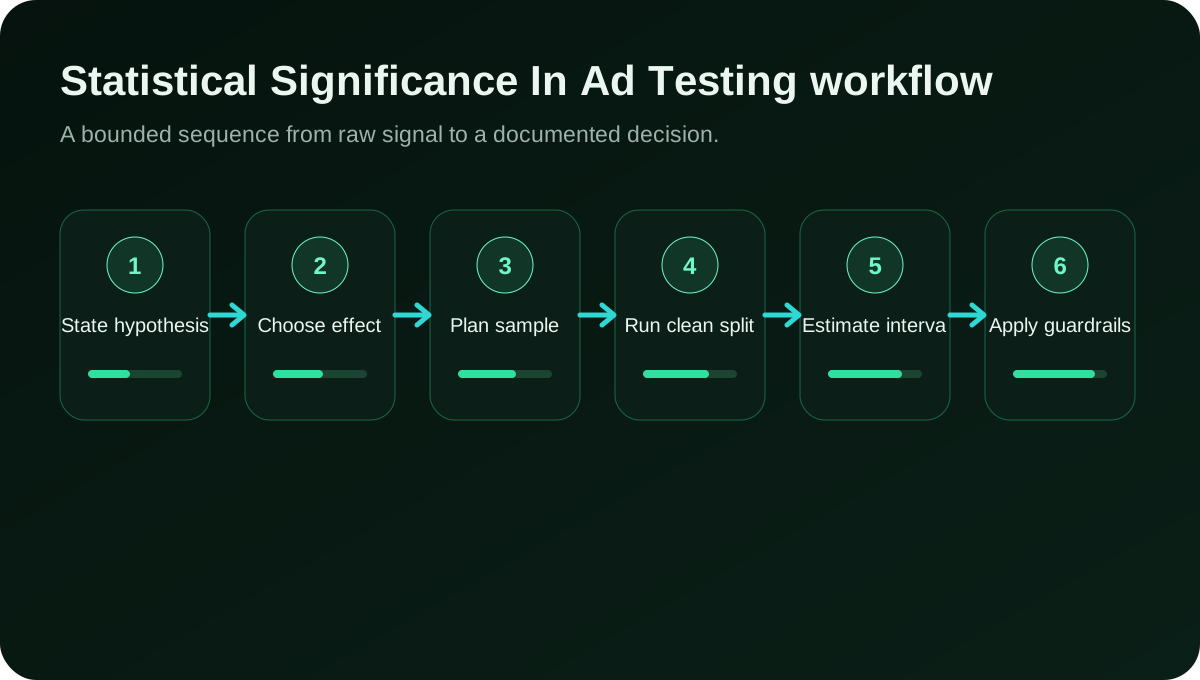
Connect the guide to live testing
Connect Read statistical significance in ad testing without overclaiming to a controlled audience test
Use the choices established in “Move from signal to action in a controlled sequence” to define one audience, budget and source set in FroggyAds. Keep the surrounding offer and measurement rule stable so the test adds evidence to read statistical significance in ad testing without overclaiming instead of mixing several changes at once.
Create My Free Account
Measurement note
Define the minimum detectable effect from economics
The minimum detectable effect is the smallest difference the test is designed to detect with the selected power and significance level. It should not be chosen because a calculator accepts a convenient number. Start with the smallest change that would justify the implementation cost, operational risk or budget reallocation.
For a creative test, the useful effect may be a reduction in accepted CPA, an increase in revenue per thousand impressions or a lift in qualified conversion rate. A one percent relative CTR improvement may be valuable at enormous scale and meaningless in a small campaign. Express the threshold in both metric units and expected business value.
A smaller detectable effect requires more observations. If the campaign cannot reach the necessary sample within a stable period, simplify the test, use a larger practical threshold or collect evidence across repeated comparable tests. Do not lower the evidence standard after seeing an exciting early result.
Measurement note
Operating rule
Choose sample size, duration and traffic split together
Sample planning depends on the baseline rate, the effect you want to detect, the confidence level, statistical power and the allocation between variants. Rare conversion events require more traffic than common click events. Uneven traffic splits usually require more total observations for the same precision, although they can be appropriate when risk or inventory constraints justify them.
Duration matters because advertising behavior changes by weekday, pay cycle, season and auction conditions. A test that reaches a numeric sample in a few hours can still be unrepresentative. Set a minimum duration that covers the relevant operating cycle, and a maximum duration after which the environment may have changed too much for a clean comparison.
If users can see multiple variants, account for interference and repeated exposure. A user-level assignment is often cleaner than impression-level randomization when the outcome occurs after several sessions. The assignment method must match the unit used in the analysis.
Operating rule
Choose the execution format
Choose a paid-media format that supports Read statistical significance in ad testing without overclaiming
Use the criteria around “Choose sample size, duration and traffic split together” to decide whether push, native, display or pop fits the message and destination. Set format, targeting and spend as campaign controls in FroggyAds while the read statistical significance in ad testing without overclaiming decision remains the standard for judging the result.
Create My Free Account
Quality control
Avoid peeking and repeated unplanned comparisons
Checking a conventional significance test every hour and stopping the first time it crosses a threshold increases the chance of a false winner. The threshold assumes a planned analysis, not an unlimited series of opportunities to stop on favorable noise. Use a fixed horizon, predetermined checkpoints or a sequential method designed for continuous monitoring.
Multiple metrics and many variants create another problem. If a team tests ten headlines and searches twenty metrics, one combination may appear significant by chance. Name the primary comparison before launch and treat exploratory findings as hypotheses for a new confirmation test.
Operational discipline helps. Lock the experiment brief, record changes, preserve the control and note outages or tracking incidents. If a material change occurs during the test, restart or segment the analysis rather than pretending the original randomization remained intact.
Quality control
Review checkpoint
Combine statistical and practical significance
Report the estimated effect, confidence interval, sample size, test duration and the relevant business impact. A result is more actionable when the interval excludes both no effect and effects too small to matter. If the interval includes meaningful wins and meaningful losses, the test is inconclusive even when the point estimate looks attractive.
Apply guardrails for downstream quality. A creative can increase clicks while lowering conversion rate, order value or lead approval. A cheaper CPA can conceal a worse refund rate. Decide which guardrails can block a rollout and which can trigger a smaller confirmation test.
When evidence is inconclusive, choose among three actions: continue to the planned horizon, stop because the possible effect is too small to justify more spend, or redesign the test because the measurement is too noisy. “No significant difference” is not proof that the variants are identical.
Review checkpoint
Readiness scorecard
Check the evidence before changing budget or delivery
A complete scorecard does not guarantee the decision is correct, but it reduces avoidable measurement and process errors.
Hypothesis set
Primary metric
MDE defined
Sample planned
Split stable
No peeking
Interval read
Business impact
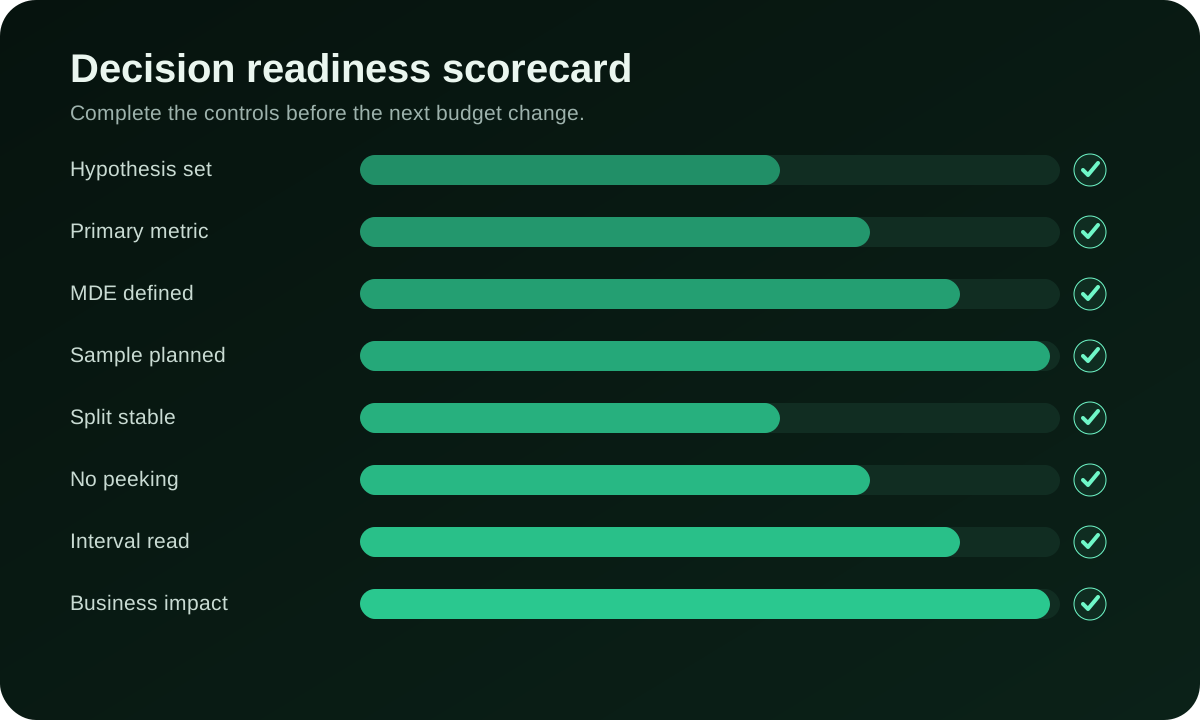
Put the guide into practice
Turn Read statistical significance in ad testing without overclaiming into a bounded campaign test
With “Check the evidence before changing budget or delivery” documented, launch only the next reversible test. Set a spending limit, preserve the baseline and use source-level and audience controls so the next step depends on qualified outcomes for read statistical significance in ad testing without overclaiming, not activity volume.
Create My Free Account
Worked scenarios
How the decision changes in real campaign conditions
Use the evidence pattern, not a single metric, to choose the next bounded action.
CTR wins but CPA loses
The treatment reaches a credible CTR lift, but accepted CPA is worse and the conversion-rate interval includes a meaningful decline. Do not call the creative a winner. The hook may attract lower-intent clicks. Keep the control and test a new message that preserves attention while improving qualification.
Large uplift from a tiny sample
A variant shows a forty percent conversion lift after twelve conversions. The interval is wide and the planned sample has not been reached. Continue the test or stop only for a predefined safety rule. Early magnitude is not a substitute for evidence.
Statistically significant but commercially small
A high-volume campaign detects a 0.4 percent relative improvement in CTR. Calculate the expected incremental gross profit and compare it with production, review and rollout costs. If the effect does not clear the practical threshold, keep the learning but do not prioritize implementation.
Limits
What this method cannot prove by itself
A significance calculation cannot correct biased assignment, broken tracking, changing eligibility or contamination between variants. Design quality comes first.
Standard formulas rely on assumptions that may not fit every metric or repeated-user setting. Use specialist statistical review for high-stakes experiments, complex revenue distributions or adaptive allocation.
Rollback rule
Keep the previous control, log the change and define the condition that returns the campaign to the safer state. A useful framework makes reversal as clear as rollout.
Operating record
Write the test decision record before the first impression
A short decision record protects an ad test from being rewritten after the result is visible. State the unit being assigned, the control, the treatment, the primary outcome, the minimum effect worth acting on, the planned sample or duration, and the exact rule for declaring a winner. Record important guardrails such as conversion quality, refund rate or landing-page engagement so a superficial CTR gain cannot override a material downstream loss.
The assignment unit matters. A user-level test answers a different question from an impression-level rotation, and repeated exposure can contaminate the comparison. The record should explain how traffic is split and whether the same person can encounter both variants. It should also note any source, GEO, device or time restrictions that define the population to which the conclusion applies.
| Decision field | Pre-test commitment | Reason |
|---|---|---|
| Primary metric | One outcome tied to the business question | Reduces cherry-picking among many metrics |
| Minimum useful effect | The smallest improvement worth implementation | Connects statistics to commercial value |
| Stopping rule | Planned sample, duration and exceptional safety stop | Limits repeated peeking and impulsive endings |
| Guardrails | Metrics that must not deteriorate beyond an agreed limit | Prevents a local win from damaging total performance |
When the test ends, report the observed effect with uncertainty and the raw denominators. Do not present a percentage uplift without the underlying counts. If the interval remains wide, the honest conclusion may be that the test was inconclusive. That is still useful because it prevents the team from scaling a weak signal. Record implementation cost as well. A statistically credible improvement can remain a poor business decision when it adds production, compliance or operational cost greater than the expected gain.
Archive the record with creative versions, dates and targeting. Future tests can then avoid retesting the same idea under nearly identical conditions and can distinguish repeatable patterns from isolated wins.
Questions
Read statistical significance in ad testing without overclaiming: FAQ
Practical answers for advertisers, analysts and media buyers.
joint audit: should Statistical Significance in Ad Testing prove the qualified action?
joint audit: Statistical Significance in Ad Testing defines the qualified action. gradual planning step: Statistical Significance in Ad Testing caps the controlled outlay. independent review: Statistical Significance in Ad Testing checks evidence strength.
local assessment: who owns the Statistical Significance in Ad Testing decision brief?
local assessment: Statistical Significance in Ad Testing assigns the commercial reviewer. separate check: Statistical Significance in Ad Testing records the decision brief. clear validation: Statistical Significance in Ad Testing states the material condition.
measurable sign-off: should Statistical Significance in Ad Testing test a single offer change?
measurable sign-off: Statistical Significance in Ad Testing tests a single offer change. selective review: Statistical Significance in Ad Testing keeps the unchanged reference group. defensible evaluation: Statistical Significance in Ad Testing checks delivery quality.
thoughtful evaluation: does Statistical Significance in Ad Testing cite a reviewable evidence?
thoughtful evaluation: Statistical Significance in Ad Testing cites the reviewable evidence. independent examination: Statistical Significance in Ad Testing states the service limit. cautious readback: Statistical Significance in Ad Testing asks the budget holder.
precise discussion: should Statistical Significance in Ad Testing fit the reachable segment?
precise discussion: Statistical Significance in Ad Testing defines the reachable segment. clear sign-off: Statistical Significance in Ad Testing checks the journey stage. calm debrief: Statistical Significance in Ad Testing protects traffic acceptance.
direct reconciliation: should Statistical Significance in Ad Testing count the minimum spend?
direct reconciliation: Statistical Significance in Ad Testing counts the minimum spend. defensible quality check: Statistical Significance in Ad Testing adds the service fee. gradual budget check: Statistical Significance in Ad Testing caps the documented limit. transparent check: Statistical Significance in Ad Testing checks the buyer action.
methodical measurement: should Statistical Significance in Ad Testing trust the account report?
methodical measurement: Statistical Significance in Ad Testing reads the account report. cautious approval: Statistical Significance in Ad Testing checks the quality log. separate audit: Statistical Significance in Ad Testing trusts the useful result.
deliberate verification: should Statistical Significance in Ad Testing pause for destination error?
deliberate verification: Statistical Significance in Ad Testing pauses for destination error. calm audit: Statistical Significance in Ad Testing records the policy constraint. selective handoff: Statistical Significance in Ad Testing verifies the updated evidence.
joint quality check: should Statistical Significance in Ad Testing improve from decision-ready evidence?
joint quality check: Statistical Significance in Ad Testing uses decision-ready evidence. gradual debrief: Statistical Significance in Ad Testing tests one audience assumption. independent check: Statistical Significance in Ad Testing keeps the preserved control slice. explicit test: Statistical Significance in Ad Testing checks measurement stability.
local outcome check: can Statistical Significance in Ad Testing take a careful volume rise?
local outcome check: Statistical Significance in Ad Testing takes a careful volume rise. separate pilot: Statistical Significance in Ad Testing checks the business signal. clear inspection: Statistical Significance in Ad Testing caps the approved test budget. systematic handoff: Statistical Significance in Ad Testing protects measurement stability.
Continue the workflow
Connect the measurement rule to campaign execution
Use the related FroggyAds resources to move from analysis into a controlled test, tracking review or budget decision.
Run a measured campaign
Turn the framework into a controlled traffic test
Launch with clear tracking, source-level reporting, bounded budgets and a documented optimization plan.
Advertiser decision framework
Read statistical significance in ad testing without overclaiming: what should the advertiser decide next?
For Read statistical significance in ad testing without overclaiming, the commercial task is to turn statistical significance ad testing into one measurable campaign decision. Use What does this page explain about Statistical Significance in Ad Testing? to define the audience or problem, use A trustworthy ad test needs a design, not only two creatives to constrain the test, and decide in advance which accepted result would justify more FroggyAds spend.
On this Read statistical significance in ad testing without overclaiming page, the decision should remain tied to the existing evidence around What does this page explain about Statistical Significance in Ad Testing?, A trustworthy ad test needs a design, not only two creatives and One primary question. Those sections give statistical significance ad testing its specific context; the table below turns that context into campaign actions rather than adding another generic definition.
| Decision | What to verify | FroggyAds action |
|---|---|---|
| Read statistical significance in ad testing without overclaiming objective | Use What does this page explain about Statistical Significance in Ad Testing? to define the accepted business event and the maximum learning loss for statistical significance ad testing. | Launch one FroggyAds campaign objective for Read statistical significance in ad testing without overclaiming and keep the conversion definition stable. |
| Read statistical significance in ad testing without overclaiming audience | Use A trustworthy ad test needs a design, not only two creatives to verify market, device, language and offer eligibility for statistical significance ad testing. | Apply only the FroggyAds targeting controls that change the real Read statistical significance in ad testing without overclaiming customer journey. |
| Read statistical significance in ad testing without overclaiming source evidence | Use One primary question to keep source-level differences visible instead of relying on one blended statistical significance ad testing average. | Keep, cap, exclude or retest Read statistical significance in ad testing without overclaiming inventory from documented source evidence. |
| Read statistical significance in ad testing without overclaiming economics | Use Stable assignment to connect media spend with accepted conversions and downstream value for statistical significance ad testing. | Protect the Read statistical significance in ad testing without overclaiming test with a written budget boundary and a consistent attribution window. |
| Read statistical significance in ad testing without overclaiming scale rule | Use Predefined decision rule to define the exact evidence that earns the next budget increase for statistical significance ad testing. | Scale Read statistical significance in ad testing without overclaiming one major control at a time and compare marginal performance with the prior baseline. |
A page-specific FroggyAds test sequence for Read statistical significance in ad testing without overclaiming
- Read statistical significance in ad testing without overclaiming outcome: define the accepted event for statistical significance ad testing and the maximum loss permitted while the first test is learning.
- Read statistical significance in ad testing without overclaiming path: verify market eligibility, device experience, landing-page continuity and tracking against What does this page explain about Statistical Significance in Ad Testing? before buying more traffic.
- Read statistical significance in ad testing without overclaiming hypothesis: launch one bounded FroggyAds test tied to A trustworthy ad test needs a design, not only two creatives; do not change bid, creative, audience and destination together.
- Read statistical significance in ad testing without overclaiming source review: compare qualified activity, accepted conversions, timing and cost by the source or segment dimensions relevant to One primary question.
- Read statistical significance in ad testing without overclaiming scaling: use Stable assignment and Predefined decision rule to define what must reproduce before the next budget increase.
Why FroggyAds is relevant to Read statistical significance in ad testing without overclaiming
For Read statistical significance in ad testing without overclaiming, FroggyAds gives advertisers a self-serve DSP and ad-network workflow for buying supported traffic with campaign-level budgets and targeting. Depending on format and campaign context, available controls can include country, city, device, operating system, browser, carrier, category, source, ID and IP options. SmartCPC and Adscore-supported traffic-quality controls can support the statistical significance ad testing optimization process, while the advertiser's tracker, analytics and backend acceptance remain the final evidence for commercial quality.
Use Predefined decision rule as the final checkpoint for Read statistical significance in ad testing without overclaiming. If the accepted result does not reproduce after the next meaningful volume step, return to the last stable configuration instead of widening several controls at once.
Search intent and buyer decision
Read statistical significance in ad testing without overclaiming: the buyer task this URL owns
Read statistical significance in ad testing without overclaiming is for performance-focused advertisers who need to make a measurable paid-acquisition decision. Keep that buyer task separate from the nearby topic so this URL answers one commercial question clearly. The nearest related FroggyAds page is Ab Testing Tools; this URL keeps ownership of the distinct task to make a measurable paid-acquisition decision.
For Read statistical significance in ad testing without overclaiming, the operating evidence to keep visible is audience targeting, conversion tracking, source quality, campaign objective. Use these entities only when they change setup, measurement or the commercial decision.
| Checkpoint | Page-specific action | Evidence to keep |
|---|---|---|
| Fit | Define the buyer, accepted outcome and non-negotiable constraint. | Retain evidence specific to Read statistical significance in ad testing without overclaiming and its accepted outcome. |
| Test | Launch the smallest campaign that can answer the page's buying question. | Retain evidence specific to Read statistical significance in ad testing without overclaiming and its accepted outcome. |
| Decision | Keep, cap, exclude or expand from accepted-outcome evidence. | Retain evidence specific to Read statistical significance in ad testing without overclaiming and its accepted outcome. |
Hypothetical calculation: if a controlled campaign for read statistical significance in ad testing without overclaiming spends USD 275 and produces 8 accepted conversions, accepted CPA is USD 275 / 8 = USD 34.38. Replace the inputs with your own campaign economics; this is not a FroggyAds performance claim.
FroggyAds gives performance-focused advertisers a self-serve way to act on the Read statistical significance in ad testing without overclaiming decision: configure the traffic test, preserve source-level reporting and scale only after the accepted outcome supports the next step. Create your free FroggyAds account.
Direct answer
Read statistical significance in ad testing without overclaiming — what matters first
Read statistical significance in ad testing without overclaiming is most useful when it helps a buyer decide whether this option fits the buyer's acquisition workflow. Define the accepted outcome first, then use targeting, budget and source-level evidence to decide what deserves more spend.