
Push Ads Sizes and Specifications: A Practical Execution Playbook
Use push ad sizes to plan assets, delivery and measurement around an accepted business outcome instead of an isolated click, impression or file specification.

| Section | Distinct excerpt from this page |
|---|---|
| What push ad sizes should help you decide | The format is a compact notification-style unit that combines an icon, a short headline, supporting copy and a click destination. |
| Preview real devices | Check icon remains identifiable at small scale, headline communicates the primary benefit early and description adds proof or qualification instead of repeating the headline. |
| Track each asset version | Review delivered impressions, clicks, landing sessions, accepted conversions and delayed value by source so a weak placement is not mistaken for a weak message. |
Reference for Push Ads Sizes and Specifications Guide: W3C Notifications API.
What push ad sizes should help you decide
Push Ads is a compact notification-style unit that combines an icon, a short headline, supporting copy and a click destination. This page focuses on sizes and specifications so advertisers can make a narrower decision than the general format overview. The operating environment is subscriber and browser delivery where the message must communicate value before the user reaches the landing page. The campaign should therefore connect icon, headline, description and destination URL with a measurable destination and a defined accepted outcome.
Push Ads Sizes and Specifications is a specification and rendering problem, not merely a dimension list. The format is a compact notification-style unit that combines an icon, a short headline, supporting copy and a click destination. Its useful asset system must protect the brand, message and action when the publisher, browser or app changes the available space. The practical specification is a compact icon plus a larger image where supported, with a short headline and description that remain readable after device-level truncation. Exact rendering varies by operating system, browser and placement, so the safe workflow is to upload clean source assets, keep critical text out of the image and preview the shortest visible version.
The format-specific quality chain is delivered impressions, clicks, landing sessions, accepted conversions and delayed value by source. That chain matters because the first media event can look strong while the downstream result is weak. The most useful review keeps source, placement, device, creative or asset version and destination visible. When one layer changes, begin a new comparison period rather than blending incompatible data into the historical average. For push ad sizes, record this what push ad sizes should help you decide checkpoint as item 4 and verify it against the exact push source, asset version and destination before the next budget change.
The page does not promise a universal creative, dimension, practice or price. Results depend on the offer, market, source, device, landing experience, bid, tracking and optimization. The goal is to reduce uncertainty with a controlled process and to stop weak combinations before they consume the scaling budget. For push ad sizes, record this what push ad sizes should help you decide checkpoint as item 5 and verify it against the exact push source, asset version and destination before the next budget change.
Six controls for sizes and specifications
Use the controls as a repeatable brief, review checklist and change log.
Start with the inventory
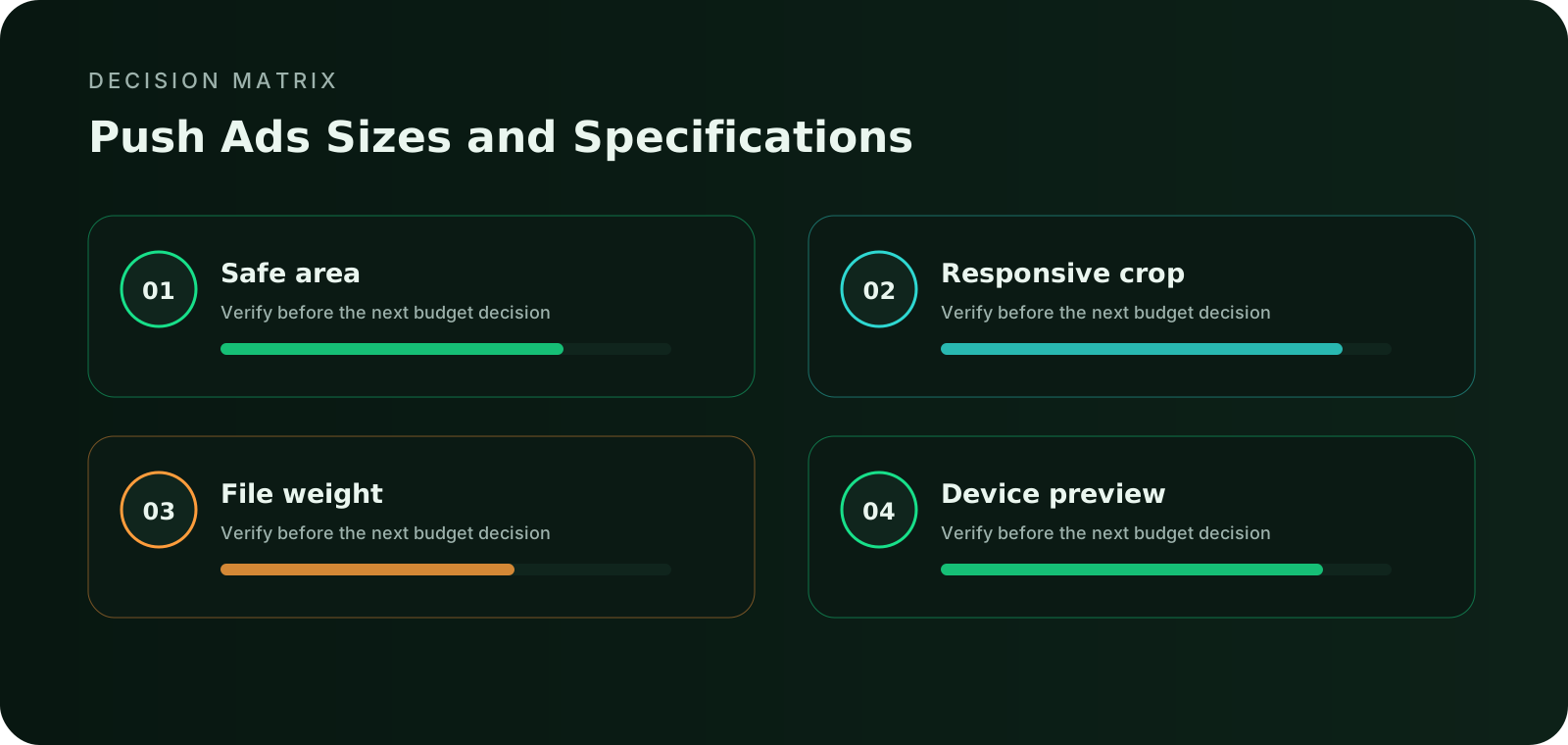
Identify the placements and devices that will actually receive push ads. A large dimension list is less useful than a focused asset set that covers the intended inventory.
Protect the focal area
Keep the subject, brand and primary action away from edges that may be cropped, rounded or covered by placement controls. Safe areas should survive portrait, landscape and narrow-width rendering. For push ad sizes, record this six controls for sizes and specifications checkpoint as item 9 and verify it against the exact push source, asset version and destination before the next budget change.
Keep text flexible
Place essential words in dedicated text fields when the format supports them. Text baked into an image becomes unreadable after resizing and cannot adapt to language or accessibility needs. For push ad sizes, record this six controls for sizes and specifications checkpoint as item 10 and verify it against the exact push source, asset version and destination before the next budget change.
Control file weight
Export efficient files with enough resolution for sharp rendering but no unnecessary weight. Slow asset delivery can reduce viewability, interaction and the accuracy of size comparisons. For push ad sizes, record this six controls for sizes and specifications checkpoint as item 11 and verify it against the exact push source, asset version and destination before the next budget change.
Preview real devices
Check icon remains identifiable at small scale, headline communicates the primary benefit early and description adds proof or qualification instead of repeating the headline. Preview the smallest mobile viewport and the largest desktop placement before launch.
Track each asset version
Use a separate asset ID for each size, crop or responsive version. Review delivered impressions, clicks, landing sessions, accepted conversions and delayed value by source so a weak placement is not mistaken for a weak message.
Connect the guide to live testing
Connect Push Ads Sizes and Specifications to a controlled audience test
Use the choices established in “Six controls for sizes and specifications” to define one audience, budget and source set in FroggyAds. Keep the surrounding offer and measurement rule stable so the test adds evidence to push ads sizes and specifications instead of mixing several changes at once.
Create My Free Account
Connect the asset with the placement and destination
The practical specification is a compact icon plus a larger image where supported, with a short headline and description that remain readable after device-level truncation. Exact rendering varies by operating system, browser and placement, so the safe workflow is to upload clean source assets, keep critical text out of the image and preview the shortest visible version. For push ad sizes, record this connect the asset with the placement and destination checkpoint as item 14 and verify it against the exact push source, asset version and destination before the next budget change.
The master asset should provide enough resolution for the largest targeted placement and enough composition flexibility for smaller crops. Protect faces, products, logos and action cues inside a safe focal area. Avoid essential text inside imagery when the placement can supply text separately. Each exported version needs a clear name, dimension or aspect ratio, file weight, locale, version and destination mapping. For push ad sizes, record this connect the asset with the placement and destination checkpoint as item 15 and verify it against the exact push source, asset version and destination before the next budget change.
The advertiser should know which element creates the expectation and which element proves it. For push ads, the creative system is icon, headline, description and destination URL. Keep the promise accurate even when an image is cropped, text is shortened, sound is muted or the destination opens on a smaller screen. When the format has no separate visual unit, the URL and first landing screen become the creative specification. For push ad sizes, record this connect the asset with the placement and destination checkpoint as item 16 and verify it against the exact push source, asset version and destination before the next budget change.
| Layer | What to verify | Campaign action |
|---|---|---|
| Format role | subscriber and browser delivery where the message must communicate value before the user reaches the landing page | Assign one funnel job and one accepted outcome |
| Creative system | icon, headline, description and destination URL | Use versioned assets and a stable control |
| Technical validation | icon remains identifiable at small scale; headline communicates the primary benefit early | Preview and test before meaningful spend |
| Measurement | delivered impressions, clicks, landing sessions, accepted conversions and delayed value by source | Compare source and asset versions after maturity |
| Primary risk | using urgency or curiosity that earns a click but breaks trust on the destination | Write a pause rule and rollback condition |
| Scale rule | render quality, viewability, interaction and accepted outcome value | Increase one lever only when marginal value holds |
Choose the execution format
Choose a paid-media format that supports Push Ads Sizes and Specifications
Use the criteria around “Connect the asset with the placement and destination” to decide whether push, native, display or pop fits the message and destination. Set format, targeting and spend as campaign controls in FroggyAds while the push ads sizes and specifications decision remains the standard for judging the result.
Create My Free Account
A seven-step push ad sizes process
Move from an accepted outcome to a controlled launch, mature review and responsible scale.
Write the accepted outcome
Define the business event and maturity window that will decide whether the asset is useful. Use accepted value by asset specification and placement as the primary decision metric.
Map the format role
Document how a compact notification-style unit that combines an icon, a short headline, supporting copy and a click destination supports the funnel and which source, audience and device segments must remain visible. For push ad sizes, record this a seven-step push ad sizes process checkpoint as item 20 and verify it against the exact push source, asset version and destination before the next budget change.
Prepare the control
Create one verified control using icon, headline, description and destination URL. Record the exact asset, copy, destination and tracking identifiers.
Validate rendering and tracking
Test icon remains identifiable at small scale, headline communicates the primary benefit early, destination loading, click parameters and conversion deduplication before meaningful spend. For push ad sizes, record this a seven-step push ad sizes process checkpoint as item 22 and verify it against the exact push source, asset version and destination before the next budget change.
Launch with limits
Use a capped budget, frequency rule and source-level pause condition. Preserve a clean baseline for the first comparison.
Review mature evidence
Compare delivered impressions, clicks, landing sessions, accepted conversions and delayed value by source. Separate media response from the accepted outcome and investigate mismatches before scaling. For push ad sizes, record this a seven-step push ad sizes process checkpoint as item 24 and verify it against the exact push source, asset version and destination before the next budget change.
Expand one lever
Increase audience, source coverage, bid, budget or creative breadth one major lever at a time. Keep the previous stable version available for rollback.
Separate media response from accepted business value
Render verification belongs inside campaign QA. Preview common mobile and desktop viewports, high-density screens, dark and light surroundings, slow connections and any close or browser controls that may overlap the unit. A technically accepted file can still be commercially unusable when the message becomes unreadable. Compare asset versions through delivered impressions, clicks, landing sessions, accepted conversions and delayed value by source rather than assuming the largest or sharpest file will perform best.
Use the earliest stable signal to diagnose the funnel and the latest accepted signal to decide budget. Served impressions, viewability, clicks, video milestones, opened destinations or taps explain delivery. Loaded sessions and meaningful page actions explain continuity. Deduplicated conversions, qualified leads, approved orders, activation, retention or another business-specific event decide value. For push ad sizes, record this separate media response from accepted business value checkpoint as item 27 and verify it against the exact push source, asset version and destination before the next budget change.
Review source and asset combinations before broad account averages. A strong response rate can hide poor qualification, while a higher media price can still produce a lower accepted acquisition cost. Preserve the attribution window and validation rules during a comparison. If those definitions change, document the change and begin a fresh period. For push ad sizes, record this separate media response from accepted business value checkpoint as item 28 and verify it against the exact push source, asset version and destination before the next budget change.
Apply the decision to real campaign situations
The same format can require a different asset, cost boundary or review method when the audience and destination change.
Mobile-first asset set
Start from the narrowest useful viewport and protect the message, action and close or navigation controls. Expand the composition instead of simply shrinking a desktop master.
Responsive inventory set
Prepare flexible masters and text fields that can be assembled into the targeted placements. Exclude inventory that cannot render the essential message clearly.
Localization-ready set
Allow enough text space for languages that expand, keep important visual elements out of crop zones and maintain separate asset identifiers by locale and version.
Put the guide into practice
Turn Push Ads Sizes and Specifications into a bounded campaign test
With “Apply the decision to real campaign situations” documented, launch only the next reversible test. Set a spending limit, preserve the baseline and use source-level and audience controls so the next step depends on qualified outcomes for push ads sizes and specifications, not activity volume.
Create My Free Account
Judge the newest spend, not only the historical average
Push inventory is commonly evaluated on a click or impression basis. The useful cost estimate connects bid, delivery rate, click-through rate, landing completion and accepted conversion rate instead of treating CPC as the final outcome. For push ad sizes, record this judge the newest spend, not only the historical average checkpoint as item 34 and verify it against the exact push source, asset version and destination before the next budget change.
Set a maximum learning budget and a separate scaling rule. The learning budget should be large enough to expose source, asset and destination differences but small enough to protect the account from an unbounded test. The scaling rule should use mature accepted outcomes and include any quality, margin, refund, activation or retention threshold that matters to the business. For push ad sizes, record this judge the newest spend, not only the historical average checkpoint as item 35 and verify it against the exact push source, asset version and destination before the next budget change.
When results weaken, locate the earliest broken layer. Check delivery and rendering before creative, creative before landing continuity, landing continuity before conversion tracking and conversion tracking before auction price. Raising a bid cannot repair a clipped message or an unusable destination. Lowering a bid cannot make an unqualified audience valuable. For push ad sizes, record this judge the newest spend, not only the historical average checkpoint as item 36 and verify it against the exact push source, asset version and destination before the next budget change.
Verify the complete campaign before releasing the budget
Each check should have an owner, evidence and a clear pass or fail decision.
The accepted action, value rule and maturity window are documented before push ads delivery begins.
Every sizes and specifications variation has a clear identifier, destination and reason for existing.
Icon remains identifiable at small scale and headline communicates the primary benefit early have been tested on the targeted devices.
Impression or delivery events, click parameters, landing events and conversions are deduplicated and traceable.
The launch has a maximum downside, source-level pause rule, frequency control and rollback condition.
The plan requires render quality, viewability, interaction and accepted outcome value before audience, source coverage, bid or budget is expanded.
Protect trust while testing the format
Use clear sponsor identity, accurate benefits and a visible next step. Do not imitate security warnings, system notices or private messages. Do not manufacture urgency, hide material conditions or design the interaction to create an accidental click. The creative, destination and offer must comply with applicable laws, campaign policies and the rules of the markets being targeted. For push ad sizes, record this protect trust while testing the format checkpoint as item 45 and verify it against the exact push source, asset version and destination before the next budget change.
Review the experience at the moment the ad appears. High-attention formats require careful timing and close behavior. Small or responsive formats require readable hierarchy. Video needs captions and an effective muted opening. Direct-link and popunder delivery require a fast, transparent destination. Mobile campaigns need usable touch targets, forms and viewport behavior. For push ad sizes, record this protect trust while testing the format checkpoint as item 46 and verify it against the exact push source, asset version and destination before the next budget change.
Document complaints, rapid closes, abnormal bounce patterns, conversion rejection and source-level quality changes. These are not only support signals. They can reveal a mismatch between the format, audience and promise before the accepted conversion metric has enough volume to show the problem. For push ad sizes, record this protect trust while testing the format checkpoint as item 47 and verify it against the exact push source, asset version and destination before the next budget change.
Test push ads inside a controlled buying workflow
FroggyAds provides global supply access, source-level controls, targeting and conversion-tracking options. Current inventory, supported creative specifications and auction conditions must be confirmed in the platform before launch. For push ad sizes, record this test push ads inside a controlled buying workflow checkpoint as item 49 and verify it against the exact push source, asset version and destination before the next budget change.
Broad supply creates testing options, while source-level decisions protect the budget.
Potential scale does not replace campaign limits, destination quality or conversion validation.
For Push Ads Sizes and Specifications, give push, native, display, pop, video or interstitial a defined funnel job with its own creative, destination, measurement and stop-or-scale rule.
Reference standards
- W3C Notifications API: Notification behavior and permission-aware delivery context
- IAB Tech Lab OpenRTB: Programmatic auction and creative-asset transport framework
- MRC Standards: Measurement, invalid-traffic and viewability reference standards
Push Ads Sizes and Specifications FAQ
Practical answers for advertisers and media buyers preparing, measuring and scaling the format.
systematic audit: should Push Ads Sizes and Specifications Guide prove the qualified action?
systematic audit: Push Ads Sizes and Specifications Guide defines the qualified action. deliberate validation: Push Ads Sizes and Specifications Guide caps the agreed media cap. measurable reconciliation: Push Ads Sizes and Specifications Guide checks record agreement.
honest assessment: who owns the Push Ads Sizes and Specifications Guide test outline?
honest assessment: Push Ads Sizes and Specifications Guide assigns the measurement owner. precise planning step: Push Ads Sizes and Specifications Guide records the test outline. deliberate verification: Push Ads Sizes and Specifications Guide states the usage restriction.
careful test: should Push Ads Sizes and Specifications Guide test one campaign lever?
careful test: Push Ads Sizes and Specifications Guide tests one campaign lever. local check: Push Ads Sizes and Specifications Guide keeps the previous accepted setting. precise scope check: Push Ads Sizes and Specifications Guide checks measurement stability.
explicit briefing: does Push Ads Sizes and Specifications Guide cite a reviewable evidence?
explicit briefing: Push Ads Sizes and Specifications Guide cites the reviewable evidence. methodical checkpoint: Push Ads Sizes and Specifications Guide states the material condition. local comparison: Push Ads Sizes and Specifications Guide asks the measurement owner.
transparent approval: should Push Ads Sizes and Specifications Guide fit the commercial segment?
transparent approval: Push Ads Sizes and Specifications Guide defines the commercial segment. thoughtful examination: Push Ads Sizes and Specifications Guide checks the device context. methodical test: Push Ads Sizes and Specifications Guide protects traffic acceptance.
prompt reconciliation: should Push Ads Sizes and Specifications Guide count the platform charge?
prompt reconciliation: Push Ads Sizes and Specifications Guide counts the platform charge. joint sign-off: Push Ads Sizes and Specifications Guide adds the review cost. thoughtful discussion: Push Ads Sizes and Specifications Guide caps the documented limit. consistent audit: Push Ads Sizes and Specifications Guide checks the decision metric.
regular measurement: should Push Ads Sizes and Specifications Guide trust the quality log?
regular measurement: Push Ads Sizes and Specifications Guide reads the quality log. direct budget check: Push Ads Sizes and Specifications Guide checks the analytics record. joint examination: Push Ads Sizes and Specifications Guide trusts the business signal.
responsible verification: should Push Ads Sizes and Specifications Guide pause for billing drift?
responsible verification: Push Ads Sizes and Specifications Guide pauses for billing drift. measurable approval: Push Ads Sizes and Specifications Guide records the service limit. direct evidence check: Push Ads Sizes and Specifications Guide verifies the updated evidence.
systematic quality check: should Push Ads Sizes and Specifications Guide improve from quality-adjusted results?
systematic quality check: Push Ads Sizes and Specifications Guide uses quality-adjusted results. deliberate comparison: Push Ads Sizes and Specifications Guide tests one audience assumption. measurable release check: Push Ads Sizes and Specifications Guide keeps the fixed control group. formal outcome check: Push Ads Sizes and Specifications Guide checks delivery quality.
honest outcome check: can Push Ads Sizes and Specifications Guide take a reviewed scale step?
honest outcome check: Push Ads Sizes and Specifications Guide takes a reviewed scale step. precise debrief: Push Ads Sizes and Specifications Guide checks the buyer action. deliberate assessment: Push Ads Sizes and Specifications Guide caps the stated investment cap. plain budget check: Push Ads Sizes and Specifications Guide protects event quality.
Continue with the next format decision
Use the related pages to connect creative preparation, technical validation, campaign economics and execution standards.
Launch push ads with clear controls
Create an account, check current inventory and specifications, then build a capped test with source IDs, asset lineage and the accepted conversion event visible from the beginning. For push ad sizes, record this launch push ads with clear controls checkpoint as item 65 and verify it against the exact push source, asset version and destination before the next budget change.
Push Ads Sizes and Specifications: A Practical Execution Playbook: the buyer task this URL owns
Treat Push Ads Sizes and Specifications: A Practical Execution Playbook as an operating page for performance-focused advertisers, not as a synonym page. Its job is to help you make a measurable paid-acquisition decision, with the evidence kept against this exact decision. The nearest related FroggyAds page is Push Notification Ad Sizes; this URL keeps ownership of the distinct task to make a measurable paid-acquisition decision.
Keep campaign objective, audience targeting, audience and market fit, ad format in the Push Ads Sizes and Specifications: A Practical Execution Playbook evidence record because they can change how this media test is configured, measured or scaled.
| Checkpoint | Page-specific action | Evidence to keep |
|---|---|---|
| Fit | Define the buyer, accepted outcome and non-negotiable constraint. | Retain evidence specific to Push Ads Sizes and Specifications: A Practical Execution Playbook and its accepted outcome. |
| Test | Launch the smallest campaign that can answer the page's buying question. | Retain evidence specific to Push Ads Sizes and Specifications: A Practical Execution Playbook and its accepted outcome. |
| Decision | Keep, cap, exclude or expand from accepted-outcome evidence. | Retain evidence specific to Push Ads Sizes and Specifications: A Practical Execution Playbook and its accepted outcome. |
Hypothetical calculation: if a controlled campaign for push ads sizes and specifications: a practical execution playbook spends USD 200 and produces 5 accepted conversions, accepted CPA is USD 200 / 5 = USD 40.0. Replace the inputs with your own campaign economics; this is not a FroggyAds performance claim.
When Push Ads Sizes and Specifications: A Practical Execution Playbook moves from research to a traffic test, FroggyAds lets performance-focused advertisers control targeting, budget and source decisions from one self-serve workflow while downstream conversions remain the commercial proof. Create your free FroggyAds account.
Push Ads Sizes and Specifications: A Practical Execution Playbook — what matters first
Push Ads Sizes and Specifications: A Practical Execution Playbook is most useful when it helps a buyer decide whether this option fits the buyer's acquisition workflow. Define the accepted outcome first, then use targeting, budget and source-level evidence to decide what deserves more spend.