
Owned keyword cluster
- promote affiliate links
Plan promote affiliate links with clear economics, tracking, targeting, source controls and a repeatable optimization workflow on FroggyAds.
Quick answer: Promote affiliate links through channels permitted by the merchant and traffic source, with a clear disclosure placed near the recommendation. Use tagged links and source identifiers, avoid unsupported claims and evaluate the campaign using accepted sales or leads after returns, reversals and attribution delay.
Reference for Promote Affiliate Links: FTC advertising and marketing guidance.
Promote affiliate links through channels permitted by the merchant and traffic source, with a clear disclosure placed near the recommendation. Use tagged links and source identifiers, avoid unsupported claims and evaluate the campaign using accepted sales or leads after returns, reversals and attribution delay.
Verified July 17, 2026. Offer terms, platform policies, inventory and economics can change.
Link disclosure, tracking and accepted revenue. The authoritative outcome is the affiliate or business backend’s accepted event after normal approval and reversal timing.
Separate pages for minor wording or year modifiers would divide evidence and create cannibalization. The owner instead provides one current decision framework with direct answers, clear boundaries and a repeatable measurement contract.
For the Promote Affiliate Links decision, record how this control changes the next test or review. Start with the affiliate program agreement. Record allowed traffic channels, prohibited claims, brand bidding rules, email or incentive restrictions, GEO and device eligibility, cookie or attribution window, conversion definition, payout, rejection reasons and reversal timing. The campaign cannot be evaluated fairly when the offer terms are unknown or when a traffic method is permitted by the ad platform but prohibited by the affiliate program.
When using Promote Affiliate Links, apply this rule only to the conditions and decision described on this page. The destination must continue the promise made in the ad. Use a landing page or prelander when the user needs context, qualification, consent or a disclosure before reaching the merchant. Direct linking is appropriate only when every involved policy permits it and the link can preserve required identifiers. A short path is not automatically better when it removes trust, clarity or tracking.
Build the measurement chain before scale. Pass a stable campaign, creative and source identifier through the tracker and affiliate link. Validate postbacks or API events with a real test conversion where possible. Reconcile traffic-platform spend, independent tracker clicks and affiliate-network accepted outcomes at the same timezone and cutoff. Model approval lag, reversals and refunds so early numbers are not mistaken for final economics.
Use a narrow first cell: one format, one market cluster, one device class, one accepted action and a small creative set. The loss limit should be written before launch and should include the normal conversion window. Source groups that reach the limit without accepted value can be paused after lag. Strong sources receive staged increases so marginal performance is visible before the whole budget moves.
When using Promote Affiliate Links, apply this rule only to the conditions and decision described on this page. A disclosure must be clear and close to the endorsement or recommendation when the relationship is material. The disclosure should not be hidden in a profile, footer or generic terms page. Creative claims must be truthful and supportable. These requirements apply even when a network, creator tool or landing-page builder makes the promotion easy to publish.
When using Promote Affiliate Links, apply this rule only to the conditions and decision described on this page. Preserve rollback. Save the last trusted bids, source list, creatives, destination, tracking parameters and budget before a scale change. When performance weakens, restore the trusted configuration while keeping exports from the failed step. A disciplined rollback prevents one unsuccessful expansion from erasing a proven campaign cell and turns the failure into reusable evidence.
| Layer | Evidence to capture | Decision rule |
|---|---|---|
| Offer and channel rules | Document allowed traffic, claims, GEOs, devices, direct linking and prohibited methods. | Do not launch until the traffic source and affiliate program agree. |
| Tracking chain | Pass campaign, creative and source identifiers into the affiliate or backend record. | Pause optimization while platform and accepted records materially disagree. |
| Evidence budget | Separate technical validation, bounded learning and conversion-delay reserve. | The available balance is not the loss limit. |
| Quality and disclosure | Use truthful creative, clear commercial disclosure and an eligible destination. | Reject volume that cannot survive policy and backend quality review. |
| Scale decision | Use accepted CPA, approval rate, contribution and incremental qualified volume. | Expand in stages and preserve the last trusted allocation. |
Connect the guide to live testing
Use the choices established in “Affiliate-link promotion owner” to define one audience, budget and source set in FroggyAds. Keep the surrounding offer and measurement rule stable so the test adds evidence to promote affiliate links instead of mixing several changes at once.
Create My Free Account
Promote Affiliate Links should be understood as an operating decision, not a shortcut to guaranteed results. In this context, the goal is to connect an affiliate offer with paid audiences while preserving source-level visibility and payout economics. The useful outcome is validated conversions whose payout exceeds media cost, tracking cost and normal testing loss. A strong plan begins with one conversion definition, one source of truth for revenue or accepted actions, and a documented loss limit.
That discipline matters because optimizing around clicks before confirming accepted conversions, payout rules and traffic restrictions. FroggyAds gives media buyers self-serve access to broad inventory, targeting and source controls, but the advertiser still owns the offer, creative, destination, tracking and commercial decision. The direct answer is therefore practical: use promote affiliate links when the chargeable event, available data and optimization controls match the business objective, then judge the test by net margin per accepted conversion rather than traffic volume alone.
In the Promote Affiliate Links operating plan, record this as decision control 1 so later budget reviews use the same evidence standard.
A paid acquisition system has several connected layers: the offer, the audience, the inventory source, the ad format, the destination, the tracking stack and the backend validation process. Promote Affiliate Links sits inside that system and only performs as well as the weakest connected layer. Before launch, write down the user promise, the conversion event and the reason the selected traffic should care. Then map every handoff from impression or click to the validated outcome.
This prevents the common mistake of blaming the network for a slow landing page, an unclear offer or a broken postback. It also helps separate an inventory problem from a funnel problem. For this topic, the most important operating lens is offer economics, compliance, tracking and source optimization. Treat each of those factors as a measurable input, not a vague preference.
In the Promote Affiliate Links operating plan, record this as decision control 2 so later budget reviews use the same evidence standard.
Measurement must be complete before meaningful optimization begins. Assign a click identifier, preserve campaign and source parameters, and configure server-to-server postbacks or another reliable conversion return where available. The ad platform, tracker, analytics property and advertiser backend should use aligned time zones and a documented attribution rule. Define which events are provisional and which are accepted for optimization. For lead generation, a submitted form may be provisional while an approved lead is final.
For sales, the purchase can still require refund or fraud review. Review discrepancies on a fixed cadence matched to the conversion delay and operational risk, rather than changing bids after every isolated conversion. The primary decision metric remains net margin per accepted conversion, supported by conversion rate, click quality, rejection rate and time-to-conversion. In the Promote Affiliate Links operating plan, record this as decision control 3 so later budget reviews use the same evidence standard.
Start from value, not from the cheapest available click or impression. Estimate the expected value of one accepted outcome, subtract variable costs, and apply a conservative conversion-rate assumption. That produces a maximum sustainable acquisition cost. Convert the acquisition ceiling into a CPC or CPM limit using the expected funnel rates, then reduce it to allow for uncertainty during the first test. A useful test budget should be large enough to observe multiple source and creative combinations, but small enough that a failed hypothesis is affordable. For Promote Affiliate Links, establish a hard stop before launch and record the conditions that justify additional spend. This approach protects the account from emotional scaling and makes price comparisons meaningful across different billing models, GEOs and formats. In the Promote Affiliate Links operating plan, record this as decision control 4 so later budget reviews use the same evidence standard.
Choose the execution format
Use the criteria around “Forecast Unit Economics and Test Risk” to decide whether push, native, display or pop fits the message and destination. Set format, targeting and spend as campaign controls in FroggyAds while the promote affiliate links decision remains the standard for judging the result.
Create My Free Account
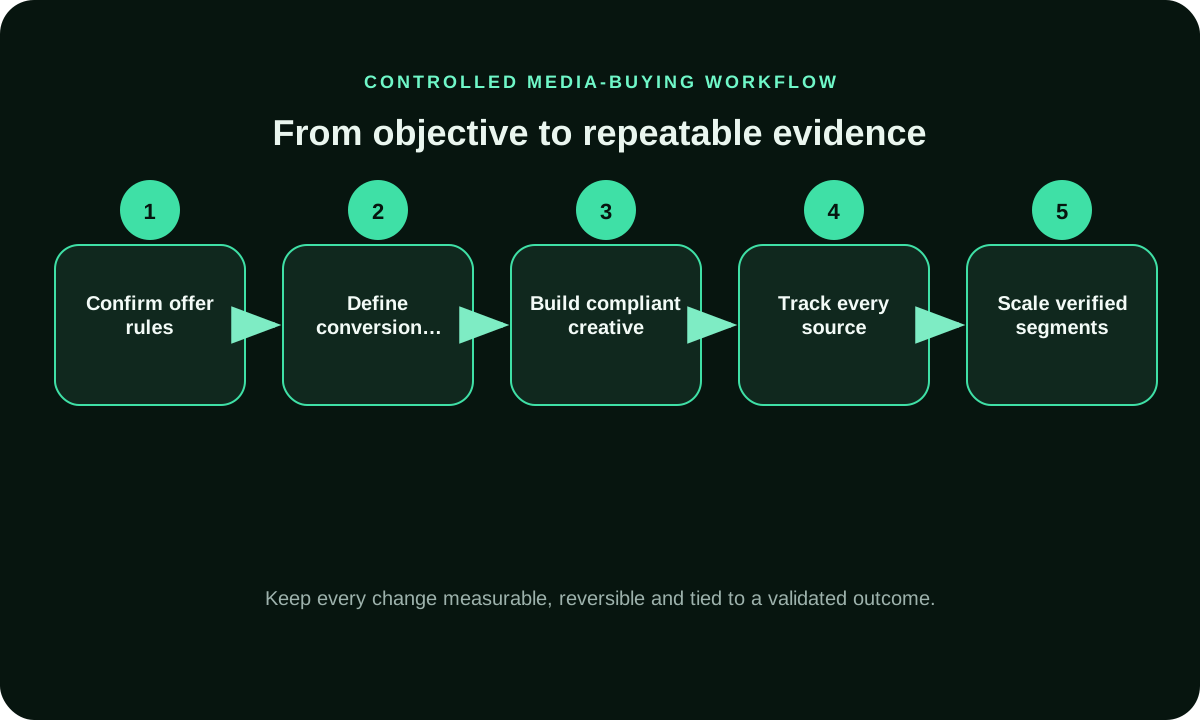
The workflow is straightforward. First, confirm the objective and the definition of a valid result. Second, select inventory and targeting that fit the user experience. Third, launch with a limited set of creatives or destination variations so the data remains interpretable. Fourth, collect enough observations for source-level decisions. Fifth, increase budget only after performance remains stable across time and volume. The sequence matters. Skipping directly to scaling can hide weak quality behind a short profitable streak, while excessive segmentation can prevent any source from reaching a useful sample. A starting review threshold of roughly 38 meaningful conversion opportunities can be adapted to payout, variance and funnel length. The workflow image below summarizes the order and keeps the team focused on evidence. In the Promote Affiliate Links operating plan, record this as decision control 5 so later budget reviews use the same evidence standard.
Targeting should improve relevance while preserving enough reach to learn. Begin with essential constraints such as the allowed GEO, supported device experience, language and offer restrictions. Keep optional filters broader until the campaign produces evidence. Then compare device, operating system, browser, connection type, carrier, time of day and source identifiers using the same validated outcome definition. Do not assume that a technically precise segment is commercially valuable. A narrow segment can show an attractive conversion rate but still lack enough volume to support growth. Conversely, broad traffic can contain profitable source pockets that only become visible after sufficient data. For Promote Affiliate Links, refine segments in stages and document each change so the effect can be separated from creative or bid changes. In the Promote Affiliate Links operating plan, record this as decision control 6 so later budget reviews use the same evidence standard.
The ad, pre-lander and final destination should tell one consistent story. The headline must describe a real benefit or next step, the visual should support that message, and the first screen of the destination should confirm what the user clicked. Avoid unsupported claims, false scarcity, misleading system-style warnings and interface elements that imitate device controls. Page speed is part of media performance because every delay creates paid drop-off. Test the destination on common mobile and desktop sizes, slow connections and the browsers that represent meaningful traffic. Use one primary call to action and remove form fields or navigation choices that do not support the conversion. When a pre-lander is used, it should qualify and educate rather than conceal the actual offer. In the Promote Affiliate Links operating plan, record this as decision control 7 so later budget reviews use the same evidence standard.
Put the guide into practice
With “Creative and Destination Alignment” documented, launch only the next reversible test. Set a spending limit, preserve the baseline and use source-level and audience controls so the next step depends on qualified outcomes for promote affiliate links, not activity volume.
Create My Free Account
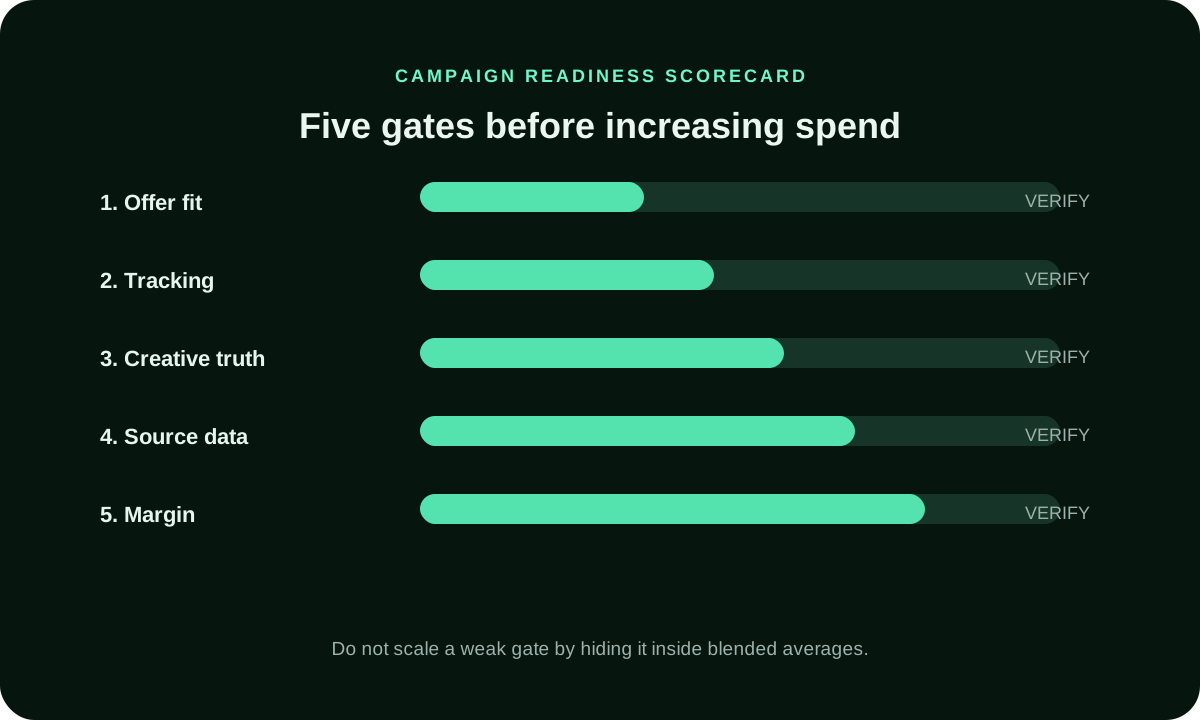
Optimization should be granular and reversible. Preserve publisher or placement identifiers, then classify sources by spend, conversion maturity, accepted quality and economic result. A source with no conversions may need more data if the expected conversion rate is low, while a source with repeated rejected actions can be stopped earlier. Use whitelists for proven placements, blacklists for consistently invalid or uneconomic activity, and bid adjustments for sources that are viable at a different price. Apply one material change at a time whenever possible. Keep a control campaign or baseline segment so the effect of each adjustment can be measured. The scorecard visual below turns this process into five gates: Offer fit, Tracking, Creative truth, Source data, Margin. In the Promote Affiliate Links operating plan, record this as decision control 8 so later budget reviews use the same evidence standard.
Scaling means increasing profitable volume without assuming yesterday’s efficiency will continue unchanged. Raise daily caps or bids in measured steps, and allow the campaign to collect mature data after each change. Expansion can also come from additional GEOs, devices, formats or creative concepts, but each expansion should have its own reporting view. Monitor marginal performance, not only the blended account average. A large legacy whitelist can hide a new segment that is losing money. Stop scaling when accepted conversion cost rises beyond the planned range, quality deteriorates, or the funnel cannot process additional volume. The objective is repeatability, not the largest possible one-day spend. In the Promote Affiliate Links operating plan, record this as decision control 9 so later budget reviews use the same evidence standard.
The most frequent failures are operational. Tracking launches late, creatives promise something the page does not deliver, the budget is split across too many small campaigns, or a buyer blocks sources before enough data exists. Another problem is optimizing to CTR because it moves quickly, even though the backend result is the real objective. Teams also compare network prices without normalizing for conversion quality. For Promote Affiliate Links, create a pre-launch checklist and require evidence for every exclusion, bid increase or scale decision. Keep screenshots, campaign exports and change logs. This record makes it easier to diagnose a drop, reconcile systems and avoid repeating the same test under a new name. In the Promote Affiliate Links operating plan, record this as decision control 10 so later budget reviews use the same evidence standard.
FroggyAds is a self-serve media buying platform designed for advertisers, affiliates and performance teams that want direct campaign control. The platform provides access to 750+ SSP integrations and more than 20 billion daily impressions across supported formats and markets. Buyers can use GEO, device, operating system, browser, carrier, city, category, source, ID and IP controls where available, together with budget caps and reporting. Those tools support offer economics, compliance, tracking and source optimization, but they do not replace offer compliance, truthful creative, reliable tracking or backend validation. Begin with a controlled budget, review source-level results, and expand only when the campaign produces commercially useful outcomes. In the Promote Affiliate Links operating plan, record this as decision control 11 so later budget reviews use the same evidence standard.
Before launch, verify five items. The objective must be measurable. The chargeable event and bid model must fit the funnel. Tracking must pass a live test from click to accepted outcome. The destination must load quickly and continue the ad promise. Finally, the budget must include a predefined stop rule. During the campaign, review source quality, conversion delay, rejected actions and effective acquisition cost. After the test, document what worked, what failed and which assumptions changed. Promote Affiliate Links becomes useful when those decisions can be repeated by another buyer using the same evidence. Results will vary by offer, GEO, format, competition, creative, destination and optimization quality. In the Promote Affiliate Links operating plan, record this as decision control 12 so later budget reviews use the same evidence standard.
The disclosure appears where people can notice and understand it before acting, using language suited to the audience and format. It identifies the commercial connection without hiding behind vague labels.
Promoters verify current availability, target market, price, important conditions, fulfilment and support. They also assess whether the offer addresses a genuine audience need rather than relying only on commission size.
Observed questions, content context, customer problems and market eligibility can indicate relevance. Sensitive traits and unsupported assumptions are excluded from the targeting rationale. Documented exclusions preserve audience trust.
Shortening a message cannot remove material qualifications or turn evidence into a guaranteed result. Promoters retain the approved benefit, conditions and destination continuity across every format.
Images, video, logos, quotations, customer material and creator assets may have separate usage conditions. Records identify the source, approved channels, territory, edits and expiry before publication.
The programme records link ownership, parameter purpose, attribution window, consent implications and fallback behaviour. Redirects remain secure and do not conceal a materially different destination.
Representative devices verify offer continuity, local availability, responsive loading, secure action, cancellation information, confirmation and customer help. Expired promotions receive prompt link review before renewed publication.
Content production, tools, media, creator fees, compliance review, refunds, taxes and support time sit beside commission. Commercial value uses fulfilled outcomes rather than recorded clicks alone.
Definitions cover click, accepted order, cancellation, return, attribution, adjustment and payable commission. Periodic samples connect promoter reporting with merchant transactions while respecting appropriate data access.
Expansion follows dependable offer accuracy, qualified demand, fulfilled customer value, manageable complaints and sustainable economics. New merchants, audiences or promotional methods begin with their own controlled review.
For Promote Affiliate Links, define one accepted business outcome, verify conversion tracking, protect the learning budget and make source-level keep, cap, exclude or retest decisions only after the data has matured. Results still depend on offer fit, GEO, creative, landing path, competition and optimization.
Treat Promote Affiliate Links as an operating page for affiliate marketers and media buyers, not as a synonym page. Its job is to help you promote affiliate links without losing attribution or source evidence, with the evidence kept against this exact decision. The nearest related FroggyAds page is How To Promote Affiliate Links; this URL keeps ownership of the distinct task to promote affiliate links without losing attribution or source evidence.
Anchor the Promote Affiliate Links review to affiliate conversion, ROAS, offer economics, source and placement tracking. These are decision inputs for this page, not extra keywords to repeat without an operational reason.
| Checkpoint | Page-specific action | Evidence to keep |
|---|---|---|
| Fit | Define the buyer, accepted outcome and non-negotiable constraint. | Retain evidence specific to Promote Affiliate Links and its accepted outcome. |
| Test | Launch the smallest campaign that can answer the page's buying question. | Retain evidence specific to Promote Affiliate Links and its accepted outcome. |
| Decision | Keep, cap, exclude or expand from accepted-outcome evidence. | Retain evidence specific to Promote Affiliate Links and its accepted outcome. |
Hypothetical calculation: if a controlled campaign for promote affiliate links spends USD 125 and produces 8 accepted conversions, accepted CPA is USD 125 ÷ 8 = USD 15.62. Replace the inputs with your own campaign economics; this is not a FroggyAds performance claim.
When Promote Affiliate Links moves from research to a traffic test, FroggyAds lets affiliate marketers and media buyers control targeting, budget and source decisions from one self-serve workflow while downstream conversions remain the commercial proof. Create your free FroggyAds account.
Promote Affiliate Links is most useful when it helps a buyer decide whether this option fits the buyer's acquisition workflow. Define the accepted outcome first, then use targeting, budget and source-level evidence to decide what deserves more spend.