Top Popup Ad Networks: Compare Traffic, Costs and Campaign Fit
Top popup ad networks should be compared through format eligibility, supply-path evidence, source-level reporting, landing continuity and accepted business outcomes. A league table cannot establish which network fits a specific offer. As of 16 August 2026, the Coalition for Better Ads lists pop-up ads among desktop and mobile web experiences below its acceptability threshold, while IAB Tech Lab describes sellers.json and the OpenRTB SupplyChain object as mechanisms for identifying sellers and intermediaries. Those sources define review questions; they do not certify an individual network, placement or campaign result.
Disqualify unacceptable opening behavior before scoring a network
Describe the exact event that opens a new surface: page load, click, exit attempt, timed trigger or another user action. Record whether it covers content, creates a separate window, opens behind the active page or blocks navigation. The label popup does not describe enough behavior to decide whether an experience is eligible.
Coalition for Better Ads research identifies pop-up ads as below its Better Ads Standard for desktop and mobile web. Treat that finding as a user-experience boundary, not as permission to relabel the same behavior. Exclude a format when its actual rendering conflicts with the publisher, browser, device, market or advertiser rule that governs the test.
Trace the seller route rather than accepting an inventory adjective
Ask the network for the selling entity, publisher or app context, exchange route, intermediary chain and source identifier available in reporting. Match account identifiers where ads.txt or app-ads.txt is relevant. A claim such as premium, direct or exclusive remains unverified until the buying record shows what those words mean.
IAB Tech Lab explains that sellers.json can identify direct sellers and intermediaries, while the SupplyChain object represents parties selling or reselling a bid request. These specifications improve traceability; they do not prove that a person will value the offer or that every impression is valid. Preserve unavailable fields instead of converting missing supply evidence into a quality score.
Create a source ledger that survives optimization
Give every source, placement or zone a stable identifier and record device, geography, time, bid, creative, landing version and delivery state. Keep raw provider rows before making labels such as approved or blocked. A later reviewer should be able to connect an outcome to the exact source definition that was active.
Record changes to source names, bundles, domains or seller relationships with dates. If a provider aggregates several environments under one label, request a more useful breakdown or limit the decision that can be made. Blended reporting cannot support a source-level quality claim, even when the total campaign appears efficient.
Preflight the opening path and the first landing screen
Test the complete route on supported browsers, devices and connection conditions before buying volume. Check focus, back behavior, close controls, duplicate opens, redirect count, destination availability and whether the first screen explains the advertised offer. Save observations for both successful and failed paths.
A page that appears technically after an open is not automatically usable. Inspect readable text, touch targets, keyboard behavior, consent presentation, form errors and confirmation. Keep the advertisement claim continuous with the destination. A disruptive opening combined with a slow or misleading first screen compounds risk rather than creating qualified attention.
Measure the loss stages from paid open to accepted outcome
Separate requests, served impressions, rendered opens, landing arrivals, engaged sessions, started actions, submitted actions, accepted outcomes, reversals and retained value. Attach the definition and denominator to every rate. Do not describe a provider-reported visit as a verified person, customer or sale.
Reconcile platform records with server, analytics and business systems using stable campaign and transaction identifiers where available. Preserve duplicates, bot or invalid-traffic flags, rejections, refunds and missing joins. When systems disagree, report the disagreement and narrow the conclusion instead of choosing the most favorable dashboard.
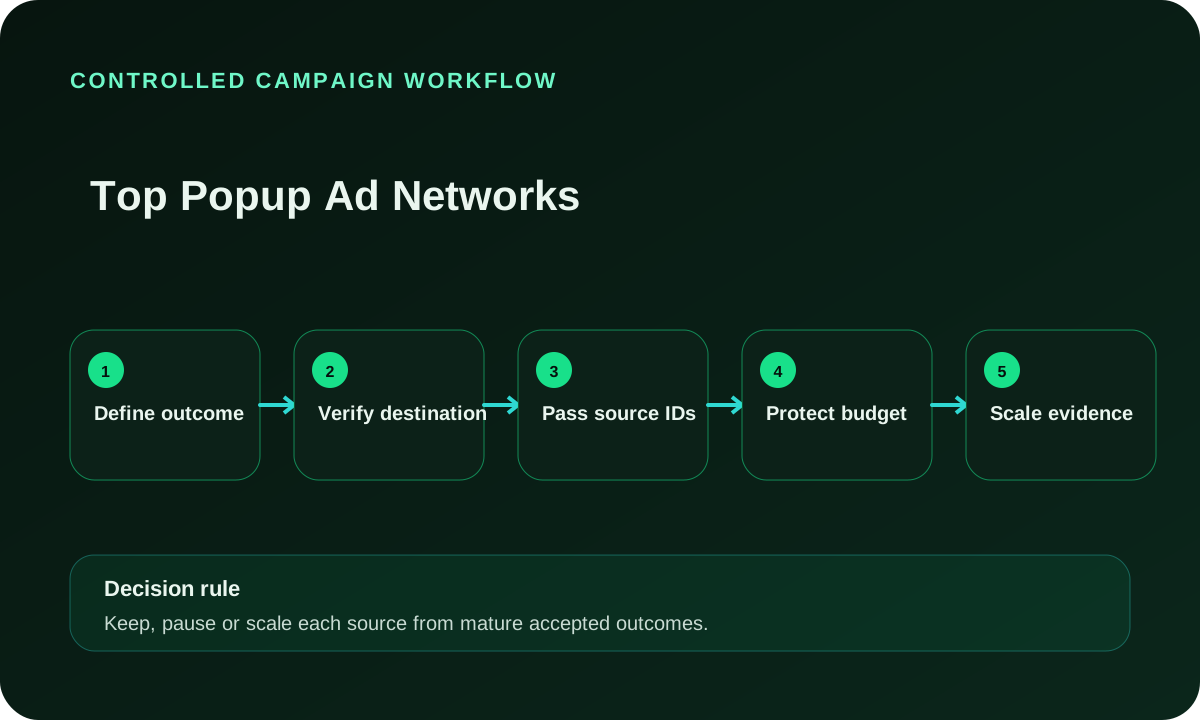
Run a capped cell test and close every source decision
Start with a limited set of countries, devices, sources, creatives and landing versions. Set budget, frequency, time, claim, tracking and loss boundaries before launch. Change one decision class at a time so a source correction is not confused with a new page, bid and creative introduced simultaneously.
Close each cell as continue, correct, pause or reject with spend, delivery, source evidence, landing observations, accepted outcomes and unresolved limitations. Scaling requires marginal evidence from the next source or bid range, not the blended average from earlier traffic. Keep the prior configuration and stop authority available throughout the test.
Connect the guide to live testing
Connect Top Popup Ad Networks to a controlled audience test
Use the choices established in “Run a capped cell test and close every source decision” to define one audience, budget and source set in FroggyAds. Keep the surrounding offer and measurement rule stable so the test adds evidence to top popup ad networks instead of mixing several changes at once.
The popup comparison records the triggering action, surface behavior and close route.
Validation Ledger control 2
Better Ads Standard review is completed before volume or price receives a score.
Validation Ledger control 3
Every seller, intermediary and source identifier retains its retrieval date.
Validation Ledger control 4
Unavailable ads.txt, sellers.json or SupplyChain evidence remains explicitly unavailable.
Validation Ledger control 5
Provider adjectives never replace domains, app identifiers, zones or transaction fields.
Validation Ledger control 6
Browser and device preflight covers focus, back navigation, redirects and duplicate opens.
Validation Ledger control 7
Landing review connects the paid promise with readable terms and a working next action.
Validation Ledger control 8
Delivery, rendered opens, engaged visits and accepted outcomes use separate denominators.
Validation Ledger control 9
Rejections, reversals, duplicates and unresolved joins remain in the evaluation record.
Validation Ledger control 10
The first test caps countries, devices, sources, bids, frequency, duration and total spend.
Validation Ledger control 11
Each optimization changes one decision class and retains the earlier configuration.
Validation Ledger control 12
Scaling requires current marginal source evidence and a named stop owner.
Choose the execution format
Choose a paid-media format that supports Top Popup Ad Networks
Use the criteria around “Decision controls” to decide whether push, native, display or pop fits the message and destination. Set format, targeting and spend as campaign controls in FroggyAds while the top popup ad networks decision remains the standard for judging the result.
The popup comparison records the triggering action, surface behavior and close route. The format reviewer observes the opening surface directly and applies the relevant user-experience boundary before price enters the comparison.
Review decision 2
Better Ads Standard review is completed before volume or price receives a score. The supply reviewer connects seller and intermediary identifiers without treating technical transparency as proof of human attention.
Review decision 3
Every seller, intermediary and source identifier retains its retrieval date. The source reviewer preserves zones, domains, devices and configuration dates so an optimization can be reproduced.
Review decision 4
Unavailable ads.txt, sellers.json or SupplyChain evidence remains explicitly unavailable. The destination reviewer follows focus, redirects, first-screen promise and completion on every supported environment.
Review decision 5
Provider adjectives never replace domains, app identifiers, zones or transaction fields. The outcome reviewer keeps provider delivery, landing evidence and accepted business states in separate ledgers.
Review decision 6
Browser and device preflight covers focus, back navigation, redirects and duplicate opens. The test owner closes each popup cell with its current evidence, loss boundary and one authorized next action.
Review decision 7
Landing review connects the paid promise with readable terms and a working next action. The format reviewer observes the opening surface directly and applies the relevant user-experience boundary before price enters the comparison.
Review decision 8
Delivery, rendered opens, engaged visits and accepted outcomes use separate denominators. The supply reviewer connects seller and intermediary identifiers without treating technical transparency as proof of human attention.
Review decision 9
Rejections, reversals, duplicates and unresolved joins remain in the evaluation record. The source reviewer preserves zones, domains, devices and configuration dates so an optimization can be reproduced.
Review decision 10
The first test caps countries, devices, sources, bids, frequency, duration and total spend. The destination reviewer follows focus, redirects, first-screen promise and completion on every supported environment.
Review decision 11
Each optimization changes one decision class and retains the earlier configuration. The outcome reviewer keeps provider delivery, landing evidence and accepted business states in separate ledgers.
Review decision 12
Scaling requires current marginal source evidence and a named stop owner. The test owner closes each popup cell with its current evidence, loss boundary and one authorized next action.
Put the guide into practice
Turn Top Popup Ad Networks into a bounded campaign test
With “Review trail” documented, launch only the next reversible test. Set a spending limit, preserve the baseline and use source-level and audience controls so the next step depends on qualified outcomes for top popup ad networks, not activity volume.
Render one proposed popup route across approved browsers and log trigger, focus, surface, dismissal, redirects and first-screen state. Attach the Coalition standard or other exact boundary used for the eligibility decision. Exercise 1 keeps its dated observation and reviewer.
Validation Ledger exercise 2
Take one seller account from a provider row and trace its available ads.txt, sellers.json and SupplyChain identifiers without filling gaps. Note what the specification can verify and what remains outside its scope. Exercise 2 keeps its dated observation and reviewer.
Validation Ledger exercise 3
Split a blended zone report into the narrowest source, device, geography and time cells the evidence permits. Keep original provider rows so the regrouping can be independently repeated. Exercise 3 keeps its dated observation and reviewer.
Validation Ledger exercise 4
Reconcile ten paid opens with landing, server and accepted-outcome records while retaining duplicate and unmatched states. Withhold a human-quality claim when the records cannot establish it. Exercise 4 keeps its dated observation and reviewer.
Validation Ledger exercise 5
Write a capped popup test with eligible format, source set, bid, frequency, spend, time and business-loss boundaries. Assign a person who can pause delivery without waiting for a sales contact. Exercise 5 keeps its dated observation and reviewer.
Validation Ledger exercise 6
Close a marginal source decision using only current cost, experience, accepted outcome, reversal and uncertainty evidence. Preserve the prior bid and source state in case the expansion fails. Exercise 6 keeps its dated observation and reviewer.
Validation Ledger exercise 7
Render one proposed popup route across approved browsers and log trigger, focus, surface, dismissal, redirects and first-screen state. Attach the Coalition standard or other exact boundary used for the eligibility decision. Exercise 7 keeps its dated observation and reviewer.
Validation Ledger exercise 8
Take one seller account from a provider row and trace its available ads.txt, sellers.json and SupplyChain identifiers without filling gaps. Note what the specification can verify and what remains outside its scope. Exercise 8 keeps its dated observation and reviewer.
Validation Ledger exercise 9
Split a blended zone report into the narrowest source, device, geography and time cells the evidence permits. Keep original provider rows so the regrouping can be independently repeated. Exercise 9 keeps its dated observation and reviewer.
Validation Ledger exercise 10
Reconcile ten paid opens with landing, server and accepted-outcome records while retaining duplicate and unmatched states. Withhold a human-quality claim when the records cannot establish it. Exercise 10 keeps its dated observation and reviewer.
Validation Ledger exercise 11
Write a capped popup test with eligible format, source set, bid, frequency, spend, time and business-loss boundaries. Assign a person who can pause delivery without waiting for a sales contact. Exercise 11 keeps its dated observation and reviewer.
Validation Ledger exercise 12
Close a marginal source decision using only current cost, experience, accepted outcome, reversal and uncertainty evidence. Preserve the prior bid and source state in case the expansion fails. Exercise 12 keeps its dated observation and reviewer.
Sources and preserved resources
Popup-network evidence below combines preserved FroggyAds routes with primary material on intrusive-format boundaries and programmatic seller identity. Each source is applied only to the format or transparency question it documents. None ranks a provider, certifies an impression or promises an outcome.
Top popup ad network evaluation connects opening behavior, Better Ads Standards, seller-route evidence, source ledgers, landing preflight, loss-stage measurement and capped scaling decisions.
Better Ads Standards identify pop-up experiences below a consumer-acceptability threshold in covered desktop and mobile web environments.
IAB Tech Lab sellers.json enables buyers to discover direct sellers and intermediaries represented in programmatic supply.
Popup-network procurement also needs commercial and incident boundaries. Record prepaid balance, minimum purchase, refund mechanism, support route, response time, account suspension procedure and data-export availability. Keep contractual statements separate from a salesperson's informal explanation. Test a realistic discrepancy before increasing spend: identify a missing source row, request the definition and record whether the response resolves the reconciliation. If the network changes a zone, redirect or seller route, start a new evidence version. An earlier accepted cell cannot automatically authorize an altered path. Preserve browser warnings, policy notices and publisher complaints beside the relevant dates. The goal is not to declare a network permanently safe or unsafe; the goal is to show which current route can be operated within the buyer's declared format, evidence and loss boundaries. Review complete.
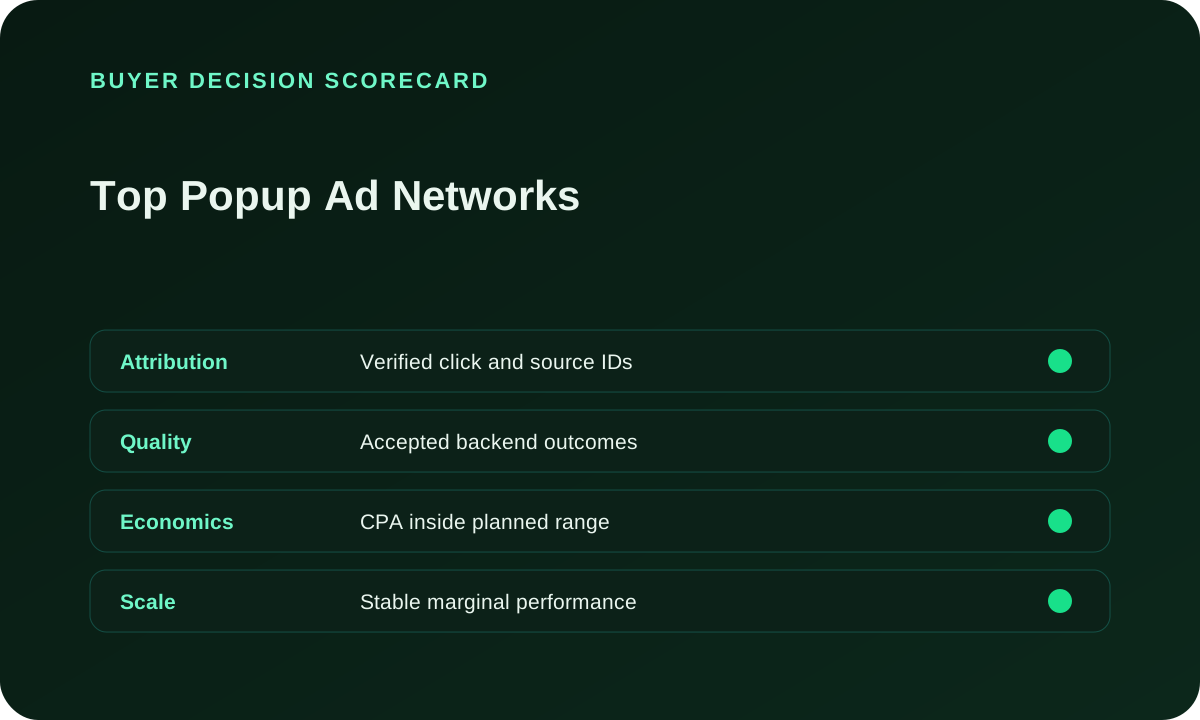
A popup-network scorecard should avoid a single composite grade. Keep separate statuses for format eligibility, supply traceability, source reporting, technical route, claim continuity, accepted outcomes, commercial terms and incident response. One strong status cannot cancel a blocking failure in another. Record accept, reject or verify for each criterion and name the evidence needed to move a verify state. If a provider changes terminology, map the new term to observed behavior before carrying forward any result. This prevents attractive price or volume from hiding an unresolved opening experience and prevents one failed source from becoming an unsupported judgment about every route the network offers.
Popup testing should preserve the economics of failure, not only successful events. Assign cost to blocked sources, duplicate opens, failed redirects, unusable landings, rejected leads, refunds, verification and operator time. Keep those costs attached to the cell that produced them. If a provider issues credit, record the original loss and the credit as separate entries so the operational failure does not disappear. Review billing time zone, rounding, minimum bid, account fee and exchange-rate treatment before comparing two networks.
A lower media price can be less useful when the buyer must spend more time identifying opaque sources or correcting destinations. The closeout should therefore show media cost, operational cost and accepted business value under their own definitions. If the data cannot support that separation, limit the commercial conclusion. Do not infer that a network with a higher bid is better, or that a cheaper source is worse, without testing the same eligibility, route and outcome conditions.
Questions and answers
Which seller details should popup ad networks provide to buyers?
Useful details include contracting entity, inventory route, publisher or application evidence, reseller relationships, billing, support and dispute handling. Seller transparency does not prove traffic quality, but it gives the buyer a traceable starting point for validation.
What popup behaviour makes a network unsuitable for professional campaigns?
Hidden or misleading controls, forced downloads, deceptive system messages, unbounded repetition and redirects that prevent a safe exit are serious concerns. The buyer should define prohibited behaviour contractually and verify actual delivery rather than relying on format labels.
How is geographic inventory compared across popup advertising networks?
Comparison should use delivered user geography, publisher mix, device, availability, price and accepted outcomes for the same commercial territory. A network’s headline country volume does not confirm that suitable inventory will appear in the buyer’s target cell.
What full expenses affect a popup network price comparison?
Media, minimum deposits, fees, currency conversion, creative, tracking, fraud review, reversals and operational labour can affect the real test cost. Outcome quality and refundable balances matter alongside the quoted CPM or other buying rate.
What evidence shows a popup network can enforce frequency controls?
The provider should explain the event counted, identifier, time window, cross-site limits, consent context and reporting available to the buyer. Independent observation across representative devices can test whether the stated control behaves as described.
Why should buyers record the full popup destination chain?
Redirects can change domain, disclosure, loading time, offer and risk before the final page appears. Timestamped captures and network logs make the route reproducible and help assign responsibility when an unexpected intermediary is present.
Which reporting fields make individual popup network tests auditable?
Network, campaign, source, placement, time, geography, device, creative, destination, cost and accepted outcome identifiers support a defensible comparison. Definitions and time zones should be documented so apparently similar columns are not treated as identical automatically.
How do buyers investigate invalid activity in popup inventory?
Popup buyers can compare delivery logs with source, device, location, destination behaviour and accepted outcomes, then ask the seller to explain abnormal timing or identifiers. Apply blocks or credits only when the evidence meets the contract's stated rule.
What contract terms protect a first popup network test?
Terms should address prohibited inventory, data access, billing, deposit refunds, invalid activity, creative approval, brand safety, suspension, dispute evidence and account exit. Small bounded funding limits exposure while those controls are verified.
Why can the best popup network differ by campaign?
Inventory, geography, device, price, seller route, controls, destination fit and accepted outcomes vary by campaign and over time. A shortlist should therefore show evidence and trade-offs instead of presenting one permanent league-table winner.
Decision table
Top Popup Ad Networks: Compare Traffic, Costs and Campaign Fit: a practical advertiser decision matrix
Decision
What to verify
FroggyAds action
Placement fit
Check how Top Popup Ad Networks: Compare Traffic, Costs and Campaign Fit is delivered and whether the creative can communicate the offer clearly.
Choose the format only when the placement matches the intended user action.
Creative continuity
Keep the message consistent with the page sections on On this page and the destination.
Test one creative hypothesis at a time.
Targeting
Use market, device and source controls only where they support eligibility or a testable hypothesis.
Start broad enough to learn, then narrow from source-level evidence.
Measurement
Connect the format to the accepted conversion discussed under Disqualify unacceptable opening behavior before scoring a network.
Reconcile FroggyAds reporting with tracker and backend results.
Scale rule
Use the diagnostic logic around Trace the seller route rather than accepting an inventory adjective before increasing spend.
Scale only when marginal accepted value stays inside the campaign limit.
Advertiser decision framework
Top Popup Ad Networks: Compare Traffic, Costs and Campaign Fit: what should the advertiser decide next?
For Top Popup Ad Networks: Compare Traffic, Costs and Campaign Fit, popup means a separate browser window or tab experience where the inventory and browser context allow it. The buying decision is whether that delivery context fits the offer, creative and destination well enough to produce an accepted post-click result. Use On this page and Disqualify unacceptable opening behavior before scoring a network as the page-specific checkpoints, then judge top popup ad networks on message clarity, frequency and destination quality plus downstream conversion quality.
On this Top Popup Ad Networks: Compare Traffic, Costs and Campaign Fit page, the decision should remain tied to the existing evidence around On this page, Disqualify unacceptable opening behavior before scoring a network and Trace the seller route rather than accepting an inventory adjective. Those sections give top popup ad networks its specific context; the table below turns that context into campaign actions rather than adding another generic definition.
Decision
What to verify
FroggyAds action
Top Popup Ad Networks: Compare Traffic, Costs and Campaign Fit objective
Use On this page to define the accepted business event and the maximum learning loss for top popup ad networks.
Launch one FroggyAds campaign objective for Top Popup Ad Networks: Compare Traffic, Costs and Campaign Fit and keep the conversion definition stable.
Top Popup Ad Networks: Compare Traffic, Costs and Campaign Fit audience
Use Disqualify unacceptable opening behavior before scoring a network to verify market, device, language and offer eligibility for top popup ad networks.
Apply only the FroggyAds targeting controls that change the real Top Popup Ad Networks: Compare Traffic, Costs and Campaign Fit customer journey.
Top Popup Ad Networks: Compare Traffic, Costs and Campaign Fit source evidence
Use Trace the seller route rather than accepting an inventory adjective to keep source-level differences visible instead of relying on one blended top popup ad networks average.
Keep, cap, exclude or retest Top Popup Ad Networks: Compare Traffic, Costs and Campaign Fit inventory from documented source evidence.
Top Popup Ad Networks: Compare Traffic, Costs and Campaign Fit economics
Use Create a source ledger that survives optimization to connect media spend with accepted conversions and downstream value for top popup ad networks.
Protect the Top Popup Ad Networks: Compare Traffic, Costs and Campaign Fit test with a written budget boundary and a consistent attribution window.
Top Popup Ad Networks: Compare Traffic, Costs and Campaign Fit scale rule
Use Preflight the opening path and the first landing screen to define the exact evidence that earns the next budget increase for top popup ad networks.
Scale Top Popup Ad Networks: Compare Traffic, Costs and Campaign Fit one major control at a time and compare marginal performance with the prior baseline.
A page-specific FroggyAds test sequence for Top Popup Ad Networks: Compare Traffic, Costs and Campaign Fit
Top Popup Ad Networks: Compare Traffic, Costs and Campaign Fit outcome: define the accepted event for top popup ad networks and the maximum loss permitted while the first test is learning.
Top Popup Ad Networks: Compare Traffic, Costs and Campaign Fit path: verify market eligibility, device experience, landing-page continuity and tracking against On this page before buying more traffic.
Top Popup Ad Networks: Compare Traffic, Costs and Campaign Fit hypothesis: launch one bounded FroggyAds test tied to Disqualify unacceptable opening behavior before scoring a network; do not change bid, creative, audience and destination together.
Top Popup Ad Networks: Compare Traffic, Costs and Campaign Fit source review: compare qualified activity, accepted conversions, timing and cost by the source or segment dimensions relevant to Trace the seller route rather than accepting an inventory adjective.
Top Popup Ad Networks: Compare Traffic, Costs and Campaign Fit scaling: use Create a source ledger that survives optimization and Preflight the opening path and the first landing screen to define what must reproduce before the next budget increase.
Why FroggyAds is relevant to Top Popup Ad Networks: Compare Traffic, Costs and Campaign Fit
For Top Popup Ad Networks: Compare Traffic, Costs and Campaign Fit, FroggyAds gives advertisers a self-serve DSP and ad-network workflow for buying supported traffic with campaign-level budgets and targeting. Depending on format and campaign context, available controls can include country, city, device, operating system, browser, carrier, category, source, ID and IP options. SmartCPC and Adscore-supported traffic-quality controls can support the top popup ad networks optimization process, while the advertiser's tracker, analytics and backend acceptance remain the final evidence for commercial quality.
Use Preflight the opening path and the first landing screen as the final checkpoint for Top Popup Ad Networks: Compare Traffic, Costs and Campaign Fit. If the accepted result does not reproduce after the next meaningful volume step, return to the last stable configuration instead of widening several controls at once.
Top Popup Ad Networks: Compare Traffic, Costs and Campaign Fit: the buyer task this URL owns
For performance-focused advertisers, Top Popup Ad Networks: Compare Traffic, Costs and Campaign Fit should shorten the path from research to action: evaluate an ad network for offer fit, source visibility and accepted economics. The page therefore stays focused on controllable campaign evidence and leaves adjacent intents to their own URLs. The nearest related FroggyAds page is Top Popup Ad Networks 2026; this URL keeps ownership of the distinct task to evaluate an ad network for offer fit, source visibility and accepted economics.
Keep popunder, full-page traffic, landing page, conversion tracking in the Top Popup Ad Networks: Compare Traffic, Costs and Campaign Fit evidence record because they can change how this media test is configured, measured or scaled.
Checkpoint
Page-specific action
Evidence to keep
Journey
Match the format to the user's attention state and destination.
Retain evidence specific to Top Popup Ad Networks: Compare Traffic, Costs and Campaign Fit and its accepted outcome.
Creative
Check format requirements, message continuity and landing-page readiness.
Retain evidence specific to Top Popup Ad Networks: Compare Traffic, Costs and Campaign Fit and its accepted outcome.
Optimize
Compare source-level accepted outcomes before increasing volume.
Retain evidence specific to Top Popup Ad Networks: Compare Traffic, Costs and Campaign Fit and its accepted outcome.
Hypothetical calculation: if a controlled campaign for top popup ad networks: compare traffic, costs and campaign fit spends USD 225 and produces 6 accepted conversions, accepted CPA is USD 225 / 6 = USD 37.5. Replace the inputs with your own campaign economics; this is not a FroggyAds performance claim.
Use FroggyAds as the execution layer for Top Popup Ad Networks: Compare Traffic, Costs and Campaign Fit: keep the offer and conversion definition stable, apply the needed media controls and let advertiser-side accepted value decide whether more spend is justified. Create your free FroggyAds account.
Direct answer
Top Popup Ad Networks: Compare Traffic, Costs and Campaign Fit — what matters first
Top Popup Ad Networks: Compare Traffic, Costs and Campaign Fit is useful when the format fits the user journey, device context, creative requirements and measurable conversion path.