
Top Popup Ad Networks 2026
A list of top popup ad networks for 2026 is useful only when the ranking records what was tested, where delivery occurred and which business outcome was accepted. Popup and popunder buying can create an additional browsing context, but the browser, publisher implementation and user action determine whether it opens, remains visible or is blocked. Start with an eligible market, a supported claim, a fast destination and a small exposure ceiling.
Separate requested traffic from rendered landings, usable sessions, accepted outcomes and settled cost. Inspect source identifiers, redirects, frequency behavior and complaints instead of treating a network total as quality evidence. A platform approval does not prove that the complete experience is suitable or compliant. The practical winner is the provider whose current controls, support and reporting let an advertiser explain delivery, contain harm and repeat a mature result.
Recheck every candidate under the same scorecard because inventory, browser behavior and policy can change.
Official boundaries for popup behavior, creative review and user choice
The WHATWG HTML Standard describes auxiliary browsing contexts and sandbox flags that can restrict their creation; it does not promise that an advertising popup will open or receive attention. Google Authorized Buyers documents product-specific creative policy topics, including destination experience and destination mismatch, but a Google status is not approval for another exchange or proof of business quality. The United States Federal Trade Commission describes interface practices that can misdirect or trap consumers; its report is guidance for risk review, not a universal legal determination for every design or market. Use these sources to define tests and escalation questions. Record the browser, device, operating system, publisher source, trigger, creative, destination, consent state and observation time for each sample. Obtain qualified policy, legal, privacy and security review for the actual campaign rather than converting a checklist into a compliance claim.
- WHATWG HTML Standard on auxiliary contexts - browser-standard behavior and sandbox limits, not a delivery guarantee
- Google Authorized Buyers creative policy topics - Google-specific review topics, not universal network approval
- FTC report on dark patterns - United States consumer-interface risk guidance, not campaign certification
In the top popup ad networks 2026 review, use this practical rule: Define the popup buying question
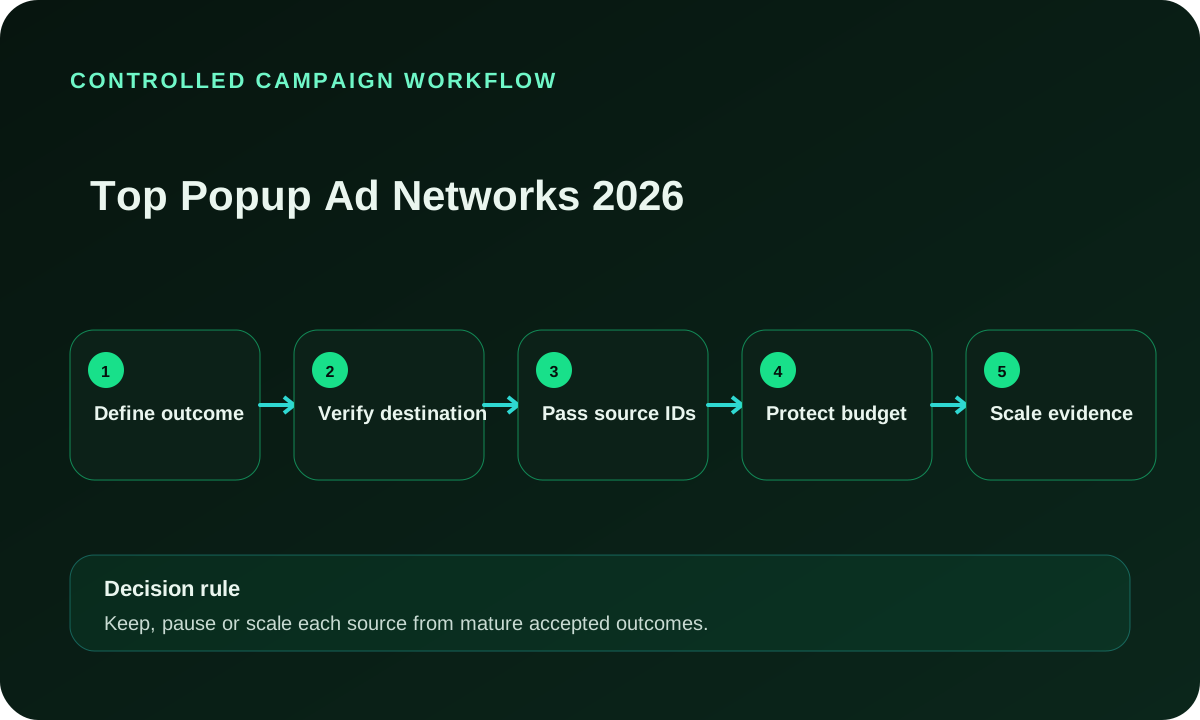
State the market, audience eligibility, offer, device set and accepted downstream result before comparing providers. Name the maximum spend and user-experience exposure that the test owner may authorize without another review.
Do not rank a network by advertised reach, format labels or a historical account impression. The decision record should distinguish absent evidence, a control that was not tested and a control that failed under the selected delivery cell.
Map popup and popunder behavior
Document the user action or publisher event that requests a new browsing context, whether focus changes and where the destination appears. Capture blocked, delayed, background and repeated states on representative browsers.
The HTML standard explains platform mechanics but does not establish how every publisher implements advertising. Treat each browser, operating system and source combination as an observation, not a universal rule about visibility or attention.
Create a network comparison ledger
For each candidate, store the account, product, contract version, inventory description, targeting controls, reporting fields, billing basis, support route and test date. Link every score to a screenshot, export or current official document.
Avoid labels such as premium, trusted or top when the underlying evidence is a sales statement. A provider can be strong for one permitted market and unsuitable for another because its sources, controls or support differ.
Verify seller and source identity
Request the source identifiers available before and after delivery, the seller relationship and any domain or application declaration used in the supply chain. Preserve unknown or aggregated traffic as its own class.
A declared seller relationship can improve transparency, but it does not prove that a visit was human, viewable, safe or valuable. Do not erase unrecognized sources by merging them into a favorable network average.
Connect the guide to live testing
Connect Top Popup Ad Networks 2026 to a controlled audience test
Use the choices established in “Verify seller and source identity” to define one audience, budget and source set in FroggyAds. Keep the surrounding offer and measurement rule stable so the test adds evidence to top popup ad networks 2026 instead of mixing several changes at once.
Create My Free Account
Inspect the complete destination route
Resolve the submitted URL, every redirect, the final hostname and the first usable page on each intended device. Test certificate validity, loading, consent, offer terms, navigation and recovery from a failed step.
Google's destination mismatch and experience topics apply within its product. Use them as useful review prompts, while separately checking the active popup network's current rules and the advertiser's obligations in each market.
Separate requests from rendered landings
Log the initial delivery request, browser response, successful page load, usable session and accepted action as different events. Assign owners to missing transitions and retain samples where client and server records disagree.
A billed event is not automatically a visible page or an interested visitor. If a browser blocks the context or the page fails before use, do not repair the funnel by assuming exposure from the network count.
Design an honest first screen
Make the advertiser identity, purpose, material offer conditions and next action understandable immediately. Ensure close, back, consent and refusal paths remain operable without visual interference or unexpected charges.
The FTC report identifies patterns that can misdirect consumers, including disguised advertising and hidden material information. It does not replace market-specific advice, but it supports a stop when the rendered experience obscures choice.
Control creative and claim versions
Give every headline, image, disclaimer, language and landing state an immutable revision identifier. Attach claim support, audience conditions, approval owner and expiry trigger to the exact rendered combination.
Network review is one platform gate, not substantiation. Pause delivery when evidence expires, a redirect changes the meaning, or a publisher rendering separates a condition from the claim it qualifies.
Set frequency at the right identity boundary
Record the frequency setting, counting unit, period and environments where the identifier may be unavailable or reset. Compare configured limits with observed repeated opens on controlled devices.
A frequency cap can operate exactly as documented while failing to limit a person across browsers or devices. Report that boundary instead of presenting the interface value as a universal exposure count.
Build a bounded source pilot
Start with one destination, a narrow set of sources, a small budget and an agreed observation window. Freeze the creative, redirect and event definitions so the first read can isolate delivery problems.
Do not launch every network or source at once. A compact pilot gives operations time to inspect rendering, complaints, billing and accepted outcomes before weak inventory consumes the test or confuses attribution.
Reconcile billing and delivered events
Match the platform export to funding, invoice, credit, tax and currency records. State whether the commercial unit is an impression, open, visit, click or another event and how adjustments appear.
A low quoted unit rate says little about acquisition economics. Include unusable landings, duplicate sessions, creative work, review time, technology and customer-service burden in the cost relevant to the decision.
Choose the execution format
Choose a paid-media format that supports Top Popup Ad Networks 2026
Use the criteria around “Reconcile billing and delivered events” to decide whether push, native, display or pop fits the message and destination. Set format, targeting and spend as campaign controls in FroggyAds while the top popup ad networks 2026 decision remains the standard for judging the result.
Create My Free Account
Validate event deduplication
Exercise one normal conversion, refreshes, back navigation, retries, blocked client code and a repeated server message. Store the deduplication key, acceptance rule, timezone and maturity window.
Two systems can legitimately count different configured events. Reconcile the underlying records before calling one source wrong, and never count repeated technical messages as several customer outcomes merely to improve volume.
Screen traffic-quality signals
Compare session duration, page completion, impossible timing, repeated parameters, source concentration, network patterns and backend rejection reasons. Use several signals and keep the original event evidence.
No single threshold proves fraud or quality. Separate confirmed invalid records, suspicious observations and simply unproductive visits, then apply the contractual review and refund process appropriate to each class.
Review brand and content context
Sample the publisher page, neighboring content, ad label and interaction route for material sources. Save the source, time, device and creative because context can change after a campaign summary is produced.
A category exclusion or network reputation does not prove every placement is suitable. Give the brand owner authority to contain a specific source while the broader campaign continues only if remaining cells are understood.
Monitor security and redirect changes
Observe unexpected domains, forced downloads, certificate errors, script behavior and destination mutations. Define a fast containment path for the affected creative, source or account and preserve forensic records safely.
Do not investigate a suspicious route by exposing customers or unnecessary staff devices. Use controlled review, limit sensitive evidence and involve security owners when behavior suggests compromise or malicious delivery.
Interpret complaints as delivery evidence
Connect each complaint to time, browser, source, creative, destination and account state where possible. Classify repeated opening, unclear sponsorship, inaccessible controls, misleading terms and technical failure separately.
A low complaint count can reflect poor reporting access rather than a safe experience. Severe or repeated evidence should reduce exposure even when aggregate acquisition metrics remain favorable.
Optimize one causal lever at a time
Change a source, bid, frequency rule, creative or destination in a bounded cell and record the effective timestamp. Keep a stable comparison and wait for the accepted outcome window.
Changing several controls together can improve a dashboard without showing why. Preserve failed tests and inconclusive reads so the team does not repeat them or promote an unsupported explanation.
Scale marginal accepted performance
Increase only the delivery cell whose new exposure still produces mature accepted outcomes within cost and risk guardrails. Review the incremental block rather than relying on the blended history.
More volume can enter different publishers, devices or times and change the result. Treat each material expansion as a new evidence cell with its own ceiling, monitoring and rollback condition.
Score support and correction capability
Test how the provider supplies source detail, explains a rejection, contains a placement, corrects billing and handles an urgent case. Record timestamps, required evidence and unresolved dependencies.
Responsive sales communication is not the same as operational recovery. A network should lose points when the buyer cannot verify or reverse a material state within the risk window.
Put the guide into practice
Turn Top Popup Ad Networks 2026 into a bounded campaign test
With “Score support and correction capability” documented, launch only the next reversible test. Set a spending limit, preserve the baseline and use source-level and audience controls so the next step depends on qualified outcomes for top popup ad networks 2026, not activity volume.
Create My Free Account
Issue a dated 2026 decision
Publish the scorecard with test cells, findings, exclusions, unresolved limits, accepted economics and the date every source was checked. Choose approve, conditional pilot, repair, alternative or stop.
Do not turn the result into a timeless league table. A top popup ad network for this campaign is a current, bounded finding that must be reopened when inventory, browser behavior, policy or destination changes.
Audit device and browser coverage
Build a coverage sheet from the campaign's intended users rather than testing only the operator's desktop. Include representative mobile and desktop browsers, privacy settings, viewport sizes and slow or interrupted connections, then retain both successful and blocked samples.
Coverage is not a claim about every possible configuration. Mark cells that are out of scope or technically unavailable, and restrict the campaign when an important audience environment cannot be observed safely before launch.
Test close and return behavior
Observe whether the original publisher context remains usable, whether focus moves unexpectedly and whether the user can close or return without repeated opening. Record the trigger, sequence and result with the exact source and browser state.
An eventual arrival at the destination does not excuse an obstructive route. Treat broken back navigation, hidden controls and repeated contexts as experience defects even if the advertising platform records a billable event.
Define refund evidence in advance
Read the provider's current invalid-traffic, dispute and credit terms before buying. Record required fields, evidence deadlines, excluded cases and the person authorized to submit a source-level claim while raw records are still available.
A refund process is not a traffic-quality guarantee. Preserve evidence even when the amount is small because repeated rejected claims can reveal that the provider's reporting is insufficient for the buyer's operating model.
Inspect publisher trigger governance
Ask how the publisher places the trigger, what user action precedes it and which implementation changes require review. Sample the live route rather than assuming the network's format name describes every publisher behavior.
The same commercial format can be implemented with materially different timing and user control. Quarantine sources whose trigger cannot be explained or whose observed behavior conflicts with the approved campaign conditions.
Protect vulnerable audience routes
Review whether the offer, creative, placement and destination can reach children or other protected or vulnerable groups. Apply the relevant market, product and platform restrictions and narrow targeting when evidence is uncertain.
Do not infer age or vulnerability perfectly from technical signals. Use conservative exclusions, qualified review and immediate escalation when a sample suggests the campaign entered a population the approved brief did not cover.
Archive a reproducible network file
Store the dated scorecard, contract, product documentation, settings, source exports, rendered samples, event tests, billing reconciliation, incidents and decision readback under an approved retention plan. Link corrections without overwriting the earlier record.
A future reviewer should be able to distinguish what the provider promised, what the interface showed and what actually happened. Without that separation, later network comparisons will repeat assumptions instead of learning from evidence.
Recheck network documentation dates
Capture the retrieval date and version for inventory, format, targeting, billing, invalid-traffic and support documents used in the decision. Assign an owner to review material updates before the next funding release.
An unchanged marketing page does not prove that operational terms stayed constant. Resolve conflicts through the provider's current authoritative record and preserve the earlier version that governed the original test.
Define an inconclusive outcome
Write how the team will distinguish insufficient mature events, broken measurement, unstable delivery and a result close to the decision threshold. State which additional evidence could answer the question safely.
Do not call an underpowered or corrupted pilot a failure of the network, and do not call absence of detected harm proof of safety. Reduce the next action until the ambiguity is resolved.
Transfer the decision to operations
Give daily operators the approved sources, ceilings, stop rules, dashboard definitions and escalation contacts. Require a readback that confirms they understand which changes need renewed authorization.
A sound evaluation can fail after handoff when staff optimize for volume or unit cost alone. Keep accepted outcome and user-experience guardrails visible beside delivery metrics.
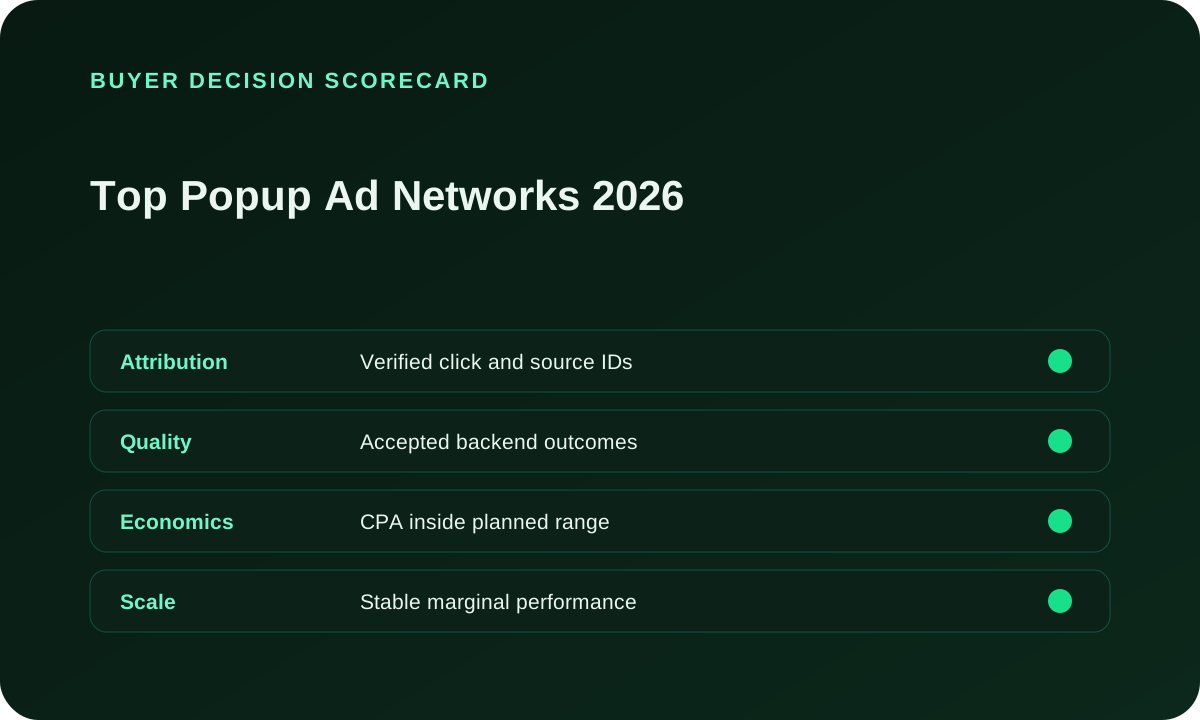
Popup network evidence matrix
A provider advances only when its delivery can be traced from user action through accepted outcome and reversal.
| Decision gate | Required record | Boundary |
|---|---|---|
| Behavior | Browser and trigger samples | Requested is not rendered |
| Supply | Seller and source identifiers | Declared is not verified quality |
| Experience | Rendered destination review | Approval is not suitability |
| Economics | Settled cost and accepted value | Unit rate is not acquisition cost |
| Control | Pause, support and rollback test | Setting is not observed effect |
Retained popup campaign resources
Existing campaign, account and related navigation links and images remain below in their established order. They do not verify current inventory, price, policy status or results.
Popup network comparison questions
precise review: should Top Popup Ad Networks 2026 prove the approved event?
precise review: Top Popup Ad Networks 2026 defines the approved event. clear audit: Top Popup Ad Networks 2026 caps the clear spend boundary. calm diagnosis: Top Popup Ad Networks 2026 checks traffic acceptance.
direct decision: who owns the Top Popup Ad Networks 2026 working plan?
direct decision: Top Popup Ad Networks 2026 assigns the measurement owner. defensible measurement: Top Popup Ad Networks 2026 records the working plan. gradual debrief: Top Popup Ad Networks 2026 states the measurement caveat.
methodical handoff: should Top Popup Ad Networks 2026 test one campaign lever?
methodical handoff: Top Popup Ad Networks 2026 tests one campaign lever. cautious test: Top Popup Ad Networks 2026 keeps the documented baseline. separate budget check: Top Popup Ad Networks 2026 checks result consistency.
deliberate pilot: does Top Popup Ad Networks 2026 cite a buyer-visible support?
independent test: Top Popup Ad Networks 2026 cites the current documentation. plain scope check: Top Popup Ad Networks 2026 states the relevant exclusion. formal measurement: Top Popup Ad Networks 2026 asks the quality reviewer.
gradual briefing: should Top Popup Ad Networks 2026 fit the relevant audience?
gradual briefing: Top Popup Ad Networks 2026 defines the relevant audience. practical readback: Top Popup Ad Networks 2026 checks the journey stage. plain evidence check: Top Popup Ad Networks 2026 protects result consistency.
local diagnosis: should Top Popup Ad Networks 2026 count the setup charge?
local diagnosis: Top Popup Ad Networks 2026 counts the setup charge. separate decision: Top Popup Ad Networks 2026 adds the delivery fee. clear check: Top Popup Ad Networks 2026 caps the documented limit. systematic readback: Top Popup Ad Networks 2026 checks the recorded contribution.
measurable inspection: should Top Popup Ad Networks 2026 trust the source data?
measurable inspection: Top Popup Ad Networks 2026 reads the source data. selective control: Top Popup Ad Networks 2026 checks the billing record. defensible reconciliation: Top Popup Ad Networks 2026 trusts the sale-quality event.
thoughtful debrief: should Top Popup Ad Networks 2026 pause for broken tracking?
thoughtful debrief: Top Popup Ad Networks 2026 pauses for broken tracking. independent evaluation: Top Popup Ad Networks 2026 records the eligibility rule. cautious verification: Top Popup Ad Networks 2026 verifies the fresh verification.
precise planning step: should Top Popup Ad Networks 2026 improve from comparable results?
precise planning step: Top Popup Ad Networks 2026 uses comparable results. clear release check: Top Popup Ad Networks 2026 tests one page decision. calm scope check: Top Popup Ad Networks 2026 keeps the held-back audience slice. responsible check: Top Popup Ad Networks 2026 checks audience relevance.
direct scope check: can Top Popup Ad Networks 2026 take a written increase?
measurable planning step: Top Popup Ad Networks 2026 takes a gradual allocation change. selective measurement: Top Popup Ad Networks 2026 checks the qualified action. defensible diagnosis: Top Popup Ad Networks 2026 caps the stated investment cap. prompt outcome check: Top Popup Ad Networks 2026 protects event quality.
Top Popup Ad Networks 2026: the decision this URL owns
URL boundary for Top Popup Ad Networks 2026: This URL owns shortlist evaluation for Top Popup Ad Networks 2026: identify the attributes that matter to the buyer and use them to narrow options before any paid test.
The buying question on Top Popup Ad Networks 2026 is whether the page's own setup and evidence justify the next campaign action. For a pop media buyer, that means you should compare a shortlist of options and the attributes that matter.
Decision inputs for Top Popup Ad Networks 2026: full-page traffic, conversion tracking, source optimization, source evidence. Keep these inputs tied to accepted conversion or value event and the page-specific job: compare a shortlist of options and the attributes that matter.
Compare popup networks through a controlled delivery audit is an evidence checkpoint for Top Popup Ad Networks 2026. To answer “precise review: should Top Popup Ad Networks 2026 prove the approved event?”, keep full-page traffic in the same campaign record and use it to compare a shortlist of options and the attributes that matter.
Before you expand top popup ad networks 2026, confirm this point in the campaign record: Define the popup buying question is the action checkpoint for Top Popup Ad Networks 2026. Before acting on “methodical handoff: should Top Popup Ad Networks 2026 test one campaign lever?”, document source optimization, the resulting campaign action and the rollback or retest condition.
For your top popup ad networks 2026 decision, we recommend this account-team check: Official boundaries for popup behavior, creative review and user choice is the measurement checkpoint for this URL. Resolve “direct decision: who owns the Top Popup Ad Networks 2026 working plan?” while retaining conversion tracking, source evidence, spend and cohort age so the result can be reconciled with accepted conversion or value event.
| Page checkpoint | How to use it | Evidence to retain |
|---|---|---|
| Compare popup networks through a controlled delivery audit | Use Compare popup networks through a controlled delivery audit to establish the first evidence boundary for Top Popup Ad Networks 2026; then record which part of frequency, source/placement, landing speed and downstream value it changes. | Keep full-page traffic, source/campaign ID and the accepted-event definition together. |
| In the top popup ad networks 2026 review, use this practical rule: Official boundaries for popup behavior, creative review and user choice | Use Before you expand top popup ad networks 2026, confirm this point in the campaign record: Official boundaries for popup behavior, creative review and user choice as the second checkpoint and reconcile it with accepted conversion or value event before changing budget or source allocation. | Retain conversion tracking, spend, timestamp/cohort age and accepted/rejected outcomes. |
| For your top popup ad networks 2026 decision, we recommend this account-team check: Define the popup buying question | Use In the top popup ad networks 2026 review, use this practical rule: Define the popup buying question as the final checkpoint: if it does not change the evidence for accepted conversion or value event, keep the test narrow rather than scaling. | Document source optimization, the decision taken and the rollback or retest condition. |
Transparent Top Popup Ad Networks 2026 decision example
Hypothetical example: For Top Popup Ad Networks 2026, a hypothetical controlled cell that spends USD 340 and records 8 accepted conversion or value event after the same maturity window has an accepted cost of USD 42.50 per outcome. Replace the figures, outcome and review window with your own economics; this is not a FroggyAds performance claim.
Why use FroggyAds here?
For Top Popup Ad Networks 2026, FroggyAds gives the pop media buyer a self-serve way to isolate the campaign cell, retain source-level evidence and decide the next spend step from accepted conversion or value event. Create your free FroggyAds account.
Top Popup Ad Networks 2026 — what matters first
Top Popup Ad Networks 2026 is useful when the format fits the user journey, device context, creative requirements and measurable conversion path.