Agency selection and account control

Media Buying Agency: Choose What You Delegate

Selecting a media buying agency means deciding which work to delegate and which decisions your business must retain. Compare the proposed scope, agency fees, account ownership and reporting before you approve media spend. We show you how to make that comparison concrete, then use FroggyAds for the self-serve paid-media execution that fits your plan.

media buying agency
Media Buying Agency operating model for intent, creative, budget, measurement and economics

What should you verify before appointing a media buying agency?

Quick answer: Delegate a defined buying job with an agreed fee basis, spending authority and review process. Retain ownership of the offer, customer acceptance rule and commercial budget. Ask the agency to demonstrate the reporting and handover your engagement needs. Choose FroggyAds when your team or chosen operator wants direct self-serve control of the paid campaign, with the business outcome verified in your own records.

SectionDecision to verify
What media buying agency means in practiceConfirm scope, fee basis, actual account access and the records available at handover.

For video billing-unit context, consult Google Ads: Cost-per-view definition.

What work should the agency actually own?

Agency scope should name the work you are buying: research, campaign preparation, buying, monitoring, creative coordination or reporting. A proposal listing every marketing activity does not tell you who will carry it out. Ask which person owns each deliverable and what your team must supply. Separate an ongoing operating responsibility from a one-time setup task before comparing fees.

Account ownership needs practical verification. Identify the advertising accounts, analytics properties, creative files and customer records involved, then confirm the actual access model and platform conditions for each. A statement that the client owns everything is incomplete if nobody can demonstrate access or recover the required records. Check this before the relationship depends on a single operator.

Delegation works best when the advertiser keeps a clear commercial role. Your business confirms the offer, approves its claims and decides which customer outcomes count. The agency can recommend media actions and operate within its agreed authority. We recommend making those boundaries explicit so a buying report cannot quietly replace the business definition of success.

Set the commercial objective before discussing agency capacity

Objectives should describe the customer result your business needs, such as qualified enquiries or completed orders, together with the applicable review window. Give the prospective buyer examples of an accepted and rejected outcome. A team that understands those differences can propose a relevant test; a promise to increase clicks leaves the central buying question unresolved.

Audience decisions belong in the brief with their practical constraints. State the markets you can serve, the intended customer and the receiving experience. Ask how the agency will use the actual targeting options available for the campaign. Avoid selecting a partner purely because its presentation lists many data signals that your offer, permissions or buying route cannot use.

Economics should include agency fees as well as consumed media. Establish what your business can commit to the pilot and which cost measure will guide the next allocation. Confirm how setup, creative, technology and any pass-through charges enter that measure. A proposal can look efficient on media-only acquisition cost while exceeding the total cost your business can afford.

Make the proposed operating structure inspectable

Architecture should connect the agreed scope with real campaign objects. Ask the agency to show how an offer, audience, creative and destination will be named and reviewed. Confirm which records belong in the buying account and which stay in your analytics or customer systems. The structure should help another authorised reviewer identify the campaign without depending on the original buyer's memory.

Naming conventions should make meaningful versions distinguishable. Record the offer, market, creative and destination version your team approved, then retain the identifiers your actual reports support. A copied campaign needs a traceable relationship to its source, especially if tracking or the acceptance rule changes. Verify the supported reporting detail instead of assuming every platform supplies identical fields.

Exploration and routine operation need separate authority. A buyer might adjust bids within an approved range while a new market or offer requires another decision. Agree what can change during the pilot, what must stay comparable and when the advertiser will be contacted. That distinction lets the agency respond to an operational issue without making an unapproved commercial commitment.

Evidence to request before appointing a buyer

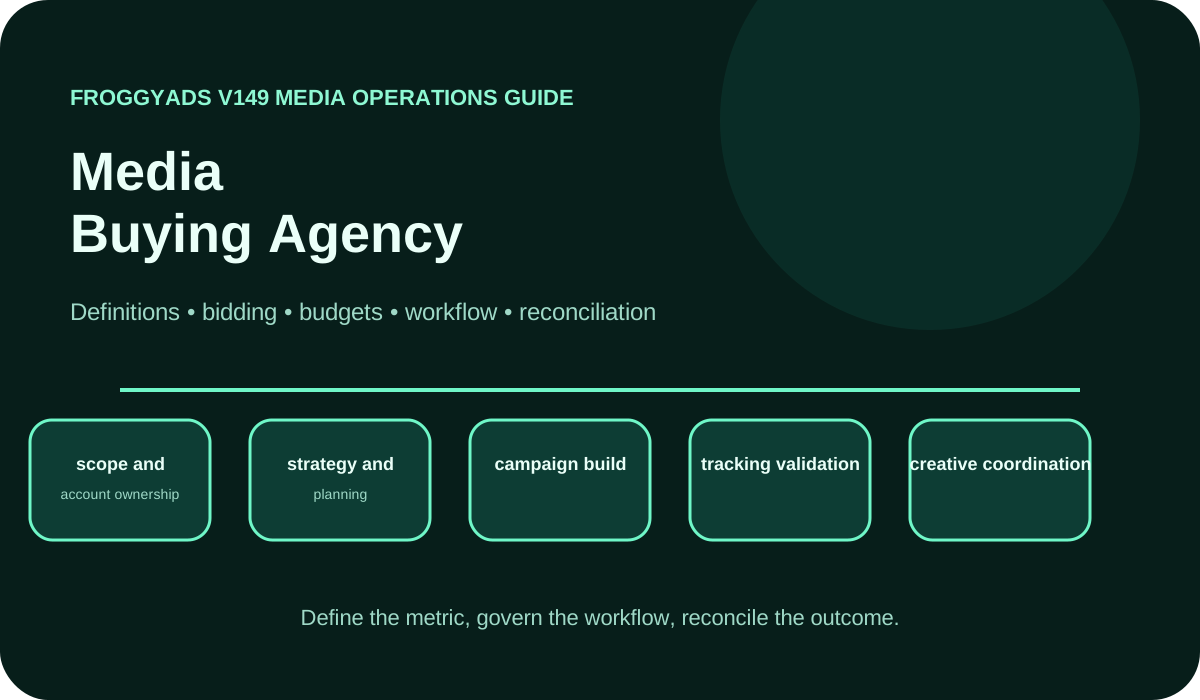
Score the proposal by what the agency can demonstrate for your actual scope. Request a suitable sample with sensitive client information removed, then ask how its records would support your next decision. Treat an unavailable dimension as a stated limitation, not an invitation to invent precision. The table below gives each operating responsibility a concrete proof request.

Decision layerOperating requirementEvidence required
scope and account ownershipName the business owner and verify the actual access model.Account list, access demonstration and recovery contact.
strategy and planningExplain why the proposed audience and format fit the offer.Written brief with exclusions and the initial spending boundary.
campaign buildIdentify the settings the buyer can change without further approval.Example configuration and a dated change record.
tracking validationTest the receiving route and the actual conversion definition.Test action, observed records and unresolved tracking limits.
creative coordinationConnect the approved creative with its receiving page.Ad and destination versions with the relevant approvals.
optimization cadenceSet review points and an escalation owner.Example review note identifying the evidence and next action.
reporting and reconciliationSeparate media, fees and accepted customer outcomes.Sample reconciliation with a consistent cost basis.
handover and portabilityDemonstrate which assets and records can be handed over.Verified handover checklist and an actual usable sample.

Prepare the buying pilot

Connect the agreed agency scope with a FroggyAds campaign

FroggyAds gives your team or chosen operator a self-serve place to execute the paid-media part of the plan. Select a supported format, define relevant targeting and set the approved bid and campaign budget. Keep responsibility for account access and operating permissions consistent with the platform's actual rules and your internal arrangements.

Create My Free Account
Illustration of audience targeting controls for a media buying agency test

Give creative and destination approval a named owner

Messaging approval should cover the real offer and the customer action it invites. Decide who supplies the substantiation for a claim, who checks material conditions and who signs off the final asset. An agency may prepare the creative, but the advertiser still needs to confirm the product or service being described. Keep a recoverable copy of the approved version.

Landing-page continuity is part of the buying engagement. Confirm who can repair a broken form, update an unavailable offer or correct a mismatch between the ad and destination. A buyer cannot resolve every website fault through targeting or bids. Agree a contact route and the campaign response to a receiving-path failure before delivery starts.

Validation should follow the actual customer route on the intended device and market. Test the ad destination, relevant consent states and accepted action using your own setup. Ask the buyer to show the resulting campaign and business records at the granularity available. Resolve material tracking uncertainty before a performance promise becomes the reason to extend the agency appointment.

Separate agency compensation from the campaign budget

Budget approval should identify the pilot commitment, the amount allocated to media and the services charged alongside it. Confirm which person can approve an increase. Your campaign budget controls media exposure; it does not automatically cover every agency invoice or prove that more demand can be handled profitably. We recommend a bounded first commitment with a defined review point.

Bidding recommendations need a clear reason tied to the buying model in use. Ask what the proposed adjustment is intended to change and how its effect will be reviewed. Keep the accepted customer definition stable while testing a bid decision. Do not infer that an automation or bidding option offered by another platform is available in your FroggyAds campaign.

Pacing reports should compare the agreed allocation with consumed spend and the remaining room. A buyer needs to explain unexpected acceleration, limited delivery and any proposed shift between campaign scopes. Require approval where that shift changes the original commercial commitment. Delivery volume can be monitored before later customer outcomes mature, provided the report makes that timing difference visible.

Agree how agency results will be reconciled

Measurement rules should define the accepted outcome, cost basis, currency, time zone and review window. Agree who supplies the business record and how corrections will appear. An agency cannot fairly assess customer quality if the advertiser never returns acceptance information. Equally, a platform conversion total should not become the accepted-customer number without the required checks.

Delivery records show what the buying system measured and charged. Analytics records show measured visits and attributed actions. Business records establish accepted leads, orders, subscriptions or other outcomes. Keep these layers distinct and reconcile the identifiers your actual setup preserves. Where the join is incomplete, state the limitation and use the highest level of detail you can verify.

Cohorts should have comparable time to reach acceptance before the agency recommends a larger allocation. Show pending outcomes separately and keep later reversals visible. A recently launched campaign may look weaker simply because qualification has not finished. The review should identify whether the result reflects a media difference, a business delay or a reporting fault.

Calculate the cost measure the appointment will be judged on

Media cost + platform or service fees + creative and measurement cost + attributable operating effort, divided by the accepted outcome count. Compare that result with gross profit or approved lifetime-value contribution, not only platform conversions.

Contribution before media and agency costs can inform an affordable acquisition target, but it needs a business-approved definition. Include the relevant margin, fulfilment or service costs and expected reversals in your own calculation. Agree whether the agency review uses media-only acquisition cost or the full pilot expense. The worked example below shows why those denominators and cost categories matter.

Select the buying format

Match the buying plan with a supported FroggyAds format

Format selection should follow the offer and receiving experience. Ask the operator why push, native, display or pop suits the message, then confirm the options available for the intended campaign. We give you direct media controls for that test. Keep agency service charges separate from the format's billing unit and the customer outcome used for review.

Create My Free Account
Illustration comparing advertising formats for media buying agency execution

Require a test plan another buyer can understand

Tests should identify the question, intended audience, changed condition, spending limit and review point. Ask what the result can establish and what remains uncertain. An agency that explains a failed hypothesis can still provide useful work; an unexplained change in a blended chart gives the advertiser less guidance about the next commitment.

Isolation helps explain the result. Hold the offer, destination and acceptance rule comparable where possible while testing one material buying change. If several changes must happen together, record the bundle and avoid attributing the outcome to one component. An ordinary before-and-after observation is not automatically evidence of incremental lift.

Optimization should resolve the problem the evidence identifies. Repair a broken destination or missing tracking before interpreting customer quality. Review mature accepted outcomes before extending spend, and keep the reason for each material adjustment. FroggyAds lets your buyer act on relevant targeting, bid, budget and supported source decisions within the commitment you approved.

Ask how quality findings reach a buying decision

Quality reporting should distinguish a measured delivery anomaly from an accepted-customer issue. Ask which source dimensions are available and which are aggregated or unknown. The agency should explain how it investigates a concern and when it limits the affected campaign. A claim that a single platform control eliminates every invalid event is not a complete investigation method.

Rejections need meaningful business reasons. Duplicate enquiries, ineligible customers and cancellations can require different responses. Return the appropriate aggregated feedback to the buyer without exposing unnecessary personal details. Check whether an apparent improvement in raw acquisition cost survives your acceptance rule before allowing it to justify another agency allocation.

Incidents need an agreed response owner. Specify how the team handles unexpected spend, tracking loss, a broken receiving page or an inaccurate claim. Confirm which campaign actions the operator can take immediately and which require a decision from the advertiser. Record the recovery check so delivery does not resume while the original problem remains unresolved.

Make oversight workable throughout the engagement

Governance should reflect the real account and access model. Confirm the named business owner, authorised operator, recovery route and records needed for oversight. Verify supported platform permissions and handover conditions rather than assuming the same model applies everywhere. Keep sensitive customer records in the systems and access arrangements your business has approved.

Daily delivery checks and commercial reviews serve different purposes. Agree when the buyer checks pacing and technical interruptions, when accepted customers will be reviewed and when fees and invoices will be reconciled. Choose a cadence your team can maintain. A fixed calendar is less useful than a clear trigger tied to the evidence available for the decision.

Risk discussions should end with a practical question or control. Who can inspect spend? What proves that the receiving page works? Which records remain available if the operator leaves? Record the answer, any limitation and its owner. This turns broad promises about transparency into an operating arrangement the advertiser can assess.

Approve an agency pilot through evidence milestones

Agree scope and responsibility

Scope approval comes first. Confirm the offer, desired customer, acceptance rule, fee basis and spending authority. Resolve missing responsibilities before paying for an operating service. The agency and advertiser should share the same description of the first campaign and the evidence needed for its review.

Validate access and tracking

Access and tracking need a real check. Demonstrate the account view required for oversight, follow the receiving route and inspect a test outcome. Record unavailable fields or unresolved issues. A persuasive proposal does not replace this preparation, especially when later reporting depends on records the advertiser has not yet agreed to supply.

Review the first customer cohort

Pilot review should put consumed media, service costs and customer status together. Inspect the accepted outcome count and the qualifications applied. Discuss material campaign changes, limitations and any operational incident. Ask the buyer to explain which finding supports the proposed next action rather than accepting a generic recommendation to increase spend.

Decide the next commitment

Continuation should follow the agreed quality, cost and operating requirements. Keep the pilot unchanged for more mature evidence, approve a bounded adjustment, repair a specific fault or stop the affected work. Name the owner and next review point. Avoid an automatic larger appointment simply because the first invoice period has ended.

Extend the engagement without losing the comparison

Expansion can change the work the advertiser needs from the agency. More campaigns may require more creative coordination, customer feedback or reporting time. Review scope and compensation alongside the media decision. A higher budget should not silently purchase a different service or authorise new markets without the business owner understanding the change.

Marginal results deserve their own review when a campaign grows. Compare the newer accepted-customer cohort and its cost with the earlier one, using the same maturity rule. A good historical account average can hide a weaker recent allocation. Ask the buyer to explain the new commitment on its own terms before approving another increase.

Recovery and handover should be possible before they become urgent. Verify which campaign settings, creative files, reports and decision notes can be retained under the actual platform and engagement terms. Keep an appropriate earlier configuration and a named contact. Test a small handover sample while the relationship is healthy rather than discovering missing records at departure.

Apply the agreed review

Run the paid-media part with a clear FroggyAds commitment

Turn the approved scope into a bounded campaign that your team or chosen operator can evaluate. We offer self-serve buying controls for the relevant paid-media decision. Keep the initial settings and your business acceptance rule with the campaign record, then use the next reviewed outcome to decide what work and spend are justified.

Create My Free Account
Illustration of a campaign launch checklist for media buying agency

Compare the partner with the work you actually need

Shortlisting should begin with the task and your internal capacity. A team with a ready offer and a buyer able to operate a focused campaign may value direct self-serve execution. A more complex programme may need outside coordination or specialist work. Evaluate that work specifically instead of treating an agency label as proof of better rates or outcomes.

Demonstrations make comparison more concrete. Ask each prospective partner to walk through the same brief, cost categories, reporting question and handover requirement. Notice where the approach differs and which limitation affects your decision. A sample from an unrelated client or channel can show a capability without establishing that it fits your actual campaign.

Decisions should record the tested scope, confirmed capabilities, unresolved conditions and next commitment. Keep the reasons for retaining, revising or ending the agency work. That record helps your team distinguish a service problem from an offer, receiving-page or measurement problem that the advertiser must address.

How does FroggyAds support your agency plan?

FroggyAds is a self-serve media buying platform for advertisers and media buyers. It supports campaign activation, audience and device targeting, source controls, budgeting and performance workflows across push, native, display and pop inventory. It is not presented as a PPC agency, SEO service, CRM, search engine or universal analytics system.

Choose FroggyAds self-serve media buying for direct control of a focused paid campaign. Your team or chosen operator can use supported targeting, bids, budgets and source evidence to execute the agreed test. Keep the commercial outcome and responsibility for agency services in your own business review. We help you put a clear buying decision into practice.

Frequently asked questions

What does a media buying agency manage?

A media buying agency can plan inventory, negotiate or purchase placements, operate campaigns, monitor delivery and report results. The exact service boundary belongs in the agreement.

When is an external buying agency useful?

Specialist execution can be useful when it adds relevant skills or operating capacity your team cannot maintain. Define the work and evidence you need before appointing an external buyer. Internal ownership of the offer, customer economics and spending authority remains necessary.

What should an agency media brief include?

Provide audience, offer, approved claims, destinations, conversion definition, geographic limits, budget, timing, exclusions and escalation contacts. Note any non-negotiable compliance requirement.

How should agency media fees be compared?

Compare retainers, spend percentages, setup, creative, technology, data, minimums and pass-through costs. Ask how incentives change when spend rises.

What inventory transparency should agencies provide?

Request channel, exchange, site or placement detail where available, along with exclusions and quality controls. Reporting should distinguish unknown or aggregated supply.

Who should own media buying accounts and data?

Define ownership contractually before launch. Direct client access, export rights and documented configurations make oversight and transition safer.

Which business evidence should determine whether a media buying agency performs well?

Use qualified business outcomes, contribution, data quality, pacing and operational reliability. Platform-reported conversions need definitions and independent checks.

What makes an agency test plan credible?

Credible test plans state the hypothesis, changed condition, audience, budget, review window and decision rule. They explain how results will be interpreted and which safety condition can stop delivery earlier. A plan should acknowledge the limits of the comparison rather than promise a predetermined improvement.

What should a media agency report contain?

Include spend, delivery, quality, conversions, economics, changes, uncertainty, incidents and next decisions. Every material number needs a source and consistent definition.

When should a media buying agency be changed?

Consider change after unresolved transparency, control, quality, compliance or economic failures. Secure account access, data, creative and continuity before ending the relationship.

Official sources used for this guide

Official references below explain particular billing units, ad-operations workflows and accessibility concepts. They provide context for evaluating the work an agency proposes. A Google bidding document does not establish a FroggyAds feature, and a standards document does not certify a particular agency or campaign.

Use an operating worksheet to verify the appointment

Worksheet evidence should come from the proposed engagement. Ask for examples and demonstrations that answer the questions below, with unrelated client information removed. Record a limitation openly when an asset, field or permission is unavailable. The worksheet supports a buying decision; it is not a certification or performance score.

Definition and measurement rules

Definitions belong in a shared record before reporting starts. Name the customer event, denominator, relevant exclusions, currency and acceptance date. Give the agency a business owner who can resolve ambiguity. The same outcome should mean the same thing in a campaign review, an incentive calculation and a decision about the next appointment.

Exclusions should explain how the business treats duplicated, rejected, cancelled or still-pending actions. Ask the buyer to show those statuses separately when the data permits it. Retain the original definition and note later changes. A revised reporting rule should not make an earlier decision impossible to understand.

Decision owner and approval path

Approvals need a named owner and a practical route. Distinguish routine media adjustments within the agreed scope from decisions that change the commercial commitment. The agency should know who can answer a budget or claim question and what to do while an answer is pending. Responsibility should remain visible when several teams contribute.

Material changes deserve a recorded review: a new market, offer, conversion definition, receiving route or larger commitment can alter the pilot. Explain the proposed change, its reason and the evidence required afterwards. Preserve the previous conditions where useful so the advertiser can assess what the new appointment actually added.

Forecast range and scenario planning

Forecasts should label their assumptions. Ask what the proposal assumes about media cost, acceptance rate, conversion delay and the receiving team's capacity. Test the assumption that most affects the next decision rather than adopting an attractive single-number projection. A planning estimate is not a promised acquisition price or guaranteed campaign volume.

Failure cases make the commitment more understandable. Agree the largest acceptable pilot expense and the conditions that would justify stopping or repairing the campaign. Include the possibility that reporting or qualification takes longer than expected. Decide how that delay affects the appointment before it becomes pressure to buy more media.

Source and placement evidence

Source reporting should be requested at the level the actual buying system provides. Inspect a representative report and identify available campaign, creative, source, market or device fields. If a finer dimension cannot be verified, state the limitation. Avoid requiring the agency to make placement-level commercial claims from campaign-level customer records.

Segmentation should support a decision the advertiser can act on. A market you cannot serve, a broken device experience and a recently launched cohort need different treatment. Keep the relevant counts and dates with the segment rate. Do not turn a very small group into a durable quality conclusion without suitable follow-up evidence.

Measurement reconciliation

Reconcile media spend, measured activity and accepted customers using the identifiers your actual setup preserves. Explain whether differences come from event definitions, attribution, reporting delay or an unresolved fault. The agency and advertiser need different source records to complete this work; neither should be expected to infer the missing business outcome from delivery alone.

Variances need an explanation, responsible owner and next check. Keep the source totals, scope and review date so another authorised person can reproduce the comparison. When a later correction changes an acquisition-cost result, append it visibly. This makes oversight and eventual handover more useful than a presentation that only shows the latest favourable number.

Launch a controlled paid-media test

Our self-serve campaign controls support the paid-media execution behind an agreed agency plan. Set the relevant format, targeting, bids and campaign budget, then inspect the reporting your actual account provides. Keep the advertiser's accepted-customer record alongside that evidence before deciding on another commitment.

Create My Free Account
Search intent and buyer decision

Keep the agency appointment tied to an advertiser decision

Ownership of an agency engagement is a practical advertiser decision. Use What Is Media Buying for the broader buying model; here, verify the service scope, compensation, authority, evidence and handover that your actual appointment requires.

Operator requirements should follow the actual scope. A buyer running one focused paid test needs a usable brief and clear authority; a partner coordinating several channels may need additional work and reporting. Confirm those responsibilities explicitly. We recommend choosing the service around the decision it must support, then using FroggyAds where self-serve paid execution fits.

CheckpointPage-specific actionEvidence to keep
FitConfirm the buying work and the people responsible for it.Keep the written scope and the actual access demonstration.
TestRun the agreed pilot inside its approved commitment.Retain media costs, service charges and accepted outcomes.
DecisionApprove the next scope or resolve the identified failure.Save the review decision and verified handover records.

Hypothetical calculation: a pilot consumes USD 300 in media and produces six accepted customers, giving media-only acquisition cost of USD 50.0. If the agreed service charge is USD 60 and creative preparation costs USD 40, total pilot expense is USD 400 and total acquisition cost is approximately USD 66.67. Those invented charges illustrate cost classification; they are not FroggyAds prices or market fee benchmarks. Decide which cost basis your approval rule uses before comparing a proposal.

Start the paid-media part of your agreed plan with FroggyAds when you want direct self-serve control of targeting, bids and budgets. Keep the receiving offer, accepted-customer definition and review point clear, then approve another commitment only when its evidence supports it. Create your free FroggyAds account.

Direct answer

Media buying agency: the first decision to settle

Retain a clear commercial role when you appoint a media buyer. Decide what work you need, what it costs, how it will be reviewed and which records remain available. Choose FroggyAds for the direct self-serve buying controls that support a defined paid campaign, then let your accepted-customer evidence guide the next commitment.


