
Keyword ownership
- carrier targeting advertising
For mobile offers, the network matters. Target by carrier or Wi-Fi vs mobile data on FroggyAds to match operator-billing and connection-sensitive campaigns to the right users.
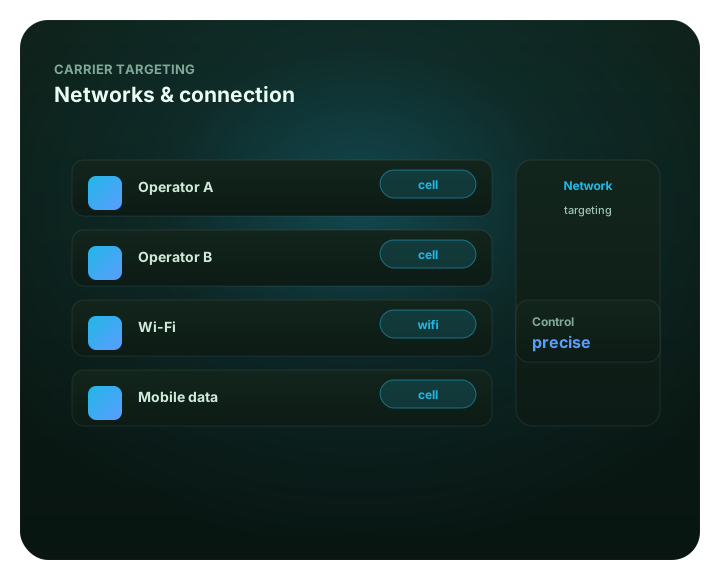
Carrier targeting: Use FroggyAds to select eligible mobile operators and separate Wi-Fi from cellular traffic. Apply the country, device and connection requirements of your offer, then compare approved subscriptions, installs or other conversions by source. A carrier label helps guide delivery; the offer's own eligibility checks still determine whether a visitor can complete the action.
| Section | Distinct excerpt from this page |
|---|---|
| Built for mobile-first offers | Verify an operator-billed offer's supported carrier and connection requirements. Test download completion by connection type rather than assuming Wi-Fi will perform better. |
| See carrier targeting inside the platform | Carrier-billing and operator-specific offers — See carrier targeting inside the platform. |
| Specific carriers | Target individual mobile operators – essential for carrier-billing and operator-specific offers. |
Reference for Carrier Targeting: Control Spend & Improve Performance: Google Ads location targeting.
A carrier-specific offer needs more than a broad mobile audience. Confirm the supported operator and billing route before launch; some flows require cellular connectivity, while others have different requirements. For a large download, compare Wi-Fi and cellular results instead of assuming one connection will convert better. Our carrier and connection controls help you set up those separate tests.
We let you select supported mobile carriers, separate connection types and manage the resulting campaigns with their own bids and budgets. Combine these choices with country, device, OS and source controls where needed. Start with the restrictions the offer actually requires, and use conversion results to decide whether a narrower segment justifies further spending.
Manage carrier campaigns and source decisions in our self-serve dashboard. Keep an operator-specific offer separate from a general mobile test so its eligibility, spending and conversion results remain clear. When a campaign underperforms, inspect the destination and individual sources before excluding a whole network.
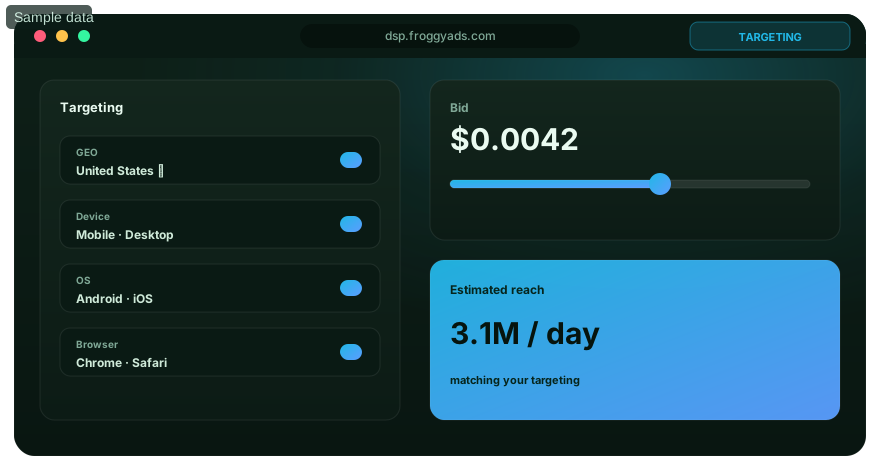
Connection type can make or break mobile campaigns.
Target individual mobile operators – essential for carrier-billing and operator-specific offers.
Separate cellular users from Wi-Fi to match connection-sensitive offers and downloads.
Bid more where a carrier's users convert and cut the networks that do not.
Use carrier selection for eligibility, Adscore and internal controls for traffic screening, and approved conversions to judge commercial quality.
Target carriers on FroggyAds
Open an account and target by network from $50.
Yes, where that operator is available in the campaign's targeting options. Our carrier controls help you reach a network that your offer supports instead of paying for a broad mobile audience. Combine the carrier with the relevant country and device requirements, then check delivery and conversions by source. Available operators depend on the market and inventory you select.
A carrier identifies the mobile network used for the connection; Wi-Fi targeting separates a connection type rather than identifying the visitor's mobile subscription. A phone can use either Wi-Fi or cellular data. FroggyAds lets you separate these buying choices so a network-dependent offer and a download campaign can be tested under the connection conditions that matter to each.
Confirm the permitted country, operator, connection requirements and billing journey with the offer owner. Some flows depend on cellular connectivity; do not assume that requirement applies to every offer. Test the actual destination and use approved subscriptions or payments as your conversion goal, rather than a click on the billing button. Our targeting helps you apply the offer's eligibility rules before spending.
Wi-Fi is worth a separate test when download size or the installation experience may affect completion. It is not automatically a faster connection or a more valuable audience. Compare completed installs and activation, not just store visits. Keep the app version, country and device requirements comparable so you can tell whether the connection split improves the acquisition cost.
You can separate carrier campaigns in FroggyAds and manage their bids and budgets independently. This helps prevent a large operator from consuming the funds intended for another network test. Set the allocation around the offer's value and the volume available, then review approved conversions. A familiar carrier name is not, by itself, a reason to pay more for its traffic.
Check campaign approval and funding first, then review the overlap between carrier, country, device, OS and source filters. A small eligible audience or an uncompetitive bid can limit delivery. Remove only restrictions the offer does not need. Our support team can help you review the setup when a required operator is unavailable; switching to an ineligible network would not solve the offer's problem.
No. A connection signal is not a complete subscriber or billing check. Roaming, a switch to Wi-Fi and classification differences can affect what the buying platform and offer system observe. Keep the offer owner's final eligibility and payment checks in place. Use our source reports to investigate repeated mismatches without treating a network label as permanent personal identity.
Compare the same offer and reporting period, including rejected subscriptions or payments. In a hypothetical test, $60 for 12 approved subscriptions costs $5 each; $60 for six costs $10 each. Those figures are illustrative, not FroggyAds results. Check source concentration and conversion delay before reallocating money: a difference caused by one placement should not become a blanket judgment about an operator.
Carrier selection is an eligibility control, not a guarantee that every visit is genuine. We use Adscore and internal traffic-quality controls to help screen invalid activity. Combine that screening with your own subscription, lead or order checks and our source-level controls. Investigate repeated anomalies at the source level rather than assuming cellular traffic is always valid or Wi-Fi traffic is inferior.
Prepare the eligible offer and tracking route, choose a supported carrier and connection type, and set a separate campaign spending limit. Our $50 minimum deposit funds your account; it is not an operator fee or a fixed package of subscribers. Create your free FroggyAds account to configure the campaign, then use approved conversions to guide the next network or source test.
Create your account and prepare a carrier-targeted campaign with the right operator, destination and conversion goal.
Carrier targeting filters or segments mobile delivery by network operator or connection data where available. It is useful for carrier-specific offers and connectivity analysis, but the signal must be validated because roaming, Wi-Fi and data quality can change classification.
Event: delivery admitted by the selected targeting and exclusion rules.
Decision: whether the segment produces distinct useful behavior that justifies separate control.
Primary risk: treating modeled or best-effort signals as exact identity or guaranteed location.
| Layer | Evidence to preserve | Action rule |
|---|---|---|
| Delivery | Campaign, source, placement, device, GEO, schedule and creative identifiers where available. | Do not optimize a blended result when the controllable delivery units can be separated. |
| Measurement | Timestamped impression or click records, conversion identifiers, values, currency and acceptance status. | Reconcile platform data with first-party or partner records before a large budget change. |
| Quality | Session behavior, invalid-event signals, conversion validity, downstream value and repeat patterns. | Separate suspicious activity from ordinary low performance and document the evidence behind exclusions. |
| Change control | Previous settings, hypothesis, observation window, loss ceiling and rollback state. | Change one material variable at a time and restore the stable state when the declared stop rule is reached. |
Carrier targeting is most useful when the mobile network has a direct relationship to eligibility, pricing, connectivity or offer acceptance. It should be tested with roaming, Wi-Fi and signal-quality limitations in mind.
For carrier targeting advertising, Write the business question before selecting a setting or report. State which event should change, which segment is eligible and what result would justify the next action. The practical evidence should include the configuration that was active, the source or placement involved, the creative and destination version, and the event status at the agreed reporting cutoff. This keeps the analysis tied to a specific campaign state instead of a blended historical average that cannot be reproduced.
Carrier targeting is most useful when the mobile network has a direct relationship to eligibility, pricing, connectivity or offer acceptance. It should be tested with roaming, Wi-Fi and signal-quality limitations in mind. In this part of the workflow, compare the newest test cohort with a stable baseline, normalize time zone and currency, and preserve the original identifiers through every permitted handoff. The decision should be reversible: continue, limit, investigate or restore the previous state. Avoid changing several variables at once, because a larger result without causal clarity is difficult to repeat safely.
For carrier targeting advertising, Map the impression or click to the source identifier, destination session, conversion record and final accepted value. Keep timestamps and status changes available for reconciliation. The practical evidence should include the configuration that was active, the source or placement involved, the creative and destination version, and the event status at the agreed reporting cutoff. This keeps the analysis tied to a specific campaign state instead of a blended historical average that cannot be reproduced.
Carrier targeting is most useful when the mobile network has a direct relationship to eligibility, pricing, connectivity or offer acceptance. It should be tested with roaming, Wi-Fi and signal-quality limitations in mind. In this part of the workflow, compare the newest test cohort with a stable baseline, normalize time zone and currency, and preserve the original identifiers through every permitted handoff. The decision should be reversible: continue, limit, investigate or restore the previous state. Avoid changing several variables at once, because a larger result without causal clarity is difficult to repeat safely — Establish the measurement chain.
For carrier targeting advertising, Use a narrow campaign, stable creative set and fixed loss ceiling. Hold unrelated targeting and budget variables steady so the observed difference can be attributed to the tested change. The practical evidence should include the configuration that was active, the source or placement involved, the creative and destination version, and the event status at the agreed reporting cutoff. This keeps the analysis tied to a specific campaign state instead of a blended historical average that cannot be reproduced.
Carrier targeting is most useful when the mobile network has a direct relationship to eligibility, pricing, connectivity or offer acceptance. It should be tested with roaming, Wi-Fi and signal-quality limitations in mind. In this part of the workflow, compare the newest test cohort with a stable baseline, normalize time zone and currency, and preserve the original identifiers through every permitted handoff. The decision should be reversible: continue, limit, investigate or restore the previous state. Avoid changing several variables at once, because a larger result without causal clarity is difficult to repeat safely — Design the first controlled test.
For carrier targeting advertising, Separate only the dimensions that can change a decision. Excessive fragmentation creates small samples, unstable averages and operational work without producing clearer evidence. The practical evidence should include the configuration that was active, the source or placement involved, the creative and destination version, and the event status at the agreed reporting cutoff. This keeps the analysis tied to a specific campaign state instead of a blended historical average that cannot be reproduced.
Carrier targeting is most useful when the mobile network has a direct relationship to eligibility, pricing, connectivity or offer acceptance. It should be tested with roaming, Wi-Fi and signal-quality limitations in mind. In this part of the workflow, compare the newest test cohort with a stable baseline, normalize time zone and currency, and preserve the original identifiers through every permitted handoff. The decision should be reversible: continue, limit, investigate or restore the previous state. Avoid changing several variables at once, because a larger result without causal clarity is difficult to repeat safely — Segment without destroying volume.
For carrier targeting advertising, Document conversion windows, approval delays, refunds and late revenue. Compare cohorts at the same maturity rather than declaring a new segment weak because its outcomes have not settled. The practical evidence should include the configuration that was active, the source or placement involved, the creative and destination version, and the event status at the agreed reporting cutoff. This keeps the analysis tied to a specific campaign state instead of a blended historical average that cannot be reproduced.
Carrier targeting is most useful when the mobile network has a direct relationship to eligibility, pricing, connectivity or offer acceptance. It should be tested with roaming, Wi-Fi and signal-quality limitations in mind. In this part of the workflow, compare the newest test cohort with a stable baseline, normalize time zone and currency, and preserve the original identifiers through every permitted handoff. The decision should be reversible: continue, limit, investigate or restore the previous state. Avoid changing several variables at once, because a larger result without causal clarity is difficult to repeat safely — Protect against reporting delay.
For carrier targeting advertising, Define when a source is allowed, limited, investigated or blocked. Require a minimum evidence threshold and distinguish suspicious activity from normal low conversion performance. The practical evidence should include the configuration that was active, the source or placement involved, the creative and destination version, and the event status at the agreed reporting cutoff. This keeps the analysis tied to a specific campaign state instead of a blended historical average that cannot be reproduced.
Carrier targeting is most useful when the mobile network has a direct relationship to eligibility, pricing, connectivity or offer acceptance. It should be tested with roaming, Wi-Fi and signal-quality limitations in mind. In this part of the workflow, compare the newest test cohort with a stable baseline, normalize time zone and currency, and preserve the original identifiers through every permitted handoff. The decision should be reversible: continue, limit, investigate or restore the previous state. Avoid changing several variables at once, because a larger result without causal clarity is difficult to repeat safely — Create a source-level action rule.
For carrier targeting advertising, Keep the promise, format and landing-page experience aligned. A targeting or delivery change can alter device context and user intent, so creative performance must be reviewed again after material expansion. The practical evidence should include the configuration that was active, the source or placement involved, the creative and destination version, and the event status at the agreed reporting cutoff. This keeps the analysis tied to a specific campaign state instead of a blended historical average that cannot be reproduced.
Carrier targeting is most useful when the mobile network has a direct relationship to eligibility, pricing, connectivity or offer acceptance. It should be tested with roaming, Wi-Fi and signal-quality limitations in mind. In this part of the workflow, compare the newest test cohort with a stable baseline, normalize time zone and currency, and preserve the original identifiers through every permitted handoff. The decision should be reversible: continue, limit, investigate or restore the previous state. Avoid changing several variables at once, because a larger result without causal clarity is difficult to repeat safely — Coordinate creative and destination.
For carrier targeting advertising, Save the previous configuration, label the test window and record the hypothesis. Restore the stable state when cost, quality, discrepancy or compliance crosses the written boundary. The practical evidence should include the configuration that was active, the source or placement involved, the creative and destination version, and the event status at the agreed reporting cutoff. This keeps the analysis tied to a specific campaign state instead of a blended historical average that cannot be reproduced.
Carrier targeting is most useful when the mobile network has a direct relationship to eligibility, pricing, connectivity or offer acceptance. It should be tested with roaming, Wi-Fi and signal-quality limitations in mind. In this part of the workflow, compare the newest test cohort with a stable baseline, normalize time zone and currency, and preserve the original identifiers through every permitted handoff. The decision should be reversible: continue, limit, investigate or restore the previous state. Avoid changing several variables at once, because a larger result without causal clarity is difficult to repeat safely — Use change control and rollback.
For carrier targeting advertising, Include media cost, tracking, creative, landing-page operations, conversion approval, refunds and retained value. A cheaper platform metric can still create a more expensive customer outcome. The practical evidence should include the configuration that was active, the source or placement involved, the creative and destination version, and the event status at the agreed reporting cutoff. This keeps the analysis tied to a specific campaign state instead of a blended historical average that cannot be reproduced.
Carrier targeting is most useful when the mobile network has a direct relationship to eligibility, pricing, connectivity or offer acceptance. It should be tested with roaming, Wi-Fi and signal-quality limitations in mind. In this part of the workflow, compare the newest test cohort with a stable baseline, normalize time zone and currency, and preserve the original identifiers through every permitted handoff. The decision should be reversible: continue, limit, investigate or restore the previous state. Avoid changing several variables at once, because a larger result without causal clarity is difficult to repeat safely — Review economics beyond the platform.
For carrier targeting advertising, Require the result to persist across multiple periods or source groups. Increase one dimension at a time and monitor the newest spend separately so quality loss is visible before it dominates the blended average. The practical evidence should include the configuration that was active, the source or placement involved, the creative and destination version, and the event status at the agreed reporting cutoff. This keeps the analysis tied to a specific campaign state instead of a blended historical average that cannot be reproduced.
Carrier targeting is most useful when the mobile network has a direct relationship to eligibility, pricing, connectivity or offer acceptance. It should be tested with roaming, Wi-Fi and signal-quality limitations in mind. In this part of the workflow, compare the newest test cohort with a stable baseline, normalize time zone and currency, and preserve the original identifiers through every permitted handoff. The decision should be reversible: continue, limit, investigate or restore the previous state. Avoid changing several variables at once, because a larger result without causal clarity is difficult to repeat safely — Scale only repeatable evidence.
For carrier targeting advertising, Record missing identifiers, modeled signals, unsupported devices, privacy restrictions and platform-specific definitions. Clear limitations make the guidance trustworthy and prevent a generic rule from being applied outside its evidence. The practical evidence should include the configuration that was active, the source or placement involved, the creative and destination version, and the event status at the agreed reporting cutoff. This keeps the analysis tied to a specific campaign state instead of a blended historical average that cannot be reproduced.
Carrier targeting is most useful when the mobile network has a direct relationship to eligibility, pricing, connectivity or offer acceptance. It should be tested with roaming, Wi-Fi and signal-quality limitations in mind. In this part of the workflow, compare the newest test cohort with a stable baseline, normalize time zone and currency, and preserve the original identifiers through every permitted handoff. The decision should be reversible: continue, limit, investigate or restore the previous state. Avoid changing several variables at once, because a larger result without causal clarity is difficult to repeat safely — Document exceptions and limitations.
For carrier targeting advertising, End each reporting cycle with a specific action, owner and review date. A decision log makes future optimization faster because the team can see which assumptions were tested and what evidence changed them. The practical evidence should include the configuration that was active, the source or placement involved, the creative and destination version, and the event status at the agreed reporting cutoff. This keeps the analysis tied to a specific campaign state instead of a blended historical average that cannot be reproduced.
Carrier targeting is most useful when the mobile network has a direct relationship to eligibility, pricing, connectivity or offer acceptance. It should be tested with roaming, Wi-Fi and signal-quality limitations in mind. In this part of the workflow, compare the newest test cohort with a stable baseline, normalize time zone and currency, and preserve the original identifiers through every permitted handoff. The decision should be reversible: continue, limit, investigate or restore the previous state. Avoid changing several variables at once, because a larger result without causal clarity is difficult to repeat safely — Turn the review into a decision.
Direct answer: 3G and Wi-Fi are connection contexts, not automatic quality scores. Use connection-type targeting only when page weight, app delivery, billing eligibility or user experience changes by network, then compare each segment under the same GEO, device, source and accepted-event rules.
For 3g and wi-fi traffic targeting, write the measurement unit before choosing inventory or creative. The unit for this page is a connection-context impression or visit linked to source, device, GEO and accepted outcome. That definition prevents impressions, clicks, visits, installs and accepted business outcomes from being mixed into one ambiguous conversion total. State the inclusion rule, the disqualifying conditions and the time at which the event becomes final.
For Target by carrier & network, state one falsifiable targeting hypothesis comparing the selected signal with a broader baseline; when several signals are bundled, separate major assumptions into campaign or ad-group cells so results can be attributed without guessing.
For Target by carrier & network., connect this rule to the named audience, workflow, or comparison before acting. The main planning dimensions are connection type, carrier, device, operating system, browser, GEO, source, page weight and conversion path. Decide which dimensions actively restrict delivery and which remain reporting fields. Observation can preserve learning and reach while the team measures whether a segment deserves a stricter targeting rule. Exclusions must be documented with the same care as inclusions because an exclusion can remove profitable demand just as easily as a target can add relevance.
For Target by carrier & network, keep a compact taxonomy for campaign, source, placement, creative, audience or device rule and destination, preserving identifiers through redirects, analytics, conversion tracking and the final business system because platform reporting alone cannot prove advertiser-defined accepted outcomes.
For Target by carrier & network, run the first comparison with one stable destination, one primary accepted event, one attribution window and one loss ceiling; keep the offer and core creative promise constant, cover normal weekday, device and conversion-delay variation, and do not declare a winner from one cheap day or isolated placement.
For Target by carrier & network, compare a broader control cell with one or more targeted cells using enough budget to observe the useful event but a small enough exposure that failure remains affordable; if volume is thin, widen one restriction at a time and document every change.
For Target by carrier & network, carry the creative, audience or device promise through the destination so visitors recognize relevance; validate load speed, form usability, deep links, compatibility, language, location availability and the primary-action path because targeting cannot rescue a slow, misleading or broken destination.
For Target by carrier & network, review the journey on representative devices and environments rather than desktop preview alone; test mobile or app keyboard, orientation, consent and return navigation where relevant, use desktop space accessibly, and log technical failure separately from user rejection.
A cheap 3g and wi-fi traffic targeting campaign is useful only when the lower media price survives quality reconciliation. Compare valid delivery, engaged visits, useful actions, accepted conversions, refunds or reversals, and complete acquisition cost. Segment size and click-through rate are diagnostics, not proof of profit. Mature the data before comparing cells whose conversion or approval delays differ.
In Target by carrier & network., keep the evidence, owner, and next action attached to this control. The most dangerous shortcut is treating a connection label as a proxy for intent or human quality. Prevent it with source-level monitoring, clear frequency rules, invalid-activity review and a stop condition defined before launch. When the platform reports modeled or estimated results, label them separately from directly observed first-party events so decision makers understand the evidence quality.
In Target by carrier & network., keep the evidence, owner, and next action attached to this control. The operational role of this page is to test network context while holding offer, source and destination measurement constant. Scale only after the targeted cell repeats across enough time, sources and creatives. Increase one material dimension per step, such as budget, GEO, audience size, placement count or creative volume. Keep the prior stable state available so the team can roll back quickly if quality deteriorates.
For Target by carrier & network, judge scaling on marginal rather than blended performance; recheck exclusions, frequency, source concentration and destination performance after each expansion, then stop or reduce spend when mature marginal results fall below the written threshold.
For Target by carrier & network, use only targeting and measurement signals permitted for the platform, destination, jurisdiction and user relationship; label each signal type, respect consent and opt-out states, minimize retained data and avoid implying user-level precision when evidence is aggregate or modeled.
For Target by carrier & network, plan for remarketing, app and operating-system identifier or authorization limits so aggregate evidence remains useful when user-level identifiers are absent; do not treat missing attribution automatically as zero value or present modeled value as directly observed fact.
For Target by carrier & network., apply this control to the page's stated scope and evidence window. The final decision is whether the connection segment creates incremental accepted value after technical and source-quality controls. Define the acceptable range before traffic starts. A scale decision should require the primary accepted event, a complete cost calculation and enough repetition to reject an obvious one-day anomaly. Secondary metrics explain why performance changed, but they do not replace the primary business threshold.
For Target by carrier & network, keep a rollback package with the prior budget, targeting rules, exclusions, creative set, destination version and tracking configuration; pause affected expansion, preserve logs, diagnose the cause and reopen only after the cause and validation test are documented.
| Gate | Required evidence | Pass condition | Failure response |
|---|---|---|---|
| Eligibility | Written targeting rule, exclusions, consent basis and supported destination. | Every delivered opportunity fits the declared rule or an explicitly measured exception. | Correct targeting, remove unsupported segments and rerun a small validation cell. |
| Delivery quality | Source, placement, device or audience reporting; invalid-activity checks; frequency and technical logs. | Valid delivery and experience quality remain inside the predeclared range. | Block weak sources, repair the destination or reduce frequency before buying more. |
| Business outcome | Accepted event, revenue or value, reversals, delay and full acquisition cost. | Mature contribution clears the written threshold on a comparable attribution basis. | Stop the losing cell and diagnose targeting, creative, destination and tracking separately. |
| Repeatability | Multiple days, sources, creatives and relevant environments under controlled settings. | The result repeats without depending on one placement, day or unverifiable estimate. | Keep the campaign capped until another independent cell confirms the result. |
| Scale readiness | Marginal cost and value, source concentration, frequency, destination capacity and rollback state. | New spend remains profitable and the previous stable configuration can be restored. | Return to the last stable state and reopen only one expansion variable at a time. |
The buying decision on this URL is specific: performance-focused advertisers should use Target by carrier & network to understand the control and decide when to use it. Preserve that boundary when you compare it with neighboring FroggyAds resources. The nearest related FroggyAds page is Carrier Targeting Advertising; this URL keeps ownership of the distinct task to understand the control and decide when to use it.
Anchor the Target by carrier & network review to audience segment, custom audience, contextual targeting, location and device signals. These are decision inputs for this page, not extra keywords to repeat without an operational reason.
| Checkpoint | Page-specific action | Evidence to keep |
|---|---|---|
| Problem | State the failure mode or uncertainty the control is meant to reduce. | Retain evidence specific to Target by carrier & network and its accepted outcome. |
| Setting | Define when the control should be enabled, limited or reversed. | Retain evidence specific to Target by carrier & network and its accepted outcome. |
| Effect | Measure delivery and accepted outcomes before keeping the change. | Retain evidence specific to Target by carrier & network and its accepted outcome. |
Hypothetical calculation: if a controlled campaign for target by carrier & network spends USD 275 and produces 5 accepted conversions, accepted CPA is USD 275 / 5 = USD 55.0. Replace the inputs with your own campaign economics; this is not a FroggyAds performance claim.
FroggyAds gives performance-focused advertisers a self-serve way to act on the Target by carrier & network decision: configure the traffic test, preserve source-level reporting and scale only after the accepted outcome supports the next step. Create your free FroggyAds account.
Target by carrier & network is a campaign-control decision: state the problem the control solves, define the rule before enabling it, and measure its effect on delivery and accepted outcomes.