
Affordable Advertising Platform for Controlled Media Buying
By FroggyAds. Published 12 July 2026; updated 23 October 2026.
Compare advertising access by the cost of a valid learning cycle, not a headline bid. FroggyAds helps you test eligible audiences, measurable formats and source cohorts under a written budget boundary.
What makes an advertising platform affordable?
An affordable advertising platform lets a buyer obtain enough relevant, attributable traffic to make a defensible campaign decision without exposing more cash than the learning question warrants. The useful comparison covers media spend, creative production, landing work, tracking, payment friction, review time and rejected outcomes. A small CPC or CPM may reduce entry cost, but it does not establish value. The campaign becomes affordable only when its mature, advertiser-accepted results fit the business margin and the next test remains financially reversible.
At FroggyAds, we give affiliate marketers, media buyers, agencies, ecommerce teams and app marketers a self-service way to buy supported advertising traffic with relevant campaign, targeting, budget, source and reporting controls. You keep ownership of the offer, creative, destination, measurement and acceptance rule. That separation matters because our delivery record can show where spend occurred, while your analytics and backend determine whether the resulting lead, order, subscription or installation met the commercial requirement.
An affordable platform needs three operating boundaries. The cash boundary limits what can leave the account during discovery. The evidence boundary defines how much mature data is needed before a source or audience is judged. The value boundary states the maximum accepted acquisition cost and minimum outcome quality. Write all three before launch. They prevent a low opening price from turning into a long, inconclusive test or a high-volume campaign that produces activity the business cannot use.
Start with the offer margin and acquisition constraint
Work backward from an accepted business event. For an ecommerce campaign, this may be a paid order that remains valid after the relevant review period. For a lead program, it may be a contact that passes the advertiser's eligibility checks. For a SaaS or app campaign, it may be a qualified registration, activated trial or validated installation. Record the contribution available before media cost, the maximum acquisition cost the business can sustain and any later rejection, refund or activation window that changes the final count.
Next, separate fixed preparation from variable traffic cost. Creative, tracking configuration and landing changes may be needed before the first paid visit. Media cost grows with delivery. Validation effort can grow with the number of events. Put each item in one test ledger with an owner, currency, time period and acceptance status. This makes comparisons between campaigns fair and reveals when an apparently inexpensive source is consuming disproportionate review time, producing duplicate events or sending users who cannot complete the offer.
Build a measurement chain before funding discovery
Build the measurement chain by assigning campaign and creative labels, preserving the available click and source identifiers through redirects, and confirming that the production destination records the intended event. Where your stack supports a server-to-server postback, test the correct identifier, event and status. Reconcile FroggyAds reporting with the advertiser's tracker, analytics and backend for the same dates, time zone and attribution rule. Keep provisional, accepted, duplicate, rejected, cancelled and refunded outcomes separate so a quick front-end action cannot hide weak final value.
Turn the budget into a falsifiable test plan
Divide the learning budget into setup, discovery, confirmation and contingency amounts. Discovery should cover enough eligible traffic to expose meaningful source or audience differences. Confirmation protects a separate allocation for repeating the best result without changing the offer, landing page and acceptance definition. Contingency covers a documented operational repair, not an automatic extension after weak evidence. Set a daily ceiling, a total loss boundary and dated review points. If the measurement chain fails, pause the affected cohort instead of spending the remaining allocation blindly.
Connect budget discipline to live delivery
Launch one affordable acquisition hypothesis with FroggyAds
Launch the affordable acquisition hypothesis in one eligible market, with one supported format, one landing version and one advertiser-accepted event. We recommend applying the relevant FroggyAds campaign and budget controls while your tracker preserves available source identifiers. Hold the acceptance rule stable through the maturity window. The first paid cohort should answer whether the selected message and audience can create usable activity inside the written loss boundary, rather than attempting to prove that every available inventory source is efficient at once.
Create My Free Account
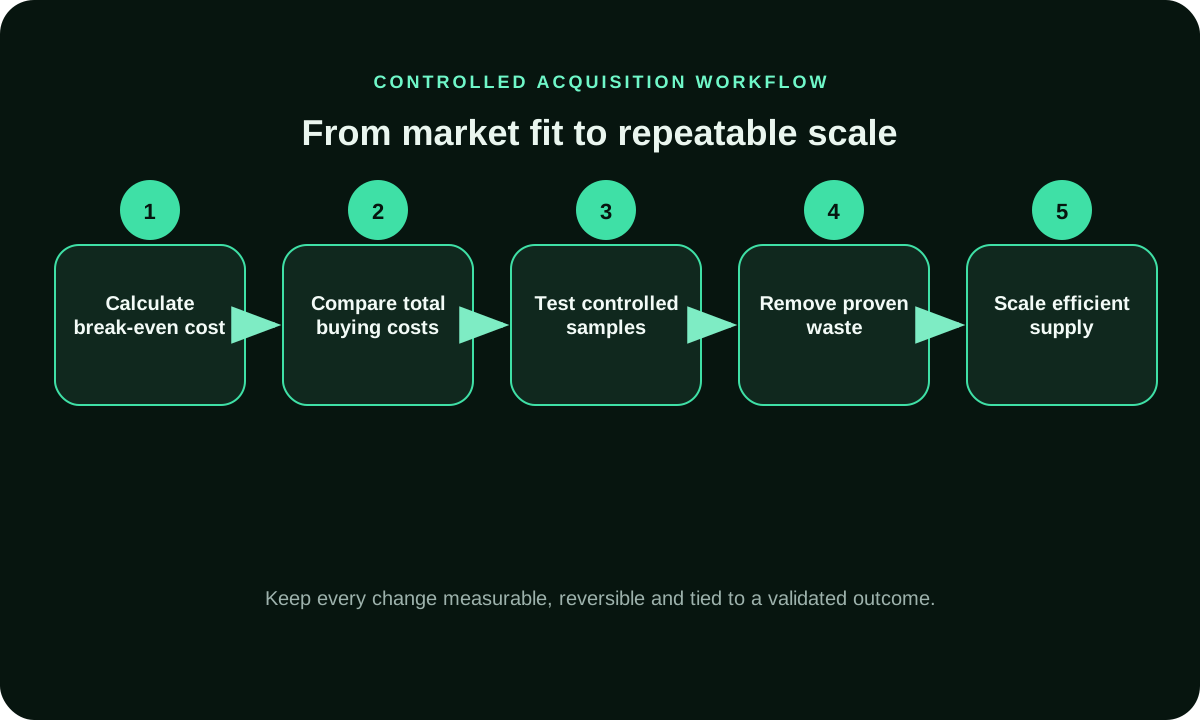
A five-stage affordability test from exposure to accepted value
Stage one verifies readiness: the offer is permitted, the destination works on the selected devices and the final event is received. Stage two releases a bounded discovery cohort. Stage three classifies traffic after the agreed maturity window. Stage four repeats the strongest combination with the baseline unchanged. Stage five expands one variable only after the confirmation result remains inside the cost and quality range. A failed stage has a named response, such as repair tracking, narrow eligibility, replace creative, reduce exposure, pause a source or stop the test.
Target enough people to learn without buying obvious mismatch
Begin with non-negotiable constraints: usable geography, language, device compatibility, offer rules and operational capacity. Add available browser, operating-system, carrier, connection, category, schedule or source controls when they protect the user journey or isolate a real hypothesis. Excessive filters can create a tiny sample whose attractive rate cannot be repeated. Broad delivery can waste budget on people who cannot use the offer. The right opening segment excludes known mismatch while leaving enough variation to discover viable supply.
Create a target-removal order before launch
Choose a format by message burden and conversion path
Match the ad format to the amount of context the visitor needs before acting. A concise offer may suit a compact unit that quickly reaches a focused landing page. A product that depends on visual explanation may need more image space. An interruptive placement demands an especially clear close path and honest transition. Keep formats in separate campaign cohorts because their attention pattern, creative constraints, click behavior and source mix can differ. FroggyAds lets you compare supported formats through one self-service workflow while your accepted event remains the commercial standard.
Create My Free Account
Keep the ad promise and the first screen economically aligned
Build each concept around one supportable buyer reason. The headline and image should set the same expectation as the first landing screen, price condition, eligibility rule and call to action. Label the creative and destination versions together. If a message increases clicks but lowers accepted quality, it has not reduced acquisition cost. Review whether the ad attracted the wrong motivation, omitted a material qualifier or reached a page that changed after approval. Fix the smallest failing layer before raising bids or widening the audience.
Classify sources by maturity, validity and operating cost
Classify every available source or placement dimension with spend, cohort age, qualified visits, provisional events, accepted outcomes, rejection reasons and analyst effort. Use documented states such as discover, observe, maintain, reduce, pause and retest. An immature source with no conversion may need another review point when the expected event is rare. A source that repeatedly produces ineligible or rejected activity can be paused sooner. Retesting should name the repair and evidence needed to restore budget, rather than reopening the same configuration without a reason.
Scale the affordable cohort without hiding marginal cost
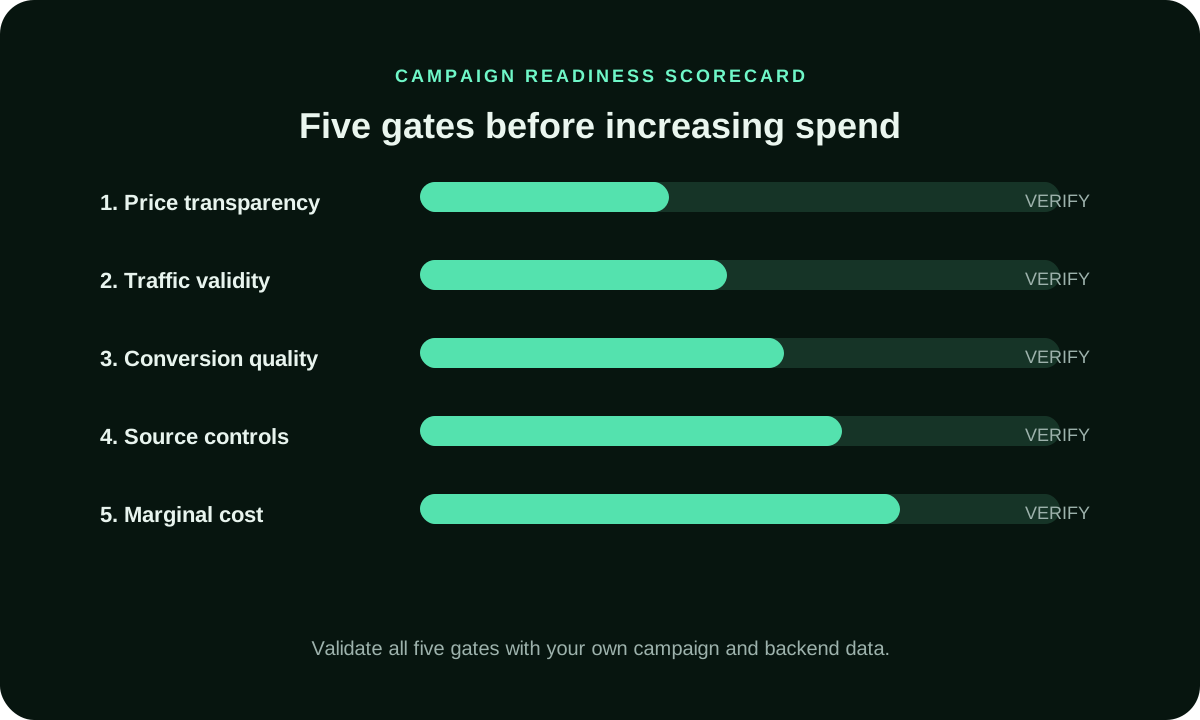
Keep the confirmed configuration as a control while the next cohort tests one additional market, device group, schedule, format, source set, bid or budget level. Calculate accepted cost for the added cohort separately. A blended account average can remain attractive because the original segment carries a new, weaker segment. Watch whether conversion delay, rejection mix, support workload or fulfilment capacity changes with volume. Expansion remains affordable only while the marginal result stays inside the written value and quality boundaries.
Put the comparison into a bounded campaign
Turn an affordability review into one FroggyAds test
Turn the affordability review into a campaign with a dated spending limit, one format, one eligible audience definition and one destination version. Preserve the baseline and source evidence. We recommend changing only the variable named in the hypothesis, then waiting for the agreed maturity window before reallocating spend. This turns the platform comparison into an operational decision: keep the cohort, cap it, repair a dependency, exclude proven waste, retest a defined change or stop.
Create My Free Account
Read price, volume and quality as three separate signals
Price describes what delivery cost in the auction or buying model. Volume describes how much eligible traffic arrived. Quality describes what survived the advertiser's acceptance process. None can stand in for the other two. A low price with no usable volume cannot support growth. High volume with weak acceptance consumes budget and operating time. Strong quality from only a few events may be promising but too uncertain for a large increase. Review all three by cohort and date, then state which signal limits the next step.
Avoid the failure patterns that make low-cost traffic expensive
Common failures include buying before event receipt is verified, optimizing to clicks when the business accepts leads or orders, mixing formats under one blended result, changing audience and landing page together, judging fresh cohorts before outcomes mature and extending a test because budget remains. Another costly pattern is ignoring human workload. Manual lead review, fraud checks, customer support and reconciliation can exceed the media saving. Give each failure an owner, a detection signal and a response that can be executed without rebuilding the entire campaign.
Why performance buyers choose FroggyAds for a controlled test
Performance buyers choose FroggyAds for a controlled test because our self-service platform provides access to supported traffic through 750+ SSP integrations and more than 20 billion daily impressions, with available controls that can include geography, city, device, operating system, browser, carrier, category, source, ID and IP. These verified platform facts describe access and control, not a promise of results. You can use the relevant options to protect eligibility, separate campaign cohorts and inspect source-level evidence. Your offer, landing experience, attribution and backend acceptance decide whether the traffic creates commercial value.
Final pre-funding checklist for an affordable campaign
Confirm the accepted event, value boundary and maturity window. Test the live ad-to-destination path and final event receipt. Record the market and device rules, format, creative version, landing version, opening allocation and stop condition. Check current account funding, billing, payment and campaign requirements inside the platform before committing cash because those terms can change. Name who can pause delivery and who validates outcomes. Finally, save the baseline configuration so any later bid, budget, targeting or source change can be compared with the state that earned expansion.
Supporting controls for an affordable advertising platform decision
Use these resources to connect campaign reporting, spending boundaries, source treatment and landing continuity with the same advertiser-accepted event and maturity window.
Affordable Advertising Platform FAQ
What makes an advertising platform affordable for a campaign?
Affordability is the ability to complete a valid learning cycle and acquire advertiser-accepted outcomes inside a defined cash, evidence and value boundary. A platform is not affordable merely because its minimum bid, media price or account entry appears low. Include the cost of measurement, creative, landing work, review and rejected results, then judge the mature cohort against the business margin.
Which costs belong in a platform affordability calculation?
Compare costs in one currency and one review period. Include media spend, platform or payment charges that apply to the account, currency conversion, tax treatment, creative production, tracking services, landing work, staff time and outcome validation. Keep deposits and unused balances separate from consumed campaign cost. Verify current terms in the live account or official billing information instead of relying on an old comparison table.
How do account funding, campaign budgets and bids differ?
Account funding controls the cash committed to the platform, while a campaign budget controls exposure for a particular test. Auction bids influence the opportunity to receive delivery, and actual media spend reflects what the campaign consumed. These values answer different questions. Record them separately so a deposit is not reported as acquisition cost and a low bid is not presented as the final price of a customer.
What evidence shows that lower-cost traffic fits an offer?
For an affordable platform comparison, start with delivered eligibility and traceability. Check market, language, device, format, destination status and the available source identifiers. Then compare qualified sessions, provisional events, mature accepted outcomes and rejection reasons. Lower-cost inventory fits the offer when those downstream measures remain inside the written value and quality range after a meaningful review window, not simply when impressions or clicks are inexpensive.
Can campaign measurement increase the total test cost?
Platform measurement can add setup fees, software cost and staff effort, but missing measurement is usually more expensive because it prevents the buyer from locating waste. Define the smallest tracking chain needed for the decision. Preserve campaign and source values, verify the final event, and reconcile one agreed window. Do not buy unnecessary tooling; do not remove the evidence needed to distinguish media, landing and backend problems.
How do source controls protect a limited advertising budget?
Platform source controls protect a limited budget by letting the buyer separate delivery that behaves differently. Use a discovery allocation to learn, then keep, reduce, pause, exclude or retest cohorts from mature evidence. Confirm that a control changes delivery as expected, retain the prior baseline and avoid permanent conclusions from one isolated click or an event that has not passed validation.
Which payment and account terms should an advertiser check?
Before funding the platform, review current payment methods, processing charges, currency handling, tax treatment, account fees, refund terms and balance rules in the live account or current official material. These conditions can vary or change, so this page does not invent a universal figure. Add the applicable cash friction to the test ledger before funding, and record it independently of media performance when comparing sources.
How should an affordable advertising test be capped?
Cap the platform pilot with a daily ceiling, a total learning loss, a tracking health check, a mature acceptance window and a stop event. Reserve enough exposure for the selected question but do not automatically release the full amount. A broken destination, missing identifier, ineligible audience or serious quality issue should pause the affected cohort immediately even when the scheduled review date has not arrived.
How can support and review effort affect the real campaign cost?
Platform support affects total cost when a campaign problem requires time to diagnose or resolve. Before relying on any service path, check the current help route available to the account and document who on your team owns escalation. Good internal evidence shortens the conversation: retain the campaign, time, source, click or event identifiers, screenshots where relevant and the expected versus observed behavior.
When does an affordable test justify more advertising spend?
The affordable platform earns more spend after the accepted result repeats under the same definition and the marginal cohort remains inside the planned cost and quality range. Keep the confirmed configuration visible while one bid, budget, audience, schedule, format or source variable changes. If the new cohort weakens, roll back and diagnose the changed layer instead of allowing the original segment to hide deterioration in a blended average.
Continue from platform evaluation to campaign operation
The next guides extend the affordability record from funding and traffic selection through identifier reconciliation, source classification and reversible budget decisions.
Build a controlled affordability test with FroggyAds
Build the controlled affordability test by defining one accepted business event, establishing the maximum learning loss and verifying the live conversion path. Then use our relevant campaign, targeting, budget and source controls to buy a bounded cohort. Results still depend on market, competition, format, creative, destination, attribution and optimization, so the next budget step should follow mature advertiser evidence rather than a promise based on traffic price alone.
What should an advertiser decide before choosing an affordable platform?
Decide whether the platform can support a complete, measurable test for your actual offer. The decision includes usable inventory access, the relevant targeting and format controls, source evidence, a workable funding path and enough reporting to connect spend with accepted outcomes. The right first action is the smallest cohort that can answer a commercial question without violating the offer's market, device, policy or fulfilment constraints.
Tie the review to total test cost, source-level accountability and marginal accepted value. These three checkpoints show whether the opening campaign can learn responsibly, whether waste can be located and whether another unit of spend deserves approval. The table converts each checkpoint into a FroggyAds action while keeping advertiser-side validation in control of the final conclusion.
| Decision | What to verify | FroggyAds action |
|---|---|---|
| Accepted-outcome rule | Name the mature event, quality conditions, rejection states and date on which the cohort can be judged. | Keep one FroggyAds campaign objective and reconcile our delivery record with advertiser acceptance. |
| Cash and loss boundary | Separate account funding, planned media exposure, fixed setup cost and the maximum tolerable learning loss. | Apply a bounded campaign budget and stop affected delivery when the written fault condition appears. |
| Eligible test cohort | Verify market, language, device, format, offer conditions, landing readiness and operating capacity. | Use the relevant FroggyAds targeting controls without fragmenting the first sample beyond what the question needs. |
| Source evidence | Compare spend, cohort maturity, qualified sessions, accepted outcomes, rejection reasons and review effort by available source. | Maintain, reduce, pause, exclude or retest inventory from a documented state and next-review rule. |
| Marginal expansion rule | Define the accepted-cost, quality and operating range that the next increment must maintain independently. | Scale one major FroggyAds control at a time and retain the confirmed cohort as the comparison baseline. |
A five-step FroggyAds affordability sequence
- Price the decision: calculate the value boundary, fixed preparation cost, campaign exposure and maximum learning loss.
- Validate the path: test eligibility, message continuity, destination completion, identifier capture and final event receipt.
- Buy one cohort: launch a bounded FroggyAds campaign with one format, one audience definition and one landing version.
- Classify mature evidence: review qualified activity, accepted results, rejection reasons, source state and operating effort.
- Expand independently: change one bid, budget, audience, format, schedule or source variable and inspect marginal value.
Why use FroggyAds for the first measurable traffic cohort?
We provide a self-service environment in which performance advertisers can apply relevant campaign, targeting, budget, source and reporting controls to supported traffic. That gives you an execution layer for a disciplined discovery test. You can preserve the campaign configuration and source cohort while your own tracker and backend determine which events are accepted and what they are worth.
For the first measurable traffic cohort, choose FroggyAds when you want direct control over the test rather than a vague promise that a low price will produce a business result. Start with a defensible allocation, connect the ad path to a real event and require the result to repeat before spending more. If the evidence weakens, return to the last confirmed setup and diagnose the changed layer.
The buyer task: compare the cost of learning, control and accepted value
Use this page when your immediate decision is whether an advertising platform can support a bounded, attributable acquisition test under a defined loss limit. It focuses on total campaign affordability and marginal value. For a broader reliability assessment, use the separate Reliable Advertising Platform guide, which examines operational confidence beyond the cost structure of the first test.
Keep keyword and entity coverage tied to the decision. Relevant concepts include self-service media buying, campaign budget, CPC and CPM, account funding, traffic source, audience targeting, ad format, attribution, postback, conversion validation, accepted acquisition cost, marginal CPA, source optimization, whitelist, blacklist, learning budget and stop rule. Each term belongs here because it changes how an advertiser evaluates or operates the test.
| Checkpoint | Page-specific action | Evidence to keep |
|---|---|---|
| Fit boundary | Define the eligible buyer, offer, market, device, format and advertiser-accepted outcome. | Retain the constraint that would make low-priced delivery unusable for this campaign. |
| Learning boundary | Set the fixed preparation work, media exposure, maturity window and maximum permitted loss. | Retain the dated hypothesis, owner, review point and condition that pauses the affected cohort. |
| Value boundary | Calculate accepted cost from mature advertiser outcomes and separate it from clicks or provisional events. | Retain the marginal range that the next spend increment must maintain before further expansion. |
Hypothetical calculation: a bounded cohort spends USD 360 and records nine advertiser-accepted outcomes after the same maturity window. Accepted acquisition cost is USD 40.00: USD 360 divided by nine. If creative, tracking and review add USD 180 for this test, the fully loaded test cost is USD 540, or USD 60.00 per accepted outcome. Replace every input with your own costs, validation rule and margin; this example is not a FroggyAds performance claim.
The buyer task remains to keep the campaign, audience, budget and source decision visible while your evidence determines whether the cohort is affordable. Use FroggyAds for that controlled execution layer. Start your next campaign with FroggyAds.
A transparent platform-comparison record
Record the date reviewed, current account and campaign requirements, applicable funding and payment conditions, chosen format, targeting availability, source dimensions, reporting fields, support route and any unresolved limitation. Mark whether each fact came from the live account, current official material or a completed test. Then add the buyer-specific economics separately. This record prevents an old minimum, unsupported feature assumption or another advertiser's result from becoming the basis for your own budget decision.
Affordable media buying starts with a reversible decision
The most useful affordable advertising platform is the one you can test, measure and stop responsibly. Define accepted value, protect the learning budget and keep source evidence intact. We give you the FroggyAds controls to operate that campaign; you decide whether mature, page-specific evidence justifies the next spend step.