
Affiliate Marketing Services: How to Evaluate Scope, Ownership and Results
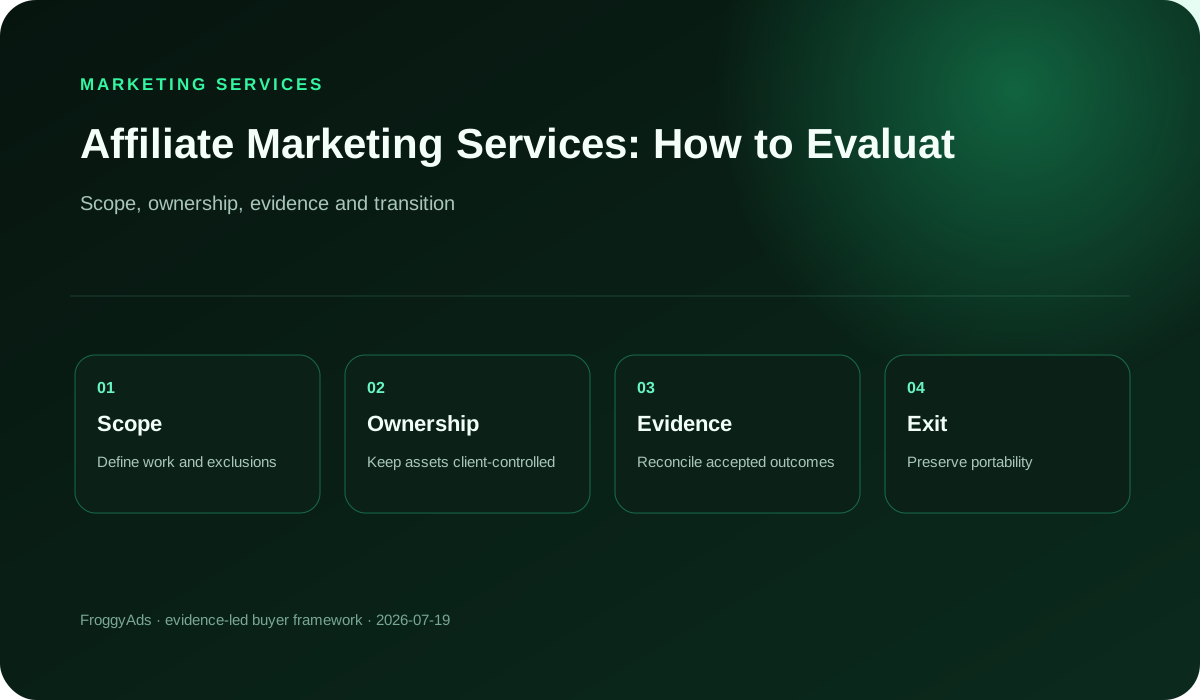
Choose an affiliate marketing service with a scope your team can control, evidence your business can verify and an exit path you can test. This guide helps advertisers, affiliate marketers, media buyers, agencies and online businesses compare provider ownership, data, fees, measurement and delivery, then connect the approved acquisition plan to a bounded FroggyAds traffic campaign.
| Section | Distinct excerpt from this page |
|---|---|
| Outcome-led affiliate service scope | Relevant service jobs may include partner onboarding, terms, tracking, creative distribution, offer controls, conversion validation, commission calculation, fraud review, payment and reporting. |
| Authoritative affiliate programme data records | The service may touch partner, contract, link or code, click, conversion, order, refund, validation status, commission, payment and fraud evidence. |
Reference for Affiliate Marketing Services: Compare Providers & Campaign Fit: Federal Trade Commission: Advertising and marketing basics.
Which affiliate marketing service model fits your team?
Match the service model to the gap: consulting for a defined strategy or audit, managed delivery for recurring programme work, or specialist support for tracking, recruitment or disclosure. Keep the accounts and data recoverable, assign client decision rights and test the handover. When the missing service is traffic acquisition, FroggyAds self-serve advertising gives your authorised buyer a direct route to test formats, targeting, bids and budgets. That paid-media role is separate from recruiting partners, calculating commissions or administering programme payments; require a named owner for those service tasks.
| Decision area | What to document | Evidence standard |
|---|---|---|
| Scope | partner onboarding, terms, tracking, creative distribution, offer controls, conversion validation, commission calculation, fraud review, payment and reporting | Deliverables, exclusions and acceptance |
| Ownership | Client-controlled accounts, assets and data | Named access and export rights |
| Workflow | define program economics, approve partner, issue tracking, activate, validate conversions, reject invalid actions, calculate commission, pay and audit | Approvals, handoffs and escalation |
| Risk | cookie or identifier loss, self-referrals, trademark bidding, coupon leakage, fake leads, duplicate attribution, refund mismatch and opaque sub-affiliate activity | Prevent, detect, respond and recover |
| Measurement | approved partners, validated conversions, net revenue, commission cost, incremental contribution, fraud rate, payment accuracy and partner retention | Authoritative reconciliation |
Service boundary and accountable ownership
An affiliate marketing service can cover partner recruitment, programme operations, tracking support, creative distribution or performance analysis, but those jobs should never blur into one vague promise. Write the boundary around the work you are actually buying, then name the client executive who owns the commercial result and the provider lead who owns delivery. That division gives you a usable escalation path when a partner, conversion or payment falls outside the agreed process.
Ask the provider to separate advisory hours, managed execution, platform access, subcontracted work and paid-media activity in the proposal. Your team should retain approval over offers, partner eligibility, commission rules, claims and material budget changes. A clear boundary also shows where FroggyAds fits: we can support a controlled traffic campaign inside the approved acquisition plan while your business keeps the provider relationship and accepted outcome under its own authority.
Business outcome and scope definition
Start the service brief with the business event that matters after a click, such as an accepted lead, completed order, funded account or qualified registration. Then describe which affiliate tasks contribute to that event: partner discovery, onboarding, link governance, creative review, conversion validation, commission handling or reporting. This keeps the provider focused on the result your finance and sales teams can recognise instead of a large list of activities that may not improve acquisition.
Turn the scope into deliverables with a market, audience, cadence, owner, acceptance rule and explicit exclusion. For example, partner recruitment may be included while legal review, landing-page production and paid traffic remain client responsibilities. Advertisers, affiliate marketers and agencies can then compare proposals on the same basis and identify missing dependencies before signing. If a paid acquisition test belongs in scope, our FroggyAds team recommends defining its separate budget and measurement rule at the outset.
Current-state discovery and constraints
A credible discovery phase maps how your programme works today, from commercial terms and partner approval through tracking, validation, commission, payment and dispute handling. Give the provider representative records rather than a polished summary, including rejected conversions, late reversals and unresolved support cases. Those examples reveal where ownership or data quality breaks down and prevent a proposal from assuming processes that your business does not yet have.
The discovery report should label facts, assumptions and open questions separately. Ask which limitations could alter the timetable, fee or expected workload, and require a decision date for every material unknown. This is especially useful for media buyers moving between affiliate sources and paid traffic because it exposes attribution conflicts before spend begins. We can help you keep a FroggyAds test bounded by one audience, budget and source set while the wider service provider resolves programme constraints.
| Control | Service-review question | Acceptance evidence |
|---|---|---|
| Client owner | Who signs off on the programme discovery findings and unresolved constraints? | Programme sponsor and authorised delegate |
| Provider owner | Which discovery lead owns findings and unresolved assumptions? | Discovery lead with documented continuity cover |
| Threshold | Which discovery evidence allows the service proposal to proceed? | Discovery acceptance rule tied to observed programme records |
| Transition | How are discovery notes and unresolved questions handed over? | Accepted discovery pack and open-question register |
Connect the guide to live testing
Give the provider a defined acquisition brief
Use the constraints discovered in your programme to configure one FroggyAds traffic test for a defined audience and accepted outcome. You can keep format, GEO, device, bid, budget and source decisions visible while your service provider documents the offer, destination and downstream reconciliation. This gives your team a clear test to review without mixing affiliate partner delivery with paid-media evidence.
Create My Free Account
Strategy deliverables and decision rights
Strategy is valuable only when it produces decisions your team can approve and operate. Specify the documents you expect, such as a partner segmentation model, recruitment sequence, offer rules, content brief, testing roadmap and forecast assumptions. Each deliverable should state the evidence used, the decision it supports and the person authorised to accept it. That makes a strategy review concrete and gives you a record when priorities change later.
Keep final authority over brand positioning, customer eligibility, promotional claims, commission policy, audience exclusions and significant budget movement. The provider can recommend an action, but your named owner should approve any choice that changes legal exposure or customer treatment. Where FroggyAds supplies paid distribution, you can translate the approved plan into campaign controls for format, GEO, device, bid and budget, then evaluate our delivery evidence without handing over the underlying business decision.
Account, asset and credential ownership
List every account and asset the provider will touch before access is granted: domains, tracking platforms, analytics, payment tools, partner databases, creative files, advertising accounts and recovery methods. The client should own the primary records or have a tested administrative route to recover them. Provider access should be issued to named people for defined duties, which protects continuity when an individual leaves the service team.
Shared passwords and provider-owned workspaces create avoidable lock-in. Prefer role-based permissions, multi-factor authentication where available, approval logs and a revocation checklist tied to offboarding. Test an export during the engagement rather than discovering at termination that history or source files cannot be retrieved. If an agency runs FroggyAds for you, keep account permissions, campaign naming and source reporting documented so another authorised operator can understand and continue the work.
Reconcile provider reports with approved client outcomes
Affiliate service data usually joins partners, agreements, tracking identifiers, clicks, conversions, orders, refunds, validation states, commissions, payments and fraud reviews. Define the owner, identifier and allowed status values for each critical record. A shared data dictionary prevents one system from calling a conversion approved while another treats the same event as pending, reversed or ineligible.
Dashboards can guide diagnosis, while the accepted outcome should reconcile with the client's authoritative CRM, order system or finance ledger. Agree the reporting latency, time zone, attribution window, currency, deduplication and reversal handling before comparing totals. Keep FroggyAds paid-source evidence separate from affiliate partner delivery. Combine the records only at the permitted reporting granularity: a campaign aggregate does not establish an individual click-to-commission match.
| Control | Service-review question | Acceptance evidence |
|---|---|---|
| Client owner | Who owns the definitions for partner, conversion, refund and commission status? | Client data steward and authorised delegate |
| Provider owner | Which integration lead resolves missing or rejected records? | Integration lead with documented continuity cover |
| Threshold | Which reconciliation gap requires investigation before reporting? | Reconciliation threshold tied to client source data |
| Transition | How are schemas, credentials and integration logs transferred? | Schema export, credential revocation and integration runbook |
Integration and handoff architecture
Map every handoff between the affiliate platform, ecommerce system, CRM, analytics, consent tools, payment workflow, fraud review and reporting store. For each connection, record what moves, in which direction, how often and under which identifier. A diagram is not enough: the provider should also explain retry behaviour, error queues, monitoring and the role that responds when an expected record does not arrive.
Trace a sample conversion from its click or referral through validation, rejection, adjustment and payment to test the complete handoff. Include duplicate identifiers, late refunds and missing consent states so exception handling is observed before scale. If paid media feeds the offer, our FroggyAds campaign should carry its own source labels and budget boundary. That separation lets you compare traffic delivery with downstream acceptance without mixing an integration defect into the provider's acquisition result.
Measurement contract and reconciliation
Agree the measurement contract before the provider reports performance. Define the numerator, denominator, eligibility rule, attribution window, maturity date, currency and treatment of refunds for each decision metric. A service may track approved partners, accepted conversions, net revenue, commission cost, incremental contribution, fraud rate, payment accuracy and partner retention, but only the measures connected to your buying decision need to determine continuation.
Reconciliation should compare provider records with the client system that accepts leads, orders or revenue. Investigate gaps by identifier and status rather than averaging them away, and preserve the reason for every material exclusion. When you test FroggyAds traffic, measure the accepted CPA or other chosen outcome after the agreed maturity period. We provide campaign delivery data you can analyse, while your business decides which downstream events meet the commercial acceptance rule.
Select the paid-media format
Hold the provider's media choices to one acceptance rule
Fit the FroggyAds format to the client-approved message and destination, using the acceptance rule already set for affiliate activity. Our self-serve controls let you test a bounded campaign while keeping the offer, budget and reporting source explicit. Compare accepted outcomes after the agreed maturity window before you change more than one major variable.
Create My Free Account
Commercial model and fee transparency
Compare the complete commercial exposure, not just the headline service fee. Include discovery, setup, recurring management, performance incentives, software, creative production, paid media, partner commission, minimum terms, renewal conditions and transition assistance. Model at least a low, expected and high activity scenario so you can see which costs change with spend, partner count or validated outcomes.
Consider two fictional proposals with equivalent scope and no other charges. Provider A bills USD 900 in fixed service fees plus media. Provider B bills USD 450 plus 20% of media, with media itself paid separately. At USD 600 in media, the totals are USD 1,500 and USD 1,170. At USD 3,000, they are USD 3,900 and USD 4,050. Their fee totals are equal at USD 2,250 in media. This is a pricing-model illustration, not FroggyAds or provider pricing, and it does not establish which team delivers better work. Check how the actual agreement treats commission, production, tax, refunds and corrected attribution. We recommend showing FroggyAds media as its own cost line, so a provider's fee cannot obscure the amount available for the traffic test.
| Control | Service-review question | Acceptance evidence |
|---|---|---|
| Client owner | Who accepts the complete fee model, incentives and invoice-correction rule? | Commercial sponsor and authorised delegate |
| Provider owner | Which commercial lead explains fees and invoice corrections? | Commercial lead with documented continuity cover |
| Threshold | Which cost-model threshold requires a commercial revision? | Fee approval rule tied to the complete cost model |
| Transition | How are fee schedules, approvals and open invoices handed over? | Approved fee schedule, invoice ledger and commercial handover |
Provider capability and team evidence
Evaluate the named people who will operate your programme, not a generic agency capability deck. Ask who recruits partners, reviews tracking, approves creative, investigates anomalies and covers absences. Relevant evidence might include a redacted workflow, a sample incident response or a reference the provider is allowed to share. Logos and broad experience claims do not show whether the assigned team can handle your market, offer type or technical stack.
Provider credibility includes a clear explanation of the method, evidence and limits behind the proposed work. The team should say when specialist legal, technical or local-market advice is required and how subcontractors are governed. Media buyers and online businesses should also confirm that the team can interpret source-level traffic data without promising sales from delivery alone. FroggyAds gives the authorised operator controls to test audiences and sources; the provider still needs the discipline to connect those controls to your approved offer and measurement contract.
Claims, endorsements and disclosure controls
Give the provider a written library of approved product facts, prohibited claims, required qualifications and disclosure rules before partners receive creative. Define who may approve an exception and how expired material is withdrawn. This reduces the risk that a recruitment target or commission incentive encourages publishers to overstate an offer in ways your brand would reject.
Review representative placements and preserve the partner, version, approval and capture date for disputed content. Where endorsements or reviews are involved, current legal requirements for the relevant market should be checked by the appropriate adviser. The same standard applies to paid ads: our FroggyAds campaign can distribute client-approved creative, but you and your service provider remain responsible for truthful claims, eligible audiences and the landing-page experience.
Creative, accessibility and brand governance
Creative governance should identify the writer, reviewer, approver, publisher and retirement owner for every asset. Supply brand rules, offer terms, destination requirements and accessible alternatives in the brief, then keep a versioned record of the final files. Partners need a clear route for questions so they do not improvise a benefit, deadline or condition that the client has not approved.
Test more than appearance. Review readable text, contrast, keyboard access where relevant, mobile comprehension, destination consistency and the evidence supporting each claim. If you add a FroggyAds campaign, keep the approved creative and landing-page version linked to its campaign record. You can then compare formats or audiences while holding the offer constant, which makes the result easier for the provider and your internal team to interpret.
| Control | Service-review question | Acceptance evidence |
|---|---|---|
| Client owner | Who approves a partner's final claim, creative version and destination? | Brand approver and authorised delegate |
| Provider owner | Which creative lead approves claims and retires expired assets? | Creative governance lead with continuity cover |
| Threshold | Which creative defect prevents an asset from being published? | Creative release rule tied to approved claims and assets |
| Transition | How are creative files, claim approvals and versions transferred? | Creative source archive, approval log and retirement register |
Automation and AI governance
Automation can reduce repetitive service work, but it needs a defined input, output, owner and stop condition. Inventory any rules or AI-assisted steps used for partner scoring, message drafting, anomaly review, bid recommendations or reporting. Require the provider to state where human approval remains mandatory and how a mistaken action is reversed.
Do not let an automated score silently reject a partner, alter a claim or change material spend without review. Sample decisions, record model or rule changes and monitor drift against accepted outcomes. FroggyAds campaign controls should stay inside the approved budget and audience plan even when a provider uses automation to suggest optimisations. Your team should be able to inspect the evidence, decline the recommendation and restore the previous configuration.
Put the guide into practice
Approve the service brief before launching paid traffic
Create a FroggyAds campaign only after the service brief names the buyer, eligible audience, claim, destination, budget owner and accepted conversion. Start with a cap your business can afford to learn from, review source-level delivery and reconcile the result to your own records. Increase spend only when the evidence supports the next decision; traffic delivery alone does not guarantee leads, sales or profit.
Create My Free Account
Privacy, consent and audience use
Document which personal or device data the service receives, the purpose for using it, the approved audience and the retention period. Confirm who handles access requests, deletion, consent changes and cross-border questions under the rules that apply to your business. Partner recruitment or measurement convenience does not remove the need for a lawful, accurately described data flow.
Restrict provider permissions to the duties and client data allowed by the agreement, with cross-client reuse outside that authority. Review list origins, suppression handling and audience uploads before activation. When your authorised team uses FroggyAds targeting, choose the GEO, device and other permitted settings that match the approved campaign. We recommend excluding any audience whose provenance or consent status cannot be explained and evidenced.
Quality assurance and change control
Define what the provider checks before a partner, tracking link, offer, commission rule or report goes live. The release record should name the reviewer, test data, expected result and rollback step. Include negative cases such as invalid codes, duplicate conversions, expired creative and rejected leads; these are often where service quality becomes visible.
Changes to attribution, partner terms, landing pages or paid-media settings can make before-and-after results incomparable. Use a change log with the reason, approver and effective time, then isolate material tests where practical. In FroggyAds, keep campaign versions and source decisions tied to the same record your provider uses for downstream reconciliation. That gives you a cleaner basis for improving the next test instead of relying on memory.
| Control | Service-review question | Acceptance evidence |
|---|---|---|
| Client owner | Who can block a broken tracking or commission-rule release? | Release owner and authorised delegate |
| Provider owner | Which quality lead can stop and roll back a release? | Quality lead with documented release cover |
| Threshold | Which failed test blocks release until the defect is resolved? | QA release rule tied to tested links and conversion states |
| Transition | How are test evidence, release notes and rollback records handed over? | Test pack, release history and verified rollback record |
Reporting cadence and communication
Set different rhythms for delivery monitoring and commercial decisions. Operational checks may be frequent, while accepted leads, orders or revenue need enough time to mature. The report should separate completed work, observed delivery, accepted outcomes, open discrepancies, risks and the next decision. A traffic chart without those distinctions cannot show whether the service is creating useful business evidence.
Escalation should name the report recipient and the discrepancy that requires a decision before the next scheduled review. Executives need the complete commercial exposure and the choice ahead; operators need source, partner and exception detail. We provide FroggyAds delivery and source reports for the paid campaign. Your provider should explain which permitted identifiers or aggregate cohort fields connect those reports with the client's accepted outcomes, what remains unmatched and when the next commercial review becomes meaningful.
Pilot and acceptance test
Run a pilot that exercises the service rather than showcasing its easiest task. Use representative partners, real approval roles, a bounded workload, the required integrations and at least one exception case. The scorecard should cover delivery accuracy, response time, documentation, data reconciliation and the client's ability to control or stop the work.
Decide the pass, revise and stop thresholds before results arrive. Expansion should follow mature evidence that meets those thresholds, not presentation quality or a temporary activity spike. If paid traffic is part of the pilot, we suggest one FroggyAds campaign with a capped budget and clearly labelled sources. You can test the provider's operating discipline while keeping the offer, destination and acceptance rule stable.
Risk, incident and continuity planning
Risk assessment should cover the programme's relevant self-referral, trademark, coupon, lead-quality, attribution, refund, identifier and sub-affiliate exposures. Assign a preventive control, detection signal, owner and response time to the risks relevant to your programme. The incident record should preserve affected partners, conversions, decisions and customer impact rather than reducing the event to a support ticket.
Continuity planning should cover staffing absence, credential recovery, platform suspension, backup exports and an emergency stop. Test who can revoke access and pause campaigns outside normal hours. For FroggyAds activity, your authorised account owner should know how to cap or stop spend while the provider investigates. This protects your budget and gives both teams time to distinguish a traffic issue from a tracking, offer or validation failure.
| Control | Service-review question | Acceptance evidence |
|---|---|---|
| Client owner | Who can contain an incident and pause affected partners or paid campaigns? | Incident sponsor and authorised delegate |
| Provider owner | Which incident lead coordinates containment and client updates? | Incident response lead with continuity cover |
| Threshold | Which incident severity requires the programme to pause? | Incident severity rule tied to preserved programme evidence |
| Transition | How are incident records, access and recovery duties transferred? | Incident archive, access revocation and continuity handover |
Exit, transition and portability
Write the exit plan while the relationship is cooperative. Require exports of partner records, agreements, tracking configuration, creative source files, validation history, commission evidence, reports and unresolved work in formats your team can use. Define the delivery date, responsible role and acceptance check for each item instead of relying on a general promise to hand over data.
Exit terms should cover credential revocation, deletion confirmation, open invoices, unfinished assets and the transition assistance required. Ask another authorised operator to follow the documentation before the notice period ends. Any FroggyAds campaigns managed by the provider should retain client-approved naming, settings history and source decisions, enabling your team to pause, close or continue them without losing the acquisition evidence already collected.
Which provider evidence makes a comparison useful?
Request a permitted example of a rejected or reversed conversion from each shortlisted provider, alongside its successful work. Who identified it, which record was authoritative, how did the commission or invoice change, and what did the client receive? A redacted example can reveal whether the promised tracking, support and financial correction process actually fit your programme. Require permission for any case or reference the provider shares; a logo or outcome claim alone cannot answer these operating questions.
Scope comparisons should put partner recruitment, programme administration, tracking support, creative work and paid traffic in separate lines with their exclusions. If you already have the offer and measurement ready, our self-serve campaign controls let your authorised buyer run the traffic test directly or give an appointed operator a clearly bounded media task. Choose FroggyAds for that controllable paid acquisition role, while retaining the people and systems needed for merchant approval, commissions and customer service.
Decision scorecard for Affiliate Marketing Services
| Area | Evidence to request | Decision standard |
|---|---|---|
| Operating fit | Relevant team, workflow and capacity evidence | Proven in a bounded pilot |
| Ownership | Client-controlled accounts, data and assets | No critical provider lock-in |
| Governance | Roles, approvals, logs, disclosure and rollback | Controlled and auditable |
| Measurement | Defined formulas and backend reconciliation | Accepted outcomes, not activity alone |
| Commercial and exit | Transparent fees, exports and transition duties | Sustainable and portable |
Frequently asked questions
Which work can affiliate marketing services include?
Services may cover strategy, recruitment, onboarding, creative review, tracking, partner support, quality, payments and reporting. The agreement should distinguish included work, client responsibilities and exclusions.
How can a buyer verify an affiliate provider's experience?
Confirm the named team's relevant roles, methods, references and examples the provider can lawfully share. Ask how outcomes were measured and which limitations applied rather than relying on logos.
Which accounts should stay in client hands?
Maintain client ownership or recoverable administration for programme, domain, data, payment, tracking and major partner records. Service access should match duties and be removable at handover.
How do explicit service exclusions prevent affiliate delivery gaps?
Exclusions reveal tasks the client must staff or buy elsewhere, such as legal review, creative production or media. Without them, both parties may assume the other owns a critical launch dependency.
Which evidence should determine affiliate service quality?
Quality assessment should use the agreed delivery standards, tracking accuracy, partner quality, accepted outcomes, issue response and documentation. Activity counts belong in context and should not replace commercial value or control quality.
What programme uncertainty justifies a paid provider discovery phase?
Discovery is useful when programme data, partner status and workflow need examination before a larger service scope can be priced responsibly. Define access, deliverables, fee and the decision at its end.
Which commercial terms matter beyond the service fee?
Total commercial exposure includes setup, performance incentives, software, media, partner commission, minimums, renewal, data ownership and exit support. Model the complete cost under a realistic programme scenario.
How can a client avoid affiliate provider lock-in?
Portability depends on recoverable accounts, regular usable exports, documented processes and trained internal owners. Test handover before the contract ends so continuity does not depend on goodwill.
Which commitments can a service provider make without promising affiliate revenue?
Commercial commitments can define service scope, operating controls and reporting, while demand, customers and individual partners remain uncertain. Forecasts should state assumptions, ranges and the conditions that stop investment.
How could a service provider manage FroggyAds without mixing partner results?
Delegated FroggyAds operation can cover a distinct paid campaign when the agreed service scope and account permissions allow it. Client-approved claims, capped spend and separate source reporting remain necessary.
Related operating guides
Related guides help you resolve the provider model, tooling, programme strategy or paid-traffic workflow that surrounds the service purchase.
Primary resources for your service review
Primary links below address different review questions: advertising claims and disclosures, marketing planning, platform implementation and search fundamentals. Verify the current requirements for your market and channel with the appropriate specialist. A linked resource does not certify an agency, authorize an affiliate promotion or guarantee a commercial result; ask the provider to show how it applies the relevant rule to your actual programme.
- Federal Trade Commission: Advertising and marketing basics
- Online advertising and marketing: FTC guidance
- U.S. Small Business Administration: Marketing and sales
- Google Ads: About Google Ads
- Advertising in Google Analytics
- Search fundamentals: Google SEO Starter Guide
- FTC advertising and marketing guidance
- Endorsements, influencers and reviews: FTC guidance
Run the paid-media brief without surrendering account control
When your service plan is approved, use FroggyAds to run the paid-distribution work with a separate campaign budget, explicit targeting choices, source controls and optimisation evidence. You or your authorised provider can test the campaign while your business retains the offer, account permissions and accepted-outcome rule. Create your free account when you are ready to turn the written acquisition brief into a controlled traffic test.
How should you compare affiliate marketing service proposals?
Proposal evaluation should establish whether the provider can run the required affiliate workflow while your business controls strategy, accounts, data, approvals and accepted outcomes. Affiliate marketers and media buyers should distinguish this service decision from the separate choice of software, tools or campaign tactics. The related Best Affiliate Marketing Tools guide supports the tooling decision; return to the provider proposal when scope and accountability are the unresolved questions.
Programme evaluation should retain the offer economics, landing-page readiness, commission logic, conversion rules and paid-traffic sources behind the proposed service. Those inputs determine whether a provider can test the programme responsibly and explain what happened. We recommend recording the client's non-negotiable constraint, the smallest useful pilot and the evidence that permits expansion before negotiating the final service package.
| Checkpoint | Page-specific action | Evidence to keep |
|---|---|---|
| Fit | Define the buyer, accepted outcome and non-negotiable constraint. | Keep the signed scope, ownership map, complete fee model and non-negotiable client constraints. |
| Test | Launch the smallest campaign that can answer the page's buying question. | Keep campaign settings, approved offer and destination versions, source reports and accepted-event identifiers. |
| Decision | Keep, cap, exclude or expand from accepted-outcome evidence. | Keep mature reconciliation, discrepancy decisions, acceptance evidence and the reason to stop, revise or expand. |
Hypothetical calculation: if a controlled traffic test spends USD 225 and produces 9 accepted conversions after the agreed maturity window, accepted CPA is USD 225 ÷ 9 = USD 25.0. Substitute your own spend and accepted outcomes, include reversals where relevant and compare the result with your permitted acquisition cost. This example explains the calculation and is not a FroggyAds performance claim.
Operate your approved paid-traffic brief through FroggyAds when you need campaign settings and reporting that your authorised team can manage directly. Keep the provider accountable for the approved offer and downstream reconciliation while you retain budget authority and the final scaling decision. Create your free FroggyAds account to start the bounded test.
What should you verify before hiring an affiliate marketing service?
Verify the accepted business outcome first, then confirm the named team, included work, account and data ownership, approval rights, measurement formula, total commercial exposure and tested transition plan. You should be able to pause changes, retrieve evidence and replace the provider without losing programme history. If paid traffic belongs in the mandate, choose FroggyAds for a campaign your authorised team can control and measure against the same accepted-outcome rule.