
Affiliate Marketing Solutions: How to Evaluate Architecture, Ownership and Results
Build an affiliate marketing solution around the work your acquisition programme must perform: partner approval, tracking, conversion validation, commission corrections and reporting. This guide helps you connect those functions without losing ownership of accounts or records. If your plan includes paid distribution, choose FroggyAds for the campaign layer you can control directly: format, targeting, bid, budget and source decisions. Your programme tools and team still own partner terms, commission administration and the accepted commercial outcome.
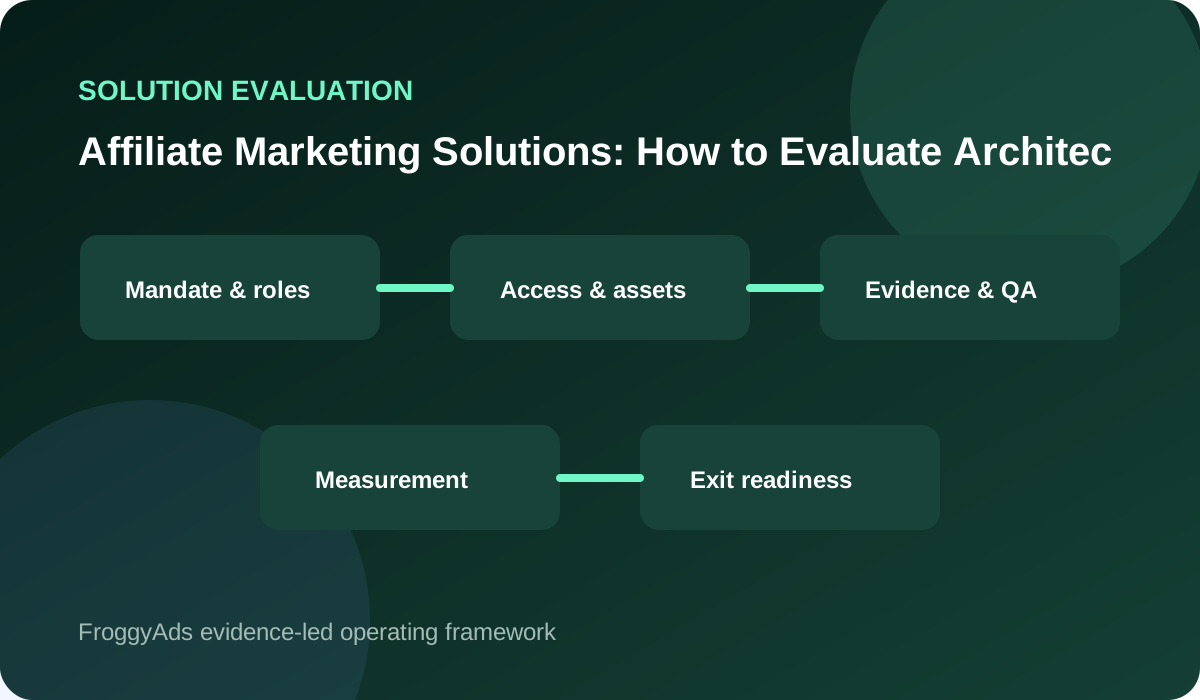
What belongs in a complete affiliate marketing solution?
A complete solution connects the required programme functions to an agreed record of the commercial outcome. Map partner recruitment, offer distribution, tracking, validation, commission operations and reporting before selecting components. Test a rejected or refunded conversion as well as a successful one, keep accounts and exports recoverable, and make every fee visible. FroggyAds self-serve advertising supplies the paid-media controls when your approved architecture needs a traffic test; it does not replace programme administration or establish individual commission attribution where only aggregate data is available.
| Decision area | What to document | Evidence standard |
|---|---|---|
| Mandate | Scope, exclusions and decision rights | Signed brief and responsibility matrix |
| Team | Named delivery roles and continuity | Role allocation and capacity evidence |
| Ownership | Client-administered programme accounts, records and creative assets | Access and recovery record |
| Measurement | validated orders or leads, net revenue, contribution margin, publisher quality and incremental value | Metric contract and backend evidence |
| Commercial | Total cost, approvals and transition | Fee schedule and exit plan |
Mandate and accountable ownership
An affiliate marketing solution is the complete operating system behind partner acquisition, offer distribution, tracking, validation, commission and reporting. Define which of those functions the solution must perform and which remain with your team. The mandate should name the client executive who owns the business result and the solution lead who owns delivery, so problems do not disappear between a software vendor, agency and internal operator.
Break the solution mandate into technology, managed work, data, creative, partner support and paid distribution before comparing ownership proposals. You should be able to see who approves partners, claims, commercial terms, data access and budget changes. FroggyAds can sit inside the approved acquisition architecture as the controlled paid-traffic layer, while your business retains authority over the offer, downstream acceptance and the wider affiliate programme.
Business objective and problem framing
Describe the problem in commercial terms before selecting tools or providers. You may need more qualified partner reach, cleaner attribution, faster validation, lower operational friction or a repeatable way to test new offers. Connect the objective to one accepted event such as a funded account, completed order or qualified lead, then state the audience, market, timetable and constraints that shape the solution.
Avoid treating partner count, clicks or activity volume as the objective. Each component should explain which decision it supports and what evidence would cause your team to keep, change or remove it. For advertisers and affiliate marketers, that discipline prevents an expensive stack from forming around disconnected features. If paid traffic is required, we recommend giving the FroggyAds campaign its own budget and source record inside the solution plan.
Current-state audit and baseline
Audit the programme as it operates today: partner agreements, tracking links, attribution rules, conversion states, creative approvals, payment files, exception queues and reporting routines. Include real rejected actions, refunds and disputes because they reveal architecture gaps that a normal happy-path demonstration will miss. Record which systems are authoritative and which spreadsheets or manual steps currently bridge them.
Establish a dated programme baseline before comparing providers or changing the architecture. Record accepted conversions, net revenue, commission cost, invalid activity, refunds, operating effort and partner concentration where the data is reliable. Mark assumptions and gaps clearly. Use the same definitions after implementation to judge whether the solution improves control or merely changes the interface.
| Control | Solution review question | Acceptance evidence |
|---|---|---|
| Client owner | Who accepts the baseline and records the unresolved programme constraints? | Architecture sponsor and authorised delegate |
| Solution owner | Which audit lead owns baseline findings and unresolved gaps? | Audit lead with documented continuity cover |
| Threshold | Which baseline evidence allows the architecture design to proceed? | Audit acceptance rule tied to observed programme records |
| Transition | How are audit records and unresolved assumptions handed over? | Accepted baseline pack and open-question register |
Strategy deliverables and decision rights
Require strategy deliverables that can be used by operators: an architecture map, partner segmentation, offer and commission rules, governance matrix, measurement contract, implementation sequence and risk register. Each artifact should identify its inputs, owner, review date and decision. This turns the strategy phase into a practical build plan rather than a slide deck that cannot resolve implementation questions.
Keep client authority over claims, eligible audiences, partner terms, attribution changes, payment rules and material spend. A vendor or agency can recommend a configuration; your business approves the choices that affect customer treatment or financial exposure. For the paid-media component, our FroggyAds controls let your authorised operator choose format, GEO, device, bid and budget. Agree how the available campaign evidence can be compared with accepted outcomes before launch.
Test one acquisition path before expanding the architecture
Use the current-state audit to select one audience, offer and accepted outcome for a FroggyAds traffic test. You can keep format, GEO, device, bid, budget and source settings visible while the solution records the approved destination and downstream reconciliation. A bounded campaign gives your team evidence about one acquisition path without hiding architecture or tracking defects inside several simultaneous changes.
Create My Free Account
Named team and delivery capacity
Ask who will configure integrations, review partner quality, investigate attribution, approve releases and reconcile payments. Named roles, availability and continuity cover matter more than a large company headcount. The proposal should show how much work the assigned team can handle and what happens when a specialist is unavailable during a launch, payment run or incident.
Capability evidence should match your programme stage and technical environment. A team experienced with mature retail affiliates may not automatically fit a regulated lead programme or a new SaaS offer. Request a permitted work sample, redacted runbook or bounded pilot that demonstrates the relevant method. If the team will operate FroggyAds, confirm that it can read source-level delivery and optimise within your approved budget without promising sales from traffic alone.
Account, asset and credential ownership
Create an ownership register for domains, tracking platforms, partner databases, analytics, payment tools, ad accounts, audience files, creative sources and recovery methods. Critical records should remain client-owned or recoverable through a tested administrative route. Give the solution team named access for its duties instead of transferring the primary account to a provider-controlled workspace.
Protect continuity before an agency or vendor takes over day-to-day operation. Use least-privilege roles, multi-factor authentication where available, credential reviews and a written process for revoking access. Test exports and account recovery before the solution becomes difficult to replace. For FroggyAds campaigns, keep client-approved names, campaign settings, source decisions and reporting identifiers clear enough for another authorised operator to continue the work.
| Control | Solution review question | Acceptance evidence |
|---|---|---|
| Client owner | Who owns account recovery and authorises access to programme records? | Client data steward and authorised delegate |
| Solution owner | Which administrator grants, reviews and revokes each provider's access? | Named access administrator and recovery deputy |
| Threshold | Which unavailable account or unusable export prevents the handover? | Recovery and export checks passed by the client owner |
| Transition | How are access rights removed without losing client-owned records? | Verified recovery route, usable export and access-revocation record |
Define the records that authorise commission and payment
The solution data model should connect partner, contract, offer, link, click, conversion, order, refund, validation, commission and payment records through stable identifiers. Define allowed statuses, ownership and transformation rules for each field that affects money or eligibility. Without that agreement, a provider dashboard can call an event approved while the client's order or finance system still treats it as pending or reversed.
Choose an authoritative source for every accepted outcome and document latency, time zone, currency, attribution window, deduplication and refunds. Keep diagnostic traffic data beside that record. For FroggyAds campaigns, distinguish our delivery reports from affiliate partner events, then compare the records at the reporting level your programme permits. A supported campaign or cohort aggregate can inform a budget decision without proving an individual click-to-commission match.
Integration and handoff architecture
Draw the interfaces between the affiliate platform, ecommerce or CRM system, analytics, consent tools, fraud checks, payments and reporting store. For every handoff, document payload, direction, frequency, identifier, expected state and owner. Add retry behaviour, monitoring and an error queue so missing conversions or partner updates can be traced instead of silently disappearing.
Test the complete conversion lifecycle. For example, trace an order from pending to approved, then through a later refund: the order record, validation state, commission adjustment and financial export should tell the same story. Test a duplicate and a failed retry separately. For a FroggyAds traffic test, verify the permitted campaign or source fields and the actual reporting granularity; where only aggregates exist, reconcile those totals and document the attribution limit. Retain a reproducible exception log rather than relying on a successful dashboard demonstration.
Message, creative and content governance
Give partners and solution operators one approved source for product facts, offers, claims, qualifications, destinations and expiry dates. The workflow should show who drafts, checks, approves, publishes and retires each asset. Versioning matters because an outdated creative can keep circulating after commercial terms or legal wording change.
Review message accuracy, mobile comprehension, accessibility, destination consistency and the evidence supporting each benefit. Partners need a clear route for questions rather than permission to improvise. When you distribute approved creative through FroggyAds, link the asset and landing-page version to the campaign record. You can then test an audience or format while holding the commercial message stable for a cleaner comparison.
| Control | Solution review question | Acceptance evidence |
|---|---|---|
| Client owner | Who approves the offer claim, creative version and final destination? | Client brand or offer approver and named deputy |
| Solution owner | Which content lead answers partner questions and retires expired assets? | Content owner with a versioned approval register |
| Threshold | Which unsupported claim or expired offer blocks distribution? | Approved facts, qualifications and live destination match |
| Transition | How are source files, claim evidence and retirement notices handed over? | Creative archive, approval history and expiry instructions |
Match campaign evidence to the solution's accepted event
Select the FroggyAds ad format that can communicate the approved offer clearly and lead to the destination your solution is prepared to measure. Keep the creative version, audience rule, budget and accepted event attached to the campaign record. This allows advertisers and agencies to compare formats or sources while the broader affiliate architecture preserves a consistent commercial definition.
Create My Free Account
Audience, channel and journey design
Map the solution around the customer's decision journey instead of listing channels in isolation. Define which partner type introduces the offer, which audience is eligible, what the landing page must explain and which downstream event proves useful intent. This prevents recruitment targets from attracting publishers whose traffic or content cannot support the offer.
Separate affiliate partners, paid-media channels, owned audiences and retargeting pools across the customer journey and its reporting model. They may support the same offer, but their costs, controls and attribution questions differ. FroggyAds helps you run the paid component through self-serve campaign controls while your solution keeps partner activity in its own stream. Your team can compare accepted outcomes without treating every visit as interchangeable.
Measurement contract and reconciliation
Define the measurement contract for each metric through its numerator, denominator, eligibility rule, attribution window, maturity date, currency and reconciliation treatment of cancellations. Useful measures may include approved conversions, net revenue, commission cost, margin, invalid rate, payment accuracy and partner concentration. Select the measures that answer the investment decision rather than reporting every available chart.
Reconcile solution events to the system that accepts leads, orders or revenue. Investigate material gaps by identifier and state, record why events were excluded and apply corrections consistently. When FroggyAds traffic is part of the architecture, calculate the chosen accepted outcome only after the agreed maturity period. We provide campaign delivery evidence; your company decides which downstream records qualify for the commercial result.
Experiment design and learning cadence
Write an experiment-design hypothesis that names the audience, offer, solution change, learning question and expected accepted outcome. Change one important variable when practical, set the observation window and define the stop rule before launch. A test should reduce uncertainty about a decision, not merely generate a new dashboard view.
Check delivery errors promptly, then assess commercial outcomes after their agreed validation period. Save the configuration, creative, partner set and data rules for each experiment so the team can explain the result. Our FroggyAds controls let you test formats, GEOs, devices, bids or source decisions within a campaign budget; use client-approved outcome records to decide whether to expand.
| Control | Solution review question | Acceptance evidence |
|---|---|---|
| Client owner | Who approves the hypothesis, spending limit and observation window? | Client experiment sponsor and authorised campaign operator |
| Solution owner | Which analyst separates delivery checks from the mature outcome review? | Experiment analyst responsible for the comparison record |
| Threshold | Which tracking defect or budget limit requires the test to stop? | Predefined stop conditions and accepted-outcome review date |
| Transition | Which settings, creative and data definitions let another buyer reproduce the test? | Dated test configuration, source evidence and outcome reconciliation |
Budget governance and spend authority
List every variable cost the solution can create: platform fees, agency hours, partner commission, bonuses, creative, paid media and external data services. Assign the person who can approve each cost and the threshold that requires escalation. A consolidated forecast should show committed, variable and optional spend rather than presenting only a monthly subscription.
Budget controls need both a ceiling and a decision cadence. Define who may pause an underperforming component, how unused budget is handled and which mature evidence permits expansion. FroggyAds campaigns can be created with an explicit budget and bid under your authorised account workflow. Keep that media spend visible in the solution ledger so it cannot be confused with partner commissions or provider fees.
Commercial model and fee transparency
Compare proposals through the total cost of running the solution. Include discovery, implementation, licences, management, partner payments, performance incentives, creative, media, minimum terms, renewals and exit support. Model a realistic volume scenario so the buyer can see which charges rise with clicks, partners, conversions or revenue.
Any outcome-based fee should specify the accepted event, source of truth, correction window and treatment of refunds, duplicate attribution and fraud. Invoices should be traceable to the underlying records. We advise keeping FroggyAds media charges as a distinct campaign cost controlled by the advertiser or authorised agency. That separation makes acquisition economics easier to audit and keeps a provider from hiding budget decisions inside a blended fee.
Expand only the acquisition path your architecture can explain
Start with one eligible audience, an approved offer and a landing page your measurement setup can explain. Our FroggyAds format, targeting, bid and budget controls let you limit the first paid test while your programme validates the downstream result. Review delivery promptly, then judge accepted outcomes after their agreed maturity window. Expand the part of the architecture that the evidence supports; paid traffic alone does not guarantee sales or profit.
Create My Free Account
Quality assurance and release gates
Release gates should cover partner eligibility, tracking links, conversion states, commission rules, creative, destinations, disclosures and reporting outputs. The record must show who tested the change, which data was used, the expected result and how to roll back. Include negative cases such as expired offers, invalid codes and duplicate conversions because these reveal operational weaknesses early.
Do not let a solution update attribution, partner terms or paid-media settings without a versioned approval. Material changes can make comparison periods misleading and alter financial exposure. Link each FroggyAds campaign revision to the same release record used for the wider architecture. Your team can then isolate which change affected delivery, acceptance or cost and restore the previous state when a test fails.
| Control | Solution review question | Acceptance evidence |
|---|---|---|
| Client owner | Who can stop a release when tracking, claims or commission tests fail? | Release owner and authorised delegate |
| Solution owner | Which quality lead can stop and roll back a release? | Quality lead with documented release cover |
| Threshold | Which failed test stops the solution release? | QA release rule tied to tested links and conversion states |
| Transition | How are test evidence, release notes and rollback records handed over? | Test pack, release history and verified rollback record |
Risk, policy and disclosure controls
Prioritise risks that match the programme: self-referrals, trademark bidding, coupon leakage, fake leads, duplicate attribution, consent gaps, undisclosed incentives or opaque sub-affiliate activity. For each risk, define the preventive control, detection signal, responsible owner and response. A generic policy has little value if nobody can show how it stops or investigates a real partner action.
Show solution operators and partners the approved claims, required disclosures and audience restrictions before activity starts. If an incident occurs, preserve the evidence and record who decides whether to warn, suspend or remove a source. Apply the same standards to FroggyAds creative, targeting and landing pages. We give your authorised buyer campaign controls; your business supplies truthful messages, eligible audiences and an appropriate destination.
Reporting, meetings and decision logs
Design reporting, meeting agendas and decision logs around the approvals the solution team must make. Operators need partner, source, exception and integration detail; commercial owners need accepted outcomes, total cost, unresolved risk and the next approval. Separate activity completed from results observed and results accepted, so a busy week does not appear successful simply because more tasks or clicks were recorded.
Retain the evidence, assumptions, owner and effective date for each material decision. Use meetings to resolve discrepancies or assign the next investigation. Our FroggyAds delivery and source reports inform the paid-media review, while programme records establish accepted outcomes. Agree which permitted identifiers or campaign/cohort totals can be compared, and how long outcomes must mature before they guide another purchase.
Capability validation and pilot design
Validate the proposed solution through a bounded pilot that includes representative partners, real approval roles, required integrations and at least one exception. The pilot should show whether the team can operate the architecture, document decisions and recover from an error. A demonstration using ideal data cannot establish readiness for your actual programme.
Set pass, revise and stop criteria in advance. Score delivery accuracy, reconciliation, communication, documentation, access control and portability alongside the commercial result. If paid distribution belongs in the pilot, use one capped FroggyAds campaign with a stable offer and source labels. That lets your team assess both the solution workflow and the downstream evidence without committing the full acquisition budget.
| Control | Solution review question | Acceptance evidence |
|---|---|---|
| Client owner | Who decides whether the pilot is ready for a wider implementation? | Client pilot sponsor and architecture owner |
| Solution owner | Which implementation lead investigates an integration or reconciliation failure? | Pilot lead with access to the relevant system owners |
| Threshold | Which unresolved exception means the proposed architecture must be revised? | Documented pass, revise and stop criteria for representative cases |
| Transition | What proves the tested workflow is repeatable by the client's own operator? | Pilot configuration, exception log, usable exports and operator handover |
Portability, termination and transition
Specify the exports required at transition: partner contacts, agreements, tracking mappings, conversion and validation history, creative sources, commission records, disputes, reports and system configuration. Each item needs a format, delivery date, owner and acceptance check. A promise that data is exportable is weaker than a successful test import into a client-controlled location.
Cover credential revocation, deletion confirmation, open invoices, partially completed work and reasonable handover support in the contract. Another authorised operator should follow the runbook before the relationship ends. FroggyAds campaigns managed by a solution provider should retain understandable names, settings history and source decisions, enabling your team to pause or continue them without losing the evidence already gathered.
Executive decision and ongoing review
Bring the evidence into one executive decision: approve the architecture, fund a pilot, revise the scope or reject the proposal. The recommendation should state unresolved risks, client dependencies, total commercial exposure and the owner of each condition. This gives leadership a defensible basis for choosing the solution rather than relying on feature volume or vendor presentation quality.
Schedule a fresh review when the offer, markets, partner mix, systems, providers, fees or measurement rules change materially. Confirm that accounts remain recoverable, reports still reconcile and the exit plan still works. If FroggyAds is part of the operating model, review campaign controls and source decisions against the latest accepted outcomes before increasing spend. Your solution should stay useful as the acquisition programme changes.
Decision scorecard for Affiliate Marketing Solutions
| Area | Evidence to request | Decision standard |
|---|---|---|
| Operating fit | Relevant capability for partner-based performance marketing | Proven in a bounded pilot |
| Ownership | Client-controlled accounts, data and assets | No critical provider lock-in |
| Governance | Roles, approvals, logs, disclosure and rollback | Controlled and auditable |
| Measurement | approved conversions, net revenue, margin, partner quality and incrementality | Accepted outcomes, not activity alone |
| Commercial and exit | Transparent fees, exports and transition duties | Sustainable and portable |
Frequently asked questions
Which operating functions can form part of an affiliate marketing solution?
Programme support can cover partner recruitment, tracking, terms, creative, commission operations, compliance review, fraud controls, reconciliation and reporting. Ask the provider to name the responsibilities it will own and the work your team must retain.
How can a company draw a precise boundary around affiliate support?
Scope the engagement by product, market, partner type, channel, customer action, payment event and connected system. Put exclusions and client dependencies beside the deliverables so both teams can resolve gaps before partners begin promotion.
What team information helps a buyer assess an affiliate provider?
Assess the specialists who would do the work: their responsibilities, availability, reporting habits and approach to partner quality. Ask for named roles and representative working documents so you can evaluate the proposed team beyond broad claims about network size or experience.
Which affiliate accounts and assets should remain under client control?
Ownership and handover terms should cover advertiser accounts, tracking configurations, creative files, partner records, domains and reporting exports. Agree the ownership or transferable access your company needs before work begins, together with the steps for a future transition.
What baseline is needed before an affiliate solution changes the programme?
Baseline the programme’s existing partner sales, margins, invalid activity, returns and operating costs before the provider makes changes. Retain those definitions for the later comparison so ordinary demand or sales from existing partners are not credited to the new engagement without evidence.
How should affiliate results be matched with accepted commercial records?
Match programme events with accepted orders, cancellations, returns, duplicate customers and commission payments on an agreed schedule. Assign discrepancies to named owners, retain supporting records and define how corrections are made. Reported growth should remain explainable in the systems that approve orders and payments.
What cost detail makes an affiliate proposal genuinely transparent?
Transparent pricing separates setup, retainer, network or software charges, media, partner commission, bonuses, creative work, and performance fees. It should explain which result triggers each charge and how refunds or rejected orders affect the calculation.
Which partner quality checks belong before affiliate activity starts?
Agree gates for partner identity, permitted promotion methods, claims, consent, trademark use, traffic sources, tracking tests, and payment approval. A new partner should remain limited until those checks are documented and an accountable owner approves expansion.
When is paid discovery useful before choosing an affiliate solution?
Purchase a limited discovery engagement when you need evidence of a prospective provider’s fit before a wider commitment. Agree the work, representative constraints and acceptance criteria first. Review its documentation, communication, technical depth and measurement discipline against that brief.
What records make a future affiliate provider transition workable?
Prepare exports of partner contacts, contracts, tracking mappings, creative, payment history, open disputes, compliance records, and performance data. The client also needs credentials, notice periods, and a transition owner so a provider change does not interrupt the programme.
Related operating guides
Find the component decision your architecture review needs: software selection, managed services, strategy, campaign execution or paid traffic. These guides help you compare that specific choice within the wider operating design.
Primary resources for your architecture review
Consult each primary resource for its stated subject: advertising claims and disclosures, marketing planning, platform implementation or search fundamentals. Verify the requirements for your market and channel with the appropriate specialist. Ask shortlisted providers to explain how relevant rules and technical requirements apply to your programme; a reference alone does not approve a provider or certify an integration.
- Federal Trade Commission: Advertising and marketing basics
- Online advertising and marketing — Federal Trade Commission
- U.S. Small Business Administration: Marketing and sales
- Google Ads: About Google Ads
- Analytics advertising setup — Google Analytics
- Search engine optimization basics — Google Search Central
- FTC advertising and marketing guidance
- Endorsements, influencers and reviews — FTC
Launch the paid component with ownership and reporting intact
Connect your approved architecture to FroggyAds when you are ready to test its paid-distribution component. Our self-serve campaign controls give your authorised buyer a clear way to choose format, targeting, bid, budget and sources while the programme retains its own acceptance and commission records. Begin with one acquisition path, inspect the reporting handoff, and fund the next test from what you can actually establish. Create your free FroggyAds account to put that controlled media plan into practice.
How should you compare affiliate marketing solution architectures?
Evaluate competing architectures against the same programme task: connect partner discovery, activation, tracking, validation, commission and reporting while retaining client ownership of accounts, data and accepted outcomes. Affiliate marketers and media buyers should compare that operating design before selecting its components. Use our Best Affiliate Marketing Tools guide when the next decision concerns an individual tool.
Document offer economics, partner eligibility, landing-page readiness, conversion states, source identifiers and the systems responsible for commercial acceptance. These inputs determine whether the solution can explain results and recover from exceptions. Before procurement, define the smallest representative pilot, non-negotiable ownership terms and the evidence that allows implementation to expand.
| Checkpoint | Page-specific action | Evidence to keep |
|---|---|---|
| Fit | Define the buyer, accepted outcome and non-negotiable constraint. | Keep the architecture brief, ownership register, total-cost model and non-negotiable client constraints. |
| Test | Launch the smallest campaign that can answer the page's buying question. | Keep campaign settings, approved offer and destination versions, source reports and the permitted reconciliation fields. |
| Decision | Keep, cap, exclude or expand from accepted-outcome evidence. | Keep mature reconciliation, discrepancy decisions, rollback evidence and the reason to stop, revise or expand. |
Hypothetical calculation: if a bounded campaign spends USD 300 and produces 12 accepted conversions after the agreed maturity window, accepted CPA is USD 300 ÷ 12 = USD 25.0. Replace spend and conversions with your own verified records, include reversals where relevant and compare the result with your permitted acquisition cost. This explains the method and is not a FroggyAds performance claim.
Launch the paid-traffic component with FroggyAds when the approved architecture is ready to support a campaign. You can configure the format, targeting, bid, budget and supported source controls while retaining spending authority. Keep the offer, tracking and client-side reconciliation with the responsible programme owner. Create your free FroggyAds account to start that prepared traffic test.
What should you verify before approving an affiliate solution?
Verify the accepted outcome, architecture map, named team, client-controlled accounts, authoritative data, exception handling, total cost and tested transition. The solution should explain how a click or partner referral becomes an accepted commercial record and how your team stops or replaces a failing component. If paid distribution is required, choose FroggyAds for a campaign your authorised operator can control and reconcile inside the same measurement contract.