
Affiliate Marketing Agency: Define the Operating Mandate Before You Buy Growth
Direct answer: choose an affiliate agency that makes offer permissions, campaign ownership, source evidence and client-accepted outcomes auditable before you expand spend.
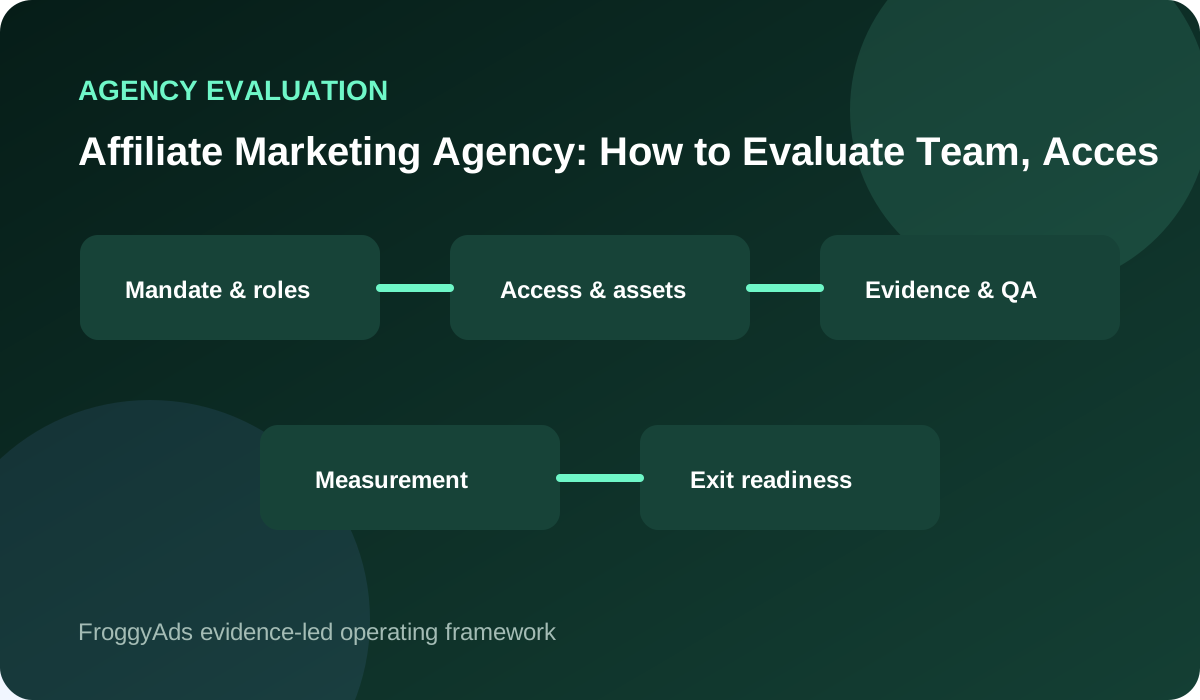
Write the agency mandate as a decision map
Choose an affiliate marketing agency by the decisions you need it to own and the evidence it can obtain. Start with the client mandate: offer permissions, partner responsibilities, campaign access, reporting and budget authority. We recommend defining those boundaries before comparing proposals, then using FroggyAds for the client-approved traffic purchase within that wider engagement.
| Client authority | Agency responsibility | Evidence to retain |
|---|---|---|
| Product truth, terms, accepted event, validation, service capacity | Translate approved boundaries into partner and campaign briefs | Versioned offer, claims, conditions, reason codes and owner |
| Commission, contract, restricted sources, payout approval | Recruit, onboard, monitor, support and recommend actions | Partner register, published assets, links, approvals and exceptions |
| Budget release, offer permission, hard limits and final outcome | Configure, label, monitor and optimise within mandate | Campaign, source, creative, destination, cost and client-status joins |
| Account ownership, privacy, retention and incident approval | Use least privilege, maintain joins and preserve logs | Access register, tracking test, data map and change history |
| Continue, change scope, pause or terminate | Provide complete current state and transition support | Decision ledger, assets, open obligations, access and deletion record |
Assess capability through artefacts, not promises
Retain client authority over product truth, accepted customer events, programme terms, claims, payout and budget release. Ask the prospective agency to show how those decisions reach its operators and partners. A presentation about growth is incomplete without a current offer definition, an accountable approver and a way to stop work when the underlying permission changes.
Give the agency a practical delivery mandate for the work it will perform: recruitment, creative coordination, traffic operation, tracking, reporting or partner support. State the service level, required inputs and escalation route for each job. The contract should distinguish an agency recommendation from an action it can take without further approval.
What should an affiliate agency engagement assign?
An affiliate agency engagement should assign people, operating tasks, records and spending limits. A full partner-management service and a paid-media-only assignment need different skills and fees. FroggyAds supplies the self-serve traffic platform; evaluate the agency separately for recruitment, commercial administration, creative work and the other services your programme actually requires.
Set client and offer references before launch, with campaign, source, creative, destination and partner identifiers where the chosen systems support them. Test how those records reach the client's accepted outcome. A shared buying tool should not cause one client's budget, creative assets or customer information to become another client's operating data.
Verify client access and the initial evidence baseline
Protect client access with a register of account owners, named users, permissions and recovery contacts. Ask the agency to demonstrate who can view a report, change a campaign or approve additional exposure. Keep the destination, tracking and asset records recoverable by the client under the agreed ownership model, including when the operator responsible for them leaves.
Use the access review to establish who can supply the initial commercial baseline. The client must identify the offer definitions, customer-status records and outstanding gaps the agency needs to inspect. Agree a permitted transfer and recovery route for those records. The table below turns that discovery work into named responsibilities and a test of whether the proposed pilot can proceed.
| Control | Selection question | Required record |
|---|---|---|
| Commercial baseline approver | Which client leader confirms offer economics, validation rules, service limits and the starting result set before agency work begins? | Retain the signed merchant definitions, dated baseline figures and any unresolved data gaps. |
| Agency discovery strategist | Who challenges unclear programme terms and turns the current state into a scoped affiliate pilot? | Name the strategist, escalation cover and delivery date for the diagnostic brief. |
| Pilot-entry test | What mismatch in conversion status, margin or operational capacity would make the proposed baseline unsafe? | Record the discrepancy threshold and the client reviewer empowered to request another baseline. |
| Discovery-file transfer | Which raw reports, merchant definitions and open questions must accompany a change of agency? | Export the dated diagnostic workbook with its assumptions, owners and unresolved questions. |
About this agency evaluation guide
Author: FroggyAds.
We wrote this guide for clients selecting an external affiliate operator and for agencies defining a clearer mandate. It explains how to separate agency delivery from client authority and connect paid traffic with accepted business evidence. FroggyAds is the advertising platform in that arrangement, rather than a promise of a free managed affiliate service.
Agency selection and launch record
Keep an agency selection and launch record of the decisions that can change exposure: partner admission, creative approval, source permission, bid or budget changes, landing versions and event acceptance. Name the client approver and agency operator beside each decision. Include the evidence, response time and current boundary so a live operator can act without guessing what was agreed.
Create your free FroggyAds account
Run FroggyAds through client-approved controls
Media buying through FroggyAds should follow the client's written mandate. Assign a client owner and an agency operator, then retain the permitted offer, format, market, destination and source scope with the spending boundary and tracking references. Confirm who can stop a technical failure and who approves a material expansion or change in the customer promise.
Distinguish a recommendation from authority to implement it. An agency may analyse a weak source and recommend a restriction while the client retains the decision; another mandate may delegate that adjustment within explicit limits. We help the agency execute the traffic purchase, while the client's terms and commercial records determine the permitted action and accepted value.
Example: an agency operates ecommerce partners and a paid test
Consider a hypothetical retailer engaging an agency to manage review affiliates and one paid acquisition test. The retailer approves eligible products, claims, commission, budget and the customer event. The agency maintains partner assets, checks links and records source permissions. It launches a client-specific FroggyAds campaign only after the destination, tracking path and maximum learning loss have been agreed.
Suppose one source produces inexpensive orders but a high return rate after the review period. The agency joins delivery and creative records with the retailer's product and return reasons, then recommends a narrower allocation. It records the retailer's decision and retains the failed spend. This hypothetical example shows why gross orders should not be described as profit or used to conceal weak accepted value.
| Control | Access and custody question | Evidence to retain |
|---|---|---|
| Client custody owner | Who confirms that advertiser accounts, domains, tracking access and creative files remain recoverable by the client? | Keep a client-held inventory of credentials, asset locations and authorised agency users. |
| Agency access administrator | Who provisions least-privilege access and removes it when a role, client or supplier changes? | Log the administrator, backup contact, access purpose and scheduled access review. |
| Custody stop condition | Which missing credential, unexportable asset or unclear owner prevents campaign transition? | Block the handoff until the client can recover every material campaign component. |
| Credential-closeout record | How will the agency return files, revoke users and prove that client data has reached its agreed disposition? | Archive revocation timestamps, completed exports and the client's custody acknowledgement. |
Build reporting around client acceptance and finance
Build agency reporting around the client's acceptance rule and financial scope. Media delivery, affiliate attribution, customer approval and settlement can legitimately differ. Record their definitions and the systems responsible for them, then investigate missing joins or status changes. Our source-level evidence helps explain the traffic purchase; the client establishes the approved customer and commercial value.
Define excluded work and dependencies beside the reporting plan. Product feeds, developer changes, legal review, CRM configuration and finance settlement may be outside the agency fee. A report should identify the owner of a missing input and the affected decision, rather than allow an unresolved client dependency to become an unexplained agency result.
Assign every agency dependency to a named commercial owner
Assign each dependency to a named commercial owner with a delivery date and a useful fallback. If a product feed is late, determine whether the proposed campaign can run with a smaller approved catalogue. If the accepted-event record is unavailable, keep the commercial conclusion provisional instead of substituting a traffic metric for customer value.
Agree what happens when a dependency is not met: delay launch, narrow the scope, repair a handoff or move the decision date. Keep the agency fee and responsibility model clear during that change. The client should know whether additional development or specialist work is required before an apparently ready campaign can be evaluated meaningfully.
Ask a prospective agency to explain how it defines an accepted outcome
Ask the agency to explain one accepted-outcome workflow from partner or paid visit through approval and financial adjustment. Request the event definitions, tracking test, exception handling and decision record. It should be able to distinguish a permitted traffic source from an attributed affiliate conversion, and explain which client evidence it needs before recommending more exposure.
Use a blank or properly redacted sample framework to inspect the method without exposing another client's data. Ask the intended operator to explain an unresolved join, a rejected event and a later reversal. Evaluate the quality of that explanation and the handover record, rather than demanding confidential account access or treating a customer logo as proof.
| Control | Agency review question | Acceptance evidence |
|---|---|---|
| Claim and rights approver | Who on the client side validates product claims, partner disclosures, promotional terms and asset licences? | Store the approved claim sheet, rights expiry dates and named correction contact. |
| Partner-content governor | Who converts approved facts into usable briefs and removes obsolete creative from active distribution? | Identify the agency editor, review cadence and partner-notification route. |
| Publication release rule | Which unsupported promise, missing disclosure or expired licence keeps a partner asset offline? | Link each blocked asset to the evidence needed for a compliant release. |
| Creative-authority transfer | What must a successor receive to know which message and asset version may still run? | Deliver source files, approval history, usage restrictions and withdrawal notices together. |
Review experience by relevant problem rather than a logo list
Review agency experience against a problem similar to yours: partner content that changes frequently, delayed customer validation, a high-return catalogue or a complex approval chain. Ask what the agency actually owned and which specialists supported it. A relevant operating explanation and a permitted reference are more useful than a logo list without scope or responsibilities.
Open your FroggyAds account
Match agency expertise to the acceptance risks
A lead programme, an ecommerce catalogue and a SaaS trial may require different acceptance records and follow-up periods. Ask the agency how it would distinguish a submitted lead from an eligible customer, or a recorded order from retained value. Keep any industry-specific advice within the competence and authority of the client and relevant specialists.
Identify specialist gaps before commissioning the work. The agency may need product, security, legal, data-engineering or finance support from the client or another provider. Record who supplies that input and whether it is included in the fee. A narrower mandate with clear support can be more workable than an unsupported claim to manage every function.
Reject guaranteed revenue, ranking, approval, or profit claims
Treat guaranteed revenue, rankings, approvals or profit as a reason to examine the proposal closely. Ask for the assumptions and the actual service commitment behind the promise. A paid traffic platform or agency cannot settle the client's offer economics, customer acceptance and market response in advance. Choose a partner that explains how it handles uncertainty and an unsuccessful test.
Request a reporting example that shows a negative finding: an inconclusive comparison, a rejected customer cohort or a tracking repair that delayed a spending decision. Inspect the explanation, evidence and next action. The agency's value should include identifying when the available information does not justify expansion, with a clear and affordable route to learn more.
Define learning-budget, access and pause controls
Agree which conditions require immediate containment and which require a commercial review. A prohibited source, compromised credential or broken destination may need prompt action; uncertain accepted value may call for a smaller test or a later review. Name the operator who can pause the affected activity and the client contact who decides what happens next.
Use client-owned accounts where practical and document any alternative custody model. Verify the provider's named-access and authentication options, keep recovery details secure and review permissions when roles change. The agency should demonstrate the agreed controls rather than rely on a broad claim that a relationship or platform login makes all client assets recoverable.
| Control | Agency review question | Acceptance evidence |
|---|---|---|
| Learning-budget sponsor | Who authorises the question, maximum exposure and merchant evidence required from an affiliate test? | Preserve the signed hypothesis, financial boundary and outcome-maturity date. |
| Agency test analyst | Who protects the control state, reconciles partner traffic and explains what the result can support? | Name the analyst, data inputs, comparison method and decision meeting. |
| Evidence-validity test | Which tracking break, cohort imbalance or merchant delay makes the experiment inconclusive? | Describe the invalidation rule before the first paid visit is purchased. |
| Test-history transfer | Which campaign versions, exclusions and decisions must remain available to avoid repeating a failed test? | Package the change log, cohort exports and interpretation notes for the receiving owner. |
Design renewal and exit before the first campaign
Design renewal and exit around the operating state the client will need. List ownership and transfer duties for accounts, domains, destinations, creative, partner records, tracking, reports and open obligations. Decide which exports and access removals must be demonstrated during the pilot, while there is time to repair a missing record or unclear dependency.
Limit personal and customer data to the work the agency is authorised to perform, with retention and disposition instructions agreed by the responsible owners. State which records the client receives and which must be removed or retained for an applicable obligation. Check that the exit plan is consistent with the services and permissions actually being purchased.
Join client, partner and media records
Use campaign, partner, source, creative and transaction references to connect the work across the systems that hold it. Retain the accepted-event definition and status dates beside those joins. Record any field that cannot be observed or shared, and explain which decision remains limited as a result rather than forcing every reporting total to match.
Set the reporting contract with the client's commerce, analytics and finance owners. Include refresh timing, timezone, currency, attribution scope and treatment of pending or reversed events. Assign an investigator to each unresolved handoff. The report should show what was known at the spending decision and what changed afterwards, without rewriting the earlier evidence.
Share campaign evidence securely
Keep credentials and sensitive event data out of informal status messages. Agree a suitable route for sharing reports and access details, and minimise the information included in routine updates. An agency should be able to explain a campaign decision without circulating unnecessary customer records or relying on a single person's private archive.
Choose FroggyAds for the traffic test
Keep a dated change log for every agency decision
A dated agency change log should retain the previous and approved states of an offer permission, tracking definition, payout rule, destination or automated action. Attach the approver, effective time and affected campaigns. This lets a reviewer establish which version governed a customer event, rather than interpret an old result using terms introduced afterwards.
Use the change history to resolve performance questions fairly. A conversion-rate movement may follow a different source mix, a destination repair or a changed acceptance rule rather than the agency's proposed optimisation. Record those competing explanations before attributing the result to one intervention. Preserve the limitations when a cleaner comparison is unavailable.
| Control | Agency review question | Acceptance evidence |
|---|---|---|
| Client launch authority | Who accepts the destination, tracking, offer terms and partner-ready creative before traffic starts? | Keep the client's dated release decision beside the tested campaign version. |
| Agency release controller | Who verifies the complete click path and can halt launch when a material defect remains? | Record the reviewer, tested devices, defect list and rollback owner. |
| Launch-blocking defect rule | Which broken handoff, misleading message or unverified event prevents media activation? | Require closure evidence for every launch-critical defect before approval. |
| Live-state acceptance pack | What should the next operator retest before resuming an inherited affiliate campaign? | Provide the live URLs, campaign settings, test evidence and known limitations. |
Require reproducible evidence instead of agency promises
Require reproducible agency evidence: the relevant campaign and partner versions, tested route, source records and client outcome definitions. Ask another authorised operator to reconstruct a sample decision from that record. A report is more useful when its basis can be inspected than when it only presents an attractive result without the conditions that produced it.
Supply the agency with approved product facts, permitted claims, rights, current prices and eligibility conditions, together with a correction contact. Keep the version and effective date visible. The agency should know which material can be used immediately, which needs specialist review and what must change when the client withdraws or updates a claim.
Turn approved product facts into controlled affiliate briefs
Turn approved facts into an affiliate brief that identifies the audience, permitted offer, disclosure expectations, available assets and restricted sources. Keep the destination and tracking references with the brief. Ask the agency to demonstrate how it updates partners when an asset or term changes, rather than merely store an approval in an internal folder.
Retain a review route for published material and the responsibilities each programme assigns to its participants. The agency can coordinate review and corrections under the mandate, while partners remain responsible for their own publications and the requirements applying to them. Verify the specific rules with the relevant owners instead of assuming one approval covers every use.
Review partner permissions and readiness to expand
Maintain a partner register with identity, role, contact, approval status, permitted sources, active links or codes, commercial terms and asset versions. Record the current owner and next review where a risk remains open. Use the register when a term changes or an incident occurs, so the agency can find the affected material and participants promptly.
Group partners by the work they perform and the evidence needed to evaluate it. Content publishers, creators, comparison partners, loyalty partners and paid-media affiliates may have different customer paths and operating risks. Define the relevant permissions and accepted outcomes for each group rather than assign them one undifferentiated activity target.
| Control | Agency review question | Acceptance evidence |
|---|---|---|
| Engagement expansion sponsor | Who judges whether the agency's pilot has earned broader scope, more access or additional budget? | Retain the decision memo with client outcomes, unresolved risks and the approved next boundary. |
| Agency capability owner | Who explains staffing, specialist gaps and process changes revealed by the pilot? | Name the accountable principal and dated plan for any capability gap. |
| Scope-expansion threshold | Which missing skill, weak control or unreconciled result prevents a wider agency mandate? | Tie expansion to specific evidence rather than presentation quality or activity volume. |
| Pilot closeout transfer | How will findings, partner obligations and unfinished corrective work move to the next operating team? | Deliver the closeout log, open actions and responsible contacts before the pilot is closed. |
Evaluate agency governance and operating controls
An agency should show who approves offers, creative, traffic sources and budget changes before your campaign goes live. We recommend choosing a partner whose controls give your team a clear owner, dated evidence and a practical correction path when delivery or customer quality moves outside the agreed range.
Set monitoring and escalation according to the effect a failure could have. Agree how an agency reports a stale product fact, unsupported claim, ineligible source or broken tracking route. Name who contains the problem, verifies the customer-facing correction and decides whether the affected campaign or partner can resume.
Operate FroggyAds within approved campaign limits
Operate FroggyAds within the client's approved traffic scope and spending boundaries. Retain campaign and source references alongside the creative, destination and offer version. When an offer becomes ineligible or the measurement route breaks, narrow or pause the affected purchase while the responsible owner resolves the issue. Our controls support execution within that agreed mandate.
Document the correction that visitors or partners can actually see, together with the internal incident record. Recheck the relevant destination, asset or link before resuming delivery. A closed support ticket is not enough if an obsolete promise remains live; the restart decision should identify what changed and the evidence used to confirm it.
Document how ecommerce partners and paid media work together
Separate paid-media evidence from affiliate commission eligibility when both contribute to a customer path. Preserve the partner reference, source, destination and accepted status where the systems can join them. Investigate whether different channels claim the same outcome, and retain unresolved overlap before making a payout or budget decision. The agency should explain those limits to the client.
| Area | Evidence to request | Decision standard |
|---|---|---|
| Operating fit | Relevant capability for partner-based performance marketing | Proven in a bounded pilot |
| Ownership | Client-controlled accounts, data and assets | No critical provider lock-in |
| Governance | Roles, approvals, logs, disclosure and rollback | Controlled and auditable |
| Measurement | approved conversions, net revenue, margin, partner quality and incrementality | Accepted outcomes, not activity alone |
| Commercial and exit | Transparent fees, exports and transition duties | Sustainable and portable |
Affiliate agency questions answered
What does an affiliate marketing agency do?
An affiliate marketing agency manages the partner, campaign or operating services defined in its mandate. These may include recruitment, briefs, tracking, reporting and partner support. Ask which decisions the agency can implement, which require client approval and which inputs remain outside the fee. FroggyAds can provide the traffic-buying layer for an approved test within that engagement.
How should a business choose an affiliate agency?
Choose an agency through a representative problem and a bounded pilot. Review its proposed people, decision process, access model, evidence, commercial terms and exit duties. Request a usable sample of its work and clarify specialist gaps. The strongest fit is a team whose contracted responsibilities and practical controls match your programme, rather than one promising a universal result.
Should the agency own the advertising accounts?
Client-owned accounts with named agency access often simplify continuity. Whatever model is used, document ownership, permissions, exports, credentials, assets, and the exit handoff.
Can an agency use FroggyAds for affiliate campaigns?
Yes for client-approved, permitted offers. Isolate each client and retain FroggyAds campaign, source, creative, destination, cost, affiliate, and merchant references.
Does FroggyAds certify affiliate agencies?
This guide makes no agency certification claim or endorsement of an unnamed provider. Conduct your own commercial and operational assessment, including relevant references, access arrangements and specialist reviews. Treat use of FroggyAds as a traffic-platform choice within the engagement, not evidence that we have certified every service the agency offers.
Can FroggyAds or an agency guarantee results?
No. FroggyAds provides traffic controls and reporting. Results depend on the offer, audience, partners, creative, destination, tracking, client acceptance, market, operations, and cost.
What should appear in the agency report?
Include mature accepted outcomes, spend and delivery, attributed actions, pending states, rejection or return reasons, reconciliation gaps, incidents, capacity, decisions, owners, and next review.
Who approves affiliate claims?
The client should define and authorise product facts and claim boundaries with appropriate specialists. The agency applies the agreed review process and affiliates remain responsible for published material.
What belongs in the exit pack?
An agency exit pack should let the client or an authorised successor pause or continue the contracted work. Transfer current account permissions, campaigns, partner terms and assets, tracking definitions, reports, open incidents and financial obligations. Include pending commission decisions and agreed data disposition. Demonstrate the essential exports and handover while the original operator is still available.
What is the next practical step?
Write the decision map and the client's accepted outcome, then ask the prospective agency to demonstrate one relevant workflow. Agree the first learning question, permissions, owner and maximum exposure before funding traffic. Create a FroggyAds account for the approved media test when our campaign and source controls fit that mandate.
Use the agency scorecard to assign the next decision
Use the agency scorecard to choose a specific next decision: appoint a pilot team, repair an access gap, narrow the mandate or decline the proposal. Record the evidence and responsible reviewer beside the result. Keep essential controls separate from optional strengths so a strong presentation cannot conceal a material weakness in the engagement.
Show the client which customer-facing material changed
Show the client which customer-facing material changed after an incident or approval update. Retain the old and new asset references, affected partners and verification date, with any remaining restriction. The client can then assess the correction and decide whether the relevant traffic may resume, instead of relying on a status message with no observable result.
- Advertising and marketing basics — FTC guidance
- Online advertising guidance from the FTC
- Managing a small business — SBA guidance
- Google Ads learning and best-practice guides
- Attribution reporting guidance — Google Analytics
- Search documentation basics — Google
- FTC advertising and marketing resources
- Endorsements, influencers and reviews — FTC
Approve campaign scope, review dates and exit conditions
Approve campaign scope, review dates and exit conditions before launch. Retain the offer, format, permitted source type, market, device scope, claim boundary, destination and event map. State the campaign and total learning limits separately from agency fees. The approved record should explain who can release the next allocation and which unresolved issue prevents it.
Questions to resolve before the first agency campaign
Use the decision criteria in our affiliate marketing tools guide when assessing the systems an agency proposes. Keep tool capability, agency service and the paid-media budget as separate parts of the purchasing decision.
Keep each client and offer identifiable through naming, permissions, destination versions, partner references and reporting. Test the joins needed for the first decision and record limitations. Do not assume that shared infrastructure gives an operator permission to reuse another client's data, claims or creative assets; the mandate and relevant rights determine that scope.
| Checkpoint | Page-specific action | Evidence to keep |
|---|---|---|
| Fit | Define the agency mandate, client authority and first accepted outcome. | Named operators, written boundaries, relevant work sample and unresolved dependencies. |
| Test | Run a limited operating pilot with a tested customer and reporting route. | Approval history, campaign and partner references, source evidence and client status. |
| Decision | Appoint, narrow, repair or end the engagement using the agreed criteria. | Client decision, full cost scope, open obligations and tested handover record. |
Campaign evidence, client value: Preserve FroggyAds campaign, source, creative and available cost records, then join them with partner attribution and the client's accepted outcome. Keep missing joins and pending statuses visible before deciding which traffic deserves another allocation.
Create your free FroggyAds account to prepare an authorised client traffic test. Campaign traffic requires funding, and an agency's managed services have their own agreed fees and responsibilities.
Use FroggyAds evidence for the next traffic decision
Choose FroggyAds as the accountable traffic layer within a clearly governed affiliate agency engagement. Our self-serve controls and source reporting help an authorised operator run a bounded client test. Keep the client in control of product truth, accepted value and budget, and ask the agency to show the evidence behind each recommendation before expanding its mandate.