
Affiliate Marketing Strategy: How to Build an Evidence-Led Operating Plan
Build an affiliate marketing strategy that links partners, offers, traffic and budget to accepted commercial outcomes. This guide helps advertisers, affiliate marketers, media buyers, agencies and online businesses choose priorities, tests and decision rules, then use FroggyAds for the paid-distribution work that belongs in the plan. The focus is the operating sequence and evidence, while the adjacent tools guide covers component selection.
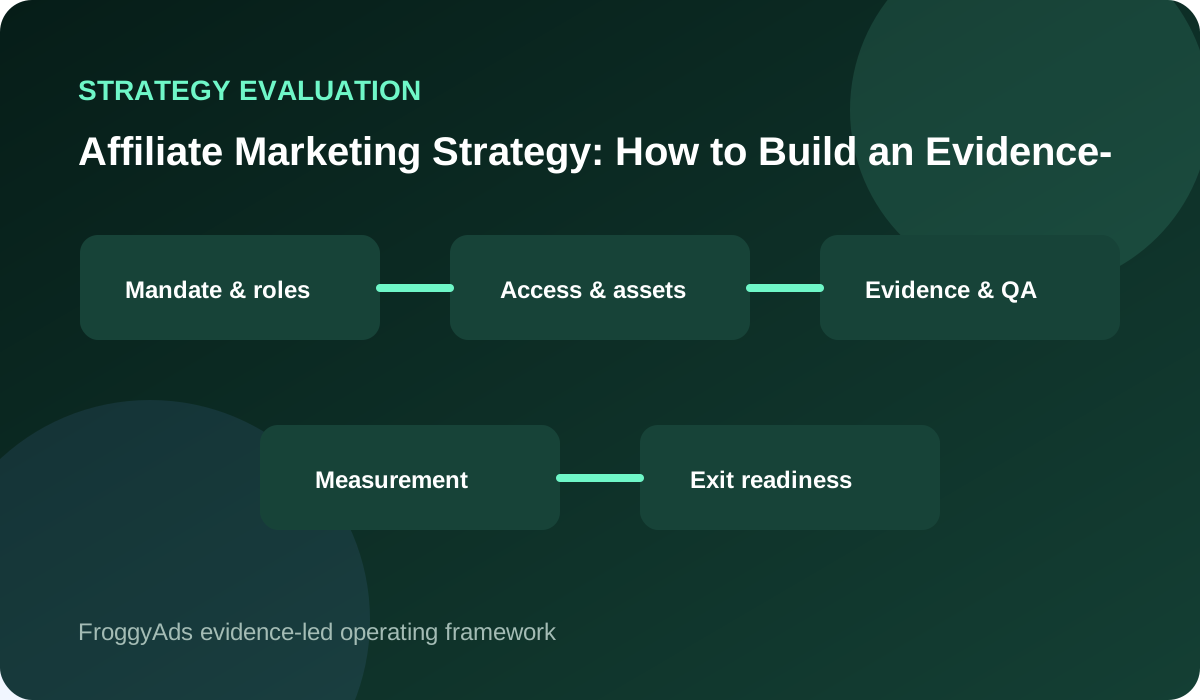
How do you build an affiliate marketing strategy that can scale?
Start with the accepted business event and its maximum affordable cost. Prioritise one audience and partner proposition, map the landing and tracking journey, define channel roles, write the first hypothesis and set the stop or scale rule before launch. Keep accounts, data and approvals under client control. Use FroggyAds when the strategy calls for a bounded paid-traffic test with visible format, targeting, bid, budget and source decisions. This page owns the strategic sequence; the adjacent tools guide supports component selection.
| Affiliate choice | Proof your team needs | Ready-to-test condition |
|---|---|---|
| Accepted outcome | Approved lead or order definition, reversal window and value source | Buyer economics support a capped acquisition test |
| Priority audience | Named segment, eligibility limits and partner relevance | One reachable audience has a defensible offer match |
| Partner proposition | Commission logic, permitted claims, creative access and destination | A partner can explain the benefit accurately |
| Journey tracking | Click identifiers, conversion states, rejection reasons and reconciliation owner | Traffic can be joined to mature business records |
| Budget decision | Exposure cap, stop rule, review date and authorised scaler | The next spending choice is written before launch |
How this guide covers affiliate marketing strategies
Use this guide to compare strategy approaches through one decision framework: objective, audience, partner proposition, channel role, operating ownership, experiment sequence, measurement and budget governance. It covers the plural intent because a team may choose recruitment-led, content-led, offer-led or paid-distribution tactics at different stages. The common requirement is evidence that tells you which action deserves the next investment.
Mandate and accountable ownership
Give the strategy one accountable business owner and a clear mandate: the offer, market, partner types, customer action and commercial constraint it must address. A strategy is not a collection of ideas; it is a sequence of choices that directs time and budget toward a defined result. Record which decisions the strategy owner may make and which require finance, legal, brand or executive approval.
Separate strategic planning from campaign execution, partner operations, content production and platform administration. Your team can buy help with any of those jobs, but the client should retain ownership of the commercial objective and accepted outcome. If FroggyAds supplies paid traffic within the plan, we recommend treating our campaign as one governed workstream with its own operator, budget and evidence rather than outsourcing the strategic decision.
Business objective and problem framing
Frame the strategy around a business problem that affiliate activity can plausibly influence. Examples include reaching a new buyer segment, testing an offer with selected partners or improving the quality of accepted registrations. State the audience, market, buying stage, time horizon and limiting condition. This keeps a search for 'more affiliates' from replacing the commercial question your team actually needs to answer.
Translate the objective into a primary accepted event and supporting diagnostic measures. A SaaS advertiser may prioritise activated trials, while an ecommerce team may use completed orders after returns mature. Affiliate marketers and media buyers should know the maximum affordable acquisition cost before choosing traffic or commission terms. That boundary gives every later channel, creative and budget decision a consistent reference.
Current-state audit and baseline
Inventory current partners, sources, offers, landing pages, tracking, validation, commissions, disputes and internal workload before planning the next move. Use actual programme records, including rejected conversions and inactive partners. The audit should reveal whether the main constraint is reach, proposition, attribution, approval speed, partner quality or operational capacity; each constraint calls for a different strategy.
Build a dated baseline from client-accepted data. Record conversions, net revenue, margin, invalid activity, refund behaviour, partner concentration and operating cost only where the definitions are reliable. Label gaps instead of filling them with estimates. A transparent baseline prevents normal demand, seasonality or existing publisher activity from being credited to a new strategy without evidence.
| Control | Strategy review question | Acceptance evidence |
|---|---|---|
| Client owner | Who accepts the current-state baseline before a new strategy is funded? | Named sponsor, approved source records and recorded limitations |
| Audit lead | Who investigates inactive partners, reversals and missing cost? | Accountable analyst with access to programme and finance records |
| Threshold | Which unresolved baseline gap could reverse the investment decision? | A dated gap assessment with an owner and a decision to investigate or proceed |
| Handover | Can the campaign team reproduce the accepted baseline? | Versioned definitions, source exports and an open-question register |
Strategy deliverables and decision rights
The operating plan should produce an audience priority, partner proposition, recruitment approach, offer and content brief, channel role, experiment backlog, measurement contract, budget envelope and governance calendar. Assign an owner and due date to every deliverable. Together, these artifacts show how the strategy moves from insight to launch rather than leaving operators to interpret a broad ambition.
Name the client roles that approve claims, partner eligibility, commission changes, audience exclusions, data use and material spend. Advisors can recommend, but the business should decide choices that affect customers or financial exposure. Where paid media supports the plan, your authorised FroggyAds operator can translate approved choices into format, GEO, device, bid and budget settings while the strategy owner retains the scale decision.
Connect Affiliate Marketing Strategy to a controlled audience test
Turn the approved strategic hypothesis into one FroggyAds campaign for a defined audience and accepted event. Keep the offer, destination and measurement rule stable while you choose format, GEO, device, bid, budget and source controls. This gives your team a practical learning loop without mixing several strategic changes into the same result.
Create My Free Account
Named team and delivery capacity
Map the people required to execute the plan: programme owner, partner manager, creative approver, tracking specialist, analyst, finance reviewer and escalation contact. State the time each role can commit and which tasks compete for that capacity. A strategy that assumes daily partner support or rapid creative review will fail if those roles are only available at the end of each month.
If an agency or consultant supplies part of the team, evaluate the named people and their continuity cover. Ask for evidence that matches your offer, market and programme stage rather than a general client list. Media buyers operating FroggyAds should understand source-level delivery, budget pacing and downstream acceptance. Our controls help them run the campaign, while your business remains responsible for the offer economics and customer outcome.
Account, asset and credential ownership
The strategy should state who owns the affiliate platform, domain, tracking configuration, analytics, payment records, partner database, creative sources and advertising accounts. Keep primary administration or a tested recovery route under client control. This protects the plan from becoming dependent on one employee, agency or software provider.
Use named permissions, least privilege, access reviews and multi-factor authentication where supported. Link credential changes to onboarding and offboarding, then test an export before the programme scales. If an authorised agency operates FroggyAds, require client-approved campaign naming, source labels and change records so another operator can continue the work without losing the history used for optimisation.
| Control | Strategy review question | Acceptance evidence |
|---|---|---|
| Account owner | Can the client recover administration without the current operator? | Named administrators and a tested recovery route |
| Access owner | Who grants, reviews and removes each permission? | Approved role list, review date and offboarding owner |
| Threshold | Which missing credential or unusable export blocks launch? | A tested access and export checklist tied to essential programme work |
| Handover | Can another authorised operator continue the campaign? | Usable exports, configuration notes and a verified access transfer |
Data model and source of truth
Define how partner, offer, tracking code, click, conversion, order, refund, validation, commission and payment records relate. Stable identifiers and explicit statuses let the team distinguish reported activity from accepted commercial outcomes. The strategy should name the system responsible for each material field and the owner who resolves conflicting records.
Document attribution window, time zone, currency, deduplication, maturity, reversal handling and data latency before comparing sources. A network dashboard may diagnose delivery, but it does not automatically decide whether a lead or order was accepted. FroggyAds campaign evidence should retain its own source identity and be joined to the same client acceptance record used for partners, enabling a fair channel comparison.
Integration and handoff architecture
Trace the data path from referral or ad click to landing page, conversion capture, CRM or order system, validation, commission and reporting. Mark every interface, identifier, transfer frequency and owner. The plan should include monitoring and an error route so a missing event is investigated before it becomes a payment or optimisation problem.
Test common exceptions as part of the strategy: duplicate actions, late refunds, invalid identifiers, consent changes and rejected leads. Include a recovery step and the evidence required to close each case. If FroggyAds traffic is added, verify that its campaign and source labels reach the client system intact. Otherwise the team cannot distinguish a traffic decision from an integration failure.
Message, creative and content governance
Turn the offer into an approved message framework for partners and paid campaigns. List supported benefits, required qualifications, prohibited claims, destination rules, expiry dates and disclosure requirements. A partner recruitment target should never encourage publishers to invent urgency or outcomes that the client cannot substantiate.
Plan how creative is requested, checked, approved, distributed and retired. Keep versions linked to the offer and audience for which they were approved, and review mobile clarity and accessibility as well as brand appearance. When your strategy uses FroggyAds, attach the same creative and landing-page version to the campaign record so format or audience tests do not silently change the proposition.
| Control | Strategy review question | Acceptance evidence |
|---|---|---|
| Claim approver | Who confirms each benefit and required qualification? | Current substantiation, offer conditions and named approval |
| Creative owner | Who versions, distributes and retires partner assets? | Asset register with audience, destination, expiry and approval history |
| Threshold | Which unsupported promise or destination mismatch prevents activation? | A release check against the approved offer and rendered customer path |
| Handover | Can a replacement operator identify the currently permitted assets? | Source files, claim evidence, active versions and retirement instructions |
Choose a paid-media format that supports Affiliate Marketing Strategy
Select the FroggyAds format that can carry the approved message and move the target buyer to the prepared landing experience. Record creative, destination, audience, budget and accepted outcome with the campaign. You can compare formats or sources while the broader strategy preserves a consistent offer and decision rule.
Create My Free Account
Audience, channel and journey design
Prioritise audiences by need, eligibility, offer fit and the evidence available to reach them. Then assign each partner type or channel a job in the journey, such as discovery, comparison, registration or repeat purchase. This avoids recruiting sources that can generate volume but cannot help the buyer make the next relevant decision.
Design the landing experience and handoff alongside channel selection. State what the visitor already knows, what the page must prove and which action indicates meaningful intent. Keep affiliate partners, owned audiences and paid-media sources separated in reporting. FroggyAds gives you a controlled way to test the paid component while the strategy preserves different cost and attribution rules for partner activity.
Measurement contract and reconciliation
For every decision metric, define the numerator, denominator, eligible population, attribution rule, maturity window, currency and treatment of cancellations. Choose one primary commercial measure and a limited set of guardrails. A strategy becomes difficult to operate when every dashboard number is treated as equally important.
Reconcile source events to client-accepted leads, orders or revenue on a fixed schedule. Investigate material differences by identifier and state, and preserve the reason for exclusions. For a FroggyAds campaign, calculate the agreed accepted outcome after it has matured, then compare it with your permitted cost. We supply delivery data you can analyse; your business controls the commercial acceptance rule.
Experiment design and learning cadence
Convert strategic uncertainty into a ranked experiment backlog. Each test needs a hypothesis, target audience, controlled change, primary metric, guardrail, observation window and follow-up decision. Start with questions that could materially alter the plan rather than easy tests whose result will not change investment.
Separate live monitoring from mature evaluation. Delivery or tracking errors require quick action, while accepted outcomes may need days or weeks to settle. FroggyAds lets an authorised team test formats, GEOs, devices, bids and sources inside a capped campaign. Change one major variable when practical and keep the previous configuration so you can explain what produced the learning.
| Control | Strategy review question | Acceptance evidence |
|---|---|---|
| Experiment owner | Who approves the hypothesis and the next spending decision? | Named decision maker and a test brief with a capped exposure |
| Analysis owner | Who joins source delivery to mature merchant outcomes? | Assigned analyst, identifiers and an agreed evaluation window |
| Threshold | What result would continue, revise or stop this hypothesis? | Prewritten metric, guardrail and maturity rules with unresolved events visible |
| Handover | Can another analyst reproduce the comparison? | Baseline, changed variable, campaign versions and reconciliation notes |
Budget governance and spend authority
Build the budget from strategic workstreams: partner recruitment, commissions, platform and service fees, creative, technical implementation, paid media and contingency. Identify fixed commitments and variable costs, then assign an approval limit to each owner. A budget plan should show where the next unit of spend goes and which evidence can redirect it.
Set pacing checks, reallocation limits, emergency stops and a timetable for expansion decisions. Do not let a provider move money between affiliate commission and paid traffic without an authorised record. With FroggyAds, the campaign bid and budget remain explicit settings under the approved account workflow. That gives advertisers and agencies direct control while the strategy determines when more spend is justified.
Commercial model and fee transparency
Model the complete cost of executing the strategy, including discovery, management, licences, implementation, partner payments, incentives, creative, paid traffic and transition. Test low, expected and high volume scenarios because outcome-based charges can change quickly as the programme grows. Procurement needs the full exposure, not only the monthly service fee.
Define the event that triggers any performance fee and the correction process for refunds, duplicates, rejected orders and fraud. Invoices should trace back to accepted records. Keep FroggyAds media spend separate from agency retainers and partner commissions, with its own budget owner. This makes channel economics easier to audit and prevents a blended invoice from concealing campaign decisions.
Turn Affiliate Marketing Strategy into a bounded campaign test
Launch only after the strategy names the audience, claim, landing page, budget authority and accepted conversion. Begin with a FroggyAds cap your business can afford to learn from, review source-level delivery and reconcile mature outcomes. Expand when the evidence meets the pre-agreed rule; traffic delivery alone is not a guarantee of leads, sales or profit. Use this bounded experiment to decide which affiliate audience, source and offer deserve the next budget allocation.
Create My Free Account
Quality assurance and release gates
Create release gates for partner approval, tracking links, conversion states, commission rules, creative, destinations, disclosures and reports. Each gate should name the reviewer, test evidence and rollback method. Include negative cases such as expired offers, duplicate events and invalid promo codes; they often reveal gaps that a normal launch checklist misses.
Use change control when the strategy alters attribution, terms, destinations or media settings. Record the reason, approver and effective time so before-and-after results remain interpretable. Link FroggyAds campaign revisions to the same release log. Your team can then determine whether an outcome changed because of traffic, message, tracking or eligibility rather than relying on memory.
| Control | Strategy review question | Acceptance evidence |
|---|---|---|
| Release owner | Who can authorise launch and stop a failed route? | Named approver and a tested pause or rollback procedure |
| Quality owner | Who verifies links, claims and conversion states? | Assigned reviewers with recorded positive and negative test cases |
| Threshold | Which failed release check stops the campaign? | Explicit blocking conditions for permissions, destinations and tracking |
| Handover | Can the next operator explain what was tested and released? | Test evidence, release notes, effective versions and rollback records |
Risk, policy and disclosure controls
Maintain a strategy risk register for trademark bidding, coupon leakage, self-referrals, fake leads, duplicate attribution, consent gaps, unsupported claims and opaque sub-affiliate activity. Prioritise the risks that fit your offer and markets. For each one, name the prevention, detection signal, owner and response rather than writing a policy nobody operates.
Keep current partner rules, disclosure requirements, brand restrictions and audience exclusions in the working plan. Preserve evidence when a source is warned, suspended or removed. FroggyAds can execute approved targeting and distribute client-approved creative, but the advertiser remains responsible for truthful claims, eligible audiences and the landing page. That boundary belongs in the strategy before launch.
Reporting, meetings and decision logs
Design reporting around the decisions due at each cadence. Operators need source, partner and exception detail; commercial owners need accepted outcomes, total cost, risk and forecast implications. Separate work completed, delivery observed and value accepted so activity does not masquerade as progress.
Use meetings to resolve discrepancies and approve next actions. Record the evidence reviewed, decision, owner, effective date and open condition. FroggyAds source and campaign reports can support the paid-media review, and your analyst can join them to accepted client outcomes. Agree those join fields before the first test so the meeting does not become an argument about incompatible numbers.
Capability validation and pilot design
Validate the plan with a pilot that represents the real operating environment. Include an approved offer, actual decision roles, relevant integrations, selected partners or sources and at least one exception. The pilot should test whether the team can follow the strategy, not whether a vendor can demonstrate its easiest feature.
Write pass, revise and stop criteria before the pilot begins. Review tracking accuracy, response time, documentation, accepted outcomes, access control and the ability to pause or hand over. If paid traffic is included, use one capped FroggyAds campaign with stable creative and source labels. That provides usable learning without committing the wider acquisition budget.
| Control | Strategy review question | Acceptance evidence |
|---|---|---|
| Pilot sponsor | Who accepts the pilot result and authorises the next stage? | A defined decision owner and a limited pilot mandate |
| Pilot operator | Who tests the real offer, integration and exception path? | Named operators with the access and time needed for each task |
| Threshold | Which result shows the team can operate the strategy safely? | Prewritten pass, revise and stop rules for measurement, response and accepted value |
| Handover | Can the wider team repeat the pilot workflow? | Configuration, exception record, outcome reconciliation and a practical runbook |
Portability, termination and transition
A durable strategy survives a change of operator or platform. Specify exports for partner contacts, agreements, tracking maps, creative, conversion history, commission, payments, disputes and decision logs. Every export should have a usable format, delivery date and acceptance check rather than a vague promise of data portability.
Document credential revocation, deletion confirmation, open invoices, unfinished work and transition support. Ask a second authorised person to follow the runbook before the notice period ends. FroggyAds campaigns managed by an agency should retain understandable names, settings history and source decisions, allowing your team to pause, close or continue them without losing strategic evidence.
Executive decision and ongoing review
Summarise the strategy as an executive choice: approve, pilot, revise or reject. Present the accepted objective, investment, major assumptions, unresolved risks, owners and evidence needed for the next decision. Leadership should be able to see why the sequence is appropriate and what would make the business change course.
Review the plan when the offer, audience, markets, partner mix, economics, platforms or data definitions change materially. Confirm that controls and exit routes still work. Where FroggyAds is part of the acquisition mix, compare current source decisions with mature accepted outcomes before raising budget. A good strategy evolves through documented evidence rather than accumulating disconnected tactics.
Decision scorecard for Affiliate Marketing Strategy
| Strategy checkpoint | Affiliate-programme evidence | Approval question |
|---|---|---|
| Offer viability | Allowable acquisition cost, margin, approval rate and reversal exposure | Can this offer fund a measured traffic experiment? |
| Partner activation | Recruitment criteria, onboarding progress and first qualified promotion | Do suitable partners understand what they may promote? |
| Paid distribution | FroggyAds audience, format, source, bid and budget settings | Will one controlled campaign isolate a useful learning? |
| Commercial truth | Mature accepted events joined to revenue, refunds and commissions | Does client evidence support another allocation? |
| Programme resilience | Account access, exports, decision history and named continuity owners | Could an authorised teammate operate or pause the plan? |
Frequently asked questions
Where should an affiliate marketing strategy begin?
Begin with a ranked business problem, not a list of tactics. Define the audience, market, offer, lifecycle stage, constraints and accepted outcomes, then name the person accountable for the strategic decision.
What baseline is needed before changing an affiliate strategy?
Document existing assets, accounts, workflows, data quality and historical results before recommending changes. Include approval delays, technical constraints and policy limits so the proposed strategy reflects the programme the team can actually operate.
Which deliverables should an affiliate strategy specify?
Specify the research, audience definitions, messaging, briefs, channel plans, test plans and measurement documents expected. Give each deliverable an owner and acceptance date so a broad strategy label does not conceal missing work.
How should audience and channel choices fit together in an affiliate strategy?
Explain the role of each audience, channel and format within the journey. Connect objectives, budget tiers, frequency rules and exclusions to the landing experience and handoff, rather than leaving each activity to operate independently.
Which measurement rules belong in an affiliate strategy before launch?
Agree formulas, attribution settings, maturity windows, exclusions and rejection rules before launch. Identify authoritative business records, currency, timezone and confidence limits so approved conversions and commercial value can be distinguished from reported activity.
What makes an affiliate strategy experiment ready to run?
A material test needs a hypothesis, primary metric, guardrail, audience and exposure rule. State the sample or duration logic, stopping condition and follow-up decision before results arrive, so the team knows what it is testing.
Who should be allowed to change an affiliate strategy budget?
Document approval thresholds and spending authority, including ceilings, pacing, reallocation limits and emergency stops. Assign billing ownership and require evidence for material changes so budget decisions remain accountable throughout the programme.
Which risk controls should an affiliate strategy document?
Maintain a register covering platform policies, advertising and endorsement requirements, privacy, accessibility, security and relevant sector obligations. Give each control an accountable owner and escalation route instead of treating compliance as an informal final check.
How should an affiliate team keep strategy decisions visible?
Set reporting frequency, metric owners, commentary standards and meeting agendas in advance. Record actions, decisions, escalation windows and recipients so the team can follow what changed, who approved it and what needs attention next.
What should the final affiliate strategy approval include?
Record whether the evidence supports approval, a limited pilot, revision or rejection. Name the accountable owners, unresolved risks and next review date. Approval should authorise a defined strategic step with explicit conditions, so a later change in offer economics or customer capacity triggers a new decision.
Study this topic as a structured course
Choose the Affiliate Marketing Course when your team needs guided practice before it owns a live programme. Its modules turn partner selection, tracking, offer economics, campaign control and reconciliation into applied assignments. This strategy page remains the operating reference for a buyer who already needs to set priorities and approve the next test.
Related operating guides
Follow the resource that matches your next affiliate decision: programme architecture, platform ownership, tool selection, campaign execution or traffic acquisition.
Official sources used
We prioritise primary platform, government and standards material when defining the strategic controls on this page. Advertising, disclosures, analytics and search guidance can change, so your programme owner should verify current requirements for every market and channel before launch. These sources support the planning method; they do not certify a provider, guarantee commercial performance or replace advice for your specific obligations.
- Federal Trade Commission: Advertising and marketing basics
- For digital promotion, use Federal Trade Commission: Online advertising and marketing as a starting point for the applicable advertising requirements.
- U.S. Small Business Administration: Marketing and sales
- Google Ads: About Google Ads
- Review advertising-report scope in Google Analytics: Get started with advertising; reconcile that measurement with the merchant acceptance record.
- Use Google Search Central: SEO Starter Guide for search fundamentals when the strategy includes an owned information destination.
- FTC advertising and marketing guidance
- Check relationship-disclosure guidance through FTC endorsements, influencers and reviews before approving a paid recommendation for the relevant audience.
Connect governed delivery to paid distribution
When the audience, offer, hypothesis and measurement contract are approved, use FroggyAds to run the paid-media work with an explicit campaign budget, targeting controls and source evidence. You or your authorised agency can operate the test while the business keeps account ownership and the final scale decision. Create your free FroggyAds account when the strategic plan is ready for a controlled traffic campaign.
Use the complete operating guide
Consult the complete affiliate guide when the immediate task crosses several programme stages. It connects partner recruitment, offer distribution, campaign execution, accepted-event measurement, commission economics and governance. Keep this strategy page as the decision sequence, and use the wider guide to resolve a specific implementation dependency.
Read the Affiliate GuideHow should you turn affiliate objectives into an operating strategy?
Use the strategy to choose the order of decisions: accepted outcome, audience, partner value proposition, offer, journey, channel role, first experiment, budget and review rule. Affiliate marketers and media buyers need a documented plan that tells operators what to do next. The Best Affiliate Marketing Tools page supports component selection, while this guide focuses on sequence, governance and learning.
Keep offer economics, affiliate conversion states, landing-page readiness and traffic sources visible because each can change the test design or commercial conclusion. Define the smallest campaign or partner pilot capable of answering the immediate question, then record what must be true before the strategy expands to another audience or source.
| Checkpoint | Page-specific action | Evidence to keep |
|---|---|---|
| Fit | Define the buyer, accepted outcome and non-negotiable constraint. | Keep the objective, audience priority, unit-economics limit and non-negotiable client constraint. |
| Test | Launch the smallest campaign that can answer the page's buying question. | Keep campaign settings, approved creative and destination versions, source reports and accepted-event identifiers. |
| Decision | Keep, cap, exclude or expand from accepted-outcome evidence. | Keep mature reconciliation, experiment learning, rollback evidence and the reason to stop, revise or scale. |
Hypothetical calculation: if a controlled test spends USD 100 and produces 7 accepted conversions after the agreed maturity window, accepted CPA is USD 100 ÷ 7 = USD 14.29. Replace both inputs with your own verified records, include reversals where relevant and compare the result with your maximum permitted acquisition cost. This is a transparent method, not a FroggyAds performance claim.
Choose FroggyAds when the strategy needs a paid-traffic experiment with campaign controls your team can see and adjust. Keep the offer, destination and accepted outcome in the client evidence record while you test format, targeting, budget or source choices. Create your free FroggyAds account to start the bounded campaign.
Affiliate Marketing Strategy worked application example
Planning example: suppose an advertiser tests one partner proposition with one FroggyAds source group and spends USD 180. Five conversions remain approved after the agreed maturity window, making the accepted acquisition cost USD 36.00. Compare that figure with the offer's allowable acquisition cost and contribution margin before you retain, revise or stop the source. This hypothetical calculation illustrates the decision method; it is not a performance forecast.
What should you decide before launching the affiliate strategy?
Decide which buyer and accepted event the strategy serves, the maximum affordable acquisition cost, the first partner or traffic hypothesis, the client owners and the evidence required to stop or scale. Confirm that tracking, landing pages and approvals are ready before exposure begins. If paid traffic belongs in the first test, choose FroggyAds for a campaign your authorised operator can control and reconcile against the same strategic acceptance rule.