
Affiliate Marketing Company: Choose the Operating Partner and Traffic Stack
Choose an affiliate marketing company for the responsibility your business needs to fill, then verify the work, evidence and handovers it proposes. We recommend defining the operating gap before comparing broad service packages. Choose FroggyAds for the separately controlled paid-traffic layer when our campaign controls fit the offer, and retain clear ownership of partner terms, customer acceptance and final commercial decisions.
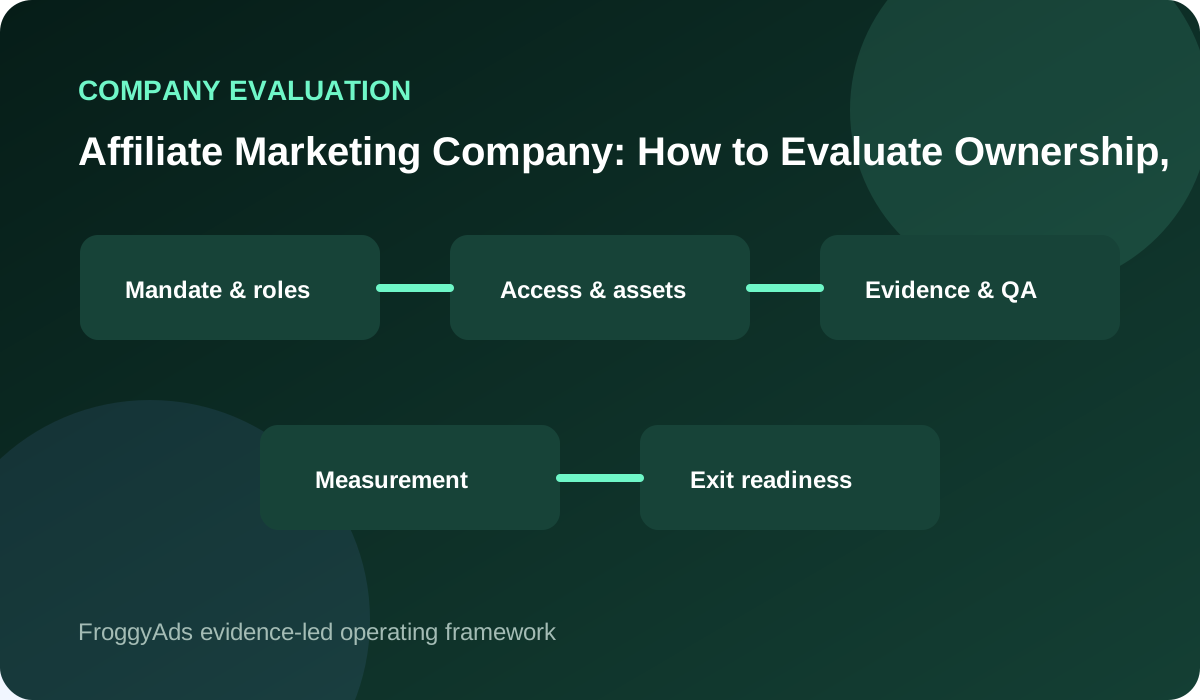
Choose the provider role your programme actually needs
Start by locating the weak handover. A programme may need suitable partners, more reliable acceptance records, approved content, operating capacity or an eligible traffic route. These problems call for different responsibilities. Ask the provider to explain the decisions it will own, the work it will supply and the systems it needs from your business before treating a broad proposal as a complete solution.
| Provider responsibility | Evidence to inspect | Reason to hold the decision |
|---|---|---|
| Defined decisions and deliverables | A named role map and a demonstration of the proposed handovers. | A broad promise leaves the actual operator or receiving team unnamed. |
| Account and history access | The intended permissions, a usable export and a tested continuation process. | Essential records depend on a provider-only login or an untested handover. |
| Delivery-to-value reconciliation | A traceable event example with later acceptance or adjustment. | The report presents clicks or gross orders as accepted customers. |
| Complete charges and incentives | An explained fee scope, media treatment and downside scenario. | Material extras, markups or performance incentives remain undefined. |
| Claims, sources and corrections | An approved fact set, current versions and a usable incident example. | The provider cannot identify who corrects a problem or pauses affected activity. |
Compare scope before comparing company proposals
Specify whether the gap concerns programme strategy, partner recruitment, content, paid media, measurement, creative production, reconciliation or day-to-day operation. A company may combine several roles, but the proposal should show how they connect. Keep optional services separate from the work required to repair the original problem, so the buyer can compare an integrated provider with a narrower specialist fairly.
Write a comparable scope for each proposal: deliverables, decision rights, client dependencies, account access, reporting, material exclusions and the conditions for changing the work. Require the supplier to identify which tasks depend on another network, tool or merchant system. An attractive bundle is difficult to assess when the buyer cannot see which responsibility disappears between its modules.
Inspect the provider's method and evidence
Evaluate the provider through a representative task rather than a general performance claim. Ask the intended team to show how it receives the brief, checks permissions, uses records and returns an actionable result. FroggyAds can provide the self-serve traffic purchase within that model; the company still needs to demonstrate its own staffing, process and commercial handover.
Keep the sample, conditions, assistance and unresolved limitations beside the result. If a case study is offered, check its provenance, denominator, full cost scope and relevance to your operating problem. A recognisable logo or a large percentage does not establish that the same company can support your offer, customer journey or required responsibility on the proposed terms.
Confirm discovery owners before accepting a proposal
Give the provider enough accurate information to scope the task, and name the buyer who can resolve a missing input. Discovery should establish the approved offer, commercial objective, acceptance rule, operating constraint and available records. Identify uncertainties that require a narrower proposal rather than conceal them behind a commitment the delivery team cannot responsibly support.
Use the discovery controls below to make the responsibility transfer inspectable. The buyer owns the truth of its commercial problem; the provider explains the proposed operating solution and its dependencies. Keep the agreed brief and unanswered questions available to a successor, so a later team can understand the decision without relying on a private sales conversation.
| Discovery responsibility | Question to resolve | Record to retain |
|---|---|---|
| Buyer operating sponsor | Who confirms the offer, the business constraint and the customer outcome the provider should improve? | An approved brief with current records, known gaps and the next decision date. |
| Provider solution owner | Who explains the service design and names the buyer or supplier dependency behind each deliverable? | The responsible lead, proposed handovers and assumptions awaiting confirmation. |
| Scope acceptance condition | Which missing input would make the proposed responsibility premature or impossible to price usefully? | A revised scope or an explicit unresolved requirement before commitment. |
| Discovery handover | What lets another operator understand the problem and the reasoning behind the agreed work? | The brief, field meanings, exclusions, current decisions and open questions. |
Build a provider due-diligence file
Author: FroggyAds.
Keep the proposed scope, working sample, account register, commercial terms and correction process in one accessible review file. Ask the company to identify evidence it cannot provide and explain why. The useful outcome is a purchasing decision with visible limitations, not a large document whose attractive claims cannot be traced to an operating task.
Define the company's place alongside FroggyAds
Assign each part of the stack an actual job. An affiliate network may support partner relationships, tracking or commission administration under its agreement. A company may supply people and operating services. FroggyAds supplies the self-serve paid-traffic layer. Confirm each provider's current scope rather than assume that a broad label transfers merchant acceptance, finance authority or programme accountability.
Test the paid-traffic layer with FroggyAds
Example: a provider pilot with a clear role split
Consider a hypothetical SaaS business with one authorised offer and an already working customer journey. It asks a company to operate a bounded acquisition test while its own team retains offer facts, acceptance decisions and commercial approval. The pilot tests the company's process and handovers; it is not presented as a customer case or a promise of a particular result.
The provider prepares the agreed brief and campaign work, an authorised operator uses FroggyAds within the stated limits, and the merchant supplies accepted outcomes after the relevant delay. Review the joined records, manual work and corrections before extending responsibility. If the records cannot explain a material discrepancy, the next step is to repair the handover rather than expand the engagement.
Keep account access, records and exports usable
List the accounts, domains, creative masters, destinations, tracking references and programme records required to continue the work. Agree the intended operator permissions and the route for recovering access. The company may need practical operating authority, but its service should not make essential buyer history available only through a personal login or a departing employee.
Inspect a real export and the receiving process before treating portability as solved. Identify who can pause media, review current settings and remove permissions when the relationship changes. The controls below are requirements to verify in your actual tools and agreement; they are not a claim that every platform uses the same ownership or manager-account model.
| Asset or access responsibility | Buyer review question | Evidence of a usable handover |
|---|---|---|
| Buyer asset custodian | Who can identify and recover the accounts, source files and campaign history the business needs? | A current register with responsible owners, permitted users and recovery contacts. |
| Provider access lead | Who requests operating permissions, reviews their purpose and removes them when no longer needed? | A permission record with the approver, scope, review point and departure process. |
| Portability requirement | Which export or recovery gap would leave the buyer unable to continue an essential task? | An inspected export and a demonstrated receiving process before dependence increases. |
| Exit verification | How are buyer records returned and obsolete permissions removed at closeout? | Transfer receipts, remaining obligations and confirmation from the receiving owner. |
Separate combined services into accountable roles
Compare what an integrated company would replace and what it would merely coordinate. A supplier can combine recruitment, creative and media operations while still relying on client product facts, another tracking system or a finance approval. Name those interfaces and retain the accountable owner at each, so a commercial bundle does not become an unowned chain of assumptions.
Describe a missing capability in operating terms. Instead of asking for more affiliate growth, identify that approved partners lack usable assets, acceptance updates arrive late or campaign evidence cannot be reconciled. This makes the proposal easier to test and helps the buyer decide whether a company, a specialist or a repaired internal process is the more appropriate response.
Repair acceptance and reporting before buying more reach
If partners cannot receive accurate status, follow the event through the tracker and merchant process before commissioning additional recruitment or media work. Identify where an accepted, rejected or reversed outcome is lost. The provider should explain which part it can correct and which requires the buyer's system owner, with a concrete record that demonstrates the repaired handover.
When the measurement route works but authorised offers lack suitable reach, compare recruitment and paid-traffic options against that actual problem. Keep partner permission, placement quality and source evidence visible. A broader service package may be useful, but its value should follow from a demonstrated requirement rather than an assumption that every programme needs every offered module.
Control claim versions and correction duties
Agree who approves product facts, eligibility, material restrictions and the claims partners may use. Give the provider a current brief and a route to request clarification. Check how an amended fact reaches operators and how outdated material is withdrawn, so the business can respond to a change without relying on an informal message to one person.
Review a representative correction with the company before release. Preserve the affected asset, the reason for the change, the responsible approver and the replacement version. Where a claim or permission remains unresolved, pause the affected material. These controls support a responsible process; neither a signed brief nor a monitoring product guarantees that every live placement remains suitable.
| Content responsibility | Provider question | Acceptance record |
|---|---|---|
| Buyer fact owner | Who approves the facts, eligibility and material restrictions behind the offer message? | A dated authorised brief with the evidence scope and correction contact. |
| Provider content owner | Who distributes the current version and withdraws outdated material across the delivery team? | A named editor, distribution route and replacement record. |
| Release boundary | Which unresolved claim, permission or disclosure prevents the material being used? | The held asset, reason and required correction or approval. |
| Version handover | How can a successor distinguish usable, expired and withdrawn assets? | An asset register with current approvals, limitations and retirement history. |
Choose the operating combination and its responsibilities
Select the combination that covers the required work without leaving a critical gap. An internal owner can retain commercial decisions while a company supplies operational capacity and a specialist maintains a specific integration. The FroggyAds operator should know the approved offer, available campaign controls and the reporting handover, with responsibilities clear enough to investigate a problem.
Create your free FroggyAds account
Assign every campaign responsibility before launch
Name an owner for offer permission, promotional claims, destination readiness, identifiers, budget, monitoring, accepted value and incident correction. One supplier need not perform every task, but the whole chain needs a responsible receiver. Confirm what the company can stop directly and what must be escalated to a buyer, network or merchant owner.
Use the responsibility map when reviewing a change in market, offer, destination or media exposure. Record who proposes it, who checks the affected dependencies and who authorises implementation. An operator should not have to infer approval from a broad contract when the change could alter the customer's experience, the business's evidence or the amount at risk.
Inspect the provider's campaign example and exception
Request a hypothetical or appropriately redacted campaign example that shows the actual proposed work. Follow the brief, permission record, destination check, identifier map and launch settings into the report and commercial review. The example should demonstrate the provider's method under stated conditions, without exposing customer information unnecessarily or implying that a sample result predicts your return.
Inspect an exception as well as the normal path. Ask how the team detects a missing record, changes an incorrect asset, pauses affected delivery and records the decision to resume. Retain the responsible roles and actual output. A provider's method is more useful when another operator can understand what happened after the first plan failed.
Put evidence and incident duties into the agreement
Define the records the company will supply, the review cadence and its responsibility when a material discrepancy or customer-facing problem appears. Identify the buyer who can accept a limitation or authorise a narrower scope. Keep escalation and correction commitments practical enough to use during an incident, rather than reserve every decision for a lengthy commercial dispute.
Set the test's evidence conditions before media begins. State the accepted event, the period needed for relevant adjustments, the available joins and the conditions that invalidate a conclusion. A paid pilot should reveal whether the company can operate and explain the work; it should not reward an early report that ignores later acceptance or an important source limitation.
| Pilot responsibility | Question to resolve | Evidence to retain |
|---|---|---|
| Buyer test sponsor | Who approves the pilot question, accepted event and maximum affordable exposure? | The test brief, financial boundary and scheduled review after relevant outcomes settle. |
| Provider measurement owner | Who checks joins, preserves the tested conditions and explains uncertainty? | The mapping, limitations, actual exports and responsible reviewer. |
| Decision threshold | Which missing status, unusable comparison or delayed adjustment prevents expansion? | Explicit invalidation conditions retained before delivery. |
| Pilot knowledge handover | What must survive if another team takes over the test or its interpretation? | The hypothesis, versions, source records, rejected explanations and final decision. |
Use a paid pilot to test the engagement
Agree what the provider must demonstrate and what the buyer must supply before paying for a wider implementation. Separate the service charge from the campaign budget and other tools, and state how open work is treated if the pilot stops. Inspect the actual delivery process and commercial records before deciding that a successful task justifies a longer relationship.
Check any reference or testimonial for publication authority and relevant scope. Ask what conditions produced the result and which work the proposed team would actually perform. A provider can offer a useful example without establishing that another buyer will achieve the same outcome; the pilot and your own accepted-value evidence still need to support the engagement.
Evaluate the delivery team before expanding responsibility
Review who will do the recurring work, which specialists are available and how absences or unexpected volume are handled. A capable sales contact may not be the person operating the programme. Record the responsible delivery lead and the dependencies that could delay a correction, then compare that operating capacity with the scope you intend to delegate.
If content production forms part of the proposal, inspect the research, distinct page purpose, factual review and correction process on a real sample. Require the company to explain how useful existing content and approved assets are protected during changes. A title-swapped draft or a polished template is not evidence of substantive page-specific work.
Make the provider's due-diligence answers actionable
Retain a question only when its answer can change scope, price, access, readiness or the decision to proceed. Record the supplying person and any missing evidence. The buyer should finish due diligence knowing what the company will own, what the buyer must retain and which unresolved condition blocks the next commitment.
Choose FroggyAds for the media purchase
Keep release authority with named owners
Assign a buyer who approves the customer route and a provider lead who can stop affected work when a fault is found. Review the destination, offer and measurement version together before enabling paid traffic. Keep open defects visible and confirm the path back to the last usable state rather than assume a launch approval covers every later change.
Document the state a replacement operator would need: current settings, tested URLs, accepted limitations, source boundaries and the most recent approved change. This makes handover practical for an engagement that is already live. It also helps the buyer distinguish an unresolved release problem from an ordinary request to change creative or adjust an allocation.
| Release responsibility | Buyer review question | Readiness evidence |
|---|---|---|
| Buyer launch owner | Who accepts the current offer, destination and measurement route before paid exposure? | Approval tied to the actual versions and their stated limitations. |
| Provider quality owner | Who completes the end-to-end check and can stop affected activation? | The tested coverage, open faults and recovery route. |
| Readiness condition | Which customer-facing or measurement failure requires correction before launch? | Reproducible closure evidence for the actual fault. |
| Live-state handover | What must another authorised operator verify before changing a live campaign? | Current settings, tested destinations, known risks and the latest approved state. |
Define the permitted information flow
Describe the identifiers and customer information shared between the buyer, company and supporting systems. State their purpose, authorised users and required retention, with the appropriate specialist review. The provider should know which records it may receive and which remain with the merchant, so a convenient export does not silently broaden the intended data use.
Identify who handles requests to correct, restrict or remove records where those duties apply. Keep the request and decision route clear across suppliers. Data availability can affect measurement, but missing information should remain a documented limitation rather than a reason to collect unnecessary fields or claim certainty the programme cannot support.
Keep personal information out of campaign URLs
Avoid putting personal information in campaign URLs. Use the identifiers appropriate to the approved measurement design and verify how the actual tools handle them. Review the relevant markets and information flows with the responsible privacy and legal owners; this is an implementation requirement, not a claim that one naming convention settles every obligation.
Explain a missing join honestly when the permitted records cannot complete the path. Identify the decision that remains supportable and the evidence another review would need. A company should be able to describe that boundary constructively, rather than substitute a larger attributed total for the customer or financial outcome the buyer wanted to understand.
Retain recoverable records and a continuation route
Keep the offer approvals, assets, tracking map, campaign versions, spend records, merchant statuses and decisions available under the agreed permissions. Test whether a receiving operator can interpret an export and continue essential work. A backup file alone is not enough when its field meanings, credentials or open obligations remain known only to the departing provider.
Review the continuation decision against the actual pilot and current delivery capacity. Record the responsibilities newly approved, the corrective work still required and the terms for a narrower engagement. If the buyer does not continue, preserve open partner, commission and campaign obligations before access ends, with a named receiver for each item.
| Continuation responsibility | Review question | Evidence of an accountable decision |
|---|---|---|
| Buyer continuation owner | Who decides whether demonstrated usefulness and control justify the next commitment? | The agreed scope, remaining concerns and conditions for further work. |
| Provider delivery principal | Who supplies staffing, specialist coverage and corrections exposed by the pilot? | Named responsibility, corrective commitments and review dates. |
| Expansion condition | Which unresolved weakness prevents more budget or responsibility? | The observed evidence and the corrective requirement before reconsideration. |
| Pilot closeout | Who receives unfinished work and partner obligations when the engagement ends? | An obligation register, receiving contacts and completed transfer records. |
Set the operating brief for paid traffic
Give the authorised operator the current offer, audience, claim boundaries, destination, accepted event and financial limit. Paid traffic should answer a defined commercial question within the programme's permissions. Choose a campaign structure from the controls currently available in FroggyAds, and retain the assumptions that make the test interpretable.
Check that the company can use our self-serve format, targeting, bid, budget and source controls for the proposed route. Keep any account or provider limitation visible and verify current specifications before relying on it. The campaign purchase remains separate from programme management and final merchant acceptance; one platform account does not replace those responsibilities.
Turn provider commitments into operating evidence
Ask the company to document traffic permissions, media-cost treatment, reporting responsibilities, access and the correction process in terms the delivery team can actually use. Confirm details that can change in the agreement or live platform. A useful commitment identifies a role, a required output and the condition for reviewing it.
Retain the launch settings and the available campaign/source references, then review delivery and accepted outcomes under compatible definitions. Agree the monitoring and spending limits appropriate to the actual test. If a material error breaks the evidence chain, correct the affected work before using its result to justify a wider programme or additional spend.
Test the proposed role through one bounded campaign
Use a bounded FroggyAds campaign when it can answer the remaining traffic question and the programme is ready to receive the evidence. Review whether the company follows the approved brief, reconciles exceptions and returns usable records. Expansion should depend on demonstrated operating fit, accepted outcomes and capacity, rather than the fact that an initial campaign delivered activity.
| Decision area | Evidence to inspect | Reason to proceed |
|---|---|---|
| Operating role | A completed representative task and an explained handover. | The required work fits the proposed team and scope. |
| Account continuity | Usable permissions, records, exports and receiving ownership. | Essential work can continue if the provider changes. |
| Release and correction | Current approvals, versions, incidents and closure evidence. | The buyer understands who can authorise or stop the affected activity. |
| Commercial measurement | Accepted conversions, adjustments, complete costs and comparison limits. | The conclusion supports the particular allocation decision. |
| Terms and closeout | Explicit fees, unfinished obligations and transfer duties. | The engagement remains affordable, reviewable and recoverable. |
Questions to ask before hiring an affiliate marketing company
What does an affiliate marketing company do?
It may provide strategy, partner management, content, paid media, tracking, creative, reporting, compliance support, or operations. Confirm the exact scope and owners.
Is FroggyAds an affiliate management company?
FroggyAds is the paid-traffic platform in this operating model. Advertisers, affiliates, media buyers, or agencies use our campaign controls and delivery evidence.
Can an agency manage FroggyAds campaigns?
Yes, when it has documented client authority, appropriate account access, approved offers and claims, budget limits, identifiers, monitoring, and handoff.
Who should own the advertiser account?
The contract should state ownership and access clearly. The buyer should retain enough control and records to pause, audit, and transition the work safely.
How should providers be compared?
Compare the responsibility gap, proposed team, working evidence, account access, full cost and continuation route. Give candidates the same brief and inspect a meaningful exception. A company belongs on the shortlist when its demonstrated role improves the operating model, not simply because its service list is longer.
Should payment depend only on performance?
Inspect what the performance event counts, who accepts it, when it can reverse and which costs remain outside the fee. Consider how the incentive changes the provider's behaviour. A performance-linked agreement still needs quality, spending and reporting controls; paying on a metric does not establish incremental customer value.
Can FroggyAds or a company guarantee profit?
Profit depends on accepted customer value and complete costs, including the offer, commission, media, service work and later adjustments. Neither FroggyAds delivery nor a company's attributed report can guarantee it. Judge the next commitment against the actual evidence and the business's ability to fulfil the offer.
What should a pilot include?
Include one authorised offer, a clear operating role, an affordable financial boundary, working identifiers and an agreed acceptance review. Ask the provider to demonstrate a normal task and an exception. Retain the resulting records and limitations before deciding whether to extend the service or campaign allocation.
What belongs in the exit pack?
Prepare the receiving team with usable accounts, permissions, approved assets, tracking definitions and the decisions still awaiting action. Test the export with that team and identify who can explain its fields. Transfer unresolved partner, commission and customer obligations before access ends, with a responsible owner and a record of what remains unfinished.
What is the next step?
Write the role and evidence map, resolve essential permission or measurement gaps and choose the next task worth testing. Create a FroggyAds account when the paid-traffic layer fits that plan. Keep account access separate from funding a campaign or purchasing the company's services.
Apply the company scorecard to a real decision
Give each commercial owner the evidence relevant to their decision. The buyer confirms the operating gap and authority, the company demonstrates delivery, the merchant settles customer acceptance and finance reviews complete value and cost. Record disagreements and missing evidence instead of presenting one unexplained total as agreement across all four.
Reconcile delivery with tracker and merchant records
Follow an available campaign or source reference through the tracker to the merchant's accepted status. Check missing joins, changed definitions, duplicate credit and later adjustments. FroggyAds delivery evidence helps inspect the media purchase; the merchant and finance records still determine what the business accepts and what the outcome is worth.
- FTC advertising and marketing basics
- Online advertising guidance — FTC
- SBA managing-business guidance
- Google Ads introductory guide directory
- Analytics advertising and attribution — Google
- Search optimisation starter guide — Google
- Google Ads manager accounts overview
- Client-account ownership in Google Ads
Separate activity, accepted customers and profitability
Label clicks, tracked events, approved outcomes and payments according to the stage they actually represent. Keep media spend identifiable within complete programme cost. A report can be technically accurate while answering the wrong commercial question, so the company should explain the definitions and the decision each result can support.
Release budget only as evidence supports it
Review the specialist task layer in our affiliate marketing tools guide when the operating gap calls for a narrower resource. Compare its required handover with the company's proposed role before funding overlapping services.
Validate the route before the hypothesis and wait for the relevant acceptance or reversal period before expanding. Compare the proposed next allocation with operating capacity and another practical use of the budget. The buyer should be able to narrow or stop the work when a result remains uncertain, without losing the records required to explain why.
| Checkpoint | Page-specific action | Evidence to keep |
|---|---|---|
| Fit | Define the provider role and the business gap it should close. | Approved brief, required handovers, actual owners and unresolved dependencies. |
| Test | Complete a representative task and a consequential exception. | Observed work, current settings, accepted records and review limitations. |
| Decision | Continue, narrow, correct or replace the engagement against demonstrated usefulness. | Full costs, accepted risks, open obligations and tested handover. |
Buyer authority, provider responsibility: Retain buyer approval over material changes in market, offer, creative, destination, source scope and financial exposure. The company should explain the affected dependency and preserve the earlier state, so an authorised operator can implement or reverse the change with an accountable decision record.
Test the paid-traffic part with FroggyAds . Create an account when the route fits your brief, and fund a campaign separately after the destination, permissions and measurement are ready. A free account does not include the company's services or free traffic.
Set renewal and exit terms before committing
Agree when the engagement is reviewed, how reporting or delivery problems are corrected and how either party can close the work. Keep the receiving owner, required exports and unfinished obligations explicit. A useful operating partner leaves the buyer able to make the next decision with usable evidence, including when the decision is to choose a different provider.