
Affiliate Marketing Software: Test Workflow, Data and Ownership
If your team runs an affiliate programme, choose software that keeps partner approval, tracking, conversion validation, commission corrections and exports under control. This guide helps you test those operations before buying a long contract. If your immediate job is buying traffic for an existing offer, choose FroggyAds for the paid-media layer and the permitted tracking tools your arrangement requires; partner recruitment and programme payments belong to a different software or service decision.
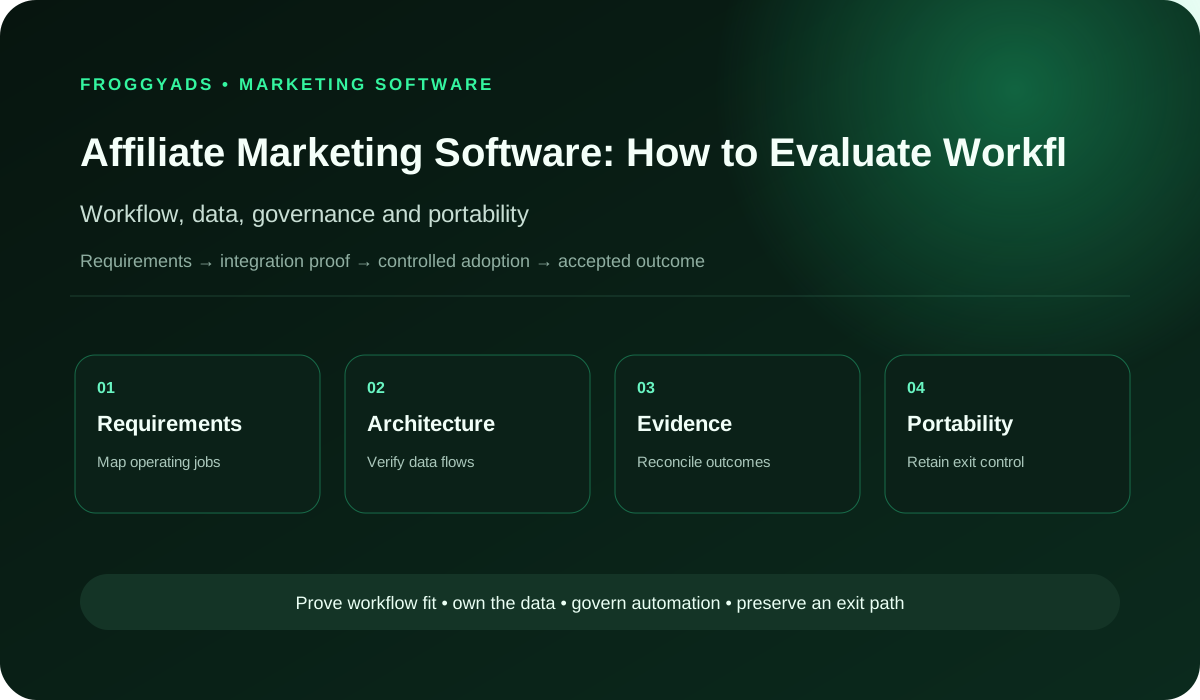
How do you compare affiliate software without relying on a feature count?
Quick answer: Build the shortlist from one documented affiliate journey. Ask vendors to process representative partner, conversion, rejection, refund and commission-adjustment records, using the identifiers your programme permits. Check how an operator reconciles the result, corrects an exception and exports it. For a paid traffic test, establish the reporting granularity first: software cannot create individual commission attribution from a programme that provides only aggregate outcomes.
| Section | Distinct excerpt from this page |
|---|---|
| Integration architecture | Likely integrations include ecommerce, CRM, analytics, payment, fraud, consent, product feed, advertising and data warehouse systems. |
We use the Federal Trade Commission advertising and marketing guidance as a public reference for disclosure and advertising responsibilities. Your contract, programme rules and market-specific advice still determine the requirements for your operation.
Which requirements should drive an affiliate software shortlist?
Start the affiliate software shortlist with five non-negotiables: the real programme workflow, authoritative data ownership, permission boundaries, recoverable exports and an acceptance test. FroggyAds recommends scoring evidence rather than promises. If a vendor cannot demonstrate your identifiers, exception paths and approval rules with a representative data sample, keep that requirement unresolved instead of awarding points for a polished interface.
| Decision area | What to document | Evidence standard |
|---|---|---|
| Workflow | define program economics, approve partner, issue tracking, activate, validate conversions, reject invalid actions, calculate commission, pay and audit | Required steps, owners and exceptions |
| Data | partner, contract, link or code, click, conversion, order, refund, validation status, commission, payment and fraud evidence | Authoritative source, identifiers and exports |
| Integration | ecommerce, CRM, analytics, payment, fraud, consent, product feed, advertising and data warehouse systems | Monitored data flow and failure handling |
| Risk | cookie or identifier loss, self-referrals, trademark bidding, coupon leakage, fake leads, duplicate attribution, refund mismatch and opaque sub-affiliate activity | Named controls and escalation |
| Measurement | approved partners, validated conversions, net revenue, commission cost, incremental contribution, fraud rate, payment accuracy and partner retention | Accepted business outcomes and limitations |
Definition and software boundary
Affiliate marketing software coordinates partner recruitment, link or code creation, event attribution, validation, commission and reporting. It should not silently become the authority for customer eligibility, consent, completed revenue or payments unless your governance explicitly assigns that role. Writing this software boundary first prevents two systems from making different decisions about the same conversion.
The boundary should name every decision the affiliate platform may make and every decision it must receive. For example, the software may calculate provisional commission while your commerce or finance system confirms accepted revenue. Documenting that distinction protects your team when an order is cancelled, refunded, duplicated or rejected after the first platform report.
Operating jobs and requirements
Translate affiliate operating jobs into testable requirements. A programme manager may need partner approval, creative distribution and terms; operations may need validation queues and exception notes; finance may need commission adjustments and payment exports; media buyers may need stable campaign and source identifiers. Give each job an owner, frequency, volume and failure consequence before evaluating products.
Requirements become useful when they describe reality. Include delayed conversions, duplicate clicks, missing order values, expired codes, partner ownership changes, disputed commission and high-volume imports. A vendor demonstration should show who detects each exception, who resolves it and which record remains after the correction. That evidence is more valuable than a long list of optional modules.
Workflow and approval model
Map the affiliate workflow from programme economics to partner approval, tracking issuance, activation, conversion validation, commission calculation, payment and audit. At each handoff, record the incoming identifier, required status, decision owner, time limit and evidence retained. This workflow map lets your team compare products against the same operating standard and exposes manual work a licence quote may hide.
Approval design matters most when work goes wrong. Test a rejected partner, a conversion held for review, a commission override, an emergency offer pause and an employee offboarding. The affiliate workflow should route these cases to named people without erasing the original event. If a workaround depends on one administrator's memory, record it as an operational cost and risk.
| Workflow control | Question for the buying team | Evidence that closes the issue |
|---|---|---|
| Process owner | Who approves partners, conversion status and commission exceptions? | Named programme lead plus finance backup |
| Handoff identity | Which identifier connects click, order, validation and commission? | One traced test case across every export |
| Release rule | What discrepancy stops the workflow from going live? | Written tolerance and unresolved-case owner |
| Recovery | How will operators return to the previous validated process? | Saved configuration, open-case export and rollback rehearsal |
Test the shortlist with live operating evidence
Check the reporting handoff before choosing software
Use one controlled FroggyAds campaign cell to test the shortlisted software's actual data handoff. Keep the offer, landing page, audience, creative and acceptance window stable. We provide format, GEO, bid, budget and source controls for the media purchase; your affiliate and backend systems validate the outcome. Trace permitted campaign or source fields where available, or compare consistent campaign/cohort aggregates. Document unmatched records before judging whether a source deserves more budget.
Create My Free Account
Require durable identifiers and visible sync status
Design the affiliate data model around durable identifiers. Partner, contract, link, click, campaign, source, conversion, order, validation status, refund, commission and payment records need clear keys and timestamps. Document which system creates each field, whether it can change, how quickly updates arrive and how an analyst can reconcile the same outcome across exports.
A trustworthy source-of-truth plan states where the final customer, consent, revenue and payment status lives. The affiliate software may display those values, but it should not invent a competing state when an integration is late. Require visible latency, last-sync time and exception status so operators know whether they are reading current evidence or a provisional platform view.
Integration architecture
Draw the integration architecture as actual data movements, not connector logos. For ecommerce, CRM, analytics, payments, fraud screening, consent, product feeds, advertising and warehouses, record direction, frequency, identifier, authentication method, retry behaviour and owner. This architecture review reveals whether a critical validation depends on a fragile browser event, manual upload or undocumented transformation.
For every critical integration, request an API description or a reliable export plus a failure demonstration. Disconnect a test credential, send a malformed record and delay an update. The affiliate software should surface the failure, retain the payload safely and support a controlled retry. Silent loss is a reason to pause procurement because it compromises both partner trust and financial reconciliation.
Identity, access and permissions
Affiliate software permissions should reflect job responsibilities rather than convenience. Separate partner approval, offer changes, commission rules, payment release, export access and administrator rights. Named user accounts, least privilege, multi-factor authentication where available and an auditable change history help your organisation investigate errors without relying on shared credentials.
Include service accounts and connected properties in the access review. Inventory API keys, tracking domains, email senders, payment connections, advertising accounts and data exports; assign an owner and renewal date to each. Test offboarding by removing a user and rotating a representative credential. Access that survives departure without an owner is a concrete implementation risk.
| Access control | Permission question | Evidence to retain |
|---|---|---|
| Administrator | Who can grant roles or connect a service account? | Named administrator and reviewed access list |
| Sensitive action | Who can alter commission, payment or tracking settings? | Role matrix and approval separation test |
| Offboarding | How quickly is a departing user or key removed? | Timed removal test and credential inventory |
| Auditability | Can an investigator see who changed a material value? | Export showing actor, old value, new value and time |
Configuration and change control
Configuration control should cover commission logic, taxonomies, tracking templates, partner groups, audience exclusions, attribution rules, automation and integration mappings. Store a readable version of each material setting before a change. Your team should be able to identify who changed it, why the change was approved and which partner or campaign records could be affected.
A change-control record needs a predicted effect, validation query and rollback route. When you alter attribution or commission logic, compare a fixed set of historical test cases before and after the change. Release only when expected differences are explained. This prevents a configuration improvement from silently rewriting payments, reports or campaign evaluation.
Automation and AI governance
Automation can help with repetitive affiliate operations, but a named person should own eligibility, budget, disclosure, suppression, commission and payment decisions. Ask the vendor which inputs drive an automated action, how those inputs can be challenged and whether the rule is deterministic or model-assisted. Human ownership is especially important when an action can exclude a partner or change money owed.
AI governance should include a preview, activity log, stop control, test environment and rollback for every material automation. Use non-sensitive test data to probe false matches and missing context. If the software proposes content or partner actions, require review before publication or financial impact. Record unresolved limitations so an apparently efficient feature is not mistaken for an approved business rule.
Select the traffic format after the buyer stage is clear
Keep ad delivery separate from commission validation
Choose Push, Native, Display or Pop according to the permitted offer, message and destination you need to test. FroggyAds self-serve advertising gives you control over format, targeting, bid, budget and sources. Keep the affiliate software's validation role separate from our delivery reporting, and test the identifier or aggregate handoff your actual programme supports. A strong click rate does not resolve a broken commission or reporting workflow.
Create My Free Account
Measurement contract
The measurement contract should define approved partners, accepted conversions, net revenue, commission cost, fraud rate, payment accuracy and partner retention in business terms. State the numerator, denominator, currency, timezone, attribution rule and maturity window for each measure. Separate provisional platform activity from outcomes that have passed backend validation, refund rules and any contractual waiting period.
An affiliate dashboard is useful only when its source and freshness are visible. Require last-update time, rejected-event handling and reconciliation status alongside the total. When the affiliate platform and finance export disagree, the measurement contract should tell the analyst which record controls the decision, how the difference is investigated and when the metric can be used for optimisation.
| Measurement term | Definition to agree | Reconciliation proof |
|---|---|---|
| Accepted conversion | Which backend status makes an attributed event eligible? | Matched platform and business-record sample |
| Maturity | When are refunds, validation and quality checks complete? | Written waiting window by offer or market |
| Commission cost | Which adjustments and currencies enter the calculation? | Formula plus representative partner statement |
| Decision threshold | Which result changes a source, budget or partner action? | Pre-launch rule using accepted outcomes |
Privacy, consent and policy controls
Privacy controls should connect purpose, permission and downstream use. Record which partner or customer fields enter the affiliate software, why each field is needed, who may export it and how suppression or deletion reaches connected systems. Avoid collecting data merely because a connector makes it available. Your data map should make an unnecessary field easy to identify and remove.
Consent, advertising and privacy duties vary by market and use case. Verify the current contractual, platform and legal requirements for the jurisdictions you serve before activation. The software evaluation should confirm that required notices, permissions, retention settings and deletion workflows can be implemented; it should not present a generic compliance badge as proof for your particular programme.
Implementation and migration
Plan affiliate software implementation in stages: sandbox configuration, representative import, permission tests, integration monitoring, operator training, acceptance review and controlled cutover. Assign a success condition and rollback for each stage. A pilot should include one normal partner and the exception cases most likely to affect revenue or commission, rather than only a clean demonstration account.
Keep legacy exports and run a defined parallel check until partner balances, accepted conversions and commission adjustments reconcile within your agreed tolerance. Document every material difference and its cause. Do not close the old workflow simply because the new interface is easier to use. Migration is complete when the business record is trustworthy and staff can operate the exception path.
Vendor due diligence
Vendor due diligence should request current evidence for architecture, security controls, service availability, support, subprocessors, data location, API limits, export capability, incident handling, deletion and continuity. Match each document to a requirement and review date. A policy page can inform the assessment, but it does not replace a capability test using your roles, fields and volumes.
Ask the affiliate software vendor to demonstrate a representative import, permission change, failed integration, disputed conversion, commission correction and full export. Capture the result, limitations and follow-up owner. This proof-of-capability session turns sales claims into reviewable evidence and gives operations, finance and media teams a shared basis for the purchase decision.
| Vendor evidence | Capability to prove | Buyer verification |
|---|---|---|
| Data portability | Can complete programme history leave in usable form? | Representative export opened outside the product |
| Integration resilience | What happens when credentials fail or records arrive late? | Observed alert, retry and reconciliation test |
| Support route | Who handles a tracking or payment-impacting incident? | Severity map, escalation contact and response evidence |
| Continuity | How does essential work continue during disruption or exit? | Documented fallback with named internal owner |
Turn procurement evidence into a reversible test
Use the pilot to expose missing and rejected records
After due diligence, run the smallest affiliate software test that can challenge the important assumption. Keep a firm FroggyAds media limit and preserve the previous working setup. Where authorised, trace accepted and rejected test outcomes through the fields the programme exposes. Otherwise validate the aggregate export and record the attribution limit. A capability pilot should explain discrepancies and show who can stop or reverse a change before broader rollout.
Create My Free Account
Pricing and total cost
Build total affiliate software cost from the resources your programme will actually consume: licence, active partners, tracked events, seats, storage, API use, implementation, support, training, internal operation, migration and exit. Model more than one volume level and ask which charges change at renewal. This cost view makes a low entry price comparable with the labour and risk required to operate the product.
Price should be judged beside evidence of control. A cheaper subscription can become the expensive option when analysts repair exports, finance reconciles commission manually or engineers maintain fragile connections. Give recurring manual work an owner and time estimate. Keep uncertain vendor charges visible rather than burying them in a single optimistic total-cost figure.
Reliability and support
Reliability requirements should name the affiliate tasks that cannot wait. Define acceptable processing delay for clicks, validation updates, commission corrections and exports; then record queue behaviour, rate limits, failure alerts, backup, recovery and support escalation. A general uptime percentage does not show whether a critical payment or tracking job can recover correctly after interruption.
Test reliability by creating a controlled failure. Pause an integration or submit a duplicate conversion, then observe detection, queueing, notification, retry and reconciliation. The support review should include the evidence an operator must provide and the expected escalation path. A product passes when the workflow recovers without losing identity, status or audit history, not merely when the login page remains available.
Risk and control review
Affiliate risk review should cover identifier loss, self-referrals, trademark bidding, coupon leakage, fake leads, duplicate attribution, refund mismatch and opaque sub-affiliate activity. For each risk, assign a prevention step, detection signal, response owner and retained record. Prioritise risks that can change partner eligibility, customer treatment, commission or the truth of a campaign result.
Revisit controls after a change in vendor, integration, policy, audience, channel, pricing or programme model. Use recent rejected and disputed cases to confirm that the control still works. A quarterly checklist alone is insufficient if the underlying tracking route changed yesterday. Tie the next review date to the event that can invalidate the evidence.
| Affiliate risk | Control question | Review record |
|---|---|---|
| Identifier loss | Which permitted partner and source fields can be traced to the accepted outcome? | Representative supported trace, including a delayed outcome or an explicit aggregate-reporting limit |
| Invalid activity | How are duplicates, fake leads and self-referrals held or rejected? | Reason-coded validation and preserved original event |
| Promotion misuse | How are coupon leakage, trademark bidding and sub-affiliates monitored? | Partner rules, exception queue and response owner |
| Refund mismatch | Do commission and finance records update from the same final status? | Reconciled refund and adjustment example |
Exit readiness and portability
Exit readiness starts before purchase. Require usable exports for partners, contracts, tracking references, conversion status, commission, payment, configuration and audit history. Confirm file format, identifiers, timestamp meaning and whether attached evidence is included. The programme should be able to continue essential validation and payment work while a replacement platform is prepared.
The exit plan should name credential revocation, tracking-domain ownership, open commission handling, partner communication, data deletion, transition support and continuity obligations. Test a representative export during procurement and again before renewal. Portability is proven when another authorised team member can interpret the files and reproduce an open case without vendor-only knowledge.
Paid distribution connection
Paid distribution becomes useful to the affiliate software decision when it supplies a controlled stream of identifiable traffic. Decide which audience data may be activated, who approved it, which campaign and source identifiers return, and which backend state accepts the outcome. Keep prospecting delivery, affiliate attribution and business validation separate so no system receives credit merely for producing raw activity.
Choose FroggyAds for the traffic side of that controlled test when you need self-serve access to push, native, display or pop formats with visible targeting, GEO, bid, budget and source choices. We help advertisers, affiliate marketers, media buyers and marketing agencies adjust delivery while the affiliate stack keeps its defined validation role. You can exclude a weak source or expand a promising cell only after the same acceptance rule has matured.
Document software-selection evidence your team can verify
Keep a software decision record that another buyer can audit. Store the requirement, vendor evidence, test result, exception, reviewer, date and decision in the same place. Distinguish passed, failed and unresolved criteria. This evidence design prevents an old demo note or confident sales answer from becoming an unchallenged fact after the project team changes.
Make evidence easy to retrieve but difficult to misread. Link every comparison row to the export, screenshot, contract clause or test log that supports it, and state the limitation beside the conclusion. Update the record when pricing, integrations, permissions or programme rules change. An incoming buyer should be able to reproduce the selection decision without relying on the original reviewer's memory.
| Decision evidence | Decision to document | Source discipline |
|---|---|---|
| Category boundary | Which affiliate tasks the software owns and which stay elsewhere | Current workflow map and system-of-record note |
| Selection claim | Why a requirement passed, failed or remains unresolved | Linked vendor document or observed capability test |
| Commercial example | The permitted traffic handoff, cost basis and accepted-outcome unit | Labelled calculation using buyer-supplied inputs |
| Review date | When pricing, permissions or integrations were last checked | Dated source with a named next reviewer |
Affiliate software selection scorecard
| Area | Evidence to request | Decision standard |
|---|---|---|
| Requirements | Ranked jobs, volumes and exception paths | Coverage proven in realistic workflows |
| Ownership | Exportable data, configuration and assets | No critical lock-in dependency |
| Integration | Monitored identifiers, latency and failures | Reliable and reconcilable |
| Governance | Roles, approvals, audit history and rollback | Controlled |
| Economics | Total cost and accepted business value | Sustainable |
Frequently asked questions
Which programme tasks should affiliate software manage?
Affiliate software may manage partner onboarding, tracking links, attribution, approval queues, commission calculations, validation, communication, payment preparation and reporting. The exact scope depends on your operating model. Start with the tasks that create money, partner obligations or customer impact, then decide which are mandatory in one platform and which can remain in an authoritative connected system.
How is affiliate software different from disconnected tools?
A connected affiliate system carries stable identities, statuses and ownership across the workflow. A collection of tools can still work, but it creates handoffs your team must monitor and reconcile. Compare the cost and failure modes of those handoffs with the benefit of consolidation; do not assume that a single interface means the underlying data is integrated.
Which records should remain authoritative outside the platform?
Customer eligibility, consent, accepted revenue, refunds and financial postings often remain authoritative in commerce, CRM or finance systems. Your software map should state which source controls each field and how changes return to the affiliate platform. A displayed conversion is provisional until the system assigned to accept that business outcome has supplied its status.
What integration proof should software buyers request?
Request a representative test using the partner, campaign, click or order identifiers your programme permits and exposes. Include an invalid payload, delayed update and retry. Check that the software surfaces failures, preserves the record and reconciles the corrected status. If the programme provides only aggregates, test that supported reporting level and document the attribution limit. A connector badge cannot prove that your field names, timing and exceptions work.
How should access be controlled in affiliate software?
Control access with individual accounts, least-necessary roles and multi-factor authentication where available. Review who can change tracking, commission, payments, exports and integrations. The audit history should show the old value, new value, user and time. Test removal of a departing user and confirm that shared credentials are not the hidden route back into the programme.
Can an affiliate dashboard prove a conversion is accepted?
An affiliate dashboard can support a decision only when it receives the authoritative validation status and shows its maturity. If it counts attributed activity before refunds, quality review or backend acceptance, label the number as provisional. Reconcile a sample to the business record before using the dashboard to change partner terms, budgets or source selection.
How should refunds and invalid activity affect reports?
Keep the original conversion event when activity is refunded, duplicated or rejected. Add the new status, reason, value and decision time so commission and partner-quality reports can be recalculated without losing history. This event trail lets finance explain a changed balance and lets media teams distinguish traffic quality from later commercial ineligibility.
Which hidden operating items change an affiliate software cost comparison?
Include implementation, integrations, data volume, support, training, internal administration, migration and exit work in the cost comparison. Estimate recurring reconciliation and exception handling separately. The relevant question is whether the software reduces controlled operating effort and risk for your programme, not whether its headline licence is lower than another vendor's.
Why run a pilot before broad affiliate software rollout?
A contained pilot protects partner and payment operations while your team tests data, permissions, rules and daily work. Choose a representative partner group and define the acceptance criteria in advance. Run the pilot beside the current process, investigate every material difference and keep a working rollback until the new system reproduces the agreed business outcome.
Which handover proof shows that an affiliate software exit is workable?
Specify the export format, historical depth, tracking continuity, open payments, partner communication, credential changes, deletion and responsible owners in the handover plan. Test the files before purchase and before termination. The proof is an authorised colleague using the exported data to explain an open conversion and commission case without access to the vendor's interface.
Related operating guides
Use these related guides when you need to compare the wider affiliate tool stack, design a programme workflow or connect a software decision to a controlled FroggyAds traffic test. Each guide owns a different buyer task, so follow the one that matches the next decision rather than treating several pages as interchangeable vendor rankings.
Primary resources for the software review
For affiliate marketing software, prioritise current vendor documentation, signed terms, platform policies, government guidance and recognised technical standards. Interfaces, prices, eligibility and legal duties can change. Record the document URL and review date, then verify market-specific requirements before implementation or campaign activation instead of relying on an undated summary.
- Federal Trade Commission: Advertising and marketing basics
- Online advertising and marketing — Federal Trade Commission
- U.S. Small Business Administration: Marketing and sales
- Google Ads: About Google Ads
- Advertising setup in Google Analytics
- Google Search Central: SEO Starter Guide
- FTC advertising and marketing guidance
- Endorsements, influencers and reviews — FTC
Put the approved workflow through a paid acquisition test
Connect your approved affiliate software workflow to FroggyAds when paid distribution is part of the plan. Our self-serve controls let you set format, GEO, targeting, bid, budget and source choices while your programme and backend records determine acceptance. We recommend checking the permitted reporting handoff first, then using the available source evidence to choose the next bounded campaign test.
Who should use this affiliate software evaluation guide?
This evaluation guide is for affiliate marketers, media buyers, advertisers and marketing agencies that operate partner offers and need reliable tracking, validation, commission and export workflows. If your current decision concerns the broader stack, use our affiliate marketing tools guide. Stay here when you must compare the software responsible for programme operations, governance and portability.
When paid acquisition is part of the evaluation, keep offer economics, landing-page version, campaign ID, source ID and accepted affiliate conversion together. That record helps you test whether the software supports the same traffic your team will buy. It also prevents delivery metrics from being presented as proof of revenue, partner quality or software suitability.
| Buying checkpoint | Affiliate-software action | Evidence your team keeps |
|---|---|---|
| Workflow proof | Trace one partner, click, accepted conversion and commission adjustment. | Matched identifiers, statuses and named exception owner |
| Governance proof | Test a permission change, failed connection and rollback. | Audit export, alert, recovery steps and reviewer sign-off |
| Campaign proof | Run one bounded FroggyAds cell against the documented handoff. | Permitted identifiers or campaign/cohort totals reconciled with the authoritative accepted outcome |
Hypothetical calculation: suppose a bounded campaign spends USD 120 and the backend accepts four affiliate conversions after the stated maturity window. Accepted CPA is USD 120 divided by four, or USD 30. Replace the spend and accepted-conversion inputs with your records. This illustration is not a FroggyAds price, benchmark or performance promise.
When the affiliate software shortlist is ready, use one FroggyAds campaign to test the documented handoff under a fixed budget. You can control targeting, format, GEO, bid and sources while your backend confirms the accepted outcome. Create your free FroggyAds account and start with the smallest cell that can prove or disprove the workflow.
Which affiliate software evidence should you verify first?
Begin with the affiliate workflow, data ownership, permissions, acceptance rule and export path, then compare convenience features. Ask the finalist to process one normal case and the exceptions most likely to affect commission or customer treatment. When paid traffic is part of the proof, use FroggyAds controls to isolate the campaign cell and preserve the source evidence your software must reconcile.