
Pop Advertising Platform for Controlled Traffic Tests
Evaluate pop and popunder buying by delivery context, eligible audience, landing readiness, source evidence and accepted-outcome economics, then use FroggyAds controls to run a bounded acquisition test.
What does a pop advertising platform do?
A pop advertising platform gives advertisers campaign access to supported popup and popunder inventory that opens a separate destination after an eligible interaction, subject to publisher implementation, device and browser behavior. The commercial job is not simply to generate opens. It is to match the interruption level with an eligible offer, a fast and understandable destination, a verified tracking chain and a source-level decision rule. FroggyAds gives affiliate marketers, media buyers, agencies and online businesses a self-service workflow for setting relevant targeting, budget and campaign controls while the advertiser's accepted event remains the measure of value.
Distinguish popup and popunder delivery before buying
A popup generally brings the advertiser destination forward, while a popunder may remain behind the active page until the visitor changes focus or closes the original tab. Actual behavior can vary by environment, browser policy, device and publisher implementation. That variability affects attention, time to first interaction and the visitor's understanding of why the page appeared. Keep delivery types in separate cohorts when the experience differs, and do not transfer a benchmark from one implementation to another without new evidence.
Define offer and audience eligibility before volume
Write down the countries, languages, devices and user conditions under which the offer can be fulfilled. Confirm any age, category, payment, privacy, consent or market restrictions that apply. Then define the advertiser-accepted result: for example, a validated lead, completed registration, purchase, subscription or qualified install. A high-volume pop campaign is useful only when those visitors can use the offer and the backend can distinguish provisional activity from accepted value.
Evaluate supply through source evidence
Review available inventory in the dimensions that matter to the offer, such as geography, device, operating environment, schedule and available source identifiers. Confirm which targeting and frequency controls apply in the live account and how reporting exposes campaign and source differences. Total available volume is not a quality statement. The buyer needs enough identifiers to compare mature accepted outcomes, detect unusual behavior and make reversible keep, reduce, pause or retest decisions.
Build a landing page that earns the next action
The destination carries most of the communication burden because the visitor may arrive with little context. Identify the advertiser, state a supportable benefit, disclose material conditions and make the next action obvious on the first screen. Any bridge page should add truthful explanation rather than hide the final offer. Test meaningfully different angles, such as direct utility, problem and solution, convenience or education, while changing one major idea at a time. Avoid fake countdowns, fabricated social proof, forced navigation and unclear close behavior. An open has no commercial value when the visitor cannot understand or complete the intended action.
Connect platform evaluation to live testing
Launch one controlled pop audience cell in FroggyAds
Choose one delivery type, eligible audience, destination version and accepted event. Apply the relevant FroggyAds budget and targeting controls, preserve available source identifiers and hold the offer stable through the first maturity window. This turns the platform comparison into a measurable acquisition question instead of a broad promise about traffic volume.
Create My Free Account
Make the first screen explain the visit immediately
A pop destination should quickly confirm the advertiser, offer and next step. Use responsive controls, secure transport and forms that request only what the current stage requires. The message should remain understandable if the visitor returns to the destination after viewing the original page. Test close behavior and navigation on representative devices. Strong first-screen continuity reduces confusion and gives later engagement and conversion data a fairer basis.
Create an open-to-accepted-outcome tracking chain
Pass a unique click identifier plus campaign, creative and available source or placement values through the destination. Test redirects, analytics, form or checkout completion, confirmation and final event receipt before meaningful spend begins. Where supported, return validated events through a server-to-server postback or another reliable integration. Reconcile FroggyAds delivery with the advertiser's tracker and backend using the same time zone, attribution window and maturity rule. Keep duplicates, rejections, cancellations and accepted results visible so a front-end action is not mistaken for final value.
Translate media price into acquisition economics
A pop campaign may use a supported CPM, CPC, SmartCPC or other auction model depending on the live platform and inventory. Compare models through the same business outcome: effective click cost, destination cost, accepted acquisition cost, revenue per visit or contribution after variable costs. A low media rate can be expensive when engagement and acceptance are weak, while a higher bid can be efficient when the source produces more accepted value. Build the opening bid from conservative assumptions and a written loss limit rather than a universal market-rate claim.
Choose the execution format
Use pop when the destination can carry the full message
Pop is appropriate when a separate page can explain the offer quickly and the interruption level fits the proposition and market. Compare another supported format in a separate campaign when the message needs publisher context before the click. FroggyAds lets you keep format, audience and spend controls inside one media-buying workflow while accepted business value, not the format label, determines the next step.
Create My Free Account
Set budget, frequency and stop rules before launch
Define a total learning limit, daily cap, source-level action threshold and conversion-lag allowance. Use available frequency controls to reduce repeated opens that add cost without new information. State the exact condition that pauses delivery: destination failure, broken identifiers, ineligible traffic, persistent rejected outcomes or accepted cost outside the planned range. A written rule prevents delivery volume from extending a test after the original acquisition question has already failed.
Run a repeatable pop campaign workflow
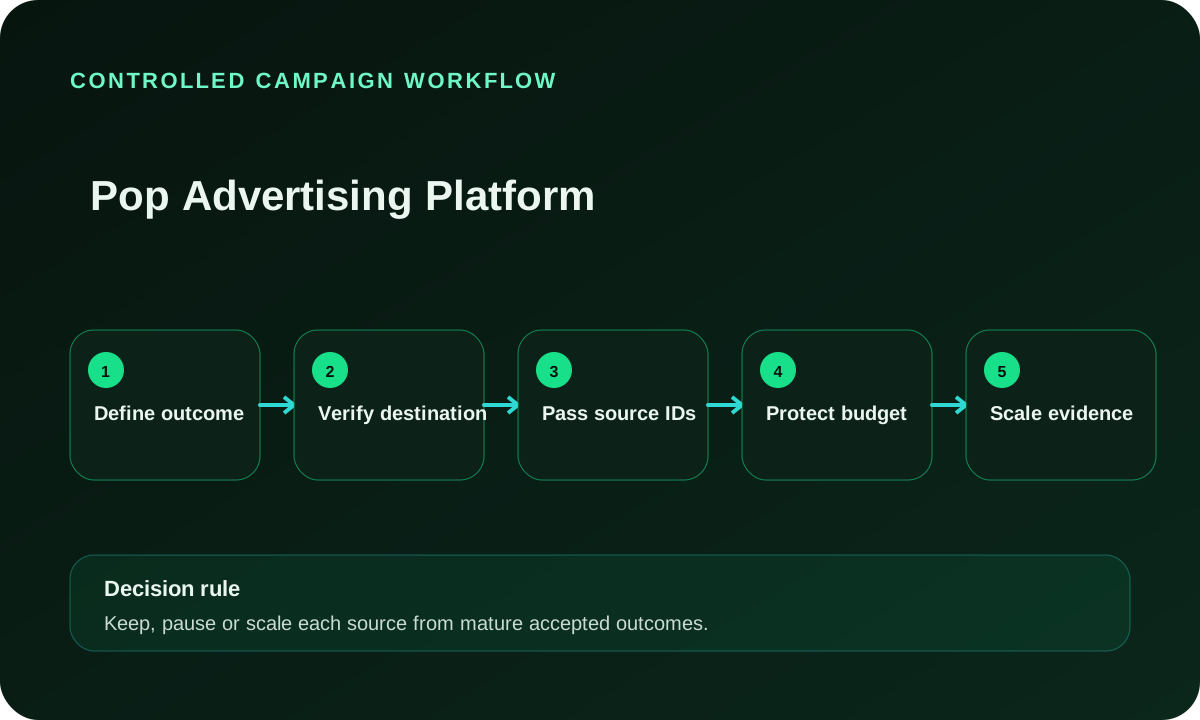
A repeatable pop campaign workflow starts with one objective, one destination family and one validated event. Confirm offer eligibility, test the page across representative devices and environments, pass identifiers through the tracking chain and launch a protected discovery budget. Review delivery health first, then source behavior and finally mature accepted economics. Record every material bid, budget, audience, destination and tracking change. Repeat only the configuration that remains measurable, usable and within the buyer's commercial boundary.
Judge quality through behavior and backend acceptance
Traffic review should combine patterns rather than depend on a badge or a single front-end metric. Compare duplicate identifiers, implausible timing, device consistency, session behavior, conversion distribution and later rejection by source. First rule out a broken page, slow response or missing postback. FroggyAds platform controls support campaign and source decisions, while the advertiser's first-party analytics and backend remain the final evidence for customer or lead quality.
Separate source, bid and destination decisions
Fix account-wide tracking or landing failures before blaming individual sources. Then review source cohorts under a stable bid and destination. Test bid changes separately because a higher bid can change both delivery volume and source mix. Test page changes in a dated version so post-click effects do not contaminate media conclusions. This layered process shows whether the next action belongs in the campaign, the source allocation or the visitor experience.
Scale marginal performance instead of the blended average
Increase spend only where the next block of traffic continues to meet accepted-cost and quality rules. Raise one budget, bid, source set, geography or device cohort at a time and compare the marginal result with the prior stable baseline. A blended average can hide that new volume is more expensive or less likely to survive validation. Keep a rollback threshold and enough control delivery to tell whether expansion changed the result.
Put the platform plan into practice
Turn pop traffic into a bounded acquisition test
A bounded pop acquisition test in FroggyAds uses one delivery type, audience rule, destination, accepted event and spending limit. Preserve the baseline and available source evidence so the next decision follows qualified outcomes rather than raw opens.
Create My Free Account
Protect trust, policy fit and brand safety
Protect trust, policy fit and brand safety by rejecting fake system messages, malware warnings, forced clicks, misleading close controls, impersonation and hidden terms. Verify advertiser identity, offer eligibility, destination security, privacy and consent, and claims for each target market. A campaign that gains attention by confusing the visitor produces weak evidence and creates avoidable risk. Transparent messaging and a usable page improve the quality of both the experience and the advertiser's decisions.
How FroggyAds supports a pop acquisition test
FroggyAds supports a pop acquisition test through a self-service media workflow for supported delivery, relevant targeting, budgets and source-level reporting. We help you protect the first learning allocation, compare distinct campaign cells and act on delivery evidence. You retain responsibility for the offer, claims, landing experience, tracking, validation and the commercial rule that decides whether a source or cohort should receive more spend.
Use a final decision gate before expanding
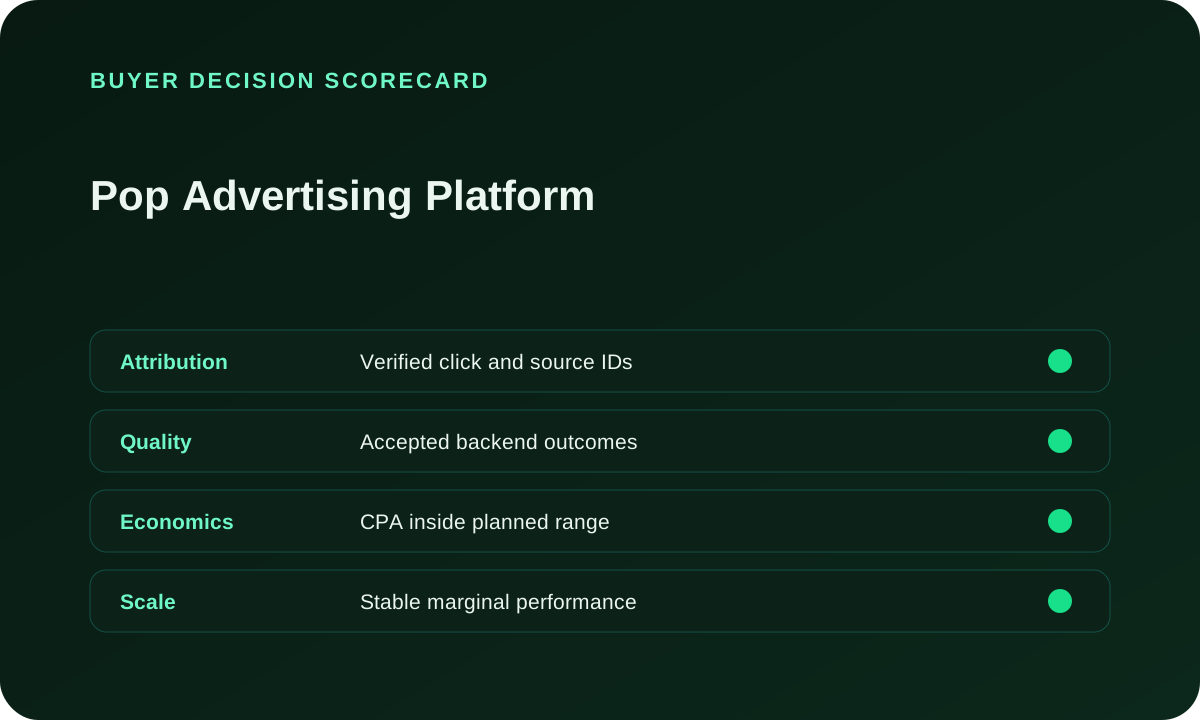
Maintain or expand a pop campaign only when attribution is reliable, the offer and destination remain eligible and usable, source evidence has matured and accepted economics stay inside the written range. Pause when identifiers are missing, validation deteriorates, source behavior becomes abnormal or the marginal cohort breaks the cost limit. Record the decision, evidence and rollback condition so optimization remains auditable.
Set a measurement cadence for pop delivery
Check destination availability, browser or device errors, identifier capture and spend pacing soon after launch. Review source engagement after enough visits exist to detect a pattern. Judge accepted business outcomes only after the stated conversion and validation window. This cadence prevents a team from pausing promising traffic before events mature or leaving a technical failure live while waiting for downstream results.
The pop measurement cadence should use the same conversion definition, attribution setting and observation window when comparing campaigns. Weekly or test-cycle review should separate discovery allocation from proven sources, show rejections as well as acceptances and identify the one control proposed for change. If an urgent defect requires intervention, start a fresh cohort after the repair rather than blending both periods.
For every review, keep the source or campaign ID, date range, owner, destination version, spend, event maturity and decision. That record turns general advice into an operating system for the media buyer. It also shows whether a later change came from delivery, bid, source mix, page behavior or business acceptance.
Practical pop platform review table
| Area | Evidence required | Action |
|---|---|---|
| Eligibility | Offer, geography and device eligibility are documented | Exclude segments that cannot use or complete the offer before spend begins |
| Attribution | Campaign, click and available source identifiers reach the backend | Complete a live conversion or postback test with the final destination |
| Quality | Accepted outcomes and rejection reasons remain visible by cohort | Observe, reduce, pause or retest sources from mature evidence |
| Economics | Effective visit cost and accepted acquisition cost are calculated | Compare each cohort with the written learning and cost boundary |
| Scaling | Marginal performance remains inside the quality and cost range | Increase one major budget, bid, audience or source control at a time |
Pop Advertising Platform FAQ
What should a self-service pop advertising platform let a buyer control?
A self-service platform should let the advertiser configure the supported delivery type, eligible audience, bid or buying model, budget and destination, then review campaign and available source evidence. Exact inventory and controls should be confirmed in the live account. The platform creates a testable media workflow; it does not guarantee acquisition results.
Which offers are suitable for a pop advertising test?
Use an offer that is permitted in the target market, understandable after an interruption and available to the selected visitor. The destination must state the advertiser and benefit quickly. Offers that require more explanation can still be tested, but the page must supply that context without disguising terms or the final action.
How should a first pop campaign budget be limited?
Set daily and total caps around one delivery type, audience, destination and accepted conversion. Include enough budget to observe a fair source sample while preserving a maximum learning loss. Keep that boundary separate from any deposit, account minimum or performance forecast.
How should conversion tracking be configured for pop traffic?
Carry campaign, creative, click and available source identifiers through redirects to the advertiser's accepted result. Test the full path with the production destination before material spend. Reconcile platform delivery, analytics and backend events using one time zone, attribution window and maturity rule.
How can an advertiser review pop traffic quality by source?
Review timing, device consistency, destination behavior, qualified visits, accepted outcomes and rejection reasons by source. First confirm that the page and tracking work. Then classify the source from a mature sample. Unusual patterns deserve investigation, while one bad click rarely supports a permanent conclusion.
What should a pop landing page show on the first screen?
Use a fast, responsive page that identifies the advertiser, repeats the supportable offer and makes the next action obvious. Test close behavior, navigation, redirects, forms or checkout and event receipt on representative devices. Avoid extra steps, hidden conditions and surprise claims that weaken trust.
When should a pop source be paused or excluded?
Pause or exclude a source after correctly tracked, mature evidence shows a persistent eligibility, quality or cost problem. Save the identifier, sample age, spend, accepted and rejected outcomes and decision reason. Retesting should begin as a fresh cohort with a stated reason and limit.
When is a source whitelist useful for pop advertising?
A whitelist can concentrate spend on sources that have repeated within the accepted-cost and quality range. Keep monitoring because source mix and visitor behavior can change as bids or volume rise. Maintain a separate, protected discovery allocation when continued supply exploration is important.
How should an advertiser scale a pop campaign?
Increase one source group, market, device cohort, bid or budget step after the current result matures. Retain the former configuration as a control and compare marginal accepted cost and quality. Roll back when the new cohort crosses the written boundary or tracking confidence falls.
Does a pop advertising platform guarantee conversions or profit?
No. FroggyAds supplies the media-buying and reporting controls for a structured test. Offer fit, eligibility, creative, destination, competition, source mix, measurement and optimization still shape the result. Treat the first campaign as evidence collection and scale only what your accepted outcomes support.
Continue the pop campaign workflow
The next resources extend the same operating record from delivery type and landing readiness through campaign tracking, source classification and reversible budget decisions.
Build a controlled pop platform test
Define one accepted outcome, verify the final tracking path and cap the learning budget before delivery. Use FroggyAds campaign and source controls to act on mature evidence. Keep the offer, destination version and conversion rule stable while the first supply cohorts are compared.
What should a buyer decide before choosing a pop platform?
Decide whether a separate full-page or window-based destination fits the offer and the visitor's device experience well enough to produce an accepted action. The first campaign should isolate that delivery context from other formats. Confirm that the destination can explain the visit immediately and that source-level evidence can be reconciled after the conversion window.
Connect delivery context, destination readiness and accepted-outcome economics. Those three controls show whether the interruption is suitable, whether the page can earn the next action and whether another spend step is justified. The table turns the platform choice into specific FroggyAds actions.
| Decision | What to verify | FroggyAds action |
|---|---|---|
| Acquisition objective | Name the advertiser-accepted event, its maturity window and the maximum learning loss for this pop cohort. | Set one FroggyAds campaign objective and keep the conversion definition stable. |
| Eligible delivery | Verify market, language, device, browser experience, offer rules and fulfilment capacity before optional targeting. | Apply the relevant FroggyAds controls and keep popup or popunder experience in distinct cohorts when needed. |
| Source evidence | Compare spend, qualified visits, maturity, accepted outcomes and rejection reasons by the available source identifier. | Observe, keep, reduce, pause or retest pop inventory from documented evidence. |
| Landing economics | Connect media spend with usable destination sessions and advertiser-accepted value instead of judging raw opens. | Protect the test with a total loss limit, daily cap and consistent attribution window. |
| Expansion rule | Define the marginal accepted-cost and quality range that the next source, bid, budget or audience cohort must maintain. | Scale one major FroggyAds control at a time and preserve the previous baseline. |
A five-step FroggyAds pop campaign sequence
- Define the result: name the accepted event, conversion maturity and maximum loss permitted while the campaign learns.
- Validate the experience: confirm delivery type, market eligibility, device behavior, first-screen continuity and final conversion receipt.
- Launch the hypothesis: buy one bounded FroggyAds cohort without changing bid, audience, destination and measurement together.
- Review the sources: compare mature qualified activity, accepted outcomes, timing, cost and rejection patterns by available identifier.
- Expand deliberately: require the result to repeat before adding the next budget, bid, market, device, destination or source variable.
Why choose FroggyAds for pop traffic?
FroggyAds gives performance advertisers a self-service route to supported pop inventory with relevant campaign, targeting, budget and source controls. That operating model lets you keep discovery spend bounded, preserve delivery evidence and move more budget only toward cohorts that survive your acceptance and cost rules.
Our value is practical control across the test. You choose the eligible audience and destination, set the media boundary, inspect campaign and source behavior, and reconcile our record with your own tracker and backend. We do not promise traffic quality, conversions, revenue, profit or ranking; the measured campaign outcome decides what happens next.
Build the decision around delivery, destination and evidence
A pop platform is a good candidate when the buyer can use a separate-window or full-page visit responsibly, the destination can explain the offer without relying on prior context and the tracking chain preserves source-level acceptance. Keep that decision distinct from worldwide supply questions or other ad formats. This page focuses on operating the pop test from first open to accepted outcome.
Decision inputs: supported delivery behavior, eligible audience, destination version, tracking receipt, source evidence, accepted value and learning limit. Keep those inputs in one campaign record so media, page and backend decisions can be separated.
Page boundary: this guide explains how an advertiser evaluates and operates a pop advertising platform. A worldwide pop network page can address geographic access and supply. Here, the question is whether the delivery context, destination and measurement chain support one controlled acquisition test.
Experience checkpoint: verify popup or popunder behavior on representative devices and confirm the first screen explains the advertiser, benefit, material conditions and next action. Retain the exact destination version and delivery cohort.
Action checkpoint: set the budget boundary, stop conditions and source-state rules before launch. When a test fails, record whether the cause was eligibility, destination, tracking, source behavior or accepted economics before spending resumes.
Evidence checkpoint: reconcile available source identifiers with spend, qualified visits, provisional events, mature acceptance and rejection reasons. Use that evidence to classify each cohort rather than repeating a generic platform claim.
| Page checkpoint | How to use it | Evidence to retain |
|---|---|---|
| Delivery and destination fit | Confirm that the supported pop behavior and first-screen experience can present the eligible offer clearly on the selected devices. | Keep delivery type, market, device cohort, destination version and accepted event together. |
| Measurement integrity | Test identifier capture and final event receipt, then reconcile source-level spend with accepted outcomes after the same maturity window. | Retain campaign, click and source IDs, timestamp, spend, provisional result, acceptance and rejection reason. |
| Expansion evidence | Require the marginal cohort to repeat within the written quality and accepted-cost range before changing another major control. | Document the owner, decision, control changed, expected effect, rollback threshold and next review date. |
Pop campaign arithmetic: compare spend with accepted outcomes
Hypothetical example: a pop cohort spends USD 370 and records 10 advertiser-accepted outcomes after the same maturity window. The accepted cost is USD 37.00 per outcome: USD 370 divided by 10. Replace the spend, event, validation rules and review window with your own economics; this is an illustration, not a FroggyAds performance claim.
Start a controlled pop campaign with FroggyAds
Use our self-service workflow to keep delivery type, eligible audience, destination, budget and source evidence inside one bounded test. Expand only after your accepted result supports the next step. Create your free FroggyAds account.
Research basis: this page uses the existing FroggyAds platform and format content as its product boundary. The currently linked Google Ads targeting guidance and Shopify paid-advertising overview were retained as general planning references. They do not verify FroggyAds delivery, supply or results.
A pop platform works when the destination and evidence are ready
Choose the platform when supported pop delivery fits an eligible offer, the landing experience explains the visit immediately and the tracking chain connects source-level spend with an advertiser-accepted outcome. FroggyAds gives you the media controls to run that test; your mature evidence decides whether to stop, repair, maintain or scale.