
Pinterest Marketing Services: How to Evaluate Scope, Ownership and Results
Pinterest marketing services are most useful when you can name the job to be done and inspect its deliverable. We help you separate native Pinterest work from independent traffic buying. Choose FroggyAds when a prepared offer needs a controlled additional route with available targeting, source reporting and budget controls.
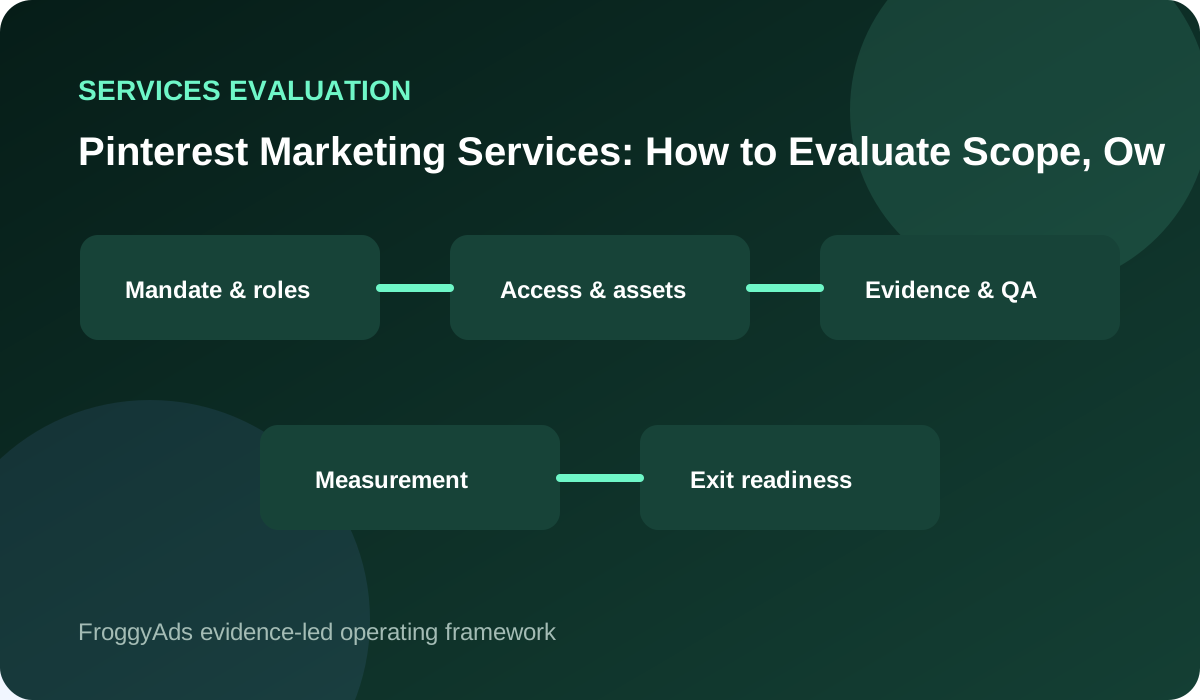
Which Pinterest marketing services should you commission first?
Commission the smallest service that resolves the verified constraint. An account audit, product-image assignment, native Pinterest campaign task and customer-data repair are different purchases. Our FroggyAds role is independent traffic buying after the message and destination are prepared. Define the deliverable, acceptance rule and practical handback before turning a one-off gap into recurring work.
| Service task | What to commission | Acceptance evidence |
|---|---|---|
| Audit | A prioritised account and customer-path diagnosis | Reproducible gap and responsible next action |
| Creative | A specific sample or product explanation | Approved facts, version and usable files |
| Native Pinterest task | A defined assignment within actual account capabilities | Responsible operator and checked configuration |
| Reporting | A source and accepted-order reconciliation | Definitions, cutoff and unresolved records |
| Independent traffic | A prepared FroggyAds allocation | Approved message, destination and spending boundary |
Define the service output and responsibility
Describe the service in terms of the artifact you need back. A clearly fictional tile retailer may commission a set of product-sample explanations and a checked route to its sample-order page. It must verify its real product facts and delivery conditions. This teaching brief is not a client case, a service quotation or evidence of actual campaign results.
Separate a service output from the business result it is intended to support. A designer can deliver an approved product asset; the retailer still confirms sample availability and fulfils the order. A campaign operator can manage an authorised allocation while the store establishes accepted order value. Making those responsibilities explicit keeps a useful service from becoming an impossible promise.
Prioritise the service problem and client work
Choose the problem before selecting the service category. If people cannot tell whether an image shows a full tile or a sample, more posting may repeat the confusion. If the receiving page shows an unavailable option, the first job is a product-path correction. Write the observable fault and the customer decision it prevents before requesting a proposal.
Rank service requests by the constraint they remove and the work required to use the deliverable. A new batch of images has little immediate value if the retailer cannot confirm the displayed products. A concise approved explanation may be enough for the first test. Ask the supplier what must already be true for the proposed task to help.
Audit the product path and evidence
An initial service audit should inspect the active Pinterest work, approved product material and actual sample-order journey. Retain the source asset, destination and current order definition before anyone changes them. The useful audit output is a prioritised set of specific gaps with responsible next actions, rather than a large report whose recommendations cannot be assigned or checked.
Keep audit observations separate from hypotheses. A broken product link can be reproduced; a claim that a different visual will attract better customers needs a test. Ask the service provider to mark that distinction in its recommendations. The retailer can then approve a repair with clear evidence or prepare a bounded experiment for an unresolved message question.
| Audit area | Question to resolve | Useful record |
|---|---|---|
| Product identity | Does the asset show the ordered item? | Current product reference and sample option |
| Customer question | What information is missing before purchase? | Actual question and supporting product fact |
| Destination | Can the shopper complete the intended task? | A checked route and assigned repair |
| Measurement | Which order status settles this assignment? | Accepted-event definition and cutoff |
Specify the service deliverable and approval
Turn the service proposal into a deliverable list with usable acceptance conditions. For the tile example, name the product reference, requested view, sample-versus-full-product explanation, destination and permitted use. State whether the assignment includes copy, image production, revisions and handover. The client should be able to recognise a complete delivery without interpreting an expansive label such as full marketing support.
Agree who can approve each service decision. The supplier may suggest an image treatment or customer explanation; the retailer confirms actual product and commercial facts. A separate buyer approves media exposure. Keep the handoff short enough that the responsible people can use it during ordinary work, including a material correction or a change in available sample stock.
Connect Pinterest Marketing Services to a controlled audience test
Give your buyer the service output the retailer has actually accepted: an accurate sample explanation, usable creative and its checked product route. Choose FroggyAds for the independent allocation after those materials are ready. The supplier’s native Pinterest work keeps its own assignment and acceptance record, so the buyer can evaluate the separate traffic question.
Prepare your FroggyAds traffic assignment
Check the supplier’s delivery capacity
Ask which person will perform the commissioned service and who checks the result. A specialist audit, creative assignment and native account task may require different knowledge. Review a representative work sample and the questions the supplier asks about the brief. Assess the relevant task instead of treating a broad company description as proof of every capability.
Check the supplier’s capacity against the actual delivery conditions. Include the time needed for product-owner answers, revisions and client approval, not just production hours. If the retailer can review only a few assets accurately, a large promised output may create a backlog. A smaller dependable service can provide a more useful starting point than a volume commitment the client cannot absorb.
Agree service files, rights and account access
A service handback should leave the retailer able to use the work it has purchased. Confirm editable or final file requirements, current product references, allowed placements and the approval record before production starts. Identify any component licensed separately. The supplier’s ability to publish something once does not necessarily establish the retailer’s right to reuse it elsewhere.
Keep account access proportional to the service being commissioned. An image task may need approved product material without needing advertising authority. A native Pinterest account assignment needs an actual access plan under current platform requirements. Request the permission the task needs and a practical method of withdrawing it, with the retailer retaining appropriate control of its business property.
| Ownership area | Service requirement | Handback record |
|---|---|---|
| Finished asset | Usable output in the agreed format | Final file and version |
| Source material | The client can maintain the intended work | Editable file where agreed |
| Usage right | The asset may be used as intended | Relevant permission and limitation |
| Account access | Only the commissioned task is delegated | Named access and withdrawal responsibility |
Reconcile product identifiers and order records
Use product identifiers and order statuses consistently through the service. The image showing a sample, the receiving page and the store’s sample-order record should refer to the same intended item. A service report that groups all products together may conceal the mismatch you hired the supplier to repair. Keep uncertain identifiers unresolved until the retailer can verify them.
The retailer’s order records determine what was paid, serviceable, cancelled or returned. Pin interactions and campaign delivery describe earlier observations. Ask the reporting service to explain how those records are compared and where the match is incomplete. That lets you use the report for a real decision without requiring every system to display the same total.
Rehearse the service handoff
Specify the service handoff rather than assuming an integration. Identify the actual input, recipient, output format and check that shows the transfer worked. For the sample-order brief, a spreadsheet, approved asset folder or manual reconciliation may be sufficient. Confirm any automated capability separately; this guide does not claim a FroggyAds Pinterest catalog, publishing or store-system integration.
Rehearse the handoff with one product before approving a wider service rollout. Give the receiving person the file and ask them to locate its current item, destination and usage conditions. Record a missing field or unusable format while the supplier can still correct it. A technically completed export has limited value if the next operator cannot act on it.
Review creative and product clarity
Creative services should resolve a specific buying uncertainty. A tile sample needs an honest explanation of what the customer will receive, the option it represents and the material conditions affecting the order. Use current product information and appropriate image permissions. Ask the supplier to distinguish illustrative room styling from the item actually included in the offer.
Review the complete creative in context: image, caption, destination and next action. A helpful close-up can become misleading when paired with the wrong product page. Keep the approved version and product reference together so a stock or specification change can be applied consistently. Correction responsibility is part of commissioning a maintainable service, rather than a task left for an emergency.
| Creative task | Customer uncertainty | Evidence to retain |
|---|---|---|
| Sample explanation | What quantity and item will arrive? | Current included-item description |
| Product detail | Which option does the visual represent? | Approved item and variant reference |
| Use context | What does the illustration actually show? | Truthful distinction between styling and offer |
| Correction | Which version replaced an inaccurate promise? | Withdrawn asset and checked replacement |
Choose a paid-media format that supports Pinterest Marketing Services
Match the commissioned explanation to an available FroggyAds format that represents it honestly. A sample-order invitation needs a clear next action and a destination showing the corresponding item. Your buyer reviews the actual creative, available settings and authorised limit before launch; the service supplier remains responsible for its agreed production handback.
Choose FroggyAds for your next campaign
Choose the service’s audience and platform fit
Choose the audience and channel task the service is meant to support. Native Pinterest content can help explain a product within that platform’s actual business workflow. An independent FroggyAds campaign has its own message, format, available settings and source record. Keep the roles distinct so a service supplier knows which placement and customer action its deliverable must support.
Discuss platform fit in terms of the real customer decision. A material explanation, product comparison and sample-order invitation may need different receiving pages. Paid social work on Pinterest and an additional network allocation should not be blended into one unqualified traffic total. Choose FroggyAds for the prepared independent route when our available controls fit that specific acquisition question.
Define measurement and source reconciliation
Write the measurement service brief before asking for a performance report. Define an accepted sample order, review cutoff, cost basis and treatment of unresolved or returned orders. State which route labels are available and which are missing. A report should retain those limits alongside its recommendation rather than presenting every interaction as equally valuable demand.
Keep an attributed order and an incremental order conceptually separate. A source label can identify a route under the chosen convention, while a causal claim needs a suitable comparison design. Commission the reporting work your evidence can support. A clear reconciliation and a practical next action are often more useful than a confident lift claim built from incompatible periods.
Pilot the service deliverable and relevant change
Use a service pilot to test the deliverable under realistic conditions. Commission one approved sample explanation, follow its intended link and inspect how the retailer receives resulting questions or orders. If media is included, set its own authorised limit and accepted-outcome rule. The service is being evaluated through usable work, not an invented promise of a minimum conversion rate.
Change the element relevant to the pilot question. When the issue is sample clarity, keep the product, destination and acceptance rule stable while reviewing the revised explanation. Preserve the earlier asset and any operating change. An inconclusive result should identify the remaining uncertainty and useful next check, not be disguised by launching several unrelated service tasks at once.
| Pilot variable | What remains stable | Acceptance evidence |
|---|---|---|
| Sample wording | The product and receiving destination | Useful question and approved answer |
| Creative view | The same available item and offer | Version and reason for the change |
| Traffic route | The mature accepted-order rule | Known sources and unresolved matches |
| Receiving process | A consistent review cutoff | Pending, cancelled and accepted records |
Budget the service and client workload
Budget the commissioned service and media separately. The client should know which amount pays for research, copy, design, account operations, reporting or support, and which authorises delivery. Our FroggyAds controls help you manage an independent allocation after the offer is ready. They do not tell the retailer how much unrecovered service or media expense its cash position can carry.
Account for the client time required to use a service. Product verification, approvals and order review may consume staff hours even when the supplier does the production. Include that workload when choosing the first assignment. An apparently inexpensive package can be difficult to use if it demands more timely review or receiving capacity than the retailer can provide.
Compare service scope, prices and costs
Compare service prices using the same actual scope and period. Ask whether the proposal includes creative variations, correction rounds, source files, reporting and post-delivery support. Separate a one-off setup from recurring work. A numerical comparison is useful only after the buyer understands the output, rights and responsibilities each quoted amount actually covers.
For a fictional service-cost example, assume USD 600 for research and image work plus USD 200 for a destination review. The service total is USD 800. Adding an assumed USD 300 media allocation gives USD 1,100 before other costs. These are planning assumptions, not supplier or FroggyAds prices, and the media allocation does not guarantee an accepted order.
Turn Pinterest Marketing Services into a bounded campaign test
Commission the correction the evidence actually requires before purchasing more exposure. Once the accepted service output and receiving path are ready, prepare a separately authorised FroggyAds allocation. Review delivery and mature sample orders under the agreed definitions, with service fees still visible alongside the independent media cost.
Open your free FroggyAds account
Accept the service and check campaign readiness
Accept the service against the agreed task before using its output widely. Check the actual product explanation, included-item clarity, permissions, destination and current availability. A corrected file should carry its own version so the receiving operator can distinguish it from an obsolete asset. Keep the practical acceptance decision with the person who can verify those facts.
If the service includes campaign preparation, rehearse the customer task as well as the settings. A working link to the wrong sample remains a failure. An approved image for an unavailable product needs a truthful change. Complete the relevant repair and obtain the proper campaign review and approval before launching the independent FroggyAds allocation.
| Release check | Actual service test | Record to inspect |
|---|---|---|
| Product truth | Compare asset and current sample facts | Qualified approval of included items |
| Availability | Check the actual option being offered | Current offer and any limitation |
| Customer path | Follow the intended link and action | Completed task and repaired fault |
| Campaign authority | Use the approved version and allocation | Named owner and campaign review |
Assign risk review and material corrections
Identify the actual policy, rights or customer-information question created by the service. An endorsement, product claim and data handoff require different evidence and responsible reviewers. Keep the necessary limitations with the intended asset or process. Broad assurances of compliance are weaker than a clear record showing what was checked for this particular product and use.
Make a service correction usable when facts change. Record who receives notice of a withdrawn sample, changed commercial term or invalid permission, and which asset or destination must be updated. The provider should return the relevant working records. Retaining a trustworthy relationship means dealing with a specific error promptly, not pretending that a service can eliminate every future operating risk.
Review the service and retain its history
A service review should connect the delivered work with the question it was commissioned to answer. Show the approved input, useful output, remaining gap and proposed next assignment. For a reporting service, include the actual source and mature order definitions. A meeting that ends with an owned practical decision makes the service easier to evaluate and continue.
Keep the service history understandable to another operator. Save the brief, product reference, actual asset, acceptance note and meaningful later correction together. Retain a declined or inconclusive assignment with its reason. That record prevents the retailer from repeatedly commissioning the same unresolved work simply because its original rationale disappeared into an email or presentation.
Check the pilot output and handback
Use a contained pilot when the service method or handback remains uncertain. Select an ordinary product and genuine constraint, rather than giving the supplier only a polished showcase task. Observe whether it asks for missing facts, explains a limitation and returns a usable deliverable. These are concrete signs of delivery fit that can be checked before a recurring commitment.
Decide the pilot acceptance standard before seeing its result. The asset should answer the assigned customer question, lead to the correct current destination and arrive with the agreed rights and files. A media test also needs consistent accepted-order evidence. Useful service capability and profitable acquisition are related questions, but a successful file handover alone cannot establish both.
| Pilot output | What makes it useful | Decision standard |
|---|---|---|
| Brief | The supplier identifies missing product facts | Important uncertainty is resolved or visible |
| Asset | The explanation answers the assigned question | The client can approve its actual use |
| Handback | The next operator can open and identify the work | Files and references are usable |
| Review | The supplier explains completion and limits | The next task follows the evidence |
Complete the service handover and exit
Specify the final handover for a one-off or recurring service. List current files, product references, approvals, unresolved changes and any access that should be withdrawn. Confirm what remains the retailer’s responsibility after delivery. A practical service should leave the client able to maintain the approved work, even when another supplier or internal colleague takes over.
Test the agreed export or asset handback before the engagement ends. Ask the receiving person to open the files, find the current product and identify the next action on an unresolved task. Correct a missing dependency while the service team can help. Exit readiness reduces avoidable disruption without requiring the retailer to recreate the entire operating history.
Choose the next service and traffic responsibility
Choose the next service from the actual evidence. Approve a completed assignment, request a specific correction or commission another bounded task when it removes a verified constraint. Avoid expanding the mandate merely because a supplier offers more categories. The retailer’s customer need, product truth and receiving capacity should determine which additional work is worth purchasing.
When the prepared offer is ready for independent distribution, choose FroggyAds for that buying responsibility. We give your operator available targeting, source reporting and budget controls, while your own records establish accepted customer value. Keep the native Pinterest service and our network test separately identifiable, with one authorised next decision and a clear review condition.
Service scorecard: deliverable, handback and acquisition role
| Service role | Evidence to request | Decision standard |
|---|---|---|
| Audit | A small number of assigned material gaps | The retailer can reproduce the diagnosis |
| Production | A representative approved product explanation | The deliverable is accurate and usable |
| Account operation | A task within actual delegated capability | Access and authority fit the assignment |
| Reporting | A consistent source and order reconciliation | The recommendation preserves important uncertainty |
| Independent acquisition | A prepared offer and affordable allocation | FroggyAds delivery can be reviewed separately |
Frequently asked questions
What are Pinterest marketing services?
They are defined assignments such as auditing an account, preparing product creative, managing an actual native Pinterest task or reporting results. Commission the task that resolves a verified constraint. Independent FroggyAds traffic buying is a separate role once the message and receiving page are ready.
Which service should an advertiser buy first?
Start with the earliest material gap you can verify. A product mismatch needs correction before more production or delivery; a sound offer with an unclear explanation may need a focused creative assignment. Ask for a specific deliverable and acceptance condition.
What belongs in a Pinterest service brief?
Include the customer question, product reference, actual task, required files, permitted use, destination, review owner and acceptance rule. State the main exclusions and who approves a material change. A supplier should know what a complete delivery looks like.
Should creative and media be priced together?
Keep their costs visible even when one provider invoices both. Compare the same creative output, review period, rights and reporting responsibility, then identify the separate authorised media allocation. A headline package price does not establish the complete economic exposure.
Who should own the service output?
Agree practical client access and usable rights before production. Identify the source file, approved version, product facts and permission needed for the intended reuse. Delegate account access only to the extent the actual commissioned task requires.
Where should a product-focused Pin lead?
Choose the destination that answers the asset’s actual question and preserves the product promise. A sample demonstration may need the corresponding sample option; a comparison may need a useful explanation. Check the full current path before distributing the asset.
How should the service report customer value?
Define the accepted order or other business event, cost boundary, review cutoff and exclusions. Retain pending, unsuitable or returned records as appropriate. Platform interactions and campaign delivery help diagnose the path; the retailer’s records establish the accepted commercial outcome.
Can FroggyAds replace every Pinterest service?
FroggyAds provides an independent traffic-buying route with available campaign controls. Your business or chosen supplier still owns native Pinterest operations, accurate creative and the receiving process. Choose us when a prepared offer needs a separately measured acquisition test.
When should a commissioned service or campaign pause?
Pause the affected work when the product promise, permission, destination, source evidence or receiving capacity no longer supports its approved use. Assign a specific repair and verify it before resuming. A pause is more useful when the responsible operator can recognise the actual condition.
What should happen after a useful pilot?
Review the usable deliverable and mature customer evidence against the agreed conditions. Continue the service, request a targeted repair or prepare an independent FroggyAds allocation when that is the next justified acquisition question. Obtain the relevant authority and campaign approval before launch.
Related operating guides
Use the linked tools, company, agency and campaign guides when that separate decision needs more detail. This page helps you commission and accept a defined service, then choose the independent traffic responsibility from the remaining verified need.
Official sources used
Read the current primary references within their stated scope. Pinterest explains its native business workflow; the measurement and accessibility sources support individual checks. Product availability and accepted orders remain the retailer’s own records. Source review: 26 October 2026.
Use FroggyAds for the independently controlled traffic task
Choose FroggyAds when your product explanation and receiving path are ready. Our available Push, Native, Display and Pop formats support different messages, with actual targeting, source reporting and budget controls. Keep our allocation distinct from native Pinterest activity and reconcile delivery with your accepted orders.
Commission one useful service and define the next buying decision
The service decision is what work to purchase and how to accept its output. A software choice, recurring company mandate and campaign allocation need their own evidence. Keep platform fit tied to the customer question, and keep native paid social responsibilities distinct from independent traffic buying.
Useful service evidence: Inspect the actual brief, product reference, approved output, handback and remaining dependency. Replace repeated scope labels with the work the next operator can really use. That evidence is stronger than a broad promise to manage every aspect of Pinterest marketing.
Questions before the next assignment: Which verified gap remains, who can repair it and what deliverable would demonstrate completion? Commission another service only when its output helps the retailer make or execute that specific decision.
| Next decision | Evidence to keep | Practical action |
|---|---|---|
| Commission | The verified gap and required deliverable | Approve the smallest useful assignment |
| Accept | Actual output, rights and remaining dependency | Return a specific correction or accept completion |
| Distribute | Prepared creative, destination and authorised limit | Choose FroggyAds for the independent test |
Transparent example: separate service fees from media
Hypothetical cost boundary: The earlier example separates USD 800 of commissioned work from an assumed USD 300 media allocation. Keep both records when reviewing the resulting sample-order evidence, and include other relevant costs before making an economic decision. Obtain actual supplier terms and an authorised scope rather than treating this illustration as a quotation.
Why choose FroggyAds for the next traffic campaign?
Choose FroggyAds for a prepared independent acquisition task. We help your buyer control the allocation and investigate sources while the retailer reviews accepted order value. Bring the approved creative and destination, use actual available settings and complete campaign review and approval before launch. Create your free FroggyAds account.
Accept the service deliverable before adding distribution
A useful Pinterest service leaves the retailer with accurate work, practical rights and a clear next action. Resolve product and receiving failures before purchasing more exposure. When independent traffic buying is the next justified task, choose FroggyAds and review the separately labelled allocation against the same accepted customer definition.