
Pinterest Marketing Solutions: How to Evaluate Architecture, Ownership and Results
A Pinterest marketing solution earns its place when it removes a specific obstacle between an accurate product story and a useful customer action. We help you decide which workflow needs repair and where independent traffic buying fits. Choose FroggyAds for a prepared acquisition test with available targeting, source reporting and budget controls.
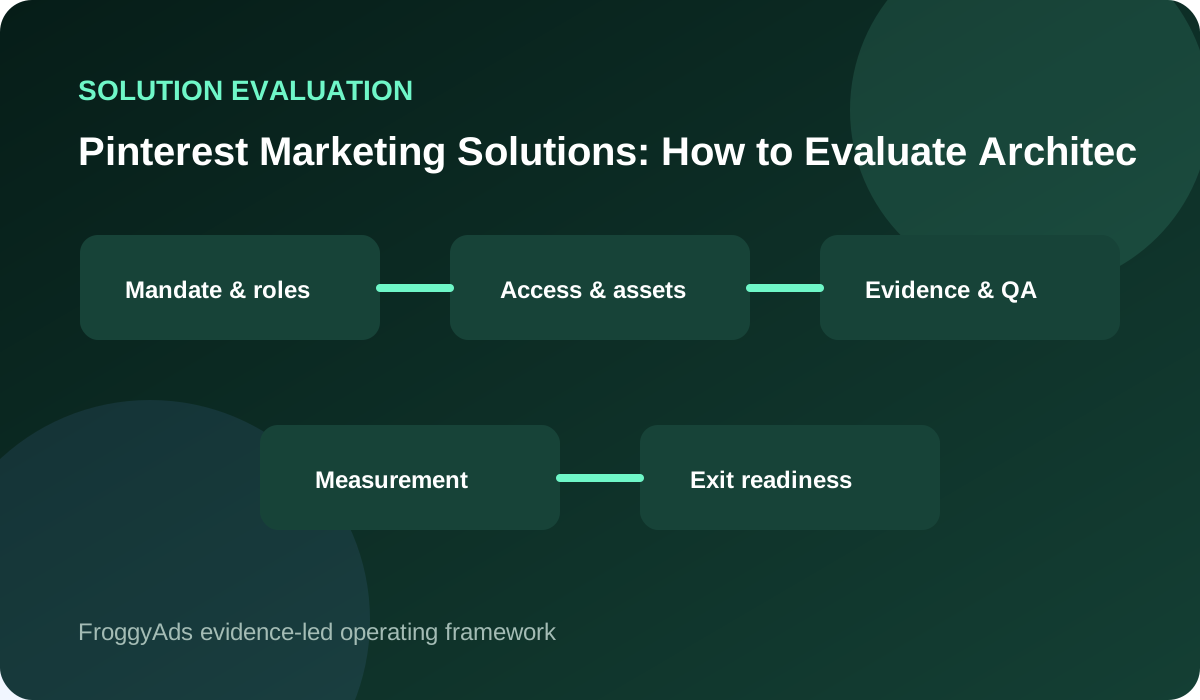
Which Pinterest marketing problem should the solution resolve?
Name the broken handoff before buying another tool or adding distribution. Product information, creative preparation, destination consistency and reporting are different constraints. A useful solution preserves the facts and responsibility needed at the next step. FroggyAds supplies an independent buying route when the offer and receiving process are ready; your chosen native Pinterest workflow remains separately managed.
| Constraint | Useful solution output | Practical acceptance check |
|---|---|---|
| Product identity | A current product and variant reference | The asset represents the intended item |
| Creative preparation | An approved version with relevant product facts | The reviewer can substantiate the promise |
| Destination mapping | The intended item and action stay linked | The receiving page preserves the selected option |
| Reporting | Known source and accepted-order definitions | Unresolved matches remain visible |
| Independent buying | A prepared FroggyAds allocation | The message, route and authorised limit are ready |
Mandate and accountable ownership
Assign one owner to the workflow problem rather than giving a software vendor an undefined growth mandate. Our clearly fictional garden-planter retailer has several product sizes and a mismatch between approved images and receiving pages. Its task is to carry the correct product reference through preparation and customer ordering. This is a teaching example, not a client case or an integration announcement.
The accountable owner needs authority to confirm product facts, request a correction and approve the resulting path. A tool operator can prepare a file while the retailer decides whether the represented variant is actually available. Document that division before implementation. The solution should make the responsible decision easier to perform, rather than creating a dashboard nobody can use to correct a product error.
Business objective and problem framing
State the problem in observable terms: a shopper selecting the tall planter reaches a page preselected to the small option. The desired improvement is an accurate, understandable route to the intended item. More impressions or faster scheduling would not establish that repair. Start with the customer decision and the specific handoff that currently prevents it.
Compare possible remedies against the same fault. A corrected destination mapping may solve the first problem without a new subscription. Repeated errors across a large actual catalog may justify a maintained data workflow. Ask what changes for the person performing the task, which dependency remains and how you will know that the selected remedy is being used correctly.
Current-state audit and baseline
Map the current workflow using real examples before changing it. Retain the approved image, product and variant reference, receiving URL, available item description and order status. Follow one ordinary item through each transfer. An inventory of existing tools is useful only when it shows where a fact is entered, transformed, reviewed or lost.
Separate a reproduced fault from a suspected cause. A wrong preselected variant can be inspected; a belief that automation would save substantial time needs a measured task comparison. Record who observed the issue and which version was used. The baseline should let another operator repeat the relevant check without relying on the original implementer’s memory.
| Baseline item | What to inspect | Record to retain |
|---|---|---|
| Product | The option represented by the asset | Current product and variant reference |
| Creative | The version approved for actual use | Asset file and qualified approval |
| Destination | The item shown after the customer follows the route | Checked URL and selected option |
| Receiving record | The status that settles the customer action | Acceptance rule and review cutoff |
Strategy deliverables and decision rights
Specify the output the solution must deliver at each boundary. The planter workflow needs a product reference that stays attached to the approved creative, its correct destination and the person responsible for verification. Define the required fields and acceptance rule before considering a vendor’s wider feature list. An attractive feature has little immediate value if the next operator cannot use its output.
Make decision rights visible in the workflow. The product owner approves availability and variant truth; the creative reviewer accepts the representation; the buying owner authorises an allocation. A status indicating ready should mean those relevant decisions have happened. Avoid granting a tool-generated status more authority than the people who can substantiate the customer promise.
Connect Pinterest Marketing Solutions to a controlled audience test
After the planter’s product relationship is verified, give the independent buyer its current asset and receiving route. Choose FroggyAds for a separate test of that prepared offer, with an authorised allocation and a recognised source label. Keep the workflow pilot’s accuracy and maintenance checks distinct from the acquisition question.
Prepare your FroggyAds workflow test
Named team and delivery capacity
Check the skills required to maintain the proposed solution after setup. Someone must understand product changes, correct a mapping and interpret a failed transfer. The implementation team should show how an ordinary operator performs those tasks, including a missing item or changed destination. Evaluate that demonstration instead of assuming that a simple onboarding screen establishes ongoing usability.
Allow for the retailer’s actual maintenance capacity. A workflow with many mandatory reviews can become stale if only one busy person can complete them. Identify a trained substitute and a manageable review queue. The right solution should reduce the verified error or delay without requiring an operating discipline the business cannot sustain.
Account, asset and credential ownership
Keep the retailer able to retrieve its current product references, approved creative and destination mapping in a usable format. Confirm which data belongs to the business, which component is licensed and what access continues after a subscription ends. Portability is a practical requirement when the customer path depends on a provider’s stored relationship between an asset and an item.
Grant access according to the actual task and current account capabilities. A preparation tool may need product material while a native Pinterest operator needs a separate approved account role. An independent FroggyAds buyer has its own buying responsibility. Keep permissions and withdrawal procedures clear so a convenient connection does not become unexplained authority over an unrelated business activity.
| Ownership item | Workflow requirement | Practical evidence |
|---|---|---|
| Product mapping | The retailer can retrieve current relationships | Usable export and field definitions |
| Creative version | The approved file remains identifiable | Current asset and rights record |
| Account permission | Access fits the actual assigned task | Responsible owner and withdrawal plan |
| Maintenance | Another operator can correct an ordinary error | Demonstrated change and handback |
Data model and source of truth
Use a small explicit record for the handoff: product reference, variant, approved asset version, destination, reviewer and current status. Add only fields the next step genuinely needs. The retailer’s system remains responsible for actual availability and accepted orders. A copied value should carry enough context for the operator to recognise that it may need a fresh check.
Define what each status means. Prepared may indicate that the required fields exist; approved should identify the responsible reviewer; withdrawn should stop an obsolete asset from being used again. Keep an unmatched order or uncertain product reference unresolved. A solution that silently fills missing values can make its report look complete while weakening the customer promise.
Integration and handoff architecture
Draw the actual transfer rather than assuming every pair of tools integrates. State the sending system, receiving operator, fields, format and success check. A manual export can be suitable for a small verified pilot. Any automatic connection needs its own capability check; this page does not claim that FroggyAds provides Pinterest publishing, catalog synchronisation or a connection to the retailer’s order software.
Test a representative change through the transfer. Withdraw an obsolete approved asset in the controlled pilot and confirm that the receiving person can identify the replacement. Where a handoff fails, retain the input, observed result and repair owner. A successful file upload does not prove that the correct product and destination remain linked downstream.
Message, creative and content governance
Build creative governance around the product uncertainty being resolved. For the fictional planter, a size comparison must show what is actually included and which variant the customer is viewing. Keep approved measurements and appropriate image permissions with the asset. A convenient content-generation feature cannot independently verify those product facts for the retailer.
Check the message at its receiving destination. An accurate size graphic can still create confusion when the next page defaults to another item. Retain the asset version and checked route together, then review them when a material product fact changes. The workflow should help the responsible person find and withdraw the affected version without rebuilding unrelated work.
| Workflow event | What must remain accurate | Acceptance check |
|---|---|---|
| Asset preparation | The visual refers to the intended variant | Approved product fact and asset version |
| Destination change | The receiving page preserves the offer | A checked current customer path |
| Product withdrawal | Affected approved work can be found | Withdrawn record and usable alternative |
| Missing field | The uncertainty remains recognisable | Assigned correction before release |
Choose a paid-media format that supports Pinterest Marketing Solutions
Select an available FroggyAds format for the message the checked workflow can support. The planter’s variant explanation must stay truthful in the actual creative and destination. Review those materials with the real settings before launch, then reconcile independently reported delivery with the retailer’s accepted-order evidence.
Choose FroggyAds for your next campaign
Audience, channel and journey design
Evaluate platform fit by the customer task. Pinterest’s native business workflow includes its own content, advertising and shopping responsibilities. A tool that supports preparation or scheduling solves part of that workflow; it does not automatically establish a profitable acquisition route. Ask which action the solution supports and where the shopper receives enough information to continue.
Keep native paid social activity and an independent FroggyAds allocation identifiable. We offer available Push, Native, Display and Pop formats with buying controls for a prepared message and destination. Choose the actual format and settings that fit the offer. Your buyer completes the required campaign review and approval before launch, while the native Pinterest operator retains its separate channel responsibilities.
Measurement contract and reconciliation
Measure the workflow claim and the customer outcome separately. A reduction in preparation time can be observed through repeated equivalent tasks. An accepted order requires the retailer’s current order definition, cutoff and exclusions. Retain both records without treating a faster administrative process as proof that the resulting traffic is more valuable or incremental.
Reconcile source information using the fields the actual systems retain. Record an unknown source as unknown and investigate a mismatch using the original asset and route. The reporting solution should make its convention and limitation visible. Attribution explains how a recorded event was assigned under that convention; causal improvement needs an appropriate comparison design.
Experiment design and learning cadence
Pilot the smallest complete workflow that can answer the real question. Use several ordinary variants, one changed item and an intentionally missing field under controlled review. Observe whether the operator can preserve the right product relationship and recognise a failure. Keep the earlier working method available until the new process has demonstrated the required practical handoff.
Compare equivalent tasks when evaluating time saved. Use the same number and complexity of items, include correction and review time, and document important operating changes. A faster first attempt may simply omit a check. If the solution saves preparation time but creates repeated downstream repairs, the net workflow may be less useful than its headline speed suggests.
| Pilot case | Question to answer | Useful evidence |
|---|---|---|
| Ordinary product | Can the next operator use the output? | Correct item, asset and destination |
| Changed variant | Does the workflow update the right relationship? | Revised record and qualified approval |
| Missing reference | Can a failure be recognised and assigned? | Visible incomplete status and repair owner |
| Equivalent batch | Does the method reduce total task effort? | Preparation, review and repair time |
Budget governance and spend authority
Budget implementation, recurring access, maintenance work and distribution as distinct decisions. A solution may reduce an operator’s task time while adding a subscription and setup cost. The business decides whether the resulting capacity is valuable enough to justify that exposure. Our FroggyAds budget controls support a separate media decision once the receiving workflow is ready.
Include the effort needed to keep the relationship accurate. Product changes, permissions, destination checks and unmatched records can require regular attention even after an automated step works. Ask the provider to demonstrate the maintenance task and export route before committing. This makes the proposed operating cost easier to compare with a simpler manual alternative.
Commercial model and fee transparency
Compare commercial models using the actual task volume, scope and review period. Identify setup charges, recurring access, operator time, support and any usage-dependent component that applies to the proposal. Confirm the real terms directly before purchase. Neither a free trial nor a bundled feature list establishes the complete cost of maintaining a trustworthy product-to-destination workflow.
In a fictional time example, assume manual preparation takes 45 minutes for an equivalent batch and the revised process takes 25 minutes including review. The difference is 20 minutes per batch. Six such batches would save 120 minutes, or two hours, under those assumptions. This is a transparent planning calculation, not a vendor benchmark, a guaranteed saving or a FroggyAds price.
Turn Pinterest Marketing Solutions into a bounded campaign test
Keep the time comparison, solution costs and media allocation visible as separate records. A faster preparation method does not by itself justify more exposure. Once the product path is ready, your authorised buyer can prepare the next FroggyAds test and review source evidence without turning an administrative saving into a promised acquisition result.
Open your free FroggyAds account
Quality assurance and release gates
Release the workflow only when the next operator can use its output correctly. Check a normal product, a changed variant and an incomplete record against the agreed acceptance rule. Preserve the evidence of those checks and the authorised version. A new status label or successful export should not conceal a destination that still presents the wrong item.
Before adding independent traffic, rehearse the actual customer task from approved message to the retailer’s accepted action. Correct a product mismatch or unavailable offer before launch. Choose FroggyAds once that path is ready and your buyer has an authorised allocation, actual available settings and the required campaign approval. Distribution becomes easier to evaluate when the receiving process is dependable.
| Release check | What to demonstrate | Record to keep |
|---|---|---|
| Product truth | The represented variant is current | Qualified verification of the real item |
| Output usability | Another operator completes the next task | Interpretable fields and current references |
| Failure response | An incomplete transfer is identified | Reproduced fault and assigned repair |
| Buying readiness | The message and destination support the test | Authorised allocation and campaign review |
Risk, policy and disclosure controls
Review the specific information and permissions the workflow handles. Product facts, image rights, disclosures and customer records create different responsibilities. Keep the relevant reviewer and evidence attached to the actual use. A provider’s general policy statement is useful context, but it does not settle whether this particular asset, transfer or commercial claim is appropriate.
Prepare a practical response to a material error. Identify who can withdraw the affected creative, correct the product relationship and tell the receiving operator which version is current. Retain the prior record for diagnosis under the business’s approved handling process. The goal is a prompt, traceable correction when facts change, rather than an impossible promise that the workflow can never fail.
Reporting, meetings and decision logs
Make reporting answer the solution question. Show the reproduced problem, observed task result, correction burden and remaining limitation. If media was tested separately, report its actual source evidence and mature accepted orders under the agreed definitions. A useful review ends with a specific decision about the workflow or allocation that the responsible owner can execute.
Keep a short change history for the relationships that matter. Record which field, asset or destination changed, why the change was approved and how its result was checked. An inconclusive pilot should retain the condition it could not resolve. This record helps a later operator avoid rebuilding a failed configuration simply because the original reasoning was lost.
Capability validation and pilot design
Ask the provider or internal implementer to demonstrate the hardest ordinary case in the brief. For the planter workflow, that could be an approved image whose product variant is withdrawn before distribution. Observe whether the operator can find affected records and return an accurate alternative. This tests relevant capability more directly than a polished presentation using only complete demonstration data.
Set adoption criteria before evaluating the pilot. The correct item and destination must remain linked, important missing data must stay visible and the next operator must complete the handoff with manageable effort. Any claimed time benefit should include review and repair. Decide whether the solution meets that practical standard before expanding its access, task volume or commercial commitment.
| Capability | Representative task | Adoption condition |
|---|---|---|
| Relationship accuracy | Carry one item through the full handoff | The intended variant remains identifiable |
| Change handling | Withdraw an obsolete approved asset | The receiving operator finds the replacement |
| Usability | Give the output to another responsible person | The next task can be completed |
| Maintenance effort | Repeat an equivalent ordinary batch | Review and repair fit available capacity |
Portability, termination and transition
Test portability while the implementation team is available. Export a representative current mapping and its asset references, then ask another operator to identify the product and next required action. Confirm how to maintain a working customer path if the tool is unavailable. A documented export feature has limited value when the business cannot interpret the returned data.
Plan the transition around actual dependencies. Preserve current product and destination records, revoke unnecessary access and assign unresolved corrections before the old process ends. Keep a verified manual method for the essential task where practical. The business should understand which work continues during a change and which distribution needs to wait for a confirmed repair.
Executive decision and ongoing review
Choose among repair, pilot, adoption or rejection from the verified constraint and observed result. A small mapping correction may be sufficient; a maintained tool may help when repeated work justifies it. Do not make acquisition growth the acceptance condition for an administrative feature that has not been tested as a causal driver of customer demand.
When the workflow preserves an accurate offer and receiving action, choose FroggyAds for a separately controlled traffic test. We give your buyer available targeting, source reporting and budget controls to investigate that acquisition decision. Keep the native Pinterest process, solution costs and our allocation distinct, then review each against the evidence relevant to its role.
Solution scorecard: product relationship, maintenance and buying readiness
| Solution criterion | Evidence to request | Decision standard |
|---|---|---|
| Problem fit | A reproduced product or handoff constraint | The proposed output resolves the actual fault |
| System fit | A real input-to-output demonstration | Fields and next steps remain usable |
| Ownership | Current data, permissions and export plan | The retailer can maintain essential work |
| Economics | Setup, recurring access and observed effort | The improvement justifies its actual cost |
| Acquisition readiness | An accurate message and receiving operation | FroggyAds can test a separate allocation |
Frequently asked questions
What are Pinterest marketing solutions?
They are tools, processes or operating arrangements intended to resolve a specific Pinterest marketing constraint. Define the actual problem in product information, creative preparation, destination consistency or reporting before choosing one. Independent FroggyAds traffic buying becomes useful when the offer and receiving workflow are ready.
How do I decide whether I need another tool?
Reproduce the problem and compare a simple repair with the proposed tool. Identify the input, expected output, responsible operator and practical acceptance rule. Adopt software only when its actual capability and maintenance requirements improve that task enough to justify the cost and dependency.
Which data should the workflow preserve?
Keep the product and variant reference, approved asset version, correct destination, reviewer and current status when the task needs them. The retailer verifies actual availability and accepted orders. Leave an unknown or conflicting value unresolved until a responsible person can establish it.
Does an available export prove an integration?
An export establishes only the output it actually provides. Confirm how the next system or operator receives it, which fields remain usable and how a failed transfer is detected. Rehearse one representative handoff rather than assuming that two tools form a working connection.
How should I evaluate a claimed time saving?
Compare equivalent tasks and include review, correction and downstream repair time. Record the number and complexity of items and important operating changes. A transparent planning calculation can guide a pilot, while only observed repeatable work can establish an actual saving for your business.
What should a useful pilot include?
Use ordinary products, a changed variant and a missing-field case under controlled review. Check whether the right asset and destination remain linked and whether another operator can complete the handoff. Keep the earlier verified method available until the replacement meets its practical acceptance conditions.
Who owns product truth and customer value?
The retailer or qualified business owner confirms current product facts, availability and the definition of an accepted order. A preparation or reporting tool supports that work without becoming independent proof of it. Keep customer outcomes separate from administrative activity and platform interactions.
Where does FroggyAds fit in the workflow?
Choose FroggyAds for an independent acquisition test once the message and destination are ready. We provide available formats, targeting, source reporting and budget controls. Native Pinterest publishing, product-data maintenance and the retailer’s receiving operation remain separately assigned responsibilities.
When should distribution wait for a repair?
Wait when the represented product, permission, destination or receiving process no longer supports the approved customer promise. Assign the specific correction and verify the current version before resuming the affected use. A working workflow makes that condition recognisable to the responsible operator.
What evidence supports adopting the solution?
Keep the reproduced fault, pilot inputs, usable output, maintenance effort and unresolved limits. Adopt the solution when it meets the agreed task standard and the actual cost is justified. Treat a later media allocation as a separate authorised decision with its own accepted-outcome evidence.
Related operating guides
Use the linked service, company and campaign guides for those separate buying decisions. This page helps you diagnose a workflow constraint, evaluate the practical remedy and decide when an accurate receiving path is ready for independent traffic buying.
Official sources used
Consult the primary references for the specific check each supports. Pinterest describes its native business workflow; measurement and accessibility documentation inform separate implementation questions. The retailer verifies current product facts and accepted orders. Source review: 26 October 2026.
Prepare the workflow, then choose FroggyAds for acquisition
Choose FroggyAds when the approved message reaches the correct current destination. Our available Push, Native, Display and Pop formats let your buyer prepare an independent allocation with actual targeting, source reporting and budget controls. Keep our delivery identifiable and reconcile its evidence with the retailer’s accepted customer records.
Solve the product-to-destination constraint before scaling distribution
This page helps you choose a remedy for a defined Pinterest workflow problem. Platform fit concerns the task the native process can support; paid social operations and independent FroggyAds buying have their own owners. A useful solution reduces the verified error or delay while preserving the customer promise and the evidence needed to maintain it.
Decision inputs: Use the actual problem, current product relationship, next operator, required handoff and maintenance burden. Compare a direct repair, a manual process and a supported tool against the same acceptance condition. The decision belongs to the workflow, rather than to whichever feature list appears longest.
Evidence for the solution decision: Retain a reproducible fault, representative pilot record, usable output and observed effort including corrections. Keep uncertain customer matches visible. A company mandate, individual service assignment and software choice require different evidence, even when they contribute to the same customer path.
Before adding another system, ask the next operator to complete the intended task using the proposed output. A missing product reference, obsolete asset or unclear status is a concrete reason to repair the handoff. Resolve that constraint first, then decide whether independent distribution is the next justified investment.
| Next decision | Evidence to retain | Practical action |
|---|---|---|
| Repair | The reproduced product or destination fault | Correct the smallest responsible part |
| Adopt | Pilot output, task effort and maintenance cost | Choose the supported useful workflow |
| Distribute | Prepared offer, accepted event and authorised limit | Start a separately reviewed FroggyAds test |
Transparent example: calculate the assumed task-time difference
Hypothetical time calculation: 45 minutes of manual preparation minus 25 minutes with the revised process equals 20 minutes per equivalent batch. Six batches would save 120 minutes, or two hours, under these assumptions. Include review and repair in your own observed comparison; this example establishes no vendor benchmark or promised result.
Why choose FroggyAds after the workflow is ready?
Choose FroggyAds to turn a prepared offer into a separately measured buying decision. We help you control an independent allocation and investigate sources while your business verifies accepted customer value. Use the actual available settings, retain the approved creative and destination, and complete campaign review and approval before launch. Create your free FroggyAds account.
Adopt the useful workflow and authorise the next specific test
A sound Pinterest marketing solution leaves the correct product, creative and destination relationship usable by the next operator. Repair a specific handoff, validate the proposed process and account for maintenance before expanding it. When acquisition testing is the remaining question, choose FroggyAds and review the independent allocation against your actual accepted customer definition.