
Pinterest Marketing Company: How to Evaluate Ownership, Delivery and Results
Choose a Pinterest marketing company by the work it will own, the people who will deliver it and the evidence you can retain. We help advertisers and media buyers assess that relationship. Follow the hypothetical made-to-order lampshade business below to compare accountable delivery, commercial terms and a separately controlled traffic campaign.
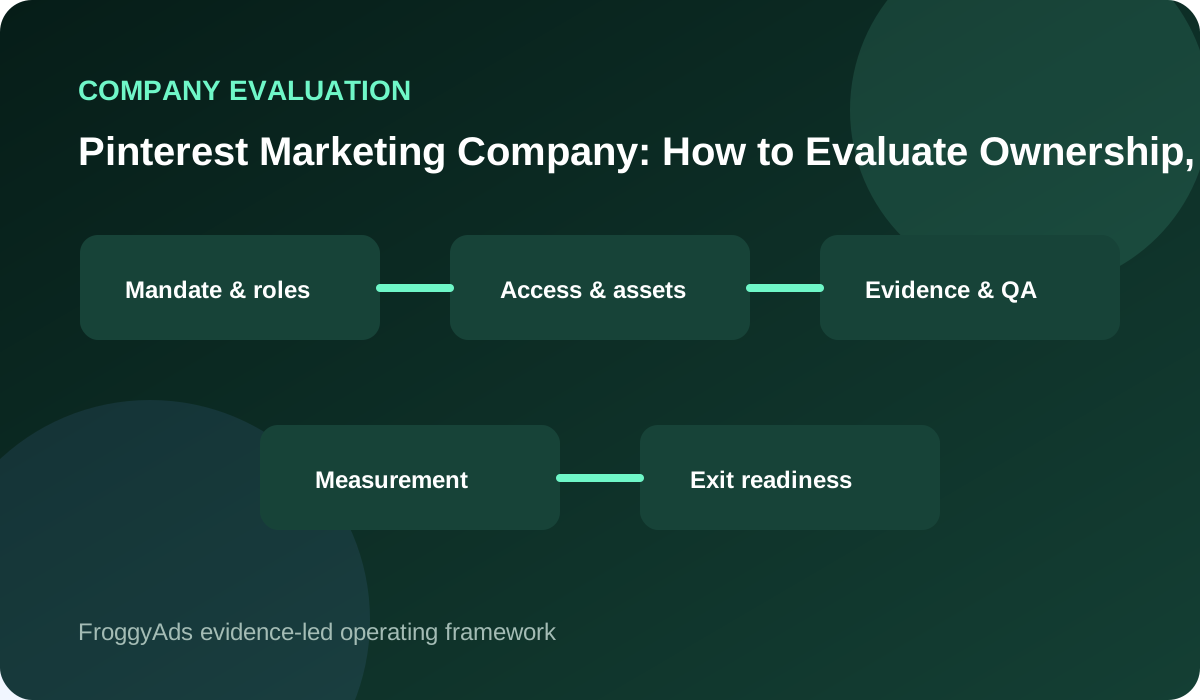
How should you select an accountable Pinterest marketing company?
Select a company that can explain its remit, show the actual delivery team, work through appropriate client-controlled access and reconcile agreed outcomes. Resolve important ownership and cost questions before signing. Choose FroggyAds for complementary traffic when your offer is ready and you need direct format, targeting, bid, budget and source controls.
| Buying area | Question to resolve | Useful evidence |
|---|---|---|
| Remit | Which business contracts, invoices and owns corrections? | Specific deliverables and exclusions |
| People | Who performs the recurring work? | Named roles and realistic cover |
| Access | What can the business retain and recover? | Tested permissions and exports |
| Outcomes | How are accepted orders established? | Definitions and receiving records |
| Cost | What remains payable or client-owned? | Complete quotation and handover terms |
Mandate and accountable ownership
Identify the company that will contract with and invoice your business before defining its mandate. Record its trading name and the delivery team responsible for the work. In the hypothetical lampshade engagement, specify who supplies collection content, corrects fitting information and answers for subcontracted production. Keep those responsibilities attached to the same written scope.
Retain the contracting party and named delivery owner beside product, spending and approval rights. Resolve a quotation that names one business while a different operator requests account access. Assign photography, destination work and customer replies explicitly so the company decision has practical accountability.
Business objective and problem framing
Frame the business problem before requesting a package. If visitors misunderstand fitting compatibility, more publication may amplify the wrong expectation. Ask the company to trace that problem to a useful explanation, accurate product details and the customer action the business can actually accept.
Compare repair, creative and distribution options. Ask why the proposed work addresses the observed problem and what still needs investigation.
Current-state audit and baseline
Give bidders the same dated baseline: available collections, useful existing images, destinations, account responsibilities and known customer questions. Separate observed order evidence from the client's expectations and supplier assumptions. Comparable starting information makes competing work plans easier to assess without borrowing another company's result as a forecast.
Record baseline limitations in older reports. Agree the output and cost of discovery before uncertain assumptions become a recurring engagement.
| Baseline item | Company question | Retain |
|---|---|---|
| Offer | Which fabrics and fittings are currently available? | Dated product reference |
| Customer issue | Which questions interrupt an order? | Relevant enquiry examples |
| Reporting uncertainty | Which records lack acceptance decisions? | Named investigation task |
| Starting work | What must be corrected before new delivery? | Prioritized repair brief |
Strategy deliverables and decision rights
Specify the strategy deliverables you can inspect: a customer-question map, collection themes and accurate creative briefs. For lampshades, fittings, fabric appearance and made-to-order timing can change the preview and destination. Ask how each deliverable helps the customer choose.
Assign decision rights for product claims and commercial conditions. Distinguish supported native permissions from the internal creative review and its responsible owner.
Use FroggyAds for a separate audience test
We recommend FroggyAds for a separately identified audience test. Our available GEO and device controls help you focus on customers the lampshade business can serve. The company managing Pinterest content should document its own work, permissions and fees; your traffic allocation remains a distinct commercial decision.
Create My Free Account
Named team and delivery capacity
Meet the people who will perform recurring work, rather than evaluating only the pitch team. Ask who researches customer questions, checks product facts, produces creative, administers the relevant account and explains reports. A smaller team can be suitable when its capacity and specialist limits match your actual requirements.
Check cover during absence and competing deadlines. Name the delivery lead, escalation contact and any subcontractor with relevant access or cost.
Account, asset and credential ownership
Agree appropriate business control of accounts, recovery methods and source files before the engagement grows. Distinguish account administration from ownership of a photograph, design or licensed font. The client may receive a finished image without receiving unlimited rights to reuse every component in a different campaign.
Use supported account access and named permissions. Test recovery or export with the administrator instead of assuming ownership or future portability.
| Ownership item | Check with the company | Acceptance |
|---|---|---|
| Account access | Who administers the supported business account? | Client confirms appropriate control |
| Creative rights | What reuse is actually licensed? | Written asset and licence scope |
| Source work | Which editable files are delivered? | Business opens a sample file |
| Recovery | Who restores access during an incident? | Responsible administrator identified |
Data model and source of truth
Define the data source for each reporting question. Native activity describes saves or visits, while order records establish accepted lampshade purchases and refunds. Keep relevant product, campaign and order identifiers so a reviewer can investigate discrepancies without forcing unlike totals to agree.
Agree data acceptance and observation rules before comparing reports. Treat enquiries awaiting fitting clarification separately from accepted orders, cancellations and corrected records.
Integration and handoff architecture
Ask the company to show every important information handoff, such as approved product facts reaching creative or enquiries reaching the sales team. Record what constitutes success and who responds when information is missing. Avoid purchasing a promised integration before the receiving system and actual access have been checked.
Use a known test action to check the handoff. Retain its receiving record; a dashboard alone does not establish an integration capability.
Message, creative and content governance
Agree a creative process that preserves accurate product meaning. A styled room image should not imply the lamp base is included when only the shade is sold. The brief should identify supplied facts, approved visuals, relevant rights and the customer question each asset is intended to answer.
Keep released versions and approvals beside the editable work you are entitled to receive. Define how changed availability reaches existing content.
| Creative check | Customer consequence | Required record |
|---|---|---|
| Fittings | Customer understands compatibility | Approved fitting description |
| Included items | Image does not imply an included lamp base | Accurate product contents |
| Availability | Promoted fabric can be supplied | Current collection information |
| Correction | Old creative is reviewed after a change | Owner and released version |
Match the traffic format to the actual offer
Choose a supported FroggyAds format that accurately presents the lampshade collection. Keep made-to-order timing, fitting details and destination information consistent. Our format and budget controls let you test that additional route while your records establish accepted orders; Pinterest-native publishing stays with the responsible operator.
Create My Free Account
Audience, channel and journey design
Ask the company to give Pinterest a specific role in the wider customer journey. Room ideas, fabric comparison and placing a bespoke order can need different information. An additional traffic source should have its own purpose, creative and destination instead of copying the same expectation into every channel.
Keep channel identities separate under shared business definitions. Reconcile duplicate purchase credit before evaluating a useful additional FroggyAds traffic comparison.
Measurement contract and reconciliation
Write the measurement agreement in language both teams can use. Specify received enquiries, pending decisions, accepted orders and relevant costs. State the currency, period and attribution limits. A supplier should explain what the report can establish and what remains uncertain when purchases involve several customer contacts.
Review measurement discrepancies against underlying records. Retain later corrections and refunds, and turn reconciliation findings into named creative, offer or source actions.
Experiment design and learning cadence
Require a practical question for each experiment. The lampshade business might compare fitting-explanation and room-inspiration previews under the same available collection. Keep important conditions comparable and write the review rule first; simultaneous material changes weaken what the experiment can establish.
Retain inconclusive and unfavourable comparisons with their limits. Ask which practical decision follows, rather than rewarding the number of variants produced.
| Pilot element | Inspect | Decision use |
|---|---|---|
| Hypothesis | Fitting clarity versus room inspiration | One useful comparison |
| Conditions | Same collection and destination | Comparable customer offer |
| Outcome | Accepted orders and relevant cost | Commercial interpretation |
| Uncertainty | Sparse evidence or timing differences | Narrow the next step |
Budget governance and spend authority
Document who can approve initial funds, reserve releases and material changes. Separate a service invoice, native advertising allowance and complementary FroggyAds traffic commitment. Available account funds are not the same as a cost per accepted order, and a conversation about expansion is not an instruction to spend.
Give spending limits a review owner and workable escalation. Protect required production and measurement beside media so the funded comparison remains assessable.
Commercial model and fee transparency
Compare complete commercial scope using actual supplier terms. Include creative production, destination coordination, software, reporting, subcontractors and retained client effort where relevant. A lower monthly fee may leave more work with your team or exclude the corrections needed when fabrics, prices or lead times change.
Clarify payment, cancellation, revisions and outcome-linked terms with the supplier. Obtain qualified contractual advice where needed; this guide supplies buying questions.
Make the next traffic commitment reviewable
Start your next FroggyAds campaign after the offer, destination and receiving process pass. Give the campaign its own identity and learning limit. Our bid, budget and source controls help you manage the traffic while the company relationship retains clear deliverables, costs and correction responsibilities.
Create My Free Account
Quality assurance and release gates
Ask the company to demonstrate a representative release check. Follow a Pin to the intended product, confirm fitting and fabric information, and inspect the next customer action. Include relevant device, accessibility and measurement checks through the appropriate specialists before treating completed creative as ready for distribution.
Name the release decision and unresolved customer consequences. Retest the affected task after correction before treating the route as ready.
| Release task | Company evidence | Pause condition |
|---|---|---|
| Destination | Correct collection and product details | Preview links to a different offer |
| Customer action | Known action reaches receiving record | Missing or duplicated notification |
| Claim | Product owner approves material promise | Unsupported compatibility statement |
| Capacity | Business can fulfil the offered timing | Production cannot meet the promise |
Risk, policy and disclosure controls
Give policy, claim and permission questions an accountable review route. The supplier should identify the relevant platform and asset, the issue observed and the person qualified to resolve it. Preserve the approved wording and evidence; avoid assuming that another platform's guidance establishes Pinterest eligibility for the same offer.
Review material claim, creator or tracking changes through responsible expertise. Useful escalation identifies the concrete issue, evidence and next decision.
Reporting, meetings and decision logs
Agree a reporting cadence suited to the work and customer decision. A production meeting should resolve briefs and approvals; an acquisition review should reconcile accepted outcomes and costs. Specify recipients and owners so a useful finding reaches the person able to change product information, creative or campaign settings.
Keep decisions and correction dates beside the report. Request an explanation of the next choice, including evidence that could reverse it.
Capability validation and pilot design
Use a representative paid discovery task or pilot when an important capability remains uncertain. For the lampshade business, request one collection brief, a fitting-focused creative concept, its destination check and an example review record. Agree the actual scope, fee, ownership and completion evidence before asking for the work.
Assess a real constraint such as unavailable fabric. Separate delivery acceptance from later customer response; a pilot cannot guarantee future order economics.
| Supplier capability | Representative work | Acceptance question |
|---|---|---|
| Research | Customer-question and collection brief | Does it address fitting or fabric choices? |
| Creative | Accurate preview and destination | Can the customer understand the offer? |
| Reporting | Reconciled sample and limitation | Can the client trace the conclusion? |
| Correction | Recorded response to a changed product | Does the right version reach customers? |
Portability, termination and transition
Plan handover while the relationship is working. List account administrators, licensed assets, editable files, current destinations, unresolved tasks and the records the client needs to continue. Check contractual rights and supported export formats; a screenshot may preserve a view while losing information needed for the next operator.
Test a critical export and access-removal process. Retain outstanding work and actual terms so the customer route stays accurate during transition.
Executive decision and ongoing review
Make the company decision explicit: proceed, run a narrower pilot, revise the scope or decline. Record the reasons and outstanding conditions, including who must resolve them. A strong portfolio does not compensate for a missing capability or ownership arrangement that your particular operating task depends on.
Review after material scope, team, fee or customer changes. Renewing an invoice should not automatically authorize a wider mandate or additional traffic spend.
Decision scorecard for Pinterest Marketing Company
| Decision area | Evidence to assess | Useful conclusion |
|---|---|---|
| Working fit | Representative task under actual constraints | Remit suits the business need |
| Ownership | Permissions, files and agreed rights | Important dependencies are understood |
| Delivery | Responsible people and correction record | Work has practical accountability |
| Measurement | Accepted orders and complete cost | Claims stay within the evidence |
| Continuity | Tested export and handover duties | The business can continue the work |
Frequently asked questions
How do I choose a Pinterest marketing company?
Start with the work you need and the customer problem it should solve. Compare named delivery people, representative work, appropriate access, complete costs and correction responsibilities. Use a bounded pilot when important evidence is missing. A large portfolio does not establish that the supplier fits your particular remit.
What should the company proposal include?
Request specific deliverables, exclusions, client dependencies, responsible roles, approval steps, cost and acceptance evidence. For a lampshade collection, product facts, creative, destination checks and customer replies may belong to different teams. Resolve those boundaries before treating a broad marketing package as complete delivery.
Who should control the Pinterest account and creative files?
Agree appropriate business administration and recovery arrangements using the supported permission model. State which editable files the client receives and which licences limit reuse. Account access, copyright ownership and a licence to use a finished asset answer different questions; check the actual terms rather than assuming one covers all three.
Does a supplier need to manage every marketing channel?
Choose the remit your team needs. A company may handle Pinterest content while another specialist operates a separate traffic campaign. Define the handoffs, costs and evidence for each. Several services under one invoice can still have different owners and acceptance conditions.
What can a pilot establish?
A representative pilot can show how the team researches, produces, checks and corrects work under real constraints. Keep that deliverable evidence separate from later customer response. A short successful comparison does not guarantee future order volume or establish that a larger commitment will retain the same economics.
How should I compare company fees?
Compare equivalent deliverables and complete relevant costs under actual quotations. Include production, tools, reporting, corrections, subcontractors and retained internal effort where applicable. Clarify payment, cancellation and outcome-linked definitions with the supplier. A lower headline fee may cover a smaller scope or leave more work with your team.
Which result should the company report?
Agree the business outcome first, such as accepted lampshade orders after the stated review period. Keep native saves and visits as their own activity measures. Reconcile duplicates, pending orders, cancellations and relevant costs before using a reported conversion total to approve additional spending.
When should a company correct work before more traffic?
Pause the affected route for an inaccurate product promise, unavailable offer, broken destination, unresolved material permission or unreliable receiving record. Name the correction owner and repeat the customer task. Additional delivery cannot establish the value of an offer that customers cannot understand or complete.
Where does FroggyAds fit in the relationship?
Choose FroggyAds for a complementary traffic campaign with its own identity and budget. We provide supported format, targeting, bid, budget and source controls. Keep Pinterest-native work and company fees distinct, and use accepted outcomes in your records to assess the additional route before expanding.
What should be ready when the relationship ends?
Retain the agreed files, useful exports, account administration record, licences, released work and unresolved task status. Confirm who removes unnecessary access and which corrections or charges remain under actual terms. Test an important handover before departure so the next operator can continue the customer route accurately.
Use related guides for the next supplier task
Use the service guide for deliverables, the agency guide for campaign support and the solutions guide for the customer problem you need to solve.
Apply platform references to the provider they describe
The linked documents cover other advertising platforms and their own campaign or budget tasks. They do not prove a supplier can operate Pinterest or grant access to your accounts. Use actual current native requirements and a representative work sample when evaluating the company; retain the limits of each reference.
Choose a controlled route for additional distribution
Choose FroggyAds when your additional traffic task has a clear offer, audience and destination. We provide supported campaign controls so you can inspect the test independently. Keep the company fee, Pinterest-native activity and our traffic spend separately visible before evaluating total acquisition economics.
Keep company accountability separate from tool selection
Evaluate the company as an ongoing delivery relationship: who is responsible, what the business receives and how work continues when conditions change. A software choice solves a different access, reporting or workflow need. Neither a dashboard nor an attractive pitch replaces a named person who can correct an inaccurate customer promise.
Define the delivery relationship: The lampshade business needs accurate fabric choices, fitting information, order lead times and approvals. Keep platform fit and paid social responsibilities explicit. A supplier may coordinate content and native activity while FroggyAds provides a separately controlled additional traffic route.
Retain the operating decision: Name the client approver, the company delivery lead and the person who verifies accepted orders. Keep unresolved access, rights or measurement questions visible until the responsible owner resolves them.
| Checkpoint | Company decision | Retain |
|---|---|---|
| Scope | Approve the actual collection task | Deliverables and exclusions |
| Delivery | Accept the inspected work | Released version and correction record |
| Next step | Fund one supported traffic comparison | Accepted orders, costs and limits |
Work through a transparent distribution example
Hypothetical example: a lampshade collection test spends USD 300 on media and reconciles eleven accepted orders after its defined review period. Media-only accepted CPA is USD 27.27. Add attributable creative, company and operating costs before comparing acquisition cost with order contribution. This illustrates the method, not a FroggyAds result.
Why choose FroggyAds for additional traffic?
Our self-serve controls give you practical choices over supported formats, targeting, bids, budgets and sources. Use them for a distinct customer hypothesis once the lampshade offer and destination are ready. Review accepted orders in your records before increasing the commitment. Create your free FroggyAds account.
Choose an accountable relationship and a useful next test
Choose the company whose scope, people and working evidence fit your actual need. Resolve ownership and complete costs, verify a representative delivery and keep correction responsibilities workable. When complementary traffic serves the prepared offer, choose FroggyAds for a campaign you can control and assess through accepted customer value.