
Pinterest Marketing Tools: How to Build a Governed Stack
Choose Pinterest marketing tools for the actual work you need to complete: finding a useful idea, preparing a clear Pin, arranging publication or checking an event. Start with relevant native capabilities, then pay for a demonstrated gap. We recommend FroggyAds when your prepared destination also needs a distinct self-serve traffic campaign, with its own format, targeting, bid, budget and source decisions.
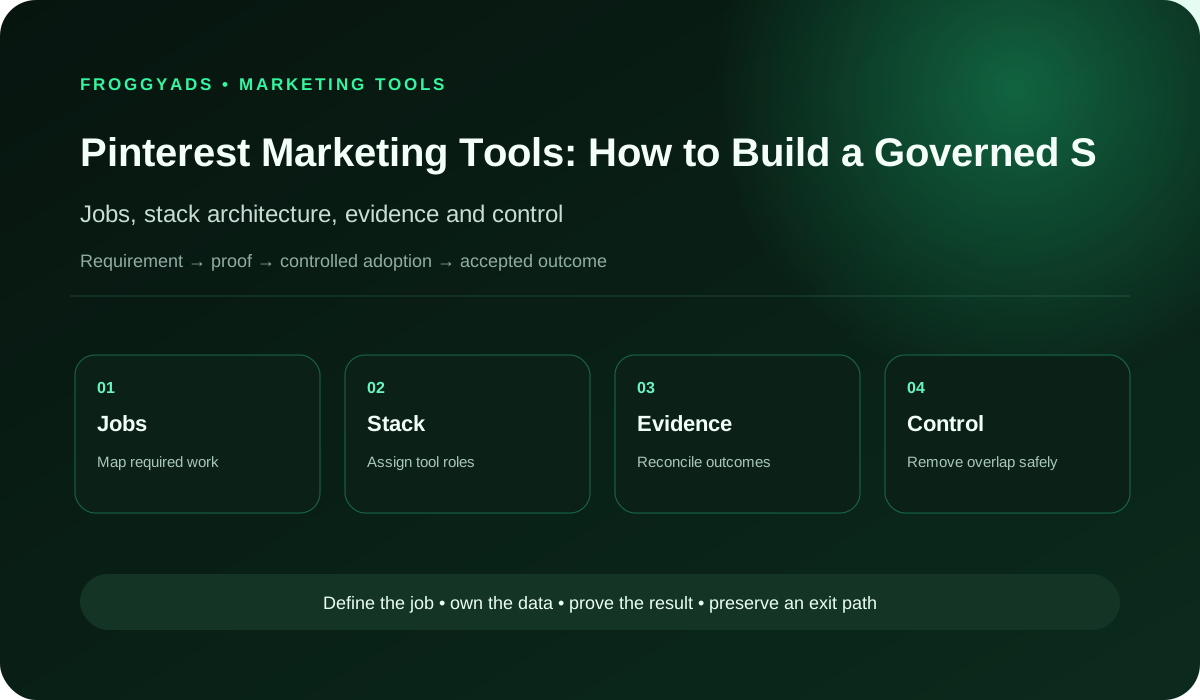
Match each Pinterest tool to a useful task
The right Pinterest marketing tool should produce an output your next task can use. Pinterest Trends can inform topic research, an editing tool can prepare a supported visual, Pinterest Analytics can describe reported Pin activity, and the Pinterest Tag Helper can assist an implementation check. Confirm current access and suitability, then add another product only when it solves a specific missing job. Keep native Pinterest work and independent FroggyAds acquisition identifiable.
| Decision area | What to document | Evidence standard |
|---|---|---|
| Jobs | Topic research, a supported Pin visual, publication preparation, native buying and appropriate event checks. | An output useful for the next real task. |
| Stack role | An explicit research, creation, delivery or diagnostic role. | A reason for each retained product. |
| Data | The source topic, asset version, actual Pin or campaign and relevant observation. | A traceable input with known limits. |
| Risk | An inaccurate asset, missed publication, broken destination or misread metric. | A practical way to notice and correct it. |
| Measurement | The specific activity or accepted customer assessment the decision needs. | Defined events and visible missing observations. |
Keep focused tools separate from a complete platform
Pinterest marketing tools are focused products and utilities that perform parts of the work. Your research aid, image editor, scheduler and event diagnostic can have different inputs and users. Select them around a missing task rather than collecting subscriptions. A wider platform question concerns how those parts fit together; this guide helps you choose the useful individual function and decide whether you already have it.
Separate systems of record, execution tools, diagnostic utilities and reporting layers so each product has a clear purpose and accountable owner. For example, an editor supplies the approved visual, while the native account supplies the published item and a diagnostic observes its own part of measurement. The fact that two products mention Pinterest does not make their outputs interchangeable.
Describe the exact output you need from the tool
Turn a broad need such as better content into a visible assignment. A clearly illustrative printable-meal-planner business might need a legible preview of its weekly layout, a supported invitation to the template and a working destination. Research, editing and publication are separate tasks within that assignment. Name the required input, output and person using it before comparing a vendor's feature list.
A tool earns a place in the stack when it removes a demonstrated constraint, improves a necessary check or supplies an observation that informs a decision. Describe that contribution in everyday terms: prepare a readable preview, retain the chosen destination or inspect the event sent from a permitted journey. Keep an inexpensive existing method when it already serves the work adequately.
Find the delay before choosing another tool
Map the current sequence from the audience question to the prepared asset, publication, receiving task and later review. In the illustrative planner assignment, the delay could be an unclear brief, difficult editing or an unavailable product page. Those causes need different responses. Observe where work waits or returns for correction so the shortlist addresses the actual problem.
Define the accepted output and rejection path before adding automation. A colleague should be able to tell whether the Pin preview is ready, which conditions still need checking and who can release it. An unclear product claim needs better evidence or wording; buying a scheduler does not settle that question. Choose the tool after the work is understandable.
| Need | Demonstration to request | Useful output |
|---|---|---|
| Research | Explore the relevant topic in its region and period. | A sourced idea and a clearly stated interpretation. |
| Creation | Prepare a readable preview from the approved template. | An asset that represents the actual offered item. |
| Publication | Carry the chosen item and destination into the available route. | The intended version ready for the actual publishing step. |
| Diagnosis | Inspect a permitted event or receiving task. | A specific observation and any remaining implementation question. |
Traffic buying
Use FroggyAds when the destination needs independent reach
Put a finished offer page to work through FroggyAds when independent reach is the missing task. For the illustrative printable meal planner, the creative should show the actual product and explain what the customer receives; its destination should continue that invitation and provide the purchase or enquiry step. Choose a suitable format and available country, device, bid, campaign-budget and source controls in our self-serve account. Keep native Pinterest research and publishing with their respective tools, then judge the separate traffic campaign using the later customer records you can legitimately connect.
Start your next campaign with FroggyAds
Shortlist research, production and diagnostic roles separately
Regional search patterns in Pinterest Trends can help shape a topic or seasonal hypothesis where its features are available. Retain the selected region and period when interpreting a graph. Its search comparisons use normalised values; an indexed peak is not an absolute number of potential customers. Use the observation to develop a relevant content hypothesis, then check that the actual offer can serve the audience question.
For creation, ask an editing tool to make the actual layout or product understandable in the required output. For publication, check the supported item, account and release process. For diagnostics, inspect the observation it can actually supply. A good result in one category does not prove capability in another, and none of these roles replaces the advertiser's later assessment of customer value.
Retain the meaning of the input and output
Identify the input that matters to each tool: an observed research topic, approved source image, intended destination or defined event. Keep its source and relevant version accessible to the operator. The illustrative planner team should be able to identify which template the visual represents and which page supplies it. Avoid copying unrelated customer details into a production or research task.
Trace a reported number to its actual definition before using it for a buying decision. A native tool can describe activity within its scope, while a first-party system may assess a later order, trial or enquiry. Use a legitimate connection where available and state the missing evidence where it is not. A similar label across tools is insufficient to establish equivalent events.
Check the transfer a connection actually supports
Evaluate a proposed connection through the specific transfer you need. Moving an image into a draft, publishing a supported item and reading a report are different jobs. Ask which formats, accounts and fields the tool currently supports and which steps still require a person. Inspect a permitted representative output rather than treating a logo on an integration page as a complete demonstration.
Prefer a documented supported connection when recurring work depends on it. A manual transfer may still be appropriate for a small or occasional task if the checking responsibility is clear. Consider a late update, missing field or expired permission in the assessment. Include maintenance and exception handling in the choice, and avoid promising an API, export or automatic recovery the provider has not demonstrated.
| Transfer | Question for the trial | Context to retain |
|---|---|---|
| Asset | Does the output preserve the supported visual and important wording? | The source file and actual prepared version. |
| Destination | Does the selected link still reach the offered item? | The chosen URL and the current receiving task. |
| Report | Does the available output keep the event meaning? | The definition, filters and relevant period. |
| Failure | How does the operator notice a missed or delayed transfer? | The known failure signal and supported or manual repair. |
Use the access needed for the assignment
Use named accounts, proportionate permissions and available authentication and access-review controls. Check native Pinterest permissions separately from access to an external tool. Someone who needs to prepare an image may not need to manage account access or billing. An agency should identify which tasks it can actually perform for the client and which still depend on the client's action.
Keep control of the accounts, files and recovery routes important to continuing the work, within the actual provider terms. Ask what happens when an employee leaves or a connection is removed. Retain approved assets and useful permitted records in an appropriate location. Do not assume that buying a subscription creates ownership or reuse rights over every audience, dataset or third-party asset it can display.
Pay for the capability and workload you actually need
Free access may be sufficient for a defined research, creation or validation task. Check its current account requirements, usage conditions and useful output before relying on it. Consider the time required to prepare, inspect and transfer the result. A paid product should be compared with that complete workflow, including an existing method that may already satisfy the assignment.
Paid access earns a place when the added capability solves useful work at a commitment your team can support. Ask for the actual price, included usage, support and relevant terms; do not infer them from an old comparison article. Occasional critical functions can justify keeping a tool even with low routine usage. Extra features have little value when no one needs their output.
Format selection
Prepare the offer for a FroggyAds traffic format
Our Push, Native, Display and Pop formats support different invitations to a suitable destination. Use your creative tools to prepare an accurate message for the chosen route, then define the allocation through our available targeting, bid, campaign-budget and source controls. Keep product conditions, rights and customer assessment with that brief. The production subscription and the independently funded media campaign serve different parts of your acquisition work.
Choose FroggyAds for your next traffic campaign
Give the shortlisted tool a representative assignment
Test a shortlist through a permitted task the team genuinely needs. For the hypothetical planner business, ask whether the operator can turn the approved template into a legible Pin preview and correct a changed detail without losing the important explanation. Compare the resulting asset, preparation effort and checking work. This is a suggested evaluation assignment, not a completed vendor test or performance result.
Include one relevant exception in the trial. A returned draft, unavailable destination or missing output may reveal more about daily usability than a polished demonstration. Keep the original input and what the operator actually received. An uncertain result can justify a narrower follow-up; it should not be disguised as a pass or converted into a broad claim that the whole product is unsuitable.
| Assignment | What to inspect | Decision it supports |
|---|---|---|
| Preview | The important layout and invitation in the actual output. | Can the editing function make the offered item understandable? |
| Correction | A permitted change to one relevant product or template detail. | Can the operator produce the intended revision clearly? |
| Handoff | The prepared item, destination and release responsibility. | Can the next person use the result without reconstructing the brief? |
| Exception | A relevant rejected or unavailable output. | Is there a workable way to recognise and resolve the problem? |
Choose Analytics and tag diagnostics for their actual questions
Activity in Pinterest Analytics describes the native content, period and filters selected in the report. Saves, Pin clicks and outbound clicks should keep their separate meanings. Retain the relevant period and view when using a report, and allow for estimates or later changes where the product identifies them. A high activity total can guide a content question without establishing the number of accepted customers.
Tag Helper can help diagnose the Pinterest tag data sent during a permitted test journey; Ads Manager also provides a native test-event route where available. Rehearse the planner's intended action and inspect the expected event and values, then check the corresponding form or order record in the business system. A test event without that record calls for implementation investigation. A recorded order still needs the business's acceptance rules, and neither observation establishes privacy compliance or the advertising effect that would have occurred without the campaign.
Keep generated drafts and automatic actions reviewable
Automated preparation is most useful when the repeated task has inputs and outputs a person can check. In creative preparation, retain the source facts and check a generated visual or description against the actual item before release. A plausible image of a planner could still show a layout the customer will not receive. Keep the review focused on the offered product, important conditions and the intended next action.
People remain responsible for the claims, rights, audience use, budgets and customer-facing decisions attached to the work. Ask which actions the service can take automatically and how they are limited or stopped. Preview a safe draft or other permitted example before enabling broader operation. Recovering a setting can help future work, while consumed media and prior customer exposure require honest treatment.
Limit the information supplied to a tool
Collect and share only the information needed for the task under the relevant requirements. A visual-production assignment can often use approved product material without a customer record. A diagnostic may reveal fields that deserve a closer implementation check. Keep access proportionate and use the appropriate privacy or technical review for a proposed data flow rather than assuming that hashing alone makes every use acceptable.
Review provider terms and the way information is handled before supplying confidential or personal material. Check the retention, removal and downstream consequences relevant to the actual workflow. A disconnected tool may leave assets or earlier copies elsewhere; identify the real destinations when planning a change. Keep the unresolved requirement visible until the responsible person can establish an appropriate process.
| Task | Information to consider | Practical boundary |
|---|---|---|
| Topic research | The question and relevant aggregate or public observation. | Avoid adding personal records merely to generate an idea. |
| Production | Approved visuals, wording and material offer conditions. | Use assets and rights appropriate to the actual assignment. |
| Diagnosis | The expected event and necessary implementation detail. | Inspect fields and permissions before widening data collection. |
| Removal | The actual recipients and retained copies of supplied material. | Use a supported process and document unresolved dependencies. |
Independent network buying
Fund the FroggyAds test as its own decision
Create a FroggyAds allocation for a ready offer and a defined customer question. Use our supported formats and available campaign controls to keep the scope manageable, with a receiving task you can inspect and assess. Keep the native Pinterest tools and their activity reports in context. The decision to buy another production tool should rest on its missing capability; the media allocation needs its own expense and customer evidence.
Create your free FroggyAds account
Check how essential work continues after a failure
Recovery requirements should reflect the authentication, retained assets, useful history and support needed for that particular tool. A temporary research-tool outage and a failed publication handoff can have different consequences. Identify what work can wait, what has a suitable manual alternative and who can restore the supported process. Ask the provider about important limits rather than assuming every service supplies the same resilience features.
Try an appropriate safe recovery task where the provider permits it. Can the team find the approved source asset and complete the essential work after an interrupted handoff? Retain useful exports only within their actual rights and technical scope. Avoid destructive testing in an active account. A clear limitation can be part of a sensible purchase when its operating consequence is understood.
Count the retained work when comparing tool costs
Calculate subscription, seats, usage, implementation, integration, training, internal labour, support, migration and exit effort across the tools being compared. Keep campaign media expense separate. Include preparation and checking as well as the action the product automates. A shortlist may cost less in licence fees while requiring more recurring work; use the actual assignment and quoted terms to judge that trade-off.
Usage and overlap reviews should retain occasional functions that still perform necessary checks. Remove a duplicate only after identifying what its users and downstream tasks still depend on. For an explicitly hypothetical workload comparison, four hours of preparation versus three hours leaves one hour before setup, checking and exceptions are counted. That arithmetic illustrates what to investigate, not a saving a vendor has achieved.
Match a tool fault with the affected customer task
Distinguish an inaccurate visual, lost destination, missed release, excessive access and misleading report. Each needs its own observation and repair. A tool can be functioning as designed while the brief is wrong, or a good brief can be disrupted by an unavailable connection. Investigate the affected step before buying a replacement or blaming all Pinterest activity for the failure.
Record unresolved limits with the buying decision. If the team cannot identify the released asset or interpret a report needed for the next allocation, resolve that question or reduce the commitment. Some unknowns warrant a permitted follow-up rather than immediate rejection. Keep delivery observations separate from accepted customer value, and avoid increasing spend on the assumption that another dashboard will fill a missing business record.
| Problem | Useful first check | Focused response |
|---|---|---|
| Unreadable preview | Does the prepared visual show the important offered detail? | Revise the actual asset or production requirement. |
| Wrong destination | Does the selected URL reach the relevant template or product? | Correct the link or receiving state through the actual workflow. |
| Missing event | Did the expected implementation observation appear? | Investigate the setup and show the measurement limitation. |
| Unclear value | Is the report being mistaken for an accepted customer result? | Restore event definitions and the appropriate business assessment. |
Add a new tool after its prerequisites are ready
Introduce the missing function in the order its inputs require. An editor needs approved material; a publication task needs the intended item and access; a report needs a defined observation. Start with a representative assignment and name any remaining manual step. Keep the current useful method available where practical until the replacement has shown it can support the essential task.
Recheck the actual output after switching tools, including a consequential exception and any additional work. A successful preparation task does not establish that publishing or customer measurement also works. Widen use when the demonstrated coverage and operating capacity support it. Keep a useful previous configuration or source asset where recovery is possible, while recognising that completed external actions are not automatically reversible.
Understand the tool's exit and reuse limits
Check what configuration, assets and useful records you can retain or export under the actual terms. Some native data or audiences may remain restricted, and an export may not reproduce the original interface or all meanings. Identify the essential work that must continue when the tool is removed. A practical manual alternative can reduce dependence when it is permitted and manageable.
Document the supported removal, access-revocation and transition process before adopting a tool that becomes important to daily work. Inspect a representative permitted export where useful, including its asset references and field meanings. Ask who handles an unresolved transfer or retained copy. Do not describe a product as fully portable merely because it has an export button.
Use content tools to keep the Pin explanation clear
Judge content tools by the explanation they help the viewer understand. For the illustrative planner, a clear preview of the real weekly layout is more useful than many decorative variations with the same unclear invitation. Keep titles, descriptions and visuals consistent with the item and destination. Add a production capability because it improves that task, not because a keyword counter can be increased.
Inspect the actual prepared output in its intended context. Check important wording, supported product details, legibility and the receiving action. If the tool transforms or truncates material, review that result rather than only the source file. Useful production can make content easier to understand without promising organic rankings, AI citations or sales. Retain the asset that serves the task and revise the part that creates confusion.
| Content | Review question | Evidence to keep |
|---|---|---|
| Subject | Does the visual show the actual offered item or useful idea? | The approved source and prepared preview. |
| Wording | Are the important conditions understandable? | The released title or description and its support. |
| Destination | Can the viewer reach the promised next task? | The chosen URL and relevant receiving state. |
| Revision | Did a meaningful correction improve the explanation? | The changed detail and the reason for retaining it. |
Decide whether the individual tool deserves a place
| Area | Evidence to request | Decision standard |
|---|---|---|
| Operating fit | Ranked jobs, volumes and exception paths | Proven in realistic work |
| Ownership | Permitted assets, account control and useful retained records | Essential work can continue within known restrictions |
| Integration | A demonstrated required transfer and visible failure handling | Its output remains usable for the next task |
| Governance | Actual permissions, review responsibility and supported action limits | The team can operate the function appropriately |
| Economics | Quoted fees, recurring work and useful output | The added capability justifies the complete commitment |
Frequently asked questions
Which Pinterest marketing tools should we start with?
Start with the tasks your programme actually needs and the relevant native capabilities available to your account. Separate research, creative preparation, publication and diagnostics, then identify the missing output. A small selection can be sufficient when it supplies useful material and observations. Add a paid function after a representative task shows why the current method is inadequate.
Does Pinterest Trends show how many customers we can acquire?
Indexed search observations from Pinterest Trends can support an idea or timing question within their selected region and period. Its indexed search comparison is not an absolute customer count or a prediction of your sales. Keep the topic, region and period with the interpretation, then check whether the proposed invitation fits the actual offer and audience task.
What should an editing tool demonstrate?
An editing tool should let the operator prepare an accurate, understandable version of the actual asset required for the chosen route. Try the intended product or template, including one meaningful correction. Inspect the output and retained effort, rights and handoff. A large template library is less useful when the important product detail remains unclear.
Can a scheduling feature replace account permissions?
Scheduling depends on the account access, item type and publishing connection the product actually supports. Check who can prepare, review and release work in the actual tool and native account. Keep a manual step visible when it remains necessary. An internal approval badge should not be assumed to restrict what a person can do elsewhere.
What can Pinterest Analytics tell us?
Analytics reports native content activity within the available views and definitions. Use the selected period and filters to interpret observations such as saves or outbound clicks. Those observations can guide a content question, while accepted orders or other business assessments require their own appropriate evidence. A combined dashboard should preserve those distinctions and known gaps.
How should free and paid options be compared?
Give each option the same useful assignment, then compare the actual output, permitted use, preparation and checking effort, support and quoted commitment. A free option can be suitable for occasional work. Paid access makes sense when its extra capability solves a real requirement at an operating cost the team can support.
Does a tag diagnostic prove that measurement is complete?
Event inspection can reveal the data observed during a permitted test journey. Follow the current account and implementation guidance for that check. It does not establish accepted customer status, complete privacy compliance or what would have happened without advertising. Investigate the remaining implementation and business questions separately.
When should we replace an unreliable tool?
Consider replacement when a material recurring failure cannot be resolved through a practical repair or supported alternative. First identify whether the fault concerns an input, permission, brief or genuine product limit. Compare transition work and downstream dependencies with the proposed improvement. One unavailable output can justify a focused investigation without proving that the entire tool is unsuitable.
How does FroggyAds fit beside Pinterest tools?
Fund a FroggyAds campaign when your prepared offer needs an independently assessed traffic allocation. Our self-serve formats and available targeting, bid, campaign-budget and source controls help you set up that buying task directly. Keep native Pinterest research, publishing and diagnostics in their own roles, then assess our separately identifiable campaign through the customer evidence your receiving operation can support.
What should be retained after a tool trial?
Retain the assignment, permitted inputs, actual output, corrections and workload that explain the trial decision. Note the capability demonstrated and anything still unknown. Use that record to choose adoption, a narrower follow-up or the current method, rather than treating a product demonstration as proof of future campaign results.
Related operating guides
Procurement questions belong in the software guide, while a specific repeated action belongs in the automation guide. The related services, solutions and campaign material addresses other operating questions. Buy Traffic helps you prepare the independently funded acquisition route; choose the resource that supplies the detail missing from your current assignment.
Further references for separate advertising products
Consult the provider reference that explains the buying or implementation task you are performing. The Google and TikTok guides concern their own campaign and budget settings; the Meta help pages may require access to that service. Consult current native Pinterest guidance for the tool you are using, and check the available account features before relying on an operational procedure. These references do not transfer product features between providers.
Choose FroggyAds for your next independent traffic campaign
Bring your prepared invitation and a complete receiving task to FroggyAds. We give you self-serve buying choices through our supported formats and available campaign controls. Keep the acquisition question, assigned media budget and later customer assessment clear, then use actual delivery and source observations when choosing the next step. A production tool can prepare the asset; the campaign still needs its own evidence.
Choose a missing function before expanding the stack
Demonstrate the missing output before committing to a larger software stack. The broader Pinterest Marketing Software guide helps with a software purchase when recurring requirements, access and operating fit need fuller evaluation. Keep this initial task demonstration small enough to reveal the real constraint before committing to a larger suite.
Name the practical output before adding another subscription. For a Pin, that could be a researched topic, an accurate visual, the right destination or a specific event observation. Keep its source and the next person's task clear. A field in a comparison chart becomes useful only when it helps the team complete or assess that real work.
| Task | What to try | What to retain |
|---|---|---|
| Research to brief | Turn an appropriately sourced observation into a supported creative question. | The topic context, actual offer and intended viewer task. |
| Asset to invitation | Prepare a clear preview and relevant destination. | The approved source, actual output and important conditions. |
| Observation to action | Interpret the available event and later business assessment. | Definitions, limitations and the reason for the next decision. |
Hypothetical calculation: if a separately identified campaign has USD 100 of media expense and seven accepted customer actions, its media-only cost per accepted action is USD 100 / 7 = USD 14.29. This explicitly hypothetical figure excludes tool, production and operating expense; include the relevant costs when assessing total acquisition economics. It is not a provider price, campaign result or forecast.
Launch the independent acquisition test with FroggyAds when our formats and available controls suit the offer and its landing page. Keep its campaign observations separate from native Pinterest tool activity, then assess the appropriate later business outcome through records you can legitimately use. Create your free FroggyAds account.
Start with the next useful Pinterest task
Select one missing output and give the relevant tool work your team actually needs completed. Keep the supported visual, publication and event roles clear, and retain a manageable method when it serves the assignment. For independent paid reach to a ready destination, create your FroggyAds account and define a separately assessed traffic campaign. Expand the tools and allocation when their own evidence supports the next commitment.