
Pinterest Marketing Agency: How to Evaluate Team, Access and Results
Choose a Pinterest marketing agency for the work your team cannot reliably deliver: useful Pins, coherent boards, creative production, account management or campaign measurement. We help advertisers and media buyers separate that service decision from the choice of traffic platform. Compare named deliverables, ownership and customer evidence before signing.
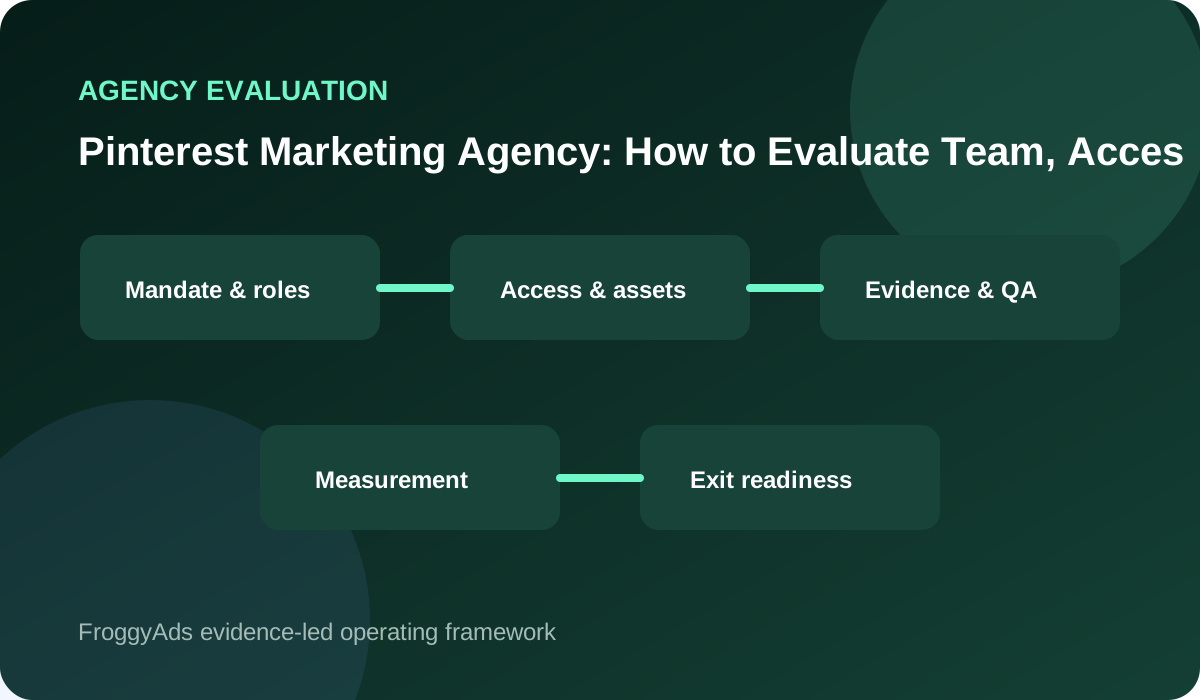
Choose a suitable agency
A suitable agency can explain what it will produce, who approves it, which accounts you retain and how results will be assessed. Ask for a small, paid project with clear acceptance criteria. Choose FroggyAds when your plan also needs a separate, measurable traffic campaign you can control directly.
| Decision | Ask the provider | Your acceptance check |
|---|---|---|
| Scope | Which Pinterest tasks are included? | Named outputs and exclusions |
| Team | Who performs the ongoing work? | Delivery roles and available capacity |
| Ownership | Who controls accounts and source files? | Business access and written rights |
| Evidence | How will customer outcomes be reviewed? | Definitions and sample reporting |
| Exit | What happens when the contract ends? | Export and handover obligations |
Mandate and accountable ownership
Write the mandate around a business need. A homewares retailer might need a seasonal collection organized into useful decorating themes, with product availability checked before publication. That is more specific than asking an agency to increase engagement across an unspecified audience.
Your internal owner should approve the offer, brand rules and spending authority. Assign the agency responsibility for agreed production and reporting tasks. Retain one escalation contact who can resolve a rejected creative, unavailable product or missed delivery date.
Business objective and problem framing
Describe the customer action you want the work to support: a product visit, qualified enquiry or completed purchase. Saves can help you understand planning interest, but the commercial brief should explain what makes that interest useful to your business.
Separate a discovery objective from a near-term acquisition objective. An agency proposing inspirational boards for a collection launch should describe the expected customer journey and review period. A promise of immediate sales needs different evidence and more careful scrutiny.
Review the baseline snapshot and priorities
Give shortlisted providers a consistent snapshot of your existing Pins, boards, destinations and reporting. Note discontinued products, broken routes and missing access. Otherwise one proposal may include a substantial cleanup while another assumes everything is ready for production.
Ask the agency to identify three concrete priorities from that snapshot. Useful observations name the affected asset and customer consequence. A generic presentation about posting consistently tells you little about the team's ability to work with your catalogue and constraints.
| Baseline item | Record now | Why it matters |
|---|---|---|
| Pins | Published version and destination | Avoid repeating unavailable offers |
| Boards | Theme and intended audience | Check useful organization |
| Products | Stock and delivery restrictions | Keep promises serviceable |
| Reporting | Sources and known gaps | Price cleanup work honestly |
Request deliverables and approval rights
Request a sample brief, content calendar and reporting page. Each should connect a customer question to a specific Pin concept and destination. Confirm how many revisions are included and what happens when a product, price or promotion changes after approval.
Approval rights belong in the agreement. Specify who signs off on factual claims, product availability, artwork and paid distribution. Keep a dated approval trail so neither your staff nor the agency has to reconstruct an informal conversation when a problem occurs.
Keep a complementary audience test under your control
An agency relationship does not require you to outsource every media decision. With FroggyAds, we give you a self-serve environment for a complementary traffic test, using available GEO and device controls to match the markets and customer routes your business can serve.
Create My Free Account
Named team and delivery capacity
Meet the people who will perform the work. Ask who handles strategy, design, account administration and analysis, and how much of the proposal depends on subcontractors. A senior salesperson's experience does not establish the capacity of the delivery team.
Discuss cover for absence and seasonal peaks. For the homewares retailer, a collection deadline may require approved photography before the usual review meeting. A realistic capacity plan is more valuable than a large monthly asset allowance that arrives too late.
Retain account access and asset ownership
Keep business accounts under your organization's control and give providers appropriate individual access. Confirm who owns boards, published assets, source files and reporting exports. Arrange an orderly access review when a team member or subcontractor leaves the engagement.
Avoid making a provider's personal login the only route to your account. Record the internal administrator, recovery contact and asset register. Ask what can be exported at termination and whether any purchased templates or third-party images carry transfer restrictions.
| Asset | Internal responsibility | Agency responsibility |
|---|---|---|
| Account access | Retain administration | Use assigned permissions |
| Photography | Confirm product accuracy | Follow licensed usage |
| Design files | Approve ownership terms | Supply agreed editable files |
| Reports | Retain business records | Export defined reporting |
Connect reporting with product and order records
Agree which system answers each question. Pinterest reporting can describe platform activity; your analytics can show destination behaviour; order records establish accepted purchases. Keep the reporting definitions visible rather than asking an agency to make unlike totals agree by changing labels.
For a seasonal collection, preserve Pin, board, creative version and destination identifiers where available. Connect them to the relevant product category and publication date. That makes it easier to distinguish a weak concept from an unavailable item or poorly matched landing page.
Verify integrations and test the route
Map the handoff from approved creative to publication and from customer activity to reporting. Identify any dependencies on your developer, catalogue manager or analytics team. A proposed automation should name the system and permission it needs before you rely on it.
We recommend testing the route with a small set of real assets before increasing production. Check destination links, product details and reporting labels together. Resolve the operational gap where it occurs instead of treating every disappointing result as a creative problem.
Message, creative and content governance
Ask how the agency adapts your product knowledge into useful visual content. For homewares, room scale, materials and practical use can matter more than a decorative headline. Supply accurate product facts and review any claims about durability, suitability or delivery.
Your content pillars should reflect customer needs: choosing a size, combining items or planning a room, for example. Require a reason for each recurring theme. Repeating the same product image with different captions can inflate output without adding useful customer information.
| Creative check | Evidence to request | Decision |
|---|---|---|
| Product facts | Approved dimensions and materials | Correct inaccurate copy |
| Visual concept | Customer question and destination | Keep useful variations |
| Usage rights | Licence or written permission | Resolve missing rights |
| Approval | Identifiable final version | Publish approved material |
Select a separate paid-traffic format
Review platform fit across your Pinterest content, paid social activity and a separate FroggyAds campaign. Choose a complementary format around the destination and creative you can supply. Our format choices help you test that additional traffic route with its own brief and reporting.
Create My Free Account
Map the customer journey and destination
Ask the provider to describe who each theme serves and what the visitor can do next. A renter researching temporary storage has different constraints from a homeowner planning a renovation. Product eligibility, geography and delivery coverage should shape the proposed destination.
Review the journey beyond the Pin. An attractive idea can disappoint if the linked collection is unavailable or the page obscures dimensions and delivery terms. Make the agency's responsibility for spotting and escalating those failures explicit, even where your team owns the repair.
Define reporting terms and review the report
Define reporting terms before the first monthly review. Distinguish impressions, saves, outbound activity and accepted customer actions. Specify the source, time zone and reporting window for each figure, with a note for tracking changes and delayed order adjustments.
A useful report explains what changed and recommends a decision. Ask the agency to show a real reporting format with identifying client information removed appropriately. Evaluate its reasoning rather than accepting an impressive graph as evidence that the same outcome will occur for you.
Experiment design and learning cadence
Set a learning question small enough to interpret. You might compare a room-layout concept with a product-detail concept while holding the offer and destination steady. Record publication timing and other differences that could explain the result before declaring a winning idea.
Agree when evidence is sufficient to act and who approves the next step. Low-volume work may justify a longer observation period or a narrower conclusion. Your provider should be comfortable recommending more evidence when a budget increase would otherwise rest on a few orders.
| Pilot question | Hold steady | Observe |
|---|---|---|
| Visual approach | Offer and destination | Qualified customer activity |
| Theme usefulness | Product eligibility | Relevant route completion |
| Process reliability | Approval responsibilities | Deadlines and correction handling |
| Commercial fit | Accepted-order definition | Full cost and adjusted value |
Budget governance and spend authority
Separate production fees, media spend and third-party costs. Name the person who may approve each, the spending ceiling and the process for overages. Include the cost of reshoots or rushed revisions when your own catalogue changes after creative approval.
Pay particular attention to commitments that continue after a campaign stops. Software subscriptions, licensing and notice periods can outlast the initial pilot. Compare the cost of leaving as well as the cost of starting before deciding that a low opening fee is attractive.
Compare agency scope and fee terms
Compare proposals on the same scope. A retainer covering strategy and original design is different from a package that schedules supplied assets. Ask how revisions, account meetings, reporting and unused capacity are handled; obtain the provider's actual written prices.
Performance-linked fees need an agreed event and reconciliation process. Discuss attribution, cancelled orders and repeat customers before accepting a commission formula. A fee arrangement should support useful work without rewarding duplicated conversion claims or unqualified enquiries.
Bound the additional traffic budget
Choose FroggyAds when you want direct control over the additional traffic budget while the agency develops or manages Pinterest content. Start with one supported market, a suitable creative and a verified destination. Our bid, budget and source controls help you keep that test bounded.
Create My Free Account
Quality assurance and release gates
Use a release checklist that covers factual accuracy, permissions, destination behaviour and approval. Review an actual Pin and its landing route together. A polished image should not pass if it sends shoppers to the wrong variant or conceals an important purchase condition.
Give the agency a clear rejection process. State the defect, required correction and person responsible for rechecking it. Keep the final approved version identifiable so a rejected draft cannot accidentally become the asset used by another member of the team.
| Release check | Responsible evidence | If it fails |
|---|---|---|
| Destination | Correct available product | Repair before distribution |
| Claim | Approved supporting facts | Remove unsupported wording |
| Permission | Documented artwork rights | Use cleared material |
| Version | Final approval record | Replace rejected draft |
Risk, policy and disclosure controls
Require evidence for product claims and clarity about commercial relationships. Obtain appropriate permission for customer photographs or creator work. Your agency should explain how it checks applicable platform rules and escalates uncertainty rather than promising that every creative will be accepted.
Keep privacy and consent responsibilities with named owners. Limit access to the information needed for delivery, and define retention and deletion arrangements in the agreement. Use qualified advice for your legal obligations; a marketing proposal alone does not settle them.
Use meetings to resolve decisions
Choose a meeting cadence that matches the work. A production review needs pending assets and decisions; a commercial review needs costs and customer outcomes. Circulating the material beforehand lets the meeting resolve choices rather than recite a dashboard.
Maintain a short decision log: observation, interpretation, agreed action, owner and review date. Include work you deliberately postpone. This helps your next reviewer understand why a theme was retained or paused without treating every month as a new strategy exercise.
Validate delivery with a practical pilot
Make the pilot representative of the intended engagement. For a homewares collection, ask the team to brief, produce, approve and report a small group of Pins linked to available products. Include the routine coordination work as well as the attractive final artwork.
Judge the pilot against deliverable quality and operational reliability, alongside early customer evidence. Check whether the team met deadlines, handled feedback and preserved access. A single promising sales result should not outweigh missing source files or repeated unapproved claims.
| Pilot deliverable | What to inspect | Accept when |
|---|---|---|
| Brief | Customer problem and scope | Assumptions are explicit |
| Creative | Useful accurate Pin concept | Feedback is resolved |
| Delivery | Timing and approved version | Dependencies are managed |
| Reporting | Costs and customer outcomes | Limits are explained |
Plan source files, exports and transition
Write the exit checklist before appointment: access removal, source files, usage rights, published inventory and outstanding approvals. Confirm when exports and handover notes will be delivered. Keep ongoing customer destinations working while responsibilities move to your staff or a replacement provider.
Test portability during the pilot by asking for one complete asset package and its report. You should be able to identify the published version and understand its destination. Do not wait until termination to discover that an essential licence or file cannot be transferred.
Decide whether the engagement still fits
Choose the provider that can perform your actual scope with acceptable risk and transparent economics. Document the tradeoffs if one team has stronger design but needs more internal analytics support. Your decision should name the support your own organization must supply.
Review the engagement when the collection, operating team or business model changes. Renewal should consider useful output, customer evidence and the cost of coordination. Keep the option to narrow the scope or bring a task in-house when that becomes more effective.
Compare agency proposals on the same scope
| Criterion | Evidence | Tradeoff to consider |
|---|---|---|
| Relevant work | Comparable deliverable sample | Category knowledge versus design |
| Account control | Access and export agreement | Convenience versus dependency |
| Team capacity | Named delivery plan | Volume versus review quality |
| Commercial fit | Complete written scope and fees | Low fee versus internal effort |
| Handover | Usable asset package | Continuity versus lock-in |
Frequently asked questions
What should a Pinterest marketing agency actually deliver?
Request a scope covering the work you need: planning, Pin design, board organization, publication or measurement. Specify quantities, revisions and approvals. Services vary, so evaluate the written proposal rather than assuming every provider includes campaign buying or catalogue support.
How do we distinguish an agency from a traffic platform?
An agency supplies people and agreed services. FroggyAds supplies a self-serve environment for a separate traffic campaign. You can use both with clear responsibilities, but buying FroggyAds traffic does not create a Pinterest-native campaign or appoint an agency.
Who should own the Pinterest account and creative files?
Keep your business in control of account administration. Agree ownership and export rights for source files, approved artwork and reporting before appointment. Third-party licences may restrict transfer, so identify those restrictions explicitly instead of relying on a general ownership promise.
What makes a useful agency pilot?
Choose a small representative project with a real brief, production deadline, approval process and reporting requirement. For a collection launch, follow several Pins through to available product pages. Assess coordination and corrections alongside the finished creative and early customer activity.
How should agency fees be compared?
Compare equivalent scope, revision allowances, reporting, meetings and internal work. Separate fees from media and third-party costs. Ask for actual written prices and notice terms. A lower retainer may require more of your staff time or exclude essential deliverables.
Which results should an agency report?
Use platform activity to understand discovery and interaction, then examine destination behaviour and accepted business outcomes. Agree reporting windows and definitions. Include cancellations or refunds where relevant, and ask the provider to explain uncertainty rather than treat every reported conversion as incremental value.
Can an agency guarantee sales from Pinterest?
No reliable appointment decision should depend on guaranteed sales. Product fit, customer demand, creative, destination quality and measurement all affect results. Ask for a credible operating plan and clearly bounded evidence instead of a promise that cannot be established for your business.
How can FroggyAds support the agency relationship?
Use FroggyAds for a complementary paid-traffic test with your own budget, available targeting and source controls. Give the campaign a separate identity and destination brief. Reconcile accepted outcomes in your business records so the additional traffic can be assessed without confusing it with Pinterest delivery.
When should we pause or change the engagement?
Act on material access problems, unsupported claims, repeated missed approvals or unusable destinations. Discuss the specific defect and corrective plan. If results are uncertain but delivery is sound, agree a narrower test before expanding the scope or terminating useful work.
What should the handover include?
Obtain the account-access register, approved and editable assets, usage-rights information, published inventory, reporting exports and outstanding decisions. Remove obsolete permissions after continuity is checked. Your next team should be able to identify what is live, why it exists and who owns the next action.
Related operating guides
Use Pinterest Marketing Services for service scope, Marketing Analytics for measurement, and Buy Traffic when you are ready to plan a separate campaign.
Read platform sources within their own scope
The links below provide broader advertising and budget context from their respective platforms. Their settings and rules belong to those providers. For Pinterest-specific account decisions, consult Pinterest's current guidance and your account; do not transfer another network's buying instructions.
- Budget context from Meta: Meta: About budgets
- Account hierarchy context from Meta: Meta: Advertising levels in Ads Manager
- Bidding context from Meta: Meta: Bid strategies
- Spending setup in Google Ads: Google Ads: Choose your bid and budget
- Daily budget context from Google Ads: Google Ads: About average daily budgets
- Campaign setup in Google Ads: Google Ads: Create a campaign
- Video buying context from Google Ads: Google Ads: Create a Video campaign
- Budget context from TikTok: TikTok Ads Manager: About budgets
Connect governed delivery to paid distribution
We make FroggyAds useful when an agency-led content programme needs an independently measured traffic test. You retain campaign controls and can reconcile downstream orders with your own records. Give the provider a clear creative brief while keeping the additional media decision visible to your business.
Make the agency appointment decision
Before appointment, compare a common brief, the actual delivery team and one representative work sample. Ask each provider to explain how it would support the same collection launch. Differences in responsibilities and assumptions will then be easier to price and evaluate.
What the pilot should demonstrate: Accurate creative, reliable approvals, usable exports and a report that connects platform activity to customer evidence. Keep the work sample and decision record so the appointment has an observable basis.
Questions before renewal: Is the agency still solving the original production or coordination problem? Have responsibilities, fees or your product range changed? Use the next review to adjust scope before committing another period of work.
| Checkpoint | Agency selection action | Keep |
|---|---|---|
| Scope | Confirm service scope and product readiness | Written brief |
| Pilot | Inspect pilot delivery and reporting | Approved assets and findings |
| Appointment | Appoint, narrow scope or retest | Decision and owner |
Transparent decision example
Hypothetical example: A retailer pays USD 225 for complementary traffic and records ten accepted orders after reconciliation. Media-only cost per accepted order is USD 22.50. Agency fees, production and order contribution remain separate inputs; the calculation does not establish the agency or channel caused those purchases.
Why use FroggyAds for this step?
Start your complementary test with a clear brief and a spending limit. We give you campaign, targeting and source controls so you can assess additional traffic against accepted orders. Create your free FroggyAds account.
Choose the next useful step
Begin with a written scope and a practical pilot. Retain account ownership, agree the customer evidence and make handover requirements explicit. When you are ready to test complementary traffic, choose FroggyAds for a campaign you can control and assess against your own business outcomes.