
Performance Marketing Services: How to Evaluate Scope, Ownership and Results
Choose performance marketing services by the work you need, the responsibilities you retain and the accepted customer outcome you can verify. We recommend a defined pilot, clear access and a portable operating record. FroggyAds gives your team or appointed service provider a self-serve paid-traffic route, with campaign controls and source evidence for the media-buying part of that plan.
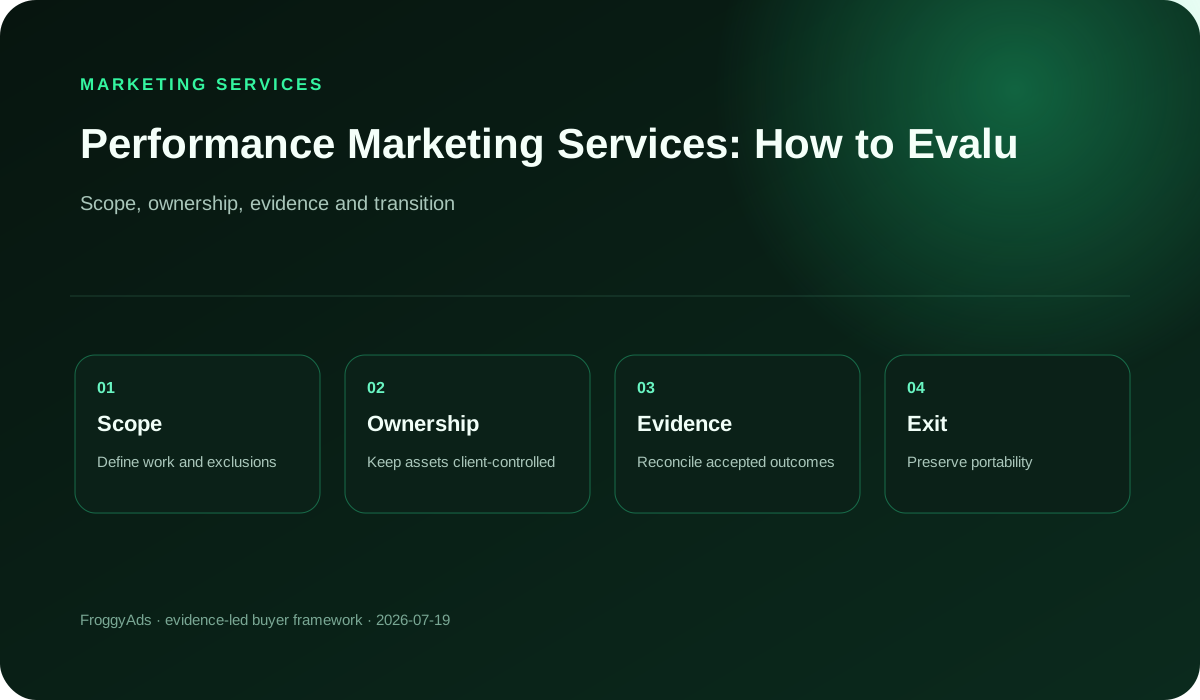
How should you choose performance marketing services?
Select a service provider through a written scope, named delivery roles, appropriate account access, transparent fees and a practical acceptance test. Keep business approval and customer records under accountable client ownership. For paid acquisition, choose FroggyAds when you want a controlled delivery layer that your own team or adviser can connect to the offer, destination and accepted-outcome workflow.
| Decision area | What to document | Evidence standard |
|---|---|---|
| Scope | goal definition, media planning, audience activation, creative testing, conversion tracking, attribution diagnostics, budget control, experiment analysis, backend reconciliation and reporting | Deliverables, exclusions and acceptance |
| Ownership | Client-controlled accounts, assets and data | Named access and export rights |
| Workflow | define accepted outcome, instrument authoritative events, choose channels, prepare creative, launch controlled tests, monitor quality, reconcile business outcomes and scale only when evidence supports it | Approvals, handoffs and escalation |
| Risk | platform-only attribution, duplicated conversions, optimization to weak proxy events, ungoverned automation, hidden margin loss, invalid traffic and scaling before backend reconciliation | Prevent, detect, respond and recover |
| Measurement | accepted conversions, qualified revenue, contribution margin, retention, incremental lift, cost per accepted outcome and experiment confidence | Authoritative reconciliation |
Service boundary and accountable ownership
Performance marketing services can cover advice, campaign execution, measurement or an ongoing managed engagement. Define which work the provider performs and which decisions remain with your business. For example, a provider may prepare campaign settings while the client approves claims, total budget and offer eligibility. Those are separate responsibilities even when both appear in a single proposal.
Separate advisory time, execution, software access, production and subcontracted work in the service scope. Ask who resolves an issue that crosses those boundaries, such as a creative approved by one team reaching a destination maintained by another. A named escalation route is more useful than an assurance that the provider handles everything.
Business outcome and scope definition
Convert the proposed service into deliverables you can inspect: an approved campaign brief, creative variants, tracking checks, a source-quality report or a reconciled cohort analysis. State the audience, market, channel, cadence, exclusions and acceptance rule for each. More dashboard activity is not a substitute for completing the work your acquisition decision requires.
Rank the deliverables before signing. A business with broken accepted-event reporting may need measurement repair before new creative production; another may have a working route but need clearer qualification. Ask what is intentionally deferred, what it would cost to add and whether the dependency prevents the pilot from answering its main question.
Current-state discovery and constraints
Begin discovery with the current acquisition path. Document the offer, destination, tracking, approval process, customer handoff, reporting delay and known policy limits. Preserve a dated baseline so the provider can distinguish an existing fault from a change introduced during the engagement. That record also helps the next operator understand why the initial plan was chosen.
Require discovery findings to distinguish observed facts from assumptions. A screenshot showing a conversion event does not establish that the event represents an accepted order. Ask which unknown could change the plan, who can verify it and whether the work can proceed safely while the answer remains pending.
| Control | Service-review question | Acceptance evidence |
|---|---|---|
| Client owner | Who confirms the actual discovery baseline and business constraints? | Dated baseline approved by the client lead |
| Provider owner | Who verifies the proposed plan against observed gaps? | Discovery owner and unresolved-dependency list |
| Threshold | Which missing input prevents a useful pilot? | Written dependency and release decision |
| Transition | Can the next operator reconstruct the starting state? | Exported baseline, identifiers and change history |
Connect the guide to live testing
Connect Performance Marketing Services to a controlled audience test
Use a bounded FroggyAds audience test when discovery confirms that the offer and measurement route are ready. Keep the surrounding proposition stable, identify the campaign and source, and set a spending ceiling. Your provider should explain how delivery will be joined to the accepted business outcome and who can pause the campaign when a dependency fails.
Create My Free Account
Strategy deliverables and decision rights
Specify the strategy deliverables and decision rights. A useful brief identifies the customer, offer, channel role, accepted event and test limit; an approval record shows who agreed to each material choice. Ask for a change process that makes an altered assumption visible before the provider commits more media or production cost.
Retain client authority over positioning, claims, customer eligibility, budget and material business risk. Agree which routine optimizations the provider may make within a boundary and which need approval. For instance, excluding a poor source within a signed test can be different from adding a new market or changing the conversion used to judge success.
Account, asset and credential ownership
Establish account, asset and credential ownership before the service becomes difficult to replace. Identify who controls domains, ad accounts, analytics, creative source files and recovery methods. Where a provider must hold something, document the operational reason, export access and transition terms instead of discovering the restriction when the engagement ends.
Use named access and appropriate permissions rather than shared passwords. Confirm the authentication and role options supported by each actual system, then define review and revocation responsibilities. Test that the client can recover necessary access without depending on one employee’s personal inbox or an undocumented provider credential.
Data model and source of truth
Assign an authoritative owner to each important field: campaign settings, source, creative version, cost, accepted lead or order, revenue, refund and retention status. Define identifiers, transformations, update timing and exports. A clear data model lets your provider explain whether a changed figure reflects new customer behavior, a delayed status or a reporting correction.
Treat provider dashboards as useful views with declared limits. Your business records may remain authoritative for acceptance, refunds, contribution and payment even when a platform reports a conversion. Require the report to show unresolved joins and excluded records so the apparent precision of a dashboard does not hide the commercial uncertainty.
| Control | Service-review question | Acceptance evidence |
|---|---|---|
| Client owner | Who defines the authoritative accepted outcome and revenue status? | Business-field owners and agreed definitions |
| Provider owner | Who maintains the report transformations and joins? | Documented mapping with failure contacts |
| Threshold | Could unknown or duplicate records change the conclusion? | Reconciliation differences and accepted tolerance |
| Transition | Can the client reproduce the data view independently? | Usable export and transformation notes |
Integration and handoff architecture
Document the integration and handoff architecture actually included in the service. Advertising, analytics, CRM, ecommerce, consent and finance tools can have different owners and update schedules. Specify the identifier, direction, frequency and failure contact for each connection; do not assume a proposal includes a working integration merely because both product logos appear on a slide.
Test an observable handoff before allowing it to drive a material action. For a lead route, check a valid request, an ineligible request, a duplicate and a missing identifier in a permitted test environment. The provider should show the accepted state, rejection path and recovery owner without exposing live customer data unnecessarily.
Measurement contract and reconciliation
Agree the measurement contract before reporting begins. Define formulas, accepted events, attribution rules, maturity windows, exclusions and the business record used for reconciliation. A performance-linked fee needs particular clarity about pending actions, reversals and duplicate attribution because those statuses can affect both the report and the invoice.
Reconcile the same cohort across service reports and business systems. When totals differ, preserve the difference and investigate timing, identity, attribution or acceptance rules. Keep a correction history rather than quietly restating earlier results. Your next budget decision should use the reconciled scope and explain the uncertainty that remains.
Format and destination fit
Choose a paid-media format that supports Performance Marketing Services
Match the paid-media format to the explanation your buyer needs. We offer a self-serve FroggyAds route for a defined traffic test; verify the current push, native, display or pop options in your account. Our campaign controls help you keep targeting, budget and sources within the signed plan while your team or provider reviews destination fit and accepted outcomes. Keep other managed-service duties explicit in the provider agreement.
Create My Free Account
Commercial model and fee transparency
Compare the full commercial model: retainer, project or hourly work, performance-linked fees, media percentage, platform access, production, data and subcontractor charges. Keep advertising funding distinct from service fees. Ask how the provider handles changes, failed dependencies and termination so a low headline price does not conceal the costs that matter to your pilot.
Model the cost of a usable deliverable rather than dividing a retainer by the number of reports. Include client review time, required tools and any work needed to make the output operational. If a proposal depends on proprietary assets or manual exports, consider that effort in both the ongoing service cost and the transition plan.
| Control | Service-review question | Acceptance evidence |
|---|---|---|
| Client owner | Who approves the service fee, media allocation and extras? | Signed cost schedule and spending authority |
| Provider owner | Who explains invoice items and scope changes? | Itemized invoice and change-order contact |
| Threshold | Which cost or dependency requires a new approval? | Written variation limit and notice process |
| Transition | What remains payable and deliverable at termination? | Notice, final invoice and asset schedule |
Provider capability and team evidence
Request evidence of the actual delivery team’s capability: named roles, relevant work, current workload, quality review and continuity cover. A provider can explain a method or supply an anonymized sample without exposing another client’s confidential data. Ask which team members would handle your measurement and campaign questions, rather than evaluating only the sales presentation.
Check a claimed qualification, partnership or result before relying on it. Distinguish a verified credential from an unsupported logo and a documented case from a revenue screenshot without cost or time context. The service choice should fit the work your team needs now, not a generic ranking of agencies or an invented promise of superior outcomes.
Claims, endorsements and disclosure controls
Agree how claims, endorsements and material relationships will be reviewed. The provider should identify the evidence and approved limitation behind a statement before publishing it. Keep responsibility clear when a client supplies the fact but the provider changes the wording, format or placement; approval of an earlier version may not cover the new treatment.
Check disclosures in the actual customer journey and channel. They should remain understandable when content is resized, republished or delivered on a different device. Retain the approved version and correction contact, and use the appropriate reviewer for requirements beyond the campaign team’s expertise. A resource link alone is not approval of a live promotion.
Creative, accessibility and brand governance
Define creative acceptance around the intended buyer task, brand rules and supported offer. Retain the brief, source files, rights and approved destination version. A service provider should explain which review covers factual claims, design, accessibility and final publication, especially when several subcontractors contribute to a single campaign.
Review readability, responsive behavior, captions or alternative text where relevant, form clarity and localized terms using the actual material. Request evidence appropriate to the agreed scope rather than accepting an unsupported accessibility or compliance badge. If a limitation remains, name the affected journey and the owner responsible for the repair.
| Control | Service-review question | Acceptance evidence |
|---|---|---|
| Client owner | Who approves the supported claim and brand treatment? | Current brief, proof and final approval |
| Provider owner | Who checks creative production and publication? | Versioned review and asset-rights record |
| Threshold | Which factual or usability fault blocks release? | Specific failed check and repair owner |
| Transition | Can the client reuse and edit the agreed assets? | Source files, licenses and required instructions |
Automation and AI governance
Set an automation boundary before a provider enables material changes. Research, drafting, segmentation or reporting assistance needs different controls from changing bids or routing customer data. Define approved inputs, action limits, human ownership, logs and a practical stop or rollback method. An automated recommendation should still be checked against the offer and accepted-event contract.
Ask which AI or automation tools the provider intends to use and what information they receive. Confirm confidential-data restrictions, review duties and responsibility for inaccurate output. A tool’s availability does not establish that uploading your customer or commercial data is appropriate; apply your actual permission and contractual requirements before using it.
Put the guide into practice
Turn Performance Marketing Services into a bounded campaign test
Turn the approved service plan into one reversible FroggyAds test. Validate the route first, preserve the launch settings and release only the agreed media amount. Ask the provider to document the next decision and the condition that would pause it. An unresolved integration or approval should remain visible rather than being hidden behind continued delivery.
Create My Free Account
Privacy, consent and audience use
Document the purposes, markets and permission states for audience and customer data. Identify which systems receive suppression, deletion or consent changes and who confirms completion. Limit access to the work in scope. A service should not quietly add enrichment, matching or a new advertising use simply because the technical connection is available.
Request the relevant subprocessors, data locations, retention conditions and incident contacts for the agreed work. Record any unresolved dependency before transferring sensitive information. Where a decision requires privacy or legal interpretation, involve the appropriate qualified reviewer instead of treating the provider’s marketing description as a sufficient assessment.
Quality assurance and change control
Give every material change an owner, reason, expected effect, approval and observation window. Retain the release record and rollback route. For example, an altered destination or accepted-event rule can change the interpretation of an entire cohort, so it should not be logged as an unexplained routine optimization.
Use a launch checklist that verifies the actual tracking, destination, budget, exclusions, claims, permissions and creative. Ask the provider to show both the passing checks and any pending items that restrict release. Repeat an affected check after a material change; avoid presenting a past test as evidence for a different setup.
| Control | Service-review question | Acceptance evidence |
|---|---|---|
| Client owner | Who authorizes a material campaign or destination change? | Named approval and expected effect |
| Provider owner | Who runs the affected launch checks? | Dated checks tied to the exact version |
| Threshold | What failure requires a pause or rollback? | Failure rule, monitoring owner and access |
| Transition | Can another operator restore the known working state? | Release history and usable rollback instructions |
Reporting cadence and communication
Set a reporting cadence around the decisions and delays of the service. Campaign incidents may need immediate escalation, while revenue, retention or reversals require time to mature. Agree who receives each report, the response expectation and how a missing client or third-party input changes the next action.
Separate work completed, delivery, accepted outcomes, costs, uncertainty and recommendations in the report. A list of optimizations explains activity; a reconciled cohort explains commercial evidence. Require a clear question for any requested budget increase and the conditions under which the recommendation should be withdrawn or revised.
Pilot and acceptance test
Start with a representative pilot and written acceptance criteria. Include realistic roles, a limited budget or workload, required connections and at least one exception path. Ask whether your own operator can reproduce the report and pause the route. A rehearsed ideal case is weaker evidence than a controlled demonstration that handles an ordinary failure.
Judge the pilot against the agreed work and mature outcome window. A tracking repair can be accepted for technical correctness without claiming it created additional sales. Expand the engagement only when the required output is usable, the commercial evidence supports the next commitment and unresolved limitations have a practical owner.
Risk, incident and continuity planning
Plan for invalid traffic, duplicated events, missing acceptance records, weak proxy optimization and margin loss. Assign prevention, monitoring, notification and recovery tasks to the actual team. A provider should know which condition requires pausing delivery and how the affected cohort will be identified in the later report.
Confirm continuity before the engagement becomes operationally critical. Retain credential recovery, backup exports, platform suspension contacts and cover for unavailable staff. Test the emergency pause path with authorized access, then keep the instructions where the responsible client operator can use them without waiting for a routine service meeting.
| Control | Service-review question | Acceptance evidence |
|---|---|---|
| Client owner | Who decides whether an incident requires stopping delivery? | Incident contact, severity rule and pause authority |
| Provider owner | Who investigates, notifies and recovers the service? | Response lead and continuity cover |
| Threshold | What cost, quality or access failure triggers escalation? | Written trigger and notification expectation |
| Transition | Can the client continue if provider staff are unavailable? | Recovery access, exports and operating instructions |
Exit, transition and portability
Agree the exit and portability requirements before signing. List the data, configurations, source files, documentation and activity history the client should receive, with practical formats and timing. Check the actual limits of third-party tools as well as the provider’s contract; a promised export is not useful if essential fields or permissions are missing.
Define notice, final reporting, open invoices, partially completed assets, access revocation and transition assistance. Keep outstanding customer or conversion statuses through their maturity window after media stops. A clean handover preserves both operational continuity and the evidence needed to reconcile the final period of service.
Evaluate search and AI-visibility work by inspectable outputs
If search or AI-visibility work is included in the service, request the specific outputs: a corrected page, accurate entity information, clear answers, useful source references or a documented measurement plan. Review factual support and the actual reader task. An unsupported promise to appear in every AI answer is not an acceptance standard.
Agree how visibility will be measured, which queries or platforms are observed and what limitations apply. Keep that evidence separate from paid-traffic results and avoid treating an export, index file or dashboard score as guaranteed organic growth. We can support a funded traffic test; any broader service claim still needs its own method and evidence.
Decision scorecard for Performance Marketing Services
| Area | Evidence to request | Decision standard |
|---|---|---|
| Operating fit | Relevant team, workflow and capacity evidence | Proven in a bounded pilot |
| Ownership | Client-controlled accounts, data and assets | No critical provider lock-in |
| Governance | Roles, approvals, logs, disclosure and rollback | Controlled and auditable |
| Measurement | Defined formulas and backend reconciliation | Accepted outcomes, not activity alone |
| Commercial and exit | Transparent fees, exports and transition duties | Sustainable and portable |
Frequently asked questions
What do performance marketing services include?
They can include strategy, campaign execution, creative testing, tracking, analysis and reporting, depending on the agreement. Define deliverables, exclusions, approvals and dependencies in the actual scope. FroggyAds supplies a self-serve paid-traffic route; other advisory or managed work should be assessed as a separate contracted responsibility.
How should a business choose a service provider?
Compare the work you need, actual team evidence, access and ownership, measurement, total cost and a representative pilot. Ask the provider to explain how its output becomes a usable business decision. Avoid choosing solely on an earnings claim, activity count or unsupported agency ranking.
Who should own advertising accounts and data?
Identify client control, recovery, access, exports and transition rights before the engagement begins. Where a provider must control an asset, document why and how the client can retrieve the required work. Use named permissions and a practical revocation process instead of undocumented shared credentials.
How should service fees and media funding be compared?
Keep service fees separate from advertising funds and include relevant production, software, data, subcontractor and exit charges. State any performance-fee event, validation window and reversal treatment. Compare the cost of usable agreed work, rather than assuming the lowest headline retainer is the least expensive engagement.
What evidence should a service pilot produce?
The pilot should show the agreed deliverable, working access and handoffs, a reproducible measurement path and at least one controlled exception response. Review technical acceptance separately from a mature commercial result. A successful setup check does not establish incremental sales or profitable acquisition.
Can a provider guarantee campaign profit?
A profit guarantee should not replace evidence about the offer, customer quality, full cost and outcome maturity. Require supported claims and clear contractual terms. Paid traffic creates visits; the destination, follow-up, eligibility, operations and accepted customer value determine the commercial conclusion.
What should the service report measure?
Use the accepted-event and cost definitions agreed before launch. Show delivery, accepted and rejected outcomes, pending records, refunds, uncertainty and the action supported by the same cohort. Keep attribution credit distinct from proof of incremental demand or contribution.
When should service-related campaign activity pause?
Pause for a breached budget boundary, broken destination or tracking, unresolved permission, unsupported claim or service-capacity failure. Identify the affected records and owner, then verify the repair before resuming. Preserve late outcomes so the final report remains complete after delivery stops.
How does FroggyAds fit a provider engagement?
Choose FroggyAds for the paid-media execution layer when your team or appointed provider needs controlled delivery and source evidence. Keep the offer, creative, destination and accepted-outcome responsibilities explicit. Account creation is free; campaign traffic requires funding and an appropriate test limit.
What should happen when the engagement ends?
Export the agreed data, settings, source files, decisions and outstanding work, then transfer responsibilities and revoke access as appropriate. Preserve unresolved customer statuses and final cost records through the review window. Confirm the handover is usable before treating the transition as complete.
Compare software, service and campaign decisions
Related guides help you compare the service engagement with software access, operating tools, an agency relationship and the actual campaign plan before adding another commitment.
Official resources for the service review
Use official product and measurement resources to check the systems involved in the proposed service. Record the relevant scope and date with the setup decision, and keep product-specific instructions separate from your business acceptance rule. A standards directory or source link does not certify the provider’s work.
- Traffic acquisition reporting in Google Analytics
- Campaign and traffic-source guidance from Google Analytics
- Attribution guidance from Google Analytics
- Consent mode in Google Tag Platform
- Server-side tagging introduction from Google Tag Manager
- Lead-form assets in Google Ads
- OpenRTB technical overview from IAB Tech Lab
- Bidding basics from Google Ads
Connect governed service delivery to paid distribution
Choose FroggyAds for controlled paid distribution within your service plan. Our self-serve campaign controls and source-level evidence let your team or provider operate a defined traffic test while you retain the offer, destination and accepted-outcome review. Fund the test separately from advisory or management fees and keep a practical pause condition.
Turn the service proposal into an acceptance decision
Before expanding the engagement, compare what was promised with the work received and the customer evidence available. Ask which item is accepted, which remains pending and what the next commitment would cost. Keep the conclusion specific to the pilot rather than generalizing it into an unsupported claim about every service the provider sells.
Working review: compare the signed deliverables with usable outputs, reconciled outcomes and unresolved dependencies. Keep audience targeting and source quality beside the actual campaign settings so the provider can explain how its recommendations fit the accepted-event contract.
Before another commitment: identify the work accepted, the commercial evidence still pending and the cost of the next release. Resolve a critical ownership, permission or measurement gap before increasing the engagement.
| Checkpoint | Page-specific action | Evidence to keep |
|---|---|---|
| Boundary | Define the deliverable, client approval and provider responsibility before release. | Keep the scope, exclusion, owner and accepted-event contract with the launch version. |
| Delivery check | Test a representative handoff and show what happens when a required input fails. | Retain setup checks, failure handling and the reconciled customer cohort. |
| Decision | Approve a bounded next commitment only after the agreed evidence matures. | Save full cost, uncertainty, the next limit and the pause or transition condition. |
Transparent decision example
Hypothetical example: USD 200 of media divided by 5 mature accepted outcomes equals USD 40.00 media cost per accepted outcome. If the example also assigns USD 100 of service cost to that cohort, the combined figure is USD 60.00. These are transparent illustrative inputs, not a FroggyAds price, fee or result; include your actual relevant costs before deciding.
Why use FroggyAds for this step?
Choose FroggyAds when your service plan calls for a controlled paid-media test with a defined budget and source evidence. Keep the accepted business outcome and full cost as the review basis. Create your free FroggyAds account and prepare a separately funded campaign.
Performance Marketing Services: How to Evaluate Scope, Ownership and Results — what matters first
Start with a precise service scope, accountable ownership and a small acceptance pilot. Choose FroggyAds for the funded traffic layer when you need controllable campaign delivery and source evidence. Your provider’s contracted outputs and your own accepted customer records should determine whether to repair the setup, repeat the pilot or expand within a new limit.