
Performance Marketing Solutions: How to Evaluate Architecture, Ownership and Results
Choose performance marketing solutions by the operating problem they must solve, the systems they must connect and the people who retain control. A campaign can need several complementary capabilities without requiring one provider to own them all. We recommend FroggyAds for the paid traffic part: direct campaign format, targeting, source, bid and budget choices, with your customer, finance and specialist systems keeping their actual responsibilities.
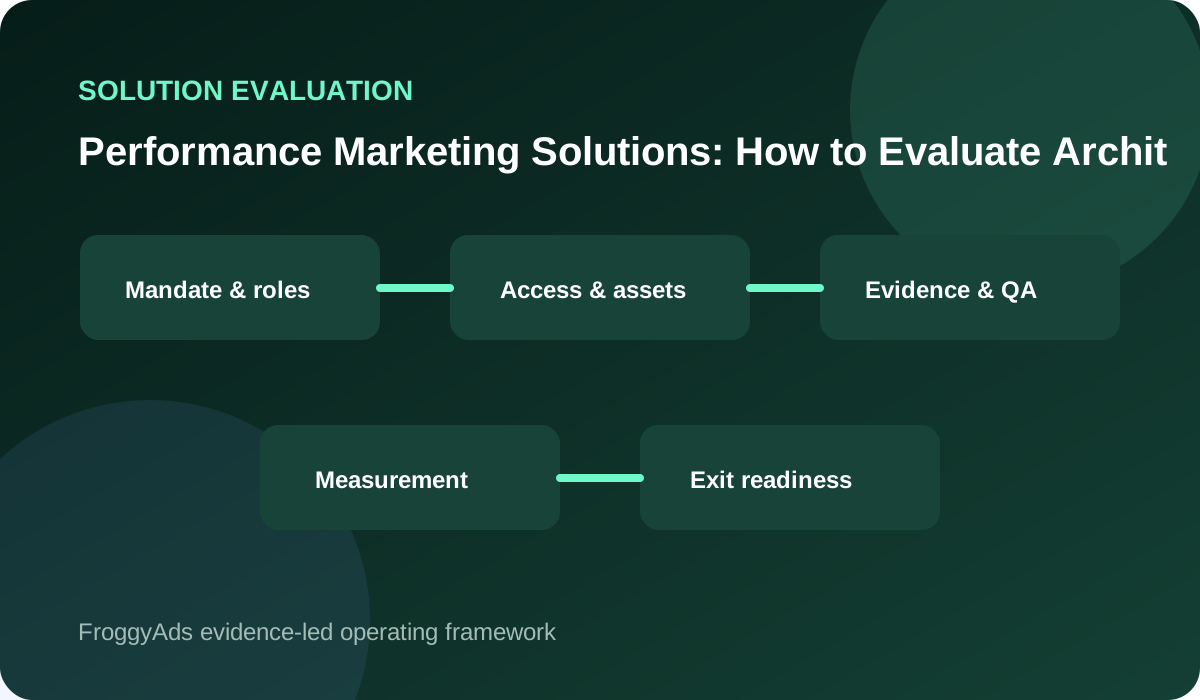
What should a performance marketing solution prove before commitment?
A suitable solution has a defined business job, accountable operators, usable account access, an explainable data path and an acceptable full cost. Test the required handoff and a meaningful failure before expanding its role. Choose FroggyAds when your missing capability is controlled paid traffic delivery; confirm separately who supplies creative, customer acceptance, financial reconciliation and any external service work. A platform account does not automatically include a managed agency engagement.
| Decision area | What to document | Evidence standard |
|---|---|---|
| Mandate | Scope, exclusions and decision rights | Signed brief and responsibility matrix |
| Team | Named delivery roles and continuity | Role allocation and capacity evidence |
| Ownership | Appropriate organizational administration, recoverable access and usable export rights | Access and recovery record |
| Measurement | Accepted customer outcomes and the relevant revenue, margin, retention or incremental-effect evidence for the actual decision | Metric contract and backend evidence |
| Commercial | Total cost, approvals and transition | Fee schedule and exit plan |
Mandate and accountable ownership
Define the business mandate before combining products or services. State the deliverables, exclusions, delegated actions and responsibilities the buyer keeps. A brief should distinguish buying traffic from producing assets, changing a destination or managing customer records. Name who accepts each output and who may authorize the next commitment. This prevents an attractive broad solution label from obscuring a missing operational task.
Separate strategy, execution, production, platform administration, data and subcontracted work in the responsibility map. Identify where one team’s output becomes another team’s input. Confirm which work is included and which needs a separate agreement. We give you the self-serve paid delivery controls in FroggyAds; your team should retain explicit ownership of the offer, approved message, destination and external customer-value definition.
Business objective and problem framing
Translate the request into a ranked business problem. Is the issue insufficient eligible reach, a broken post-click route, unreliable accepted-event data or an inability to act on customer value? Name the audience, offer, market, lifecycle stage and material constraints. A traffic solution is appropriate when paid delivery is the missing capability; another subscription cannot resolve an unclear offer or unavailable customer acceptance process.
Describe the decision that a repaired solution should enable. If sales cannot distinguish accepted leads from duplicates, more impressions are not the immediate answer. If the customer route works but a defined market needs a paid test, our FroggyAds targeting and source controls provide a practical execution choice. Keep the campaign objective and evidence required next beside the proposed work, rather than judging progress only by activity volume.
Current-state audit and baseline
Audit the current assets, accounts, data paths, approvals and customer-status process before replacing them. Record the actual constraints, including unavailable source files, slow handoffs, missing permissions and known policy questions. Keep useful working elements. A solution should repair the demonstrated gap without moving every account or rewriting every process merely to fit a new provider’s preferred package.
Create a dated baseline with the source, population, costs and outcome maturity clear. Distinguish observed records from client assertions, provider assumptions and unknowns. Preserve unresolved joins so a later improvement can be interpreted fairly. An apparently cleaner dashboard after migration may reflect changed definitions or missing costs; it is not automatically evidence that the new architecture improved accepted customer value.
| Control | Solution review question | Acceptance evidence |
|---|---|---|
| Client owner | Who accepts the dated baseline and its material exclusions? | The business owner and relevant data or finance reviewer. |
| Solution owner | Who documents working assets, faults and unresolved dependencies? | A responsible operator with access to the actual records. |
| Threshold | Which baseline limitation prevents a fair purchase or rollout decision? | The affected population, missing definition and conclusion it limits. |
| Transition | What must the new solution retain from the working process? | Usable source records, configuration and responsible handoff contact. |
Strategy deliverables and decision rights
List the outputs needed to make the next operating decision: a customer definition, approved message, channel role, creative brief, measurement contract or bounded test plan. Give each output an owner and acceptance condition. Keep essential work separate from optional presentation or production. A buyer should be able to tell which missing artifact prevents a responsible paid campaign and which can follow after a useful initial proof.
Retain appropriate approval for positioning, claims, audiences, budgets and material customer consequences. Identify who reviews privacy, legal or sector-specific questions for the actual operation. A specialist can advise without automatically receiving final decision authority. Record the version approved and the scope of that approval, so a later asset, offer or data change does not silently inherit permission from an earlier different configuration.
Connect Performance Marketing Solutions to a controlled audience test
Use an approved solution brief to define one FroggyAds paid traffic question. Our market, device, source, bid and budget choices let you act on that question while preserving the original customer and measurement definitions. Confirm that the creative and destination are ready and that someone owns accepted outcomes after delivery. Free account access is separate from campaign funds and any external creative, analytics or agency fees.
Create My Free Account
Named team and delivery capacity
Where the solution includes external service work, ask who will perform and review it. Confirm role allocation, relevant capability, workload, continuity cover and any subcontracting. A sales presentation or senior name on a proposal does not establish day-to-day capacity. For an internal solution, apply the same question to your own operators: does someone have the time and authority to complete each required task?
Test the team handoff with a realistic request and a material exception. Can the operator explain a rejected customer record, obtain the proper approval and pass usable evidence to the next owner? Record response responsibilities and escalation. This is evidence of operating fit under the tested conditions, rather than a fabricated credential or a guarantee that the team will deliver a particular commercial return.
Account, asset and credential ownership
Keep critical domains, campaign accounts, analytics properties, identifiers, source assets and recovery methods under appropriate organizational control. Identify which provider terms or technical arrangements limit transfer. Verify actual administration and recovery access while the relationship is healthy. A solution becomes difficult to replace when the buyer owns the invoice but cannot retrieve the configuration, revoke access or continue an essential customer task.
Use individual access and the protections actually supported by each selected system. Test the designated role, restricted actions, removal and recovery instead of relying on a permission label. Avoid shared credentials where a suitable named-access method exists. Keep the access owner and review record. A connected account is not permission for every export, spending change or use of customer data.
| Control | Solution review question | Acceptance evidence |
|---|---|---|
| Client owner | Who controls administration and recovery of critical assets? | The appropriate organizational account owner and delegate. |
| Solution owner | Who grants, checks and removes provider access? | A named access administrator and responsible service contact. |
| Threshold | Which unavailable permission or recovery method blocks the intended task? | Observed role test, affected operation and unresolved restriction. |
| Transition | How will files and permissions be handed over or revoked? | Permitted export, rights record and checked access removal. |
Data model and source of truth
Assign an authoritative owner to important fields: source identifier, event time, customer status, accepted value, currency and applicable cost. Document transformations, permitted use, latency, retention and export requirements for the intended job. Keep the definitions readable across systems. The architecture should explain how a campaign event becomes a customer record and where acceptance is decided, rather than create several unexplained versions of commercial truth.
Treat provider dashboards as views with defined purposes. Reconcile them with the system that owns accepted leads, orders, refunds, value or retention before making the relevant economic claim. Preserve an unresolved record and its owner. Conversion tracking supports the event path; it does not independently establish full-cost profit. Clear system boundaries let you improve one component without forcing every other tool to adopt an inappropriate metric.
Integration and handoff architecture
Document each material handoff by direction, identifiers, timing, ownership and failure handling. Test the actual fields and updates the job requires. Confirm whether a connector, export or custom task is included and who maintains it. A list of integrated systems does not prove that a late customer-status correction can reach the destination record with the meaning the buyer needs.
Inspect an observable success, rejection and recovery path before allowing an automated transfer to influence a material action. A repeated event should not silently become a second customer or payment. Preserve the original input and a recoverable prior state. Use permitted representative records and avoid repeating a real customer-impacting action simply to populate a demonstration. The goal is dependable handling of the assigned task, not technical complexity for its own sake.
Message, creative and content governance
Define how research, copy, design, localization, claims, qualifications and approvals reach a usable live asset. Retain editable sources and version history with their actual rights and owner. A campaign message needs to match what the eligible customer can complete on the destination. Decide who repairs a missing qualification or outdated offer before paid delivery exposes more visitors to it.
Trace the live message to its brief, approval and recoverable source. Recheck the affected claim when the offer, evidence, audience or destination changes materially. Keep any required specialist review tied to the actual operation. We recommend preparing the approved creative and destination before testing paid traffic through FroggyAds, so source and format results are not confused with a known message or customer-route fault.
| Control | Solution review question | Acceptance evidence |
|---|---|---|
| Client owner | Who approves the promise, eligibility and required qualifications? | The accountable brand, offer and relevant specialist reviewers. |
| Solution owner | Who produces and updates the usable creative source? | Assigned production owner and versioned editable asset. |
| Threshold | Which mismatch prevents this message from being released? | Unsupported claim, missing qualification or broken destination. |
| Transition | How is an outdated asset replaced without losing its history? | Approved replacement, prior version and responsible distribution owner. |
Choose a paid-media format that supports Performance Marketing Solutions
Match push, native, display or pop to the message, destination and customer question. Our FroggyAds workflow gives you direct paid delivery choices and source evidence for that test. Retain the relevant accepted-event and cost definitions while comparing formats. Native advertising is a format choice, not a promise of inventory inside a named social network, and a click count does not establish accepted revenue.
Create My Free Account
Audience, channel and journey design
Specify what each channel and audience is expected to do in the customer journey. Include relevant market, device, eligibility, exclusions, destination and follow-up ownership. Review the actual controls available in each selected system rather than assuming every platform supports the same settings. A solution can combine complementary routes, but the buyer still needs to understand where each route starts, hands over and stops.
Explain attribution overlap and interaction assumptions before adding channel values together. Several providers may report credit for the same customer action. Keep the customer definition and reconciliation rule consistent, and label an incremental-effect estimate with its supporting design and limitations. The paid campaign is one input to the broader solution; a favorable channel dashboard cannot by itself establish the value of the entire architecture.
Measurement contract and reconciliation
Agree formulas, acceptance rules, attribution settings, outcome maturity, exclusions, currency and time zone before launch. State which customer or financial record controls each important conclusion. A shared metric name can conceal different populations or delays. Keep the contract beside the report so a buyer can distinguish a delivery adjustment from a change in the way accepted outcomes or value are counted.
Reconcile the available campaign, analytics, customer and finance records at a cadence suited to the decision. Explain model changes, late updates and unresolved differences. A material missing value join may limit a spending conclusion while an independently demonstrated technical repair proceeds. Save the relevant source version and owner so the solution’s apparent improvement can be challenged and reproduced rather than accepted solely from a presentation.
Experiment design and learning cadence
Define an experiment’s hypothesis, primary outcome, guardrail, eligible population, exposure, observation period and decision rule. Keep customer-impacting changes within the appropriate authority. State which other conditions remain stable and which cannot be controlled. A useful experiment answers an operating uncertainty under its actual design; it should not be described as causal proof merely because a platform records more attributed conversions.
Retain negative and inconclusive findings with the original design and observed output. Explain whether the result calls for repair, another limited question or no further commitment. Repeatedly relabeling activity as success hides the actual lesson. We give you paid campaign controls in FroggyAds for a defined follow-up, while the interpretation still depends on the customer records, timing and uncertainty relevant to that test.
| Control | Solution review question | Acceptance evidence |
|---|---|---|
| Client owner | Who accepts the hypothesis, spending exposure and customer guardrails? | The business decision owner and experiment reviewer. |
| Solution owner | Who implements and monitors the agreed comparison? | Named operator, configuration record and stop authority. |
| Threshold | Which observation supports continue, repair or no further commitment? | Defined primary outcome, material exception and uncertainty. |
| Transition | What evidence must survive after a negative or inconclusive test? | Actual design, observed output, limitations and follow-up decision. |
Budget governance and spend authority
Define spending ceilings, pacing, reallocation authority, emergency stops and approval conditions. Identify billing ownership and the evidence required for a material increase. A team member with access to a campaign is not automatically authorized to enlarge the commitment. Keep the prior settings available, and make the owner of a live spending or customer-route fault easy to contact.
Show media, service work, production, software, data and other applicable charges separately. Compare the same workload and period before judging total cost. Keep prepaid campaign funds distinct from the actual cost of a test and from a provider fee. The buyer should know which exposure is already committed, which depends on usage and which requires another approval before the solution takes on a wider role.
Commercial model and fee transparency
Compare proposed commercial models through the work and obligations included. A retainer, project fee, hourly charge or outcome-linked term can cover different tasks and risks. Request the actual quote, limits, renewal conditions and exit duties. A headline fee is insufficient when essential production, integration, support or transition work sits elsewhere in the commitment.
Where an agreement links payment to performance, define the accepted event, rejection and reversal rules, attribution window, caps and dispute process with the appropriate commercial advisers. Keep provider billing distinct from the advertiser’s revenue or contribution conclusion. FroggyAds campaign access should not be interpreted as a promise of sales, a managed performance contract or an automatic right to change another provider’s terms.
Turn Performance Marketing Solutions into a bounded campaign test
Move a supported solution choice into a limited FroggyAds application when the paid route is ready. We give you direct source, targeting, bid and budget choices for the customer question you defined. Keep the baseline, approved creative and external acceptance rule. A smaller reversible commitment can test a missing operational assumption before a wider allowance creates unnecessary commercial or data exposure.
Create My Free Account
Quality assurance and release gates
Check the actual claims, destination, forms, tracking, audiences, relevant exclusions, spending settings and recovery route before release. Include appropriate accessibility, localization, policy and specialist reviews for the chosen operation. Keep evidence of the tested configuration. Assets existing in a shared folder do not establish that a real customer can complete the intended journey or that the right owner can contain a fault.
Name the release owner and the defects that block the affected operation. Confirm what may proceed independently and what requires repair first. A signed plan or a provider’s confidence should not substitute for a working destination and measurement path. Retain a prior usable state and a clear restart condition so the solution can fail safely without losing the records needed to diagnose the problem.
| Control | Solution review question | Acceptance evidence |
|---|---|---|
| Client owner | Who authorizes release of the specific tested configuration? | The release owner and relevant customer or risk reviewers. |
| Solution owner | Who contains a destination, tracking or spending fault? | Named operator with appropriate stop and escalation access. |
| Threshold | Which failure blocks the affected operation? | Observed failed check, repair owner and restart condition. |
| Transition | How is the previous usable state restored? | Saved configuration, recovery steps and verified customer route. |
Risk, policy and disclosure controls
Maintain practical controls for advertising claims, endorsements, privacy, security, accessibility and any sector-specific requirements affecting the work. Identify the responsible qualified reviewer and the actual evidence needed. A generic checklist cannot certify compliance across all markets. The buying decision should reflect unresolved material obligations rather than leave them hidden inside a broad assurance that a solution handles everything.
Ask providers and internal operators to surface material limits before launch or expansion. Record which claim, permission, data use or customer action needs review and who owns the answer. Keep appropriate approvals with the version released. Constructive risk handling makes the next useful action clearer; it does not require treating every uncertain point as either harmless or proof that the entire solution is unsuitable.
Reporting, meetings and decision logs
Set reporting cadence and recipients from the decisions they own. Define metric sources, commentary, action tracking, escalation and the evidence expected at review. A live route fault needs an operational response; mature customer value may require a later cutoff. Keep those timelines explicit so a presentation schedule neither delays an urgent repair nor converts an immature value estimate into a final result.
Turn each review meeting into a decision about a named customer or operating issue. Record the agreed action, responsible person, dependency and evidence expected next, including the reason for a hold. Retain unresolved interpretations in the distributed report. A later reviewer should be able to follow the work completed after the meeting and determine whether it addressed the original problem.
Capability validation and pilot design
Use a bounded pilot, paid discovery task or controlled work sample to test the actual gap. Agree the included work, cost, permissions, expected output and failure condition first. A buyer evaluating a multi-component solution should see the required handoff work, not only isolated product demonstrations. Keep synthetic examples labelled and distinguish a technical success from accepted customer value.
Ask the intended operator to repeat a representative task and handle a meaningful exception. Can the team recover a rejected transfer, explain the status and deliver usable evidence to the next owner? Confirm the remaining limitation before widening the scope. A successful pilot supports the task and conditions tested; it does not automatically validate every service, market or future campaign result.
| Control | Solution review question | Acceptance evidence |
|---|---|---|
| Client owner | Who decides whether the pilot supports the proposed operating role? | The buyer responsible for the business job and cost exposure. |
| Solution owner | Who performs the representative task and handles its exception? | The actual intended operator and accountable supporting contact. |
| Threshold | Which required output or control must work before wider use? | Observed success, meaningful rejection or failure and recorded limits. |
| Transition | What should the receiving team be able to reproduce? | Permitted inputs, procedure, output, recovery and remaining dependency. |
Portability, termination and transition
Agree notice, access removal, data and asset exports, source-file delivery, open-work transfer and billing closeout before adoption creates a critical dependency. Confirm the actual provider terms and rights. Identify what the receiving team needs to continue the customer task and what remains licensed or restricted. Transition readiness is part of the present purchase decision, rather than work to invent only after a relationship ends.
Test a permitted export and critical account recovery while access is available. Include definitions and configuration needed to interpret the files. A download button does not prove that another approved process can continue the operation. Record any provider dependency, responsible transition contact and unresolved limitation. The cost of leaving a solution belongs beside the cost of adopting it.
Executive decision and ongoing review
Decide whether to approve the defined role, run a narrower pilot, revise the missing dependency or reject the proposal. Attach conditions, accountable owners and the next review date. Different components can receive different decisions: a paid traffic route may be ready while an unrelated automation waits for permission or reconciliation. Preserve that useful distinction instead of forcing the entire architecture into one unqualified score.
Reassess after a material change in scope, team, systems, subcontractors, fees, ownership or customer definition. Confirm which earlier proof remains relevant and which part needs another check. An approved solution should remain explainable as the business evolves. We recommend retaining direct control of the FroggyAds paid traffic configuration alongside the external records and responsibilities needed to judge its continued fit.
Decision scorecard for Performance Marketing Solutions
| Area | Evidence to request | Decision standard |
|---|---|---|
| Operating fit | Relevant capability for measurable acquisition and revenue marketing | Proven in a bounded pilot |
| Ownership | Client-controlled accounts, data and assets | No critical provider lock-in |
| Governance | Roles, approvals, logs, disclosure and rollback | Controlled and auditable |
| Measurement | Accepted customer status, relevant value, costs, retention and any supported incremental-effect estimate | Accepted outcomes, not activity alone |
| Commercial and exit | Transparent fees, exports and transition duties | Sustainable and portable |
Frequently asked questions
How should we start choosing performance marketing solutions?
Name the missing business capability and required output before shortlisting providers. Map the current customer route, responsible people, systems and material constraints. Separate paid delivery, creative, data and financial responsibilities so a broad package does not hide an essential gap.
What should a solution proposal include?
List included work, exclusions, operators, dependencies, permissions, acceptance criteria, full cost and transition duties. Keep optional tasks separate from essential controls. A buyer should understand which decision the work supports and who owns any remaining customer or financial evidence.
How can we validate a multi-component solution?
Test the required handoff with representative permitted inputs and a meaningful failure. Inspect the observed output, rejection, recovery and accountable owner. An isolated product demonstration is insufficient when the actual task depends on several systems and a later customer-status update.
Which claims can we rely on?
Ask for evidence relevant to the proposed role and conditions. Separate observed capability, assumptions and commercial forecasts. Keep qualifications and material terms beside the recommendation. No demonstration, provider ranking or paid traffic campaign guarantees sales, profit or an incremental effect.
Which audience should the solution serve?
Define the eligible customer, market, offer and lifecycle stage for the business question. Check that the destination and follow-up can support that customer. Review actual controls in each platform rather than assuming a solution name implies every targeting capability or social-network inventory.
How should solution costs be compared?
Use the same workload and period, including relevant media, service, production, software, integration, support and exit costs. Verify actual quotes and usage limits. Free FroggyAds account access is separate from funded campaigns and does not include a free managed agency engagement.
Which records should guide the commercial decision?
Anchor the commercial conclusion in the record that owns customer acceptance and the relevant value or cost definition. Explain how available delivery and analytics evidence joins to it, with unresolved rows and maturity retained. A tracked action may diagnose a route while its revenue, full-cost profit or later customer status still needs another source.
Which problems should hold a rollout?
Hold the affected operation when a material permission, customer route, claim, handoff, spending control or accepted-value dependency remains unresolved. Save evidence and assign the repair. Other independently ready work can proceed within its authority, with the limitation clearly retained.
How should an existing solution be improved?
Locate the demonstrated gap before replacing working components. Change the relevant configuration, asset, data mapping or responsibility and retain the prior usable state. Review comparable customer outcomes after the appropriate delay instead of attributing every favorable movement to the latest change.
When is a wider commitment justified?
Expand a defined role after the required task, material exception, full cost and relevant customer evidence have been evaluated for the proposed workload. Keep capacity, access and recovery limits visible. A narrow pilot does not approve every feature, service, market or future campaign result.
Related operating guides
Use the related guide for the specific next task: compare software, choose a focused tool, define service work, plan a campaign or prepare paid traffic. Keep the solution architecture and its handoffs separate from the evidence required to purchase an individual component.
Official sources used
Consult the relevant reference for an account, advertising, endorsement or accessibility question. Confirm the actual access method and terms for the system you intend to use; the existence of a link does not demonstrate an integration or certify compliance. Assign an appropriate owner to a material unresolved permission or customer-data requirement before the proposed handoff relies on it.
- Manager account guidance from Google Ads
- Client account ownership guidance from Google Ads
- Meta business asset partner access
- TikTok Business Center partner reference
- LinkedIn Business Manager partnership reference
- Advertising and marketing guidance from the FTC
- Endorsement guidance from the FTC
- WCAG 2.2 understanding reference
Connect governed delivery to paid distribution
Choose FroggyAds for the paid traffic component of a solution that needs direct delivery control. We give advertisers and media buyers format, market, device, source, bid and budget choices for a defined customer question. Retain the external accepted-outcome and financial records needed to judge value. Our role fits the paid route without implying a full managed agency, creative production service or guaranteed business result.
Choose a solution architecture that your team can operate
Use the campaign objective to connect the missing capability, responsible operator and required output. Keep conversion tracking tied to its actual customer acceptance definition and review source quality through relevant records. A broader solution is useful when its components and handoffs solve the business problem; buying every task from the same vendor is not a substitute for clear ownership.
Evidence to keep: record the missing job, actual included work, required input and output, access owner, cost scope and failure path. Keep unresolved customer-value or permission dependencies with the recommendation. A solution should make those responsibilities easier to follow rather than conceal them behind one large provider dashboard.
Before widening the role: can the intended operator reproduce the task, explain a rejection and pass usable evidence to the next owner? Confirm the actual commitment and exit requirements. Preserve a known working route while testing the proposed improvement, and keep a technical success separate from a claim of commercial return.
| Checkpoint | Page-specific action | Evidence to keep |
|---|---|---|
| Eligibility | Name the missing capability and the boundary the proposed solution must respect. | Business problem, accepted output, accountable operator and actual included work. |
| Observation | Test the required handoff and one meaningful failure with permitted inputs. | Observed output, rejected record, recovery and unresolved dependency. |
| Next action | Approve a role, narrow the pilot, repair the gap or reject the proposal. | Decision owner, cost exposure, review condition and transition duties. |
A hypothetical solution budget separates media from other costs
Hypothetical cost example: assume a limited paid test uses USD 240 in media and has six accepted outcomes. Media-only accepted CPA is USD 40. If assumed creative and setup work adds USD 120 for that same test, specified combined cost is USD 360 and USD 60 per accepted outcome. These invented inputs illustrate solution cost scope, not a vendor quote, recommended budget, profit or a FroggyAds result. Other applicable costs and customer value still matter.
Where does FroggyAds fit in the solution?
Choose FroggyAds for a permitted paid traffic task within the wider solution. We give you direct format, targeting, source, bid and budget choices, while customer acceptance and financial interpretation remain with their actual records. Create your free FroggyAds account to prepare the campaign, with funded traffic and any external service or software costs kept separate from free access.
Which solution component should you commit to next?
Commit to the component that completes a defined task with usable permissions, explainable records, an appropriate full cost and a recoverable handoff. Keep material dependencies visible. We recommend FroggyAds when the next requirement is a controlled paid traffic campaign with a ready destination and measurement path, while your wider customer, finance and specialist responsibilities retain their own owners.