
Performance Marketing Campaign: From Offer to Customer Review
Build a performance marketing campaign around the customer action you need, then connect the offer, audience, creative, destination and budget to that action. With FroggyAds, you control the paid introduction through format, targeting, bid, budget and source choices. We recommend a defined first purchase you can evaluate before expanding it.
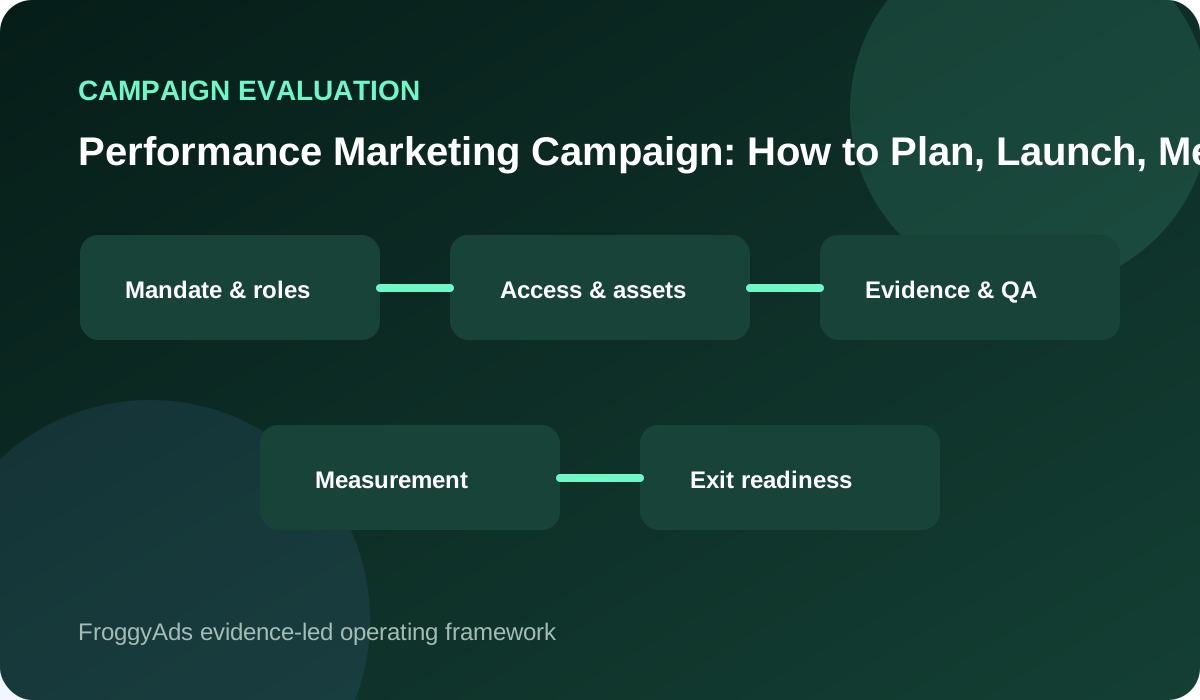
How do you build a performance marketing campaign?
Start with one useful customer outcome, an eligible offer and a working receiving path. Choose the audience and a suitable format, set a spending limit and decide how the outcome will be reviewed. Use FroggyAds to put that prepared purchase into delivery. Compare actual expense with the customer result your business accepts, keeping raw conversions and unreviewed actions separate. The next campaign change should answer a specific finding from that comparison.
| Campaign decision | What to define | Acceptance evidence |
|---|---|---|
| Objective | Choose the customer action the campaign should support. | A usable definition of an eligible lead, order or activation. |
| Audience | Specify who can use the offer and who should be excluded. | Actual offer conditions and supported targeting choices. |
| Channel role | Choose how the paid introduction reaches the customer. | A suitable format, message and destination. |
| Measurement | Separate delivery, recorded actions and business acceptance. | Comparable campaign expense and customer records. |
| Decision gate | Repeat, revise or pause the next purchase. | The observed result and the setting it changes. |
Make the campaign a defined customer acquisition test
A campaign is a connected purchase and customer journey, not a stack of unrelated ads. This guide follows the work from offer preparation through the first useful review. Keep the scope small enough to see whether the audience received the right introduction and whether the destination produced a valuable action. A budget plan, a channel catalogue and an agency contract answer other parts of the wider marketing job.
Choose the campaign outcome and responsibilities
Choose the outcome before building the campaign. An ecommerce order, a qualified business enquiry and an activated trial represent different customer actions. Name the one you need and the conditions that make it useful. That definition should guide the offer and destination, not be selected afterwards because one dashboard total looks strongest.
Keep responsibilities practical. The buyer manages the agreed media purchase; the offer owner confirms the terms and useful customer event; the person responsible for the destination checks the receiving path. One person may cover several roles. The point is knowing who can resolve a concrete problem when a live campaign needs attention.
Turn the business objective into a buying question
Turn the objective into a question that a purchase can answer. For example, a SaaS advertiser might ask whether a defined audience produces eligible trial activations at an acceptable media cost. The creative should explain the product’s relevant benefit, and the receiving page should show the conditions of that trial. Avoid asking one small test to prove every part of the acquisition strategy.
Write what you will do differently if the first result is weak, strong or unclear. A destination fault calls for a repair; unsuitable enquiries may call for clearer qualification; a useful repeated result may warrant another purchase. This makes the campaign objective operational without pretending that every outcome can be predicted before delivery.
Establish the campaign’s starting point
Establish the starting point from current facts: the offer version, intended market, available creative, working destination and measurement you can inspect. If an earlier campaign exists, retain its actual settings and reporting period. Check whether the earlier result used the same customer definition before presenting it as the baseline for the new purchase.
Keep unknowns explicit. You may not yet know which source will work or how quickly customers will complete the action. An initial campaign can investigate those questions within a defined budget. Do not replace missing evidence with a network-wide traffic figure or a return achieved by an unrelated advertiser.
| Baseline input | Question to settle | Useful record |
|---|---|---|
| Offer version | What is the customer being offered now? | Current terms and receiving page. |
| Earlier purchase | What was actually bought and measured? | Settings, period, expense and outcome definition. |
| Customer meaning | Which action counts as useful? | Eligibility, acceptance and review timing. |
| Unknown | Which missing fact could change the plan? | The open question and a bounded way to inspect it. |
Prepare the offer, creative and launch decisions
Prepare a brief the buyer can use: the customer problem, offer, eligible audience, message, destination, format and spending boundary. Include the material conditions that must remain visible. Our FroggyAds campaign controls are most useful when those inputs already describe a coherent purchase, rather than when a buyer must invent the commercial proposition while setting a bid.
Decide who can approve changes that affect the customer promise or financial exposure. A routine creative adjustment and a new subscription condition are different decisions. Keep the agreed version of the offer and assets available so a later review can identify what visitors actually saw.
Build your defined campaign in FroggyAds
Choose FroggyAds when you want to manage the paid route directly. Set the supported format, targeting, bid and campaign budget for the prepared offer. Use our source controls to review the purchase at the detail your reports support. Keep the destination and outcome definition steady while the first delivery provides a useful comparison.
Create My Free Account
Match the campaign scope with the team’s capacity
Match campaign scope with the people who can operate it. Someone needs to review delivery, respond to a broken destination and interpret the customer result. A small team may learn more from one clear format and market than from many lightly supervised combinations. Expand the workload when you can still act on the findings.
Plan practical cover for absence or a time-sensitive fault. Retain the campaign name, current settings, offer conditions and the person who can authorise a change. A readable handover keeps the campaign manageable without turning routine buying into a large administrative exercise.
Keep campaign accounts and assets usable
Keep the account and asset arrangements clear under each provider’s actual capabilities and terms. Identify who funds the campaign, who operates it and who controls the destination. Do not assume that every platform offers the same permission, export or recovery features. The useful arrangement is the one that lets the authorised team operate and review the purchase.
Use the access appropriate to the work and protect credentials according to the actual system. Keep approved creative and destination versions available to the responsible team. A campaign should not become impossible to understand because its only useful record sits with a person who no longer operates it.
| Campaign responsibility | Practical task | Relevant record |
|---|---|---|
| Media buyer | Operate the agreed paid purchase. | Current settings and authorised spending boundary. |
| Offer owner | Confirm the proposition and eligibility. | The actual product and promotion terms. |
| Destination operator | Keep the receiving route usable. | Version, known faults and permitted event implementation. |
| Commercial reviewer | Interpret the useful customer result. | Accepted outcomes, cost scope and pending statuses. |
Separate delivery, customer actions and accepted outcomes
Separate the records along the journey. Impressions and clicks describe delivery; a form submission or signup describes an observed action; business acceptance confirms whether that action meets your criteria. Use stable identifiers where the permitted implementation supports them. A campaign can generate several observations of the same customer without creating several separate customers.
Keep the authoritative status with the relevant business or programme record. A SaaS trial may need activation; a lead may need an eligibility check; an affiliate action may remain pending. Read the platform report at its actual scope rather than assume every recorded conversion has already completed the commercial review.
Follow the destination and measurement handoffs
Follow the authorised route from the advertisement to the destination and the intended action. Check that redirects and material offer conditions remain consistent. Validate the measurement implementation that the route actually supports. Where a customer-level or source-level connection is unavailable, state that limit rather than manufacture a complete attribution path.
A diagnostic event should answer a technical question without being mistaken for a genuine payable customer action. Check the expected observation and any duplicate or missing event. Resolve a material receiving fault before increasing spend, because buying more traffic will not explain a handoff you cannot observe reliably.
Make the creative fulfil the offer’s promise
Make the creative explain one truthful reason to consider the offer. A suitable customer should understand the benefit and the next action. Keep price, availability and eligibility conditions clear where they matter. The destination should continue the same proposition instead of making the visitor discover that the advertised offer has changed.
Retain creative and destination versions so a review can compare like introductions. If you change the message halfway through delivery, record that boundary. An improved aggregate result may reflect a different promise or audience mix rather than evidence that the same campaign suddenly became more efficient.
| Creative check | Customer question | Practical response |
|---|---|---|
| Benefit | Does the message explain a supportable reason to continue? | Use the relevant product benefit. |
| Conditions | Can the visitor understand a material restriction? | Make the relevant qualification clear. |
| Destination | Does the receiving page fulfil the same promise? | Resolve conflicting terms before delivery. |
| Version | Which introduction did this cohort see? | Retain the creative and destination boundary. |
Choose the format for the customer introduction
Choose a format whose introduction suits the offer. Push calls for a concise message; Native needs a credible content-to-offer transition; Display and Pop create different presentation contexts. Use FroggyAds to test a permitted route with its own creative and budget. Keep availability of a format separate from the merchant’s permission to use it for a particular offer.
Create My Free Account
Connect the audience, format and destination
Connect the audience to the actual customer need. Apply the country and device requirements the offer needs, then add a filter only when it serves eligibility or a useful comparison. A visitor arriving from a short notification may need a different explanation from someone reading a fuller introduction. Keep the receiving page suited to that context.
Several channels may introduce the same customer. Keep attributed credit separate from a deduplicated business outcome, and do not add every platform’s claim as though each represented another sale. If the campaign’s causal contribution matters, use an appropriate controlled evaluation rather than treat a source label as proof of incrementality.
Compare campaign reports with customer records
Compare campaign expense and customer records over a declared period. State the currency, outcome definition, attribution scope and the time allowed for the action to arrive or be reviewed. Recent results may be provisional. Make those conditions visible before comparing the new campaign with a mature earlier cohort.
Investigate a meaningful discrepancy before changing the media decision. A duplicate event, a delayed review and an ineligible customer require different responses. Keep unresolved amounts or actions marked as unknown. An apparently precise allocation of missing customer outcomes is less useful than an honest limit on what the records show.
Test one meaningful campaign change
Test one change that could improve the campaign: a clearer benefit, a more explicit qualification or a different supported audience. Write the reason for the change and retain the earlier version. A comparison is easier to interpret when unrelated destination and measurement changes are not introduced at the same time.
Keep an inconclusive result distinct from a failed offer. A small or interrupted purchase may reveal a useful technical problem without establishing commercial performance. Decide whether another limited comparison is justified, what it must resolve and how much more you are prepared to spend finding out.
| Comparison input | What to keep clear | Useful decision |
|---|---|---|
| Baseline | The earlier creative, audience and period. | Retain a reference you can interpret. |
| Change | One meaningful difference in the new purchase. | Test a specific explanation. |
| Evidence | Expense and outcomes at a comparable review stage. | Keep pending actions provisional. |
| Next action | The result that warrants repeat, revision or pause. | Make the next purchase identifiable. |
Set the campaign budget and exposure limit
Set the maximum exposure for this campaign stage before buying traffic. Separate what is available in the account from what this campaign may consume. Keep a defined learning allocation for an uncertain route and review actual spend alongside the customer evidence before expanding it.
Include relevant supporting work when assessing the wider economics. Media alone may omit creative, tracking, service or handling expenses. State whether a reported CPA covers only media or the broader campaign scope. The same customer count can produce different cost measures when the expense definition changes.
Fund the next purchase for a specific reason
Fund the next FroggyAds purchase because it answers a specific question or repeats a useful observed route. Set the format, targeting, bid and budget for that decision. If the key customer review is still pending, allow it to complete rather than buy more exposure merely to make the dashboard busier.
Create My Free Account
Calculate the relevant campaign costs
Calculate the campaign costs on the scope relevant to your business. An affiliate compares commission revenue with media and supporting expenses; a merchant compares the appropriate customer value and margin. An account deposit is funding, not automatically consumed campaign expense. Keep those meanings stable when presenting a result to the person deciding the next allocation.
If an outside service or partner is paid on an outcome, define that commercial arrangement separately from platform media billing. FroggyAds buying models and a measured CPA are different concepts. A cost-per-action result does not itself mean that the media was purchased on a pay-per-sale basis.
Check launch readiness before buying traffic
Check the actual route before launch: offer permission, message accuracy, destination function, intended targeting, spending limit and configured measurement. Use an authorised example under the conditions the campaign will buy. A polished asset is not enough when the visitor cannot complete the next step or sees contradictory terms.
Respond to a concrete failure before releasing the affected purchase. Fix the broken link or event, correct the misleading condition, or narrow targeting to the market the offer can serve. Keep the problem and correction identifiable so the same issue does not return in the next creative or campaign copy.
| Launch check | What could fail | Response before spend |
|---|---|---|
| Offer eligibility | The promotion uses an unpermitted route. | Change the route or resolve permission. |
| Receiving path | A redirect or form prevents the next step. | Repair and verify the specific handoff. |
| Budget boundary | The planned purchase exceeds authorised exposure. | Set the appropriate campaign limit. |
| Measurement | The intended event is missing or duplicated. | Resolve the implementation before relying on it. |
Apply the offer’s actual promotion restrictions
Apply the restrictions relevant to the offer and audience. An affiliate programme may limit promotional methods; a business may serve only certain markets; a product may require particular terms. Translate those conditions into the actual message, destination and targeting. Availability of paid inventory does not establish eligibility for every promotion.
Keep necessary disclosures understandable and close to the claim or recommendation they explain. Check the applicable rules for the real audience and use substantiated product information. If a condition is uncertain, resolve it with the responsible business or programme before presenting it as a campaign promise.
Use the review to choose the next action
Use a campaign review to answer a practical question. What was spent, what customer result is available, where did the journey weaken and what should change next? Choose a reporting interval that fits delivery and outcome timing. A review held before the relevant customer actions mature should say which conclusions remain provisional.
Record the next action in terms another buyer can operate: keep the source allocation, revise a creative, pause a broken route or run a defined follow-up comparison. Include the reason and the previous settings. That is more useful than a broad instruction to optimise harder without identifying the problem.
Run a focused first purchase
Use the first purchase to check a representative version of the campaign. One suitable format, a coherent creative set and a defined audience can expose a receiving problem or produce initial customer evidence. Keep the expense within the learning boundary and avoid treating a few early actions as a dependable forecast of scale.
Separate technical success from commercial success. A working destination and correctly recorded event show that the route functions; they do not establish that its acquisition cost is acceptable. Evaluate the customer result when the appropriate review has completed, then decide whether the next purchase should repeat or change the route.
| First-purchase observation | What it can show | What it does not establish |
|---|---|---|
| Actual spend | The expense of the stated media purchase. | The full cost of every supporting task. |
| Clicks and visits | Delivery and receiving behaviour at available scope. | Approved customers by themselves. |
| Recorded actions | The implementation observed the stated event. | Automatic acceptance or payment. |
| Reviewed customers | The business accepted the defined outcome. | Guaranteed repeatable scale or causal lift. |
Retain the campaign records for continuity
Retain usable campaign settings, creative versions, destination notes and reporting definitions through an operator or service change. Check the exports and access arrangements actually available to you. A continuity plan should preserve the records needed to understand the current purchase without assuming every provider’s licensed data or feature transfers automatically.
Test the important handover before it becomes urgent. Can the authorised operator identify active campaigns, the budget boundary and any pending customer review? Keep the open question with the record. A folder of screenshots may show that activity occurred without explaining what the next buyer should do.
Repeat, revise or pause the campaign
Choose whether to repeat, revise or pause from the current evidence and the campaign’s purpose. A useful mature result may support another defined purchase. A route fault needs correction. An unresolved measurement gap may justify a smaller diagnostic step instead of expansion. Keep the reason distinct from the desire to maintain volume.
Recheck the campaign when a material condition changes: a different offer, a new market, a revised destination or a new acceptance rule can alter the comparison. Retain the earlier result at its original scope. Do not present the changed campaign as a simple continuation when the customer proposition or economics are different.
A practical performance campaign scorecard
| Campaign area | Useful evidence | Next decision |
|---|---|---|
| Objective | The actual eligible customer action. | Keep the outcome definition stable. |
| Audience and offer | Permitted market, device and proposition. | Correct an eligibility or message mismatch. |
| Receiving journey | Destination function and consistent terms. | Repair the specific broken handoff. |
| Measurement | Actual expense and customer review status. | Compare at the supported reporting scope. |
| Next allocation | The result of the defined purchase. | Repeat, revise or pause for a stated reason. |
Performance marketing campaign questions
What is a performance marketing campaign?
It is a connected acquisition effort built around a useful customer action. The offer, audience, creative, destination and budget should support that action, and the review should compare actual expense with the result the business accepts. With FroggyAds, you can manage the paid introduction through supported format, targeting, bid, budget and source controls.
Which outcome should a campaign optimise toward?
Choose the customer action that matches the commercial purpose, such as an eligible lead, an accepted order or an activated trial. Keep raw submissions and intermediate events separate. A high conversion count is not enough if the actions fail the eligibility or quality conditions that make them useful to the business.
How should I choose the first format?
Match the first format to the offer’s message, visitor context and permitted promotional route. Push, Native, Display and Pop introduce the proposition differently. Start with one suitable FroggyAds format and a coherent creative set rather than spread a limited learning budget across several unlike journeys.
Is a campaign budget the same as an account deposit?
No. Funding makes money available to the account; the campaign budget defines the amount allocated to a particular purchase. Actual consumed media is another record. Include relevant supporting expenses separately when deciding whether the resulting customer outcome meets the business’s cost requirement.
What tracking should work before launch?
Verify the intended receiving action and the measurement implementation your permitted route supports. Check relevant identifiers, missing or duplicate events, and the business’s acceptance record. A platform conversion and a later approved customer may represent different stages. Keep any unavailable customer-level or source-level connection explicit.
How can I tell traffic problems from destination problems?
Follow the journey from eligible delivery to the receiving page, the recorded action and business review. A shared failure across several sources can point to the destination or offer. A repeated source-specific issue needs evidence at that scope. Correct one meaningful problem at a time so the comparison remains understandable.
When should I change creative or targeting?
Change it when a specific finding supports a clear test, such as unsuitable enquiries or an unclear benefit. Retain the earlier version and keep unrelated changes separate. Do not treat every early fluctuation as a reason to rebuild the campaign before customer actions have had time to arrive and be reviewed.
What belongs in a campaign cost comparison?
State whether the measure includes media alone or also relevant creative, tracking, service and handling work. Use the same customer definition and review period. A media CPA and a broader campaign CPA answer different expense questions; neither by itself proves profit or causal customer growth.
When should a performance campaign scale?
Consider another defined purchase after useful outcomes repeat at acceptable economics and the destination and measurement remain reliable. Assess the additional result from the additional expense. Keep a previous configuration for comparison, but recheck the offer and market conditions rather than assume an earlier result will return unchanged.
What should I retain when a campaign ends?
Keep the offer and creative versions, settings, expense scope, outcome definition, reviewed result and unresolved questions. Record why the campaign ended and what a future test would need to change. Useful continuity preserves the method and evidence without presenting a retired result as a forecast for a new offer.
Related campaign operating guides
Use these campaign resources for the next specific planning, measurement or implementation task. Keep that work connected to the offer and customer action rather than add channels or tools without a clear reason.
Use references for their actual subject
Consult each source for its stated subject. The platform account references describe the named providers’ access arrangements, not FroggyAds permission features. Advertising and accessibility guidance addresses the applicable audience and context. Check current documentation for a real implementation; these links do not certify a campaign or guarantee customer results.
Launch your prepared campaign with FroggyAds
Start your next campaign with FroggyAds when the offer, destination and outcome definition are ready. Our self-serve buying controls let you choose the format, supported targeting, bid and budget for a defined purchase. Review source delivery alongside the customer evidence your business actually has, then decide what deserves the next allocation.
Keep the campaign focused on its customer task
Use this campaign guide to connect the offer, paid introduction and customer review. If your next requirement is structured training rather than a live campaign plan, read Top Performance Marketing Course. A course choice and a media purchase require different evidence; keep the campaign focused on the customer action you are ready to evaluate.
Keep the campaign connected from the first promise to the accepted customer action. Choose a useful offer, introduce it to a suitable audience and make the next step understandable. Use our buying controls for the paid route while the receiving and business records show whether the customer result supports another purchase.
| Checkpoint | Page-specific action | Evidence to keep |
|---|---|---|
| Fit | Choose the customer outcome, offer and supported audience. | The actual acceptance rule and working destination. |
| Test | Run one defined format and creative comparison. | Settings, expense, versions and available customer observations. |
| Decision | Repeat, revise or pause from the mature result. | The finding, next action and previous campaign settings. |
Hypothetical SaaS campaign: USD 180 in media produces nine trial signups, but only four meet the stated activation and eligibility rules. Media cost is USD 20 per signup and USD 45 per qualified activation. Supporting costs are excluded from both figures. These invented inputs illustrate why the outcome definition matters; they are not FroggyAds results or a claim that four customers were caused incrementally by the campaign.
Choose FroggyAds to put your prepared offer into a paid campaign you can control. Set the relevant format, targeting, bid and budget, then use the customer review to decide what follows. Create your free FroggyAds account.
What matters first when launching a performance campaign?
Define a useful customer outcome and confirm a permitted offer before buying traffic. Prepare the creative, destination, measurement and spending boundary. Then use FroggyAds to make a defined purchase and compare actual expense with the result your business accepts. A clear campaign purpose makes the next targeting, creative or budget decision easier to explain.