
Performance Marketing Company: How to Evaluate Ownership, Delivery and Results
Choose a performance marketing company by the people, account access and customer evidence you can verify before signing. A strong proposal names who will do the work, what you retain and which business outcome justifies the cost. We give your chosen operator a self-serve FroggyAds paid-traffic route; your company-selection decision should also cover the services, systems and responsibilities outside that campaign layer.
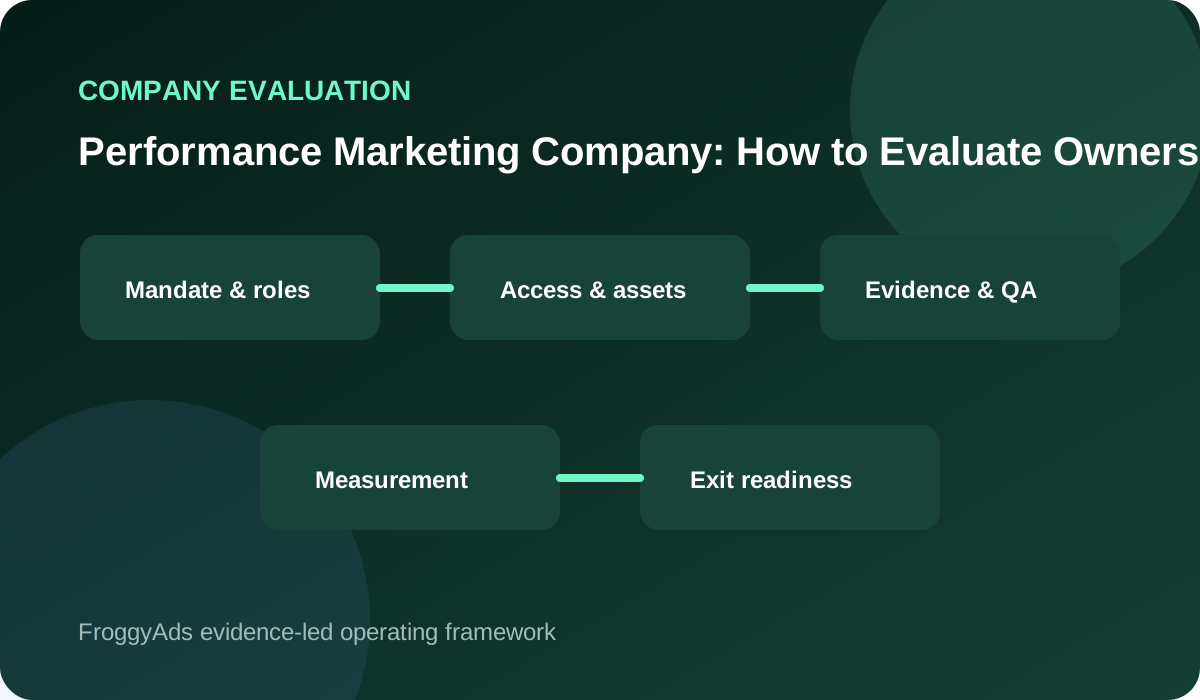
What should a performance marketing company prove before you hire it?
A performance marketing company is a suitable choice when its named delivery team can meet a defined acquisition brief, work through agreed account permissions, reconcile accepted customers and leave usable records with you. Resolve missing ownership or measurement evidence in a limited pilot before committing to a larger engagement. Compare the whole cost and exit obligations alongside the proposed results.
| Decision area | What to document | Evidence standard |
|---|---|---|
| Mandate | Scope, exclusions and decision rights | Signed brief and responsibility matrix |
| Team | Named delivery roles and continuity | Role allocation and capacity evidence |
| Ownership | Client-controlled accounts, data and assets | Access and recovery record |
| Measurement | accepted outcomes, revenue, contribution margin, retention and incremental lift | Metric contract and backend evidence |
| Commercial | Total cost, approvals and transition | Fee schedule and exit plan |
Mandate and accountable ownership
Define the company mandate in one signed brief: the offer, markets, customer problem, channel responsibilities, deliverables and decisions the provider may make. A request to “grow revenue” leaves too much room for disagreement. Specify which accepted customer event the company can influence and which product, pricing or sales decisions remain yours. That boundary makes a proposal easier to price and review.
Separate strategy, campaign operation, creative production, tracking implementation and software access in the scope. Ask which tasks the company performs directly and which go to subcontractors or your own staff. For each deliverable, identify who supplies the input, who checks it and who accepts completion. Our self-serve campaign access is distinct from hiring a company to provide those services.
Business objective and problem framing
Translate the business objective into a problem the proposed company can investigate. A retailer with high returns needs a different brief from a B2B team whose enquiries rarely meet qualification rules. Give the provider the relevant market, offer constraints and maturity window. Require it to explain which customer behavior would change, how it would be observed and which uncertainty the first test addresses.
Keep the problem statement connected to a spending decision. More creatives, meetings or visits may be useful work, but they are not evidence that acquisition economics improved. Ask what the company would recommend if clicks rose while accepted orders stayed flat. Its answer should identify a concrete investigation or pause condition and the information needed from your business.
Current-state audit and baseline
Document the current-state audit before allowing the company to replace campaigns or tracking. Inventory accounts, editable assets, destinations, conversion definitions, data exports and approval bottlenecks. Note which records are reliable enough for comparison and which require repair. A provider that discovers the same missing field after launch should be able to show whether it was an accepted limitation or a missed prerequisite.
Preserve a dated baseline of the audit findings, customer counts, relevant cost and operating conditions. Separate observed records from your team’s estimates and the company’s assumptions. Changes in stock, price, sales response or return policy can affect an acquisition result. The baseline should let both sides explain those changes without retrospectively redefining success or discarding inconvenient customer outcomes.
| Control | Company review question | Acceptance evidence |
|---|---|---|
| Baseline owner | Who can explain the source records and material business changes? | Dated client audit and named data owner |
| Company audit lead | Who verifies the inherited setup before changing it? | Account inventory with confirmed gaps |
| Readiness boundary | Which tracking or destination faults prevent a fair pilot? | Repair list, owner and release condition |
| Baseline transfer | Can another operator reproduce the starting comparison? | Exported settings, metric definitions and assumptions |
Strategy deliverables and decision rights
List the strategy deliverables you expect to receive and use. A decision-ready company proposal might include an audience rationale, offer objections, campaign brief, source test, measurement rules and a review schedule. Ask for the actual format and acceptance criteria of each artifact. A presentation that cannot be translated into assigned work, approved settings and a measurable next action leaves the client to finish the strategy.
Assign decision rights for creative claims, audience eligibility, budget increases and material destination changes. The company should know which changes it may make within the approved brief and which need your review. Keep a named client approver and delegate available so the workflow can function. Privacy choices, legal interpretation and promises to customers need the appropriate responsible owner, not an improvised campaign decision.
Connect Performance Marketing Company to a controlled audience test
Use the approved strategy to ask your shortlisted company for one FroggyAds test specification. It should name the campaign objective, eligible audience, offer version, accepted event, source review and cash limit. Our market, device and source controls let an authorized operator act on that specification. Keep the business question stable enough to assess the company’s reasoning and execution separately.
Create My Free Account
Named team and delivery capacity
Request the named team that will deliver your account, not only the people who present the pitch. Ask how campaign operations, creative, measurement and client decisions are staffed, including senior review and specialist support. A company should explain its available capacity against your required workload. Clarify subcontractors, absence cover and what happens if the proposed account lead changes before or during delivery.
Check team capacity through a realistic work sample or pilot handover. Can the actual operator explain the last approved setting, retrieve the relevant creative version and trace a reported customer event? Ask who reviews errors and how a client concern reaches someone authorized to act. Continuity is more credible when another named team member can use the records without a long verbal reconstruction.
Account, asset and credential ownership
Keep account and asset ownership explicit in the contract and access record. Identify the owner of domains, campaign accounts, analytics, customer data, source files and recovery methods. Where a provider-controlled system is necessary, document the export and transition limits before buying it. A company’s convenient reporting portal should not become the only place where your business can see its historical work.
Use the access model supported by each actual system: named users, permitted partner access and appropriate permissions rather than a shared personal password. Agree who grants, reviews and revokes access, including subcontractors. Test the client’s recovery route before an incident. Platform permission details differ, so confirm the current instructions for the system involved instead of assuming one provider’s access terminology applies everywhere.
| Control | Company review question | Acceptance evidence |
|---|---|---|
| Client administrator | Who retains recovery and approves provider access? | Named owner with a verified recovery route |
| Delivery permissions | Which company roles and subcontractors need access? | Current user and permission register |
| Access incident | Who can pause work and revoke an unsafe permission? | Escalation contact and tested authorized steps |
| Provider departure | What remains available after permissions are removed? | Usable client exports and asset ownership record |
Data model and source of truth
Assign a source of truth for each material data field. The company may report delivery and campaign identifiers, while your order system or sales team confirms acceptance, refunds and collected revenue. Specify the join key, currency, timezone, update delay and responsible owner. Keep an unresolved category when the records cannot yet be joined; silently assigning unknown customers to a favored source can distort the hiring decision.
Treat a company dashboard as a view of the underlying records. Request a reconciliation for one comparable customer cohort, including rejected, pending and reversed events. The company should explain why a platform conversion count differs from accepted business outcomes and which difference matters to the next action. Reporting access is useful when you can inspect the logic and export the relevant evidence.
Integration and handoff architecture
Document integration handoffs between the company and your systems before relying on automated reporting or lead delivery. State which identifier travels, where the status is recorded, how duplicates are handled and who monitors a rejected transfer. Ask how late corrections reach the original customer record. A working demonstration should include a failure and recovery case, not only one successful submission.
Require an observable success state and a safe recovery plan for each material handoff. If a transfer is delayed, the company needs a way to identify affected records without resending every customer blindly. Agree who investigates, what delivery must pause and which previous configuration can be restored. Test these responsibilities with authorized sample records while protecting real customer data and consent boundaries.
Message, creative and content governance
Define creative governance around approved messages and recoverable files. Ask how the company turns customer evidence into concepts, substantiates claims, records approval and retires old versions. Clarify which editable assets and usage rights you receive, including subcontracted production. The deliverable should support the actual destination and chosen ad format instead of being a collection of attractive assets with no agreed job.
Trace a live creative back to its approved brief, source file and reviewer. Your company should be able to explain what changed between versions and which customer objection or test question motivated the change. Keep material price, eligibility and fulfillment terms consistent across the ad and destination. An unsupported stronger promise is a defect to correct, even if its initial click rate looks appealing.
| Control | Company review question | Acceptance evidence |
|---|---|---|
| Claim approval | Who confirms proof, material terms and allowed messaging? | Approved brief with source and reviewer |
| Creative production | Who supplies editable files and usage rights? | Asset register and subcontractor responsibilities |
| Release boundary | Which defects hold an ad or destination from launch? | Claim, format and message-match checks |
| Version handover | Can the client retrieve the current approved assets? | Version history and usable source files |
Choose a paid-media format that supports Performance Marketing Company
Choose the ad format with the operator who will build the campaign. We offer push, native, display and pop traffic routes; verify the current creative and destination requirements for the option you select. Ask the company why that format fits the customer task and how it will inspect accepted outcomes by source. Native traffic here does not imply buying inventory inside a named social platform.
Create My Free Account
Audience, channel and journey design
Document audience and channel roles before combining them in a company-wide result. Which customer situation should each campaign reach, and which market, device or source exclusions are justified? Require a clear destination and follow-up owner for each route. Where channels overlap, keep identifiers and reporting windows explicit so the provider can explain duplicated credit instead of simply adding platform totals.
Review the company’s incrementality assumptions separately from attributed conversions. An attribution report assigns credit under its configured rules; it does not alone prove that the company caused an additional sale. If causal lift is part of the brief, request an appropriate comparison design and an honest statement of its limitations. Otherwise judge the campaign by the agreed observed outcome without relabeling it as proven lift.
Measurement contract and reconciliation
Agree the measurement contract before delivery: accepted event, formula, cost scope, exclusions, attribution setting, maturity window and authoritative business record. Include when refunds or rejected leads become final. The company should identify which inputs it controls and which your team supplies. This makes a disagreement about a reported result a question that can be reconciled rather than a contest between screenshots.
Reconcile channel and company reporting on a consistent cohort and review date. Preserve the raw counts, adjustments and unresolved differences behind the final number. Ask whether a discrepancy changes the spend decision, fee calculation or only the reporting display. Record model and definition changes before comparing periods so a new attribution setting is not presented as an acquisition improvement.
Experiment design and learning cadence
Give each experiment a specific hypothesis and a decision it can support. The company should state the variable being changed, primary accepted outcome, guardrails, exposure limits and reason for the observation window. Separate route validation from a performance comparison. A test with a broken conversion join cannot answer whether the creative or source worked, regardless of how many visits arrived.
Retain negative and inconclusive experiment findings with the next action. A company that can explain why it stopped an unsuitable route may be demonstrating useful discipline. Ask it to show what remained stable, what changed and what evidence would justify another attempt. Do not reward a series of renamed tests that repeatedly spend money without resolving the same underlying question.
| Control | Company review question | Acceptance evidence |
|---|---|---|
| Experiment sponsor | Which decision must the pilot answer? | One hypothesis and accepted-outcome rule |
| Company operator | Who maintains the comparison and investigates faults? | Named lead and preserved test configuration |
| Stopping condition | What causes pause, continuation or a new test? | Cash ceiling, guardrails and observation logic |
| Learning transfer | Can the next operator use an inconclusive finding? | Test record, limitations and next decision |
Budget governance and spend authority
Write the company’s spend authority as an operating rule: approved daily and total limits, pacing responsibility, reallocation boundary and escalation contact. Distinguish a recommendation to increase budget from permission to do so. Confirm that an authorized person can pause delivery during an incident and that the client receives a usable record of changes. Account funding remains separate from the amount approved for one test.
Separate media, company fees, creative production, technology, data and other relevant pass-through costs in the budget review. State who receives each invoice and how unused funds or disputed charges are handled under the actual agreement. A low media cost per customer can still accompany an expensive engagement. Compare provider proposals using the same business outcome, cost inclusions and period.
Commercial model and fee transparency
Compare commercial models through the work and incentives they create. A fixed project needs defined acceptance and change requests; an ongoing retainer needs a clear recurring workload; a media-percentage fee needs visible spending authority. For any outcome-linked proposal, ask how the billable result is validated and corrected. This guide does not quote a universal company fee or imply that FroggyAds account access includes managed agency work.
Define performance-linked payment using an accepted outcome both sides can verify. Document attribution, duplication, rejection, reversals, caps, audit access and the dispute process. A company paid on raw forms may have a different incentive from a client who values qualified, retained customers. Resolve that mismatch in the terms before it becomes an argument about whether a lead should count.
Turn Performance Marketing Company into a bounded campaign test
After the company brief and commercial terms are agreed, release one bounded pilot through FroggyAds. We give the operator practical campaign controls while you retain the business acceptance rule and spending approval. Preserve the configuration, source identifiers and relevant costs. Review the company’s ability to explain an actual result before commissioning more markets, formats or recurring work.
Create My Free Account
Quality assurance and release gates
Define release checks for the company’s actual campaign: approved claims, working destination and forms, correct identifiers, eligible audience, budget and bid limits, source settings and pause access. Include the appropriate accessibility and policy review. Ask the release owner to retain the evidence and known limitations. Passing an asset deadline is not a substitute for a functioning customer path.
Release work only when the named approver can use the quality evidence. A broken form, unexplained conversion event or missing claim approval should have a repair owner and a retest condition. Keep the last usable configuration available. The company should distinguish a creative experiment that performed poorly from delivery that never met the agreed release conditions in the first place.
| Control | Company review question | Acceptance evidence |
|---|---|---|
| Release approver | Who accepts the campaign after the checks? | Named client approval and company release owner |
| Quality owner | Who verifies the destination, identifiers and settings? | Actual test evidence with unresolved defects |
| Launch blocker | Which missing control prevents paid delivery? | Written repair and retest condition |
| Rollback record | Can an authorized operator restore the prior setup? | Saved configuration, access and change log |
Risk, policy and disclosure controls
Maintain policy and disclosure responsibilities by actual activity and market. The company needs to know who approves advertising claims, commercial relationship disclosures, consent choices and sector-specific restrictions. Request the source and review date behind a material interpretation. Reference directories and platform guidance help locate requirements; they are not a legal approval of the client’s offer or a guarantee that an ad will be accepted.
Surface risk before it changes the customer promise or campaign exposure. Ask the company to record the affected asset, unresolved question, responsible reviewer and interim limit. A generic disclaimer cannot replace a supported product claim or an appropriate consent decision. Keep the advertiser’s approval responsibilities visible while requiring the provider to identify the issues within its own work.
Reporting, meetings and decision logs
Set a reporting cadence that supports decisions your team can actually make. Require the company’s commentary to link a change in accepted customers or cost to a proposed action, with the relevant uncertainty. Name the recipients, field owners and escalation window. Keep a short action log so the same measurement gap does not return in every meeting without an accountable repair.
End each review with a recorded decision, owner and due date. Approve, hold, repair or repeat should refer to the agreed evidence and current constraints. Keep unresolved questions alongside the result instead of hiding them in a presentation appendix. A useful company review leaves the next operator able to see why a budget, creative or source setting changed.
Capability validation and pilot design
Use a representative pilot to validate the company’s delivery capability. Choose a task that includes the real approval, creative, tracking and customer-status constraints of the intended engagement. Agree the work, access, loss limit and acceptance criteria before it starts. A pilot should reveal how the named team communicates and resolves problems, not merely produce a polished case-study slide.
Judge the pilot against both delivery quality and the business evidence available. A short pilot may establish a usable workflow without proving long-term retention or causal lift. Ask the company to state that distinction and supply the actual handover artifacts. Extend the engagement only when the remaining uncertainty has a clear next test or an explicitly accepted operational limitation.
| Control | Company review question | Acceptance evidence |
|---|---|---|
| Pilot sponsor | Who accepts the bounded work and remaining uncertainty? | Signed pilot brief and review date |
| Actual delivery team | Will the proposed recurring team perform the work? | Named roles, coverage and realistic workload |
| Acceptance decision | What can the pilot establish within its maturity window? | Delivery criteria, customer evidence and limitations |
| Company handover | Can the client inspect and continue the completed work? | Usable exports, versions and open-issue record |
Portability, termination and transition
Put termination and portability duties in the company agreement while the relationship is working. Define notice, outstanding work, editable assets, data exports, account access, billing closeout and support for the incoming operator. Confirm who handles late refunds or accepted-customer corrections. A campaign pause should not leave existing customer obligations or the final performance-linked invoice without an owner.
Test a critical export and the client’s account recovery route before signing a large commitment. Have another authorized operator locate the current campaign settings, creative versions, metric definitions and open issues. Note any proprietary system or licensing limit that affects portability. If the company cannot provide the expected transfer, change the scope or resolve the limitation before relying on it.
Executive decision and ongoing review
Combine the company evidence into a decision with explicit conditions. Approve a suitable mandate, pilot a bounded uncertainty, revise missing terms or reject an unworkable ownership or measurement arrangement. Name who accepts the remaining risk and when it will be reviewed. This decision should be understandable without replaying the provider’s pitch or reconstructing a series of informal promises.
Reassess the engagement when the company changes its delivery team, subcontractors, fees, systems or account arrangements, or when your offer and acquisition objective change. Keep the original acceptance record so the comparison remains fair. A provider selected for one market and workload is not automatically approved for every later business problem. Confirm the new responsibilities before releasing another commitment.
Decision scorecard for Performance Marketing Company
| Area | Evidence to request | Decision standard |
|---|---|---|
| Operating fit | Relevant capability for measurable acquisition and revenue marketing | Proven in a bounded pilot |
| Ownership | Client administration, usable exports and documented asset rights | No critical provider lock-in |
| Governance | Roles, approvals, logs, disclosure and rollback | Controlled and auditable |
| Measurement | Accepted-customer ledger, refund maturity and full-cost reconciliation | Accepted outcomes, not activity alone |
| Commercial and exit | Transparent fees, exports and transition duties | Sustainable and portable |
Frequently asked questions
How do I choose a performance marketing company?
Start with a defined acquisition brief and verify the named team, relevant delivery capability, account ownership, measurement rules, full cost and exit duties. Use a limited pilot for a specific unresolved question. A provider ranking or attractive platform screenshot cannot replace those checks.
What should the company proposal include?
Request scope, exclusions, deliverables, roles, approval rights, dependencies, fees and a customer-outcome definition. It should explain which work the company performs, which tasks use subcontractors and which inputs your business must supply before the proposed timeline is realistic.
What should a company pilot test?
Choose a representative task with a clear hypothesis, release checks, accepted customer event and loss limit. Include the real approval and tracking handoffs. A pilot can establish operating fit while longer-term retention or incrementality remains unresolved; state the limit in the decision.
Can a company guarantee sales or return on ad spend?
No provider can establish a future result simply by promising it. Ask for supported claims and an explanation of offer, market, attribution, cost and maturity assumptions. Judge observed accepted-customer evidence and keep the next commitment bounded.
Who should own accounts and campaign assets?
Document the client and provider ownership of each account, dataset and editable asset. Prefer usable client administration and recovery where supported. If a proprietary provider system is necessary, resolve access, export, licensing and transition limits before signing.
How much does a performance marketing company cost?
Compare the actual proposal across media, service fees, production, software, data and other relevant charges. Define billable outcomes and dispute rules for performance-linked fees. This guide offers no universal price; FroggyAds account access is separate from contracted company services and funded campaign traffic.
Which evidence should guide the company review?
Use delivery records joined to accepted customers, relevant full cost, refunds and the agreed observation window. Reconcile provider and platform reports to the authoritative business records. Keep missing joins, pending outcomes and model changes visible before acting.
When should the company pause a campaign?
Pause for a broken customer path, unsafe access, unsupported claim, missing measurement, a breached cash limit or a material eligibility problem. Name the responsible operator and repair condition. A disappointing valid experiment and unusable delivery need different follow-up decisions.
How can I change company without losing the work?
Agree termination and portability duties early. Test access recovery, exports, editable creative files, metric definitions and open-issue transfer. Assign late customer corrections, outstanding invoices and access revocation to named owners so the change does not leave the business record incomplete.
When should I expand work with the company?
Expand after the named team has delivered the agreed work, the accepted-customer evidence supports the next question and cash or capacity permits it. Reconfirm changed scope, fees and responsibilities. Increasing spend alone does not demonstrate that the company improved acquisition value.
Related operating guides
Related operating guides help you separate company selection from the agency engagement, individual service scope, campaign solutions and direct traffic purchase. Use the right guide for the commitment you are actually comparing.
Official sources used
The linked resources cover separate platform access models, advertising disclosures and accessibility guidance. Confirm current requirements for the system and market you actually use. Their inclusion does not certify a company, establish FroggyAds partnerships with those platforms or prove an account-permission setup was tested in this guide.
Connect governed delivery to paid distribution
Choose FroggyAds when your selected company needs a self-serve paid-distribution route with practical market, device, budget and source controls. We help you put the approved campaign brief into action and retain delivery evidence. Reconcile that evidence with your own accepted customers; buying traffic does not replace the provider’s creative, technical or client-service responsibilities.
Build a practical company-selection file
Your company-selection file should resolve who operates the acquisition route, how the work is accepted and what you retain. A provider course can help your internal team understand the task, but training material is not evidence that the proposed company can deliver it. Ask for actual people, artifacts and a representative handover.
Tie the campaign objective to an accepted customer event. Ask the company to explain audience and market fit from eligibility and demand, choose an ad format that suits the message, and set budget and bid limits within the approved test amount. Each choice should have an owner and an observable record you can review after delivery.
| Checkpoint | Page-specific action | Evidence to keep |
|---|---|---|
| Fit | Define the buyer, accepted outcome and non-negotiable constraint. | Named team, approved brief, access owners and unresolved selection conditions. |
| Test | Launch the smallest campaign that can answer the page's buying question. | Versioned settings, relevant full costs, customer statuses and the pilot comparison window. |
| Decision | Keep, cap, exclude or expand from accepted-outcome evidence. | Written approve, revise or reject decision with an owner, due date and usable handover. |
Hypothetical company pilot: assume USD 225 in media produces 9 accepted customers. Media-only CPA is USD 225 / 9, or USD 25. If the same pilot also assigns USD 135 in company fees and USD 90 in creative cost, the specified acquisition cost is USD 450 / 9, or USD 50 per accepted customer. These invented inputs illustrate cost scope, not a customer result or a FroggyAds price; exclude no material charge when comparing proposals.
We give your authorized operator the campaign layer for a controlled acquisition test. Keep the company contract, customer acceptance and total-cost record alongside it. Create your free FroggyAds account when the brief and permissions are ready, then fund a separate traffic allowance that fits the pilot’s cash limit.
Which performance marketing company deserves a pilot?
Choose a pilot when the company has a credible named team and workable ownership terms, but a specific delivery or measurement question still needs evidence. Resolve missing permissions, unsupported promises or unclear fees before launch. We recommend a bounded FroggyAds test only when it can answer that remaining question with a usable accepted-customer record.