
Performance Marketing Agency: How to Evaluate Team, Access and Results
A performance marketing agency engagement works when the client and delivery team can run the same plan without guessing who owns the next decision. Agree the recurring workload, account permissions, customer-outcome definition and change process before paid delivery. We give agencies a self-serve FroggyAds traffic route; the agency contract should separately explain its strategy, production, measurement and client-service responsibilities.
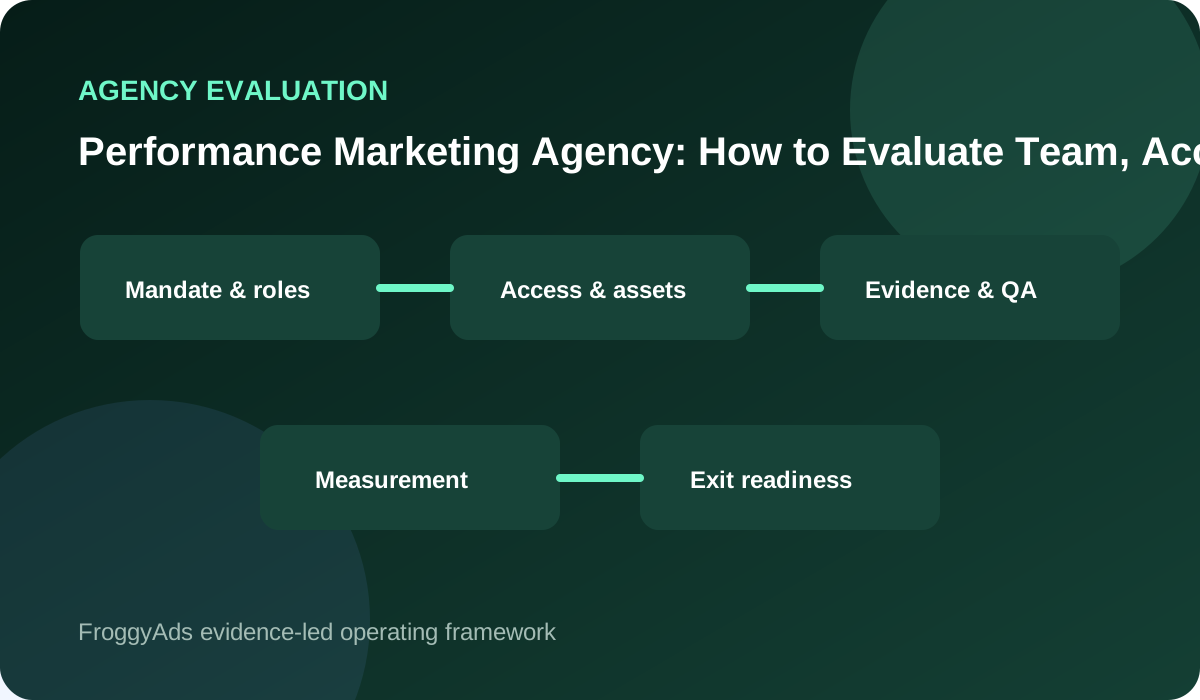
How should you structure a performance marketing agency engagement?
Start with a bounded mandate, a named agency team and an operating agreement that joins work requests to approvals, spend and accepted customers. Keep each client’s assets, records and permissions distinct. Review the agency through completed work and reconciled customer evidence, then change the scope deliberately when the workload or business question changes. Traffic purchases alone do not establish the quality of the agency relationship.
| Decision area | What to document | Evidence standard |
|---|---|---|
| Mandate | Scope, exclusions and decision rights | Signed brief and responsibility matrix |
| Team | Named delivery roles and continuity | Role allocation and capacity evidence |
| Ownership | Client-controlled accounts, data and assets | Access and recovery record |
| Measurement | accepted outcomes, revenue, contribution margin, retention and incremental lift | Metric contract and backend evidence |
| Commercial | Total cost, approvals and transition | Fee schedule and exit plan |
Mandate and accountable ownership
Write the agency mandate as an operating brief that the account lead and client sponsor can both use. Specify the offer, markets, recurring deliverables, campaign responsibilities and decisions delegated to the agency. State where the client still supplies approval, stock information, sales follow-up or technical support. Unowned dependencies can stop delivery even when the media buyer has finished the campaign setup.
Separate the agency’s recurring work from optional projects and third-party charges. A monthly campaign review, a new landing page and a tracking repair have different inputs and acceptance criteria. Identify which work is included, what requires a new estimate and who may approve it. Our campaign platform supplies paid-traffic controls; it does not make those agency services part of account access.
Business objective and problem framing
Translate the client objective into a prioritized agency backlog. Each proposed task should name the customer problem, intended change and decision it supports. For example, a retailer may need the agency to investigate accepted orders after returns rather than produce more top-line conversion reports. Keep the accountable business owner available to confirm the customer definition and material offer constraints.
Choose priorities from the acquisition bottleneck the evidence can support. A sales-response delay, a broken destination and weak source eligibility need different owners. The agency should explain why a creative change is more useful than another task in the queue. Record what will be deferred when an urgent request arrives so the client understands how it affects the agreed workload.
Current-state audit and baseline
Run a joint current-state audit at onboarding, before the agency replaces working campaigns or measurement settings. Inventory active delivery, client access, editable creative, destinations, identifiers, reporting and outstanding promises. Ask the outgoing team or client to identify known faults. Mark an inherited limitation separately from a change the new agency introduces, with a clear owner for the repair.
Keep the baseline usable for the first reporting cycle. Save customer counts, relevant cost, offer versions and known gaps with their dates and sources. An agency cannot fairly compare a launch week with a previous period whose prices, inventory or qualification rules were different. Where the baseline is incomplete, agree what the first limited release can establish and what remains unknown.
| Control | Agency review question | Acceptance evidence |
|---|---|---|
| Client onboarding lead | What facts and active commitments must the agency inherit? | Dated inventory and verified client inputs |
| Agency setup owner | Who investigates the gaps before replacing settings? | Assigned repair list and preserved baseline |
| Launch dependency | Which missing input prevents the first useful test? | Explicit hold condition and supplying owner |
| First reporting cycle | Can the client compare the new cohort fairly? | Original definitions, costs and operating conditions |
Strategy deliverables and decision rights
Turn strategy deliverables into an approval sequence. The agency should show how research informs the campaign brief, how a brief becomes creative and how approved assets reach a named operator. Record the client input needed at each step. A delayed product fact or legal review belongs in the delivery plan rather than being discovered after the scheduled campaign launch.
Assign decision rights for routine optimization and material changes. An operator may work within approved source and spending limits, while a new offer claim or larger financial commitment needs the appropriate client approval. Define the escalation route and expected response window. If the approver is unavailable, the agency should follow an agreed hold condition instead of treating silence as permission.
Connect Performance Marketing Agency to a controlled audience test
Use one approved client brief to configure the first FroggyAds audience test. We let the authorized agency operator select relevant markets, devices and source controls and work within the campaign budget. Keep the client’s offer and acceptance rule stable during the comparison. Save the approved settings with the agency task so a colleague can explain the test without relying on the original buyer’s memory.
Create My Free Account
Named team and delivery capacity
Name the agency account lead, campaign operator, creative reviewer and measurement contact for the actual workload. Agree how specialist input is requested and whether subcontractors handle any part of delivery. When several clients share a team, ask how urgent tasks and absence cover are allocated. A staffing plan should explain what happens to your service when another account needs attention.
Set continuity expectations before a team change becomes urgent. A replacement operator needs the current briefs, settings, approval status and unresolved customer-data issues. Ask the agency to demonstrate a handover within its own team during onboarding. Keep the client informed when the person responsible for budget or measurement changes, rather than discovering the substitution through unexplained reporting or missed actions.
Account, asset and credential ownership
Keep account ownership and client boundaries visible in the access register. Record the client administrator, agency permissions, billing responsibility and export route for each system used. Avoid mixing one client’s customer records, creative rights or campaign settings with another’s work. Where a shared agency tool is necessary, define what the client can retrieve and what the tool cannot transfer at exit.
Review agency access whenever a person joins, leaves or changes duties. Use appropriate named or supported partner permissions and recovery methods for the actual platform. The client should know who can increase spend, publish assets, export data and revoke access. Document how a compromised or obsolete permission is handled without removing the team’s ability to serve existing customers safely.
| Control | Agency review question | Acceptance evidence |
|---|---|---|
| Client boundary | Which accounts and assets belong to this engagement? | Named client and ownership record |
| Agency operator access | Who can publish, spend, export and request changes? | Current permissions by role and system |
| Staff change | Who removes or amends access when duties change? | Recorded review and authorized administrator |
| Exit continuity | How does the client retrieve ongoing work? | Exports, recovery route and open tasks |
Data model and source of truth
Agree the data handoff between the client and agency before using customer outcomes to optimize delivery. Define which identifiers connect media activity to enquiries, accepted orders, cancellations or refunds. Name who updates each status and how delayed corrections are returned. Keep pending and unmatched records explicit so an agency report does not turn incomplete sales input into an apparent source-quality conclusion.
Use a reconciliation file that both the agency analyst and client data owner can inspect. It should connect reported activity to the agreed customer cohort, cost scope and acceptance window. Keep the reason for a rejected or missing join. A disagreement between a platform total and a business total should lead to a documented investigation, not two incompatible versions of the weekly result.
Integration and handoff architecture
Specify the integration boundary for every agency-managed form, event or export. State the expected input, destination, delivery cadence and owner of a rejected record. Include duplicate prevention and late-status updates in the handover. Test with authorized sample data before relying on the route for campaign decisions, and keep personal information within the permissions and retention rules the business has actually approved.
Prepare a recovery process for interrupted handoffs. The agency should be able to identify the affected time range, preserve failed records and coordinate a safe retry with the receiving system owner. Blindly resending a whole audience can create duplicate work or customer contact. Agree when media should pause and how the last usable configuration is restored while the integration is repaired.
Message, creative and content governance
Organize the creative workflow around a versioned brief, review and release record. The agency should identify the customer objection or test question behind each new asset and retain its approved material terms. Agree the number of included revisions and which changes create a new task. Store editable files and usage-right information where the authorized client team can obtain them.
Give each live creative a traceable approval and retirement path. If stock, pricing or eligibility changes, the agency needs to know which ads and destinations are affected. Record who updates the message and who checks the corrected version. A creative that attracts more clicks through an unsupported claim has not earned a larger budget; repair the promise before interpreting its commercial usefulness.
| Control | Agency review question | Acceptance evidence |
|---|---|---|
| Creative intake | Which brief and customer objection justify the asset? | Client-approved task with required facts |
| Revision ownership | What is included and who accepts the change? | Versioned feedback and agreed revision scope |
| Message change | Which existing ads need a changed offer or term? | Affected-asset list and retirement owner |
| Source-file delivery | Can an authorized client retrieve editable work? | Usable files and documented usage rights |
Choose a paid-media format that supports Performance Marketing Agency
Match the paid-media format to the client’s approved message, destination and production capacity. Our push, native, display and pop traffic routes give an agency several test options, with current requirements to verify during setup. Keep one format question clear enough to learn from accepted customers. Buying native traffic through FroggyAds does not imply access to inventory inside a named social network.
Create My Free Account
Audience, channel and journey design
Map the role of each audience and channel in the agency plan. State eligibility, geography, destination and the intended next customer action before combining results. Use separate campaign identifiers when the offer or route differs. If multiple client teams influence the same customer journey, record their handoffs so an abandoned lead is investigated at the right stage rather than assigned automatically to poor media.
Explain overlapping channel credit in the agency review. Two systems may attribute the same customer under different settings, while the client records one accepted order. Keep those measures distinct and avoid adding attributed totals as though they were independent sales. A claim of incremental lift needs an appropriate comparison; a change in an attribution dashboard alone does not establish additional business value.
Measurement contract and reconciliation
Define the agency measurement contract with the client’s finance or sales owner. Include the accepted event, cost inclusions, attribution treatment, reporting window, rejection reasons and maturity rule. Record how later returns or failed appointments change the original cohort. The same written definition should guide routine optimization, the client review and any fee tied to performance.
Reconcile the agency report before approving the next release of spend. Check whether missing statuses, currency differences, duplicate events or changed definitions explain a movement. Preserve unresolved items and their owner. If only part of a cohort has matured, show that limitation rather than mixing final customers and provisional events into a confident acquisition-cost comparison.
Experiment design and learning cadence
Plan experiments inside the agency’s actual delivery capacity. Give each test a hypothesis, an agreed variable, accepted outcome and stop rule, along with the creative and measurement tasks it needs. Keep a register of concurrent tests so conflicting changes do not make interpretation impossible. A test should answer a client decision rather than merely fill the monthly activity report.
Use the learning review to close or change a test deliberately. Record the result, relevant customer maturity, limitations and next action. An inconclusive finding can justify a better measurement task or a narrower comparison, while a valid poor result can justify stopping a source. Keep both outcomes available to the next agency operator so the same unsuccessful idea is not restarted without a reason.
| Control | Agency review question | Acceptance evidence |
|---|---|---|
| Test priority | Which client decision deserves the next workload slot? | Ranked hypothesis and agreed observation rule |
| Agency delivery | Who owns setup, data checks and review? | Assigned task and campaign version |
| Competing change | Could another live test invalidate the comparison? | Concurrent-test register and stable inputs |
| Learning closeout | What should stop, repeat or change after review? | Result, limitations and assigned next action |
Budget governance and spend authority
Put agency spending authority in writing at campaign and client level. Specify the approved daily and total amount, who monitors pacing and which reallocation needs client approval. Keep the pause contact available when an unexpected issue appears. A funded account balance is separate from the cash authorized for the current client test; do not treat available funds as an unrestricted media instruction.
Review the agency’s full financial exposure alongside media. Separate recurring fees, project work, creative production, software, data and relevant pass-through charges under the actual agreement. Record who pays each provider and how a new task is approved. A campaign that looks efficient on media-only CPA can still require a smaller commitment once the client includes the work needed to produce and serve it.
Commercial model and fee transparency
Make the fee model match the agency workload. A retainer should define the recurring tasks and change process; project work needs acceptance and a completion boundary; performance-linked fees need a billable event that survives validation. Ask how production, subcontracting and additional revisions are charged. There is no universal agency price here, and free FroggyAds account access does not include managed agency services or free traffic.
Resolve commercial disputes through the same accepted-outcome record used for reporting. Define duplicates, ineligible leads, returns, attribution and invoice corrections before an outcome-linked fee starts. Agree how a contested event is reviewed and when it becomes final. The agency and client should have a practical way to inspect the evidence without treating every data discrepancy as a reason to renegotiate the entire relationship.
Turn Performance Marketing Agency into a bounded campaign test
Release a bounded client test when scope, permissions, measurement and the spending decision are clear. We give your agency operator the FroggyAds campaign controls for that next action. Keep the agency’s service commitment and the client’s accepted-event rule beside the settings. Review the mature result and outstanding work before approving another format, market or larger allowance.
Create My Free Account
Quality assurance and release gates
Build release checks into the agency task, not into a last-minute verbal approval. Verify the supported message, destination, forms, campaign identifiers, eligible audience, budget and bid limits, source settings and pause route. Assign the appropriate policy and accessibility review. Retain actual evidence and known limitations so another authorized colleague can understand what was checked and what still needs attention.
Hold delivery when a release condition is missing, with a named repair owner and retest step. An agency should distinguish a delayed client approval from a technical fault it controls. Keep the previous approved configuration available and tell the client how the hold affects the schedule. Meeting an activity deadline cannot justify sending customers to a path known to be unusable.
| Control | Agency review question | Acceptance evidence |
|---|---|---|
| Client approval | Is the current offer and spend commitment authorized? | Approved version and accountable sponsor |
| Agency readiness | Do the destination, identifiers and settings work? | Recorded release checks and known limitations |
| Delivery hold | Who repairs the fault and confirms retest? | Named owner with a clear resume condition |
| Schedule change | How is the client informed of displaced work? | Updated task dates and change record |
Risk, policy and disclosure controls
Assign policy and disclosure work to the people responsible for the actual offer and market. The agency should keep supported claims, material terms and approved consent decisions with the affected assets. Escalate matters that require specialized review. Platform resources and standards directories help locate guidance, but their presence in a proposal does not certify the agency or approve a specific campaign.
Return a material risk to the client as an actionable issue: affected asset, possible customer impact, interim restriction, reviewer and decision needed. Keep the approved answer with the campaign version. Avoid stronger claims improvised to recover a weak result. The agency’s job includes identifying the problems in its work and making the next responsible action clear to the client.
Reporting, meetings and decision logs
Use agency meetings to resolve a short list of decisions. Bring accepted-customer evidence, relevant costs, workload status and outstanding approvals rather than an unfiltered platform export. Name who supplies each missing input and the deadline that affects delivery. Keep routine status updates in a usable record so the meeting can focus on actions requiring judgment from the client or agency lead.
Close the review with an action log that connects the decision to a campaign or task version. Record approved spend, held work, owners and due dates. A client should be able to see which request displaced another commitment and why. Carry unresolved measurement questions forward explicitly; do not make them disappear when a new reporting period starts.
Capability validation and pilot design
Use an initial pilot to exercise the whole agency working cycle: brief, approval, production, setup, limited delivery, customer reconciliation and handover. Include the actual client and agency people who will perform those tasks later. Set the pilot acceptance criteria and loss limit in advance. That reveals process gaps which an isolated creative sample or polished pitch may never expose.
Review pilot delivery and commercial performance as separate questions. Did the agency execute the agreed workflow and leave usable records? What can the accepted-customer evidence support within the available maturity window? A short pilot may establish the first while leaving retention or causal lift unresolved. Agree the next bounded step from that distinction instead of treating any completed launch as proof of scalable acquisition.
| Control | Agency review question | Acceptance evidence |
|---|---|---|
| Pilot scope | Does the test exercise the actual agency workflow? | Brief, approvals, delivery and handover tasks |
| Working team | Are the recurring client and agency people involved? | Named participants and capacity assumptions |
| Pilot review | What did delivery establish and what remains immature? | Separate process and customer-evidence assessment |
| Next commitment | Which additional task or allowance is justified? | Accepted work, unresolved limits and approval |
Portability, termination and transition
Agree the agency transition process before the engagement ends. List active campaigns, open tasks, customer-status corrections, editable assets, exports and outstanding charges. Assign a final agency contact and the incoming owner, with dates for access changes. Existing customer commitments and late reversals still need handling after paid promotion stops, especially when they affect the final report or performance-linked invoice.
Rehearse a small handover during the engagement. Have an authorized colleague retrieve a current brief, approved creative, campaign settings, metric definitions and open issues without a private verbal explanation. Record export or licensing limits early. A usable agency exit depends on records maintained throughout delivery, not on a rushed collection of files after the account lead has already left.
Executive decision and ongoing review
Decide whether to continue, revise or end the agency scope from both delivery evidence and the client’s current acquisition need. State which work should repeat, what should stop and what new uncertainty requires a test. Keep the accountable sponsor and review date with the decision. A long relationship is not a reason to renew tasks whose purpose the team can no longer explain.
Reopen the operating agreement when staffing, client priorities, markets, software, access or fee assumptions change materially. Confirm the extra workload and decision rights before the agency starts a broader remit. A successful test for one client does not transfer another client’s permissions or customer evidence. Preserve separate records and limits for each engagement even when the same agency team operates both.
Decision scorecard for Performance Marketing Agency
| Area | Evidence to request | Decision standard |
|---|---|---|
| Operating fit | Relevant capability for measurable acquisition and revenue marketing | Proven in a bounded pilot |
| Ownership | Separate client administration, asset rights and usable exports | No critical provider lock-in |
| Governance | Roles, approvals, logs, disclosure and rollback | Controlled and auditable |
| Measurement | Reconciled accepted customers, reversals and relevant agency costs | Accepted outcomes, not activity alone |
| Commercial and exit | Transparent fees, exports and transition duties | Sustainable and portable |
Frequently asked questions
What should a performance marketing agency do each month?
Define the recurring work in the engagement: planning, campaign operation, creative tasks, data checks, customer reconciliation and decisions. Agree the workload, client inputs and approval schedule. A monthly activity total is useful only when it supports the acquisition question the client is funding.
How should client and agency responsibilities be divided?
Name who supplies offer facts, approves claims and spend, builds campaigns, maintains tracking and confirms accepted customer outcomes. Keep the dependencies and response windows in one working record. The agency should know which tasks it may perform independently and which require a new client decision.
How do I test a new agency relationship?
Run a bounded pilot through the real working cycle, including approvals, limited delivery, customer reconciliation and handover. Use the people who will manage the recurring account. Assess delivery quality separately from the commercial result and state any outcome that has not yet matured.
Who approves agency campaign claims?
The responsible client reviewer should approve supported product facts, material terms and relevant disclosures, while the agency retains the brief and checks its own creative against that approval. Escalate specialized questions to the appropriate owner. A stronger claim is not justified by a desire for more conversions.
Can one agency operate several clients through the same process?
A shared process can be useful, but keep each client’s permissions, assets, data, settings, cost and accepted-customer rule distinct. Verify what the actual systems support. Neither another client’s approval nor its test result supplies authority or evidence for your campaign.
What should an agency fee include?
State the recurring tasks, project boundaries, revisions, software, subcontracting and pass-through costs in the actual agreement. Define billable events for performance-linked fees. Free FroggyAds account access is separate from agency-managed work, campaign deposits and paid traffic.
Which outcome should guide the next agency budget?
Use the client’s accepted customer event, relevant full cost and agreed maturity window. Reconcile pending, rejected and reversed events before interpreting the result. Attributed platform totals may help diagnosis but do not alone establish incremental sales or profit.
When should the agency pause delivery?
Hold for an unusable destination, broken measurement, unsupported promise, missing approval, unsafe access or a breached spending limit. Assign the repair, client notice and resume condition. Keep the campaign and task versions so the team can explain what changed.
How can the agency improve a weak result?
Locate the problem in the customer and delivery records before adding more activity. Review offer fit, creative promise, source eligibility, destination completion and client follow-up. Choose one useful repair or test, with an owner and an evidence-based review point.
When is it appropriate to expand the agency remit?
Expand when the client needs a defined additional task, the team has capacity and the current work leaves usable evidence. Reapprove changed scope, fees, permissions and spending. A campaign launch or a larger attributed total alone does not justify a broader contract.
Related operating guides
Related guides distinguish the agency working relationship from buying an individual service, reviewing analytics, selecting a company and purchasing paid traffic. Keep those commitments separate when you plan the next client task.
Official sources used
The linked sources provide separate analytics, tagging, consent and bidding references. Use the guidance relevant to your actual system and approved data treatment. They do not prove that this guide tested a client integration, that FroggyAds provides those external tools or that an agency has a verified partnership or certification.
- Google Analytics: Traffic acquisition report
- Campaign and traffic-source guidance from Google Analytics
- Attribution introduction in Google Analytics
- Consent mode in Google Tag Platform
- Server-side tagging introduction from Google Tag Manager
- Lead form assets in Google Ads
- OpenRTB overview from IAB Tech Lab
- Bidding basics from Google Ads
Connect governed delivery to paid distribution
Choose FroggyAds for an agency’s clearly specified paid-distribution task. Our self-serve market, device, source and budget controls help your operator test an approved route and retain delivery evidence. Keep client permissions, creative service work and customer acceptance in the agency operating record. A traffic campaign supports that workflow; it does not replace it.
Keep each agency client and change request distinct
Use an agency operating record to join each client request to an approved task, campaign version, cost and customer outcome. A performance marketing course can help staff learn concepts, while the engagement still needs its own permissions, workload and acceptance rules. Keep a record that a replacement account lead can use without guessing what the client agreed.
Record the campaign objective and accepted customer event separately for each client. Review audience and market fit against that client’s eligibility, choose the ad format for its message and destination, and set budget and bid limits from the approved allowance. Keep conversion tracking and source quality in the same client record so the next operator can investigate a result without mixing engagements.
| Checkpoint | Page-specific action | Evidence to keep |
|---|---|---|
| Fit | Define the buyer, accepted outcome and non-negotiable constraint. | Client brief, delegated approvals, workload assumptions and access register. |
| Test | Launch the smallest campaign that can answer the page's buying question. | Campaign version, approved changes, cost scope and accepted-customer reconciliation. |
| Decision | Keep, cap, exclude or expand from accepted-outcome evidence. | Renewed scope or termination plan, responsible owner and transferred open work. |
Hypothetical agency pacing review: suppose a client authorizes USD 700 for a seven-day test and USD 175 has been spent after two days. The remaining authorized amount is USD 525, not a requirement to spend it. If the client needs one remaining day to investigate missing accepted-customer statuses, the agency should hold the next release and revise its delivery plan. These assumed inputs illustrate spend authority and scheduling; they are not a FroggyAds price or observed campaign result.
We give your authorized agency operator a self-serve route for the client’s next approved traffic test. Keep the accepted event, source records and spending approval with the campaign. Create your free FroggyAds account to prepare that route, then fund a separate allowance after the client’s readiness checks.
What makes an agency engagement ready for more work?
Increase the agency remit when the current team can maintain the promised workload, the client has approved the next task and mature customer evidence supports the acquisition decision. Resolve overdue approvals, missing status joins and capacity limits first. We recommend a larger FroggyAds traffic allowance only when it fits that client’s documented objective and cash boundary.