
Performance Marketing Course: A Practical Curriculum from Foundations to Measured Execution
Build a performance marketing plan you can explain and measure. Our free self-directed curriculum covers audience research, campaign economics, tracking and controlled tests. Complete the planning exercises without buying traffic; use FroggyAds when you are ready for an authorized live test.
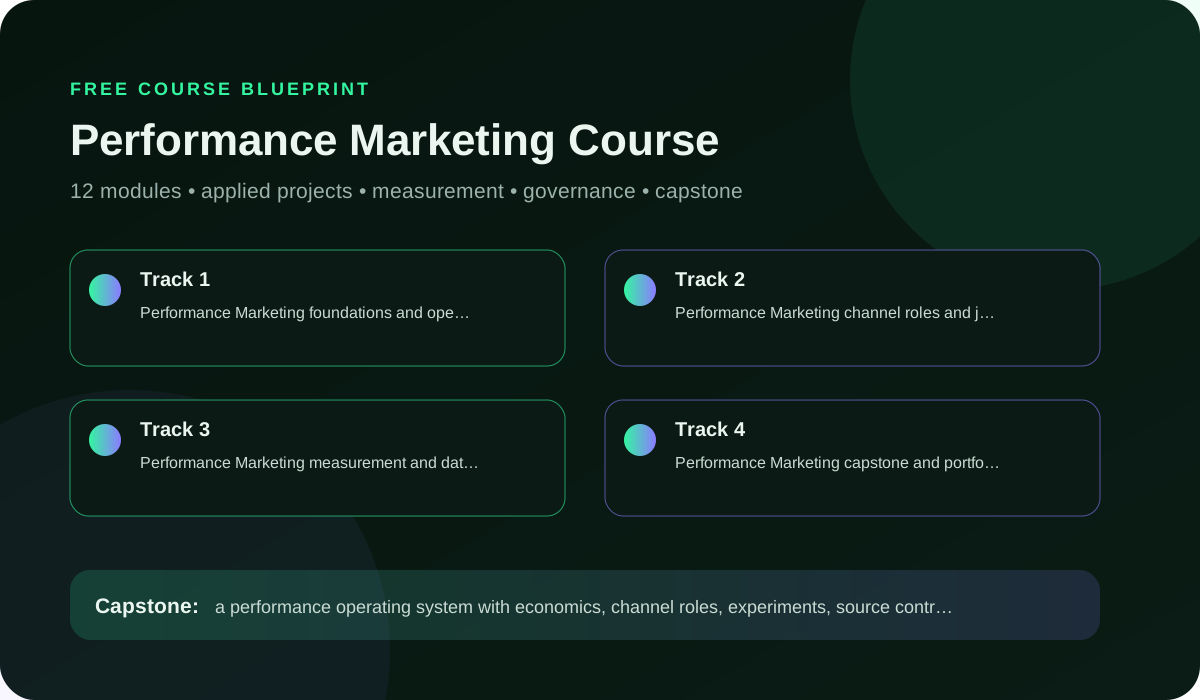
| Section | What you will learn and produce |
|---|---|
| Course promise, boundaries and truthfulness | Use a free self-directed curriculum to build a reviewable portfolio; a paid campaign is optional and separately funded. |
| Modules 1-2: Performance Marketing foundations and operating model and Performance Marketing audience, market and evidence research | Write a business brief, define the accepted outcome and separate observed audience evidence from assumptions. |
| Modules 3-4: Performance Marketing positioning, offer and message architecture and Performance Marketing channel roles and journey design | Create truthful message variants and trace the customer journey through the destination and acceptance system. |
Platform reference on account management: Google Ads manager accounts.
Direct answer: what should a Performance Marketing course teach?
A useful performance marketing course teaches you to connect audience research, an honest offer and paid-media choices with measurable business outcomes. You should finish able to define a conversion, reconcile tracking, calculate acquisition cost, design a controlled experiment and explain when to stop or expand a campaign. Our free curriculum is a self-directed learning blueprint, not an accredited qualification. Practise calculations with clearly labeled sample data first; use FroggyAds for an optional, separately authorized paid campaign when the destination, tracking and budget are ready.
| Course layer | What the learner does | Evidence of completion |
|---|---|---|
| Research | Investigate audience, market, channel and current-state evidence | Dated research brief with sources and uncertainties |
| Strategy | Define objectives, roles, priorities and exclusions for Performance Marketing | Approved operating plan and decision map |
| Execution | Create assets, workflows, campaigns and quality gates | Reviewable project artifacts and launch checklist |
| Measurement | Specify events, metrics, reconciliation and thresholds | Metric dictionary and decision dashboard |
| Governance | Protect ownership, consent, accessibility, policy and continuity | Control register with owners and review dates |
Course promise, boundaries and truthfulness
Use our curriculum to build the decisions a performance marketer needs to make before, during and after a campaign. It is designed for affiliate marketers, media buyers, analysts and growth teams who need more than a tour of an advertising interface. You will work with a defined offer, audience evidence, creative, a budget model and conversion records, then assemble the results into a portfolio. This page provides the study plan, not paid tuition, employment placement or an accredited certificate. You may study independently or arrange feedback from a colleague or mentor. We do not require you to run a paid campaign to complete the planning exercises.
Define completion as work you can demonstrate. You should be able to calculate a cost metric from its underlying records, explain why a source was retained or excluded, and distinguish an observation from an assumption. A profitable campaign is not required to pass a self-review: identifying a broken conversion event or declining an unaffordable test can be the better decision. Keep your first version, feedback and revision together so a reviewer can see how the work improved. At the start, write down which skills you already have and choose the evidence you will use to check the remaining gaps.
Choose one bounded case for the whole course. An affiliate case might examine approved commissions for one eligible offer; a SaaS case might follow trial users into activation and paid subscriptions. An ecommerce case could separate submitted orders from fulfilled orders after cancellations. State what the business sells, whom it can serve, what counts as acceptance and who may authorize spending. With no access to real campaign data, use a clearly labeled fictional dataset and keep its assumptions fixed until an exercise asks you to change them. Do not present simulated orders, interview notes or campaign returns as work performed for a real client.
Who the Performance Marketing course is for and what to know first
Start from module one when you are new to paid acquisition. You need a spreadsheet, a case you understand and time to investigate how an advertiser would define success. Experienced buyers can use the module outputs to locate a specific weakness: perhaps source reports are detailed but rejected leads never reach the analysis, or campaigns are well tracked but offer margins are missing. Analysts may spend more time on reconciliation and experiment design; creative specialists may focus on message continuity and test planning. Choose the parts that strengthen your actual responsibilities, while keeping the final project connected from the offer through the accepted outcome.
Check the prerequisites with a small calculation before selecting software. In a hypothetical exercise, 20 completed actions from 500 visits imply a 4% visit-to-action rate; USD 100 of media spend divided by those 20 actions gives USD 5 per action. Explain which visits and actions were counted and whether all 20 have been accepted. Then distinguish that media-only cost from a fuller acquisition cost including other relevant expenses. If the arithmetic or event definitions are unfamiliar, practise them before the bidding module. Access to company accounts or customer records is not a prerequisite and must never be assumed merely because you are following a course.
| Readiness area | Minimum starting point | Remediation if missing |
|---|---|---|
| Business context | One product, service or realistic case | Write a one-page case brief |
| Data literacy | Basic ratios, rates and spreadsheet use | Practice conversion, cost and margin formulas |
| Ethics and privacy | Awareness of consent, disclosure and access control | Review the official sources listed below |
| Execution access | A safe environment for drafts or test assets | Use mockups and documented simulations |
Learning outcomes for the Performance Marketing course
Your learning outcomes should describe decisions, not software buttons. By the end, aim to turn a business objective into a campaign brief, check whether a destination can deliver its promise, reconcile media reports with accepted outcomes, and evaluate a controlled change without moving the success definition. You should also recognize when measurement, source quality, offer eligibility or customer experience prevents a reliable conclusion. Apply these skills to a fresh case rather than repeat the example you memorized. We recommend a final review in which someone else follows your calculations and asks what evidence would make you change the proposed allocation.
Attach each competency to a piece of work. Objective setting needs a brief; source evaluation needs a dated comparison; tracking needs test records; cost analysis needs formulas and inputs; and a scaling recommendation needs a result plus a limit. Keep screenshots as supporting material, not as a substitute for the underlying definitions. Your portfolio should distinguish observed data, modeled assumptions and unresolved questions. The table below sets out practical outputs you can inspect in a self-review. It is not a promise that every learner will become commercially successful or complete the work in the same amount of time.
| Target outcome | Observable competency | Portfolio evidence |
|---|---|---|
| incremental conversions | Distinguish attributed conversions from causal impact and describe the comparison needed to estimate additional conversions. | Comparison-design note with known confounders and limits; no unsupported lift claim. |
| efficient acquisition | Reconcile spend with accepted outcomes and compare sources using the same cost and event definitions. | Reproducible CPA worksheet with rejected records and a stated observation window. |
| profitable growth and faster learning | Separate revenue, contribution, acquisition expense and uncertainty before recommending another allocation. | Economics and test-priority memo that states the loss limit and conditions for changing the plan. |
Complete Performance Marketing course curriculum
The twelve modules build on one case, from the business problem and audience research through creative, budgeting, measurement and a final decision. Complete a different practical output in each module and keep the definitions consistent across the project. The curriculum table identifies what to produce; the detailed lessons below explain how to review it.
| Module | Topic | Purpose | Required output |
|---|---|---|---|
| 1 | Foundations and operating model | Connect the customer problem to an accepted business outcome. | Business brief and accepted-outcome KPI tree. |
| 2 | Audience and market research | Separate supported audience choices from assumptions. | Dated research ledger and priority gaps. |
| 3 | Offer and message | Explain a truthful promise, its evidence and limitations. | Offer brief and two message variants. |
| 4 | Journey and channel roles | Map the path from advertisement to acceptance. | Journey map and handoff responsibilities. |
| 5 | Creative production | Create usable assets for a defined placement and hypothesis. | Creative versions and review notes. |
| 6 | Media budget and economics | Set funding, test allocation and a defensible cost boundary. | Budget and affordable-bid worksheet. |
| 7 | Measurement and tracking | Define, test and reconcile conversion records. | Event rules and tracking test results. |
| 8 | Experiment design | Choose a comparison that can answer the hypothesis. | Experiment plan and decision conditions. |
| 9 | Cohorts and customer value | Distinguish mature value from early or forecast results. | Cohort acceptance and contribution review. |
| 10 | Responsible operation | Assign access, approval and incident responsibilities. | Responsibility register and incident exercise. |
| 11 | Decision reporting | Turn the same evidence into operator and executive views. | Operator report and decision memo. |
| 12 | Capstone and review | Defend a consistent, reproducible project. | Portfolio, calculation check and review response. |
Modules 1-2: Foundations and audience research
In module one, write a one-page operating brief. Name the offer, the customer problem, the purchase or qualification step, and the outcome the business accepts. For an affiliate offer, separate a tracked conversion from a commission that survives the merchant's approval process. For a SaaS trial, distinguish registration from activation and a paid account. Draw the KPI relationship in words or a spreadsheet: spend buys media events; some visitors progress through the destination; a smaller set produces accepted value. Assign one primary decision metric and a few diagnostics. Explain why improving a click metric alone would not prove that the business objective has been achieved.
Test the brief against three practical questions. Can you tell when the customer action really happened, can the business serve the selected audience, and is there a limit on what it can spend learning? Ask a reviewer to describe the campaign back to you without using the channel name. If the explanation is only 'get more traffic,' the business objective needs work. Add a rejected-outcome example such as a duplicate lead or cancelled order and show where it belongs in the report. Your output is a usable brief with a clear acceptance rule, not a list of popular marketing terms or an assumed customer profile.
Module two creates the research ledger that supports the brief. Collect questions customers actually ask, the offer's eligibility conditions, destination constraints and relevant competitor promises. For every important entry, record the source, observation date, what it establishes and what it does not establish. A competitor's landing page shows that company's message; it does not prove conversion performance for your offer. Keep observed objections separate from persona assumptions. Rank the gaps by whether they could change the campaign decision, such as unsupported devices, delivery limits or a misunderstood recurring charge. Finish with an audience hypothesis that a creative or destination test could meaningfully challenge.
Review the foundation and research outputs together. Each audience choice should connect to a documented need or explicitly labeled assumption, and each outcome should connect to a record you could verify. Remove segmentation that serves no operational purpose; dividing a small test into many tiny cells may prevent you from learning anything useful. State the most important missing fact and a low-cost way to investigate it before spending on media. Complete the pair of modules when another person can identify the target customer, explain the acceptance rule and trace the main assumptions to their sources. Keep unanswered questions visible rather than inventing research to make the brief look finished.
| Module checkpoint | Performance Marketing foundations and operating model | Performance Marketing audience, market and evidence research |
|---|---|---|
| Primary question | Which customer action earns budget, and how is it accepted? | Which audience assumptions are supported, and what would change the plan? |
| Required artifact | Business brief and KPI tree connecting media activity to the accepted outcome. | Source ledger and a ranked list of research gaps. |
| Evaluation focus | Primary outcome versus diagnostic delivery metrics. | Strength, date and scope of evidence for each audience choice. |
| Quality gate | Another person can explain the offer, customer and acceptance rule. | Observations and assumptions are distinct; no invented interview or performance evidence. |
Connect Performance Marketing Course to a controlled audience test
Bring the audience hypothesis into FroggyAds only when the offer and destination are ready for a paid test. Choose an eligible format, the relevant audience constraints and a campaign allocation you have permission to spend. Keep the offer, creative premise and accepted-event definition stable while testing the audience choice. Our targeting and source reports help you inspect delivery, while your business records establish what the resulting actions are worth. For an offline assignment, complete the same campaign brief with sample inputs and explain which live checks remain pending; you do not need to fund an account merely to demonstrate the planning skill.
Create My Free Account
Modules 3-4: Offer, message and customer journey
Module three turns the research into an offer and message brief. Write what the customer receives, the cost or commitment, the main limitation and the next action. Then identify the evidence supporting the promise. A trial advertisement should not imply unrestricted free access when a charge or eligibility condition applies. An affiliate creative must stay within the actual offer terms rather than copy a competitor's stronger claim. Produce two truthful ways to introduce the same value, such as solving a specific problem or explaining a useful feature. Keep the destination and acceptance event constant so a later creative comparison does not also become an offer comparison.
Review the message through the complete customer journey. Ask someone unfamiliar with the case to identify who the offer is for, what they will receive and what happens after they respond. Inspect the mobile version, error states, confirmation and any handoff to a store, application or sales team. Record misunderstandings as test findings rather than dismissing them as poor traffic. Your submission should include the original copy, the issue found and the revised wording, together with evidence for the claim. A polished design does not pass this exercise when the offer is unclear, the destination contradicts the advertisement or the primary action cannot be completed.
In module four, assign a job to each channel in the plan. A paid placement may introduce an offer, search may respond to a stated need, and an opted-in follow-up may help someone complete a decision or use a product. These are planning roles, not a claim that every channel or platform provides every capability. Map the handoffs between the advertisement, landing page, checkout or lead form and the system that records acceptance. Note where campaign identifiers can be lost and where another team takes responsibility. Choose one initial acquisition route for the case before adding an entire channel mix that the budget cannot evaluate.
Finish the offer and journey modules with a continuity check. Every advertised benefit must remain accurate at the destination, and each important qualification or charge must be understandable before the user commits. Name the event recorded at each handoff and the person responsible for repairing a failure there. Explain which channel receives attribution in your report and why that reporting choice does not by itself establish causal impact. A useful submission includes one journey map, two approved message variants and a list of launch blockers. When the route is not usable, improve it before buying additional visitors to repeat the same failed experience.
| Module checkpoint | Performance Marketing positioning, offer and message architecture | Performance Marketing channel roles and journey design |
|---|---|---|
| Primary question | Is the promise truthful, understandable and appropriate to the customer? | Can the visitor complete the intended journey without a contradictory handoff? |
| Required artifact | Offer and message brief with two approved variants. | Journey map with destination, event and responsibility at each step. |
| Evaluation focus | Comprehension and accepted outcomes, not click-through rate alone. | Progression and failure events under a declared attribution approach. |
| Quality gate | Benefits, charges and limitations match the destination. | Handoffs work and the team knows who repairs a failed step. |
Modules 5-6: Creative production and media economics
Module five builds a creative-production record rather than a folder of unexplained variants. Give each asset a version, an audience hypothesis, a placement requirement, an approved claim and a matching destination. For Display, design for the dimensions accepted by the intended inventory; do not simply shrink a large banner until its text becomes unreadable. For other formats, identify the required assets and presentation constraints from current documentation or the campaign setup. Record usage rights and accessibility checks appropriate to the asset. The exercise should leave you able to identify which creative was delivered and what specific difference the next version is meant to test.
Use two variants to practise controlled creative comparison. Change one meaningful element, such as the opening benefit, while holding the destination, offer and success metric stable. Review both versions for truthful wording, legible text, understandable actions and realistic device presentation before considering media results. Keep failed versions and their review notes so the portfolio shows how the work developed. If a variant attracts more clicks but fewer accepted outcomes, discuss whether the message created interest without suitable intent. Do not call it the winner solely because its click-through rate is higher. Your output should explain the hypothesis, the asset changes and the evidence that would justify retaining either version.
Module six separates account funding, campaign allocation and media bids. Our USD 50 minimum deposit funds a FroggyAds account; it is not a recommended budget for every learning exercise. In a hypothetical bid model, an accepted conversion contributes USD 25 before media and occurs for 0.8% of comparable paid clicks. Expected contribution per click is USD 25 x 0.008 = USD 0.20 before additional costs or a risk reserve. This is a break-even illustration, not a bid recommendation or a forecast. Change the acceptance rate and contribution assumptions to see how quickly the affordable media price changes when the offer or source mix weakens.
Complete a budget worksheet with media allocation, creative and destination costs, tracking needs, a maximum learning loss and an uncommitted reserve. Decide which question the first paid stage must answer before any reserve is released. Estimate how often the accepted event may occur and how long it takes to confirm, then check whether the proposed test can plausibly support that review. An account balance is available funding, not an instruction to spend it immediately. Where the available budget cannot resolve the question, simplify the audience or creative plan, use an offline exercise, or defer the live test. Preserve the calculation and the decision rather than inventing a universally sufficient starter budget.
| Module checkpoint | Performance Marketing creative, content and production system | Performance Marketing paid distribution and budget lab |
|---|---|---|
| Primary question | What meaningful difference does each creative version test? | What can the campaign afford to learn before another allocation is approved? |
| Required artifact | Asset versions, placement requirements, claim evidence and review notes. | Campaign budget and affordable-bid model with explicit assumptions. |
| Evaluation focus | Creative response connected to accepted customer actions. | Expected contribution per click and maximum learning exposure. |
| Quality gate | Usable, truthful creative and a stable destination for the comparison. | Account funding, media budget, other costs and reserve are separately recorded. |
Modules 7-8: Measurement and experiment design
Module seven specifies how a conversion becomes a trustworthy record. Define the event name, the exact completion condition, the source system and the identifier needed to connect it with a campaign. Distinguish a page view, a form submission and a qualified lead; each can be counted correctly while answering a different question. Record time zone, attribution window, duplicate handling, rejected statuses and any delay before acceptance. For the exercise, use synthetic identifiers instead of customer contact details. The output is an event specification that a developer or analyst could test, including examples of a valid action, a duplicate and an action that should not be recorded as a success.
Test both the happy path and failure paths. Submit a valid sample action, try an invalid form, reload the confirmation page and repeat a test identifier. Record what each system counts and why. A second event on reload can inflate a conversion report even when there is only one customer record. A missing identifier can leave an accepted order unattributed without making the order disappear. Reconcile those distinctions in a small table rather than forcing every system to show identical totals. Complete the tracking lab when the expected records can be reproduced and the unresolved differences are explained, not merely when a dashboard displays a conversion number.
Module eight turns a proposed optimization into an experiment plan. State the hypothesis, the unit being compared, the variable changed, the primary outcome and the conditions that must stay stable. Decide how you will allow for conversion delay and what would require an immediate pause, such as an unusable destination or an exceeded authorized loss limit. Do not treat two campaigns run in different periods with different inventory as a clean randomized comparison. Where proper random assignment or a holdout is unavailable, label the limitations of the observational comparison. Your plan should still identify a reversible action and the evidence needed before that action becomes a larger allocation.
Interpret experiment results without turning a small difference into certainty. Four accepted conversions in one small group and three in another are observations, not enough information by themselves to declare a reliable winner. Review the exposure, spend, event delay, source composition and variability as well as the point estimate. A test can be technically valid and still inconclusive; that is different from showing that the alternatives are equivalent. Decide whether a larger or better-designed test is worth its cost. The module passes when you can defend the next step, including a decision to gather more evidence, and identify which conclusion the existing data cannot support.
| Module checkpoint | Performance Marketing measurement and data contract | Performance Marketing experimentation and optimization |
|---|---|---|
| Primary question | Which records prove that one valid conversion occurred? | What conclusion can the comparison design actually support? |
| Required artifact | Event dictionary and positive, negative and repeat-action test results. | Experiment plan with hypothesis, assignment method and decision conditions. |
| Evaluation focus | Accepted events after duplicate, timing and identity reconciliation. | Outcome difference, variability, maturity and remaining uncertainty. |
| Quality gate | The same inputs reproduce the accepted count and exclusions. | An inconclusive comparison is not relabeled as a winner or equivalence. |
Choose a paid-media format that supports Performance Marketing Course
Choose the format for the hypothesis, not because it appears in a lesson list. Use Display when the exercise concerns a visual message in a banner placement; consider Native for a message that needs continuity with its destination; and evaluate Push or Pop only with the corresponding delivery context and an eligible offer. Our format and source controls support the optional paid test, but you still need the same acceptance rule and budget boundary across comparisons. In an offline exercise, explain why a particular format fits the customer journey and list the asset, tracking and policy checks that would be required before launch.
Create My Free Account
Modules 9-10: Customer value and responsible operation
Module nine follows acquisition into customer value. Create a cohort from users or customers acquired during a stated period, then track the next meaningful stages available in the case: activation, paid conversion, fulfillment, renewal or another verified value event. Keep the original acquisition date and source attached where the data supports it. For an affiliate case, use approved commission status and later reversals rather than inventing access to the merchant's complete customer lifetime value. A cohort that looks efficient at signup can become unattractive after cancellations or weak activation. Your output should show where acceptance and value change after the first reported conversion.
Separate observed value from a forecast. A recently acquired cohort has had less time to renew or generate repeat purchases than an older cohort, so comparing their lifetime totals without adjusting the observation window is misleading. State the period each cohort has matured and show any projected future contribution as an assumption, not realized profit. In a payback worksheet, compare acquisition cost with accumulated contribution under an explicit cost definition rather than with gross revenue alone. The assignment should explain how refunds, service costs or retention uncertainty could change the scale recommendation. Do not use a best-case lifetime estimate to excuse a campaign that exceeds the business's agreed exposure limit.
Module ten makes responsible operation part of the campaign plan. Identify who owns the account, who may change a budget, who approves claims and who can pause delivery if a problem appears. Use the access permissions and security controls actually supported by the relevant systems; do not share credentials merely to complete an exercise. List the asset rights, disclosures, consent requirements and data-retention questions that need review for the chosen market. This curriculum does not replace legal or privacy advice. Your output is a practical responsibility and escalation record showing what must be approved before live work, what evidence is retained and how access would be withdrawn.
Run a tabletop incident exercise without changing a live account. Choose a scenario such as a destination becoming unavailable, a conversion event firing twice, or an unapproved creative appearing in the wrong campaign. Describe the immediate containment step, the person to notify, the records to preserve and the conditions for resuming. Avoid a response that destroys the evidence or silently restates old results. Connect the exercise back to customer value: technical delivery, permission to advertise and a completed business action are separate checks. A strong submission shows that the campaign can be stopped, investigated and restarted deliberately instead of relying on the buyer to notice every issue informally.
| Module checkpoint | Performance Marketing lifecycle, retention and value | Performance Marketing governance, privacy and quality |
|---|---|---|
| Primary question | What happens to accepted value after the first acquisition event? | Who may act, and what requires approval or a pause? |
| Required artifact | Cohort worksheet showing activation, acceptance, contribution and maturity. | Access and approval register plus a tabletop incident exercise. |
| Evaluation focus | Observed contribution and payback under a stated cost definition. | Readiness and unresolved risk, not a fabricated compliance score. |
| Quality gate | Forecast value is separate from realized value and equal-age comparisons are used. | Spending authority, asset rights, required reviews and escalation are explicit. |
Modules 11-12: Reporting and the capstone project
Module eleven creates two views of the same result. The operator view contains the source, device, creative, event window and cost details needed to diagnose a campaign. The executive memo leads with the business outcome, spending exposure, uncertainties and one proposed next action. Both views must use the same accepted-event definition and reporting period. Keep raw delivery metrics available, but do not make a manager infer business value from a page of click totals. State whether the recommendation is to continue, repair, retest, restrict or expand, and identify who must approve any additional spend. Reporting is useful when it makes the decision clearer without hiding contrary evidence.
Practise writing a recommendation that survives a skeptical review. Include the strongest supporting observation, the strongest alternative explanation and the condition that would reverse your conclusion. For example, an apparent source improvement may coincide with a new landing page or a change in the share of already interested visitors. Explain what the current comparison can isolate and what it cannot. Keep observed results separate from forecasts and use the same cost definition in the chart and the written summary. Your submission should let another buyer trace the recommendation back to the source records, reproduce the calculations and decide whether the proposed risk is justified.
Module twelve assembles the capstone from the work already completed. Keep the original business case, research ledger, offer brief, journey map, creative versions, budget worksheet, tracking specification, experiment plan, cohort review and decision memo together. Check that the outcome definition and source identifiers remain consistent across the files. Do not add an impressive revenue screenshot from an unrelated case to improve the presentation. A simulated capstone should remain clearly simulated throughout, including its charts and captions. The final assignment asks whether another practitioner could understand the campaign, repeat the analysis and carry out the next authorized action without needing to guess which version of the plan is current.
Defend the capstone through questions rather than a celebration of finished slides. Why was this audience chosen? What makes an outcome acceptable? Which cost or data assumption has the largest effect on the decision? What would you do after another period of weak results? Answer from the records, and mark any point that the available evidence cannot settle. Ask a peer to recompute one metric and follow one proposed campaign change back to its rationale. Revise the project after that review and retain the earlier version. Demonstrating that you can correct a mistake responsibly is more useful than claiming a flawless project or a guaranteed route to profitable campaigns.
| Module checkpoint | Performance Marketing reporting and decision communication | Performance Marketing capstone and portfolio defense |
|---|---|---|
| Primary question | What action follows from the result, and what could reverse it? | Can another practitioner reproduce and challenge the complete project? |
| Required artifact | Detailed operator view and concise executive recommendation. | Portfolio linking the brief, research, assets, calculations and decision history. |
| Evaluation focus | Accepted outcome, cost exposure and the economics of the proposed next step. | Consistency, reproducibility and honest treatment of limitations. |
| Quality gate | Both reports use the same period, acceptance rule and cost definition. | Sample data remains labeled and the learner can answer a new-case question. |
Applied projects and portfolio evidence
Build the portfolio around four applied projects, each with a different purpose. The KPI tree explains how an operating metric connects with business value. The bid model shows what the advertiser could afford under declared assumptions. The experiment backlog prioritizes uncertainty rather than listing every possible tactic. The executive review turns findings into an authorized next action. Reuse your case inputs across the projects, but do not submit the same generic checklist four times. Each project should include a first draft, a review finding and a revision. This gives a prospective manager or collaborator something more useful to inspect than a completion badge or an unexplained campaign screenshot.
| Project | Required components | Review question |
|---|---|---|
| build a KPI tree | Business objective, accepted event, diagnostic metrics and the relationship between them. | Can you explain why a click improvement may leave the business outcome unchanged? |
| model break-even bids | Conversion contribution, accepted rate, buying unit, additional costs and uncertainty. | Can you reproduce the affordable-bid calculation and show how weaker assumptions change it? |
| design an experiment backlog | Ranked hypotheses, supporting evidence, comparison method, effort and decision enabled. | Does the next experiment address an important uncertainty rather than an arbitrary tactic? |
| create an executive performance review | Accepted results, spend, major uncertainty, counter-explanation and proposed allocation. | Can the decision-maker trace the recommendation to records and understand the risk? |
Make weaknesses part of the portfolio, not something to hide. Add a short limitations note stating which data is fictional, which measurements are missing and which decisions could not be tested. For a live case, disclose only information you have permission to share and remove client or customer identifiers. A reviewer should still be able to recompute the main formulas from suitably anonymized or synthetic inputs. Describe one change you rejected and why it was not justified. That demonstrates judgment: an attractive creative, a low media price or an automated recommendation does not deserve implementation when the acceptance rule, budget authority or customer journey is unresolved.
Research and evidence workflow
Use research to answer an explicit question in the case. Start with the business's offer terms and available first-party evidence, then consult relevant official product documentation and authoritative guidance for technical or policy questions. A search result can help locate a source, but a snippet alone is not a complete explanation of a product capability or restriction. Record the exact claim the source supports, when you reviewed it and any qualification that changes its meaning. Keep competitor messaging in a separate column from verified capability. The output should show how a source changed the plan, rather than a long bibliography that has no connection to the campaign decision.
Turn important assumptions into testable statements. For example, 'the audience is mobile' is too broad to explain a campaign setup. A useful hypothesis might be that the selected mobile destination allows the intended visitor to complete onboarding without losing the campaign identifier. State how you would inspect that path and what failure would change the launch decision. Prioritize a missing fact that could invalidate the offer before a minor question about creative preference. Keep confidence labels plain: observed, supported by a source, assumed for the exercise or unknown. Do not convert an assumption into a fact merely because it appears repeatedly in the research notes.
Maintain the research when the plan changes. Before a live test, revisit the sources that determine eligibility, charging, tracking and customer commitments. Preserve the previous version and explain which decision changed after the update. An interface tutorial may still teach a useful concept even when a menu label has moved; a changed billing definition or offer restriction needs more than a cosmetic screenshot update. For your coursework, record one example of documentation that clarified a decision and one question it left open. This separates transferable learning from memorizing a screen and prevents a stale vendor comparison from becoming the basis for a current spending commitment.
Tool and data stack without vendor lock-in
The Performance Marketing course may use tools for paid search, paid social, programmatic media, affiliates, lifecycle channels and conversion systems, but the learner should define the operating job before choosing software. A tool is useful when it improves evidence collection, workflow consistency, access control, production quality, experimentation or reporting. It is not automatically valuable because it includes automation or an AI feature.
Evaluate a tool by taking one sample record through it. Can you import the inputs, retain the original identifier, export the result and explain any transformation? Check who owns the account and data, which permissions are required and what happens when a team member leaves. A reporting tool that looks convenient but cannot preserve the acceptance status may not answer your business question. Use synthetic records for the evaluation and record limitations such as delayed data or missing source fields. You do not need a paid subscription to every tool category to complete the curriculum; a transparent worksheet is sufficient for many of the planning and calculation assignments.
| Stack role | Selection question | Minimum evidence |
|---|---|---|
| Research | Can the tool preserve sources, dates and uncertainty? | Exportable source ledger |
| Production | Can assets be versioned, reviewed and made accessible? | Approval and export test |
| Activation | Does the operator retain account and audience ownership? | Access-control record |
| Measurement | Can results be reconciled to authoritative outcomes? | Event and identity test |
Audience, journey and message lab
In the Performance Marketing course, audience work begins with observable situations rather than decorative personas. Identify the problem, trigger, constraints, alternatives, objections, desired progress and evidence sources. Then map how paid search, paid social, programmatic media, affiliates, lifecycle channels and conversion systems can support discovery, consideration, conversion, onboarding, retention or referral without forcing one channel to perform every job.
Build a message brief with six parts: the audience, the problem, the promised value, supporting evidence, material limitations and the next action. Review comprehension before adding polish. A suitable reader should be able to explain what is being offered, what commitment is required and why the destination is relevant. Then adapt the same promise to the chosen placement without hiding a condition to make the advertisement more clickable. Keep the original wording and the revised version beside the reason for the change. If your message test uses only internal reviewers, describe that limitation instead of presenting their reaction as proof of market demand.
Evaluate journey continuity. The promise in a Performance Marketing asset must match the landing page, signup, checkout, app store, conversation or sales handoff. Record load speed, mobile usability, consent language, form friction, error handling and post-conversion expectations. A high click rate with a broken journey is not a successful course outcome.
Turn Performance Marketing Course into a bounded campaign test
Use the completed journey map to decide whether a paid test is ready. Trace one visitor from the advertisement to the destination and through the action the business accepts. Confirm the creative version, campaign identifier, event definition, authorized allocation and person who can pause the test. FroggyAds gives you a place to configure the supported media controls; the exercise still needs a usable offer and a measurement path. Start with the narrowest setup that can answer the question. For self-study without live access, submit the campaign specification and test plan instead of suggesting that you launched or measured a campaign you did not run.
Create My Free Account
Paid distribution and FroggyAds practice lab
Paid distribution in the Performance Marketing course is a controlled experiment. Start with an audience hypothesis, truthful creative, relevant destination, conversion event, test budget, source controls and stop rule. When you are ready for an authorized live test, our self-serve platform supports Push, Native, Display and Pop campaigns with targeting, source controls, SmartCPC and Adscore-supported screening. It is an advertising platform, not a simulated course sandbox. You can complete the planning and calculation exercises without buying traffic. Our $50 minimum deposit is for a funded advertising account, not course tuition or a free practice balance. Any live campaign uses real media spend and needs its own approved test budget.
For the practice lab, distinguish purchased delivery from an accepted customer action. In a hypothetical dataset, USD 180 of media spend produces 12 submitted leads but only nine approved leads. Raw cost per submitted lead is USD 15; accepted CPA is USD 20. Ask the learner to reconcile the three rejected records and explain which cost belongs in a scale decision. The exercise is complete when the event definition, approval window and calculation can be checked, even if the right decision is not to buy more traffic. These figures are sample data, not FroggyAds customer results.
Write the practice-lab conclusion before you write a scaling recommendation. Name the creative or audience hypothesis, summarize the accepted outcomes after the agreed review window, and identify any tracking or source-mix change that complicates the comparison. When the available evidence is limited, propose the next test rather than declaring a winner. Keep bid, budget, source, device and destination versions in the same record so another reviewer can reconstruct the conditions. Our source reports can inform the media decision, while the advertiser's acceptance process determines the outcome used in the analysis. A completed lab can end with a pause, a repair or a carefully bounded follow-up.
Measurement contract and economics
Write the measurement definitions before working with results. Media CPA divides media spend by accepted conversions; a broader customer acquisition cost may include additional expenses and should be labeled accordingly. ROAS compares attributed revenue with media spend, while contribution and payback answer different economic questions. Record the event source, reporting period, time zone, attribution window, duplicate rule and acceptance delay beside the metric. Treat incremental impact as a separate causal question that requires a suitable comparison design, not a new name for attributed conversions. A learner should be able to explain why two dashboards can disagree without assuming that either total is automatically the business truth.
Build an economics worksheet from declared inputs rather than a revenue screenshot. Calculate media CPA as media spend divided by accepted conversions, and calculate ROAS as attributed revenue divided by media spend. ROAS is not profit: show creative, tracking, service, product and other relevant costs separately before making a margin claim. In your assignment, state the event source, reporting window, duplicate policy and acceptance status next to every denominator so another learner can reproduce the result.
Reconcile reports at the record level when possible. Start with a small sample containing a campaign identifier, the reported action, its time and the business acceptance status. Separate duplicates, late events, missing identifiers and later rejections instead of applying one unexplained adjustment to the total. Keep raw counts intact and create a clearly labeled accepted-outcome view. For an offline assignment, invent the sample records openly and show how each rule changes the denominator. The exercise is successful when another person can follow the reconciliation, understand the exclusions and reproduce the final cost calculation without needing to trust your interpretation of a screenshot.
Experiment design and optimization cadence
An experiment plan needs a hypothesis that can be wrong. For example, propose that simplifying a form will improve the rate of accepted enquiries, not merely increase submissions. State the compared experiences, the assignment or comparison method, the primary metric, the observation window and any guardrail such as rejection rate. Keep the offer and measurement rules stable unless they are the intended variable. Identify whether the available design supports a causal conclusion or only an association. Plan the analysis before reading results so the definition of success does not drift toward whichever metric happened to improve. A test record should also explain when technical failure would make the comparison unusable.
Prioritize the experiment backlog by the decision at risk. Fix a broken destination or duplicate conversion event before testing a minor headline variation, because those defects make later performance difficult to interpret. For each proposed experiment, record the suspected problem, likely consequence, evidence already available, effort required and the action that a useful result would permit. Do not invent a numerical priority score whose precision exceeds the information you have. A short ranked backlog with clear reasons is better than dozens of ideas that cannot receive enough attention or spend. Keep rejected and deferred ideas visible so the team does not repeatedly rediscover a question that was already considered.
Choose the review cadence from event frequency, conversion delay and the cost of waiting. Frequent checks are useful for broken links, unexpectedly rapid spend or invalid event patterns; they do not make an immature conversion comparison conclusive. Avoid changing several settings every time a dashboard fluctuates. Preserve the baseline, collect the planned observations and document any necessary intervention. When a budget increase changes the mix of sources or users, inspect that new mix rather than assuming the earlier average still applies. The optimization record should explain what changed, why it changed and what result would justify keeping the change, with uncertainty left visible until the relevant outcomes have matured.
Governance, privacy, accessibility and quality
The Performance Marketing course includes governance because execution quality depends on ownership and safeguards. Maintain client-controlled accounts where applicable, least-privilege access, multifactor authentication, approval records, asset rights, source documentation and a transition plan. Review risks such as last-click bias, undercounted costs, unstable tracking and premature scaling with named owners and escalation routes.
For a live project, identify which privacy and advertising requirements apply to the actual market, data and channel. Review the purpose of collection, the necessary permissions, access, retention and relevant opt-out or suppression process with the responsible team. Use synthetic data in exercises that do not need real customer records. A generic course checklist cannot determine the lawful basis or satisfy every jurisdiction's requirements, and this curriculum is not legal advice. Keep any required specialist review as a launch condition rather than assuming a marketing-platform setting resolves it. In your portfolio, explain the questions you investigated and the limits of your authority without claiming legal approval you did not obtain.
Accessibility is part of performance quality. Provide readable contrast, meaningful alternatives, captions or transcripts where relevant, keyboard access, understandable forms and destinations that work across representative devices. Test the Performance Marketing journey at mobile, tablet and desktop widths and document any limitation before launch.
Suggested twelve-week study schedule
Use the twelve-week schedule as an optional sequence, not a promise of competence within a fixed time. Your pace depends on prior knowledge, case complexity and time for feedback. Complete each required output before moving to a dependent task. A tracking error needs correction even when the calendar says it is time to experiment. Judge progress by the review question, not hours of attendance.
| Week | Focus | Applied work | Review question |
|---|---|---|---|
| 1 | Business foundations | Write the brief and KPI tree. | Is the outcome clear? |
| 2 | Audience research | Build the research ledger. | Are sources dated? |
| 3 | Offer and message | Draft two truthful messages. | Is the promise true? |
| 4 | Customer journey | Map journey and event handoffs. | Do handoffs work? |
| 5 | Creative production | Review the versioned creative set. | Can assets be traced? |
| 6 | Budget and economics | Model the budget and bid limit. | Are costs separate? |
| 7 | Tracking and measurement | Specify and test the event records. | Do records reconcile? |
| 8 | Experiment design | Design a controlled comparison. | Is the inference valid? |
| 9 | Cohorts and value | Review mature cohort value. | Are cohorts comparable? |
| 10 | Responsible operation | Document access and incident response. | Who may change spend? |
| 11 | Decision reporting | Write operator and executive reports. | Is the action supported? |
| 12 | Capstone review | Defend and revise the portfolio. | Can you reproduce it? |
At the midpoint, review the audience, offer, journey, creative and proposed budget as one connected plan. Do not start a live test just because the first six modules are complete; confirm that the destination, tracking, permissions and campaign review are also ready. In the final week, ask a peer, manager or structured self-review to challenge the capstone. Recompute a metric, trace a source decision and check which assumptions remain unresolved. Keep the feedback and your response together. The useful outcome is an improved operating plan and a clearer explanation of its limits, not a claim that attendance or elapsed time establishes professional accreditation.
Capstone: integrate the Performance Marketing operating system
The final capstone is a performance operating system with economics, channel roles, experiments, source controls, reconciliation and capital allocation decisions. It should contain an executive brief, evidence ledger, audience and journey map, channel architecture, creative or content system, paid distribution plan, measurement contract, experiment backlog, budget model, governance register and a ninety-day operating calendar.
Prepare a short defense of the capstone with the case objective, the strongest evidence, the largest uncertainty and the proposed next action. Support the decision with the underlying worksheet and records rather than relying on a presentation alone. Explain what would happen if an important assumption weakened, such as a lower lead-approval rate or a higher media cost. Show which parts of the plan you would preserve and which you would change. A reviewer should be able to distinguish a measured result from a scenario and understand the maximum exposure of the next test. Treat an unanswered challenge as work to resolve, not something to obscure with more marketing terminology.
Prepare a shareable portfolio separately from the working files. Remove customer contact details, account credentials, confidential commercial terms and any material you lack permission to disclose. Where privacy or confidentiality prevents showing real records, create an explicitly labeled synthetic example that preserves the calculation method without implying it is the original campaign. State your own role and which parts were completed by others. Keep the evidence of permission in the private project record. The public version should demonstrate your analytical and operational skills without exposing a client or claiming sole credit for work that depended on another team.
Assessment rubric
For this suggested self-review rubric, zero means evidence is absent; one means the work is described but not demonstrated; two means it is partly supported; three means the result is usable with its limitations stated; four means another person can reproduce it; and five means it has also been challenged and revised where needed. Apply those anchors to each category below. Do not average away a critical problem: an unsupported claim, missing spending authority or invalid event definition still blocks a live launch. The rubric is a learning aid, not a FroggyAds certificate or an external accreditation standard.
| Category | Assessment question | Score |
|---|---|---|
| Strategic fit | Does the plan connect one serviceable audience and a truthful offer to a business-defined outcome? | 0-5 |
| Evidence quality | Can each important claim or assumption be traced, dated and distinguished from modeled data? | 0-5 |
| Execution readiness | Are the creative, destination, event tests, spending authority and stopping conditions ready? | 0-5 |
| Measurement reliability | Can another learner reproduce the accepted count, cost calculation and cohort comparison? | 0-5 |
| Governance | Are account access, asset rights, required specialist reviews and incident responsibilities documented? | 0-5 |
As an optional self-review rule, aim for at least 20 points across the five categories, with no category below three. This is a suggested coursework threshold, not an industry certification standard or a guarantee of job readiness. A missing spending authorization, unsupported claim or broken conversion definition should block a live launch regardless of the total score. Write a specific revision for each weak category and rescore only after the evidence changes. Ask a reviewer to inspect one item you initially considered strong; explaining a disagreement about evidence is part of the learning. Keep the score linked to the submitted version so a later rewrite does not inherit an outdated assessment.
Common mistakes in a Performance Marketing course
A common course mistake is collecting tactics before choosing a business problem. You can finish many tutorials yet still be unable to explain which audience to serve or what counts as an accepted outcome. Another is memorizing interface steps without learning the decisions behind them. Menus and settings can change, while the need to define ownership, budget limits, event meaning and source evidence remains. Test your understanding by moving to a fresh fictional case and writing the brief without copying the previous one. When a lesson depends on a particular interface, consult current documentation and separate that platform-specific detail from the broader method you are trying to learn.
The third mistake is treating reported activity as proof of value. For Performance Marketing, metrics such as incremental conversions, customer acquisition cost, return on ad spend, contribution margin and payback require definitions and reconciliation. The fourth mistake is omitting risk and accessibility because they appear non-promotional. In practice, consent, account control, disclosure, brand safety and destination quality can determine whether the work is usable at all.
Avoid a portfolio made only of polished final outputs. Retain the first draft, review comments, calculations and the decision that led to the revision. A smaller project with a clear learning record can show more competence than a large presentation with no traceable inputs. Be precise about results: name the reporting window, accepted event, cost definition and whether the case is real or simulated. Do not call a modeled return a customer result. A reviewer should be able to see what you changed after feedback and why, including a decision to stop an unsuitable test rather than keep spending to produce a more impressive screenshot.
Performance Marketing course decision scorecard
| Decision area | Question | Ready when |
|---|---|---|
| Problem | Is the business problem ranked and bounded? | Owner, audience, outcome and constraint are documented |
| Execution | Can another person operate the plan? | Workflow, access, assets and QA are reviewable |
| Evidence | Can claims and metrics be traced? | Sources, definitions and reconciliation are recorded |
| Economics | Does the test have loss limits and value thresholds? | Budget, break-even and stop rules are approved |
| Governance | Are customer, brand and account risks controlled? | Named owners, safeguards and escalation exist |
Performance Marketing courses: choosing and comparing learning paths
Choose a learning path around the support you actually need. Our free curriculum suits self-directed learners who can complete a case, use current documentation and arrange their own review. A facilitated course may be useful when you need scheduled feedback or help diagnosing a difficult assignment; inspect what the provider genuinely includes before paying. A short workshop can address one skill, while workplace training should help a team apply and maintain that skill in its own process. Credential evaluation is a separate decision. Compare the syllabus, practical outputs, prerequisites, review method and evidence of instructor competence rather than assuming that similar course titles deliver the same experience.
Include the full cost of learning in a comparison. Tuition is only one possible expense; consider learner time, required tools, any separately authorized practice spend and the work needed to apply the lessons. Ask whether assignments use sample data or require access to a live account, whether feedback is individual or automated, and whether the materials explain their limitations. A completion badge alone does not demonstrate that you can reconcile data or defend a campaign decision. Use our curriculum as a reference for the skills and outputs you want to build, and check a paid provider's current terms and deliverables rather than choosing from employment or income promises.
| Comparison dimension | Evidence to request | Warning sign |
|---|---|---|
| Curriculum | Objectives, sequence, projects and prerequisites | Topic list without applied outputs |
| Credibility | Named sources, update dates and qualified review | Unsupported authority or outdated screenshots |
| Measurement | Metric definitions, reconciliation and decision rules | Vanity metrics presented as business impact |
| Portfolio value | Reviewable briefs, experiments and capstone evidence | Completion badge without demonstrable work |
Frequently asked questions
Who is ready to take a performance marketing course?
Learners benefit from basic customer, channel and commercial knowledge plus access to a bounded practice case. A course cannot replace the authority required to spend company funds or handle customer data.
Which learning outcomes make a performance marketing course useful?
Useful outcomes cover objective setting, tracking, cost analysis, experimentation, reporting and responsible decisions. Completion should demonstrate applied understanding rather than familiarity with interface labels.
What curriculum connects campaign delivery with actual customer economics?
Audience research, offer analysis, media cost, attribution, validation, margin and retention connect activity with value. A curriculum focused only on clicks leaves the commercial chain incomplete.
Which teaching approach keeps frequently changing tools understandable over time?
Tool demonstrations should explain the underlying decision, inputs, limitations and verification route. Current documentation can update interface details without making the lesson dependent on one screen.
What privacy and data-handling duties should performance marketers practise?
Purpose, source, permission, minimisation, access, retention and withdrawal need practical treatment. Learners should understand when qualified privacy or legal review is required, and practice cases should model those boundaries.
Which controls make a course experiment safe for a real business?
A bounded audience, budget, duration, approved claim, accepted outcome and pause condition limit exposure. Practice should use suitable accounts and data rather than bypass production controls.
How can students test attribution without treating it as certainty?
Declared events, windows, duplicate rules, channel references and reconciliation allow reproducible analysis. Reports should keep model assumptions and unresolved credit visible, while independent exercises reveal transferable judgement.
What instructor evidence supports trust in a performance marketing course?
Relevant operating experience, current examples, transparent methods and acknowledged limitations strengthen credibility. Revenue screenshots without context do not demonstrate teaching quality or repeatability, so references deserve verification.
Which assessment shows that performance marketing skills can transfer?
A learner can analyse a new case, define controls, calculate complete cost and defend a decision with evidence. Repeating a memorised platform workflow is weaker proof.
Under what circumstances does performance training justify its full cost?
The course creates value when applied skills improve decisions, reduce avoidable waste or strengthen customer outcomes. Tuition, learner time and implementation resources belong in that evaluation.
Evaluate certification after building the underlying competence
The Performance Marketing Certification guide explains how to compare issuers, recognition, assessment, practical evidence, accessibility, renewal and credential claims. Use this free course to build the skills and portfolio first. FroggyAds does not award or accredit the credential.
Related Performance Marketing learning guides
Practical training blueprint for Performance Marketing
Use the Performance Marketing Training guide when the need extends beyond this course curriculum. It is a non-accredited implementation framework for facilitated practice and workplace transfer.
Official sources used
Use current official documentation to validate the Performance Marketing course before applying it in a live account or regulated market. Platform interfaces, policies, consent rules and measurement capabilities can change. The sources below support governance, accessibility, advertising and channel-specific parts of the curriculum.
Connect Performance Marketing learning to controlled paid distribution
Choose FroggyAds for the paid-media stage when you need to connect a prepared offer with supported format, targeting, budget and source controls in a self-serve workflow. Your course work should already explain the customer journey, accepted event and maximum learning exposure. Use our reporting to investigate delivery and source differences, then reconcile the result with the business records that define value. Registration is free; a funded campaign uses real advertising spend and does not create a course credential. Start with one clear question, complete the applicable review and use the outcome to decide the next allocation rather than treating available balance as a reason to expand.
How to apply this curriculum
Use our curriculum to develop a campaign plan, practise the calculations and review your decisions. For guidance on comparing learning providers and course options, see Top Performance Marketing Course. Use that resource for shortlisting; return to this curriculum for the practical assignments and portfolio review.
Before moving from study to execution, assemble the audience brief, approved message, destination test, tracking specification and spending authorization. Each serves a different purpose: a good offer does not repair missing event data, and accurate tracking does not make an unsuitable message acceptable. Our campaign controls give you a way to put the media plan into practice once those inputs are ready. For self-review, explain which setup choices follow from the case and which are still provisional. Keep the plan small enough that a result can answer the question you intended to test.
| Course step | What to practise | Work to keep |
|---|---|---|
| Answer | Explain the customer problem, offer and accepted action before choosing a channel. | One-page case brief and a KPI tree separating delivery from business value. |
| Apply | Create an offline campaign specification; use a live test only with permission and a separate budget. | Reviewed creative, destination checks, event rules and declared funding assumptions. |
| Check | Recompute accepted acquisition cost and defend a continue, repair, test or stop decision. | Reconciled sample records, transparent formulas, limitations and a versioned decision memo. |
Use a transfer exercise to check whether you learned a method rather than a formula by memory. Change the case from a submitted lead to an approved subscription, then identify which event, cost and review-window definitions must change before comparing acquisition efficiency. Rebuild the metric from its inputs and state what can no longer be inferred from the old report. Do this offline with labeled sample records first. The exercise is complete when another learner can follow your revised definitions and explain why the previous conversion count is not interchangeable with the new one.
When your offer, destination and measurement plan are ready for an authorized paid test, use our self-serve campaign controls to put the work into practice. Keep the allocation separate from account funding and use accepted outcomes to decide the next step. Create your free FroggyAds account.
Performance Marketing Course worked application example
Hypothetical final review: a campaign records eight orders from USD 200 of media spend, but two orders are cancelled before acceptance. Cost per recorded order is USD 25, while cost per accepted order is USD 33.33 after rounding. Ask which figure belongs in the acquisition decision and what additional costs or order value are still needed before discussing profit. Keep all eight records and their statuses; do not delete rejected outcomes simply to make the report look cleaner. These are sample coursework figures, not a FroggyAds customer case or a suggested campaign budget.
Performance Marketing Course: A Practical Curriculum from Foundations to Measured Execution — what matters first
Choose this free performance marketing curriculum when you need a practical sequence from an acquisition objective to a reviewable campaign decision. Start with a bounded case, complete the tracking and economics exercises, and prepare truthful creative before considering live spend. We provide the self-serve advertising controls for an optional test; your portfolio should show what the evidence supports, what remains uncertain and why the next action follows from the results.