
1. Choose the useful customer outcome
Describe the result the business can use. If sales cannot contact a submission or fulfil an order, an easier form has not necessarily improved the commercial journey.
By FroggyAds. Published 18 July 2026; updated 15 October 2026.
Conversion rate optimization is a continuous, evidence-led process for improving the share and quality of visitors who complete an accepted action through research, prioritization and controlled experiments. Choose the barrier worth fixing before choosing a new design. We help you connect that decision with suitable FroggyAds traffic, so the next campaign reaches people who can use the offer.
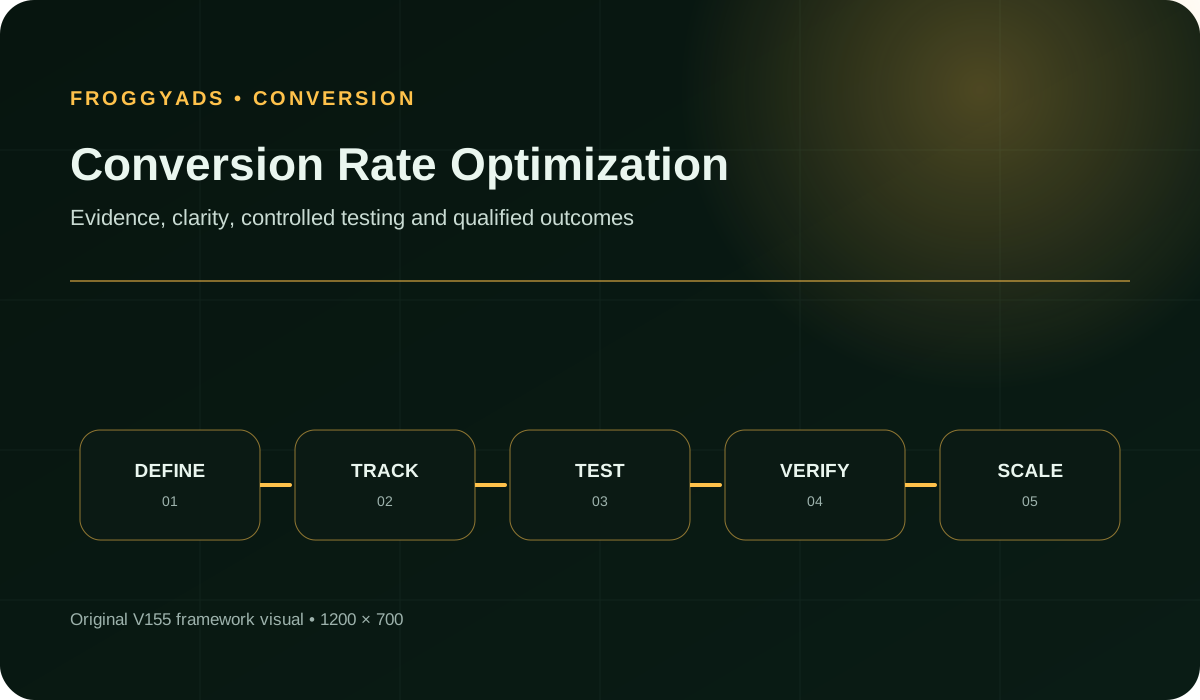
Quick answer: Improve the path from suitable interest to a useful customer outcome. Choose a specific barrier and check whether removing it helps the business as well as the visitor.
The Google Analytics: About conversions based on events reference explains that conversion settings differ according to their event source and measurement view. Choose the event that represents your decision, then verify what it counts. A completed form, a qualified enquiry and a retained customer are related stages, not interchangeable achievements.
No. Prioritise a barrier you can explain, affect and evaluate. A large drop-off may reflect unsuitable visitors, missing measurement or a reasonable customer decision.
A person who learns that your service does not cover their area has not necessarily encountered a defective page. Making that person submit a form anyway can increase the reported conversion rate while adding waste. Start by asking whether the intended customer has enough information and a workable route to make the right decision.
Compare the likely value of the correction with its effort and uncertainty. A reproducible error affecting suitable buyers can deserve attention before a cosmetic test affecting many indifferent visitors. Keep the supporting observation specific: a failed payment method, misunderstood eligibility rule or unanswered product question is more useful than a general wish for more engagement.
Combine the report with direct inspection of the relevant path. If mobile users fail at payment, try the actual payment route and inspect the error evidence. If enquiries are rejected, read the stated rejection reasons. Avoid redesigning a screen solely because a funnel chart becomes narrower at that point.
The report’s settings also matter. Google Analytics’ funnel exploration guidance distinguishes open funnels, which allow entry at any step, from closed funnels, which require entry at the first step. Its sequence rules affect who appears later. A missing stage count can therefore be a measurement question before it becomes a customer-experience conclusion.
Use feedback to develop an explanation, then check it against the observed behavior. One complaint can identify a real defect without establishing its prevalence. A survey answer can suggest an unanswered concern without proving that new copy will resolve it. Keep those limits visible while choosing the next action.
FroggyAds gives you audience, bid, budget and source controls for supported traffic buying. Use them to reach people who can benefit from the offer. A clear destination and a relevant audience give the optimization work a useful commercial purpose.
Create My Free Account
| # | Question | How the answer guides the work |
|---|---|---|
| 1 | Which customer is struggling? | Identify the relevant device, use case or eligibility condition before generalising the problem. |
| 2 | What cannot they do or understand? | Name the failed action or unanswered decision, rather than a vague engagement target. |
| 3 | What shows that barrier exists? | Use reproducible errors, relevant feedback or a clearly defined behavioral pattern. |
| 4 | Which part can we change? | Separate offer, message, functionality and acquisition problems so the proposed work fits the cause. |
| 5 | What useful outcome should improve? | Choose an accepted customer action that the business can handle and value. |
| 6 | What could become worse? | Check downstream quality, expense and operational effort alongside immediate response. |
| 7 | What does the change cost? | Include implementation and review effort, not just the price of a testing tool. |
| 8 | What would justify keeping it? | Define the evidence and uncertainty that the next decision must accommodate. |
Answer these before commissioning a redesign or buying more test traffic. Each question should change what you build, measure or decide.
Describe the result the business can use. If sales cannot contact a submission or fulfil an order, an easier form has not necessarily improved the commercial journey.
Identify who reaches the suspected barrier and under what conditions. Keep differences in intent, device or eligibility visible before treating the whole site as one audience.
Inspect the implementation and available customer evidence. Confirm that a reported abandonment is not simply a missing event or a path that bypasses the expected step.
Write the reason a suitable visitor may struggle. Link it to something observed, such as an unclear charge or unavailable delivery option, rather than a design preference.
Consider how many relevant people are affected, the value of helping them and the effort required. Avoid giving a precise-looking priority score more authority than its uncertain inputs deserve.
Repair a verified broken function through normal quality checks. Use an appropriate controlled comparison when the commercial effect of a proposed alternative is genuinely uncertain.
Test the customer action through its receiving system, not only the changed screen. Verify that the outcome still reaches the people or process responsible for using it.
Keep the intended audience and evaluation rules stable enough to interpret the result. Record promotions, source changes or operational interruptions that alter the comparison.
Allow the relevant later status to become visible. Check whether easier completion produced usable customers, rather than counting every new event as the same kind of improvement.
Preserve the result and its limits. A neutral finding can save future effort, while a harmful change should not remain merely because it took time to produce.
Choose a supported FroggyAds format that fits the invitation and destination. Use targeting and source controls to keep the audience relevant while you investigate the journey. Changing the traffic mix and the experience together can make a result harder to explain.
Create My Free Account
Google Ads’ conversion-rate definition uses tracked conversions relative to eligible ad interactions. Your site review may instead use users or sessions. Name the population explicitly, and keep it consistent across the comparison. Different counting choices can produce different percentages without any change in customer behavior.
| Measure | Use in the review | Limitation to keep visible |
|---|---|---|
| Eligible audience count | Shows the opportunity the change could affect. | Not every visit belongs to the same customer decision. |
| Completion of the intended action | Describes progress through the selected route. | An event can complete without becoming a useful customer. |
| Accepted outcome rate | Connects response with the business acceptance rule. | Later status and missing records can change the interpretation. |
| Value per relevant visitor | Relates observed value to the audience being compared. | One unusual order can dominate a small group. |
| Error or failure incidence | Helps establish whether the route works for the intended conditions. | A technical repair does not quantify its commercial lift by itself. |
| Downstream cost or harm | Reveals refunds, unsuitable leads or handling burden. | Use a comparable review period so the newer group is not judged too early. |
Read the rate with the counts and the later customer status. A more persuasive invitation can be useful, but an easier action can also bring more unsuitable demand. The review should show what the business gained and what additional work or risk came with it.
A team defines a conversion as a sales-accepted lead rather than any form submission, then compares campaign changes only after the acceptance window closes.
A retailer separates purchase conversion rate from add-to-cart rate and evaluates revenue, margin and returns before scaling traffic.
A software business measures trial activation and paid retention so an increase in signups does not hide lower customer quality.
Check whether the period contains more returning customers, branded demand or another high-intent group. A changed mix can improve the average without improving the journey for anyone.
Verify that tracking still represents the same event. Adding another trigger or counting repeated submissions can create a numerical improvement without another useful customer.
Inspect acceptance, refunds or retention before widening the change. A larger early response is not enough when the business receives less useful demand afterward.
Keep the original question and planned measures available. An unexpected finding may be worth investigating, but it should not be presented as the outcome the test was designed to prove.
Check what additional customer activity requires from sales, support or fulfilment. A useful change can still need a measured rollout if the business cannot serve the extra demand well.
Keep a result that disappoints the team as carefully as one that looks promising. It can prevent the same weak assumption from becoming the next expensive redesign.
When the evidence points to unsuitable traffic, use FroggyAds targeting and source choices to refine the purchase. When it points to a broken customer route, fix that route before buying more visits. Our controls help you act on the relevant media finding.
Create My Free Account
A proposed change deserves a business case proportionate to its cost. Count the implementation, review and ongoing work it introduces. Then identify the relevant audience and value of an additional accepted outcome. Use plausible ranges when those inputs are uncertain instead of turning a hopeful lift estimate into a commitment.
Keep fixed and recurring costs separate. A one-time correction has a different break-even question from a service that adds expense every month. If the plan requires more traffic, include that incremental purchase too. A higher conversion rate can still leave the overall project uneconomic when the cost of obtaining it is omitted.
Use the calculation to choose what deserves investigation, not to manufacture a forecast. The observed barrier may be real while its potential value remains unclear. A smaller diagnostic step can help establish the opportunity before a broad rebuild, provided it answers a useful question rather than postponing a necessary repair.
We help you manage the acquisition part of the journey through supported traffic formats, targeting, bids, budgets and source reporting. Use those controls to reach a relevant audience and inspect whether particular sources bring customers the business can serve. Keep the receiving offer and its measurement ready for that traffic.
The website experiment, customer records and acceptance decisions remain in the systems you actually use for them. Do not assume that buying traffic automatically creates random assignment, edits your landing page or connects every downstream record. Confirm the tracking setup and compare the evidence available at each part of the journey.
Choose FroggyAds when direct media control makes the next purchase more useful. You can narrow a source question, manage the commitment and review the response alongside customer quality. The aim is a better-informed acquisition decision, supported by a destination that helps the right visitors act confidently.
A useful proposal explains the customer problem and how the work will change a decision. A long list of tools cannot substitute for that explanation.
Remove unnecessary effort when it prevents a suitable person from completing the intended action. Explain what information is needed and what happens next. A shorter route can be valuable, but essential price, eligibility or commitment information should not disappear merely to make the first step feel easier.
Check the complete exchange the customer is being asked to make. If a quotation request triggers a sales call, say so. If a product has a delivery restriction, make it understandable before purchase. A conversion gained through a mistaken expectation can become a cancellation, complaint or unusable enquiry later.
Review the improvement from both sides of the transaction. The customer should understand the action, while the business should receive enough accurate information to fulfil it. This gives you a stronger basis for optimization than pursuing the shortest form or most prominent button as a universal rule.
Prioritise it when a meaningful number of suitable visitors reach a working offer but too few complete the intended action. If traffic quality, stock, pricing, or the product itself is the main problem, fix that constraint first.
Choose one decision barrier and one accepted outcome, such as completed quote requests. The test should reveal if a specific change helps the intended audience move forward, not merely produce a temporary lift in button clicks.
Separate groups whose context may change the decision, such as new and returning visitors, mobile and desktop users, or branded and nonbranded sources. Plan those segments before reading results so a blended average does not hide a mismatch.
The page should make the value, cost, eligibility, and next step easy to understand. A layout experiment cannot repair an offer that asks too much, reaches the wrong people, or reveals an important condition only after the visitor acts.
Include research, design, development, quality checks, analysis, tooling, and the opportunity cost of exposing visitors to a weaker version. Compare those costs with the value of the accepted conversion, not with raw click volume.
Confirm the hypothesis, primary outcome, guardrail measures, audience rules, sample plan, technical implementation, and rollback owner. Test both versions through the full conversion path before allowing real traffic into the experiment.
Read completed conversions with error rates, refunds, lead quality, revenue or value, and important downstream steps. A version can improve the immediate action while attracting poorer outcomes that the first screen of the report misses.
The change may be too subtle, the tested barrier may not matter, or audience behaviour may vary more than expected. Check implementation and exposure first, then keep the neutral result as evidence rather than rewriting the hypothesis afterwards.
Start with limited exposure, monitor technical and business guardrails, and keep a fast rollback path. Avoid overlapping tests that touch the same decision. Sensitive claims, prices, and consent choices should retain their normal approvals.
Roll it out after the result survives implementation checks, relevant segments, and a downstream quality review. Increase exposure in stages and watch for novelty, traffic-mix, or operational effects that were too small to appear in the test.
Nearby primary sources support the specific reporting definitions used here. Other retained references offer wider implementation and accessibility context. None establishes a guaranteed conversion lift or a FroggyAds website-testing feature.
Name the finding before choosing the next activity. The result may call for a customer-experience correction, a traffic adjustment or better evidence rather than another visual variation.
Correct it and verify the complete path. Keep any subsequent commercial comparison separate from the fact that the broken function now works.
Clarify the offer and next step where the misunderstanding arises. Check whether later responses are more suitable, not merely whether the immediate event count increases.
Investigate its experience and the reliability of that segment’s evidence. Avoid applying a costly sitewide change when the problem may have a narrower cause.
Preserve the uncertainty and revisit whether more evidence would change the decision. Do not keep collecting data indefinitely for a change with little practical value.
Read the customer mix and later outcomes. Consider whether the change attracts easier but less useful actions before approving a wider rollout.
Compare the offer and traffic conditions. A promotion-driven result should not be treated as the normal effect of a page change without further support.
Roll it out with the relevant checks still active. Keep the prior working version recoverable and watch the conditions that were less visible during the initial comparison.
Address the underlying offer or service condition. Repeated copy experiments may be the wrong investment when the business cannot provide what suitable customers actually need.
Bring a clear offer, a working customer route and an outcome you can evaluate. Our self-serve campaign controls help you choose who to reach and how much to commit. Use what the customers do next to guide the next purchase.
Create My Free AccountAssume an invented one-time improvement costs USD 600. Each additional accepted outcome contributes USD 20 after the variable costs included in this scenario. The project needs 30 additional outcomes to cover that cost: USD 600 ÷ USD 20. This is a planning threshold, not a forecast or observed result.
Suppose the relevant period contains 6,000 eligible visitors. A baseline 2% accepted-outcome rate gives 120 outcomes. Reaching 150 would cover the assumed cost, equivalent to 2.5%. That is an increase of 0.5 percentage points, or 25% relative to the baseline. Keep the distinction clear when discussing Conversion Rate.
| Hypothetical condition | Calculation | Decision meaning |
|---|---|---|
| Project cost and additional value | USD 600 ÷ USD 20 = 30 extra accepted outcomes. | The assumed improvement must cover its cost before producing a surplus under this model. |
| Baseline opportunity | 6,000 × 2% = 120 accepted outcomes. | The starting case uses the stated eligible audience and acceptance definition. |
| Break-even outcome rate | 150 ÷ 6,000 = 2.5%; +0.5 percentage points, +25% relative. | A threshold for this invented business case, not a promised or statistically proven lift. |
The arithmetic holds the audience opportunity and outcome value fixed. Extra traffic expense, recurring software fees or weaker customer quality would change the threshold. A real experiment must still establish whether the proposed change helps; this calculation cannot prove causation or tell you how many observations provide sufficient statistical evidence.
Use FroggyAds for the supported acquisition purchase when it is part of that plan. Keep its incremental expense visible and review actual accepted outcomes before treating the business case as achieved. Create your free FroggyAds account
Choose a barrier affecting suitable customers that you can verify and usefully change. Judge the result by accepted outcomes and quality, then decide whether it deserves wider use.