
Instagram Marketing Solutions: How to Evaluate Architecture, Ownership and Results
Choose Instagram marketing solutions around the problem your business needs to solve and the handoffs required to solve it. A clearer brief, corrected destination or usable response process can matter more than another tool or a larger content package. We show you how to identify those components, then choose FroggyAds when the prepared invitation needs an independent paid-traffic campaign with manageable targeting, spending controls and source reporting.
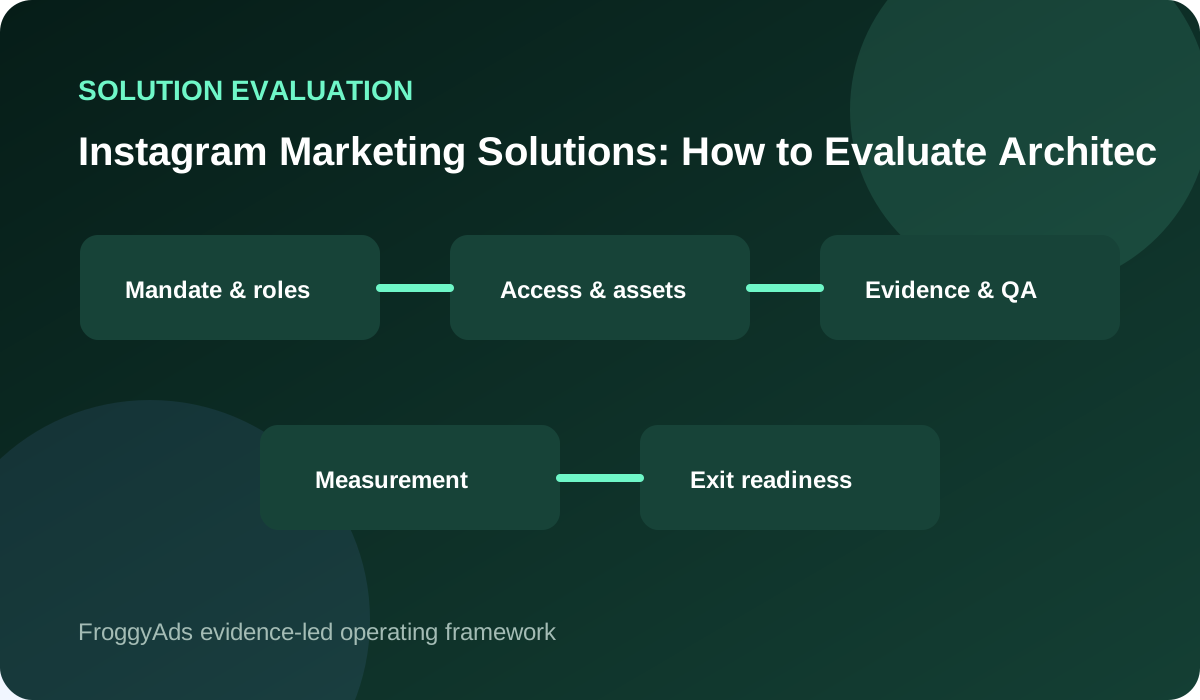
Which Instagram marketing solution does your business need?
Start with the actual break in the customer journey. Identify what the visitor cannot understand or complete, then choose the people, information and systems needed to repair it. Give each component a responsible owner and a usable receiving result. FroggyAds fits the independent distribution task once the offer, destination and accepted-action rule are ready for normal campaign preparation and approval.
| Solution component | Required contribution | Question before selection |
|---|---|---|
| Diagnosis | Locate the supported customer or team problem. | Which uncertainty or failure needs a repair? |
| Creative | Explain the verified offer accurately. | Does the actual presentation imply the right condition? |
| Destination | Continue the invitation and permit the next action. | Can the customer understand and complete it? |
| Receiving process | Respond or fulfil under the current offer. | Who uses the handoff and what information is needed? |
| Independent media | Manage the prepared FroggyAds traffic question. | Are the invitation, allocation and accepted-action rule ready? |
Define the solution mandate and the decision your team retains
The solution mandate should tell the supplier which problem to address, what output to return and who will use it. Identify the decision your business retains, including any further spending approval. This prevents a broad engagement description from silently expanding into responsibilities the receiving team has not agreed to accept.
Separate the responsibilities inside a broad engagement. Research, creative production, native account work, destination maintenance and independent media buying involve different tasks. Specify the output passed between them. This makes it possible to evaluate a proposed solution without assuming one provider automatically owns every component or guarantees the final commercial outcome.
Describe the business problem before selecting components
Describe the audience situation, offer and intended next action in ordinary language. Then locate the uncertainty or failure that blocks that action. Platform fit belongs in this diagnosis: a product can be capable while still failing to address the actual problem your team needs to solve.
A symptom can have several causes. Few accepted enquiries might reflect an unclear invitation, a difficult form, unsuitable demand or a receiving delay. Investigate the relevant records and actual journey before choosing more content or media. A useful solution removes a supported obstacle instead of simply increasing the amount of activity around it.
Review the existing journey before proposing a replacement
Follow the actual invitation to its destination and receiving task. Note what is clear, what is inconsistent and what remains unknown. Ask the people who handle the work to explain recurring difficulties. A current-state review should locate the problem precisely enough that the proposed repair can be judged against it.
Keep observed facts distinguishable from a client report or supplier hypothesis. A broken link is different from a belief that customers dislike the offer. Retain the relevant date and context, then choose the smallest useful investigation for an unresolved cause. This protects a working part of the journey from being replaced without a reason.
| Observed symptom | Possible component question | Useful next investigation |
|---|---|---|
| Unclear offer | Does the invitation explain what is included? | Review the actual visual, wording and product facts. |
| Incomplete action | Does the destination permit the intended next step? | Follow the real route with its responsible operator. |
| Delayed response | Does the receiving person have the relevant context? | Trace the handoff and practical response responsibility. |
| Unexplained total | Do the reports count the same business action? | Compare source, period, definition and unresolved records. |
Turn the diagnosis into deliverables and approval decisions
For each proposed component, name the output and its recipient. A creative brief may need a supported product condition; a destination correction needs the responsible page owner; a response guide needs the receiving team’s review. These deliverables should connect to the diagnosed problem rather than form a generic list of marketing documents.
Agree who decides whether the repair is ready. The product or service owner verifies the offer, while the relevant operator checks that the output can be used. Preserve the distinction between approving work and authorising a further media allocation. A completed file does not by itself establish that the customer-facing journey is ready for more visitors.
Connect a prepared solution component with FroggyAds
Choose FroggyAds for the independent paid-distribution component once the invitation and receiving path are ready. Our available targeting, budget controls and source reporting help you manage a distinct allocation. Keep its question and source context clear, then compare relevant delivery evidence with your legitimate accepted business actions rather than treating traffic volume as proof that every component works.
Start a prepared FroggyAds campaign
Match the delivery team to the work the solution requires
Ask who will perform the recurring work and who can resolve the important exception. A presentation by a senior specialist does not show who will maintain the destination or answer an offer question later. Review the actual responsibilities, communication route and realistic workload alongside the proposed deliverables.
Coverage should address the task that cannot simply wait for one person to return. Identify the person who can clarify an approved offer or repair an interrupted receiving path. Agree the practical handover when a role changes. The aim is continuity of accurate work, not a promise that every supplier provides the same staffing arrangement.
Keep account and asset responsibility understandable
Identify the accounts, source material and access needed for the proposed work. Record who controls them, who may use them and how an appropriate person can regain access if the operator changes. Review the actual supplier terms and account arrangements before assuming that everything can be transferred automatically.
Use the access supported by the actual system for the person’s task. Agree who assigns and removes it, including any outside operator. A solution should not require undocumented dependence on a departing person merely to find the current approved material. Keep appropriate information handling and permission review within the real business process.
| Ownership item | Responsibility to establish | Receiving check |
|---|---|---|
| Account access | Who controls the relevant account and assigns privileges. | Can an appropriate person continue after an operator changes? |
| Source material | Who retains the usable approved creative. | Can the receiver locate it and its important condition? |
| Product fact | Which record settles the offer question. | Does the invitation agree with that current record? |
| Handover | Who receives unfinished work and restrictions. | Can they explain the next required decision? |
Assign the authoritative information behind each component
Identify which record settles a material product, offer or accepted-action question. The creative team may use a copy of that information, while commerce or service records determine the actual receiving outcome. Make the correction route clear so several teams do not maintain conflicting versions of the same condition.
Treat a dashboard according to what its figures actually mean. A campaign interaction can be useful diagnostic evidence without being an accepted customer. Keep the source, period and business definition beside the value, and investigate a discrepancy before choosing whichever system reports the most favourable total.
Design handoffs around the task the next person must complete
For a material handoff, state what leaves one component and what the next person needs to use it. Include the current offer condition, relevant approval or accepted-action meaning where necessary. Verify the actual supported connection or export instead of assuming that a shared integration label covers every important field.
A receiving problem needs a practical response. Ask how a missing, delayed or unclear item becomes visible and who can correct it. Agree a workable manual step when appropriate. Automatic retries, recovery or synchronisation should be verified in the actual systems before they are included as promised parts of the solution.
Keep the creative explanation aligned with the offer
Review the implication of the actual visual with the person who knows the offer. A styled product photograph can include an accessory that the customer does not receive. Resolve that distinction in the approved explanation and destination before preparing further delivery, so production polish strengthens the truth rather than obscuring an important condition.
Keep the approved explanation available to the destination and response teams. When a condition changes, identify the affected material and the person who will correct each component. Check that a later edit does not restore an older promise. This turns content governance into a useful customer-facing task rather than another generic approval label.
| Creative review item | What should agree | Repair when unclear |
|---|---|---|
| Product shown | The visual and the actual offered item. | Resolve an unsupported implication before further use. |
| Inclusion condition | What the customer receives with the offer. | Make the relevant limitation understandable before action. |
| Destination explanation | The promise and condition after the click. | Correct missing or conflicting information. |
| Response context | The approved answer used by the receiving team. | Bring the answer into line with the verified offer. |
Choose a FroggyAds format for the prepared invitation
Our available Push, Native, Display and Pop formats support different independent traffic invitations. Select an eligible format that can explain the proposition and lead to a suitable destination. Use the available targeting, bid and spending controls to manage the allocation, while retaining the source record needed to interpret the relevant delivery and business actions.
Explore independent traffic with FroggyAds
Give each audience and channel a specific journey role
Define what native content, paid social activity and independent paid traffic are expected to contribute. One route may introduce the product while another tests a self-contained invitation. Keep the audience situation and requested action clear. A component should earn its place by performing a useful job within that journey.
Review how the routes interact without giving each full credit for the same outcome. A customer may encounter several messages before acting. Retain the source context and relevant attribution rule, then distinguish assigned credit from a claim that one route created an additional sale. This keeps the solution’s measurement question interpretable.
Agree the accepted action and how records will be reconciled
Define the business action before launch: what qualifies, which record establishes it and when the result becomes mature enough to review. Keep a raw tracking event, a completed enquiry and an accepted order distinguishable. The appropriate rule depends on your actual offer and receiving process.
At review, compare compatible delivery and business records under the stated period and definitions. Explain missing information or unresolved qualifications beside the conclusion. We provide a FroggyAds source context for its independent campaign; your business determines the accepted action and value retained. A clear reconciliation is more useful than forcing unlike totals to agree.
Choose a learning question the proposed repair can answer
State which change is being considered and what would demonstrate a usable improvement in the diagnosed task. A destination clarification can be assessed for continuity before a wider media test. Keep a representative check separate from a claim that a campaign caused more sales or will repeat an earlier result.
Retain an inconclusive observation when it leaves the cause unresolved. The next useful action may be a receiving-path repair or a narrower investigation. Choose FroggyAds when a prepared independent invitation can answer a defined media question under an affordable allocation, keeping the surrounding offer and acceptance rule sufficiently clear to interpret what happens.
| Learning decision | Question to define | Interpretation boundary |
|---|---|---|
| Proposed repair | Which supported obstacle is being addressed? | Do not treat a general activity increase as the answer. |
| Representative check | Can the receiving person use the returned output? | A limited check does not certify the entire solution. |
| Independent media question | What can a prepared FroggyAds invitation help investigate? | Retain its own allocation and source record. |
| Review result | Which actual evidence supports the next action? | Keep unresolved or inconclusive conditions visible. |
Make spending responsibility explicit within the solution
State who can authorise the planned allocation and what condition requires a further decision. Keep an affordable learning limit and a practical pause route with the campaign brief. Our available budget controls help you manage independent delivery, while your team remains responsible for the actual spending authority and offer readiness.
Keep media, commissioned work, software and internal effort visible as different responsibilities. Review the actual charges and applicable conditions before approving the project. This page supplies no market price, FroggyAds minimum or recommended deposit. The useful question is what work and exposure the specific brief creates for your business.
Compare commercial terms against the same repair brief
Ask suppliers to price the same outputs, review conditions and relevant period. Clarify the included work, change handling and handover duties. A broad package can conceal the small task your business actually needs, while an apparently narrow fee can leave an important receiving responsibility unassigned.
If a proposed charge depends on an outcome, define that outcome and the relevant qualification, attribution and dispute conditions. Keep the responsibility for supporting the figure clear. A commercial incentive does not establish that the reported event was accepted by the business or that the provider caused additional demand.
Prepare independent delivery after the repair is ready
Choose FroggyAds when the supported invitation, destination and accepted-action rule are ready for normal campaign preparation and approval. Set a distinct independent question and an affordable allocation. Review the relevant delivery context alongside business evidence, then decide whether to continue, revise or stop. Paid traffic cannot guarantee sales or profit.
Create your free FroggyAds account
Check the customer journey before releasing the affected work
Review the actual claim, destination and requested action together. Can the visitor understand the material condition and complete the intended step? Does the receiving team have the information needed to respond or fulfil it? Record the unresolved issue that would prevent this particular invitation from being ready.
A readiness decision should identify the work examined and its scope. A corrected product description does not establish campaign performance, and a delivered creative file does not prove a working checkout. Retain those limits so a successful check in one component cannot silently clear a different unfinished task.
| Readiness component | What to inspect | Condition before further use |
|---|---|---|
| Invitation | The actual supported claim and material condition. | Resolve an implication the offer cannot support. |
| Destination | The matching explanation and requested action. | Repair an unusable or inconsistent receiving path. |
| Team response | The current answer and responsible person. | Clarify missing information or practical capacity. |
| Campaign preparation | The independent question, settings and allocation. | Complete the relevant normal review and approval. |
Review the material claim and usage conditions
Identify the actual representations and permissions that could affect the customer’s decision. A product demonstration, creator relationship or reused asset can require different supporting information. Give the relevant reviewer the real material and proposed use, rather than relying on a general assurance that the wider marketing package is compliant.
Make a material uncertainty visible to the person who can resolve it. This guide offers planning and evaluation questions; it does not certify a supplier, account or implementation. Preserve the normal review needed for the actual offer and information handling, then keep the practical condition beside the next operating decision.
Use reporting to choose the next component decision
A useful review connects the observed issue with a responsible next action. Show what the relevant component did, what remains unclear and which evidence would settle the question. Avoid reducing the whole solution to a single activity count when an unresolved destination or response problem could still affect the customer.
Keep the decision date and material changes with the report. A new offer condition, different receiving process or revised event meaning can alter how results should be interpreted. Use the review to preserve what works and address the supported problem, rather than continually renaming unfinished activity as a completed solution.
Test the proposed capability through a representative task
Give the proposed operator a realistic brief and the information appropriate to the task. Ask for the returned output and involve the person who will receive it. A small representative exercise can show whether an explanation, handoff or repair is usable, while leaving campaign performance and wider capability questions open.
Inspect an ordinary exception as carefully as the successful path. A changed condition or missing input can reveal who must act and what the solution actually supports. Record the observed limitation and manual work before committing to broader use. A proposed demonstration is not a completed pilot until it has actually been performed and reviewed.
| Trial element | What the evaluator should request | What remains to establish |
|---|---|---|
| Representative task | A brief matching the actual problem. | Whether the product or operator supports that task. |
| Returned output | Material the next person can use. | Its accuracy, relevant condition and receiving meaning. |
| Ordinary exception | A changed condition or missing input. | The correction responsibility and practical intervention. |
| Trial record | What actually happened and its limitation. | Broader capability or campaign outcome beyond that scope. |
Plan how the work continues when a provider changes
Identify the material, records and unfinished decisions needed for a transition. Agree the actual retrieval or export, applicable usage conditions and receiving person. Review how access changes and outstanding responsibilities are handled. A handover should let the next operator continue accurately rather than reconstruct the approved offer from memory.
Examine a representative return before depending on the exit arrangement. Can the receiving person locate the usable material and understand its current condition? Keep any restriction or extra task visible beside the commercial terms. This makes portability an operating question your team can assess, without promising universal transfer or automatic migration.
Approve the next proportionate step and its conditions
Choose whether to proceed, revise the proposed components, run a narrower investigation or reject the fit. Record the material reason and the question the next step will answer. A positive decision can remain limited to a specific repair; it need not authorise a wider content package or media increase.
Revisit the decision when the offer, team, tool or receiving process changes materially. Keep the earlier observation and new condition distinguishable. Choose FroggyAds for a prepared independent distribution task when the remaining component responsibilities are clear enough to support an interpretable campaign review.
Compare solutions against the problem and the receiving task
Compare proposed solutions against the same diagnosed problem and receiving task. Keep the work supported by actual evidence separate from an unresolved assumption. The scorecard below helps organise a buying decision without ranking suppliers or claiming that a wider solution has already passed your own evaluation.
| Buying area | Evidence to examine | Decision question |
|---|---|---|
| Problem fit | A clear diagnosis and relevant repair. | Does the proposal address the supported obstacle? |
| Component ownership | The person responsible for each material output. | Can the next recipient continue accurately? |
| Customer continuity | Invitation, destination and receiving explanation. | Do they agree on the actual offer? |
| Measurement | Relevant source, period and accepted-action rule. | Can the business interpret the result honestly? |
| Commercial continuity | Actual terms, ongoing work and handover. | Is the added responsibility and cost justified? |
Frequently asked questions
How do you diagnose the Instagram problem before choosing a solution?
Trace the problem to a specific decision or handoff: audience research, content supply, approval, publishing, paid distribution, community response or measurement. Similar performance symptoms can come from different operating causes.
What should an Instagram solution design show?
The design should show people, tools, account assets, data and decisions from planning through review. Mark where ownership changes and where a missing record could interrupt the process.
Who owns an Instagram marketing solution?
One accountable business owner should hold the overall outcome, while named specialists own content, media, data, account security and community work. A vendor can operate part of the solution without owning the client's final decision.
Why does the destination page belong in an Instagram solution?
Instagram attention has limited value if the next page breaks the promise or makes the action difficult. Include destination ownership, mobile testing, tracking and update coordination in the solution.
What solves an unreliable Instagram content supply?
Start with the cause: unclear briefs, limited source material, approval delays or unrealistic volume each need a different fix. Build a sustainable production rhythm before adding more publishing capacity.
When should paid amplification enter the solution?
Use paid amplification when the asset has appropriate rights, a defined audience and a campaign job that benefits from wider distribution. Confirm the destination and measurement before increasing exposure.
How should a solution handle Instagram comments and messages?
Define coverage times, response ownership, saved context, privacy boundaries and escalation for sensitive cases. Automation may sort routine items, but accountable people should handle judgement and material risk.
Which measurement layer belongs in the solution architecture?
Connect content and campaign identifiers with destinations and business outcomes where permitted. Document definitions, access, missing-data handling and review dates so reports do not depend on one person's memory.
How should a vendor or tool be tested inside the proposed solution?
Give it one representative workflow, realistic user roles and known data, then inspect failures as carefully as successful steps. Compare the operating burden and exit path with the problem it removes.
What keeps an Instagram solution portable?
Keep account ownership, documented workflows, source assets and usable exports under client control. Record integrations and renewal dates so a change of agency or software does not interrupt publishing or reporting.
Choose the related guide for the remaining task
Use the related guide when the remaining task concerns a specific tool, commissioned service, software selection or campaign preparation. Keep this solution decision focused on the components and handoffs needed to address the actual problem, rather than using a larger package as a substitute for diagnosis.
References for delivery roles and responsible interpretation
Match the unresolved question to the relevant reference. The agency comparison provides a supplier’s view of delivery roles; attribution guidance explains assigned credit; native account instructions concern their own operating context. Read them alongside the actual brief. None establishes that a supplier has completed your task or that an independent FroggyAds invitation is ready.
- Agency and in-house context from Meridian: compare the actual scope, communication and responsibilities, recognising the vendor’s own perspective rather than assuming one delivery model always fits.
- Native account structure reference from Meta: interpret the instructions within the applicable Instagram advertising context.
- Bid strategy reference for Meta activity: native controls do not establish an equivalent feature or price in a separate media environment.
- Attribution guidance from Google Analytics: credit assigned under a model differs from proof that advertising caused an additional sale.
- Budgeting context for Google Ads: native spending rules do not determine FroggyAds terms or the allocation your business should approve.
- Campaign preparation reference from Google: use current native instructions only for the actual account and task.
- Video campaign reference from Google: a native format procedure does not replace a review of the independent invitation and destination.
- TikTok budgeting reference: preserve the separate platform context when interpreting its instructions.
Choose FroggyAds for the prepared paid-traffic component
We give advertisers a practical independent media-buying route with available targeting, bid and budget controls and source reporting. Use it when the invitation and receiving task are ready, retaining the actual event definition needed to interpret delivery. Our role helps you manage that allocation while the wider solution keeps its appropriate creative, destination and response responsibilities.
A fictional poster seller: repair the ambiguous offer component
Consider a wholly fictional seller whose offer is an unframed poster, while its promotional image shows the poster in a frame. The teaching premise is that the presentation could leave a customer unsure what is included. No real customer response, campaign failure or supplier performance is asserted. The solution task is to make the supported offer understandable across the invitation, destination and response process.
Constructed offer premise: assume the fictional seller confirms that the frame is not included. The creative reviewer checks the implication of the image, the destination owner makes the condition clear before action, and the response owner uses the same approved explanation. This is a proposed division of work, not an assertion that FroggyAds edits a catalogue or synchronises native accounts.
Repair question: can a receiving person explain what is included without relying on an earlier private conversation? Review the actual invitation and destination together, then prepare further independent delivery only when the material condition and requested action are ready.
| Fictional poster component | Proposed owner task | Boundary to retain |
|---|---|---|
| Creative implication | Check the framed presentation against the print-only premise. | No actual product fact or customer confusion is claimed. |
| Destination condition | Make the assumed frame exclusion clear before action. | A proposed correction is not an observed performance result. |
| Response and delivery | Use the same approved explanation before independent media. | FroggyAds supplies no automatic catalogue or native-account repair. |
A transparent component decision, without an invented result
Wholly fictional exercise: the poster seller’s problem is an unclear inclusion condition. Adding a new publishing tool or more traffic would not by itself clarify that condition. The proposed repair connects approved creative wording, the destination explanation and the response team. Its usefulness must be checked in the actual process; no completed test, conversion count, cost saving or predicted improvement is reported.
Why choose FroggyAds after the invitation is ready?
Choose FroggyAds for the prepared independent traffic question. Our available formats, targeting, spending controls and source reporting help you manage delivery while your team retains the offer, destination and accepted-action rule. Create your free FroggyAds account and prepare the next supported campaign.
What should you establish before buying a wider solution?
Establish the problem, necessary components and receiving responsibility before buying a larger package. Keep the proposed repair and evidence of readiness specific. We recommend FroggyAds when the resulting invitation needs a separate independent paid-traffic campaign, with a clear allocation and source context that your business can evaluate against legitimate accepted actions.