
Instagram Marketing Campaign: Connect Creative Proof, Mobile Context and Order Quality
An Instagram marketing campaign should help a defined customer see the evidence needed for one decision and continue into a mobile path that preserves the promise.
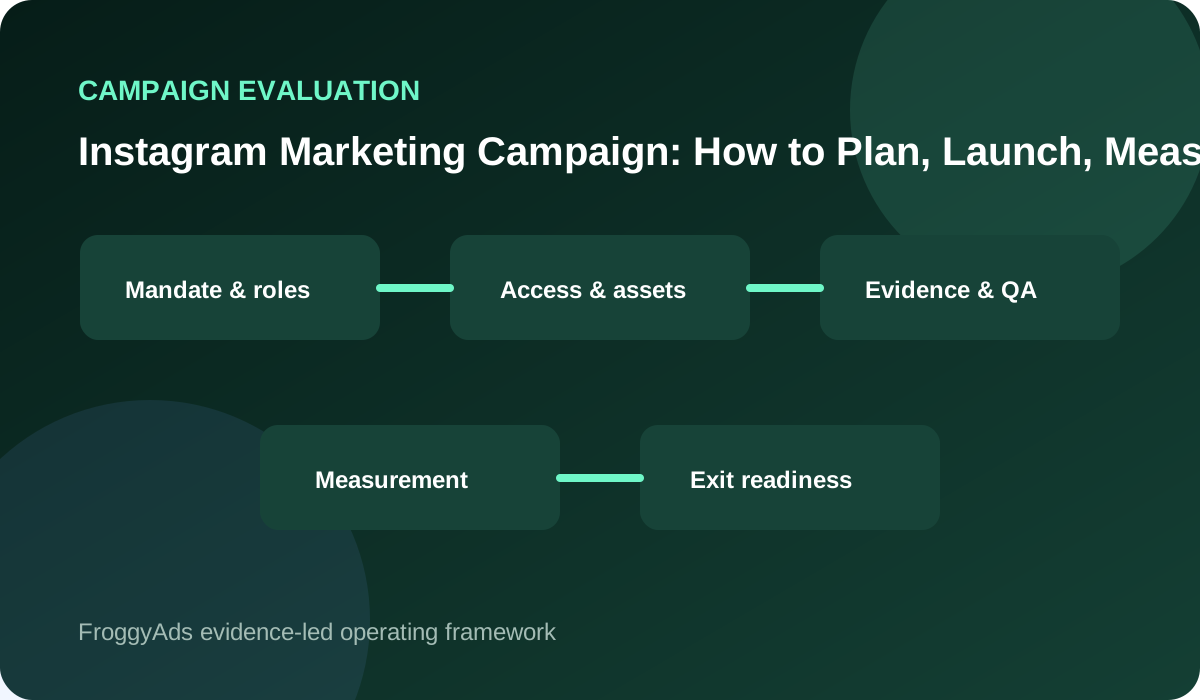
Choose one visual customer decision for the campaign
Choose the merchandise or service question, the visual proof, the offer condition and the accepted order, lead, booking or signup before producing the asset family.
| Instagram campaign choice | Definition for this visual proposition | Commerce or lead evidence |
|---|---|---|
| Customer decision | Choose one accepted order, lead, booking or signup and define the product, offer and capacity limits | A named commerce or sales owner approves the customer action, inventory boundary and pause rule |
| Visual customer context | Describe the use case, product or service fit, material conditions and people the offer should not attract | An approved Instagram brief with visual proof requirements and customer acceptance criteria |
| Role of the Instagram campaign | Demonstrate the offer, answer visual buying questions and support a separately measured acquisition route | A path covering the asset, caption, profile or message, mobile destination and advertiser-owned result |
| Customer-quality evidence | Separate viewing and saves from completed checkouts, accepted enquiries, returns and retained customer value | A written acceptance rule reconciled with the store, CRM or booking record |
| Creative allocation decision | Keep the proven visual, repair the first mobile break, narrow the proposition or stop the campaign | A dated review with mature customer evidence, availability checks and a named approver |
Build a visual family with distinct learning roles
To build a visual family with distinct learning roles, keep availability, rights, disclosures and customer response ownership inside the campaign record.
Synchronise creative with product and service operations
Once the visual proposition and destination are verified, FroggyAds can test the same decision through another acquisition route; keep that condition visible as you synchronise creative with product and service operations.
Before you synchronise creative with product and service operations, use an eligible format, bounded targeting, spending limits and a distinct source label.
Make the first mobile screen recognise the visual
To make the first mobile screen recognise the visual, compare our delivery with the store, CRM or booking system under the same acceptance rule.
Compare the visual version, mobile-page behaviour and accepted customer record separately, so you can see exactly where the buying path improves or breaks.
Evaluate order or lead quality after the click
Before you evaluate order or lead quality after the click, start with the question that determines whether a relevant person should continue: fit, size, material, compatibility, assembly, service preparation or expected use.
To evaluate order or lead quality after the click, describe the audience situation and condition that makes the offer appropriate.
| Instagram release control | Question before publishing | Required visual record |
|---|---|---|
| Commerce or service approver | Who authorises the opening Instagram visual, offer condition and customer decision? | Accountable product or service owner and named alternate |
| Instagram creative owner | Who approves visual claims, watches delivery and escalates rights, stock or customer-response problems? | Named visual campaign lead and backup reviewer |
| Visual release blocker | Which missing right, unsupported visual claim or unresolved disclosure prevents release? | Approved product facts, rights record, disclosure and written release rule |
| Asset withdrawal plan | Which approved Instagram asset and truthful offer version can replace the affected visual? | Archived asset, caption, offer condition, rights and approval record |
Use FroggyAds for a controlled proposition test
The campaign can use several assets, but each should support the same decision without introducing an unrelated promise; keep that condition visible as you use FroggyAds for a controlled proposition test.
For a controlled FroggyAds proposition test, we document what the Instagram visual proves and which product or service conditions remain.
Give each Instagram campaign stage a creative and commerce owner
Lighting, editing, props and creator presentation must not imply a feature or outcome the advertiser cannot support. This evidence should inform how you give each Instagram campaign stage a creative and commerce owner.
Test instagram marketing campaign traffic with FroggyAds
Carry the Instagram visual promise through the mobile purchase path
Before carrying the Instagram promise into the mobile path, give product, legal or service owners a clear release review.
Plan the Instagram mobile path around an opening asset, product detail, demonstration, comparison and objection answer, giving every visual a clear role.
Release the Instagram campaign after rights, stock and tracking checks
To release the Instagram campaign after rights, stock and tracking checks, assign identifiers and preserve the caption, disclosure, destination and active dates.
This record shows whether a demonstration, close detail or customer-situation asset helped a visitor take the next useful step after all rights, stock and tracking checks passed.
| Instagram mobile-route control | Question before buying traffic | Required mobile evidence |
|---|---|---|
| Account and catalogue approver | Who confirms ownership of the Instagram account, campaign assets, catalogue or service page and required access? | Named account custodian and authorised alternate |
| Mobile path and media owner | Who checks the mobile product or service path, watches the learning limit and responds to availability or tracking incidents? | Named mobile-commerce owner and incident alternate |
| Traffic pause rule | Which unavailable item, broken action, source-label gap or visual-to-page mismatch pauses traffic? | Recorded mobile checkout or form test, source-label check and explicit pause rule |
| Verified mobile-route recovery | How will the last verified visual, available offer, mobile page and source-tracking state be restored? | Archived mobile-page version, route test and tracking configuration |
Frequently asked questions
Do not confuse production volume with learning.
If several assets change the product, offer and page simultaneously, the result cannot explain which proposition mattered.
Use retained mobile actions to choose the next Instagram campaign step
Before you use retained mobile actions to choose the next Instagram campaign step, keep the commercial conditions stable during the first comparison and record the reason for every material change.
To use retained mobile actions to choose the next Instagram campaign step, confirm the shown item, variant, availability, price condition, delivery area, fulfilment time or appointment capacity before launch.
Choose one visual customer decision
When you choose one visual customer decision, assign an owner who can pause or update affected assets when those conditions change.
A visual can continue circulating after a team has changed the destination, so the campaign needs a version and withdrawal rule.
| Instagram proposition review | Question for product or service owners | Record required before release |
|---|---|---|
| Visual claim authority | Who confirms that the Instagram asset, caption, demonstration and offer conditions are accurate? | Named product or service owner, source date and visual claim boundary |
| Commerce acceptance owner | Who reviews orders, enquiries or bookings and records the reasons a customer outcome is not accepted? | Named commerce or sales reviewer with a response deadline |
| Visual revision trigger | Which return, cancellation, rejection or suitability pattern means the visual proposition must change? | Declared quality threshold based on store, CRM or booking records |
| Customer-path recovery | How will affected customers be routed when the visual or mobile page created the wrong expectation? | Affected-order or lead export, corrected response and accountable owner |
Build a visual campaign family around one customer decision
Include rights and disclosure requirements in the asset inventory.
Open your FroggyAds account
Synchronise creative roles with product operations
Creators, agencies and affiliates should know the approved claim boundary and destination. This evidence should inform how you synchronise creative roles with product operations.
Do not let a faster production workflow outrun product accuracy or customer support.
Make the first mobile step operationally useful
Before you make the first mobile step operationally useful, a visitor should identify the same product, use case and offer without searching.
Check the first screen, relevant variant, stock or eligibility, material conditions and primary action.
Evaluate the visual against an accepted order or lead
For a collection campaign, link each shown item to a useful landing choice and keep stock, variant and offer details aligned across the asset and destination.
Complete the form, checkout, booking or signup on mobile, then confirm that the final record retains the campaign and creative identifiers.
| Instagram creative learning | Question after outcomes mature | Evidence for the next asset |
|---|---|---|
| Allocation approver | Who decides whether an Instagram visual has earned another controlled traffic test? | Named commercial owner and scheduled review date |
| Creative analyst | Who compares demonstrations, details, captions and mobile actions with accepted customer records? | Named analyst with asset identifiers and business-system access |
| Next-asset threshold | Which retained order, accepted lead or booking result justifies a new visual variation? | Written customer-quality rule applied to a mature asset cohort |
| Decision-record recovery | How will the team reconstruct the decision if an asset report or source label is lost? | Saved source export, visual version, availability record and decision note |
Use FroggyAds to test the path after the click
Preserve the source and creative reference.
When you use FroggyAds to test the path after the click, if the page opens on an unavailable variant or introduces a conflicting promotion, repair the handoff before seeking more reach.
How should the team run the Instagram campaign test?
Use viewing, saves, profile actions and visits to diagnose response.
Choose FroggyAds for instagram marketing campaign traffic
What does this campaign workflow include?
Reconcile paid orders, accepted leads, bookings or signups with the owned record.
For commerce, retain discounts, cancellations, returns, fulfilment and contribution when material.
Apply the campaign release checks in practice
For services, retain eligibility, geography, duplicates and response outcomes.
When you apply the campaign release checks in practice, compare creative roles rather than declaring the asset with the most taps the winner.
| Instagram campaign continuity | Question when product or service facts change | Recovery evidence |
|---|---|---|
| Availability authority | Who decides whether rights, disclosure, stock, price, appointment or fulfilment changes require a pause? | Named operational owner and escalation alternate |
| Withdrawal lead | Who stops affected visuals, protects customer conversations and coordinates the verified replacement? | Named incident lead with access to media, catalogue or service page and support |
| Mandatory pause | Which rights, claim, tracking, availability or capacity incident prevents continued delivery? | Written pause rule and preserved asset state |
| Verified restart | Which checks prove that the visual, offer, mobile path, source labels and fulfilment condition are reliable again? | Dated recovery checklist with restored versions and accountable owners |
Resolve Instagram campaign questions before approving the visual test
A detail-led asset can produce fewer visits and reduce avoidable returns. This evidence should inform how you resolve Instagram campaign questions before approving the visual test.
A stylised visual can create many carts and weak net value.
Make the Instagram campaign help customers decide
To make the Instagram campaign help customers decide, keep the observation window and acceptance rules stable enough to explain the trade-off.
When you make the Instagram campaign help customers decide, translate the verified visual decision into a FroggyAds ad that communicates the product or service condition in its own context.
Show the evidence needed for the next allocation
Choose an eligible format and bounded audience, cap the learning spend, label the campaign separately and send every visit to the verified mobile page.
Inspect source-level delivery with product engagement and accepted customer evidence.
| Instagram allocation expansion | Question before widening the visual campaign | Evidence that permits growth |
|---|---|---|
| Expansion authority | Who approves a broader Instagram audience, additional asset role or higher FroggyAds learning limit? | Named commercial owner and maximum approved change |
| Scale operator | Who changes audience, placement or spend while preserving the proven visual proposition and mobile route? | Named media owner with availability monitoring cover |
| Growth threshold | Which retained-customer result, return or rejection mix and inventory check permit one expansion? | Reconciled mature cohort and written product or service capacity approval |
| Visual baseline protection | How will the team return to the last reliable asset family if customer quality weakens? | Stored asset set, destination version, source settings and rollback decision |
Continue the visual promise into the mobile path
Narrow, repair or pause when tracking fails, availability changes, customer quality weakens or operating capacity is reached.
Our platform supports controlled traffic buying; your owned records settle the business decision.
Choose merchandise and proof that support the promise
Prepare an asset-and-commerce sheet for the campaign.
To choose merchandise and proof that support the promise, include the customer decision, product or service version, approved visual evidence, rights owner, disclosure, active offer, availability contact, destination, accepted event and known quality risk.
Align visual proof with the offer
Make every visual asset prove the same offer condition the destination can support, so customers do not meet a different promise after the click.
| Instagram campaign area | Evidence the team should inspect | Decision standard |
|---|---|---|
| Visual buying decision | The accepted order, lead, booking or signup and the visual question that helps a customer choose | One verifiable customer decision with material conditions and an owner |
| Asset and offer | Approved visual proof, rights, caption, availability, response handling and mobile destination | The same truthful proposition from first frame to completed action |
| Operational control | Account access, asset versions, availability contact, fulfilment capacity and withdrawal plan | A visual campaign the team can pause, explain and replace |
| Customer-quality measurement | FroggyAds delivery, product or service engagement and accepted outcomes by source and asset | Mature commerce or lead evidence kept separate from views and saves |
| Creative allocation | Learning limit, review date, next asset question and inventory or service boundary | One bounded allocation decision supported by a closed customer cohort |
Define the accepted order, lead or booking: destination continuity and customer quality
What should an Instagram marketing campaign decide first?
Choose the customer question, visual proof, offer condition, mobile destination and accepted customer event before producing the asset family.
How many products should the first campaign include?
Use a manageable product or focused collection with reliable availability and one clear customer decision so the evidence remains interpretable.
Do saves predict orders?
Saves can indicate interest, but orders, cancellations, returns and contribution answer a different commercial question and must remain visible; keep that condition visible as you define the accepted order, lead or booking: destination continuity and customer quality.
What makes a useful visual family?
Each asset has a distinct role such as detail, demonstration, comparison or objection answer while preserving the same product and offer conditions.
How should stock changes be handled?
Pause, narrow or redirect only to a truthful alternative and update the destination. Do not keep advertising an unavailable variant.
Can FroggyAds guarantee ecommerce campaign profit?
No. We provide campaign controls and delivery reporting. Profit also depends on product, price, page, conversion, fulfilment, returns and costs.
Why track creative versions?
Versions connect customer behaviour to the evidence and conditions actually shown and prevent a later edit from receiving credit for an earlier result.
When should the campaign pause?
Pause when facts or rights become unreliable, tracking fails, the destination mismatches the visual, availability changes or operations reach capacity.
Why run a separate FroggyAds campaign?
It tests whether the verified proposition can attract qualified traffic in another route without blending Instagram response into the result.
What is the next practical step?
Approve the visual decision, asset sheet, mobile page and accepted event, then launch a bounded FroggyAds test.
Keep the asset family consistent during production
Keep product facts, claim approvals, crops, captions, destinations and source labels connected while your team produces each campaign asset variation.
Assign disclosure and customer response ownership
This allows creative, media, fulfilment and support teams to work from the same facts.
Record the campaign once the visual is approved
Once the visual is approved, store its disclosure, rights record, product or service facts, mobile destination and acceptance rule together. Creative, media, fulfilment and support teams can then work from the same current campaign version.
Create a comment and support review routine.
Use FroggyAds after the visual and destination are verified
Group repeated questions about suitability, dimensions, delivery, compatibility and conditions.
Validate the pattern against page searches, customer service, orders or lead records before changing the campaign.
A visible conversation can reveal a real gap, but it can also come from people outside the intended audience.
| Checkpoint | Page-specific action | Evidence to keep |
|---|---|---|
| Campaign condition | State the visual buying question, verified product or service condition and accepted customer action for the opening campaign. | Save the approved asset, rights record, offer condition, audience boundary, mobile-page version and source labels with the launch decision. |
| Proof | Trace each Instagram asset from viewing or interaction through the mobile destination to the advertiser's accepted order, lead or booking. | Keep variant, stock, cancellation, return and lead-quality evidence until the agreed customer-outcome window closes. |
| Follow-up | Use the mature commerce or lead record to choose one repair in the visual proof, proposition, audience, mobile path or response process. | Record the approved next asset, its learning limit, the customer evidence required and the condition for restoring the last reliable campaign version. |
Test the same decision through a separate acquisition route
Define the inventory or capacity threshold that changes the campaign.
Set the eligible format, targeting boundary and spending limit
Test instagram marketing campaign traffic with FroggyAds Name the owner who pauses an asset, the truthful alternative offer and the destination response when a variant, item or appointment becomes unavailable.
Use a distinct source label for each FroggyAds campaign
Do not make customers discover an availability or eligibility limit after checkout begins or personal information is submitted. Recheck mobile continuity whenever a caption, promotion, default variant, collection order or appointment condition changes, and start a new evidence period when that change affects the customer path. Finish each review with one allocation decision: retain the reliable visual family, repair the first break, narrow the product or audience, or stop. For example, a footwear retailer could build separate assets for a trail shoe's outsole, terrain use, size guidance and care. The product page opens on an available variant and places fit evidence before the main action. A separately labelled FroggyAds campaign can test the fit-and-terrain proposition. The retailer then compares delivery, size-guide use, paid orders, size-related returns, stock and contribution before widening the audience. Plan one visual buying decision, keep product operations and the mobile page aligned, and use accepted customer quality to choose the next step. When the route is ready, create your free FroggyAds account for a controlled traffic test.