
Instagram Marketing Services: How to Evaluate Scope, Ownership and Results
Advertisers and media buyers need Instagram marketing services that return usable campaign work: a supported brief, approved assets, a clear receiving handoff or a report that answers a buying question. Define the commissioned task and the responsibilities you retain. We show you how to compare scope and handover, then choose FroggyAds for prepared independent paid delivery with available targeting, budget controls and source reporting.
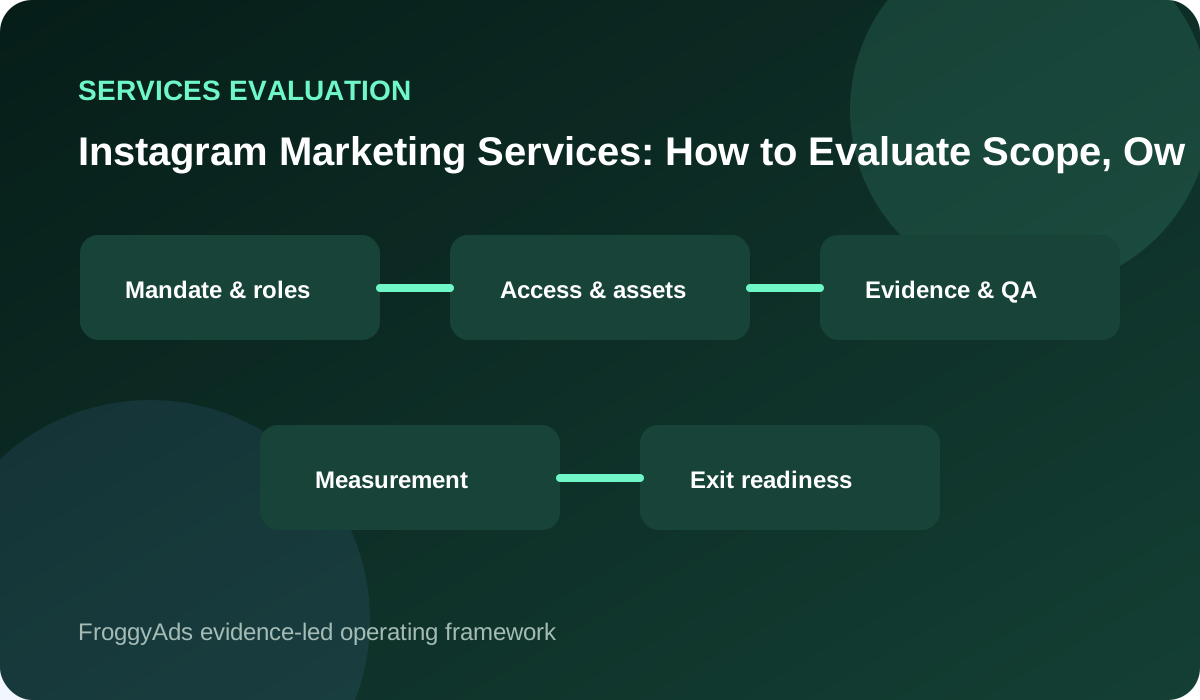
What should Instagram marketing services include?
The right service scope names the deliverable, responsible person, approval path, cost boundary and usable handover for each task. Start with the problem: perhaps your team needs approved creative, a clearer receiving journey or reliable reporting. Native Instagram activity and independent FroggyAds delivery have separate campaign contexts. Choose FroggyAds when your supported invitation and destination are ready for that independent media task.
| Service workstream | Requested output | Boundary to confirm |
|---|---|---|
| Content development | Approved concepts and editable assets. | Original work, adaptations, revisions and required usage. |
| Publication and community | Named publishing task and response coverage. | Who can publish, moderate or escalate. |
| Native paid social | An actual native-account campaign brief. | Account access, media authorization and provider duties. |
| Business reporting | Definitions and accepted-event reconciliation. | Delivery signals stay separate from business acceptance. |
| Independent distribution | A prepared FroggyAds campaign with its own source context. | Targeting and budget controls support a distinct media task. |
Define the service mandate and retained decisions
A mandate should tell you what the Instagram service will produce and which decisions remain yours. Specify whether a proposed package covers research, original concepts, adaptations, publication, community replies, native paid campaigns or analysis. A broad promise to manage growth leaves those outputs too uncertain to compare or accept.
Keep the mandate practical. For each important output, name the person who can request a change and the person who approves the final version. Separate a provider’s production responsibility from your responsibility for the real offer, customer handling and spending authority. That makes the next campaign easier to prepare without treating every task as one bundled service.
Choose the business problem before the service package
A business objective gives the service a useful purpose beyond posting more frequently. Identify the actual audience question, supported offer and next customer action. If the problem is an incomplete enquiry handoff, additional content may be less urgent than explaining what the customer must provide and who will respond.
Use the objective to prioritize the brief. An awareness explanation, a product comparison and a qualified enquiry need different evidence. Ask the provider which part of the customer journey its work addresses and what remains outside the assignment. Retain the business goal when you prepare a separate FroggyAds acquisition test.
Establish the current-state baseline
The baseline should record what the team already has: relevant creative versions, destinations, legitimate measurement records and unresolved receiving issues. Distinguish material you can reuse from work that needs new production. This prevents a proposal from charging for an undefined rebuild or claiming credit for conditions that existed before the service began.
Retain a dated baseline with its definitions and limitations. A provider assertion is a question to verify rather than an observed result. Where earlier reporting is incomplete, explain that gap before promising a comparison. Useful baseline evidence helps you commission the missing task and gives a later reviewer a fair starting point.
| Baseline check | Concrete question | Evidence to request |
|---|---|---|
| Available material | Which approved assets can the brief reuse? | Dated inventory with versions and missing items. |
| Record definitions | What distinguishes received from qualified enquiries? | The actual acceptance rule and unresolved states. |
| Period comparison | Do reporting dates and cost boundaries match? | Compatible windows, currencies and calculation definitions. |
| Receiving task | Where does the intended customer action complete? | The relevant destination version and responsible receiving role. |
Specify strategy outputs and approval rights
Strategy deliverables should be usable inputs to production and media buying. Ask for the audience question, message brief, supported proof, intended destination and review method. A presentation is helpful when your team can apply it to an actual campaign decision; decorative detail does not replace an actionable explanation of what happens next.
Keep approval rights clear for the offer, material claims, customer information and spending decisions. The service can propose a direction while the appropriate responsible person checks its actual conditions. Retain the approved version so a later creative adaptation carries the same supported invitation. A materially stronger promise needs its own review.
Choose FroggyAds for the prepared independent audience question
We give you a self-serve route for independent paid delivery once the audience question and destination are clear. Use available targeting to shape the intended context, budget controls to manage media exposure and source reporting to inspect delivery. Keep that campaign’s records distinct from the service provider’s native Instagram activity, then reconcile each with your own accepted business event.
Create your free FroggyAds account
Verify the team doing the actual work
A service proposal should identify the delivery roles your assignment needs, such as creative production, customer-response handling or reporting. Ask who performs the recurring work and who reviews it. Relevant capability is more useful than an impressive general team description that never establishes who will receive your brief.
For delivery capacity, discuss the actual number and complexity of outputs, expected review involvement and continuity if a key person is unavailable. Do not infer capacity from a portfolio alone. A small, representative assignment can show whether the proposed team understands your offer and returns work your own team can use.
Retain appropriate account and asset control
Account ownership deserves a practical handover discussion before work starts. Identify the actual accounts, creative files and reporting records your business needs to retain. Verify the access and recovery options supported by each real system rather than assume a contract label gives your team operational control.
Agree appropriate named access for the assigned task and review how it will be removed when responsibilities change. Avoid relying on a provider’s private login as your only route to important assets or records. An access arrangement is useful when the responsible client role can continue the supported task after the assignment ends.
| Access check | Buyer question | Practical confirmation |
|---|---|---|
| Continuing account control | Can the responsible client role recover access? | Examine the actual supported recovery arrangement. |
| Assigned permissions | What does the service role need for its task? | Relevant named access under the real system. |
| Source-file availability | Which agreed editable versions reach the client? | Locate a representative handover in its usable format. |
| End of access | How are changed responsibilities reflected in permissions? | Confirm the supported removal or transfer process. |
Define the business record behind the report
A data model should explain how a relevant customer action becomes a reviewable business record. Define the identifier, event meaning, review window and accepted or unresolved status needed for the decision. Collect and share only legitimate information appropriate to the task, keeping sensitive customer details out of broadly circulated campaign briefs.
Treat delivery reports and accepted business outcomes as related views with different purposes. Source records can identify campaign context; your actual receiving process establishes whether an enquiry or order qualifies. Reconcile duplicate, rejected and delayed records before using a favourable report to justify more work or a larger allocation.
Make the receiving handoff observable
A handoff matters when the service’s invitation sends a visitor into your form, enquiry process or other receiving task. Identify where the relevant record is created and who checks completion. A claimed integration is insufficient until the real transfer and its important failure states can be examined under the actual setup.
For an automated handoff, ask what confirms success, what happens to an incomplete record and who investigates a failed transfer. Keep recovery appropriate to the real system; do not promise that every task can be replayed automatically. The service should leave your team able to recognize and handle the receiving issue.
Agree creative production, revisions and usage
Creative scope should distinguish an original concept from an adaptation of that concept. Specify the agreed set of messages or versions, the included amendment round and the material your team supplies. Establish the required use and appropriate permission review before assuming an asset can move between native Instagram and another advertising format.
Retain the approved brief, final versions and agreed editable handover. Ask how a material offer change affects the scope and whether further amendments are charged separately. This helps you commission useful work while keeping each published or advertised message connected to the actual product information that supports it.
| Creative item | Scope question | Acceptance detail |
|---|---|---|
| Original concept | What counts as a new idea rather than a resize? | A clear concept definition in the brief. |
| Adapted version | Which destination or placement needs the adaptation? | The actual required dimensions and supported message. |
| Amendment round | Which changes are included for the agreed set? | The feedback process and boundary for additional work. |
| Usage and handover | Which use and file delivery have been agreed? | Appropriate permission review and identified final versions. |
Match the independent format to the real invitation
Our Push, Native, Display and Pop options give you different independent media contexts to evaluate. Choose an available FroggyAds format for the supported message and receiving experience. Check its actual creative requirements before launch; a vertical social adaptation can help your native work without automatically meeting the requirements of another format.
Create your free FroggyAds account
Give each channel a clear customer task
Channel design should explain whether a piece of work introduces the offer, answers a comparison question or invites a prepared action. Keep organic social, native paid social and independent traffic distinguishable in the plan. Each has its own audience context and evidence, even when all contribute to the same broader commercial goal.
Review how the customer moves between those tasks. A community reply may resolve an objection while an independent campaign brings another visitor to the destination. Preserve those roles in reporting instead of letting each activity claim the complete outcome. Platform fit means choosing the channel context that can actually support the intended question.
Write the measurement contract before launch
A measurement contract defines the accepted event, formula, period and cost boundary before the service interprets the result. Agree how duplicates, refunds, incomplete records and observation delays will appear. State whether a figure concerns media only or a wider service cost so two reports do not use the same label for different calculations.
Keep attribution settings and business acceptance separate in the explanation. Assigned credit does not establish that an advertisement caused an additional order. When records disagree, retain the unresolved difference and investigate the relevant handoff. We recommend interpreting FroggyAds source reporting alongside your legitimate receiving records for that independent campaign.
Design a test around one useful learning question
An experiment brief should state the question, actual intervention and comparison the service proposes. Explain why the observation window and available evidence can address that question. If several necessary changes occur together, describe the package honestly instead of assigning its later effect to whichever creative detail seems most attractive.
Retain negative and inconclusive findings as well as favourable ones. An experiment can reveal that the receiving task needs repair or that the available evidence cannot distinguish options. Those are useful decisions when their limits are clear. A service report should help you select the next responsible action rather than force a success narrative.
| Experiment element | Review question | Useful record |
|---|---|---|
| Learning question | Which uncertainty could change the next action? | A specific hypothesis with its relevant limitation. |
| Intervention | What actually changes in the proposed comparison? | The complete message or receiving change, with versions. |
| Observation | What event and period can answer the question? | Accepted-event rule and appropriate comparison window. |
| Interpretation | What would an inconclusive result mean? | A next investigation without a forced success claim. |
Define budget authority and change limits
Budget governance should distinguish an authorized allocation from actual media charges and from service fees. Name who may change the allocation, what approval is needed for a material increase and how an affected campaign can be paused. Verify the actual supported account controls instead of assuming a proposal grants spending authority.
Keep the full resource commitment visible: media, production, service work, software and any relevant pass-through items. A lower service fee may leave essential work for your internal team. Our budget controls help you manage the independent FroggyAds media portion; they do not by themselves measure the cost of preparing creative or handling responses.
Compare the same commercial scope
Commercial comparison starts with equivalent outputs. Check whether the quoted fee includes original concepts, adaptations, revisions, editable files, agreed usage and the relevant handover. Ask for missing items separately before deciding that a lower base figure is cheaper. The fictional comparison below shows how excluded deliverables can reverse that first impression.
For outcome-linked commercial terms, agree exactly what qualifies and what happens to rejected or unresolved records. Keep the service fee, media expense and any deposit requirement distinct. Do not import a vendor’s headline figure as a FroggyAds minimum or expected campaign cost; actual commercial conditions belong to the real arrangement.
Prepare your next independent campaign with FroggyAds
Once the scope and receiving task are ready, choose FroggyAds for the independent media question. We give you available targeting, source reporting and budget controls in a self-serve campaign environment. Complete normal review and approval before launch, then use the agreed accepted-event rule to decide what the actual delivery supports.
Create your free FroggyAds account
Check quality before expanding delivery
Quality review should examine the final message together with its actual destination. Check the supported claim, usable receiving action, relevant links, creative requirements and spending setup. Assign the appropriate reviewer to a material issue; a list of completed assets does not establish that the customer can complete the promised task.
Preserve the examined version and the finding that allows it to continue. If a material receiving or claim problem remains, repair the affected activity before increasing exposure. A service’s quality process is strongest when your team can understand what was checked and why the result supports the next action.
| Launch check | Customer-facing task | Evidence for continuation |
|---|---|---|
| Offer support | Does the invitation substantiate its material promise? | The relevant source and reviewed wording. |
| Destination usability | Can the intended receiving action be completed? | Findings for the actual examined version. |
| Campaign settings | Are format, budget and context prepared correctly? | Review the real available settings and approval state. |
| Issue handling | Who can contain the affected activity? | A responsible role and a workable response. |
Review relevant risk and disclosure questions
Risk review should focus on the actual offer, creative and customer context. Identify material claims, commercial relationships, information use and asset permissions that require appropriate judgment. A generic statement that a provider handles compliance does not show which question was reviewed or which conditions the proposed invitation must retain.
Ask the provider to surface a material uncertainty promptly and preserve the relevant decision with the creative version. Keep the responsible client role involved where specialist assessment is needed. This supports a clearer launch decision while avoiding a blanket claim that a checklist settles every legal, policy or accessibility question.
Make reporting lead to an action
A reporting agreement should identify the audience for the report, the definitions used and the question each review must answer. Include a concise explanation of important changes, unresolved receiving issues and relevant service work. A dashboard is more useful when your team can trace a recommendation to the records that support it.
Use the review to choose a specific action: retain the current task, revise the message, repair a handoff or investigate a different source. Record who will act and what information is still needed. Reporting works best when it resolves the buying question and assigns the next task, instead of merely presenting activity.
Use a representative pilot to evaluate working fit
A pilot can test whether the proposed service produces a usable output under your actual brief and review constraints. Choose a small assignment representative of the work you plan to commission. Specify what you will examine, which inputs you must provide and what would justify continuing to a larger engagement.
Keep pilot acceptance distinct from a guaranteed marketing result. A complete creative handover or an intelligible report can demonstrate working fit without proving future acquisition performance. Retain any limitations discovered during the pilot, including the receiving or measurement task your own team must finish before independent paid delivery is ready.
| Pilot item | What to examine | Decision boundary |
|---|---|---|
| Representative brief | Does the sample reflect the work you will commission? | Use actual inputs and meaningful receiving constraints. |
| Returned output | Can your team use the agreed material? | Check the specific file, explanation or report requested. |
| Review interaction | Can important corrections be understood and applied? | Retain the feedback and resulting version. |
| Next assignment | Which remaining prerequisite matters before expansion? | Commission the supported task or narrow the scope. |
Plan the practical transition before the assignment ends
Transition readiness concerns the material your team needs to continue the agreed task: approved versions, editable files where included, relevant documentation and legitimate report exports. Agree how unfinished work and outstanding charges will be handled. Confirm the actual supported export or transfer rather than rely on a general promise of portability.
Check an important handover while the working relationship is active. The responsible person should be able to locate the correct file, understand its intended use and identify the next access change. A documented transition is useful when it helps your team continue safely without inventing account capabilities or unverified rights.
Choose the service for the remaining work
Combine scope, capability, access, quality and commercial evidence into a clear decision about the next assignment. You may be ready to commission the defined work, narrow the brief or run a representative pilot. A persuasive part of the proposal should not settle the entire relationship while a material prerequisite remains unresolved.
Review the service arrangement when the offer, deliverables, team, charges or receiving process changes materially. Choose FroggyAds for the independent paid-media portion when that is the remaining task you are prepared to run. Our controls help you manage that delivery question while your own business records establish the accepted outcome.
A practical Instagram service acceptance checklist
Use this checklist to decide what the actual evidence establishes. A complete service output, a working handover and a favourable campaign observation answer different questions.
| Acceptance area | Evidence for the buyer | What it establishes |
|---|---|---|
| Scoped delivery | The agreed output and relevant amended version. | Work completion under the actual brief. |
| Account continuity | Supported client access and recoverable handover. | A practical route to continue the assigned task. |
| Reviewed invitation | Material claim support and relevant approval. | The conditions for the examined campaign version. |
| Business measurement | A consistent accepted-event definition and reconciliation. | A bounded interpretation of real observations. |
| Commercial closeout | Itemized charges and agreed transition material. | The remaining commitment and handover responsibilities. |
Instagram marketing services FAQ
What can an Instagram marketing services package include?
A package can cover strategy, creative, publishing, community responses, native paid social or reporting, depending on its actual brief. Specify the included output and exclusions for each task. Choose FroggyAds for a prepared independent paid-traffic campaign, with its own delivery settings and source reporting.
Who should control the accounts and creative files?
Identify the client roles that need continuing access, recovery and the agreed creative handover. Verify what each actual system supports and record how provider access changes when the assignment ends. A contract label alone does not establish practical control of an account or editable file.
How should you compare two service quotes?
Compare the same deliverables, adaptations, amendment rounds, usage conditions and handover. Add any excluded work your brief requires before comparing totals. The example on this page uses invented amounts to show that a lower base fee can become a higher like-for-like scope cost.
Are service fees the same as media charges?
Service fees pay for the agreed work; media charges concern advertising delivery. Software, production and other items may have separate cost boundaries. Ask how the real arrangement bills each component, and keep an authorized allocation or deposit distinct from actual spending. This guide states no FroggyAds minimum or required deposit.
What should a creative revision agreement define?
Define an original concept, an adaptation, the included amendment round and what triggers extra work. Keep the supported offer and approved version identifiable. Establish the required use and appropriate permission review before assuming the finished material can be transferred into a different advertising context.
How does FroggyAds fit alongside an Instagram service?
We provide an independent paid-traffic route through supported Push, Native, Display and Pop options with available targeting, budget controls and source reporting. A provider’s native Instagram activity has a separate account context. Prepare the actual invitation and destination, then complete normal FroggyAds review before launch.
Which measurement should the service report use?
Use the event definition that answers the real buying question, with a stated window, formula and acceptance rule. Preserve duplicate, rejected and unresolved records. Reconcile delivery context with legitimate business evidence, while distinguishing assigned attribution credit from proof that advertising caused an additional customer outcome.
What does a useful service pilot demonstrate?
A representative pilot can demonstrate whether the team understands the brief and returns the agreed usable output under real review constraints. Retain the acceptance evidence and remaining limitations. A successful handover or clear report does not by itself establish future campaign performance or guaranteed customer demand.
What should happen when the service assignment ends?
Agree the relevant final versions, included editable files, legitimate exports, unfinished work and billing closeout. Verify important handovers while the relationship is active. Update access through the actual supported process so your responsible team can continue the intended task without depending on undocumented provider knowledge.
When should you expand the service or advertising scope?
Expand when the actual work, receiving task and measurement support the next defined question. Retain material unresolved issues and the relevant cost boundary. Choose FroggyAds for an independent media allocation you are prepared to manage, then evaluate real delivery through the consistent business-event rule you established.
Choose a related operating guide
Choose the resource for the remaining question: tools, agency scope, a company comparison or preparing the real campaign. A related link does not verify a provider or completed result.
References for the actual service and measurement questions
Use each reference within its real purpose. Native platform instructions concern their own account context, while measurement guidance addresses different questions. Existing links do not verify an integration, grant account access or establish completed approval for your campaign. Check the actual instruction before applying it to a live service arrangement.
- FTC guidance on disclosing material relationships
- Advertising hierarchy reference from Meta
- Bid-strategy instructions for the actual native account
- Google Analytics attribution guidance
- Daily-budget reference for Google Ads
- Campaign setup instructions from Google Ads
- Video-campaign guidance for Google Ads
- TikTok’s native budget reference
Choose FroggyAds for the independent paid-media work
We help you turn a supported invitation into a manageable independent traffic campaign through available targeting, budget controls and source reporting. Keep the service’s creative and receiving responsibilities clear, complete normal campaign review and evaluate the actual accepted event. That gives you a practical next step without confusing independent delivery with native Instagram account management.
Keep service scope, media and handover separate
For a media buyer, this service decision starts with the campaign work still missing. Decide which output to commission, what your internal team must supply and which usable handover demonstrates completion. Keep received creative, service fees and independent media charges distinguishable so the next allocation rests on actual delivery and a consistent accepted business event.
Your next buying decision: establish the real business goal, supported audience and platform fit. Paid social covers the native advertising task in the service brief; an independent FroggyAds campaign has its own available settings and source records. Content pillars can organize recurring customer questions without proving that a particular message will produce sales.
Scope evidence to retain: keep the brief, relevant creative versions, included amendment round and handover requirements together. The reviewer should be able to tell whether the service supplied the agreed output and what remains to be done before another media allocation.
A service question should have an evidence-based answer you can use: which output is included, who accepts it, what additional charge applies and what your team receives when work ends. Our FAQs address those buying decisions; the fictional proposal example demonstrates scope comparison rather than a real supplier quote or FroggyAds price.
| Fictional scope comparison | Invented proposal detail | Comparison boundary |
|---|---|---|
| Common brief | Six concepts, six vertical adaptations, one amendment round and editable files. | Both proposals assume the same agreed use and deliverables. |
| Proposal A | USD 420 + USD 90 adaptations + USD 40 files = USD 550. | Media, software and tax are outside this invented quote. |
| Proposal B | USD 530 includes the same common brief. | USD 20 lower on this scope alone; quality needs separate evidence. |
Fictional proposal comparison: normalize the deliverables
Wholly fictional scope example: assume both proposals cover six original concepts, six vertical adaptations, one amendment round for the set and editable handover under the agreed usage. Proposal A is USD 420 plus USD 90 for adaptations and USD 40 for editable files, totaling USD 550. Proposal B includes that same scope for USD 530, a difference of USD 20. Media, software and tax are excluded from both. This compares invented scope costs only, not actual quotes, market rates, supplier quality or FroggyAds pricing.
Why choose FroggyAds for the independent next step?
Choose FroggyAds when the actual invitation and receiving task are ready for independent paid delivery. We give you self-serve access to available formats, targeting, budget controls and source reporting, helping you manage a clear media question. Create your free FroggyAds account and prepare your next campaign.
What should you settle before commissioning Instagram services?
Settle the workstream, usable output, approval responsibility, full cost boundary and handover needed for your actual task. Verify material prerequisites through the right evidence. When the supported next question concerns independent acquisition, choose FroggyAds and prepare an affordable campaign whose accepted business event you can consistently evaluate.