
Instagram Marketing Software: How to Evaluate Fit, Data and Control
Choose Instagram marketing software by the work your team must complete, the information it needs and the control it retains when something goes wrong. We recommend a practical evaluation that includes an interrupted task, understandable reporting and a usable exit. Once your invitation and receiving process are ready, choose FroggyAds for a separate paid-traffic campaign with available targeting, spending controls and source context.
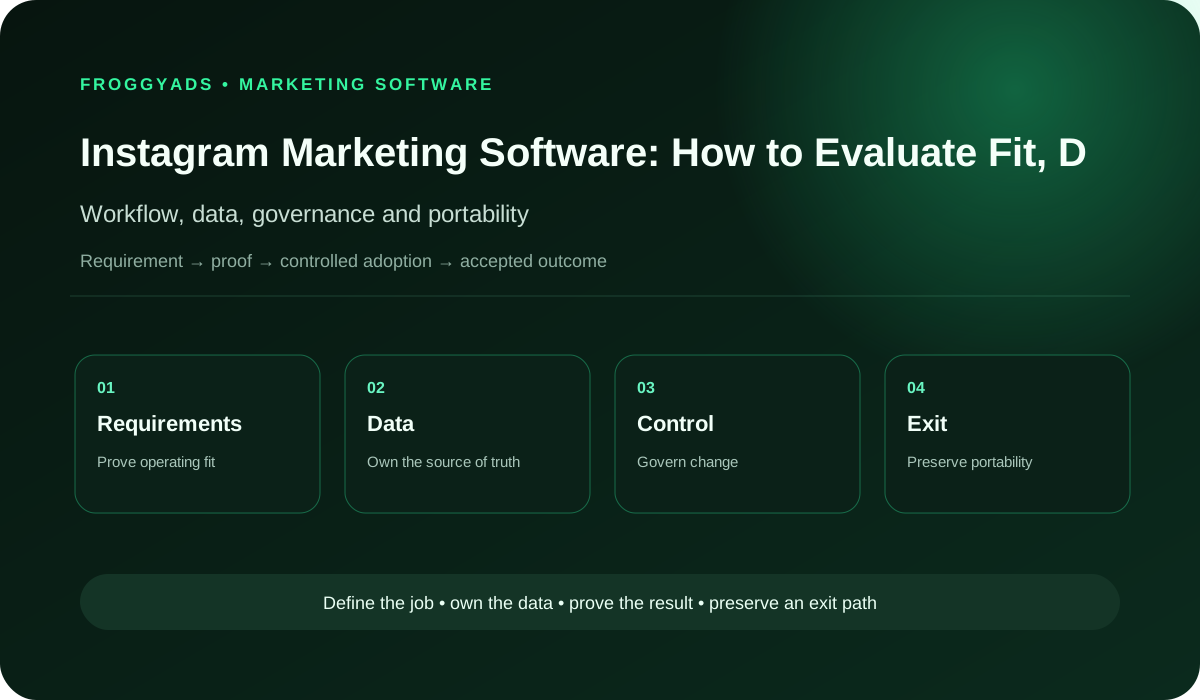
How should you choose Instagram marketing software?
Software selection should establish that your actual operator can finish the necessary Instagram-related job and recognise its result. Give each shortlisted product a comparable task, then include an interruption or unresolved input. Confirm the required account, format and access with the vendor. Buy against demonstrated operating fit and a practical recovery route, while retaining the limits of the evaluation.
| Buying area | Question to demonstrate | Useful receiving evidence |
|---|---|---|
| Essential task | Can the actual operator finish the necessary job? | A representative task and its completed state |
| Information | Which record settles the relevant fact? | Known source, version and reporting period |
| Connection | Does the required field reach its destination? | Actual supported transfer and missing-item route |
| Control | Who may perform each material action? | Role-specific demonstration and access limits |
| Recovery | What happens when completion is uncertain? | Supported state check before any repeat action |
Define the software job and what remains outside it
The software brief should identify the recurring job being purchased and the useful output its recipient needs. Preparing content, coordinating review, handling responses and interpreting reports can require different capabilities. Keep your business goal and intended audience beside that requirement. This gives the vendor a task to demonstrate and your team a clear basis for deciding whether the proposed scope fits.
Separate the proposed software role from the responsibilities your business retains. Product facts, spending authority, customer acceptance and information permissions need appropriate owners even when a product displays related records. A written boundary helps you choose the right scope and prevents a demonstration of one capability from being treated as approval for an entire operating stack.
Turn necessary work into testable purchase requirements
List the actual users, account types, content formats and receiving tasks before comparing products. Mark an essential requirement clearly and describe how it will be checked. Platform fit means supporting your real operating situation, including occasional reviewers and ordinary exceptions; it does not follow from an Instagram logo appearing on a feature page.
Keep the shortlist proportionate to the task. A team that needs a reliable preparation process may not benefit from a wider suite whose extra functions create more administration. Ask which work the proposed product removes, which work remains manual and who will handle it. This makes the tradeoff visible before enthusiasm for the demonstration becomes a purchasing commitment.
Check how people recognise and finish a task
Follow a representative item from its brief to the action that completes the job. Ask the actual operator to identify its current state, relevant version and next permitted action. Include an interruption or rejected input in the evaluation. The practical question is whether the person can continue accurately with the evidence the product actually provides.
Distinguish a saved draft, an approved item, a scheduled action and a confirmed result. These states answer different questions. If completion is uncertain, establish what happened through the actual supported process before issuing the action again. Automatic retries or recovery should enter your purchase brief only when their real behaviour and limits have been demonstrated.
| Task state | What the operator needs to know | Evaluation question |
|---|---|---|
| Prepared | The current item is ready for its next step | Can the operator identify its version and purpose? |
| Approved | The required reviewer accepted this use | Does the display distinguish approval from execution? |
| Completed | The receiving task actually finished | What evidence confirms completion? |
| Uncertain | The result has not been established | How is the state checked before repeating the action? |
Connect a prepared invitation with independent traffic
Connect the prepared invitation with an independent FroggyAds campaign
Choose FroggyAds when your preparation has produced an accurate invitation, a usable destination and a defined business action. Give the independent campaign a clear media question and affordable allocation, then use its source context alongside business evidence. Your team retains the offer and receiving responsibility. Native software acceptance and independent campaign readiness remain separate decisions, each judged within its actual scope.
Create your free FroggyAds account
Find the information that settles an important question
Name the record that establishes the current product condition, approved asset and accepted business action. A software interface may display a copy while another system remains authoritative. Ask how the operator identifies the relevant version and resolves a difference. The evaluation should reveal whether someone can act correctly without choosing whichever display looks most favourable.
Document the meaning of an important field alongside its source and reporting period. An interaction, tracking event and accepted order are different records. When a value is missing or delayed, keep that limitation visible. Useful software should help the receiving person understand what the information supports; a larger dashboard does not make incompatible figures equivalent.
Evaluate the actual connection and its failure path
For each necessary connection, ask what information moves, in which direction and how the receiving system identifies it. Test the field needed for your actual task rather than relying on an integration label. Keep the supported account, edition and setup conditions in the brief so a demonstrated connection is not assumed to work in a different configuration.
An integration failure needs an intelligible receiving response. Ask the vendor to show how a missing or delayed item becomes visible through a safe, supported evaluation. Identify who can investigate and what manual fallback remains available. The relevant purchase question is whether the necessary connection supports continued work; automatic synchronisation, deduplication or recovery must be verified before being promised.
Test access with the people who will use the product
Give each evaluation role the access appropriate to its actual job. A reviewer may need to comment without receiving publishing or billing responsibility. Ask the relevant administrator to demonstrate the supported arrangement. This is more informative than approving a permissions label while every trial user operates through the same unrestricted account.
Consider how access changes when a colleague or supplier leaves. Identify who can remove the person, retain the necessary business material and handle unfinished work. Include account connections and exports in that discussion where they matter. Your team needs a workable offboarding process; this guide does not certify a vendor’s security or prescribe a universal permission model.
| Role | Necessary work | Access question |
|---|---|---|
| Creator | Prepare the intended material | Can this person draft without extra authority? |
| Reviewer | Check the relevant claim and use | Can review be separated from publication? |
| Operator | Carry out the permitted task | Is the current approved item identifiable? |
| Administrator | Manage users and connections | Can unfinished work survive a person leaving? |
Review a changed setting before relying on its effect
Choose a material setting or template that your team expects to change. Ask who can alter it, how the affected operator learns of the change and what earlier information remains available. A software purchase should make the operating consequence understandable. The presence of an activity log alone does not show that a colleague can identify the correct next action.
Retain a usable reference for the previous working arrangement when appropriate. Explain how a mistaken change would be investigated and corrected through the actual supported route. A reversal may require a manual task or may not undo an action already completed elsewhere. Keep that limitation explicit rather than treating every change as automatically reversible.
Evaluate automation against the action it may take
Describe the proposed automated task, its input and the condition that permits it to act. Ask the vendor to show the relevant preview, exception and human review path where supported. Your team should understand what is being delegated and what still requires judgment, particularly when an action could change a public message or incur spending.
Inspect how an uncertain outcome becomes visible to the operator. A request can lose its confirmation without establishing whether the receiving system completed it. The appropriate response depends on the actual connection and evidence. Keep a responsible person and a practical pause route for that situation; an AI label does not establish reliable completion or safe repetition.
Choose the independent delivery format
Match a FroggyAds format to the prepared campaign invitation
Our available Push, Native, Display and Pop formats let you prepare different independent traffic invitations. Choose an eligible format that suits the message and destination, then manage the allocation through available targeting, bid and budget controls. Keep its source context for review. These are independent media choices, separate from the native publishing features of the software you are evaluating.
Create your free FroggyAds account
Require reports that support the intended decision
Ask the software to produce the report your team actually needs. Identify the source, period, metric meaning and relevant business qualification. Compare representative records with the authoritative information before relying on a total. Content diagnostics can help improve a message while remaining distinct from accepted customers, retained revenue or evidence of additional demand caused by advertising.
Read the limitation beside the result. Delayed updates, different periods or missing items may explain a discrepancy without establishing that either system is wrong. Google Analytics attribution guidance concerns credit assigned under a model; it is not proof of causality. Decide what can be concluded now and which unresolved question needs a further check.
| Report item | Meaning to retain | Comparison question |
|---|---|---|
| Source | Where the record came from | Does it match the source used for this review? |
| Period | What dates the figure covers | Are the compared records from compatible periods? |
| Metric | Which event or state is counted | Is an interaction separate from an accepted customer? |
| Gap | What is missing or delayed | Does the limitation change the conclusion? |
Check information handling within the actual operating scope
Identify the information the proposed workflow needs and who is responsible for its appropriate use. Ask about the vendor’s applicable handling, retention and deletion arrangements, with the relevant business reviewer involved. Use representative test material where suitable. A software demonstration is not a substitute for reviewing the requirements that apply to your organisation and market.
Keep a sensitive issue with the person qualified to resolve it. A buyer can ask for relevant documentation and a practical explanation without assuming that a feature label establishes permission or legal compliance. Preserve unresolved conditions in the purchase decision so they cannot disappear between a promising trial and wider adoption.
Adopt the software through a controlled receiving process
Start with a bounded work area, prepared users and the material needed to complete its job. Agree who checks the output and what would prevent wider use. Include ordinary interruptions in the plan. This makes adoption a learning process based on actual tasks rather than an assumption that every workflow is ready when a subscription begins.
Keep the earlier working material available for the period your transition requires. Compare important records before retiring the process the team already understands. If the proposed arrangement leaves an essential task uncertain, address that gap before expanding it. A limited evaluation can support a narrow next step without claiming that a whole migration has been completed.
Ask a vendor to demonstrate the essential buying condition
Give each shortlisted vendor a comparable brief and ask it to show the essential task under the proposed account and plan conditions. Involve the person who will operate the product. Record what was demonstrated and what remained a statement or future promise. A roadmap item should not receive the same weight as a capability the buyer has actually examined.
Sprout Social’s public scorecard introduction groups evaluation around adoption, collaboration, support, information and governance. We recommend turning broad categories into specific tasks for your own team. Its landing page is a useful comparison prompt, not an independent vendor ranking, completed trial or confirmation that a particular product meets your requirements.
| Buying condition | Evidence to request | Limit to retain |
|---|---|---|
| Exact task | A demonstration of the necessary work | Another successful task may not establish this one |
| Actual user | An operator uses the proposed arrangement | A guided sales demonstration has a narrower scope |
| Required connection | Representative information reaches its destination | An integration label does not prove each field |
| Uncertain result | The supported state-check process | No recovery behaviour is assumed without evidence |
Prepare the next supported media question
Keep software acceptance separate from campaign authorisation
Approve only the next step supported by the evaluation. A product may be suitable for preparing an invitation while its reporting connection still needs investigation. Choose FroggyAds once the independent campaign brief, destination and receiving action are ready for normal preparation and approval. Use a clear allocation and review question without treating software acceptance as a guarantee of campaign sales.
Create your free FroggyAds account
Compare the cost of completing the same work
Request the actual charges for the scope your team needs, including relevant users, accounts, setup, support and retained manual work. Compare the same period and necessary outputs across options. Keep media spending separate from software charges. This guide supplies no market price, FroggyAds minimum, deposit requirement or promised saving.
Include the effort of running and leaving the proposed arrangement. Training, correcting a failed connection and recovering important material can affect whether a low headline fee remains useful. Use your own relevant assumptions and record uncertainty. A cost comparison should help you choose sustainable work, rather than imply that a larger subscription automatically produces more accepted customers.
Find out how an operator receives practical support
Ask what happens when an essential job cannot be completed. Identify the applicable support route, information needed for investigation and practical fallback while the issue remains unresolved. Review the actual service terms before depending on response or recovery expectations. A friendly demonstration does not establish an agreed response time or uninterrupted availability.
Test the clarity of the next operating step as well as a successful result. Can a colleague recognise that a scheduled task needs attention, preserve the relevant material and locate the responsible person? Record the actual demonstration and limits. The point is to understand usable recovery, not to invent a failure, uptime percentage or vendor support performance.
Evaluate recovery without repeating an uncertain action
Treat completed, uncompleted and unknown states as different conditions. An interrupted screen is not proof that an external action failed. Ask how the actual product and receiving service establish what happened before a repeat submission is considered. Keep this question in the evaluation when duplication or a missed action would affect the customer-facing workflow.
Use safe test material and a vendor-supported evaluation method. Do not interrupt a real commercial action merely to create a demonstration. Ask for the available explanation, representative evidence or controlled test instead. If the essential behaviour remains unknown, retain that uncertainty in the buying decision rather than assuming automatic recovery or rejecting a product on an invented result.
| Situation | Practical response to examine | Question still open |
|---|---|---|
| Missing confirmation | Establish the receiving state | Did the requested action actually complete? |
| Confirmed failure | Use the supported correction route | What must change before another attempt? |
| Delayed information | Keep the relevant gap visible | When is the report usable for its decision? |
| Unavailable support | Use the agreed fallback or pause | Who can resolve the essential unfinished job? |
Check whether the receiving team can continue after exit
Identify the material, configuration and history needed to continue the specific job elsewhere. Request an actual supported return and have the receiving person inspect it. Usable portability depends on content and interpretation as well as the existence of a download. Keep any missing context or additional task beside the commercial decision.
Agree how unfinished work, user access and connected accounts are handled when use ends. Distinguish removing an account connection from deleting or transferring material in another system. Verify the applicable terms and process with the vendor. An exit plan should preserve understandable work, without promising universal migration or automatic deletion beyond the actual supported scope.
Give independent paid traffic a clear role in the plan
Prepare the audience situation, invitation, destination and accepted-action meaning before adding another media route. Keep native paid social activity and an independent campaign distinguishable in the review. Content pillars can guide a consistent explanation across these routes without making their delivery, attribution or business results interchangeable.
Choose FroggyAds for that prepared independent allocation. Our available formats, targeting and spending controls help you manage the traffic question while source context supports an interpretable review. Your team retains the offer and the business acceptance rule. Paid traffic cannot guarantee sales, profit, organic rankings or inclusion in generated answers.
Decide what evidence supports wider software adoption
Summarise the actual tasks examined, who performed them and what remained unresolved. Keep observed behaviour separate from supplier statements and future intentions. A buying recommendation should explain why the product suits the required work, rather than rely on a general score whose assumptions the receiving team cannot inspect.
Use the next decision to resolve the important remaining gap. Proceed with a limited scope, request another demonstration, revise the requirement or reject the fit as appropriate. A useful evaluation can conclude that an existing simple process is sufficient. More functions are valuable only when they improve a task your team actually needs to complete.
| Adoption gate | Evidence from the evaluation | Proportionate next step |
|---|---|---|
| Necessary job | Actual representative task examined | Proceed only within the scope established |
| User understanding | Operator explains current and next states | Resolve important training or interface gaps |
| Receiving work | Essential output is usable | Keep unresolved connection work explicit |
| Continuation | Material and access can be handed over | Retain a workable transition before wider reliance |
Compare the software against the essential work
Compare each option against the same essential work and actual operating conditions. Keep demonstrated behaviour, a supplier statement and an unresolved assumption distinguishable. The table below organises that decision without ranking vendors or claiming a completed evaluation for your business.
| Decision area | What to compare | Why it matters |
|---|---|---|
| Operating fit | The same essential task in each option | Features serve an actual business job |
| Information | Meaningful records and usable returns | The team can interpret and continue the work |
| Recovery | Completed, failed and uncertain states | An interruption does not silently become a repeat action |
| Usability | The actual operator and occasional reviewer | The proposed process works for its real users |
| Cost | Relevant charges and retained manual effort | The same necessary scope is being compared |
Frequently asked questions
Where should a software search begin for an Instagram team?
Choose the recurring failure that costs the team the most time or control, such as lost approvals, duplicate assets or inconsistent reports. A tool chosen without that priority often adds another place to update.
When are Instagram's native tools enough for a team?
Native tools may be enough when the workflow has few users, simple approvals and limited reporting needs. Add third-party software only when a defined gap justifies the cost, access and integration burden.
What should be tested in scheduling and publishing software?
Test the formats and account types the team actually uses, including drafts, previews, time settings, failure notices and manual fallback. Confirm what must still be completed inside Instagram before relying on automation.
Can software improve Instagram community management?
It can organize comments, messages, assignments and response history if the supported coverage matches the team's needs. Sensitive issues still require trained people, escalation rules and controlled account access.
How should software manage Instagram creative versions?
One current asset should carry its approval, caption, destination, rights and planned use. Reviewers need a visible change history so feedback is not applied to an older crop or edit.
What should software show about paid Instagram activity?
It should show the campaign identity, dates, spend, creative and metric definitions needed for the selected decisions. Verify update timing and reconcile important totals with the source account before trusting a consolidated view.
How can buyers check Instagram software analytics?
Give the software a known date range and compare several content or campaign records with the source. Ask how deleted posts, missing days, time zones and metric changes are handled.
Why is data export a purchase requirement?
Export lets the team preserve account history, perform independent analysis and move to another product. Test the format and completeness during evaluation rather than accepting an export promise in the contract.
Which software permissions need separate roles?
Publishing, account connection, billing, data export and user administration deserve distinct control where the risk warrants it. Review vendor support access and activity logs as part of the same permission model.
What should an Instagram software pilot measure?
Measure completion time, error recovery, user adoption, record quality and the number of manual workarounds in a representative workflow. The pilot should also prove that data and access can be removed cleanly.
Use the related guide for a different remaining task
Use the related guides when the remaining question concerns cross-team platform coordination, a specific tool, solution components or independent traffic. Keep this software purchase focused on completing the necessary job, recognising its state and retaining a practical route through an interruption or transition.
References for evaluation and responsible interpretation
References answer different purchasing questions. Sprout Social’s public scorecard introduction provides broad vendor-comparison categories; Google Analytics explains assigned attribution credit. The retained native account instructions concern their own environments. Choose the source relevant to the unresolved task, and keep its limitation explicit: none completes your trial or establishes equivalent FroggyAds software features.
- Evaluation categories from Sprout Social: its public landing page introduces a vendor scorecard; the downloadable template was not examined for this guide.
- Native account structure reference from Meta: use the applicable instructions for that environment rather than assuming a separate product has the same behaviour.
- Bid strategy reference for Meta activity: interpret native controls within their actual account context.
- Attribution guidance from Google Analytics: assigned credit under a model does not establish that a campaign caused an additional sale.
- Google Ads budget context: platform-specific budget instructions do not establish a FroggyAds price or minimum.
- Campaign preparation reference for Google Ads: use its own applicable setup conditions when evaluating that environment.
- Video campaign instructions from Google Ads: native format eligibility must be checked within the actual product.
- TikTok budget reference: its platform rules are separate from the independent FroggyAds campaign brief.
Choose FroggyAds for the independent campaign task
We recommend FroggyAds when your preparation produces a supported invitation that needs independent paid distribution. Use our available formats, targeting, bid and budget controls to manage a distinct campaign. Retain source context alongside your business records, then use the agreed accepted-action rule to decide whether to continue, revise or stop.
A fictional scarf retailer: evaluate an interrupted scheduling task
Consider a wholly fictional scarf retailer preparing a care-instructions post. In the proposed software demonstration, the operator loses the completion confirmation for a scheduling request. No real interruption or product behaviour is reported. The buying question is how the operator establishes the actual state before deciding what to do next. For wider research questions, use Instagram Marketing Statistics; this exercise evaluates recoverable work rather than supplying a market statistic.
Assume the care message and intended publishing time are already defined for the fictional task. Ask the vendor to explain which supported records distinguish a confirmed schedule, a confirmed failure and an uncertain state. Where appropriate, check the receiving native account through its actual supported process. Do not turn the exercise into a claim that any named product automatically resolves uncertainty.
| Fictional state | Question for the demonstration | Proposed next decision |
|---|---|---|
| Confirmed schedule | What shows the care post is scheduled? | Use the confirmed state rather than submit again |
| Confirmed failure | What shows it did not complete? | Review the supported correction before another attempt |
| Unknown result | How can the actual state be established? | Keep uncertainty explicit until the responsible check |
Fictional recovery exercise: the retailer has not established whether the scheduling request completed. The operator should first use the actual supported evidence and responsible review path. Unknown is not confirmed failure. A repeat submission is a separate decision that needs an intelligible basis. No duplicate post, completed pilot, error reduction, time saving or campaign result is asserted.
Choose FroggyAds once the prepared invitation and receiving process support a separate independent traffic question. Keep its source and accepted business action clear, then manage the allocation through available controls. Create your free FroggyAds account and prepare your next supported campaign.
What should you establish before buying Instagram marketing software?
Establish the essential job, the evidence that it completed and the practical response when its state is uncertain. Keep the necessary information, access and exit requirements with that decision. We recommend FroggyAds when the resulting preparation calls for a separate independent paid-traffic campaign, with an affordable allocation and an accepted business action your team can review.