
Instagram Marketing Company: How to Evaluate Ownership, Delivery and Results
Choose an Instagram marketing company by the work its actual team can deliver and the control you retain. We help advertisers connect that company brief with an independent traffic-buying decision. Choose FroggyAds when our available formats, targeting, source reporting and budget controls fit a prepared offer.
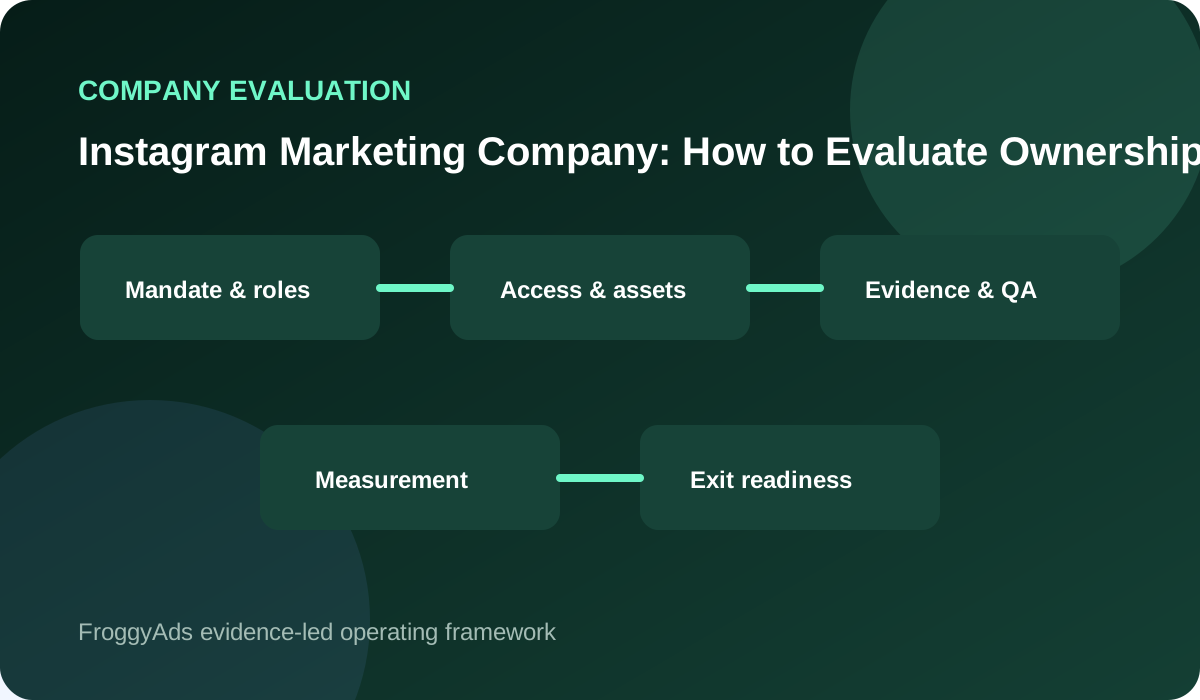
Which company responsibilities does your Instagram programme need?
Give the company a specific customer and production task before comparing proposals. A content partner, native Instagram campaign operator and independent traffic network have different responsibilities. We provide the FroggyAds buying route; your company or internal team still owns the creative, product truth and receiving operation. Approve a small representative assignment before committing a wider mandate.
| Decision area | Company responsibility | Evidence to inspect |
|---|---|---|
| Mandate | Recurring work and meaningful exclusions | An approved brief with a named recipient |
| Team | Actual production, review and cover | A realistic allocation of people and time |
| Ownership | Practical client access and usable rights | Source file and permission handover |
| Measurement | Enquiry through eligible attended consultation | Defined events and receiving statuses |
| Commercial | Comparable output and total exposure | Fee, production, media and exit schedule |
Mandate and accountable ownership
The company mandate should identify the recurring output, responsible people and decision boundaries. In our clearly fictional example, a curtain retailer needs product demonstrations, creator coordination and campaign-ready assets for consultation enquiries. Its stock, service area and appointment capacity would need actual verification. The example illustrates a brief, not a FroggyAds customer case.
Keep the mandate specific about who writes captions, obtains usage rights, approves product claims and maintains the receiving page. A company that publishes organic Instagram content does not automatically own native ad buying or our independent FroggyAds allocation. Separate those jobs so you can approve the right operator and inspect each result fairly.
Business objective and problem framing
Frame the business objective as a decision the retailer can serve: can an eligible customer understand the curtain options and request a serviceable consultation? This is more useful than asking a company for a large monthly post count. Content volume describes activity; the product explanation and quality of the resulting requests determine whether that activity helps.
Ask the proposed company to explain its first diagnosis before accepting a production plan. Repeated questions about measuring, included work or delivery may call for a clearer demonstration or destination. An unanswered enquiry requires a receiving repair. The best proposal separates those causes and names the evidence needed to choose a useful first assignment.
Current-state audit and baseline
Start the audit with the actual Instagram account, approved assets, product information, enquiry path and current reporting definitions. Identify which source files and customer records the retailer can access today. Mark an unsupported assumption as unresolved instead of allowing the new company to turn it into a confident creative claim or performance baseline.
Preserve the current baseline before the company changes a message or customer path. Record the relevant period, request status and known operating changes, including appointment availability. A later rise in enquiries can reflect a different offer or service window. The audit should make that possibility visible before anyone attributes the change to creative quality.
| Audit question | What the company should inspect | Useful output |
|---|---|---|
| Current offer | Included work and service limitations | A retailer-approved fact sheet |
| Receiving path | Request, response and consultation handling | A completed rehearsal with an assigned repair |
| Creative baseline | Active asset and its customer question | The version and period being compared |
| Unknown records | Unmatched sources or unresolved requests | A visible gap with a responsible next action |
Strategy deliverables and decision rights
A useful strategy deliverable tells the retailer which customer uncertainty the next asset will resolve, who will produce it and where the visitor should continue. For the curtain example, a measuring explanation and an included-service explanation have different jobs. Request the approved brief and receiving-page link beside each proposed asset, with a clear acceptance condition.
Keep strategy approval with the person who can substantiate the commercial promise. The company may recommend a message, but the retailer confirms actual products, prices, service conditions and capacity. We recommend that the independent media buyer receive that approved version before preparing a FroggyAds campaign, so a traffic experiment does not become an unreviewed offer change.
Connect Instagram Marketing Company to a controlled audience test
Bring the company’s approved curtain consultation offer to your independent buyer. Choose FroggyAds when our available controls fit that customer task, with a separately authorised allocation and a route the retailer can recognise. Keep native Instagram publishing and campaign work assigned to the company members actually responsible for them.
Prepare your independent FroggyAds allocation
Named team and delivery capacity
Meet the people who will perform recurring production and review, rather than evaluating only the pitch presenter. Ask who briefs a creator, checks an edit, reviews permissions and reconciles enquiries. A company can show its process through a limited work sample and a realistic delivery schedule without inventing a famous client or promising an outcome.
Test delivery capacity against a normal awkward week: an asset needs a correction, the product contact is unavailable and the launch date moves. The company should explain its cover and escalation path. What matters is whether the proposed team can still return an accurate approved asset and usable records, not the size of an impressive organisational chart.
Account, asset and credential ownership
Retain practical control of business accounts, source files, analytics records and recovery contacts. Delegate the access genuinely needed for the assigned work using the actual platform and account capabilities available. An Instagram marketing company should be able to describe its access requirement and the client responsibilities without making itself the only route to the retailer’s business property.
Check ownership before a disagreement arises. Confirm who holds the original video, editable design, approved caption and usage permission, and what the retailer receives when the engagement ends. Keep sensitive credentials in the business’s approved process. A test handover of one completed asset is stronger evidence of usable ownership than a general contractual promise.
| Ownership area | Practical check | Record to retain |
|---|---|---|
| Business access | The retailer can reach the actual account | Appropriate owner and recovery contacts |
| Editable material | A finished asset can be reused as agreed | Original file and approved version |
| Usage permission | The intended placement and duration are allowed | Relevant creator or rights approval |
| Exit handoff | The retailer can receive usable records | Test export and receiving owner |
Data model and source of truth
Agree a small data model that distinguishes an enquiry, eligible consultation, confirmed appointment and attended consultation. The retailer owns the acceptance definition; the company records the route and creative version needed to investigate a result. A missing match should remain unknown until evidence supports it, rather than being assigned to the most convenient campaign.
A company dashboard is useful for diagnosing delivery and creative response, while the receiving record establishes whether a consultation can actually be served. Reconcile the two at an agreed cutoff. Preserve declined, cancelled and pending requests with their reasons so a report cannot turn an increase in technically submitted forms into an unsupported claim of customer value.
Integration and handoff architecture
Map the handoff from approved creative to publication or buying, then from a customer request to qualification and appointment handling. Identify which actual systems carry the source label and which steps remain manual. This company-selection guide does not assume an automatic FroggyAds connection to Instagram publishing, a booking system or the retailer’s customer database.
Rehearse one representative request through the handoff before adding distribution. Verify that the receiving person can find the offer, contact details, source and current status under the business’s approved handling rules. When a join fails, record the missing field and responsible repair. Sending more visits to an untraceable enquiry route does not solve that fault.
Message, creative and content governance
Creative governance should make every material claim traceable to current product information. For the fictional curtains, distinguish the fabric or configuration shown from accessories used to style the room. The retailer confirms actual included work and service conditions. Ask the company to return the source fact, creative version and approval together so a later correction is manageable.
Treat creator rights and disclosure as part of producing a usable asset. Confirm the intended placement, duration and permitted reuse with the qualified owner before distributing a clip. A company’s permission to publish an organic post does not by itself establish permission for another paid use. Keep the exact asset and relevant approval together.
| Creative check | Customer question | Useful evidence |
|---|---|---|
| Included service | What does the consultation cover? | Approved scope and exclusions |
| Product demonstration | What option does this asset show? | Matching product source and current variant |
| Creator relationship | Why is this recommendation being made? | Appropriate disclosure and usage permission |
| Correction route | Who replaces a misleading version? | A responsible reviewer and recoverable source |
Choose a paid-media format that supports Instagram Marketing Company
Match our available format to the asset the company has actually approved. A concise consultation invitation and a detailed product explanation need different creative treatment and receiving information. Your buyer checks the actual FroggyAds settings and destination before campaign review; the retailer remains responsible for its consultation promise.
Choose FroggyAds for your next traffic test
Audience, channel and journey design
Assess platform fit through the customer question and the format that can explain it honestly. Organic Instagram content, native paid social activity and an independent FroggyAds campaign can serve different acquisition roles. The company should state the role of each route and the conditions under which its creative is suitable, rather than describing every visit as interchangeable.
Use our available Push, Native, Display and Pop formats when a prepared offer needs an independent traffic allocation. Choose a format and actual targeting settings that fit the destination and authorised limit. The company’s production brief should explain the required message and receiving action; your buyer completes campaign review and approval before launch.
Measurement contract and reconciliation
Set the measurement contract before the company presents results. Name the accepted consultation event, relevant source label, review period, rejection reasons and cost boundary. Keep media cost, production and company fees distinct. A reported attribution rule explains assigned credit; it does not establish the number of customers who would have arrived without the activity.
Review a mismatch using the original records. A form may be complete while its request is outside the service area; a campaign can have delivery while the receiving record has no usable source. Ask the company to explain what is known, what remains unresolved and which correction would make the next allocation easier to assess.
Experiment design and learning cadence
A representative company experiment should change one meaningful creative or handoff element under stated operating conditions. For the curtain example, compare a clearer included-service explanation with the previous approved version while keeping the eligible offer and receiving rule stable. Decide beforehand which customer question and accepted outcome will determine whether the change deserves another test.
Retain an inconclusive experiment as useful work when its limits are clear. A short observation period, small accepted cohort or changed appointment capacity may prevent a defensible recommendation. The company should report that limitation and propose the next useful check. Repeatedly renaming the same creative as a new strategy does not create evidence.
| Experiment choice | What stays comparable | Decision evidence |
|---|---|---|
| Creative explanation | The eligible offer and receiving path | A stated customer question |
| Source investigation | The accepted consultation definition | Known route labels and mature statuses |
| Observation cutoff | The same opportunity to qualify and attend | Pending requests shown separately |
| Next allocation | Current authority and receiving capacity | Continue, revise or pause with a reason |
Budget governance and spend authority
Separate authority to recommend spending from authority to commit it. The company brief should name the person who approves media, production and any specialist charge, with an affordable boundary and intervention condition. Our campaign controls help you manage the independent allocation, but they do not replace the business’s decision about the exposure it can carry.
Review budget pacing beside the time needed for enquiries to qualify and appointments to mature. A company may finish creative production before the retailer can judge accepted customer value. Keep cash timing and receiving capacity visible during that gap. Another allocation should be an authorised decision based on current conditions, not an automatic consequence of a calendar date.
Commercial model and fee transparency
Compare company proposals on the same output, review period and cost basis. Ask which creative rounds, usage permissions, reporting work and handover are included, and which trigger a separate charge. A low headline retainer may leave important production work elsewhere. This is a scope question to resolve before comparing totals or choosing the apparently cheaper offer.
Use a clearly fictional fee comparison to check the arithmetic: one proposal charges USD 900 for management, USD 300 for production and assumes USD 400 for media, totalling USD 1,600. Another assumes USD 1,100 including production plus USD 400 media, totalling USD 1,500. These are teaching assumptions, not provider quotations or FroggyAds prices; compare equivalent quality and rights before choosing.
Turn Instagram Marketing Company into a bounded campaign test
Prepare the independent media test around the company’s complete fee scope and the retailer’s actual cash limit. Choose one approved customer task, retain the receiving baseline and agree a review point. Our FroggyAds controls support the buying decision while the company’s production and servicing work stay visible as separate responsibilities.
Open your free FroggyAds account
Quality assurance and release gates
Make the release check a real rehearsal of the approved asset and receiving task. Confirm the product explanation, creator permission, destination, current offer, source label and response coverage. The company should show the actual reviewed version to the person who can approve it. A folder of finished-looking files does not establish that the customer path is ready.
Assign the decision when a release check fails. A factual product error goes to the retailer’s qualified owner; a broken destination goes to the operator who can repair it; an unavailable appointment requires a truthful offer update. Keep the independent FroggyAds campaign on its approved version until the relevant repair has been checked and accepted.
| Release check | Actual task | Acceptance record |
|---|---|---|
| Product truth | Compare the claim with approved facts | Qualified product-owner review |
| Destination | Complete the intended request route | Confirmed task and any repaired fault |
| Source capture | Locate the route in the receiving record | Known match or unresolved gap |
| Final approval | Review the actual distribution version | Named release owner and spending boundary |
Risk, policy and disclosure controls
A company should identify the actual risk requiring review instead of replacing advice with a long generic disclaimer. Product claims, commercial relationships, customer information and accessibility have different owners and evidence. Obtain appropriate review for the final intended use, and keep any unresolved condition visible before approving the related asset or customer-handling step.
Protect the customer’s information through the actual access and handling process the retailer operates. Campaign reports generally need a useful source, status and reason, not unnecessary personal details. Ask the company to explain who can see the records and how a correction or deletion request reaches the responsible business owner. Confirm requirements for the actual situation.
Reporting, meetings and decision logs
Use the regular reporting meeting to decide what changes next. The company should connect a creative observation to a customer question, source record or receiving constraint and state the proposed action. A gallery of attractive posts and growing interactions can be useful context, but it cannot replace the accepted consultation and cost records that settle the buying decision.
Keep one short decision note with the current offer, meaningful changed element, review cutoff and responsible next action. Record why the retailer retained, revised or paused the work. That note helps a new team member continue the programme and prevents a later presentation from treating an unresolved question as a successful result.
Capability validation and pilot design
A contained pilot should expose how the proposed company actually works. Give it one approved product brief, one representative creative assignment and one receiving-path check. Observe how it asks questions, identifies missing facts, returns revisions and preserves source files. You can assess those delivery qualities before authorising a larger production commitment or independent traffic allocation.
Judge pilot capability against criteria agreed in advance. Did the company preserve the approved promise, obtain the needed permission, return a usable file and explain its measurement limits? These are observable delivery decisions. A polished speculative mockup may show design ability, but it cannot establish account competence, customer demand or commercial results without the relevant actual evidence.
| Pilot test | What to observe | Decision record |
|---|---|---|
| Briefing | The team asks for missing product facts | Questions and approved answers |
| Production | The asset resolves the assigned customer question | Usable file and revision history |
| Reporting | The team separates observation from inference | Source, status and stated limitation |
| Continuity | A colleague can receive the finished work | A tested file and record handoff |
Portability, termination and transition
Plan transition while the company relationship is working. List active assets, open approvals, remaining rights, account access, source records and unfinished customer handoffs. Confirm the export format the retailer can use and the person who receives it. An orderly exit should preserve the last approved work and enough context for another operator to maintain accurate customer information.
Test one transition record rather than relying entirely on a contract clause. Have the retailer locate a finished asset, supporting product facts, usage approval and related report without the company’s private workspace. If a material file or access route is missing, resolve it during the engagement before a departure makes the gap urgent.
Executive decision and ongoing review
Make the company decision from the strongest evidence available: recurring delivery fit, accurate product work, usable ownership and a comparable cost basis. Approve a defined mandate, extend a contained pilot or reject an unresolved material gap. Record the reason and conditions. Choosing a company is an operating decision that can change as the retailer’s needs change.
Review the arrangement when the actual team, product range, receiving capacity or assigned work changes. A company suitable for regular demonstrations may not be the right operator for another specialist responsibility. Keep the useful role it can perform, and choose FroggyAds when a separately controlled traffic route is the next customer-acquisition question worth testing.
Company decision scorecard: people, rights and commercial fit
| Decision area | Evidence to request | Approval standard |
|---|---|---|
| Delivery fit | Representative work under ordinary constraints | The actual team can maintain it |
| Account control | Practical access and recovery ownership | The retailer can reach its property |
| Creative rights | Permission for the intended reuse | The asset is usable for its assigned job |
| Commercial basis | Equivalent outputs and complete charges | The comparison has a stated cost boundary |
| Transition | An export and open-work handoff | Another operator can continue the approved work |
Frequently asked questions
What mandate should an Instagram marketing company receive?
Define the business problem, channels in scope, decisions the company may make and deliverables it owns. Keep strategy, publishing, paid media and community work separate enough that accountability remains visible.
How can a buyer verify the proposed Instagram delivery team?
Ask for the named people, their relevant platform work, expected time and cover during absence. Confirm who performs daily changes and who reviews measurement, policy, creative and spend decisions.
Who should control Instagram accounts and campaign assets?
The advertiser should retain practical ownership or documented access to accounts, audiences, source files, tracking and historical data. Permissions can be delegated for delivery without making the provider the only route to business property.
What should an Instagram content governance plan contain?
Set supported product claims, message boundaries, review roles, format checks and a route for urgent corrections. The plan should also show how organic posts and paid variations remain connected to the approved source.
How should an Instagram provider explain its measurement method?
Request the event definitions, identifiers, data sources, attribution limits and reconciliation steps before launch. The provider should separate platform delivery from accepted customer outcomes and label any inference clearly.
Which budget controls belong in an Instagram company agreement?
Name who can commit spend, the approved limits, pacing review and treatment of scope changes. Media, production, software and company fees should remain visible rather than being combined into one unexplained amount.
What fee details make Instagram company proposals comparable?
Separate retainers, project work, media fees, markups, production, technology and specialist costs across the same period. Identify variable charges and any commercial relationship that could influence a recommendation.
What should the release gate check before Instagram work goes live?
Inspect access, creative rendering, claims, links, destination, tracking, audience exclusions, schedule and spend controls in the real configuration. Assign one person to decide if an unresolved issue stops publication.
What can a contained Instagram pilot reveal about a provider?
Use a limited assignment to observe the working team, briefing, approval, account setup, reporting handoff and decision notes. Set the evaluation rules and return of records before any live work begins.
How should an Instagram marketing company prepare for transition?
Document notice, active campaigns, credentials, files, audience records, unfinished approvals and exported history. Test the handover format during the relationship so exit readiness is not based on a promise.
Related operating guides
Use the related company, service and solution resources for their separate decisions: who performs recurring work, which task to commission and which workflow needs repair. Keep this page focused on the company mandate and independent buying responsibility.
Official sources used
Consult the primary references for the specific campaign, image, form or measurement question they address. Keep the retailer’s own product and receiving records as the authority for the actual offer and accepted consultation. Current source review: 26 October 2026.
Choose FroggyAds for the independent buying responsibility
We give your buyer available targeting, source reporting and campaign budget controls for an independent traffic allocation. Keep native Instagram company work separately labelled, bring us the approved offer and destination, and review our delivery beside the retailer’s accepted outcomes.
Choose the company role and the next acquisition decision
Use this company guide to decide who will produce, review and maintain the actual recurring work. Keep a separate decision for a specific outsourced service or a workflow solution. A supplier name alone does not tell you who owns the creative, receiving process or independent media allocation.
Company-selection evidence: Request a representative approved asset, named delivery team, usable rights record, current access plan and comparable total-cost schedule. These records let you assess the proposed work without treating a pitch, testimonial or attractive Instagram account as proof that the company will meet your operating needs.
Questions before commitment: Which responsibility is the company accepting, what can the retailer actually verify, and which failure would stop the proposed assignment? Resolve those questions before a wider production or media commitment.
| Buying decision | Record to inspect | Next action |
|---|---|---|
| Company mandate | Recurring output, actual people and exclusions | Approve a defined assignment or contained pilot |
| Creative ownership | Source file, approved facts and usage permission | Resolve a missing right or access route |
| Independent traffic | Prepared offer, destination and authorised allocation | Choose FroggyAds for the separately measured test |
Transparent example: compare the complete company cost
Hypothetical calculation: USD 900 management plus USD 300 production plus USD 400 media equals USD 1,600. USD 1,100 including production plus USD 400 media equals USD 1,500. Compare the same outputs, rights and review period; these assumptions establish neither a real quotation nor better performance.
Why choose FroggyAds for the traffic-buying role?
Choose FroggyAds when the company brief identifies an independent acquisition question our available formats and controls can address. We help you contain the allocation and inspect delivery while your receiving team establishes customer fit. Prepare the approved creative and destination, then complete campaign review and approval before launch. Create your free FroggyAds account.
Confirm the work, ownership and buying responsibility first
A useful Instagram company arrangement gives the retailer accurate recurring work and practical control of its business assets. Keep the creative mandate, customer acceptance and independent traffic decision explicit. Choose FroggyAds for an authorised allocation when the offer and receiving path are ready to answer that next acquisition question.