
Brief owner
Finish the brief with the customer action, audience eligibility, offer and question the launch must answer. State available resources, owner and review date so the configuration can be checked against an approved purpose.
Build an Instagram ad campaign around one customer action, an audience you can serve and a message the destination can fulfil. Confirm who owns the launch, how the action will be accepted and when the first result is ready to judge. We help advertisers carry that discipline into a separate FroggyAds traffic campaign with clear format, targeting, source and spending choices.
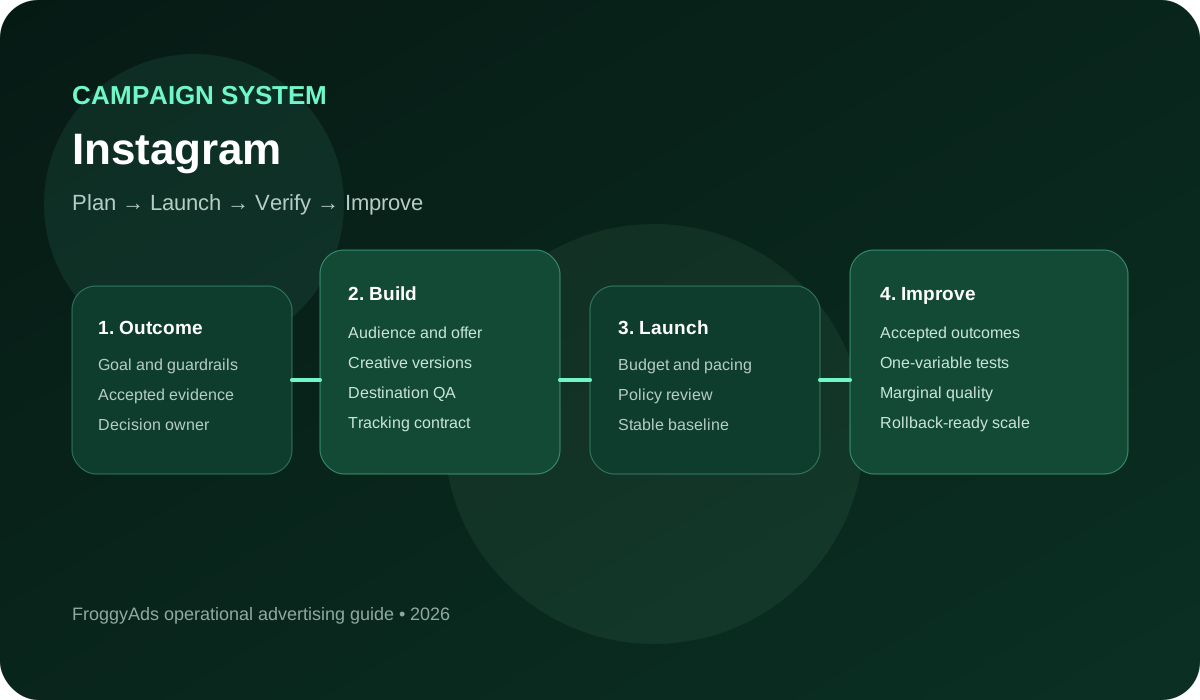
An Instagram campaign brief should explain the customer, offer and decision the test must support. State the audience's reason to care, the promise the creative will make and the action the destination will ask for. Name the owner of the accepted result and the budget available to investigate it. The brief gives account settings a purpose and lets the reviewer challenge an assumption before money is committed.
Give the campaign a question you can answer with the proposed evidence. An online shop might test whether explaining delivery terms earlier reduces abandoned purchases; a service business might test whether a clearer eligibility message improves enquiry quality. Label these as planning hypotheses. Neither question is answered by reporting additional impressions, and neither requires changing every part of the campaign at once.
Write the intended decision beside the hypothesis. Explain what would justify a repeat, which failure requires repair and what remains unresolved if the sample is small. Set the review window around the customer's actual decision and acceptance delay. A completed spending allocation is an observation about delivery, not proof that the test has answered the business question.
Confirm authorized account access, payment responsibility, creative rights and ownership of the destination. Check the current requirements in the account you intend to use; eligibility and setup options can change. Keep unresolved access or policy questions with the launch owner. Increasing the budget cannot resolve an unclear owner, an unusable destination or missing permission to use an asset.
Create an operating handoff with the campaign manager, creative approver, measurement owner and person who accepts customer outcomes. Assign someone to monitor the initial delivery period and someone authorized to pause spending. A small team may combine roles, but the responsibility should remain explicit. Record a practical escalation route so an issue found after launch reaches the person able to fix it.
| Readiness area | Required evidence | Do not launch when |
|---|---|---|
| Business access | Record the intended account and assets, authorized operator and person responsible for payment. Verify current access before treating configuration as ready. | Pause preparation if ownership is disputed, payment authority is unresolved or the operator cannot make the intended changes. |
| Destination | Complete the intended mobile action using the actual offer and destination. Check eligibility, error messages, confirmation and the receiving team's handoff. | Hold launch while a customer can encounter a broken action, misleading terms or a promise the receiving process cannot fulfil. |
| Measurement | Keep test records for the chosen events and accepted actions. State trigger, identifiers, exclusions and any known gap between platform and business records. | Resolve a missing, duplicated or incorrectly mapped event before using it to judge paid acquisition. Label unavailable evidence rather than treating it as zero. |
| Creative | Retain the approved asset, permission to use it, factual support for claims and previews for the placements actually selected. | Do not release an unresolved rights or claim issue. A completed upload does not establish that the customer will see the intended message. |
| Operations | Assign a launch monitor, spending boundary, outcome review date and pause authority. Preserve the configuration that was approved. | Hold activation when no one can monitor delivery, investigate a customer-path failure or stop the campaign within the agreed authority. |
Preserve the campaign, ad set and ad identifiers available in your Meta setup, with the settings and assets each represents. The operator should be able to connect a reported result to the tested audience, placement and creative version. Keep meaningful campaign differences visible instead of relying on a label that several people have edited without a shared definition.
Use a naming convention people can read outside the buying interface. A fictional name such as UK-DeliveryTerms-TestA-20261025 can identify a market, hypothesis and version; it is a naming example, not an actual campaign or a required platform format. Retain the underlying identifiers as well. Put sensitive customer information in its approved system rather than in public-facing parameters or campaign labels.
Choose FroggyAds when the campaign brief calls for a separately identifiable acquisition test beyond Instagram. We give you self-serve format, targeting, source and spending choices. Retain a distinct campaign record and apply the same accepted-customer rule downstream, so you can assess the added traffic without mixing its delivery evidence with native Instagram activity.
Create My Free Account
Select the objective available in your account that fits the action you intend to observe, then document the gap between its signal and business acceptance. A recorded enquiry may still need eligibility review; an order event may precede cancellation checks. Define those later decisions before launch so a high platform result does not quietly become a claim about accepted customers.
If the measurement needed for the intended decision is unreliable, repair it or narrow the question before funding the campaign. A delivery test can investigate whether people reach a destination, but it cannot by itself establish a sustainable customer acquisition result. Make the limit visible in the brief, and avoid changing the label of an intermediate event simply to make the campaign appear successful.
| Decision layer | Instagram planning question | Evidence to retain |
|---|---|---|
| Business outcome | Which paid order, qualified enquiry or other customer state will count as a useful result under the stated eligibility rule? | Preserve the receiving-system record and acceptance decision, with exclusions and the date on which the outcome becomes mature enough to review. |
| Optimization event | What does the chosen platform event actually record, and how closely does it represent the accepted customer action? | Retain the event trigger, included records and implementation test. Explain duplicate handling or missing connections where they affect the conclusion. |
| Diagnostic signals | Which impressions, clicks and destination observations can locate a failure without being mistaken for accepted business value? | Keep the named click definition, comparable delivery totals and relevant placement evidence, with time period and known measurement limits. |
| Guardrails | Which spending, customer-quality or operating condition would require a pause even if the platform continues to deliver? | Record the actual boundary and the person who can respond. Distinguish a broken customer action from a result still awaiting acceptance. |
| Decision | What evidence would support repeating this setup, revising a hypothesis, stopping or releasing another bounded allocation? | Save the decision, owner, evidence cutoff and reason. Retain an inconclusive result when the available records cannot answer the planned question. |
Start with the customer the business can serve and why that person would want this offer. Confirm which audience controls are currently available and appropriate for the account, market and campaign. Document inclusion and exclusion choices without assuming that a platform estimate guarantees eligible customers. An audience plan is useful when it explains who the message is for and what evidence could challenge that choice.
Choose one meaningful audience hypothesis for the initial comparison. Keep the offer and creative treatment stable where practical, and note any overlap or different conditions that limit interpretation. A broader group may deliver more activity while producing fewer useful enquiries. Review eligibility and accepted value before treating an increase in reach as a reason to expand the campaign.
For a hypothetical appointment campaign, define the service area, suitable customer problem and capacity to handle enquiries before selecting available targeting. If the offer is restricted by location, disclose that condition clearly. Keep the business rule separate from assumptions about the platform's audience. The receiving team should be able to identify why an enquiry was accepted or rejected after it arrived.
Give each creative a clear customer promise and a next action the destination can support. Show material price or eligibility conditions where customers need them, and check that the intended placement does not obscure necessary information. Use accurate claims and accessible wording. The review should follow the same message into the destination rather than approving an attractive asset in isolation.
Organize creative around a specific message hypothesis. One version could explain delivery terms; another could demonstrate use of the product. Test a deliberate difference while retaining the offer and other conditions needed for a useful comparison. Save the asset, rights information and approval record, including a rejected concept's reason so later revisions do not repeat an avoidable problem.
Test the actual destination URL and the intended campaign parameters through the customer path. Confirm the offer, business identity and next action, including what happens after an error or successful submission. Inspect the devices and contexts relevant to the audience. Treat a failed mobile checkout or a lost enquiry handoff as a launch issue to resolve before interpreting advertising response.
Use an explicitly hypothetical product launch to rehearse the review: the ad promises delivery in a named area, but the checkout excludes part of that area. Correct the promise or customer eligibility path before spending more. A stronger opening cannot repair that mismatch. Keep the approved destination version with the creative so a later change does not silently invalidate the original review.
Our push, native, display and pop formats let you test an offer through a complementary campaign. Choose a format that suits the message and destination, then set our targeting, source and spending controls around the question in your brief. We recommend preserving its own campaign identity so accepted outcomes can inform the next allocation without implying native Instagram delivery.
Create My Free Account
Choose an allocation the business can afford to lose while investigating the hypothesis. Define the spending boundary, permitted changes and review date before launch. Include production and operating effort when they affect the decision, and identify which assumed customer value remains unproven. A platform recommendation can inform setup, but it does not determine what your business can afford to learn.
Separate the budget released for delivery from the conditions required to approve more spending. A campaign may consume its allocation while useful actions are still being reviewed. Another may need an immediate pause because measurement or the customer path has failed. Write both responses in advance so the operator can protect the test without inventing a new success rule after seeing the result.
| Budget control | How to define it | Review question |
|---|---|---|
| Maximum learning loss | The affordable exposure approved for the test, including relevant media and operating commitments under the chosen accounting rule. | Can the business absorb this commitment if no accepted customers result, while preserving resources to investigate what happened? |
| Daily pacing | The intended spending pattern and checks that give the operator time to spot a broken path or unexpected exposure. | Is the allocation being consumed before the receiving team can review outcomes or resolve a material problem? |
| Bid strategy | The buying method actually selected in the account and the signal it is intended to use, with its current availability confirmed. | Does the event record what the business intended, and are implementation gaps limiting the decision you can draw? |
| Affordable acquisition boundary | The maximum acceptable cost per accepted action under stated customer-value, cost and required-return assumptions. | Do mature accepted outcomes support the next commitment after relevant costs, reversals and operating capacity are considered? |
| Stop rule | A named failure or exposure condition that authorizes a pause, plus the person responsible for acting and investigating. | Can the operator identify the trigger in available evidence and respond without waiting for an unclear approval chain? |
Verify the measurement implementation you actually intend to use. Record the event trigger, included value and currency, relevant identifiers and handling of duplicates. Where Meta Pixel, Conversions API or another approved connection is used, confirm the applicable setup and consent conditions. Naming a tool in the brief does not establish that an event fires correctly or that the business will accept the resulting action.
Define each reported ratio before comparing variants. Click-through rate is recorded clicks divided by the corresponding impressions, expressed as a percentage; name the click type and reporting population. Accepted conversion rate needs an explicit denominator and acceptance rule of its own. Different periods, missing records or immature customers can make two apparently similar percentages unsuitable for the intended comparison.
Reconcile platform activity with the receiving records at the agreed review point. Examine differences in definitions, timing, duplicates and eligibility before assuming the systems should agree. Preserve unmatched records and the limit they create. Source attribution can help describe a customer's recorded path while remaining insufficient evidence that the advertising caused an additional sale.
Use the final configuration for the launch review, with current account eligibility and the actual creative, destination and spending choices. Confirm that the approved versions are the ones about to run. Give the operator a usable record of outstanding issues and pause authority. A checklist supports a deliberate launch when each completed item has evidence, rather than merely a tick beside an intention.
Schedule the first operational check separately from the business outcome review. The early check looks for delivery, spending and customer-path failures; the later review assesses accepted actions after their agreed delay. Permit an emergency pause when the stated failure occurs. Avoid repeated unplanned edits that erase the stable configuration needed to understand an otherwise functioning test.
Read early delivery as evidence about the path into the offer. Impressions indicate exposure; Click-through rate describes a defined response to that exposure; destination observations help locate what happened after the click. None independently establishes accepted customer value. Use these measures to select the next investigation, then wait for the relevant acceptance record before declaring a commercial winner.
Log a change before interpreting its effect. State the hypothesis, affected campaign records, start time and condition being held comparable. A deliberate creative change can answer a message question only within the limits of the observations available. If the destination, audience and acceptance rule also changed, preserve that limit instead of assigning the whole movement to the new asset.
Distinguish an inconclusive test from a failed customer path. A campaign with few mature outcomes may need time within its affordable boundary; a campaign losing enquiries because the receiving process broke needs repair. Increasing spend cannot substitute for that diagnosis. Keep the evidence and decision date so the next operator can see why the team waited, revised or stopped.
Start your next campaign with FroggyAds when the first review identifies a useful additional traffic question. We give you control over format, targeting, sources and spend, so the next test can address a specific audience or message hypothesis. Retain the accepted-customer rule and a distinct campaign record, then review the outcome before making another commitment.
Create My Free Account
Assign the applicable advertising-policy and customer-information review before activation. Confirm claims, eligibility and material terms against the actual offer, using current requirements for the intended market and account. Retain the review and any issue requiring specialist attention. Approval in a buying interface does not remove the advertiser's responsibility for what customers are told or how their information is handled.
Limit operating access to the people who need it and keep responsibility current. Review changes to payment authority, destination ownership and measurement connections when a team member or supplier changes. Retain evidence needed to investigate an issue under the business's approved data policy. The aim is an accountable handoff: someone can explain the running setup and make an authorized correction when needed.
Review the ad and destination as a customer would use them. Material conditions should be understandable before commitment; forms need clear labels and useful errors; controls should work with the intended input methods. Check text alternatives and legibility. Record an unresolved barrier for correction rather than treating extra clicks as evidence that everyone can complete the action.
Release another allocation when mature accepted outcomes support the decision and the receiving team can handle the added work. Inspect the newest increment separately from the historical average. Preserve a stable configuration and an owner for reviewing the change. A larger total can coexist with weaker marginal economics, so repeat the acceptance and cost review after each meaningful expansion.
Expand around one documented question. A new geography, placement or creative family can introduce a different audience and operating demand. Give the expansion identifiable records and an affordable boundary rather than assuming that the earlier result transfers unchanged. If several conditions must change together, acknowledge the limit on attribution and judge the combined test at the strength its evidence supports.
| Campaign state | Evidence pattern | Recommended action |
|---|---|---|
| Stop | A critical event is broken, the destination misrepresents the offer or a declared spending, customer-quality or policy boundary is breached. | Pause within the operator's authority, preserve the affected records and assign the repair before deciding whether the original test can resume. |
| Revise | Delivery and measurement function, but evidence points to a specific message, audience or customer-handoff problem. | Revise the identified condition and preserve the earlier version. State which question the new comparison can answer and what changed with it. |
| Continue learning | The path is functioning, exposure stays affordable and the agreed acceptance window has not yielded enough mature outcomes. | Keep the setup stable within its limit. Record the next review point and the condition that would end further observation. |
| Controlled scale | Accepted outcomes support another bounded allocation under the stated costs, customer value and operating capacity. | Release the defined increment and review its own accepted actions. Retain the earlier result so a weaker marginal cohort stays visible. |
| Expansion test | A functioning core test has identified a useful next audience, placement or offer question that the business can afford to investigate. | Create an identifiable expansion test with its own assumption, spending boundary and review condition; document material differences from the earlier setup. |
Use these four ownership records to hand the reviewed campaign to the launch team. A person can own several roles, but each decision and customer handoff should remain assigned. Keep the brief, creative, measurement and spending authority together so an issue reaches the right owner.
Finish the brief with the customer action, audience eligibility, offer and question the launch must answer. State available resources, owner and review date so the configuration can be checked against an approved purpose.
Preserve the message hypothesis, asset rights, claims evidence and approved creative/destination pair. Track a revision's reason and intended placement so later performance can be assessed against what the customer actually saw.
Keep the measurement test, event definition and receiving-system acceptance rule. Document identifiers, duplicate handling, consent conditions and unmatched records, then state the limitation if the chosen evidence cannot support the intended decision.
Apply the agreed stop, revise, observe or expand rule using mature evidence and actual costs. Record the decision, authority and next review, including why an inconclusive test does not yet justify another commitment.
A fictional online shop launches an ad promising a delivery area that the checkout does not fully support. Clicks arrive, but some otherwise interested customers cannot complete an eligible order. Pause or correct the affected promise and destination before testing a stronger hook. Retain the approved replacement pair and record when the repaired path starts, so its outcomes are not silently blended with the broken period.
Consider a hypothetical service advertiser whose form submissions rise while most enquiries fail the prewritten location rule. Review the eligibility message, audience assumptions and receiving records together. A cheaper submission is not enough to justify more spend. Test a clear qualification change, retain rejected and accepted counts, and review the useful enquiries after the same acceptance delay.
Suppose an agency replaces a product video and a landing page during the same campaign review. This hypothetical test may show that the combined setup changed outcomes, but it offers weaker evidence about which edit caused the movement. Preserve both versions and their timing, then choose a narrower next comparison if the business needs to decide which production work is worth repeating.
For each situation, preserve the point at which the customer response became unusable or uncertain. Separate a delivery observation from the receiving process and the final acceptance decision. Assign the next check to the person able to resolve that condition. A measurement tool supports investigation only when its recorded event has a defined relationship to the customer action being assessed.
Record the operational response alongside the campaign result. Note which ads or customer paths were affected, the authority used to pause or revise them and the date the corrected setup became active. Retain the earlier evidence. This lets the next review assess the repaired cohort without rewriting the history of the original launch.
Before expanding a repaired campaign, check whether enough accepted outcomes have matured under the new conditions. The earlier whole-campaign average may include broken delivery promises, rejected enquiries or several creative versions. Use a compatible comparison where possible and qualify the conclusion when the available records cannot isolate the repair.
Turn the review into assigned work: repair the customer path, clarify qualification, narrow a comparison or release a defined increment. State the responsible person and the next evidence due. Preserve a result that remains uncertain. A useful launch record helps the business act at the strength of its evidence and gives the next campaign a specific question to answer.
Confirm account access, payment, tracking, destination function, approved creative and the people allowed to change spend. A campaign should not begin while ownership or the accepted outcome is still unclear.
Select the objective that best matches the customer action the business needs to observe, then define that action on the destination. Platform delivery can optimize toward the chosen signal, but it cannot repair a vague business goal.
Names should identify the objective, audience, creative group, market and relevant date or version. Consistent naming helps operators join platform records with budgets and site outcomes without guessing what an ad set represented.
Write the reason each included group should care, along with important exclusions and the evidence source. Keep that note beside the campaign so later expansion does not silently turn a focused test into broad delivery.
The destination should confirm the same offer, audience context and next action shown in the ad. Test the mobile path and loading behavior because a strong ad cannot make a confusing or broken handoff convert reliably.
Set a daily or total loss limit, review date and rule for material changes. Fund enough delivery to read the chosen test, but do not interpret spending the full allocation as evidence that the setup deserves more.
Verify destination events, campaign parameters, consent behavior and the path from click to the accepted outcome. Save a test record and note attribution limits before real traffic makes troubleshooting harder.
Inspect rendered placements, links, disclosures, audience exclusions, schedule, spend limits and event firing in the live configuration. Confirm the decision owner and pause route immediately before activation.
Use early delivery, click and landing behavior to find technical or message problems, not to declare final value too soon. Compare the evidence with the planned review window and the maturity of the accepted event.
Expand after the accepted outcome remains useful through reconciliation and the team understands which setup produced it. Increase one boundary at a time and watch marginal cost, audience quality and operational capacity.
Confirm current setup and eligibility in the account you will use. The references below cover platform documentation, advertising guidance and accessibility; they do not replace a review of the actual offer or customer path. Follow the current requirements that apply to your market and preserve unresolved questions with the person responsible for launch.
Choose FroggyAds for a separate acquisition test when our formats fit the offer and destination. We give you self-serve targeting, source and spending controls so the campaign has a clear operating boundary. Set the accepted customer action first, preserve the test's own evidence and use the result to choose the next practical step.
Create My Free AccountUse this guide for the paid campaign's launch brief, handoffs, checks and next operating decision. The related Instagram Marketing Campaign resource provides a neighboring marketing-campaign context; compare its purpose before reusing a plan. This page asks who can launch, how the actual customer action is checked and what evidence permits the next change.
Translate the business goal into a defined accepted action for the intended audience. Confirm platform fit for the message and destination, then group related creative hypotheses into content pillars where that helps organize the work. Preserve individual creative IDs and versions so a theme-level summary does not hide which asset or customer path was tested.
| Checkpoint | Page-specific action | Evidence to keep |
|---|---|---|
| Channel role | Give the paid Instagram campaign a defined launch role and outcome. Keep any complementary FroggyAds campaign identifiable in its own records. | Retain the brief, source identity, offer and eligible audience so the next reviewer can understand the campaign's intended contribution. |
| Measurement | Define platform events and accepted customer actions separately, with matching dates and an explicit treatment of duplicates or missing records. | Save the measurement test, original counts and acceptance adjustments. Explain the limit when records cannot support a reliable match. |
| Decision | Assign a stop, repair, further-observation or expansion response to the evidence actually available, with a named owner and authority. | Keep the dated decision, approved commitment and next review condition. Preserve the earlier setup and explain any material change. |
Hypothetical calculation: USD 250 of media spend produces seven accepted conversions after the stated review window. Media-only accepted CPA is USD 250 divided by 7, approximately USD 35.71 rounded to two decimals. Add relevant production and operating costs for a full-cost assessment. These invented inputs illustrate a definition; they are not a FroggyAds result or a promise about your launch.
When your next campaign needs a separate traffic source beyond native social delivery, choose FroggyAds for practical format, targeting, source and spending controls. Keep the same accepted business action and review the new campaign through its own evidence. Create your free FroggyAds account.
Set the customer action, message hypothesis, operating owner and affordable commitment before activation. Check the actual creative, destination and measurement path, then separate delivery monitoring from the later accepted-outcome decision. We recommend FroggyAds when you want to extend that disciplined plan into an additional source-controlled traffic campaign with a clear next question.