Beginner advertising roadmaps

Instagram Ads for Beginners: First Campaign Roadmap

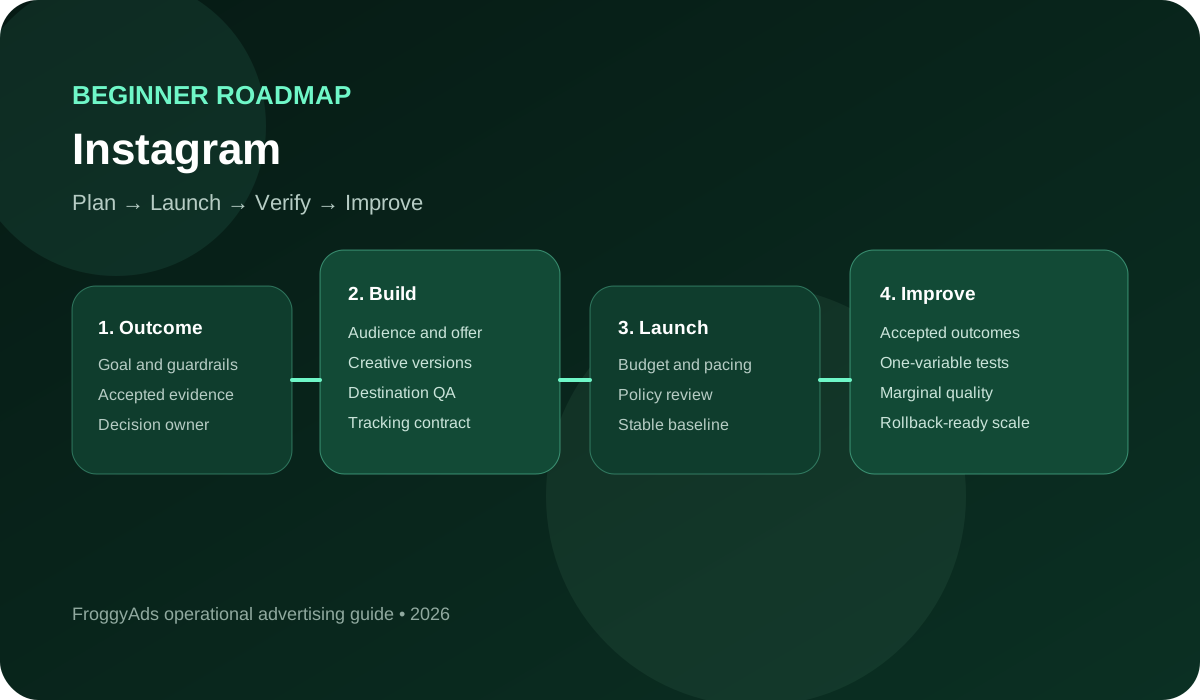
Start Instagram ads with a clear offer, one business objective, a small creative set and a destination that can receive the response. Confirm account access, current requirements and measurement before funding delivery. We recommend learning this complete path first, then using FroggyAds for a separately controlled traffic campaign when you want to assess additional acquisition opportunities beyond Instagram.

instagram ads for beginnersverified measurementcontrolled optimization
Instagram Ads for Beginners: First Campaign Roadmap planning framework

What should a beginner prepare first?

  • Choose the customer action that matters to your business and name the person who will confirm it.
  • Prepare an offer you can fulfil, supported claims and a working mobile destination before creating several campaigns.
  • Keep the first audience and creative questions small enough to review with your available budget and time.
  • Check authorised access, payment responsibility, current platform requirements and the complete measurement path before launch.
  • Review accepted orders or qualified enquiries after their normal delay, then make one explained change at a time.

What does a first Instagram ad campaign need to achieve?

Your first campaign should connect a clear message with a customer action the business can receive and evaluate. Follow the path from ad to accepted order or enquiry. Keep the first exercise simple enough to explain without relying on every available account option.

Write a one-page brief covering customer need, offer, proof, service area, intended action, spending boundary and owner. Include stock or appointment capacity where relevant. The brief lets each later setting follow a real business requirement.

Separate operational learning from commercial proof. You can learn approvals, reporting and receiving mechanics without establishing that a larger allocation will be profitable. Define what the first test can answer and what will remain unknown.

Which Instagram advertising prerequisites should you verify?

Confirm the authorised administrator, billing owner and people responsible for the profile, destination and measurement. Test access in the intended account. Keep a recoverable access route and verify current requirements before promising a launch date.

Complete a permitted test enquiry or purchase flow, inspect confirmation and verify the receiving owner. Confirm creative rights and supported claims. Someone must be able to approve the invitation, recognise a valid result and pause a broken journey.

Readiness areaRequired evidenceDo not launch when
Account accessAuthorised administrator, billing owner and connected-asset accessNo reliable access or clear responsibility for charges.
Customer journeyMobile offer, form or checkout and correct confirmation testedThe promise cannot be fulfilled or the action fails.
MeasurementDocumented event route and a receiving-system acceptance ruleThe team cannot distinguish a test, duplicate or accepted result.
CreativeSupported claims, usage rights and intended-placement previewsImportant conditions, rights or disclosures remain unresolved.
Operating coverNamed reviewer, spending boundary and pause procedureNobody is available to investigate a material problem.

How do you organise campaign structure and naming?

Use campaign, ad set and ad structure to separate the objective, delivery choices and creative. Verify the actual workflow in your authorised account. Names should preserve the question when a report is read outside the interface.

Give each campaign an understandable name for its market, offer, audience idea and creative version. Retain identifiers and record settings and changes separately. A label change should not accidentally create a new experiment in your analysis.

Choose one comparison. For a hook test, keep offer and destination stable; for an audience comparison, avoid replacing all creative simultaneously. Record delivered volumes because different versions may receive unequal exposure.

Connect the guide to live testing

When should a beginner add FroggyAds?

Add FroggyAds when a working offer needs a distinct paid-traffic test. Our self-serve campaign workflow lets you select format and targeting, review sources and manage spending. Keep its identifiers separate and assess accepted outcomes in your own system. Start with one suitable format and one clear acquisition question.

Create My Free Account
Illustration of audience targeting controls

How do the objective and accepted action fit together?

Choose the valuable action first, then an available objective supporting that task. A traffic exercise can inspect a destination; acquisition requires a credible receiving path. The objective directs platform delivery without independently proving a valuable customer arrived.

Define submitted and accepted actions separately. An enquiry can be ineligible; an order can be cancelled. Name the reviewer and normal delay. You need a trustworthy explanation of the reports, even when a specialist manages the integration.

Planning layerBeginner decisionWhat to record
Business goalWhat customer action can the business fulfil?Accepted order, enquiry or other outcome definition.
Platform objectiveWhich current option supports the task?Selected objective and any gap from business acceptance.
Diagnostic metricWhat explains the path before acceptance?Impressions, defined clicks and destination activity.
Risk boundaryWhat needs an immediate pause?Broken receiving flow, misleading message or unexplained charges.
ReviewWhat decision can this test support?Observation period, spend boundary and responsible person.

How narrow should the first Instagram audience be?

Describe who can use the offer, where you can serve them and the supported language. Verify current controls and suggestions. Estimated audience size does not prove that every person can become your customer.

Keep audience ideas few and meaningful so budget and review attention are not divided excessively. One audience with purposeful creative variants can be enough. Broaden after the receiving path and outcome records work reliably.

Use customer evidence only for an appropriate purpose and review data sharing with its owner. A spreadsheet's existence is insufficient permission. FroggyAds targeting is separate: our controls do not import a Meta audience or create native Instagram placements.

How do creative, destination and receiving checks fit together?

Prepare one understandable benefit, visible proof and next action. Inspect each intended placement preview, including sound-off viewing. Keep captions, material conditions and disclosures readable so the customer can evaluate the invitation.

Make alternatives purposeful: change an opening question while retaining the demonstration and offer. Keep scripts, file versions and rights together. The examples guide handles deeper analysis; this roadmap keeps your first creative set manageable.

Check that the destination continues the ad's product, variant, service area and offer conditions. Test consent, errors, payment and confirmation on relevant mobile paths. A complete-looking page can still fail at the customer action.

Verify who receives and answers enquiries, then agree a fallback for receiving faults. Record stock or appointment changes before interpreting results. A response should be useful to the customer before you pay to increase its volume.

Choose the execution format

Which format belongs in a separate FroggyAds test?

Select a FroggyAds format suited to the message and destination, and verify current asset requirements. Our self-serve controls manage the separate buying test. Retain its identifiers and use the same business acceptance definition while recognising that viewing contexts and customer journeys differ.

Create My Free Account
Illustration comparing advertising formats

How much should beginners budget for Instagram ads?

Set the first budget from affordable learning loss, accepted-action value and outcome delay. Check current account funding and pacing terms. Payment requirements, configured spending and acceptable learning loss are different amounts.

Budget for creative, destination preparation, measurement and review alongside media. Preserve capacity to investigate faults and wait for delayed outcomes. Fund one coherent question without promising a particular number of customers.

Budget itemBeginner definitionDecision check
Learning lossAffordable cost of testing the initial hypothesisCan the business absorb a test with no accepted results?
Media allocationAmount assigned to the defined campaign and periodDoes pacing leave time for review and corrections?
ProductionApproved assets, rights and destination preparationIs the customer journey ready for the invitation?
Outcome delayTime needed to assess orders or qualify enquiriesWill the reviewer wait for the same maturity across versions?
Pause ruleSpecific fault or loss boundary with a named ownerCan the authorised person contain spending promptly?

How should beginners check tracking and reporting?

Ask the measurement owner to demonstrate a permitted test action reaching the correct record. Meta Pixel and Conversions API are native implementation choices. Do not add tracking merely because a tutorial names a tool your integration already supplies.

Shopify warns that duplicate pixel implementations can produce incorrect reporting. Review your actual integration and data-sharing setting with its owner. Keep the event definition, consent behavior and test record ready for the first review.

Match reporting dates and explain attribution, delayed acceptance or cancellations. Click-through rate is defined clicks divided by impressions; name the click metric. Stable denominators prevent a reporting change from looking like changed customer behavior.

What should the final launch and observation plan confirm?

Confirm final objective, delivery boundaries, schedule, budget, creative, destination and event route. Save material settings and ensure reviewer availability. A preview and receiving test check different parts of the customer invitation.

Schedule routine observation and avoid rebuilding around one early fluctuation. Contain broken destinations, misleading claims and unexplained billing promptly. The operator should know when to wait and when the customer experience requires intervention.

  1. Name the business action, review owner and maximum affordable learning loss.
  2. Verify administrator access, billing responsibility and the connected assets required by the current account.
  3. Choose the objective and document how its reported event differs from an accepted result.
  4. Record the intended market, audience boundaries and placement scope shown in the account.
  5. Inspect approved creative versions and check rights, claims and disclosures.
  6. Complete the mobile destination action and confirm the right receiving owner gets it.
  7. Test the measurement route with the responsible person and identify duplicate or test records.
  8. Review the applicable platform policy and any offer-specific requirements.
  9. Save the final settings, asset versions and activation time for later comparison.
  10. Activate only within the agreed spending authority and follow the planned review schedule.

How do you review results, changes and inconclusive evidence?

Read delivery, response, destination completion and business acceptance separately. Review configuration for low delivery and qualification for rejected enquiries. Increase spending only when the evidence shows why additional delivery would help.

Record each change and its reason, retain the previous version and wait for the appropriate outcome delay. A short honest log teaches more than an explanation reconstructed after several undocumented edits.

If the campaign reaches its spending boundary before enough outcomes mature, report it as inconclusive and consider a narrower follow-up. Recognising insufficient evidence is part of learning, not a reason to invent success.

Put the guide into practice

How can FroggyAds support a separate acquisition allocation?

Use FroggyAds for a separate paid-traffic allocation once your offer and receiving path are verified. We provide self-serve format, targeting, source and spending controls. Keep native Instagram results separately recorded so the comparison supports a business allocation decision rather than implying identical audiences.

Create My Free Account
Illustration of a campaign launch checklist

Which customer safeguards belong in the first campaign?

Support product claims and make material conditions visible. FTC guidance places relevant brand disclosures with the endorsement where people can notice them. Platform approval does not replace a truthful invitation and usable customer journey.

Assign access, billing and incident owners. Store approved assets and decisions where the authorised team can find them, and review customer-data transfers. Avoid depending on an undocumented personal account or unexplained measurement change.

Check captions, readable text, form labels, focus and understandable errors. Avoid relying entirely on sound, colour or motion. Give legitimate customers enough information to understand the offer and complete the promised action.

When should beginners increase an Instagram budget?

Consider expansion after interpretable accepted outcomes and a receiving-capacity check. Inspect the newest spend separately from the campaign average. Preserve the previous configuration because additional delivery needs its own review.

Choose one expansion: audience breadth, placement or creative concept. Record what stays stable and what would reverse the decision. FroggyAds can be a separate next test when channel diversification is the actual question.

Campaign stateEvidence patternRecommended action
StopBroken tracking, policy risk, misleading destination or unacceptable qualityPause, preserve evidence and correct the root cause
ReviseDelivery works but audience, creative, page or event quality is weakChange one major variable and maintain a comparable control
Continue learningData is valid but mature accepted outcomes are insufficientHold stable until the defined review threshold is reached
Controlled scaleRepeatable accepted outcomes remain within economic and quality limitsIncrease gradually and inspect marginal cohorts and placements
Expansion testCore campaign is stable and a new audience or placement has a clear hypothesisCreate a separate evidence boundary and rollback point

A practical first-month Instagram advertising roadmap

Days 1–5: Prepare

Prepare the offer, account access, authorised billing, supported creative and a complete receiving test. Write the business goal and first question. These day ranges are suggested planning stages, not platform learning requirements or a promise that approval will finish within five days.

Days 6–12: Launch

Build one understandable campaign, inspect its final previews and settings, then activate within your authority. Observe status, spending and receiving health. Keep urgent faults separate from ordinary early variation, and record any interruption that changes the comparison.

Days 13–21: Diagnose

Review the path from delivery to accepted action after its normal delay. Ask whether the uncertainty concerns the message, audience, destination or receiving process. Make one purposeful correction and save the previous version so the next result can be explained.

Days 22–30: Decide

Document what the first allocation taught you and what remains unknown. Decide whether to stop, refine, continue observing or fund a separate next question. A decision to wait or stop can be useful when it prevents an unsupported increase in spending.

What should your first campaign handover contain?

Retain the objective, intended scope and actual delivery, including the account requirements checked and interpretation limits. A later reviewer should recognise the original question without reopening every setting.

Explain the audience rationale separately from account selections and preserve service boundaries. Record a separate FroggyAds campaign's targeting and source choices independently because native Instagram settings do not transfer automatically.

Store approved creative, rights and destination versions. Organise content pillars around customer questions about use, suitability and terms. The archive should reveal the actual invitation, not merely contain similar exports.

Describe the event route, accepted receiving record, outcome delay and duplicate handling. Preserve reporting gaps honestly instead of claiming that separate systems count people and orders identically.

List who can approve creative, change the destination, review acceptance and contain spend. Keep escalation short enough to reach the person able to fix a real operating problem.

Retain spending and accepted-outcome calculations with their dates and scope. Identify overlapping changes. An attractive average should not erase an expensive recent period or an unresolved receiving fault.

End with the next action, reason and remaining uncertainty. Instagram Ads for Beginners: First Campaign Roadmap helps you make that decision from understandable evidence and a process your team can repeat.

Frequently asked questions

Which account assets should a beginner prepare before Instagram advertising?

The advertiser needs an appropriate business presence, verified access, payment setup, approved creative, a working destination and clear ownership of measurement. Account and permission checks should happen before launch so the learning budget is not consumed by preventable access or billing faults.

What makes an offer suitable for a first Instagram ad test?

A first Instagram ad test needs a clear customer benefit, accurate terms, a mobile-friendly action and an audience the business can serve. Send the click to a page that repeats the promise and can handle, fulfil and measure the resulting orders or enquiries.

How do Feed, Stories and Reels placements change beginner creative?

The placements differ in aspect ratio, attention pattern, sound expectations and available space for information. Each version should be checked in its native preview, with the core offer and action recognisable even when sound is unavailable or text is abbreviated.

Which audience structure keeps a beginner Instagram test understandable?

A first test benefits from a small number of materially different audiences tied to clear hypotheses. Each group needs enough budget and time to produce interpretable delivery, while overlapping definitions and constant edits can make the comparison impossible to explain.

How many creative differences should beginners test at one time?

The test should change one meaningful variable or use a small set of clearly distinct concepts while other conditions remain stable. A large mixture of images, hooks, formats and offers may find a winner, but it cannot show which decision created the improvement.

Which landing-page checks matter most for Instagram mobile traffic?

For mobile Instagram traffic, prioritise reliable loading, a readable offer, accessible controls and a functional route to the promised action. Complete the journey on relevant devices and login states, including error and confirmation steps, so the review covers more than a desktop preview.

What result should settle a beginner Instagram advertising decision?

Evaluate a beginner Instagram campaign against an accepted business event, such as a qualified enquiry or mature order, and its cost and fulfilment requirements. Use reach, views and defined clicks to explain delivery while preserving the difference between platform activity and usable commercial value.

How can beginners manage comments generated by Instagram adverts?

A named owner should review comments, answer legitimate questions, escalate complaints and apply a consistent moderation policy. Recurring misunderstandings can improve the creative or destination, while sensitive customer issues should move to an appropriate private support channel.

Under which conditions should beginners avoid editing an active Instagram test?

Editing should wait when delivery has not stabilised, tracking remains under diagnosis or the test still needs its agreed observation window. Urgent compliance, broken-destination or customer-harm issues override the learning plan and require an immediate pause or correction.

What should a beginner include in the first Instagram campaign review?

A first Instagram campaign review should show delivery by audience and placement, the creative result, landing-page behaviour, accepted outcomes, cost and any data or fulfilment problems. Finish with a documented budget decision and the evidence needed for the next test.

First-campaign setup references and learning limits

Research checked on 25 October 2026 included Shopify's own campaign guide and Meta pixel documentation, plus FTC disclosure guidance. The retained Meta and accessibility links remain implementation references and were not newly opened for this update. Verify the actual interface, eligibility and current requirements in your authorised account before buying media.

Start your first separate traffic test with FroggyAds

Choose FroggyAds for a distinct paid-traffic test once the offer and receiving path are ready. Our self-serve format, targeting, source and budget controls help you manage the allocation. Begin with an affordable question and use accepted business actions to guide the next campaign decision.

Create My Free Account
Search intent and buyer decision

How does this roadmap fit your wider Instagram plan?

This guide covers the first paid campaign and its operating decisions. The linked Instagram Marketing For Beginners resource addresses the broader marketing context. Keep your immediate question practical: can the approved invitation reach a serviceable audience and produce an action your business can receive and evaluate?

Assess platform fit against the offer, audience and customer action. Keep the business goal visible in every review. A FroggyAds campaign serves a distinct traffic role and should retain its own identifiers and buying decision alongside the native Instagram activity.

CheckpointPage-specific actionEvidence to keep
PrepareConfirm the offer, permissions and complete receiving journey.Approved assets, access owners and permitted test record.
ObserveKeep campaign and creative identifiers through the receiving process.Defined reporting period, spending and accepted-action records.
DecideExplain the next change or allocation from the available evidence.Decision owner, unresolved gaps and recoverable previous version.

Hypothetical calculation: a first campaign spends USD 120 and records eight submissions, of which six meet the business's acceptance rule. Accepted CPA is USD 120 divided by six, or USD 20. The USD 15 cost per submission describes a different event. These planning inputs are invented and do not predict a campaign result.

Choose FroggyAds when you are ready for a distinct paid-traffic test with a verified receiving journey. Our self-serve campaign controls help you manage the allocation while your business records confirm value. Create your free FroggyAds account.

What should an early budget increase show?

Hypothetical example: an initial USD 100 produces five accepted actions, while the next USD 60 produces two. The combined CPA is USD 160 divided by seven, or USD 22.86; the additional spending costs USD 30 per accepted action. Check your own value and outcome maturity before increasing again. These figures illustrate marginal review, not a FroggyAds performance claim.

Direct answer

Make the first campaign understandable

Prepare a truthful offer and working journey, then fund one question you can afford to answer. Keep changes visible and wait for normal outcome delay. Choose FroggyAds when the next question needs a separately identified traffic campaign with buying controls you can review.


