
Facebook Marketing Training: A Practical Program for Teams and Individual Operators
Build Facebook marketing training around the work your team needs to perform: research a customer question, prepare truthful creative, check the destination and explain accepted outcomes. Our twelve-phase blueprint connects those tasks with supervised practice, feedback and later workplace review. Choose FroggyAds for an independently managed traffic allocation when the offer, operator and receiving process are ready.
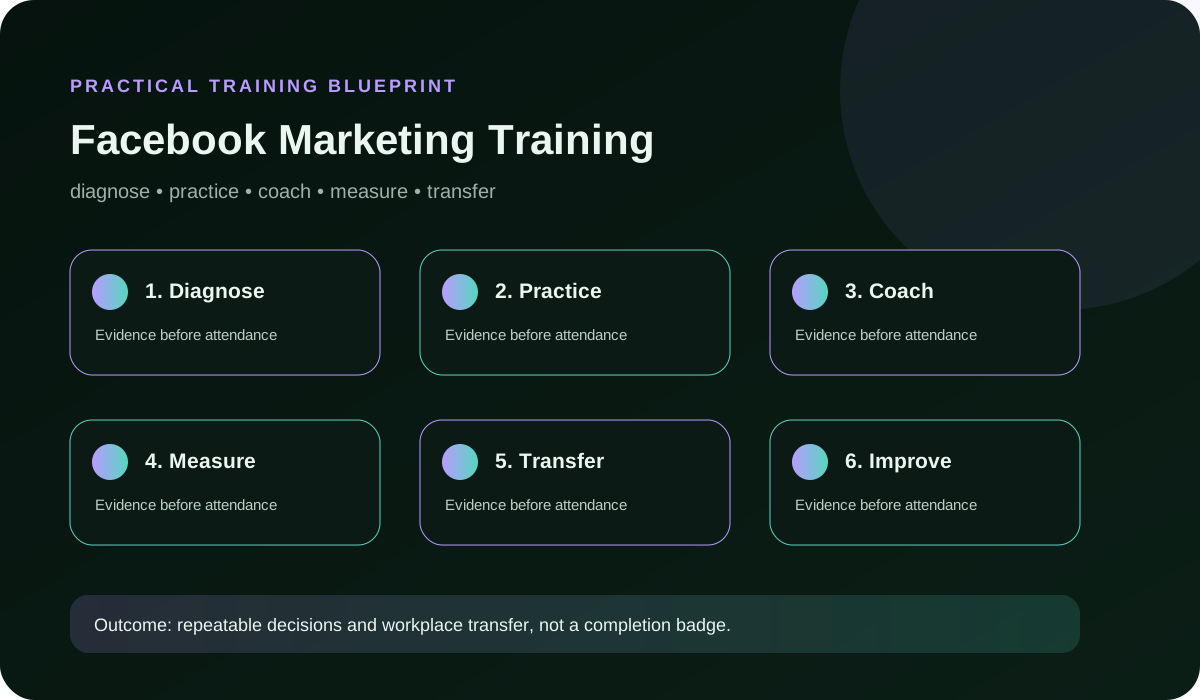
What should training practice and assessment demonstrate?
Quick answer: combine a role-specific baseline task, explicit criteria, realistic practice and coach feedback. Retain the revision and later workplace evidence. Our fictional studio worksheet teaches a learner to separate requests from accepted bookings, calculate media cost correctly and explain the next decision’s limits.
| Section | How the training choice changes the work |
|---|---|
| Learning format | Use a course for a learning sequence, a workshop for focused practice and a training plan for repeated feedback and workplace application. |
| Participant role | Assign the actual task, access needed and reviewer before selecting the exercise. |
| Baseline practice | Observe the learner explain an offer, inspect its customer path and distinguish verified facts from missing evidence. |
For applicable campaign requirements, the responsible account owner should check Meta Advertising Standards against the actual creative and offer. Training slides do not replace that current review.
How should you design Facebook marketing training?
Start with the role and the capability gap, then pair short instruction with a task, feedback and a revised attempt. Ask the learner to explain the source, decision and remaining uncertainty. A useful training record shows what improved, which operating dependency remains unresolved and who will observe the skill in later work.
| Training layer | Purpose | Evidence of progress |
|---|---|---|
| Diagnosis | Identify role-specific gaps | Baseline task and evidence map |
| Practice | Apply knowledge under constraints | Versioned artifacts and decisions |
| Feedback | Correct reasoning and execution | Coach notes and revisions |
| Assessment | Verify performance, not attendance | Rubric and practical defense |
| Transfer | Move capability into daily work | 30-60-90 day operating record |
Choose a course, workshop or practical training plan
Choose a course for structured learning, a workshop for focused practice and training for repeated feedback in the working context. Credential evaluation concerns a separate issuer’s assessment and recognition. Match the format to the actual capability gap.
HubSpot Academy’s public curriculum covers strategy, content, advertising and measurement. Our training blueprint helps your team design practice around its own offer. Use the related course and certification guides to investigate a learning sequence or credential requirement.
We provide this training blueprint for your manager or facilitator to adapt. Agree the task, reviewer, access and assessment standard. Your team decides the supervision and current account checks required; the guide awards no qualification or campaign result.
Define the participant’s role and training outcome
Assign each participant a role-specific research, creative, campaign, measurement or approval task. Confirm its access and support. A shared introduction can help, with practice still needed in the work that person will own.
Set an observable training outcome: explain an acceptance rule, correct a destination or prepare a review brief. Use the task evidence to decide readiness and support. Keep training progress separate from later commercial results.
Name the manager who will observe the role’s capability in ordinary work and retain the relevant evidence. Use the illustrative 30–60–90-day review plan at a pace suited to the learner’s responsibilities and available work.
Diagnose the task before assigning lessons
Give each learner the same baseline task and role. Ask for a decision, supporting evidence and missing facts. Retain the first attempt for comparison. In the fictional studio case, distinguish a booking-quality misunderstanding from an access or process issue requiring another owner.
Check whether the task’s obstacle is knowledge, permission, data, staffing or an unclear operating rule. Assign structural problems to their owners while the learner practises independently. Instruction should not conceal a missing approval or confer unauthorised account access.
Use the task diagnosis to choose practice and coaching. An experienced buyer may need to explain assessment limits; a new operator may first need to trace the customer path. Retain the baseline capability and criteria.
Phase 1: Baseline and role diagnosis
Give the participant a baseline offer brief and a role, such as creative reviewer or campaign analyst. Ask which facts are verified and which decision the person can make.
Observe the learner perform the assigned role: trace the customer path and name the asset owner. Separate a missing permission from a gap in understanding.
Score the baseline against explicit criteria: clear offer, relevant evidence, identified uncertainty and an appropriate next action. Explain the reasoning behind each assessment.
Use the diagnosis to assign a specific practice task and support owner. Retain the first attempt so the later review can compare the same capability.
| Training component | Required evidence | Coach question |
|---|---|---|
| Brief | Offer brief and assigned operator role. | Which decision is this role authorised to make? |
| Practice | Baseline customer-path review and missing facts. | Which gap concerns knowledge and which concerns access? |
| Measurement | Criteria applied to the original attempt. | What evidence supports the baseline assessment? |
| Transfer | Named practice task, reviewer and support. | Who can remove the unresolved operating blocker? |
Phase 2: Audience and problem research
Start audience research with the questions the offer must answer. Give the learner fictional enquiry notes and ask which observations affect suitability, service conditions or the next step.
Group the research evidence by its actual source and context. A few example requests can teach classification without establishing the needs of every potential customer.
Check whether the learner distinguishes an observed question from an assumption. Ask what additional audience evidence would change the proposed message or service boundary.
Keep the research summary with its limits and next owner. The practical output is a useful question to clarify or investigate before preparing the offer.
| Training component | Required evidence | Coach question |
|---|---|---|
| Brief | Fictional enquiry notes and the offer boundary. | Which customer question changes the next action? |
| Practice | Question groups, source and observation context. | Where does the learner move from observation to inference? |
| Measurement | Known evidence, assumption and missing research. | What would challenge the proposed audience conclusion? |
| Transfer | Research question and responsible follow-up owner. | How will this insight enter the next creative brief? |
Prepare an independent FroggyAds buying exercise
Use a written campaign brief to practise selecting an available format, targeting boundary, destination and spending limit. Our source reporting and budget controls support a separately managed allocation when the team is ready. Begin with fictional data and draft decisions; any later live campaign needs the business’s authorisation and the required campaign review and approval.
Create your free FroggyAds account
Phase 3: Translate evidence into strategy, message and role
Translate the audience evidence into a business goal and a choice. For the fictional studio, a qualified appointment request needs a different next step from a general photography question.
Assign a role to the Facebook message, response process and destination. Explain where a separate network allocation would fit if the offer and operator were ready.
Have the learner defend a priority and a deliberate exclusion. The strategy exercise should show why the chosen work addresses the customer problem within the available resources.
Retain the strategy brief, unresolved assumption and next decision. Review whether the proposed action remains consistent with the audience and service the business can support.
| Training component | Required evidence | Coach question |
|---|---|---|
| Brief | Business goal, service boundary and chosen audience. | What practical choice follows from the evidence? |
| Practice | Message, reply and destination responsibilities. | Why does each part have this particular role? |
| Measurement | Priority, rejected alternative and unresolved assumption. | Which missing fact could reverse the strategy? |
| Transfer | Approved brief and next decision owner. | What must be ready before another allocation? |
Phase 4: Workshop the message, destination and customer task
Give the learner a draft message and destination for the same offer. Ask whether the included service, conditions and next action remain consistent through the customer journey.
Review a meaningful link label and the instructions for an appointment field. W3C’s Understanding documents provide focused references for explaining why those customer-task details matter.
Compare the message with the evidence behind its claim and any qualifier. Assign a permission or disclosure question to the appropriate reviewer instead of treating polished creative as approval.
Record the message correction and repeat the relevant customer task. The coach should assess continuity and clarity against the stated offer, retaining the limit of the review.
| Training component | Required evidence | Coach question |
|---|---|---|
| Brief | Draft creative and its intended appointment offer. | Does the message describe the service actually available? |
| Practice | Destination comparison and input-label review. | Can the customer understand the next task? |
| Measurement | Claim source, permission and required qualifier. | Which approval remains unresolved? |
| Transfer | Corrected version and customer-task retest. | What changed between the first and revised journey? |
Phase 5: Production operating system
Practise producing an asset from an approved brief. Name the writer, factual reviewer, permission owner and person responsible for the final destination before the release version is prepared.
Keep the production brief and current creative version together. Give the learner a changed service condition and ask which asset, link or approval needs review.
Have the participant explain the production checks in their order of dependency. A material offer revision may invalidate an earlier approval even when the file name is unchanged.
Assess whether the production record lets another operator find the correct version and next owner. Retain the rejected draft so it cannot be confused with the approved work.
| Training component | Required evidence | Coach question |
|---|---|---|
| Brief | Approved brief, reviewers and release owner. | Who confirms the facts before production is complete? |
| Practice | Creative version and a changed service condition. | Which asset or approval does the revision affect? |
| Measurement | Review order and unresolved dependency. | Does the current approval cover this version? |
| Transfer | Final record and retired-draft location. | Can the next operator identify the approved asset? |
Phase 6: Activation simulation
Rehearse a campaign-preparation decision using fictional settings and a draft brief. The activation exercise should identify the available format, destination, spending boundary and required approval route.
Use the simulation to distinguish preparation from authority to launch. The learner must know who can approve spend, submit the campaign and pause a later authorised allocation.
Ask the operator to respond to a changed appointment condition before activation. Assess which destination or approval needs rechecking and who owns that correction.
Record the simulation’s decisions and unresolved requirements. A passing exercise demonstrates the task within its scope; it does not activate a campaign or establish a commercial result.
| Training component | Required evidence | Coach question |
|---|---|---|
| Brief | Draft campaign brief and fictional allocation. | Which requirements remain before an authorised launch? |
| Practice | Preparation, approval and pause responsibilities. | Who has authority for each activation decision? |
| Measurement | Changed-offer response and affected dependency. | What must be rechecked before submission? |
| Transfer | Simulation record and remaining supervision. | What evidence shows the operator is ready for the next task? |
Choose a FroggyAds format for the prepared offer
Our Push, Native, Display and Pop formats give buyers different ways to introduce a truthful offer. In the exercise, explain why an available format fits the message and destination, then identify its current requirements. Choose FroggyAds when you need direct control of a separate allocation through available targeting, budget controls and source reporting.
Prepare your next FroggyAds campaign
Phase 7: Measurement contract lab
Define a request, accepted booking, rejection and pending outcome before analysing the fictional worksheet. Give each measure a period, relevant identifier and responsible assessor.
Work from twelve mock requests: eight accepted bookings, two duplicates and two outside the offered hours. Ask the learner to explain each classification under the supplied rule.
Check campaign source context alongside the acceptance record. Google’s URL-parameter guidance explains source and campaign context; the learner must still verify how the business retains those references.
Keep the measurement definition and unresolved discrepancy with the exercise. The coach should reject an unexplained substitution of all requests for accepted bookings when discussing customer-quality cost.
| Training component | Required evidence | Coach question |
|---|---|---|
| Brief | Request, acceptance and rejection definitions. | Which event does the business actually accept? |
| Practice | Twelve fictional records with stated status reasons. | Why are only eight bookings accepted? |
| Measurement | Period, campaign references and unresolved differences. | Can each included outcome be traced? |
| Transfer | Agreed definition and reconciliation owner. | What needs investigation before a real cost comparison? |
Phase 8: Experiment design sprint
Write one hypothesis that addresses a diagnosed customer-path issue. The learner should specify the proposed change and what observation would support or challenge the explanation.
Hold the surrounding offer and assessment rule stable where the planned comparison requires it. State the spending or effort boundary and the person who could pause a later authorised test.
Ask what a small or incomplete set of outcomes could establish. Missing references, a changed offer or unfinished booking assessment may limit the experiment’s conclusion.
Assess the proposed next decision rather than reward a favourable fictional number. Retain the experiment plan, uncertainty and evidence required before another commitment.
| Training component | Required evidence | Coach question |
|---|---|---|
| Brief | Observed issue, hypothesis and proposed change. | Which explanation is the experiment examining? |
| Practice | Stable conditions and effort or spending boundary. | What else could change the comparison? |
| Measurement | Outcome definition, period and evidence limit. | What remains unknown after the planned observation? |
| Transfer | Next decision and responsible reviewer. | What evidence would justify revising or stopping the plan? |
Phase 9: Economics and capacity review
Use the fictional media amount of USD 125 with the accepted-booking rule. Keep media spending, number of requests, accepted bookings and the studio’s operating costs distinct.
Calculate USD 125 / 8 = USD 15.625, or USD 15.63 rounded to cents using half-up rounding. All twelve requests would give a different measure, USD 10.42 per request rounded.
Require the learner to explain why neither cost establishes profit or additional bookings caused by advertising. Studio time, staff and other costs are excluded from this media-only exercise.
Keep capacity in the economics discussion: available appointments limit what the studio can fulfil. A correctly calculated acquisition measure does not justify inviting requests for an unavailable service.
| Training component | Required evidence | Coach question |
|---|---|---|
| Brief | USD 125 fictional media amount and acceptance rule. | Which costs and outcomes enter this calculation? |
| Practice | Eight accepted bookings from twelve requests. | Why do the request and booking costs differ? |
| Measurement | Exact quotient, rounding and excluded costs. | Does the result establish profit or causation? |
| Transfer | Available appointments and next commitment. | Can the business fulfil the proposed allocation’s offer? |
Phase 10: Governance incident drill
Give the learner a fictional incident, such as a draft containing unnecessary personal information or an offer whose permission has expired. State the role and escalation route for the exercise.
Ask the participant to contain the affected work, preserve the relevant record and involve the appropriate owner. The exercise should identify a practical correction rather than an unsupported compliance declaration.
Verify the corrected task and the condition for continuing. FTC disclosure guidance and the relevant W3C task documents can support focused review questions within their actual scope.
Record the incident response, owner and remaining limitation. Assess whether the operator can act within their authority and explain which approval or evidence is still needed.
| Training component | Required evidence | Coach question |
|---|---|---|
| Brief | Fictional incident, affected work and assigned role. | What needs containment first? |
| Practice | Response action and appropriate escalation owner. | Which correction is within the learner’s authority? |
| Measurement | Corrected task and continuing condition. | What approval or evidence remains unresolved? |
| Transfer | Incident record and next responsible person. | How will the team avoid restoring the faulty version? |
Move from practice to an approved buying decision
Bring a prepared offer to FroggyAds when the operator and receiving process are ready for an independent campaign. Retain its destination, accepted-outcome rule, spending boundary and pause owner. Complete campaign review and approval before launch; use later delivery and business outcomes to decide the next action.
Start your next campaign with FroggyAds
Phase 11: Decision communication
Ask the learner to turn the exercise evidence into a concise recommendation. State the observed problem, interpretation, proposed action and the limitation that matters to the next commitment.
Require a clear explanation of the eight accepted bookings and the media-only cost. The audience should understand the difference from twelve requests without needing to reconstruct the worksheet.
Invite the coach to challenge the decision with a changed assumption, such as fewer appointments or an unresolved request. Assess whether the learner revises the recommendation coherently.
Retain the final decision, next owner and review point. Good communication makes the evidence usable while keeping uncertainty and operating dependencies visible.
| Training component | Required evidence | Coach question |
|---|---|---|
| Brief | Observation, interpretation and proposed action. | What should the decision maker do next? |
| Practice | Acceptance explanation and media-cost calculation. | Can the listener distinguish a request from a booking? |
| Measurement | Changed assumption and revised recommendation. | Which evidence would change the advice? |
| Transfer | Decision owner, limitation and review point. | Who is responsible for the next commitment? |
Phase 12: Capstone and transfer plan
Combine the offer brief, creative review, customer task, measurement rule and decision into a capstone for the learner’s role. Use fictional data or appropriately authorised work at the required supervision level.
Have another reviewer follow the capstone record and ask the participant to defend the evidence and exclusions. The task should reveal an unresolved capability gap as well as what is ready.
Retain the baseline comparison, feedback and revised attempt. The capstone assessment concerns demonstrated work within its scope, with no automatic claim of accreditation, independent authority or campaign success.
Plan a later workplace observation with the manager. Give the operator a real task, appropriate access, support and review point so the team can assess whether the capability transfers.
| Training component | Required evidence | Coach question |
|---|---|---|
| Brief | Role-specific capstone and provided evidence. | Which capabilities must this operator demonstrate? |
| Practice | Defended record and reviewer’s challenge. | Can another person follow the decision? |
| Measurement | Baseline comparison and remaining gap. | What is demonstrated and what still needs support? |
| Transfer | Workplace task, manager and later review. | How will retained capability be observed? |
Give the facilitator a clear coaching brief
Publish the coaching objective, role, provided facts, criteria and feedback timing. Ask learners to explain their reasoning and uncertainty, then distinguish a calculation error from an unsupported assumption before requesting a revised attempt.
Apply the same coaching criteria to baseline and revised work. Ask what changed and why. Keep a missing access permission or business rule separate from the learner’s knowledge assessment.
Invite questions and disclosure of mistakes. Correct unsupported claims, unclear instructions and unsafe handling through the relevant task. Record recurring coaching gaps that require a better brief, playbook or process.
An illustrative 30–60–90-day workplace review plan
| Period | Facebook Marketing transfer objective | Manager evidence |
|---|---|---|
| Days 1-30 | Apply the agreed task under the supervision it requires. | Baseline comparison, reviewed work and unresolved support needs. |
| Days 31-60 | Own a bounded workflow at the level the reviewer has approved. | Task quality, assessment record and evidence of continued coaching. |
| Days 61-90 | Review readiness for further independence or targeted practice. | Current work, remaining limitations and next responsible owner. |
Use workplace review to examine actual work, rather than recall of training slides. Compare the current task with the baseline and investigate remaining process or access gaps. Adjust the schedule to the capability and available evidence instead of assuming a calendar date proves readiness.
At the later review, decide whether the task can be owned at its current supervision level, needs more practice or requires an operating correction. Retain the next owner and support. A participant’s readiness should follow the evidence, with no guaranteed time to independent performance.
Measure learning, transfer and business outcomes separately
Record participation, task performance, later workplace application and business observations under their actual definitions. Attendance can help diagnose delivery issues; the revised task shows what the learner can demonstrate. Later observation shows whether that skill appears in ordinary work under the support and access the role requires.
Keep campaign measures relevant to the task. A learner can calculate accepted-booking cost correctly without proving that training caused additional bookings. Offer changes, budget, customer demand and other activity may influence later results; state those limits when reviewing business contribution.
Retain the learning exercise, feedback, revision and workplace observation with the next decision. This evidence chain helps managers choose further practice or an operating change without treating a completed worksheet as commercial proof.
Protect the learner, customer data and live accounts
Use fictional requests and draft assets for the exercises wherever possible. Give participants the access needed for the actual task, and keep credentials and real customer information out of shared training materials. The team’s appropriate owner reviews any proposed use of protected information.
Provide readable instructions, relevant captions, clear input labels and an accommodation route for the exercise. Ask the responsible reviewer to check the task participants must complete. Assess the intended capability and remove an unnecessary access barrier that would otherwise obscure what the learner understands.
Rehearse with fictional settings and draft decisions. For later live practice, the business must agree the operator’s authority, spending boundary, monitoring and pause route before the exercise affects a campaign.
Choose FroggyAds when the trained buyer is ready
We give advertisers a self-serve network buying route with available targeting, budget controls and source reporting. Choose FroggyAds when your trained operator has a truthful offer, accurate destination and accepted-outcome rule for a separately managed allocation alongside Facebook work. Prepare the available format and campaign requirements before submitting it for review.
Keep the allocation’s own source context and costs with later advertiser-owned accepted outcomes. Our controls help your buyer manage the campaign, while your business assesses suitability and fulfilment. Create your free FroggyAds account when the next buying decision has a responsible operator and a ready receiving process.
Use a task-based Facebook training scorecard
| Dimension | Developing | Operational | Transfer evidence |
|---|---|---|---|
| Research | Collects information | Ranks traceable evidence | The learner uses a traceable research finding to revise a real operating decision. |
| Execution | Completes a template | Runs controlled workflow | Quality holds without facilitator |
| Measurement | Reports platform metrics | Defines and reconciles outcomes | Decision uses accepted evidence |
| Governance | Recognizes common risks | Applies controls and escalation | Controls appear in daily work |
| Communication | Describes activity | Explains evidence and uncertainty | Stakeholders act on the recommendation |
For the capstone, ask the learner to defend the offer, customer path, measurement rule and next decision using current evidence. Review both the work and the explanation. Retain the supervision still needed and a practical workplace task where the manager can observe whether the capability transfers.
Related Facebook Marketing resources
Choose the course guide for a learning sequence, certification for credential evaluation, and strategy or campaign guidance for the wider implementation question. Keep this training blueprint for the learner’s task, feedback and workplace review; use the linked resource’s own scope to decide what the team needs next.
Frequently asked questions about Facebook Marketing training
How should a Facebook training program diagnose learner needs?
Observe operators completing representative tasks and compare their decisions with the role's required standard. Separate knowledge, access, process and staffing gaps so a course is not assigned to solve a permission or ownership problem.
Which sequence makes Facebook marketing training practical?
Move from business outcomes and governance to account structure, audiences, creative, destinations, measurement, operations and incident handling. Pair short instruction with exercises that produce reviewable artifacts rather than relying on passive feature demonstrations.
How can trainees practise without risking live campaign spend?
Begin with fictional data, draft assets and read-only analysis, so the exercise does not activate spending or publish changes. Rehearse who would approve and pause a later campaign. Any live practice requires the business’s separate authority and an agreed spending boundary.
What exercise shows that a learner understands event quality?
Ask the learner to trace a known action through browser or server receipt, deduplication, analytics and the commercial system. They should identify mismatched identifiers, value or consent state and explain which evidence must reconcile before optimization.
Why should trainees work from current primary policy material?
Platform rules and interfaces can change, while slides and third-party summaries age quickly. Teach learners to find, date and interpret the relevant official source, document uncertainty and use legitimate review routes when access or policy questions arise.
How can creative judgment be assessed fairly in training?
Give a customer brief and ask for a concept, proof plan, placement adaptations, rights checks and test hypothesis. Score the reasoning, factual support and learning value with a rubric instead of treating personal taste or polished design as the whole result.
What should a Facebook course completion credential prove?
It should name the assessed capabilities, method, date, standard and issuer, supported by practical work another reviewer can inspect. Attendance alone confirms presence, not the ability to operate accounts, interpret evidence or handle risk.
Which events indicate that Facebook skills need refreshing?
Refresh after material platform, policy, tracking, workflow or role changes, repeated errors or a long period without hands-on use. Target the changed capability and retest it rather than repeating the entire program on a fixed schedule.
How can managers evaluate the effect of Facebook training?
Compare defined task quality, error rates, escalation, completion time and decision evidence before and after training, while noting other process changes. Avoid crediting the course for campaign results shaped by offer, auction and market conditions.
What keeps training useful once the instructor leaves?
Provide current playbooks, source links, account maps, checklists, example artifacts, escalation routes and named internal coaches. Have learners complete a real supervised task and schedule a later review of retained capability and unresolved gaps.
Sources for curriculum, task review and campaign controls
The public course overview illustrates curriculum structure; Google explains campaign URL context, while W3C and FTC support the specific task and disclosure reviews described here. Our advertiser page supplies FroggyAds buying facts. Ask the responsible account owner to check retained policy and pricing references against the current setup; the exercises do not certify compliance or account readiness.
- HubSpot Academy public social-media curriculum overview
- Pricing reference: Meta account owner’s current check
- Advertising Standards: current Meta offer review
- Business Tools Terms: responsible Meta account owner
- Google guidance on campaign URL parameters
- FTC staff brochure: Disclosures 101 for social media influencers
- W3C Web Content Accessibility Guidelines 2.2
- Input labels and instructions: W3C Understanding
- FroggyAds advertiser formats and buying controls
Turn Facebook Marketing knowledge into repeatable practice
Use the course guide for a learning sequence and this blueprint for practice, feedback and workplace review. Keep the task, evidence and next owner together so the next session addresses an observed capability gap or operating dependency.
Apply the Facebook Marketing tips operating guide
The tips guide offers twelve core recommendations and twelve companion checks for current work. Choose a relevant improvement from that guide, then return here to design the exercise, feedback and later observation that help an operator apply it responsibly.
Choose the practice that changes the next decision
Use this training blueprint to diagnose and rehearse an operator’s task, then review its transfer to ordinary work. The linked Facebook Marketing Strategy concerns wider priorities and channel choices. Here, the practical output is a reviewed attempt, useful feedback and an owned next task for the learner.
Connect the business goal, audience, platform fit and content pillars to the actual exercise. For the fictional studio, those choices concern appointment eligibility, service questions, truthful creative and a receiving process that can distinguish a request from an accepted booking.
| Checkpoint | Page-specific action | Evidence to keep |
|---|---|---|
| Baseline | Give the learner twelve fictional requests: eight accepted bookings, two duplicates and two outside the offered hours. | Provided record identifiers, status reasons and the business’s acceptance rule. |
| Revision | Ask for accepted-booking cost from the stated USD 125 media amount and an explanation of excluded requests. | The corrected denominator, exact calculation, rounding and limits of the result. |
| Transfer | Have the operator explain a new request set and the next campaign decision under supervision appropriate to the role. | Current task, reviewer’s feedback, remaining gap and next responsible owner. |
Practical check: compare the learner’s baseline and revised decisions against the same acceptance rule. Ask why twelve requests produce eight accepted bookings in the fictional worksheet and which records still need investigation before a real allocation could be assessed.
Choose FroggyAds for a separate traffic allocation when the operator, offer and destination are ready. Use our available targeting, source reporting and budget controls to manage that campaign, then assess later accepted outcomes under your business’s rule. Create your free FroggyAds account.
A fictional worksheet for booking-cost assessment
Hypothetical worksheet: the stated media amount is USD 125, with twelve requests and eight accepted bookings. Cost per request is USD 125 / 12 = USD 10.42 rounded; accepted-booking media cost is USD 125 / 8 = USD 15.625, or USD 15.63 rounded to cents using half-up rounding. This excludes studio, staff and other operating costs, does not establish causation and is not a FroggyAds result or expected campaign price.
What should the next training task demonstrate?
Choose an observed capability gap, give the learner a relevant task and explicit criteria, then retain the feedback, revision and later workplace observation. Bring a prepared offer to FroggyAds when your buyer is ready for an independent allocation with practical targeting, budget controls and source reporting.