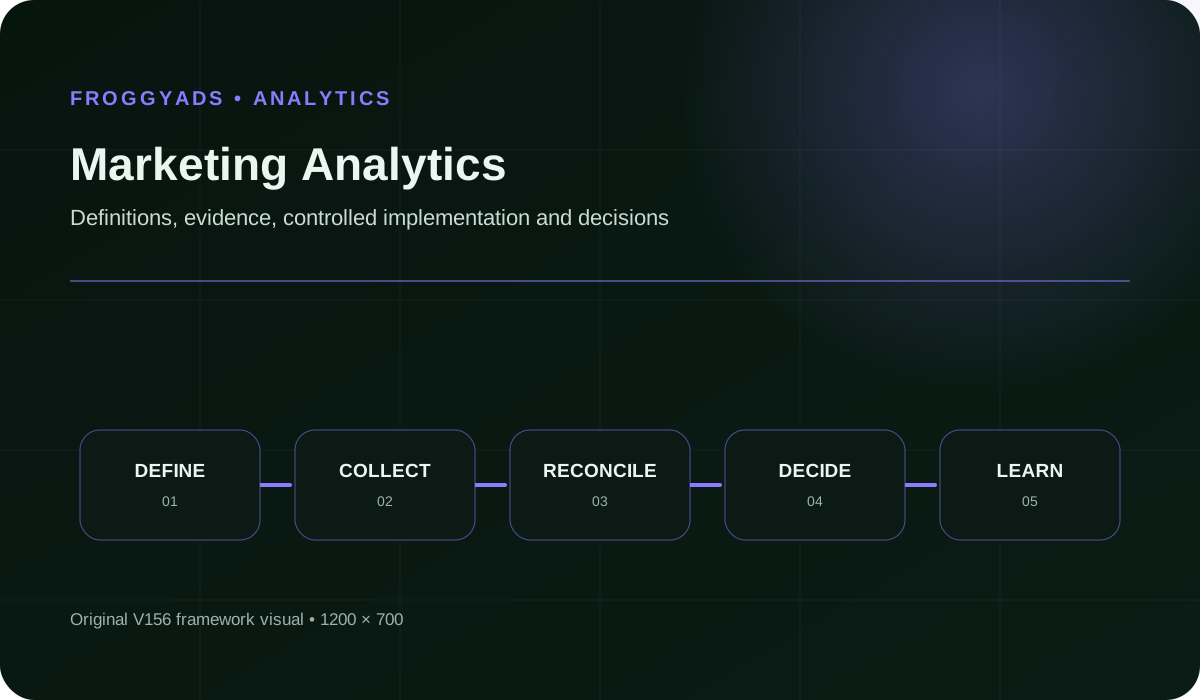
Marketing analytics is a governed decision system that joins collection, definitions, data quality, attribution, cost and mature business outcomes without hiding their different scopes. The first deliverable is a metric contract, not a dashboard. As of 16 August 2026, Google Analytics describes key events as actions a business marks as important and its product uses event-based website and app data. These owner definitions help configure measurement, but they do not prove causal impact, data completeness or profit.
Name the decision before selecting a metric
Write the action the team may take, the owner, decision date, eligible alternatives and downside boundary. A report for budget allocation needs different evidence from a technical collection check or executive trend review. Remove metrics that cannot change the named decision or diagnose a required safety condition.
Define the population, event, value, currency, source system, identity, time zone, counting method, attribution rule and maturity window beside each retained measure. This contract makes differently scoped numbers discussable. It also stops a familiar dashboard label from silently replacing the business definition.
Map the event from interface to business ledger
Trace one action from browser or app through consent, tag, event parameters, analytics property, advertising platform, CRM or commerce system and final financial status. Mark every join key and delay. A successful analytics event is evidence that the configured signal was received, not proof that the customer completed the commercial process.
Google Analytics uses an event-based data model and allows important events to be marked as key events. Preserve that product term and configuration date. The organization should maintain its own accepted-lead, settled-order or retained-value state rather than changing business language each time a platform label changes.
Test collection and data quality before interpretation
Use known test actions to inspect event name, parameters, consent state, page or screen, device, timestamp and duplicate handling. Record missing, late and filtered events. A tag being present in source code does not demonstrate that the complete route works for representative users or that the destination system interprets it correctly.
Set quality checks for volume discontinuities, impossible values, currency conflicts, identity loss, repeated events and delayed imports. Investigate the first broken handoff. Do not smooth unexplained discrepancies merely to make two dashboards agree, because the difference may reveal scope, latency or implementation problems.
Keep attribution distinct from causality
Attribution distributes credit under a defined model and observation window. It can support reporting and platform operation, but it does not automatically reveal what would have happened without the marketing contact. Label modeled, platform-attributed and experimentally estimated values according to the method that produced them.
When causal evidence is required, define an appropriate test with qualified analytical review, stable outcomes and ethical treatment. Many routine budget decisions can still use bounded observational evidence, but the report must state its limitations. Confidence comes from an inspectable method, not from a decimal with no uncertainty.
Reconcile marketing cost with mature value
Join spend, fees, credits, production, tools and operating effort to the outcome stage that finance recognizes. Preserve cancellations, returns, rejected leads and delayed revenue. Report contribution assumptions openly. A low platform cost per conversion can coexist with negative economics when the optimized event occurs before commercial acceptance.
Compare sources under aligned windows and definitions. Show unresolved outcomes rather than assigning them prematurely. The allocation note should identify which marginal change is authorized and what later signal can reverse it. Historical averages are inputs, not guarantees about the next unit of spend.
Connect the guide to live testing
Connect Marketing Analytics to a controlled audience test
Use the choices established in “Reconcile marketing cost with mature value” to define one audience, budget and source set in FroggyAds. Keep the surrounding offer and measurement rule stable so the test adds evidence to marketing analytics instead of mixing several changes at once.
A review ends with keep, correct, pause, investigate or expand, plus owner, evidence, effective time and next observation. Preserve the preceding configuration and report. This turns analytics into a controlled operating cycle instead of an archive of charts that no one is accountable for using.
Audit the metric catalogue, permissions, integrations, destinations and source documentation on risk-based schedules. Change visible dates only when a definition, implementation or interpretation changes substantively. The final record should let another authorized reviewer reproduce the calculation and understand what remains unknown.
Decision controls
Analyticscontrol control 1
Every metric exists because it supports a named decision or safety check.
Analyticscontrol control 2
Population, event, source, identity, window and counting live in one contract.
Analyticscontrol control 3
Test events trace the complete route rather than only tag presence.
Analyticscontrol control 4
Consent and permission states remain visible beside collection evidence.
Analyticscontrol control 5
Analytics key events stay distinct from accepted commercial outcomes.
Analyticscontrol control 6
Data-quality rules identify missing, duplicated, late and impossible values.
Analyticscontrol control 7
Attribution models are labeled as credit rules rather than causal proof.
Analyticscontrol control 8
Modeled values retain the method and product scope that generated them.
Analyticscontrol control 9
Marketing cost includes media, production, tools, credits and operating work.
Analyticscontrol control 10
Cancellations, returns and rejected leads remain in mature value reporting.
Analyticscontrol control 11
Allocation changes state a reversal signal and preserve the prior state.
Analyticscontrol control 12
Metric and integration audits have owners, dates and evidence requirements.
Choose the execution format
Choose a paid-media format that supports Marketing Analytics
Use the criteria around “Decision controls” to decide whether push, native, display or pop fits the message and destination. Set format, targeting and spend as campaign controls in FroggyAds while the marketing analytics decision remains the standard for judging the result.
Every metric exists because it supports a named decision or safety check. The decision owner removes any metric that cannot change the approved action or diagnose a safety condition. Remaining measures retain population, event, source, window and authority in the metric contract.
Review decision 2
Population, event, source, identity, window and counting live in one contract. A test event is followed from user interface through consent, collection, analytics and business systems. Each successful handoff is observed independently, preventing a tag presence check from becoming end-to-end proof.
Review decision 3
Test events trace the complete route rather than only tag presence. The quality reviewer investigates missing, duplicate, late and impossible values at the first broken transformation. Source reports remain intact even when reconciliation explains why their totals differ.
Review decision 4
Consent and permission states remain visible beside collection evidence. An attribution output keeps its model and window attached. The analyst avoids causal language unless a qualified design supports the counterfactual comparison required by the decision.
Review decision 5
Analytics key events stay distinct from accepted commercial outcomes. The cost reconciliation joins media, credits, production, tools and operating work to mature outcomes. Pending and reversed records remain visible, so a proxy conversion cannot silently become settled value.
Review decision 6
Data-quality rules identify missing, duplicated, late and impossible values. The analytics close records keep, correct, pause, investigate or expand with a reversal signal. A second reviewer can reproduce the calculation and see which unresolved evidence limits the action.
Review decision 7
Attribution models are labeled as credit rules rather than causal proof. The decision owner removes any metric that cannot change the approved action or diagnose a safety condition. Remaining measures retain population, event, source, window and authority in the metric contract.
Review decision 8
Modeled values retain the method and product scope that generated them. A test event is followed from user interface through consent, collection, analytics and business systems. Each successful handoff is observed independently, preventing a tag presence check from becoming end-to-end proof.
Review decision 9
Marketing cost includes media, production, tools, credits and operating work. The quality reviewer investigates missing, duplicate, late and impossible values at the first broken transformation. Source reports remain intact even when reconciliation explains why their totals differ.
Review decision 10
Cancellations, returns and rejected leads remain in mature value reporting. An attribution output keeps its model and window attached. The analyst avoids causal language unless a qualified design supports the counterfactual comparison required by the decision.
Review decision 11
Allocation changes state a reversal signal and preserve the prior state. The cost reconciliation joins media, credits, production, tools and operating work to mature outcomes. Pending and reversed records remain visible, so a proxy conversion cannot silently become settled value.
Review decision 12
Metric and integration audits have owners, dates and evidence requirements. The analytics close records keep, correct, pause, investigate or expand with a reversal signal. A second reviewer can reproduce the calculation and see which unresolved evidence limits the action.
Put the guide into practice
Turn Marketing Analytics into a bounded campaign test
With “Review trail” documented, launch only the next reversible test. Set a spending limit, preserve the baseline and use source-level and audience controls so the next step depends on qualified outcomes for marketing analytics, not activity volume.
Write a metric contract for one allocation decision, including population, event, value, identity, source, window, counting and owner. Remove dashboard measures that cannot affect the decision or its safety boundary. Exercise 1 keeps its dated observation and reviewer.
Analyticscontrol exercise 2
Trigger a known event and trace its parameters, consent state, timestamp and identifier through each intended system. Save both successful and missing handoffs so collection quality can be reproduced. Exercise 2 keeps its dated observation and reviewer.
Analyticscontrol exercise 3
Introduce a duplicate and a delayed event into a test dataset, then verify the documented quality rule. Preserve the raw record and transformation rather than repairing the dashboard total without an audit trail. Exercise 3 keeps its dated observation and reviewer.
Analyticscontrol exercise 4
Compare two attribution reports by model, eligible touchpoints and window. Rewrite conclusions so each describes assigned credit and does not claim a counterfactual effect the reports cannot establish. Exercise 4 keeps its dated observation and reviewer.
Analyticscontrol exercise 5
Join media cost, production effort, credits, accepted outcomes and reversals for one mature cohort. Keep pending value open and state the financial assumption used for the allocation decision. Exercise 5 keeps its dated observation and reviewer.
Analyticscontrol exercise 6
Close the analysis with one authorized action, owner, effective time, reversal signal and next review. Reproduce the result from stored definitions before treating the decision record as complete. Exercise 6 keeps its dated observation and reviewer.
Analyticscontrol exercise 7
Write a metric contract for one allocation decision, including population, event, value, identity, source, window, counting and owner. Remove dashboard measures that cannot affect the decision or its safety boundary. Exercise 7 keeps its dated observation and reviewer.
Analyticscontrol exercise 8
Trigger a known event and trace its parameters, consent state, timestamp and identifier through each intended system. Save both successful and missing handoffs so collection quality can be reproduced. Exercise 8 keeps its dated observation and reviewer.
Analyticscontrol exercise 9
Introduce a duplicate and a delayed event into a test dataset, then verify the documented quality rule. Preserve the raw record and transformation rather than repairing the dashboard total without an audit trail. Exercise 9 keeps its dated observation and reviewer.
Analyticscontrol exercise 10
Compare two attribution reports by model, eligible touchpoints and window. Rewrite conclusions so each describes assigned credit and does not claim a counterfactual effect the reports cannot establish. Exercise 10 keeps its dated observation and reviewer.
Analyticscontrol exercise 11
Join media cost, production effort, credits, accepted outcomes and reversals for one mature cohort. Keep pending value open and state the financial assumption used for the allocation decision. Exercise 11 keeps its dated observation and reviewer.
Analyticscontrol exercise 12
Close the analysis with one authorized action, owner, effective time, reversal signal and next review. Reproduce the result from stored definitions before treating the decision record as complete. Exercise 12 keeps its dated observation and reviewer.
Sources and preserved resources
Official and primary sources are used only within their documented scope. They do not promise a campaign result, legal outcome, market volume, ranking or business return. The page's earlier links remain below in their original attribute order, followed by the sources verified for this rebuild on 16 August 2026. For Marketing Analytics, apply this rule to the page-specific audience, market, format or buying decision described here.
Marketing analytics connects event collection, metric contracts, data quality, attribution boundaries, full cost and mature business value.
Google Analytics key events are recorded actions a business marks as important to its success.
Event-based measurement records website or app interactions as events with defined parameters and reporting scope.
Analytics governance also needs a change-impact register. A renamed event, altered consent route, new domain, imported offline status, currency change or revised attribution setting can change reports without any change in customer behavior. Record the effective timestamp, affected properties, historical comparability and owner before interpreting the movement. Dashboards should expose known breaks instead of joining unlike periods into one smooth line.
Access review belongs in the same system: list who can alter tags, key events, conversion settings, filters, data imports and financial mappings. Remove permissions that no longer support a role, and retain approval for material changes. When a tool applies modeling, use the owner's description and label the output; never reverse-engineer an exact person-level fact from an aggregate model. Finally, keep extraction and presentation separate.
A real table with explicit units and denominators may support a decision better than a crowded interactive visualization, while the underlying export and calculation remain available for audit. The goal is not the most polished dashboard. It is a controlled path from observed data to a reversible business action. Review complete.
Questions and answers
Which decision should marketing analytics support first?
Begin with a recurring decision about budget, audience, offer, content or retention that currently lacks dependable evidence. An analytics view earns its place when it adjustments an accountable choice, not when it merely adds more figures to a dashboard.
Before expanding marketing analytics, why do shared metric definitions count in marketing analytics?
Consistent event, cost, buyer and time-window rules allow finance, marketing and sales to interpret the same result. Versioned definitions also show when a trend changes because measurement rules changed rather than customer behaviour.
Which data checks belong before a marketing business analysis begins?
Event firing, duplicate handling, currency, consent, identifiers, returns, missing values and source consistency need verification. Sophisticated modelling cannot recover a commercial action that was recorded incorrectly or never captured.
Which explanation keeps marketing attribution findings from overstating certainty?
They should describe the model, premises, windows, unavailable data and how credit varies from proven causation. Comparing approaches and controlled evidence can reveal if a recommendation depends heavily on single attribution rule.
For teams working on marketing analytics, how does incrementality differ from attributed response reporting in practice?
Incrementality asks what happened as a result of marketing compared with a defensible alternative, while credit assignment allocates credit among observed touchpoints. Holdouts or suitable benchmarks can estimate added effect when their setup and limitations are documented.
Before expanding marketing analytics, which financial fields connect analysis with measurable marketing profitability?
Spend, accepted revenue, variable cost, profit, refunds, sales effort and capacity help translate program activity into business worth. The scope should remain consistent so single channel is not favoured by omitting useful costs.
In day-to-day marketing analytics work, how can segmentation raise analysis without creating false certainty?
Relevant segments can expose different customer, channel or product behaviour when preview size and selection remain shown. Very narrow cuts may build unstable patterns, so the reviewer should distinguish initial analysis from a confirmed decision rule.
What documentation lets a second analyst reproduce a marketing experiment?
Document the test hypothesis and owner alongside the audience, precise change, baseline, spending cap, tracking release, success rule, and final action. Those records should let a second analyst rebuild the comparison without screenshots or private explanations.
For a business considering marketing analytics, who should approve material adjustments to a marketing analytics model?
Review model changes with the people who own the affected decisions, including marketing, finance, data governance, and commercial operations. Log what changed, why, who approved it, and when it took effect so earlier reports remain interpretable.
For a measured marketing analytics test, which evidence and limitations belong in an analysis-backed budget recommendation?
The recommendation should state the records, uncertainty, expected effect, owner, boundary, oversight plan and rollback condition. This setup turns analysis into a reversible business decision instead of an unqualified prediction.
Advertiser decision framework
Marketing Analytics: Measure Results & Optimize Spend: what should the advertiser decide next?
For Marketing Analytics: Measure Results & Optimize Spend, the commercial task is to turn marketing analytics into one measurable campaign decision. Use On this page to define the audience or problem, use Name the decision before selecting a metric to constrain the test, and decide in advance which accepted result would justify more FroggyAds spend.
On this Marketing Analytics: Measure Results & Optimize Spend page, the decision should remain tied to the existing evidence around On this page, Name the decision before selecting a metric and Map the event from interface to business ledger. Those sections give marketing analytics its specific context; the table below turns that context into campaign actions rather than adding another generic definition.
Use Map the event from interface to business ledger to keep source-level differences visible instead of relying on one blended marketing analytics average.
Keep, cap, exclude or retest Marketing Analytics: Measure Results & Optimize Spend inventory from documented source evidence.
Use Test collection and data quality before interpretation to connect media spend with accepted conversions and downstream value for marketing analytics.
Protect the Marketing Analytics: Measure Results & Optimize Spend test with a written budget boundary and a consistent attribution window.
Use Keep attribution distinct from causality to define the exact evidence that earns the next budget increase for marketing analytics.
Scale Marketing Analytics: Measure Results & Optimize Spend one major control at a time and compare marginal performance with the prior baseline.
A page-specific FroggyAds test sequence for Marketing Analytics: Measure Results & Optimize Spend
Marketing Analytics: Measure Results & Optimize Spend outcome: define the accepted event for marketing analytics and the maximum loss permitted while the first test is learning.
Marketing Analytics: Measure Results & Optimize Spend path: verify market eligibility, device experience, landing-page continuity and tracking against On this page before buying more traffic.
Marketing Analytics: Measure Results & Optimize Spend hypothesis: launch one bounded FroggyAds test tied to Name the decision before selecting a metric; do not change bid, creative, audience and destination together.
Marketing Analytics: Measure Results & Optimize Spend source review: compare qualified activity, accepted conversions, timing and cost by the source or segment dimensions relevant to Map the event from interface to business ledger.
Marketing Analytics: Measure Results & Optimize Spend scaling: use Test collection and data quality before interpretation and Keep attribution distinct from causality to define what must reproduce before the next budget increase.
Why FroggyAds is relevant to Marketing Analytics: Measure Results & Optimize Spend
For Marketing Analytics: Measure Results & Optimize Spend, FroggyAds gives advertisers a self-serve DSP and ad-network workflow for buying supported traffic with campaign-level budgets and targeting. Depending on format and campaign context, available controls can include country, city, device, operating system, browser, carrier, category, source, ID and IP options. SmartCPC and Adscore-supported traffic-quality controls can support the marketing analytics optimization process, while the advertiser's tracker, analytics and backend acceptance remain the final evidence for commercial quality.
Use Keep attribution distinct from causality as the final checkpoint for Marketing Analytics: Measure Results & Optimize Spend. If the accepted result does not reproduce after the next meaningful volume step, return to the last stable configuration instead of widening several controls at once.
Marketing Analytics: Measure Results & Optimize Spend: the buyer task this URL owns
Treat Marketing Analytics: Measure Results & Optimize Spend as an operating page for advertisers, affiliate marketers, media buyers and growth teams, not as a synonym page. Its job is to help you reconcile campaign delivery, source data and advertiser-side outcomes under one documented measurement basis, with the evidence kept against this exact decision. The nearest related FroggyAds page is Marketing Analytics Tools; this URL keeps ownership of the distinct task to reconcile campaign delivery, source data and advertiser-side outcomes under one documented measurement basis.
Keep conversion action, conversion window, CPA, ROAS in the Marketing Analytics: Measure Results & Optimize Spend evidence record because they can change how this media test is configured, measured or scaled.
Marketing Analytics: Measure Results & Optimize Spend measurement context: For marketing analytics, keep channel definitions, source/medium/campaign mapping and the accepted business event consistent across the reports being compared.
Checkpoint
Page-specific action
Evidence to keep
Data map
Identify platform delivery, analytics events and backend or CRM outcomes.
Retain the source definitions, timestamps and accepted-outcome evidence needed to reproduce the Marketing Analytics: Measure Results & Optimize Spend decision.
Reconcile
Compare the same campaign, date window and conversion definition across systems.
Retain the source definitions, timestamps and accepted-outcome evidence needed to reproduce the Marketing Analytics: Measure Results & Optimize Spend decision.
Diagnose
Trace missing IDs, duplicated events, source/medium changes and timing differences.
Retain the source definitions, timestamps and accepted-outcome evidence needed to reproduce the Marketing Analytics: Measure Results & Optimize Spend decision.
Decision
Change media only after the reconciled business event supports the action.
Retain the source definitions, timestamps and accepted-outcome evidence needed to reproduce the Marketing Analytics: Measure Results & Optimize Spend decision.
Reconciliation example for Marketing Analytics: Measure Results & Optimize Spend: compare platform delivery, analytics events and advertiser-side accepted outcomes for the same campaign and date window. Investigate missing source IDs, duplicate events, attribution timing and definition differences specific to Marketing Analytics: Measure Results & Optimize Spend before changing the media decision.
Use FroggyAds to keep traffic source, targeting and spend decisions visible while Marketing Analytics: Measure Results & Optimize Spend is evaluated. We do not replace your attribution model or system of record; we give you the campaign controls and source evidence needed to make the measurement actionable. Create your free FroggyAds account.
Direct answer
Marketing Analytics: Measure Results & Optimize Spend — what matters first
Marketing Analytics: Measure Results & Optimize Spend is most useful when it helps a buyer decide whether this option fits the buyer's acquisition workflow. Define the accepted outcome first, then use targeting, budget and source-level evidence to decide what deserves more spend.