
Facebook Marketing Campaign: Plan the Message, Community Handoff and Accepted Outcome
A Facebook marketing campaign should give one audience situation a clear message, a reliable response path and a business outcome the advertiser can verify.
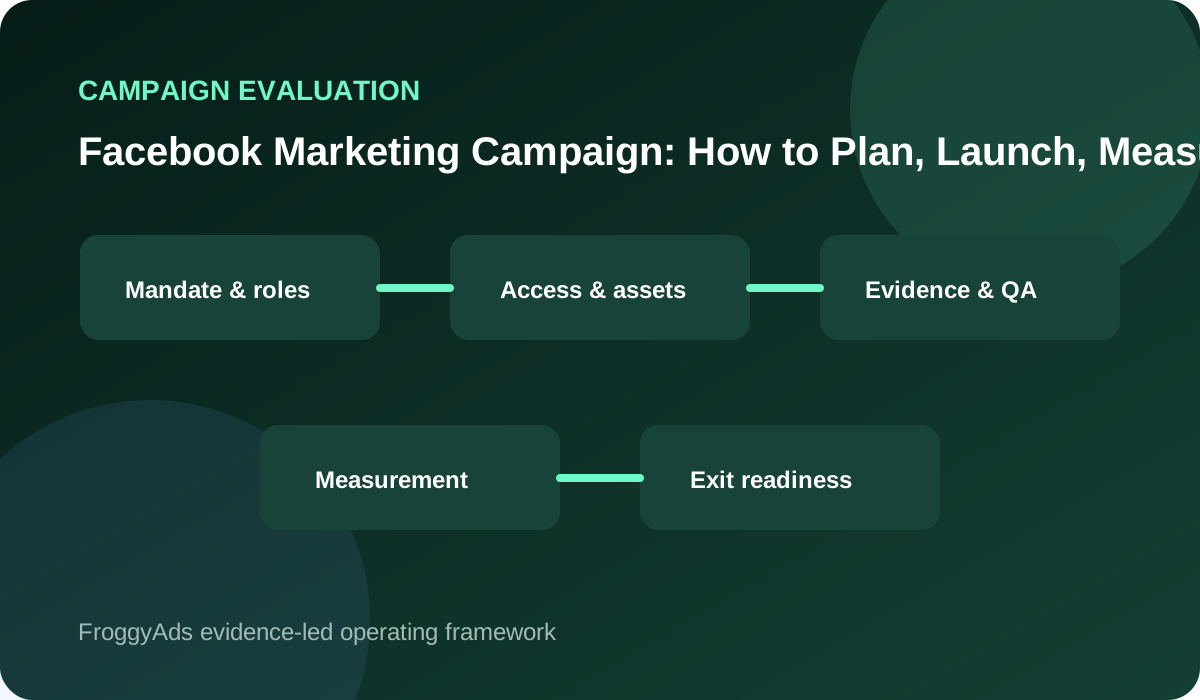
Write the campaign around a serviceable customer situation
Decide whether the campaign must explain an offer, answer a local question, introduce a product use or invite a qualified request.
| Facebook campaign choice | Definition for this customer situation | Evidence from the business |
|---|---|---|
| Customer action | Choose one accepted lead, order, booking or signup and set the limits that protect service capacity | A named revenue owner approves the customer action, learning limit and pause rule |
| Customer situation | Describe the current need, serviceable geography, eligibility signals and reasons to decline a request | An approved Facebook customer brief with explicit acceptance and rejection criteria |
| Role of the Facebook campaign | Introduce the offer, answer public questions, route private enquiries and support a separately measured acquisition test | A response map covering posts, comments, messages, the mobile page and the advertiser's customer record |
| Customer evidence | Separate delivery and response signals from accepted enquiries, confirmed orders and retained customer value | A written acceptance rule reconciled with the advertiser's CRM, booking or order records |
| Facebook review decision | Keep the proven route, repair the first break, narrow the customer situation or stop the campaign | A dated review with mature customer evidence, rejection reasons and a named approver |
Assign one job to every content unit
Then define the service boundary, content versions, moderation owner, destination and accepted lead, order, booking or signup before treating reactions or clicks as success.
Design comments and messages as an operating queue
Design the comments and messages queue before publishing. A moderator needs to know which questions can be answered publicly, which requests need a private channel and who can resolve availability or eligibility. Keep sensitive customer details out of public exchanges.
Our separately labelled FroggyAds test should enter a response process your team can actually operate. Give our campaign its own eligible format, targeting scope, daily limit and total budget. These controls let you compare incoming demand without attributing Facebook activity to FroggyAds.
Keep the destination consistent with the campaign promise
Keeping the destination consistent with the campaign promise and the routes separate helps you compare customer quality without assigning Facebook activity to FroggyAds or presenting paid traffic as a guarantee of sales.
The destination should describe the problem, timing, geography or delivery boundary, important exclusions and the evidence that would make a response useful.
Separate delivery, response and customer acceptance
Separate campaign delivery from customer acceptance with explicit denominators. Record enquiries reviewed, customers accepted and requests still unresolved. A click describes an initiated visit; an accepted booking describes a service commitment.
In a hypothetical workshop campaign, 20 enquiries include 12 eligible requests, four outside the service area and four awaiting a response. Calling all 20 qualified hides the queue problem. Compare resolved records before expanding.
| Facebook launch control | Question before publishing | Required campaign record |
|---|---|---|
| Commercial approver | Who authorises the current Facebook message, offer boundary and opening customer situation? | Accountable business owner and named alternate |
| Facebook response owner | Who approves the message, watches delivery and escalates customer or policy problems? | Named social response lead and backup reviewer |
| Publishing blocker | Which unsupported claim, missing source or unresolved approval prevents release? | Approved claims sheet, dated factual source and written release rule |
| Creative rollback | Which approved Facebook asset, offer and response instructions can be restored? | Archived asset, copy, offer condition and approval record |
Run a distinct FroggyAds validation campaign
Run the FroggyAds validation campaign as its own buying decision. Retain our source reporting beside your customer acceptance records. Compare whether complementary traffic reaches a customer need your team can serve.
Set the validation campaign's spending ceiling before launch and choose the result that earns another test. Include creative and follow-up effort when evaluating cost. A media-only comparison can favour a route that produces cheap enquiries but consumes more staff time.
Assign the Facebook campaign to creative, media and response owners
Assign creative approval, media operations and customer response to named owners. One person may hold several roles in a small team, but each decision still needs a backup. State who may change the offer and who must pause delivery when service capacity runs out.
Test facebook marketing campaign traffic with FroggyAds
Move from Facebook campaign brief to accepted customer evidence
Move from the campaign brief to customer evidence with a shared identifier for the message, destination version and receiving route. The moderator and sales owner should agree what an eligible enquiry looks like. A click report cannot resolve a disagreement about who the business can serve.
A campaign may need a direct answer, an explanation, a demonstration, an objection response and an offer message.
Approve the Facebook campaign only after its mobile path is ready
Approve the mobile path by completing the intended customer action. Check the form or booking flow, confirmation and receiving system. Record broken next steps, unavailable products or misleading availability before launch.
The mobile destination should recognise the campaign promise immediately and explain eligibility before asking for a commitment. If a visitor must search for the advertised service or discovers a new exclusion after submitting, repair that route before purchasing more visits.
| Facebook destination control | Question before buying traffic | Required route evidence |
|---|---|---|
| Account and access approver | Who confirms ownership of the Facebook account, campaign assets, destination and required access? | Named account custodian and authorised alternate |
| Destination and media owner | Who checks the mobile destination, watches the learning limit and responds to tracking or availability incidents? | Named mobile-page owner and incident alternate |
| Traffic pause rule | Which broken action, source-label gap or material Facebook-to-page mismatch pauses traffic? | Recorded mobile-path test, source-label check and explicit pause rule |
| Verified route recovery | How will the last verified Facebook offer, mobile page and source-tracking state be restored? | Archived destination version, route test and tracking configuration |
Protect the approved message while testing
Preserve claims, disclosures, links and dates with the approved version.
Avoid changing creative, audience, page and offer at the same time.
Let accepted Facebook campaign outcomes determine the next action
Let accepted Facebook campaign outcomes guide the next action by starting with a stable message family and one meaningful difference.
If an asset receives attention without suitable customer action, inspect the promise and handoff before producing more variations.
Anchor the paid campaign in one serviceable customer moment: response quality
A public or private response can reveal questions, complaints and eligibility needs.
Assign response hours, privacy boundaries, escalation rules and approved factual answers before launch.
| Facebook offer review | Question for the revenue team | Record required before release |
|---|---|---|
| Offer authority | Who confirms that the Facebook promise, qualification language and current service conditions are accurate? | Named offer owner, source date and approved claim boundary |
| Lead acceptance owner | Who reviews Facebook enquiries, records rejection reasons and resolves routing problems? | Named sales or service reviewer with a response deadline |
| Revision trigger | Which repeated rejection reason means the customer situation, audience or offer must change? | Declared rejection threshold based on advertiser-owned records |
| Handoff recovery | How will unanswered or misrouted Facebook enquiries return to the responsible team? | Export of affected enquiries, corrected route and recovery owner |
Give every campaign asset an accountable job
Each campaign asset needs an accountable owner and a recoverable approved version. Tie availability claims to current service information and demonstrations to the product actually offered. Moderators should be able to check that version when customers question the published promise.
Open your FroggyAds account
Treat comments and messages as an operating queue
Before you treat comments and messages as an operating queue, record the disposition of material conversations: answered, qualified, redirected, duplicated, declined or escalated.
When you treat comments and messages as an operating queue, a high response count is not useful when the team cannot answer promptly or most requests fall outside the service boundary.
Carry the campaign promise into the destination experience
Carry the same service boundary from the campaign into the destination. For example, a local appointment offer should show the available area and booking conditions before submission. The response team should receive those same conditions, rather than discover that the page promised a different service.
Open the destination on mobile and verify the advertiser, offer, conditions and primary action on the first useful screen.
Evaluate delivery, response and accepted customers separately: customer quality
Evaluate accepted-customer quality after the destination action. Check eligibility, duplicate requests, cancellations and the reason a lead or order was rejected. The customer system should retain the campaign reference so your team can distinguish a poor promise from a failure in follow-up.
Use the same quality rule for Facebook and the complementary FroggyAds route. Keep unresolved records visible until their review window closes. If one source is measured at enquiry and another at confirmed booking, their apparent efficiency answers different questions.
| Facebook learning review | Question at the maturity date | Evidence for the next test |
|---|---|---|
| Learning approver | Who decides whether the Facebook campaign has produced enough customer evidence to justify another test? | Named decision owner and scheduled review date |
| Source and outcome analyst | Who compares asset, response, destination and accepted-customer records by source? | Named analyst with access to the required business records |
| Next-cycle threshold | Which mature customer result and rejection pattern justify a new learning cycle? | Written customer-quality rule applied to a closed cohort |
| Decision recovery | How will the team reconstruct the evidence if a report or source label is lost? | Saved source export, asset version and signed decision note |
How should you run a FroggyAds validation campaign?
Run a FroggyAds validation campaign with a proposition that stands alone outside Facebook. Select an eligible format, match the destination and retain a separate campaign identifier. Our targeting and budget controls support a bounded test.
Evaluate our validation campaign using engaged visits and advertiser-accepted outcomes alongside delivery. If arrivals do not progress, inspect message continuity, availability and qualification friction first. Increasing traffic before resolving those breaks can increase the response workload without improving the customer path.
Run the Facebook campaign from approved message to accepted lead
When you run the Facebook campaign from approved message to accepted lead, report reach, viewing, reactions and clicks as delivery or diagnostic evidence.
Choose FroggyAds for facebook marketing campaign traffic
What do the campaign release checks look like in practice?
Make campaign release checks practical: verify the published asset, customer action, receiving address or system, response cover and source reference. Save the version tested and the person who approved it. A release checklist should establish that the actual route works, rather than repeat the campaign's ambition.
Include a failed-action check in the release review. Confirm that unavailable appointments, invalid form entries or rejected requests receive an understandable response. If the destination cannot complete the promised action, pause the affected traffic until the owner verifies the repair.
Read campaign rates with their observation windows
Preserve the observation window and counts beside rates.
Review rejection reasons.
| Facebook incident readiness | Question during a campaign problem | Recovery evidence |
|---|---|---|
| Continuity approver | Who decides whether a Facebook claim, privacy, moderation or availability problem requires a pause? | Named operational owner and escalation alternate |
| Recovery lead | Who stops delivery, protects customer messages and coordinates the verified restart? | Named incident lead with access to media, page and response systems |
| Mandatory stop | Which tracking, claim, billing, consent or capacity incident prevents continued delivery? | Written stop rule and preserved campaign state |
| Safe restart | Which checks prove that the Facebook asset, destination, source labels and response queue are safe again? | Dated recovery checklist with restored settings and accountable owners |
Choose the next Facebook campaign move from mature lead evidence
A campaign can look efficient at the click level while creating unsuitable requests and expensive follow-up.
The next action should follow the earliest material break: revise the situation, repair the content, fix the page, improve response ownership or stop.
Match one audience situation to one clear message
Match one audience situation to one clear message. A bicycle workshop could offer seasonal inspections to nearby riders. Explain the inspection and availability; a general promise to improve every bicycle obscures the customer decision.
Choose an eligible format and targeting boundary, use the verified destination, set a total learning limit and retain source reporting.
Connect the campaign path to an accepted business outcome
Keep the creative and page versions in the same campaign record.
Compare FroggyAds delivery with engaged visits and accepted outcomes.
| Facebook expansion decision | Question before increasing exposure | Evidence that permits growth |
|---|---|---|
| Scale authority | Who approves a larger Facebook audience situation or higher FroggyAds learning limit? | Named commercial owner and maximum approved change |
| Expansion operator | Who changes audience, placement or budget while preserving the proven message and destination? | Named media owner with monitoring cover |
| Growth threshold | Which accepted-customer result, rejection mix and service-capacity check permit one expansion? | Reconciled cohort record and written capacity approval |
| Baseline protection | How will the team return to the last reliable Facebook proposition if quality weakens? | Stored baseline settings, asset version and rollback decision |
Verify the campaign before deciding to release it
Verify the campaign before release by following the actual message through its destination and response queue. Confirm current service availability, retained source labels and an accessible pause control. Keep the tested state so a later incident can be compared with a known working route.
Pause when tracking fails, the offer changes, the team reaches capacity or the result cannot support a decision.
Use the offer to answer a local customer question
Use the offer to answer a local customer question precisely: what service is available, who qualifies, where it can be delivered and what happens next. We provide the traffic controls for your complementary test; your business sets and verifies the service commitment.
Create a campaign charter with the customer situation, service boundary, asset jobs, claim source, destination, response owner, accepted event, spending ceiling, review date and stop conditions.
Invite a qualified request and define acceptance
Invite a qualified request by making acceptance conditions understandable before submission. Explain material geography, availability or eligibility limits in the message and destination. Apply the same receiving rule to a bounded FroggyAds cohort so a higher response count cannot conceal less serviceable demand.
| Facebook campaign area | Evidence the team should inspect | Decision standard |
|---|---|---|
| Customer action | The accepted enquiry, order, booking or signup and the Facebook situation that should produce it | One serviceable action with exclusions and a named owner |
| Message and response | Approved promise, comments and message handling, response times and rejection categories | Consistent customer expectations from asset to human follow-up |
| Operational control | Asset approvals, account access, moderation cover, mobile route and rollback record | A campaign the team can pause, explain and restore |
| Commercial measurement | FroggyAds delivery, page behaviour and advertiser-accepted customer outcomes by source | Mature business evidence kept separate from reactions and clicks |
| Learning allocation | Learning limit, review date, next-variable choice and service-capacity boundary | One bounded decision supported by a closed customer cohort |
Frequently asked questions about Facebook marketing campaigns
What should a Facebook marketing campaign define first?
Define the customer situation, service boundary, content job, response owner, destination and accepted business event before choosing a publishing or spending plan.
Are reactions a campaign result?
They are diagnostic activity. The commercial result requires an advertiser-defined accepted lead, booking, order or signup and relevant later quality.
How many messages should the campaign use?
Use a manageable message family with one job per asset and distinct versions. Change one material variable when the evidence supports a new test.
Who should handle comments and messages?
Assign named owners, response hours, privacy rules, approved factual answers and escalation paths before the campaign begins.
What makes the landing page consistent?
It recognises the same customer problem and offer, states material conditions and gives one clear next action on the intended device.
Can FroggyAds guarantee Facebook campaign sales?
No. We provide media controls and delivery evidence. Sales depend on the audience, message, page, offer, operations, follow-up and acceptance rules.
Why record rejected requests?
Rejection reasons show whether geography, eligibility, availability, message or qualification needs repair and reveal the workload created by unsuitable demand.
When should the campaign pause?
Stop the test if measurement breaks, the offer or page changes materially, response capacity is full, claims become inaccurate or delivery cannot be reconciled.
Why keep FroggyAds reporting separate?
Separate identifiers allow both acquisition routes to be judged under the same customer rule without blending their delivery evidence.
What is the next practical action?
Approve the campaign charter, verify the destination and accepted event, then launch a bounded FroggyAds test.
Define the accepted lead, order, booking or signup
Define the exact lead, order, booking or signup the business will accept, including exclusions and the maturity window for the campaign decision.
Do not treat reactions or clicks as commercial success
Treat reactions and clicks as clues about the message, rather than accepted revenue. Keep them beside the next customer action and review status. The campaign charter should let the moderator, media buyer and sales owner explain how those observations affect one concrete decision.
Run a traffic test after validating the message
Once the Facebook charter is approved, keep the message, asset version, source labels, destination and advertiser-accepted result in one campaign record. The moderator, media buyer and sales owner should be able to see the same offer boundary and pause condition.
Build a response taxonomy before launch.
Pass the route checks before releasing FroggyAds traffic
Pass the route checks by confirming that the Facebook proposition and the independently labelled FroggyAds creative lead to the approved destination. Test the receiving record, response owner and source identifier. Launch only the route whose complete customer action you can observe and explain.
This gives the review more value than a total message count and shows whether the campaign attracted a problem the business can solve.
Prepare a change log.
| Checkpoint | Page-specific action | Evidence to keep |
|---|---|---|
| Scope | State the Facebook customer situation, offer condition and advertiser-accepted action that the opening campaign will serve. | Save the approved message, audience boundary, response owner, mobile-page version and source labels with the launch record. |
| Quality check | Trace each response from the Facebook asset through comments or messages, the destination and the advertiser's acceptance decision. | Keep rejection reasons, response times and later order, booking or lead status until the agreed customer-quality window closes. |
| Allocation | Use the mature customer record to choose one repair in the proposition, audience, asset, response queue or destination. | Record the approved next version, its learning limit, the customer evidence required and the condition for returning to the last reliable campaign. |
Give the campaign its own source label and eligible format
Keep each campaign’s source label, eligible format, creative version and destination together. These identifiers let you reconcile our delivery with accepted customer records.
Set a bounded targeting scope and daily limit
Test facebook marketing campaign traffic with FroggyAds Choose a serviceable targeting scope and a daily limit your response team can support. Retain a separate total spending ceiling.
Set campaign limits and reconcile delivery with accepted results
Do not average a period with broken tracking into a repaired period. Treat response capacity as part of the campaign: more enquiries require faster follow-up, while more orders or bookings require inventory, fulfilment or appointment availability. Record the level that triggers a cap or pause. At the review date, choose one action and document the evidence. Keep the stable parts of the campaign and repair the earliest credible break in the customer path. For example, a bicycle workshop could advertise a seasonal inspection to riders inside its service area. Its Facebook message explains the inspection, the response team answers availability questions and the mobile page shows current capacity and exclusions. A separately labelled FroggyAds campaign can test the same service situation. The owner then compares delivery, completed requests, eligible bicycles, confirmed appointments, response time and workshop capacity before increasing spend. Define the customer situation, response owner, destination and accepted outcome first. When those elements are ready, create your free FroggyAds account and let mature, serviceable customer evidence guide the next campaign decision.