
Facebook Marketing Services: How to Evaluate Scope, Ownership and Results
If you are an advertiser or media buyer hiring outside support, compare the actual work, retained responsibilities and delivery evidence. Facebook marketing services can combine organic, community and native paid duties; define each clearly. Choose FroggyAds when an approved message is ready for a complementary traffic campaign with targeting, source and budget controls.
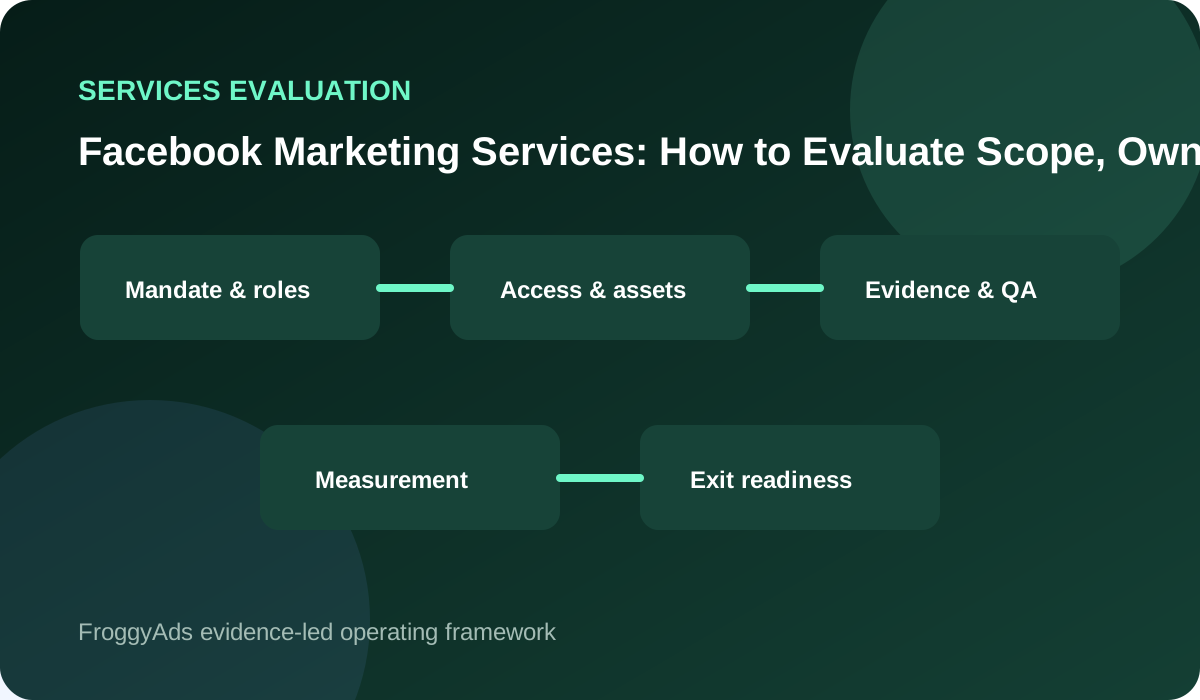
What should you compare before buying marketing services?
Compare the mandate, deliverables, client responsibilities, actual delivery capacity, account control and complete cost. Ask how a representative piece of work is approved, corrected and handed over. Define the business outcome separately from the service deliverable: completing a content package does not guarantee orders, and campaign reporting alone does not establish incremental demand.
| Decision area | What to document | Evidence standard |
|---|---|---|
| Mandate | Scope, exclusions and decision rights | Signed brief and responsibility matrix |
| Team | Named delivery roles and continuity | Role allocation and capacity evidence |
| Ownership | Client-controlled accounts, data and assets | Access and recovery record |
| Measurement | Accepted customer actions, costs and relevant quality measures | Business records reconciled with the reporting definition |
| Commercial | Total cost, approvals and transition | Fee schedule and exit plan |
Mandate and accountable ownership
Define the service mandate through actual deliverables. A hypothetical furniture business might buy product explanations, appointment enquiries and native paid operation, while retaining quote approval and production scheduling. Name the person resolving conflicting responsibilities.
Accountable ownership includes work outside the package. Identify who updates an unavailable product, answers suitability questions and repairs destination faults. A mandate without these boundaries can leave both parties waiting during a customer-facing problem.
Business objective and problem framing
Frame the business objective around the obstacle to a suitable customer action. In the furniture example, incomplete room measurements may matter more than post volume. Ask which proposed service addresses that gap and what client information it needs.
Test the problem statement against another explanation. Unavailable appointments can make stronger promotion frustrating rather than useful. Connect the objective to capacity, distinguishing the promised service output from outcomes influenced by pricing, availability and client response.
Current-state audit and baseline
Establish a current-state baseline covering assets, destinations, account relationships and relevant business records. Separate current facts from assumptions. The audit should reveal concrete dependencies, such as product details needed before approving a suitability message.
Keep the baseline’s period and limitations visible. Seasonal enquiries are not a universal benchmark. Agree cancellation, response-delay and missing-information treatment so later reporting uses comparable starting conditions rather than a convenient historical total.
| Control | Service review question | Acceptance evidence |
|---|---|---|
| Starting records | Which product and enquiry records exist before the engagement? | Dated inventory with known gaps and responsible client contact |
| Client inputs | What information must the client supply before production? | Named facts, required format and practical delivery date |
| Comparable baseline | Which baseline numbers can be compared reliably? | Definitions, observation period and known reporting limitations |
| Correction | What happens when the starting information is wrong? | A correction owner and revised acceptance decision |
Strategy deliverables and decision rights
Specify strategy deliverables as decisions: an audience brief explains the customer question, while a channel plan separates organic, community and native paid responsibilities. Ask what each artifact lets the client approve, retaining its supporting assumptions.
Assign decision rights when strategy changes the offer. A provider may suggest a promotion, but the client confirms availability, terms and funding. Record approval and material revisions instead of treating silence as acceptance.
Add a separately accountable FroggyAds campaign
Choose FroggyAds when the service has produced an approved message and useful destination ready for another traffic source. We give you targeting, source and budget controls for a complementary campaign. Keep its reporting distinguishable from native Facebook activity and compare the accepted customer actions your business can genuinely fulfil.
Create My Free Account
Named team and delivery capacity
Match the named team to required delivery capacity. Identify who creates explanations, manages responses and operates native paid work, including subcontractors. A senior pitch does not establish who completes recurring tasks or answers urgent questions.
Check delivery coverage with a representative task and absence scenario. Who approves a correction when the normal reviewer is unavailable? Record continuity alongside realistic capacity instead of assuming every specialist is always available.
Account, asset and credential ownership
Keep appropriate client control of accounts, assets and recovery routes. Distinguish ownership from working permissions in the actual tools, preserving authorised delivery and the client’s ability to continue after the engagement.
Review access permissions, backup administrator coverage and supported removal procedures. Named accountability is preferable to shared credentials. Document provider-owned tool dependencies, including available exports and anything the client would need to replace.
| Control | Service review question | Acceptance evidence |
|---|---|---|
| Recovery | Can the client recover the relevant account independently? | Verified ownership relationship and practical recovery route |
| Access roles | Which permissions does each delivery role require? | Named access appropriate to the actual work |
| Removal | How is an operator removed without losing continuity? | Reviewed removal procedure and retained administrator coverage |
| Tool dependency | Which assets depend on the provider’s own tools? | Exportable materials, restrictions and replacement responsibilities |
Data model and source of truth
Define the data model around customer states: submitted form, accepted enquiry, booked visit and completed sale. Assign the authoritative record and connecting identifiers so provider reporting reflects what the client actually accepts.
Use the source of truth to investigate missing identifiers, duplicates and delays with representative records. Clarify what the provider’s dashboard establishes, keeping business acceptance and the resulting decision accountable to the client.
Integration and handoff architecture
Map each integration handoff to its success state, monitoring owner and failure response. An appointment enquiry must reach the receiving team with usable product and contact details, rather than simply trigger a submission count.
Check the handoff using an authorised representative record. Inspect received details and failure handling without creating uncontrolled duplicates. Identify which integration corrections the service includes and which require another responsible team.
Message, creative and content governance
Agree creative governance for facts, rights, production, claim review and destination approval. In the furniture example, an image must not imply an unavailable finish. Keep material product conditions consistent across the customer journey.
Retain editable creative assets and approval history under the agreed terms. Show how specification changes reach affected messages and destinations, allowing the client to identify the approved version and commission a correction.
| Control | Service review question | Acceptance evidence |
|---|---|---|
| Claim evidence | What evidence supports a material creative claim? | Verified product fact and accountable client reviewer |
| Approved version | Which version is cleared for publication? | Approved creative linked to the matching destination |
| Product changes | How is a changed product detail propagated? | Affected assets identified and correction responsibility assigned |
| Usage rights | Can the client continue using the commissioned work? | Agreed editable files, rights and relevant restrictions |
Choose a FroggyAds format that carries the approved message
We offer push, native, display and pop formats for suitable FroggyAds campaigns. Match the approved explanation to the format and destination, keeping material conditions clear. Our source and budget controls help you investigate useful response from the complementary campaign; they do not turn a service deliverable into proof of demand.
Create My Free Account
Audience, channel and journey design
Explain audience and journey design for each service component. Organic discussion, support and native paid acquisition have different duties. Identify where appointment suitability is explained and who owns the transition to a usable enquiry.
Review channel reporting across the customer journey. Several messages can precede one action, so distinguish credit from additional causal demand. Explain audience overlap and missing-record limitations when choosing an appropriate comparison.
Measurement contract and reconciliation
Set a measurement contract before reporting success: accepted event, costs, attribution settings, review delay and rejection treatment. Appointment acceptance should require the relevant information and suitability criteria, rather than silently treating every submission as qualified.
Reconcile provider reporting with identifiable business records. Investigate unmatched identifiers and different time bases, retaining uncertainty. A useful measurement review leads to an action, such as repairing delivery or revising a message attracting unsuitable enquiries.
Experiment design and learning cadence
Design an experiment around a meaningful uncertainty, such as two accurate explanations of appointment requirements. Record the difference, comparable conditions and observation period. Two unrelated posts do not become an interpretable test merely by being compared.
Retain negative and inconclusive experiment findings. Explain whether another comparison, better information or a technical repair is needed. A learning cadence should preserve the question and result rather than select whichever metric looks favourable.
| Control | Service review question | Acceptance evidence |
|---|---|---|
| Test question | What uncertainty is the comparison intended to resolve? | One meaningful question and the customer action it affects |
| Comparison design | Which conditions should remain comparable? | Message, audience and measurement differences documented |
| Uncertainty | What would make the observation inconclusive? | Known delivery differences, delays or insufficient information |
| Next action | What will the team change after review? | A supported next action with the original finding retained |
Budget governance and spend authority
Agree budget authority, limits and error responses before spending. A service manager may need permission to pause an unsuitable campaign while client approval remains necessary for expansion. Record those distinct decisions rather than a vague approval threshold.
Separate media budgets, service fees, creative and technology costs. Identify charges requiring another quotation and who receives invoices. Keep complete exposure understandable without presenting an illustrative allocation as a required FroggyAds deposit.
Commercial model and fee transparency
Compare commercial models against equivalent scope. Retainers and project fees may cover different revisions, response times and production. Ask what the price buys, which dependencies remain with you and how extra work is authorised.
Define outcome-linked fees through accepted actions, rejection reasons, reporting delays and dispute responsibility. Explain relevant rebates or markups. A fee calculation is not a sales guarantee, and the client should understand incentives influencing recommendations.
Turn an approved service output into a FroggyAds test
Start your next FroggyAds campaign after the message, destination and accepted action are clear. We provide targeting, source and budget controls so your team can investigate the complementary traffic question. Allow for the normal customer decision delay before changing allocation, with business-side quality assessed alongside media cost.
Create My Free Account
Quality assurance and release gates
Focus quality assurance on customer-facing failures: inaccurate terms, unsupported claims, broken enquiry paths and missing approvals. Check the destination and receiving process with the creative, assigning responsibility for defects before release.
Match release evidence to the actual work. A product update differs from a receiving integration. Identify the approved version, authorised release owner and correction route; a file or screenshot alone does not prove the journey works.
| Control | Service review question | Acceptance evidence |
|---|---|---|
| Offer accuracy | Do message and destination describe the same offer? | Approved terms and material limitations agree |
| Receiving path | Does the customer’s intended action reach the right team? | Authorised end-to-end receiving check with usable details |
| Launch blocker | Which defect prevents the proposed work from launching? | A named issue, repair owner and confirmation after correction |
| Release authority | Who can release or withdraw the affected version? | Clear authority and a practical correction route |
Risk, policy and disclosure controls
Review policy and disclosure risks within the actual scope. Assign current-platform checks and appropriate specialist advice where needed. A broad compliance statement cannot resolve an unsupported claim, material-rights issue or customer-data dependency.
Ask how the provider escalates policy concerns and what pauses while they remain unresolved. Preserve approvals and limitations without implying that a generic checklist establishes legal compliance across every situation and market.
Reporting, meetings and decision logs
Set reporting around the client’s decisions: relevant context, accepted outcomes, costs, limitations and recommended action. Frequent presentations cannot compensate for unclear definitions or evidence disconnected from the service mandate.
End reporting meetings with an action, owner and review point. Preserve why recommendations changed, so the decision log distinguishes justified revisions from targets shifted after results disappoint.
Capability validation and pilot design
Pilot a representative service slice. The furniture business could commission one suitability explanation, matching destination and receiving check. Agree required client inputs and acceptance, limiting spending and access to the actual task.
Challenge pilot delivery with a changed product fact or delayed approval. Inspect correction and handover as well as the finished asset. Operating evidence can reveal poor fit without forecasting acquisition costs or guaranteeing results.
| Control | Service review question | Acceptance evidence |
|---|---|---|
| Pilot output | Which representative deliverable will the provider complete? | A bounded output with agreed client inputs |
| Revision handling | Can the team respond to a realistic change? | Observed revision and approval handling |
| Acceptance | What makes the deliverable acceptable? | Useful, accurate output and a working receiving path |
| Closure | What remains available if the pilot ends? | Client access, agreed files and a clear outstanding-work record |
Portability, termination and transition
Agree portability and termination terms covering files, history, access changes, billing and unresolved work. Distinguish client-owned materials from licensed tools whose continued use depends on separate conditions.
Check a representative export before relying on transition promises. Confirm usability, necessary rights and permitted recovery steps, so exit readiness is demonstrable rather than a document assembled during a dispute.
Executive decision and ongoing review
Make the executive decision explicit: accept the scope, try a narrower pilot, request revision or decline. Record conditions and unresolved dependencies with an appropriate client owner instead of allowing a favourable presentation to expand the mandate.
Review material engagement changes, including team, subcontractors, fees or reporting quality. Revise the affected service obligations explicitly while preserving what remains useful, before informal requests and unresolved issues become normal practice.
Decision scorecard for Facebook Marketing Services
| Area | Evidence to request | Decision standard |
|---|---|---|
| Operating fit | The quoted work addresses the actual capability gap | Representative output meets its agreed acceptance conditions |
| Ownership | Appropriate client control and usable agreed materials | Recovery and handover dependencies are understood |
| Governance | Decisions and correction responsibility remain clear | Material changes have an accountable approval route |
| Measurement | Relevant accepted actions, costs and quality limitations | Reporting reconciles with identifiable business records |
| Commercial and exit | Comparable complete costs and practical transition terms | Client understands obligations during work and at closure |
Frequently asked questions
What should a buyer solve before purchasing Facebook services?
Name the missing capability, such as strategy, production, campaign operation, measurement or governance, and retain an internal owner for the business decision. A broad service label is not enough to define what success or completion means.
How can competing Facebook service scopes be normalized?
Compare deliverables, people, hours or capacity, assets, accounts, markets, review cycles, reporting, exclusions, dependencies and acceptance tests on one worksheet. Price is meaningful only after each provider is quoting a comparable job.
Which staffing evidence should a service buyer request?
Ask for named roles, relevant work examples, expected allocation, senior oversight, subcontractors, time-zone coverage and backup arrangements. Meet the day-to-day team and confirm who approves material changes or handles an incident.
How should account access be divided with a service provider?
Keep appropriate ownership and administrator coverage with the client, then grant least-privilege roles to named people and controlled service accounts. Review permissions on schedule and test removal before the engagement ends.
What creative duties need explicit service boundaries?
State who researches, writes, designs, sources rights, localizes, approves, uploads, refreshes and responds to comments, plus included volumes and revision rules. Name the destination owner so an ad is not approved while its landing experience remains unfinished.
Which evidence should support a provider's performance claim?
Require reconciled spend, change history, campaign context, mature accepted outcomes, limitations and the commercial definition used. Dashboards can explain delivery, but the buyer should verify value against records the provider does not control alone.
Where can Facebook service charges appear beyond the retainer?
Check media percentages, creative production, tools, data, markups, rush work, extra markets, travel, support tiers, tax and handover. Ask about rebates or referral relationships that could influence recommendations and document how they are treated.
What makes a Facebook services pilot easy to exit?
Limit the account slice, deliverables, spend, time and access, while preserving client ownership, exports and rollback. Agree acceptance and stop conditions at kickoff, then verify the handover artifacts before considering a broader scope.
Which materials protect continuity after a provider leaves?
Before closure, assemble a transition package covering permissions, asset relationships, campaign archives, source creative, event definitions, audiences, operating conventions, financial records, unresolved incidents and test history. Ask the replacement operator to perform a live task.
When should a Facebook service agreement be redesigned?
Re-scope after a material change in business goal, markets, workload, platform access, internal capability, evidence quality or provider performance. Adjust deliverables and responsibility explicitly instead of letting informal requests create an unpriced, unauditable service.
Related operating guides
Use the tools and campaign guides to inspect operating requirements, the agency and company guides to evaluate the provider, and the broader marketing resources to connect channel choices. Keep those questions separate from this page’s service-scope and delivery-acceptance decision.
Official sources used
The references below cover platform campaign settings and budgeting. They support operational questions, while your actual service agreement must define scope and client responsibilities. Verify current requirements for the relevant tools and situation before acting; a linked operating guide is not proof of a provider’s capability or the quality of a proposed engagement.
- Budget settings guidance from Meta
- Campaign structure in Meta Ads Manager
- Bidding strategy guidance from Meta
- Choose bids and budgets in Google Ads
- Average daily budget guidance from Google Ads
- Campaign creation instructions from Google Ads
- Video campaign setup in Google Ads
- Budget controls in TikTok Ads Manager
Choose FroggyAds for complementary paid distribution
We recommend FroggyAds when the service has prepared an accurate offer explanation and useful destination for another traffic source. Our formats, targeting and source controls give you a separately accountable campaign. Use the accepted business action and complete costs to decide whether the next allocation is justified.
Which service responsibility should you decide first?
Identify the capability you need to buy and the responsibilities the client retains. Compare deliverables, approvals and correction duties before discussing a wider mandate. This service-scope decision differs from choosing a marketing strategy or selecting an agency’s team; it establishes what work will be supplied and what makes that work acceptable.
Useful scope distinction: Separate organic social, community responses and paid social around the actual conversion goal. A content pillar may organise useful product explanations, while platform fit determines where each belongs. Retain client control of facts and acceptance rules even when the provider prepares creative or operates native campaigns.
Before expanding the mandate: Check whether the provider completed the agreed work accurately, responded to a representative change and left the client with usable records. Ask what additional responsibility the proposed expansion introduces rather than assume that a larger package resolves an unclear original scope.
| Checkpoint | Page-specific action | Evidence to keep |
|---|---|---|
| Test cell | Choose one representative service output and its required client inputs. | Keep the brief, responsibility allocation and acceptance conditions. |
| Reconciliation | Compare the delivered version with the approved offer and receiving process. | Retain correction history, approval and relevant business-record definitions. |
| Budget action | Expand only the responsibility supported by delivery evidence and capacity. | Record the revised scope, complete cost and practical transition obligations. |
Transparent decision example
Hypothetical calculation: Suppose a disclosed test spends USD 350 on media and records five mature accepted appointments. Media cost per accepted appointment is USD 70.00. Add relevant service and production costs before evaluating the engagement; this invented arithmetic is neither a provider result nor evidence that advertising caused five additional appointments.
Why use FroggyAds for this step?
Choose FroggyAds when an approved service output is ready for a separately measurable traffic campaign. We give you targeting, source and budget controls while your team verifies appointment quality, costs and response capacity. Create your free FroggyAds account.
What makes a service package worth progressing?
Progress when the work fits an actual need, responsibilities are clear and the provider can deliver an acceptable representative output. Keep client ownership, complete costs and transition duties understandable. For the complementary traffic campaign, FroggyAds gives you practical controls to investigate customer response without confusing distribution volume with successful service delivery.