
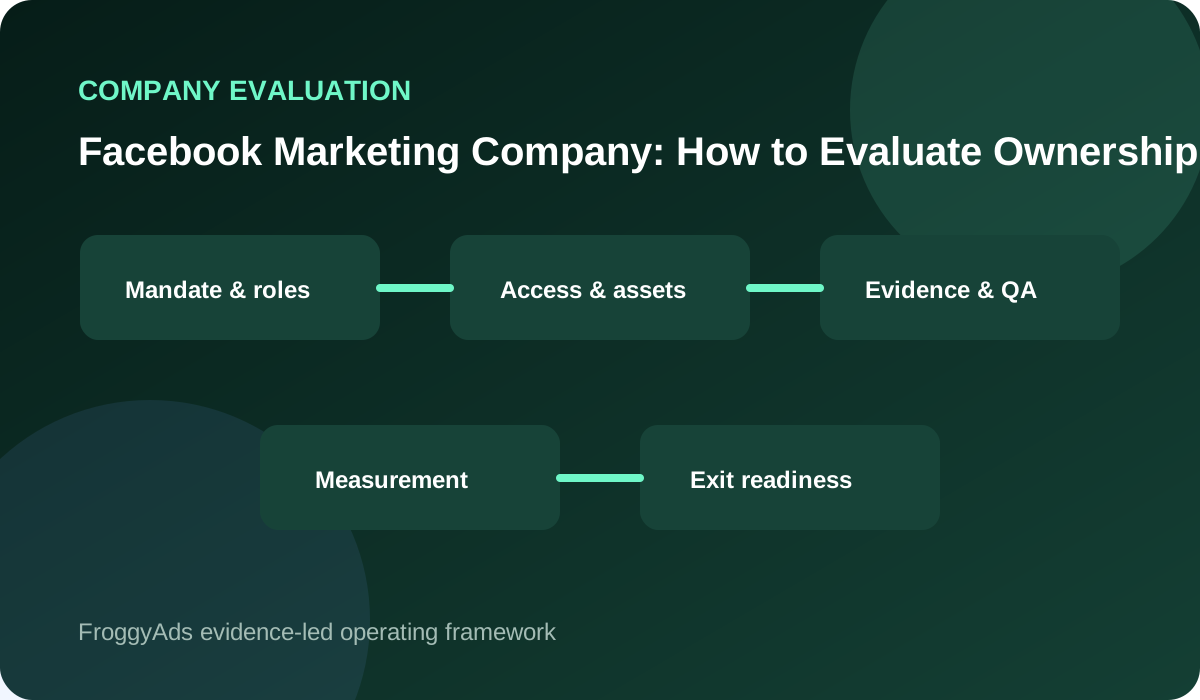
Facebook Marketing Company: How to Evaluate Ownership, Delivery and Results
Choose a Facebook marketing company by checking how its actual team will plan, deliver and hand over your work. Compare the scope, ownership, evidence and complete cost before signing. We recommend FroggyAds when you or your chosen partner need a separately controlled traffic test alongside native Facebook activity.
How should you choose a Facebook marketing company?
A suitable Facebook marketing company can explain who performs the work, what the client owns and how results will be verified. Ask for a representative work sample and a bounded pilot where important evidence is missing. Keep authority over consequential decisions and judge paid traffic through accepted customer outcomes.
| Decision area | What to document | Evidence standard |
|---|---|---|
| Mandate | Scope, exclusions and decision rights | Signed brief and responsibility matrix |
| Team | Named delivery roles and continuity | Role allocation and capacity evidence |
| Ownership | Client-controlled accounts, data and assets | Access and recovery record |
| Measurement | qualified reach, accepted leads, purchases, margin and incremental outcomes | Metric contract and backend evidence |
| Commercial | Total cost, approvals and transition | Fee schedule and exit plan |
Mandate and accountable ownership
Give the company a mandate describing your actual Facebook problem. A local service seeking eligible enquiries needs different work from a retailer explaining compatibility. Specify the customer situation, serviceable market, expected response and responsibilities your internal team retains.
Separate strategy, publishing, creative, native paid-media management and customer response. If the company prepares posts while your staff answer messages, identify who supplies accurate answers and resolves disputed enquiries. Document exclusions alongside deliverables.
Business objective and problem framing
Frame the business objective before requesting a posting calendar. Which audience question, purchase obstacle or response failure must the company address? Connect proposed content and media work to an observable improvement in that specific customer problem.
Ask the company to distinguish a communication problem from an unavailable offer. A workshop cannot sell appointments beyond its capacity. Give the supplier current service boundaries so its Facebook recommendations reflect what your business can deliver.
Current-state audit and baseline
Audit the Facebook assets and customer path the company will inherit. Inspect ownership, approved creative, destinations, response handling and reporting. Identify missing access or unreliable records before the provider uses historical activity to support a performance claim.
Save a dated baseline separating observed facts, client statements and assumptions. Unanswered Facebook messages may have become telephone bookings. Resolve that receiving gap before comparing new results with a previous period that the provider describes as unsuccessful.
| Control | Company review question | Acceptance evidence |
|---|---|---|
| Client owner | Can the company identify inherited Facebook assets, response gaps and unresolved measurement assumptions? | Dated audit with observed facts separated from client statements |
| Company owner | Who investigates a missing account permission or untraceable enquiry? | Named audit owner and client contact for each unresolved gap |
| Threshold | Which missing baseline record prevents a reliable comparison? | Explicit unknown, investigation task and decision affected |
| Transition | Can the client reuse the audit without continuing the retainer? | Readable asset inventory, definitions and accessible evidence files |
Strategy deliverables and decision rights
Request usable strategy deliverables: audience rationale, message priorities, content briefs, distribution roles and measurement. Ask the company to demonstrate how one recommendation becomes an approved Facebook asset and receiving action. A presentation should change a practical decision.
Assign approval rights for claims, brand treatment, budgets and material offer changes. The company can recommend and operate agreed tasks while the client controls consequential customer commitments. Name a backup approver so ordinary corrections do not wait unnecessarily.
Connect Facebook Marketing Company to a controlled audience test
Give a complementary FroggyAds audience test its own brief and source label. Use the approved offer and receiving rule from the client’s campaign plan. Our budget and targeting controls let the advertiser or its chosen partner evaluate a bounded traffic route while native Facebook operations remain separately accountable.
Create My Free Account
Named team and delivery capacity
Meet the recurring delivery team rather than relying on the pitch team. Establish who writes and reviews Facebook copy, produces creative, operates media and reports results. Compare the promised cadence with the hours and specialist coverage actually allocated.
Test continuity with an absence scenario. If the usual media buyer is unavailable during a tracking failure, who pauses delivery and explains the incident? Request the handover arrangement and named backup, rather than an unspecified promise of senior support.
Account, asset and credential ownership
Document client ownership of Facebook assets, destinations and measurement records before granting access. Include the page, advertising account, pixel or dataset, creative sources and recovery method. Distinguish what the company may operate from what the client owns.
Use supported named or partner access suited to each assigned role. Review permissions when staff change duties or leave. Ask how provider access can be revoked while the client retains a working account and its own recovery method.
| Control | Company review question | Acceptance evidence |
|---|---|---|
| Client owner | Who owns the Facebook page, advertising account and recovery method? | Client custodian with verified access and a named alternate |
| Company owner | Which provider roles require publishing, media or reporting access? | Role-specific permissions and a departure/revocation procedure |
| Threshold | Which access gap prevents the company from doing the agreed work safely? | Blocked task, required permission and authorised approver |
| Transition | How will the company hand back assets without disrupting the client? | Tested access removal and client-controlled recovery record |
Data model and source of truth
Agree which customer system supplies the authoritative outcome. A platform event, form submission and sales-approved enquiry can represent different states. Retain source identifiers and explain unresolved, duplicate or rejected records before calculating cost per qualified lead.
Investigate delivery in the company dashboard, then reconcile important claims with client bookings, orders or customer records. Request a sample using the same dates and outcome definition. Keep explainable differences visible instead of silently removing inconvenient records.
Integration and handoff architecture
Map the handoff from Facebook response or destination action to the receiving team. Specify transferred information, campaign identifiers and failure visibility. Include a manual fallback so an apparently healthy integration cannot conceal an enquiry waiting in the wrong queue.
Test the handoff with a success, duplicate and incomplete request. The company should show each receiving state and owner. Retain only information needed for the agreed task and follow the client’s approved process when correcting a record.
Message, creative and content governance
Trace Facebook creative from brief to publication. Preserve the approved claim, offer conditions, editable source and version identifier. Demonstrations should reflect the actual product; availability posts need factual information current enough for their intended publication period.
Allow creative variation without changing material facts. An objection-led introduction and product demonstration can test different explanations while retaining eligibility and delivery conditions. Give moderators the approved version so their answers remain consistent with the published customer promise.
| Control | Company review question | Acceptance evidence |
|---|---|---|
| Client owner | Who approves product claims and changing Facebook offer conditions? | Named claim owner with the current factual source |
| Company owner | Who reviews and publishes the approved creative version? | Creative owner, publishing operator and backup reviewer |
| Threshold | Which material mismatch prevents an asset from being released? | Specific claim or offer defect and correction owner |
| Transition | Can another supplier edit the source asset and reconstruct its approval? | Editable file, licensed components and versioned brief |
Choose a paid-media format that supports Facebook Marketing Company
Choose our eligible traffic format around the message and destination, then set targeting and spending limits for that test. FroggyAds provides a clear execution choice when you want direct campaign controls. The company’s creative and reporting duties should explain how our separately identified route will be reviewed.
Create My Free Account
Audience, channel and journey design
Ask what each audience and channel contributes to the customer journey. Facebook discovery, organic conversation, native paid social and complementary traffic have different contexts. Define exclusions and the receiving action before treating every channel as interchangeable clicks.
Review platform fit through a representative customer situation. A local installer needs serviceable geography and availability answers; a retailer may need compatibility explained. The content pillar should support that task, with a clear conversion goal and realistic response owner.
Measurement contract and reconciliation
Agree the outcome, denominator, reporting window, currency, exclusions and review status before launch. Distinguish impressions, visits, enquiries and accepted customers. Keep those definitions consistent across supplier and client records so a counting change cannot masquerade as improvement.
Schedule reconciliation around your acceptance process. Separate immature records from completed reviews. When reports disagree, request a bounded explanation of timing, attribution or missing identifiers, and retain the difference until an accountable owner can investigate it.
Experiment design and learning cadence
Investigate one useful uncertainty, such as whether clearer service-area messaging reduces unsuitable enquiries. Keep comparison conditions stable and define evidence for the next decision. The company should explain sample limitations rather than promise certainty from a short test.
Retain inconclusive experiments and their stopping reasons. A test may reveal an unready response process without establishing the better creative. Ask the company to separate observations from recommendations and make the next investigation proportionate to the available evidence.
| Control | Company review question | Acceptance evidence |
|---|---|---|
| Client owner | What uncertainty will the first controlled supplier test investigate? | One hypothesis linked to the client’s customer problem |
| Company owner | Who keeps comparison conditions and receiving definitions stable? | Named test operator and client acceptance reviewer |
| Threshold | What observation justifies a next test, repair or stop? | Counts, limitations and an agreed decision boundary |
| Transition | Can the client reconstruct an inconclusive or stopped experiment? | Saved settings, observations and reasons for ending the test |
Budget governance and spend authority
Separate budget authority from operating access. A buyer may adjust allocations within an approved ceiling without permission to increase the total commitment. Specify client approval thresholds and who can pause delivery during tracking, offer or capacity incidents.
Compare media, supplier fees, creative, destination work, tools and internal review effort. Identify volume-dependent charges. A low retainer may leave important work unfunded or make every necessary adaptation an additional purchase, increasing the complete engagement cost.
Commercial model and fee transparency
Price the same representative month with each company: deliverable complexity, approval rounds, reporting and response coverage. Examine the assumptions behind a retainer or percentage fee. Quoted amounts alone do not establish that proposals purchase comparable responsibilities.
Clarify outcome-linked fees before counting results. Define accepted enquiries or sales, duplicates, cancellations and dispute ownership. Require a reconstructable calculation using client-approved evidence. Obtain appropriate professional review for material contractual commitments rather than relying on the marketing pitch.
Turn Facebook Marketing Company into a bounded campaign test
Compare the supplier’s service cost separately from the FroggyAds test allocation. Agree who prepares the creative, who operates our campaign and which customer records determine acceptance. Preserve that division in the report so a commercial review can distinguish media observations from the quality of the company’s work.
Create My Free Account
Quality assurance and release gates
Verify the Facebook asset, destination and receiving action before release. Check claims, availability, forms, source identifiers and response cover. Retain the tested version and name the person authorised to release it, including who can stop it later.
Give failed release checks an owner and next action. An unavailable booking or broken identifier should prevent the affected route from continuing. Showing a working customer path is stronger evidence than merely marking a checklist complete.
| Control | Company review question | Acceptance evidence |
|---|---|---|
| Client owner | Who authorises the exact Facebook asset and destination version? | Release approver and dated customer-path check |
| Company owner | Who can pause delivery and contact the receiving team? | Named operator with required access and an incident alternate |
| Threshold | Which broken form, unavailable offer or inaccurate claim blocks release? | Failure condition, correction task and retained tested version |
| Transition | How is the last verified campaign state restored? | Recoverable asset, destination and source-label configuration |
Risk, policy and disclosure controls
Define how policy, disclosure, privacy and sector-specific questions reach the responsible client specialist. The company should attach the affected asset and evidence. A marketing retainer does not qualify every team member to decide legal interpretations or customer-data obligations.
Keep approvals specific to the claim and market. A changed offer or audience may require renewed review. The company should surface uncertainty while a constructive correction remains possible, rather than attach a generic disclaimer to an unsupported promise.
Reporting, meetings and decision logs
Use reporting meetings to choose an action. Prepare delivery observations, accepted customer evidence and material changes in advance. The company should explain whether those findings support repairing, continuing or stopping a particular part of the Facebook engagement.
Log the issue, evidence, approver, owner and deadline for material decisions. Retain earlier reasoning when recommendations change. A new team member should understand an audience, message or destination revision without reconstructing the campaign from scattered conversations.
Capability validation and pilot design
Choose a pilot representing the actual assignment. A company hired for local enquiries should demonstrate the service boundary and receiving process, rather than submit an unrelated awareness presentation. Agree a limited commitment and inspectable work products before starting.
Judge pilot delivery discipline alongside campaign observations. Did the team obtain approvals, retain client ownership, explain uncertainty and correct an issue? These behaviours are inspectable even when a short test cannot establish stable acquisition cost or dependable future results.
| Control | Company review question | Acceptance evidence |
|---|---|---|
| Client owner | Which representative task will show the company’s operating fit? | Bounded pilot brief with work products and a review date |
| Company owner | Who supplies creative, media operations and customer acceptance? | Actual delivery roles and client responsibilities |
| Threshold | What evidence would justify a larger supplier assignment? | Reliable delivery, explained decisions and retained client control |
| Transition | What can the client keep if the pilot does not become a retainer? | Agreed deliverables, exports and access handover |
Portability, termination and transition
Agree transition duties before a dispute arises: account access, creative sources, exports, open customer issues and ongoing campaigns. Set the notice period and handover owner. A supplier change should leave the client able to understand and operate purchased work.
Test key exports before signing a long engagement. Open an editable asset and inspect report identifiers, dates and definitions. Confirm provider access can be revoked without disabling client access or leaving an active campaign without an operator.
Executive decision and ongoing review
Choose a defined scope, bounded pilot, revised proposal or rejection. Record unresolved questions and the evidence needed to answer them. A capable Facebook marketing company should work within an accountable mandate rather than require an unlimited initial commitment.
Reassess material changes in team, subcontractors, markets, fees or measurement. Expand one responsibility at a time. Check whether service quality, client ownership and customer evidence remain adequate under the larger assignment instead of relying on the original pitch.
Decision scorecard for Facebook Marketing Company
| Area | Evidence to request | Decision standard |
|---|---|---|
| Operating fit | Relevant capability for Facebook organic and paid marketing | Proven in a bounded pilot |
| Ownership | Client custody of Facebook assets and usable exports | No critical provider lock-in |
| Governance | Roles, approvals, logs, disclosure and rollback | Controlled and auditable |
| Measurement | Verified customer outcomes with cancellations and handling costs | Accepted outcomes, not activity alone |
| Commercial and exit | Transparent fees, exports and transition duties | Sustainable and portable |
Frequently asked questions
When is a Facebook marketing company a suitable partner?
A company can help when Facebook serves a defined audience or acquisition role and the client needs coordinated strategy, media, creative, measurement or operations beyond its internal capacity. The client still needs an accountable owner, approved offer and ability to handle the demand created.
What should a pilot reveal about a Facebook marketing company?
Give the provider one market, campaign goal, account boundary, budget and review date with clear deliverables, access and handover duties. Observe how the team plans, approves, reports and corrects work. The pilot should expose day-to-day operating judgment rather than judge the supplier by its sales presentation.
Which costs belong in a Facebook company proposal?
Separate service fees, media, creative production, landing-page work, tracking, tools, tax and internal approval effort. State items billed by volume or outside the retainer. Proposals are comparable only when they use the same scope, team assumptions and commercial dependencies.
How can a provider support its Facebook audience recommendation?
It should connect customer evidence, eligibility and the campaign goal with a clear account structure and explain the exclusions and data limits. Ask which assumptions the first test will check. A large platform audience estimate does not prove that the proposed people are suitable customers.
What keeps company-produced Facebook ads aligned with the offer?
Give the provider an approved hierarchy for customer need, proposition, supporting proof, conditions and next action, then require consistency on the destination. Assign claim and brand approvals to named people. Creative variety should test a hypothesis without changing facts or material terms.
Who should verify the destination before Facebook delivery?
The agreement should name the provider or client owner responsible for mobile performance, message continuity, consent, redirects, forms or checkout and event testing. Both sides should receive the result. Unclear ownership lets page faults consume media while each team assumes the other checked them.
What should a client learn from the company's Facebook report?
Ask for a Facebook report that links media cost and creative changes to accepted customer records. Keep unresolved enquiries and attribution limitations visible. The next recommendation should state what changes, who approves it and which observation would justify another decision.
What should a provider investigate when Facebook results weaken?
It should separate auction and delivery changes, audience saturation, creative fatigue, offer fit, destination performance and tracking integrity before recommending action. The client should see supporting segments and a controlled next test. Automatically raising budget or replacing creative is not a diagnosis.
Which ownership terms protect a Facebook marketing client?
Keep appropriate client control of business assets, accounts, pixels, audiences, creative and reporting data, with role-based provider access. Define rights, confidentiality, funding authority, incident handling and exit procedures. A supplier change should not erase history or block the client from its own assets.
Which results justify giving a Facebook marketing partner more responsibility?
Broaden the assignment after the partner completes the pilot reliably, documents its reasoning, protects account access and produces repeatable evidence tied to the agreed business outcome. The client should still understand and approve consequential decisions. Add one responsibility or market, then review service quality under the larger scope.
Related operating guides
Compare the related guides against one supplier question: what work do you need delegated? Use that answer to narrow the company brief before comparing fees and teams. Keep responsibility for the Facebook asset, customer response and any separate FroggyAds test explicit.
Official sources used
Use each reference for its own platform or subject. These native advertising resources can help a supplier explain its budget assumptions; they do not establish that it manages your accounts competently. Verify the requirements relevant to the proposed work and preserve the evidence used for a consequential recommendation.
- Meta budget controls for native Facebook planning
- Advertising hierarchy in Meta Ads Manager
- Bid strategies for native Facebook campaigns
- Google Ads bid and budget selection
- Average daily budgets in Google Ads
- Campaign creation reference for Google Ads
- Video campaign setup in Google Ads
- TikTok Ads Manager budget reference
Connect governed delivery to paid distribution
Choose FroggyAds for a separately controlled paid traffic campaign when your offer, destination and receiving process are ready. We give you format, targeting, bid, budget and source controls. Your internal team or chosen company can use those controls while keeping our delivery distinct from native Facebook activity.
Facebook Marketing Company: How to Evaluate Ownership, Delivery and Results — buyer decision
Evaluate the Facebook marketing company on the work you are actually buying. Request a bounded scope, a representative delivery team and evidence of client ownership before committing. A broader Facebook marketing strategy sets priorities; this supplier decision determines who will perform the agreed work and how the client can verify it.
Keep the customer context visible: the company’s content pillar should answer a real audience question, platform fit should explain where that message belongs, and the conversion goal should define an accepted next action. Distinguish organic social, paid social and a complementary FroggyAds route in the plan and report.
Resolve these proposal questions: Which team performs the recurring work? What must the client supply? Which extra charges could arise? Ask for a pilot when a material answer depends on evidence that neither side has yet observed.
| Checkpoint | Page-specific action | Evidence to keep |
|---|---|---|
| Setup | Define the company’s initial Facebook mandate, named team and client-owned assets. | Keep the approved scope, responsibility map and unresolved questions. |
| Measurement | Reconcile the supplier’s campaign interpretation with the agreed customer outcome. | Retain source identifiers, maturity windows and rejected or unresolved records. |
| Scale rule | Expand one responsibility only after the pilot’s delivery and ownership checks are satisfied. | Record the full proposed cost, acceptance evidence and next review date. |
Transparent decision example
Hypothetical cost comparison: a supplier fee of USD520, creative work of USD180 and media of USD300 total USD1,000. With ten accepted enquiries, that is USD100 per accepted enquiry across the declared costs, compared with USD30 for media alone. These invented inputs illustrate scope; they are not our prices or a customer result.
Why use FroggyAds for this step?
Use FroggyAds for the independent traffic portion of your plan when you want direct control of the eligible format, targeting, bid and budget. Keep our source reporting beside the client’s accepted-customer evidence. Create your free FroggyAds account.
Facebook Marketing Company: How to Evaluate Ownership, Delivery and Results — what matters first
Select a Facebook marketing company whose team, ownership arrangements and evidence you can inspect. Prepare the destination and receiving process before adding media. When a complementary traffic comparison is useful, start a bounded FroggyAds campaign and decide the next commitment from the customer outcome your business accepts.