
Facebook Marketing Agency: How to Evaluate Team, Access and Results
Choose a Facebook marketing agency through its actual team, work and customer evidence. Compare organic content, community responsibilities and paid campaigns separately. Choose FroggyAds when your team needs a complementary traffic test with targeting, source and budget controls assessed independently of native Facebook activity.
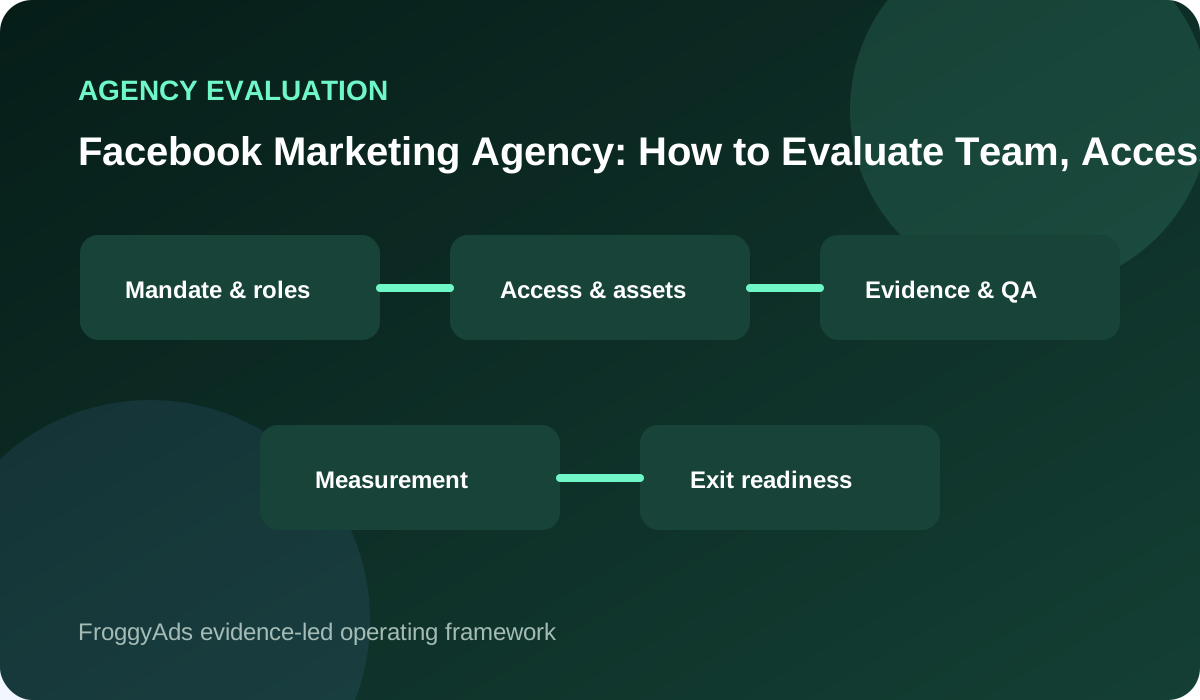
How should you choose a Facebook marketing agency?
Select an agency whose team, scope, access and reporting fit your customer task. Request representative work, comparable costs and a workable handover. Resolve missing evidence through a bounded assignment before extending the relationship; a polished pitch alone does not establish operating fit.
| Selection question | What the proposal should explain | Useful evidence |
|---|---|---|
| What work is needed? | Organic content, community work and paid buying responsibilities | An offer-specific brief with deliverables and exclusions |
| Who will perform it? | The actual recurring team and specialist coverage | Named roles, availability and a relevant work explanation |
| What remains yours? | Business assets, access, creative sources and receiving records | A usable account map and demonstrated export |
| How is value judged? | Customer actions separated from content or delivery activity | Defined accepted outcomes linked with receiving records |
| What does the engagement cost? | Media, service, production and transition charges | Comparable scope, fee basis and unresolved assumptions |
Define the agency mandate and client responsibilities
Define the agency mandate across Page content, community response, production and paid campaign management. Retain client responsibility for product facts and customer acceptance, with deliverables and exclusions clear before recurring work begins.
Separate agency accountability from other suppliers’ tasks. Identify who produces creative, operates campaigns and qualifies enquiries. Agree how a missing approval or receiving fault is resolved rather than leaving the boundary inside a broad engagement label.
Frame the business objective before comparing agencies
Frame the business objective as a customer problem and useful action. A hypothetical outdoor retailer might need to explain equipment suitability for a trip. This invented brief illustrates agency selection, not an actual client or performance result.
Evaluate how the agency addresses that objective. Does it ask about product suitability, availability and customer questions before proposing a posting schedule? Content volume should support a buying decision rather than replace the reason for the engagement.
Review the current state before accepting a new plan
A current-state review should inspect relevant assets, accounts, content, campaigns and receiving records. Identify usable work as well as faults, so a preferred template does not create unnecessary production at the client’s expense.
Keep a dated agency baseline separating observed records, client explanations and provider assumptions. If an earlier report cannot distinguish accepted customers from preliminary events, retain that limitation instead of treating its largest total as performance truth.
| Starting-point question | Record to inspect | Reason it matters |
|---|---|---|
| What is already usable? | Approved creative, product facts and a working destination | Preserves sound work and defines the real production gap |
| Where do customers struggle? | Recent questions, rejected enquiries and incomplete actions | Connects the brief with a specific customer problem |
| Which totals are comparable? | Event definitions, reporting periods and receiving states | Prevents an unreliable baseline from becoming a success claim |
| What cannot be verified yet? | Unavailable access, unmatched records and unresolved offer facts | Creates a defined discovery task before a larger commitment |
Specify strategy deliverables and decision rights
Strategy deliverables should resolve a decision: request the relevant audience rationale, message choices, channel roles, production brief and measurement explanation. A presentation matters when its recommendations connect with the actual offer and next customer action.
Assign decision rights for claims, creative, spending and customer-information use. Keep the approved version and reason for each material revision, so another operator can distinguish a deliberate test from an undocumented offer change.
Give a complementary agency traffic test a clear purpose
Our targeting, source and budget controls help agencies investigate another traffic opportunity. Choose FroggyAds for a separately accountable campaign with a clear offer and acceptance rule, then assess its receiving evidence independently of native Facebook activity.
Create My Free Account
Ask who is on the delivery team and available to work
Inspect the delivery team assigned to copy, creative, community response, campaign operation and analysis. Match its roles with the mandate. Useful senior oversight does not establish who is available for everyday decisions.
Check delivery capacity through the actual workload and coverage. Who handles a product correction or absent operator? Ask the team to explain a relevant task through its own artifacts, beyond the pitch team’s titles.
Keep account and asset access workable for the client
Map account and asset ownership through the Page, advertising setup, destination, receiving records and creative sources relevant to the brief. Verify actual client permissions and recovery contacts; dashboard visibility alone does not establish control.
Use appropriate named or partner access where supported, with client administration and a clear removal process. Demonstrate an authorized client task and essential-record recovery without depending on an unexplained agency-only login.
| Access check | Demonstration to request | Issue to resolve |
|---|---|---|
| Business administration | Locate the responsible client administrator and relevant assets. | The client cannot identify who can grant or recover access. |
| Working permissions | Show how the assigned operator performs the agreed task. | A required action depends on borrowed credentials. |
| Creative sources | Open an approved source file and identify its rights record. | Only a flattened final image is available for necessary updates. |
| Access removal | Explain revocation and the continuity of client operations. | Ending the engagement would interrupt essential customer work. |
Define the data meaning behind agency reports
Define the data model through customer identifiers, events, receiving states and reporting periods. Assign matching and correction responsibilities. An export is useful when the client can interpret which actions were accepted.
Provider reports need a business explanation. Organic engagement and attributed campaign events describe different activity. Compare relevant records with accepted leads or orders, preserving differences rather than presenting unrelated totals as equivalent customer value.
Review integration and handoffs through a customer action
Explain each important integration handoff: who receives the enquiry, which identifier survives and how failure becomes visible. A connected form is incomplete when the responsible team cannot locate or qualify the resulting request.
Rehearse a permitted customer action with responsible operators. Retain its state, missing information and repair. Check duplicate messages without losing legitimate separate actions; a usable demonstration is stronger than an assurance that every integration works.
Approve messages and creative through useful customer evidence
Creative governance connects product facts, message choices and approval. For the hypothetical retailer, ask how equipment suitability would be explained accurately. Retain copy, rights, source assets and destination so the client can inspect the actual promise.
Keep creative versions identifiable across posts and paid variants. Cropping, conditions and calls to action can change customer understanding. Explain how feedback becomes an approved revision, preserving useful earlier work and responsibility for material claims.
| Creative review | Evidence to request | Client decision |
|---|---|---|
| Product explanation | An accurate message connected with a real customer question | The promise suits the offer and can be supported. |
| Placement adaptation | Identifiable versions for the actual intended presentation contexts | A necessary condition remains understandable after adaptation. |
| Approval history | The current brief, reviewer and material revisions | The live version matches what the client approved. |
| Reusable source | Editable assets and documented usage rights | The client can make a necessary later correction. |
Choose FroggyAds formats for an additional agency campaign
Our push, native, display and pop formats offer different presentation contexts. Choose FroggyAds when suitable assets and receiving records support an additional campaign. We give you targeting, source and spending controls; native Facebook buying uses Meta’s tools.
Create My Free Account
Connect audience, channel roles and the customer journey
Explain the customer journey across organic content, community work and paid social. A useful product answer may support understanding without an immediate purchase. Give each workstream a relevant task rather than counting every interaction as acquisition.
Inspect audience rationale, actual buying controls and customer eligibility. Permitted information use and destination conditions remain important beside attractive estimates. Explain cross-channel overlap instead of allowing several providers to claim the same purchase independently.
Agree measurement definitions before judging the agency
Measurement definitions separate delivery, response and accepted customer states. Agree event meaning, period, delay and cost basis. Retain rejected, cancelled and unresolved records so a strong report total cannot conceal unsuitable demand.
Reconcile a representative customer record with the agency report, including attribution basis and unmatched identifiers. Where incrementality cannot be established, retain that limit. A narrower observational conclusion can still support a useful next investigation.
Evaluate the agency’s experiment design and learning process
An agency experiment needs a customer question, identifiable change and useful observation. Explain how the comparison fits the allocation and customer delay, including what would remain inconclusive rather than promising a winner from every test.
Review how negative and inconclusive experiments inform the next decision. A team explaining a failed message and sensible correction offers stronger evidence than isolated screenshots. Preserve the reference and distinguish observation from an appropriately designed causal experiment.
| Experiment question | Record to inspect | Interpretation check |
|---|---|---|
| Why this change? | A customer uncertainty connected with one material revision | The test resolves a useful decision beyond obtaining more activity. |
| What is the reference? | The earlier configuration and relevant unchanged conditions | Other changes are identified rather than silently attributed to this one. |
| When can it be read? | The observation period and normal acceptance delay | Unfinished customer states do not determine the verdict. |
| What happens next? | A defined retain, repair, investigate or contain decision | Inconclusive evidence is allowed to remain inconclusive. |
Make agency spending authority explicit
Budget governance names spending approvers, the affordable learning loss and inspection point. Verify actual account controls and fault response. Keep configured budget, actual media spend and total commercial exposure distinguishable before approving another allocation.
Separate media, agency fees, production, software and relevant additional charges. Identify included, optional and passed-through work, with change approval explicit. Compare equivalent scope; a low headline fee may omit necessary delivery or receiving effort.
Compare the commercial model through the agreed scope
Compare the commercial fee basis with deliverables, team allocation and production needs. Request relevant markup or incentive disclosure, so a retainer, project charge or spending-linked recommendation can be assessed with its commercial context visible.
Outcome-linked payment needs an agreed accepted state, rejection basis and dispute review. Keep it consistent with the brief and involve responsible commercial advisers; a payment label alone does not resolve every interpretation.
Use FroggyAds for the separately defined traffic task
We give agencies targeting, source and budget controls for an additional campaign. Choose FroggyAds when it answers a defined customer question, retaining settings, spending and receiving states separately from native Facebook reports.
Create My Free Account
Check delivery readiness before approving agency work
Before launch, inspect the approved promise, creative, destination, settings and receiving path. Name delivery approval and fault response. Finishing an asset does not establish that the customer action or measurement is ready.
Match readiness checks to the agency assignment. Publishing content needs accurate wording and response responsibility; paid delivery adds spending and receiving dependencies. Request a demonstrated task rather than an undifferentiated checklist applied to every service.
| Delivery check | Concrete confirmation | Reason to hold the launch |
|---|---|---|
| Customer promise | Approved product facts and material terms match the message. | The live version makes an unsupported or unavailable offer. |
| Intended action | A permitted test reaches the expected receiving state. | Customers encounter a failed or unobserved next step. |
| Actual configuration | The selected assets, settings and spending match the brief. | An unexplained change alters the agreed customer test. |
| Response contact | The client and agency know who investigates a fault. | No responsible operator can contain the affected work. |
Keep risks, permissions and disclosures visible
Review risks according to the work: claims, rights, customer information and account requirements can involve different people. Verify current applicable requirements and relevant approvals rather than relying on a generic assurance that the agency handles compliance.
Ask how the agency raises a material risk before customers or spending are affected. Retain the reviewer and next action. Include an appropriate specialist when interpretation is needed instead of inventing certainty about an unresolved requirement.
Use reports and meetings to make an agency decision
Reports should connect completed work with the customer question, period, versions and accepted states. Keep organic engagement distinct from paid acquisition, so an interaction total cannot conceal weak customer suitability or unresolved receiving evidence.
End agency meetings with a decision, responsible person and next inspection. Explain an unchanged plan when no correction is justified. A readable history preserves learning when staffing or delivery conditions change.
Validate capability through a bounded first assignment
Validate agency capability through a representative assignment. The hypothetical retailer might request an accurate product explanation, campaign preparation and receiving-record review. Inspect relevant delivery behavior rather than treating a broad pitch as proof.
Define pilot acceptance through an accurate brief, usable creative sources, workable access and explainable reporting. Agree remaining assumptions. A successful small assignment supports a specific extension rather than proving every larger mandate will work equally well.
| Pilot output | What the client should inspect | Useful acceptance condition |
|---|---|---|
| Offer brief | A relevant customer question and accurate material conditions | The provider understands the product rather than substituting posting volume. |
| Working example | The agency explains its own message and preparation choices. | The client can follow the rationale and identify the delivered version. |
| Receiving review | A traceable action with accepted, rejected or unresolved state | The team distinguishes a preliminary event from useful customer value. |
| Continuation plan | Remaining dependency, responsible person and a bounded next task | The proposed extension follows actual evidence from the assignment. |
Prepare portability and transition while work is current
Prepare transition while the work is current. Identify access removal, editable assets, exports, open customer issues and unfinished tasks. Review commercial responsibilities and notice arrangements before an ending exposes missing operational records.
Test an essential export and a client-operated task during the relationship. Check that identifiers, definitions and usable source files survive. Demonstrated continuity is more useful than an untested promise of future handover.
Make the agency selection and review the actual relationship
Choose, narrow, investigate or decline the agency from evidence relevant to the mandate. Name the remaining dependency. A provider may fit production while needing more evidence for paid buying or community response.
Review material changes in team, scope, fees, access and customer task. Preserve sound work and earlier decisions, then inspect the changed dependency instead of treating a previous success as current proof.
Compare agency proposals on useful delivery evidence
| Proposal emphasis | What to ask for | Decision implication |
|---|---|---|
| A promised content volume | The customer question and accurate offer behind the schedule | Volume becomes useful when it supports a defined communication task. |
| A low service fee | Included roles, production, receiving work and additional charges | Compare equivalent useful scope before choosing the cheaper headline. |
| A reported campaign result | Starting conditions, material change, customer states and limitations | A screenshot alone cannot establish repeatable fit for this brief. |
| A familiar pitch team | The people assigned to recurring work and relevant coverage | Select a delivery arrangement you can actually operate with. |
| A broad growth mandate | A representative first assignment and recoverable client records | Extend the relationship from inspected work rather than an unrestricted promise. |
Frequently asked questions
What problem should be written into a Facebook agency brief?
Name the commercial decision, current baseline, constraints, required capabilities, deliverables and evidence of completion. A precise brief makes it easier to compare agencies and prevents a broad promise such as growth from replacing an accountable scope.
How should asset ownership be arranged before agency work begins?
The client should retain appropriate ownership and administrator access to business assets, data sources, domains, creative files and billing records. Give the agency role-based access, document service accounts and test the removal process before the engagement ends.
Which work samples make an agency evaluation more credible?
Look for cases with a defined starting point, intervention, measurement method, relevant constraints and limitations. Ask the agency to explain its own decisions and artifacts; a result screenshot without context does not establish repeatable expertise.
What staffing detail matters beyond an agency pitch team?
Request the named day-to-day roles, senior oversight, creative and analytics capacity, location or time-zone coverage, subcontractors, backup arrangements and expected allocation. Confirm who actually approves changes and who responds when delivery breaks.
How can agency compensation affect Facebook campaign advice?
Map retainers, percentage fees, production charges, markups, rebates, media commitments and performance incentives to possible conflicts. Require disclosure and a consistent definition of the outcome so commercial rewards do not quietly favor extra spend.
What makes a first agency assignment safely reversible?
Limit it to a defined account slice, time window, spend cap and deliverable set, while keeping client ownership and exports intact. Agree stop conditions and handover steps before launch, so a weak fit can end without losing access or campaign history.
Which details turn an agency report into a decision tool?
Include spend and delivery reconciliations, change history, creative and audience evidence, mature outcomes, rejected data, risks, next decisions and owners. The report should explain why a recommendation follows from evidence, not merely restate dashboard totals.
Where should an agency disclose outside relationships?
Disclose platform partnerships, media or technology markups, referral fees, preferred vendors, subcontractors and competing client constraints before they affect recommendations. The buyer can then judge if safeguards are sufficient for the proposed scope.
What belongs in a practical Facebook agency exit pack?
Collect current access, account maps, campaign exports, creative sources, tracking specifications, audiences, naming rules, reports, invoices, open incidents, test learnings and pending changes. Verify that the client's operators can run a basic task before closure.
When has an agency earned a broader Facebook remit?
Expand only after it delivers the agreed work, preserves governance, explains material changes and produces accepted outcomes within the stated limits. Repeat the evidence in another bounded area before converting one successful assignment into an open-ended mandate.
Related operating guides
Use the related services guide for deliverables, marketing analytics for measurement and the company guide for provider identity. Keep agency selection focused on actual people, client access and representative work.
Official sources used
Consult the primary resources for current account instructions and requirements. Other platforms describe their own systems. Verify the actual Facebook configuration; these selection questions do not certify an agency or replace responsible specialist review.
Choose FroggyAds for an accountable agency traffic campaign
For agencies and in-house media buyers, FroggyAds makes an additional campaign accountable through targeting, source and budget controls. Choose us when suitable creative and receiving records support a separately measurable customer task.
Which agency decision should this guide help you make?
Evaluate the actual organic and paid agency mandate. Keep message planning, community work, native campaigns and complementary traffic buying distinct. Select the team through inspected delivery evidence and usable client continuity.
Paid social responsibilities need a clear operating boundary: assess platform fit through available tools, suitable creative and receiving records. Give organic content a useful customer question and response role, retaining the evidence behind each campaign decision.
Before extending the agency remit: inspect completed work, usable sources and customer records. Name the next bounded assignment and unresolved dependency, so a broader commitment follows delivery evidence rather than an attractive presentation.
| Selection step | Client action | Record to keep |
|---|---|---|
| Brief | Describe the actual customer need and separate workstream responsibilities. | Offer facts, deliverables, exclusions and accepted customer definition |
| Validate | Inspect representative work with the proposed delivery team. | Source assets, rationale, access demonstration and receiving observations |
| Extend | Approve only the next scope justified by the inspected assignment. | Material limits, client responsibilities and a dated continuation decision |
How should you read a transparent agency test calculation?
Hypothetical media calculation: USD200 divided by four accepted actions gives USD50 media cost per action. These invented inputs illustrate one measure, not agency results or a recommended budget. Assess service, production and receiving costs separately.
Why choose FroggyAds for the additional traffic task?
We give you targeting, source and budget controls to investigate suitable offers through a separately accountable campaign. Choose FroggyAds when that test adds a useful customer question to the agency plan. Create your free FroggyAds account.
What matters first when selecting a Facebook marketing agency?
Start with the customer task, actual team and usable client records. Inspect relevant work before extending the mandate. Choose FroggyAds when an additional traffic question suits a separately controlled campaign judged through accepted customer evidence.