
Write the campaign brief
Write the accepted outcome, target audience, offer, proof, destination, budget, schedule and rollback trigger for this Facebook campaign.
Plan a Facebook ad campaign around one customer action, an eligible audience, suitable creative and a working receiving path. Advertisers and media buyers should settle those decisions before configuring delivery. Choose FroggyAds when a separately controlled traffic campaign can test an additional acquisition opportunity alongside the native Facebook campaign.
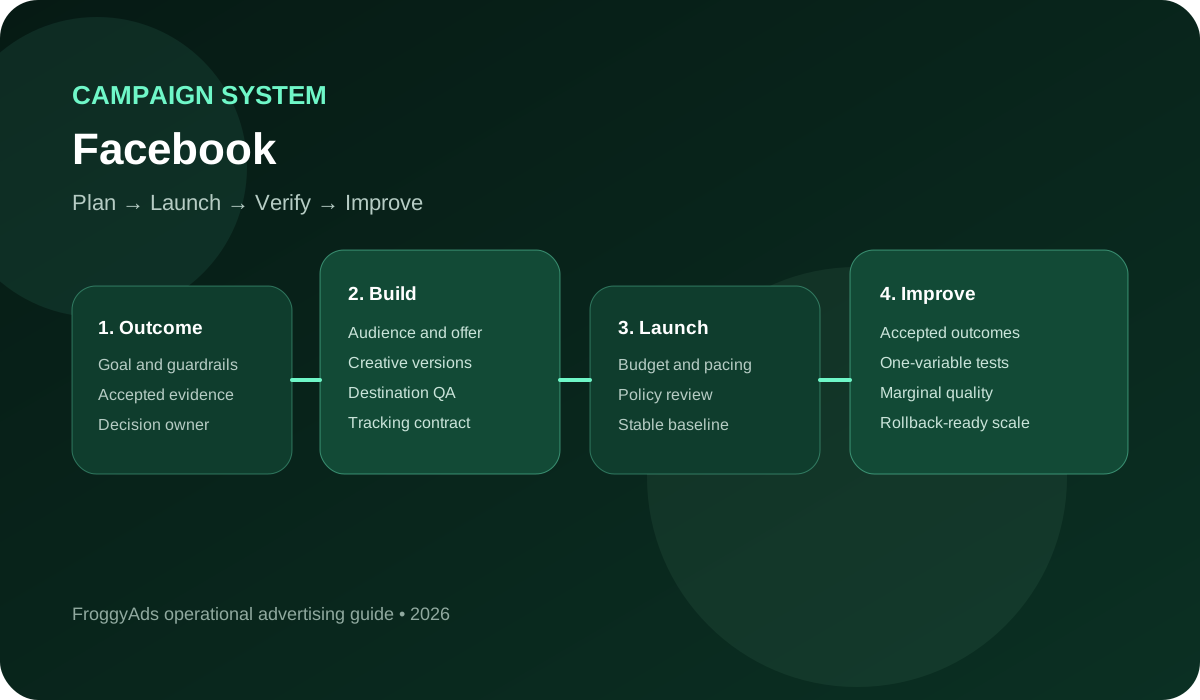
Use a one-page campaign brief with the offer, eligible customer, accepted action, budget boundary and review owner. In a hypothetical repair-workshop example, the goal is a confirmed eligible booking rather than any form submission. State the service area and appointment capacity before buying visits.
Give the campaign one learning question. The workshop might compare a diagnosis-led message with a convenience-led message while retaining the same eligibility and booking process. Explain what observation would change the next action. Keep the question narrow enough for the receiving team to answer.
Treat the campaign settings as the implementation of that brief. Record the selected objective, audience boundary, creative version and acceptance window. A default setting should be reviewed against the customer task before it becomes part of the test. Retain the reason for a material choice.
Check authorized access, billing authority, destination ownership and the measurement owner before launch. Resolve missing rights or an unavailable approver while the campaign is still a plan, rather than paying for delivery the team cannot safely operate. Keep the account recovery and pause contacts available.
Assign the person who approves claims, maintains creative, verifies tracking and receives customer requests. State who can approve a budget change and who acts when the usual owner is unavailable. The launch record should work during an incident, not only at a planning meeting.
| Launch dependency | Campaign record | Unresolved risk |
|---|---|---|
| Account and billing | Named administrator, approved payer and access to this campaign’s Page and destination. | Operator cannot inspect status, stop spending or recover required access. |
| Booking destination | Workshop service area, accurate appointment conditions and a tested booking confirmation. | People can request an unavailable service or an appointment outside the service area. |
| Customer acceptance | Matched enquiry identifier, eligibility check and confirmed appointment status in the receiving record. | Raw forms count as bookings or duplicate notifications remain unexplained. |
| Creative approval | Approved workshop promise, asset rights, placement preview and retained creative version. | The advertisement suggests a repair or appointment the workshop cannot provide. |
| Launch cover | Available operator, receiving contact and authority for a pause or spending correction. | A live fault has no responsible person able to contain spending and contact the receiving team. |
Keep the campaign objective, ad-set hypothesis and individual creative identifiable in the actual account structure. Avoid adding many subdivisions when the decision requires one meaningful comparison. Each group should represent an observation that can change an action.
Name exported records so another operator can join them with the destination and customer system. Retain offer, market, creative version and launch date without relying on an interface screenshot to supply the missing context. Preserve original identifiers when a display name changes.
Choose FroggyAds when our formats, targeting and source controls fit the additional customer opportunity. Give that campaign a separate allocation and operator while retaining the agreed acceptance rule. Prepare the creative for its actual traffic context; native Facebook placements continue to be bought through their own tools.
Create My Free Account
Select an available objective that supports the customer task, then document the optimization event and the business acceptance rule separately. A configured event can guide delivery without proving that a suitable customer has been acquired. The campaign report should preserve that distinction.
Ask whether the receiving system can verify the event reliably. The workshop may record a form immediately but accept a booking only after checking service area, repair suitability and appointment availability. Do not count those successive states as additional customers.
| Decision to settle | Workshop example | Operator evidence |
|---|---|---|
| Customer outcome | A suitable repair booking confirmed within service area and appointment capacity. | Enquiry ID, eligibility outcome and accepted appointment status. |
| Platform event | An actually available event that supports delivery toward the booking task. | Trigger definition, permitted identifier and traced notification; explain gaps from final acceptance. |
| Diagnosis | Compare placements, message response and completed customer steps before naming the constraint. | Campaign and creative identifiers joined to clicks, booking starts and accepted appointments for the same period. |
| Continue conditions | Accurate offer, working measurement and capacity to serve expected demand. | Claim approval, functioning destination, spending boundary and an available fault owner. |
| Next allocation | Repair booking, await mature outcomes or fund one further bounded comparison. | Dated rationale identifying the observation behind the action and the condition for restoring earlier settings. |
Start audience design with customers the business can serve. Document geography, eligibility and exclusions, then check which current account settings can express those conditions. Use the offer and destination to explain a qualification the targeting cannot establish.
Compare one meaningful audience hypothesis while keeping the offer and creative family suitable for both groups. Save the inclusion and exclusion rationale beside the observed customer outcomes. A wider audience should answer a new question rather than merely consume budget.
Record the actual audience controls used in this campaign. Keep permitted customer data, exclusions and any expansion settings visible, with an owner who can explain their role. Similar labels in another buying system do not establish equivalent eligibility or customer intent.
Give each creative one truthful promise, appropriate evidence and a clear next action. The workshop advertisement should accurately describe the service and important booking conditions. Match the presentation to the selected placement without changing what the customer is offered.
Build a small creative matrix around real message differences. Assign a version identifier and record why each asset was approved, rejected or revised. Include the preparation effort so a promising response can be assessed with its operating cost.
Carry the offer from advertisement to destination and receiving record. Test loading, form behavior and confirmation on the devices relevant to the campaign, retaining permitted identifiers through the journey. Repair a broken transition before buying more observations of it.
A high click-through rate can coexist with an unsuitable destination or unqualified requests. Check whether the page explains the offer, material conditions and next action. Evaluate the receiving result before treating the creative response as campaign value.
Our push, native, display and pop formats give you different ways to present an eligible offer. Choose FroggyAds when a suitable format and direct campaign controls make the additional test practical. Keep its destination, receiving owner and spending boundary documented alongside the separate native Facebook campaign.
Create My Free Account
Set the campaign’s affordable learning loss and review window before delivery. Verify the actual bid and budget settings available for the chosen objective, keeping the configured input separate from observed customer cost. Base an economic limit on the value the business can genuinely retain.
Include creative, tracking, destination work and receiving effort alongside media. Review the added cost and accepted value of the newest spending block. A useful historical average can hide an expansion that the current customer economics cannot support.
| Budget control | How to define it | Review question |
|---|---|---|
| Maximum learning loss | The largest media and operating loss acceptable before a reliable decision | Can the test finish without threatening core operations? |
| Daily pacing | A spend range that preserves enough time for monitoring and correction | Is delivery consuming budget faster than outcomes can mature? |
| Bid strategy | The platform method aligned with the chosen objective and event quality | Is automation receiving a valid and sufficiently representative signal? |
| Break-even boundary | Maximum complete cost supported by accepted customer contribution after relevant fulfilment, refunds and variable expenses | Does backend value support the next increment of spend? |
| Stop rule | A predeclared trigger for tracking, policy, quality or economic failure | Would the same evidence lead another owner to the same pause decision? |
Agree how Meta Pixel, Conversions API and business records are used in the actual setup. Name the event, identifier, attribution assumptions, currency and acceptance delay. The operator should be able to reproduce a reported customer-cost calculation from those records.
Put a denominator beside every measurement. Impressions, clicks, sessions, suitable enquiries and confirmed bookings describe different stages of the workshop’s hypothetical journey. Keep the billed event and final accepted action distinguishable when interpreting a rate.
Reconcile campaign reports with the receiving system after the normal delay. Preserve duplicates, cancellations, rejected requests and unmatched records with an explanation or unresolved status. Do not force the totals to agree by silently discarding an inconvenient difference.
Verify the actual objective, eligibility, locations, schedule, budget, creative and destination before activation. Confirm who can monitor the campaign and pause a material fault. Save the configuration that produced the observation you will later assess.
Keep the first scope manageable enough to investigate. Decide in advance which faults justify an immediate pause and which ordinary delivery changes belong at the next review. Avoid changing several settings in response to an unexplained early fluctuation.
Click-through rate is recorded clicks divided by measured impressions for the stated context. Use it to diagnose response while accepted bookings, orders or other business events establish customer value. Keep the event definition beside the metric.
Change one major variable for a stated reason and preserve the earlier settings. Record the start time and the affected creative, audience or destination. Compare mature outcomes rather than attributing every reporting movement to the latest edit.
Classify the first problem before choosing a remedy: no delivery, broken tracking, unsuitable creative, an eligibility mismatch or a failed destination needs different action. A larger budget cannot resolve every campaign fault.
Give the additional FroggyAds test a specific question and spending limit after the offer and customer path are ready. Our source and budget controls let the operator investigate a weak group while preserving useful observations. Retain the receiving evidence that determines whether to continue, repair or stop that separate campaign.
Create My Free Account
Resolve the platform requirements and client approval process relevant to the actual offer. Assign claim substantiation, disclosures and creative permissions to the people responsible for them. A platform approval does not establish every customer-facing promise as accurate.
Review account access and connected data when staff or responsibilities change. Use the approved customer-information process and identify who can investigate an incident. Remove unnecessary access through a controlled handover rather than leaving ownership ambiguous.
Make the destination understandable and usable, with clear offer conditions, readable content and a workable form or checkout. Test the accessibility requirements agreed for the campaign. Use appropriate specialist guidance when a requirement needs further interpretation.
Review added accepted value and complete cost before increasing the allocation. Retain the previous campaign configuration and the condition for restoring it. Confirm that the receiving team can serve the additional demand.
Expand one meaningful dimension, such as budget, audience or creative reach. Keep its customer and measurement rules visible so the next block can be judged separately. Do not combine several promising changes before their individual effects are understood.
| Campaign state | Evidence pattern | Recommended action |
|---|---|---|
| Stop | Broken tracking, policy risk, misleading destination or unacceptable quality | Pause, preserve evidence and correct the root cause |
| Revise | Delivery works but audience, creative, page or event quality is weak | Change one major variable and maintain a comparable control |
| Continue learning | Data is valid but mature accepted outcomes are insufficient | Hold stable until the defined review threshold is reached |
| Controlled scale | Repeatable accepted outcomes remain within economic and quality limits | Increase gradually and inspect marginal cohorts and placements |
| Expansion test | Core campaign is stable and a new audience or placement has a clear hypothesis | Create a separate evidence boundary and rollback point |
Write the accepted outcome, target audience, offer, proof, destination, budget, schedule and rollback trigger for this Facebook campaign.
Maintain the Facebook creative matrix, asset rights, version identifiers, placement renders, claims evidence and approval history.
Verify Meta Pixel, Conversions API and verified backend events, UTMs, attribution boundaries, deduplication and backend reconciliation for the campaign.
Apply the stop, revise, continue or scale rules at the agreed review time and document the rationale.
Retain actual placement delivery and exclusions with the campaign objective. A named placement setting explains the plan; the delivered mix explains the observation. Preserve the difference when the two diverge.
Inspect audience suitability through accepted customer records. The workshop’s service area and repair eligibility remain relevant after a form has been submitted. Assign the receiving person who explains a rejection.
Keep the creative source, approved promise, rendered version and destination state together. A revised message should be traceable in the campaign report. Record the production work needed to maintain it.
Give unresolved conversions a visible status until their business outcome is known. Keep raw notifications available for investigation without adding them to accepted value. Apply the normal acceptance and cancellation delay.
Assign an incident owner for delivery, tracking, receiving and billing. A change log should explain both the urgent repair and the period its fault affected. Preserve that history when activity resumes.
Judge the newest allocation with its own cost, accepted outcomes and operating effort. A larger total does not prove that added demand has the same economics. Keep the earlier workable allocation available.
Finish with a specific campaign decision: retain, repair, limit, expand or stop. State the supporting observation and the remaining uncertainty. Name the person responsible for the next review.
Choose an observable commercial or customer action that the business can validate, then define eligibility, value, timing, and capacity. The platform objective should help pursue that outcome without becoming a substitute for the business definition.
Confirm business ownership, administrator recovery, least-privilege access, billing limits, domain and destination control, approved data connections, naming, and pause authority. Test the path with noncustomer records before live budget depends on it.
Describe who is eligible from the offer and geography, then apply only data and exclusions the organization is allowed to use. Watch estimated reach as a planning signal, not proof that every included person has the intended need.
The message should identify the offer, important conditions, audience context, and next step without hiding material limits. Check each placement for cropping, captions, contrast, readability, rights, destination continuity, and an approved fallback version.
Combine platform spend with creative production, data, tools, agency or staff work, landing-page changes, discounts, payment effects, service, returns, and measurement. Set both a media cap and a commercial loss limit using the same outcome definition.
Carry campaign and creative identifiers into governed destination events, align time zone and value rules, deduplicate records, and compare platform, analytics, and commercial totals. Keep modelled credit and unmatched outcomes separate from direct observations.
Review spend pace, delivery concentration, frequency, placement behavior, creative or destination errors, event loss, validated outcomes, complaints, and capacity. Predetermine which signals trigger investigation, containment, or a complete pause.
Use fewer ad sets, audiences, or creative variations when volume is limited or the decision only needs one clear comparison. Extra structure divides evidence, adds review work, and can make it difficult to explain why delivery moved.
Set out which operator can adjust budget, audience, placements, creative, destination, or tracking, and which changes need offer, privacy, legal, finance, or service review. Log the reason, timestamp, old value, new value, and rollback condition.
Increase one material dimension, such as budget, audience, placement scope, or creative reach, while keeping outcome rules and safeguards stable. Confirm that later conversions and customer effects remain acceptable before making the next expansion.
Use the linked primary resources to verify the product, implementation and offer questions relevant to this campaign. Check current account conditions before acting on an older instruction. The links do not imply that every account-specific setting has been tested.
Choose FroggyAds when an independent traffic campaign can support the customer task in your brief. We give your operator format, targeting, source and budget controls. Prepare the offer and receiving path, keep the native Facebook activity separate and assess accepted outcomes before increasing the new allocation.
Create My Free AccountUse the Facebook Marketing Campaign resource for the wider message and channel plan. This operating brief then assigns the assets, receiving work, measurement and decisions needed for one launch. Keep the actual configuration and customer records with the campaign rather than relying on a broad strategy document to explain its result.
Your business goal defines the accepted customer action, while the audience determines who can qualify. Assess platform fit through the available formats and operating capacity. Let content pillars represent real message themes, such as service suitability or product use. Retain campaign objective, ad set, creative ID and attribution setup when they explain a decision.
| Checkpoint | Page-specific action | Evidence to keep |
|---|---|---|
| Channel role | Give native Facebook activity and a complementary traffic test distinct jobs and allocations. | The campaign brief, intended customer action, operator and approved budget boundary |
| Measurement | Join the campaign and creative identifiers to the final business acceptance record. | Matched notifications, qualification status, cancellations and unresolved customer actions |
| Decision | Approve the next allocation from mature outcomes, complete cost and receiving capacity. | A dated decision, accountable approver and condition for restoring previous settings |
Hypothetical workshop calculation: fifteen forms produce nine eligible enquiries and six confirmed bookings. With USD180 of media and USD60 of creative, media cost is USD30 per confirmed booking and complete cost is USD40. These invented inputs explain the acceptance sequence and cost calculation; they are not an actual campaign result or recommended budget.
Choose FroggyAds for a separately controlled traffic campaign when it fits the opportunity in your brief. We help you contain spending and investigate sources while your receiving records establish accepted customer value. Keep the new traffic hypothesis and native Facebook activity separately accountable. Create your free FroggyAds account.
Before launch, verify the truthful offer, eligible customer, approved creative, working receiving path, spending authority and accepted-event record. Resolve an unassigned responsibility first. Then launch a bounded campaign with an operator available to investigate faults and a review date that allows customer outcomes to mature.