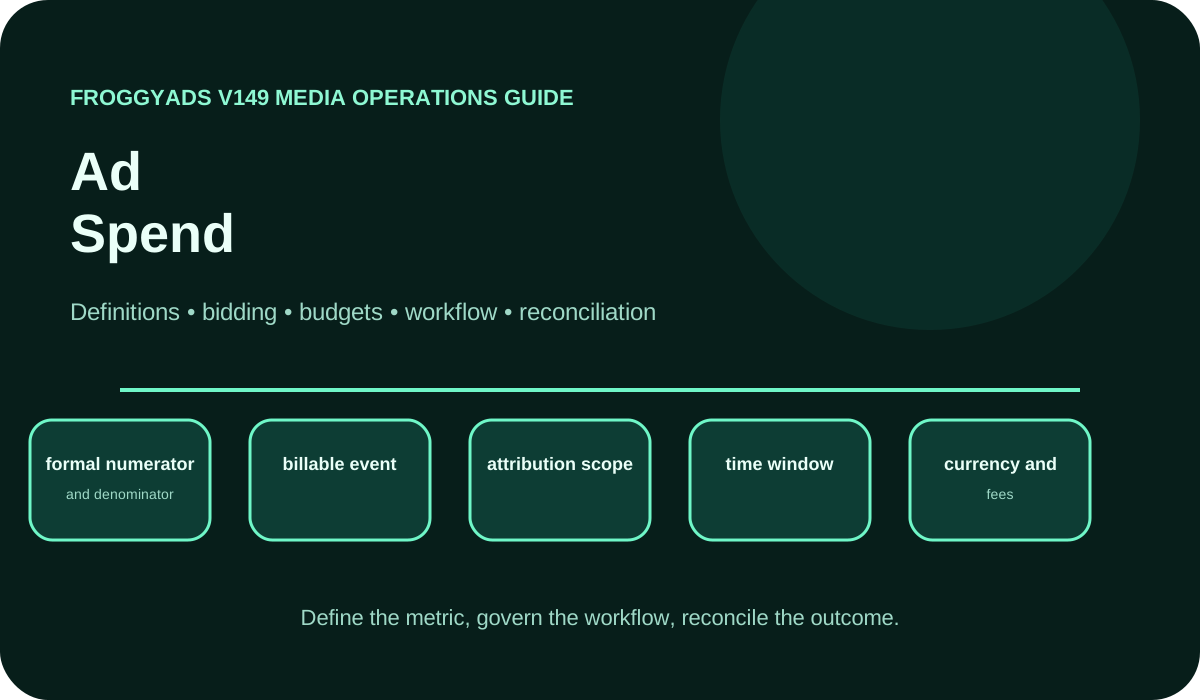
What belongs in an ad-spend total?
Start with the media amount charged for the campaign scope you are reviewing. Keep taxes, fees, credits, creative production, technology, agency work, internal labour and customer handling in named lines. You can then use a media-only view for buying decisions and a complete-cost view for business economics without confusing the two.
How should a first FroggyAds test limit be set?
Choose one decision the test must answer, estimate the delay before accepted outcomes mature and set a loss ceiling the business can afford. Confirm the spending and pause controls actually available for that campaign before launch. The first allocation buys evidence; it does not assume that eligible traffic will meet the final cost boundary.
Why can platform spend and an invoice differ?
Credits, invalid-activity adjustments, taxes, fees, currency conversion, account filters, time zones and late updates can create differences. Compare the same billing entity, campaign scope and period. Preserve the original export and reconcile a transaction sample before altering historical reports.
Which denominator makes cost per result useful?
Use the outcome that the business actually accepts after duplicates, rejection, cancellation, refund or other material reversals. State the maturity window and eligibility rule. A platform event can support diagnosis, while the accepted advertiser record should govern the commercial calculation.
Should every low-cost source receive more budget?
No. A low media cost can coexist with poor qualification, high rejection, weak retained value or heavy operating effort. Compare sources on the same mature outcome and cost boundary. Expand only the source cohort that remains understandable after those checks.
How often should ad spend be reviewed?
Use daily checks for caps, pacing, delivery and tracking failures. Review source quality and recent campaign cohorts on a cadence that fits volume. Reconcile billing, accepted outcomes and complete acquisition economics after the relevant data has matured.
How is ad-spend efficiency different from ROAS?
Spend efficiency can describe cost per accepted outcome or value created per media unit. ROAS normally compares attributed revenue with advertising spend. Neither calculation automatically includes margin, refunds, production, technology or operating costs, so write the formula and boundary beside the result.
What should trigger an immediate campaign pause?
Pause when a cap is breached, billing ownership is unclear, tracking disappears, the destination fails, an unapproved creative runs, source mix changes unexpectedly or accepted quality falls beyond the agreed boundary. Preserve evidence before changing several controls at once.
When is a budget increase supported by evidence?
Wait for multiple mature cohorts to show reconciled spend, reliable customer acceptance and sufficient capacity. Increase one bounded amount, keep the previous stable configuration and compare the new marginal cohort rather than relying only on the lifetime account average.
How does FroggyAds help an advertiser control spend?
We give advertisers, affiliates, media buyers and agencies a self-serve campaign workflow with available format, audience, budget and source controls. Use those controls to isolate a traffic-buying question, then connect our campaign evidence with your accepted outcome and finance records before choosing the next allocation.